Answers to End of Chapter Questions
1. Futures contracts are based on standardized instruments, are traded on organized
exchanges, require margins with daily marking to market, and are typically closed
2. All hedging involves some risk in the sense that cash prices (rates) do not move in
exactly the same manner as do futures prices (rates), and a hedger cannot always
3. With initial margin the trader has a position, but does not own any underlying
asset. The term downpayment suggests that the margin represents a partial
4. The trader will initially make a $1,300 margin deposit. Each basis point change is
worth $25 times two contracts or $50. The respective gains (losses) compared to
5.
a. 3-month cash Eurodollar rate is approximately 2.68% based on the LIBOR
b. Ignoring compounding and assuming the 3-month and 6-month T-bill rates
c. The 3-month T- bill forward rate is 2.15% and the September 2008
Eurodollar futures rate is 2.83%, for a di!erence of 0.68%. The two rates
d. 1) I would sell the December 2009 Eurodollar futures contract if I thought
that the futures rate would rise above 3.02% before contract expiration in
2) I would buy the December 2009 Eurodollar futures contract if I thought
that the futures rate would fall below 3.02% sometime before expiration of
6. Cross-hedges are generally riskier because the futures contract used to hedge a
7. Risk
a. Cash risk: the bank will have funds to invest in 45 days and will lose if rates
decrease between now and 45 days; it should buy a futures contract. The
b. Cash risk: the bank will lose if interest rates rise between now and when it
c. Cash risk: the bank will lose if Eurodollar time deposit rates increase at each
d. Cash risk: the bank will have funds to invest in 3 months and loses if rates fall
e. Cash risk: the bank will lose if rates on the bond increase during the delayed
financing period; it should sell a futures contract as a hedge. If cash rates rise
8. Number of futures contracts
a. 125(.5) 0.667 / 1 (.25) = 167 contracts
9. Basis risk is the risk that the di!erence between the futures rate and cash rate will
move against the hedger in the sense that the change in basis lowers the actual
10. Macrohedging and microhedging have di!erent objectives. A macrohedge is one
that o!sets risk associated with the entire porGolio of assets and liabilities, such as
11. Balance sheet (cash market) risk: DGAP = 1.5 – .9 (3.5) = – 1.65 years
a. The bank loses on balance sheet if interest rates decrease because it has
b. Assuming that all assets and liabilities are rate sensitive;
c. Change in market value of bank equity = 1.65 [+.01/(1.09)] 10 = +$151,376
12. The primary credit risk is that the counterparty will not perform as required if
13. You would choose to sell the FRA such that you will pay 6-month LIBOR and
14. You will lose in the cash market if your borrowing rates increase from the level
on January 1. To protect against loss from rising rates, you would buy an FRA
15. A swap intermediary serves as a dealer or clearinghouse for swap participants by
making a market in swaps. As intermediary, the firm guarantees performance of
16. Interest rate swaps may be more aMractive than futures because they can have
17. There is credit risk in a swap agreement. Each swap party assumes the risk that
the intermediary will make the obligated swap payment when it is owed the
18. The fixed-rate quoted in the swap rates is the rate that when compared with
Eurodollar futures rates (or forward rates from the LIBOR curve) produces
19. With the 3-year loan you are receiving a fixed 8.25%. If you enter a basic interest
rate swap with a 3-year term where you agree to pay a fixed-rate and receive
20. By issuing 3-month Eurodollar time deposits in the cash market, you are subject
to the risk that 3-month LIBOR will rise over time. To hedge this risk, you would
21. Data from Exhibit 9.12
a. The buyer of a 5-year cap on 3-month LIBOR will receive cash from the counterparty
b. The buyer of a 2-year Poor on 3-month LIBOR will receive cash from the
c. A zero-cost collar consists of buying a cap on LIBOR and selling a Poor on LIBOR with
22. The use of interest rate swaps as a hedge generally 3xes an outcome. Thus, the hedge
will produce an e!ective rate with small variation. The use of an interest rate cap allows
23.
a. The bank can buy an interest rate cap on the index of its choosing. If it wants the
b. The bank can buy an interest rate Poor on 3-month LIBOR. If LIBOR falls as expected,
c. The bank can buy an interest rate cap on LIBOR at 1% over the last reset rate. If
24. The slope of the yield curve indicates whether LIBOR forward rates are rising or falling
and whether Eurodollar futures rates are rising with farther out contract expirations. An
25.
a. If LIBOR rises, the premium will increase because the cap moves into the money. At
b. If LIBOR falls to 4.10%, the cap moves farther out of the money so the premium falls.
26.
a. A bank that is asset sensitive loses net interest income as interest rates fall, in
b. A reverse collar would similarly provide a hedge because it involves the
c. The benefit of a reverse collar over a Poor, or collar over a cap, is that it costs less in
27. The simultaneous purchase of an interest rate cap and sale of an interest rate Poor is the
28. Margin requirements:
a. None with buying an interest rate cap.
b. Margin is required with the sale of a put option on Eurodollar futures.
Activities
I. Hedging Borrowing Costs
1. The bank’s cash market risk is that its borrowing costs will rise if interest rates
rise from August 9, 2008 through November 2008. The bank should sell
2. The bank should choose the futures contract that expires immediately aUer the
planned November 2008 borrowing date. This would mean that it should sell
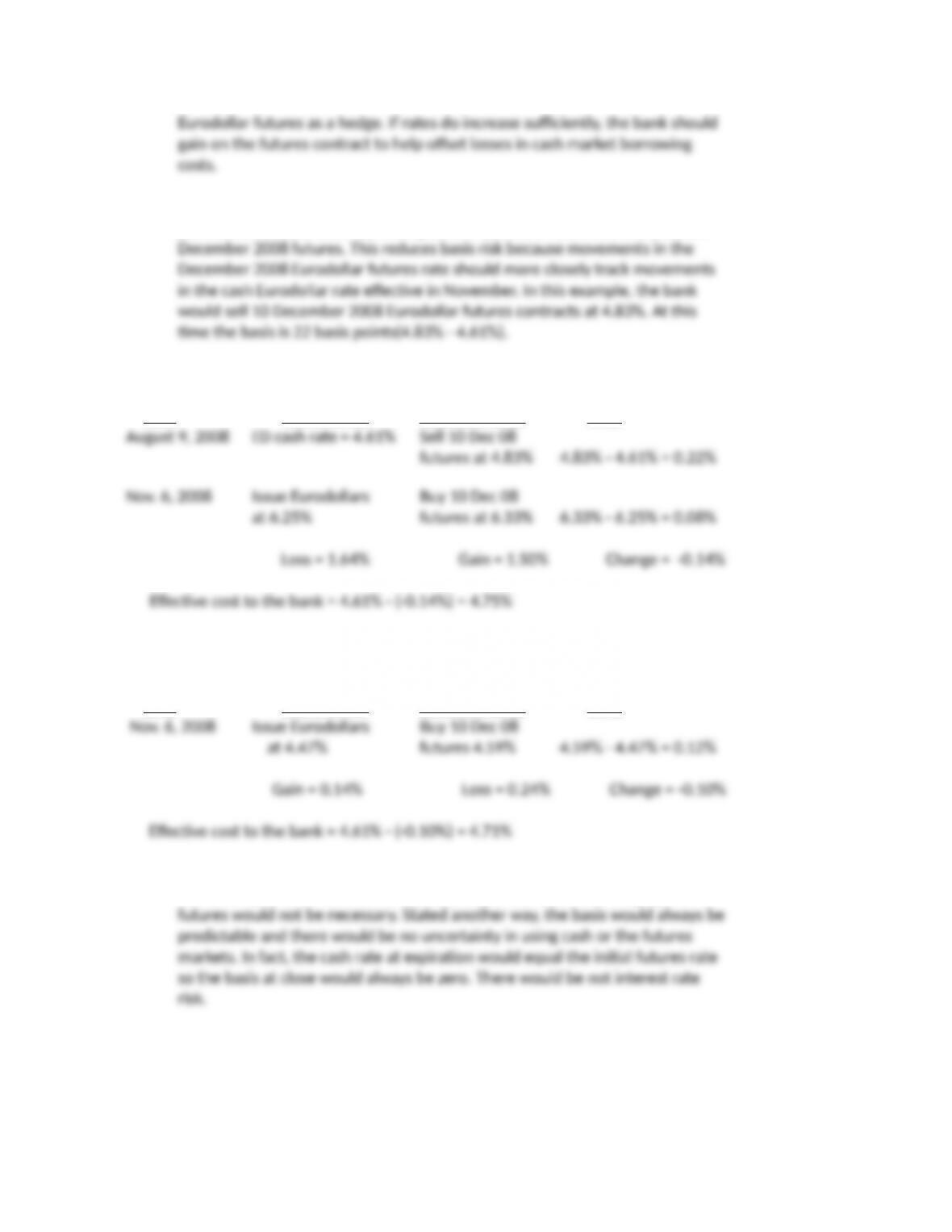
If the bank hedges in August 2008 by selling 10 December Eurodollar futures:
Date Cash Market Futures Market Basis
3. If instead rates fall:
Date Cash Market Futures Market Basis
4. If the futures rate was always an accurate forecast of the actual cash rate, then
the future path of cash rates would be totally predictable and hedging with
II. The Basis
The basis today equals 5.39% – 5.05% or 0.34%. If the futures contract expires
one week aUer the anticipated cash transaction date, the basis then should be
closer to zero because the basis must equal zero at expiration. A hedger will
III. Basic Interest Rate Swaps
1. Balance sheet transaction versus basic interest rate swap: On balance sheet,
the bank takes interest rate risk in the sense that it is liability sensitive and
1) The primary advantage of the cash transaction is that banks are familiar and
comfortable with the interest rate risk and liquidity considerations. It is easy
to explain to management and the Board of Directors. If rates change
adversely, such as 6-month CD rates increase sharply, the bank has the
2) The primary risk with the cash transaction is interest rate risk. The primary
risk with the swap is Also interest rate risk, but there is also counterparty
3) Both are speculative because they subject the bank to interest rate risk.
2.
Borrowing Alternatives: Cash Market
Internet Bank Brick & Mortar Bank Di!erence
Consider the above borrowing costs. The di!erence in quality spreads for
a. With Internet Bank’s GAP < 0 and the bank being liability sensitive, it would
b.
Internet Bank
Brick & Mortar Bank
Net cost:
3. Regional Bank Holding Company
a. The bank holding company and its subsidiary have purchased long duration
mortgages 3nanced by short duration commercial paper. It is positioned to
b. With a $100 million notional principal amount and LIBOR = 6.95%, the bank
will pay 7.37% and receive 6.95% on $100 million, for a net cash payment of
c. If LIBOR rises above 7.37%, the subsidiary is at risk that the swap will not
make the obligated swap payment. Of course, if LIBOR falls below 7.37%, the
IV. Converting Fixed-Rate Loans to Floating-Rate Loans
A bank that wants Poating rate loans can make fixed-rate loans and convert
1. Interest Rate Swap
The bank is receiving interest on the loan at a 8.5% fixed-rate. If it enters a basic
swap to pay 8.22% and receive 3-month LIBOR, it will have converted the loan to a
Poating rate loan. Its net position is:
2. Interest Rate Cap
The bank is receiving interest on the loan at a 8.5% fixed rate. If it buys an interest