Answers to End of Chapter Questions
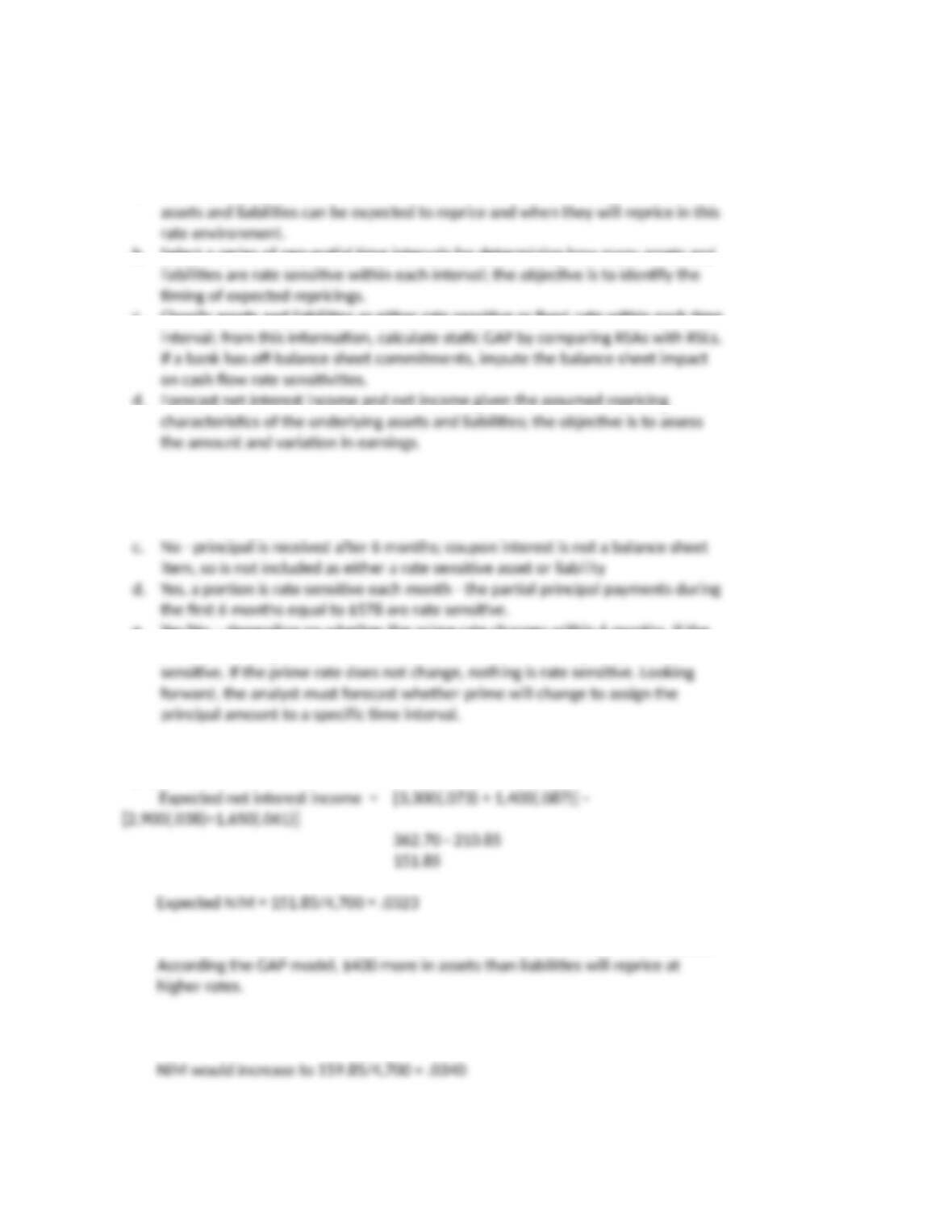
1. Basic steps in GAP analysis:
a. Develop an interest rate forecast; the objective is to estimate whether specific
b. Select a series of sequential time intervals for determining how many assets and
c. Classify assets and liabilities as either rate sensitive or fixed-rate within each time
d. Forecast net interest income and net income given the assumed repricing
2. Rate sensitive assets:
a. Yes – matures
b. Yes – matures daily
e. Yes/No – depending on whether the prime rate changes within 6 months. If the
prime rate changes within 6 months, the full amount of loan principal is rate
3. GAP analysis
a. GAP= $400
This bank will likely see its net interest income increase if interest rates increase.
b. Change in net interest income = change in rates x GAP = .02 (400) = +8
1
© 2010 Cengage Learning. All Rights Reserved. May not be scanned, copied or duplicated, or posted to a publicly
accessible website, in whole or in part.
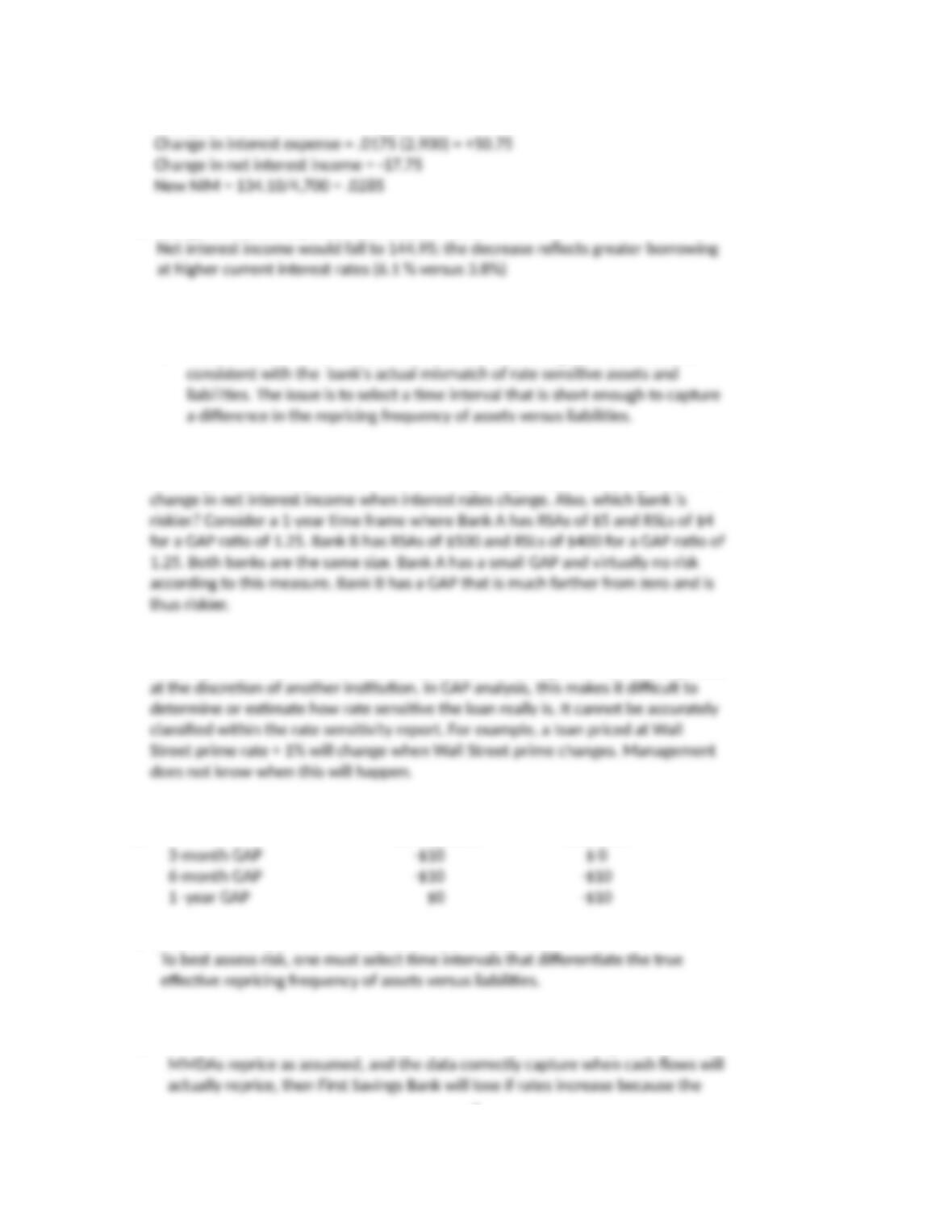
c. Change in interest income = .01 (3,300) = +33
d. Change in interest expense = 300 x .023 = +6.90
4. Given the $3 million in 6-month T-bills financed with $3 million in time deposits:
a. 6-month GAP = $3 – $3 = 0; this seems to indicate no risk
b. 3-month GAP = 0 – $3 = -$1 million; this indicates a negative GAP, which is
5. The GAP ratio = RSAs/RSLs ignores the size of a bank’s GAP relative to the size of
the bank, and thus provides no information regarding the potential magnitude of a
6. When the base rate used to price loans is not tied to a specific index, there is no
certainty as to when or how much the base rate will change over time. Changes are
7. GAP comparisons
a. County Bank City Bank
b. 3-month: County Bank; 6-month: same; 1-year: City Bank
8. First Savings Bank’s rate sensitivity report
a. If the data accurately re.ect sensitivity, that is if base rates change as assumed,
2
© 2010 Cengage Learning. All Rights Reserved. May not be scanned, copied or duplicated, or posted to a publicly
accessible website, in whole or in part.

b. If MMDAs are not repriced within 30 and 90 days while the bank’s base rate
9.
a. Financing a 1-year T-bill with a 3-month deposit will reduce a bank’s positive
GAP through one year. According to the GAP model, this transaction reduces
interest rate risk because GAP is closer to zero. With an inverted yield curve, the
b. According to GAP, both the deposit and loan are rate sensitive within 3 months
assuming the prime rate changes. Whether this transaction reduces risk
11. Embedded options in contracts
a. Fixed-rate mortgage: the borrower has the option of prepaying the outstanding
b. Fixed-rate time deposit: the depositor has the option of withdrawing the funds
prior to maturity and paying the interest penalty. It is financially aPractive to
c. Commercial loan with a cap: the borrower has purchased an option with the
3
© 2010 Cengage Learning. All Rights Reserved. May not be scanned, copied or duplicated, or posted to a publicly
accessible website, in whole or in part.
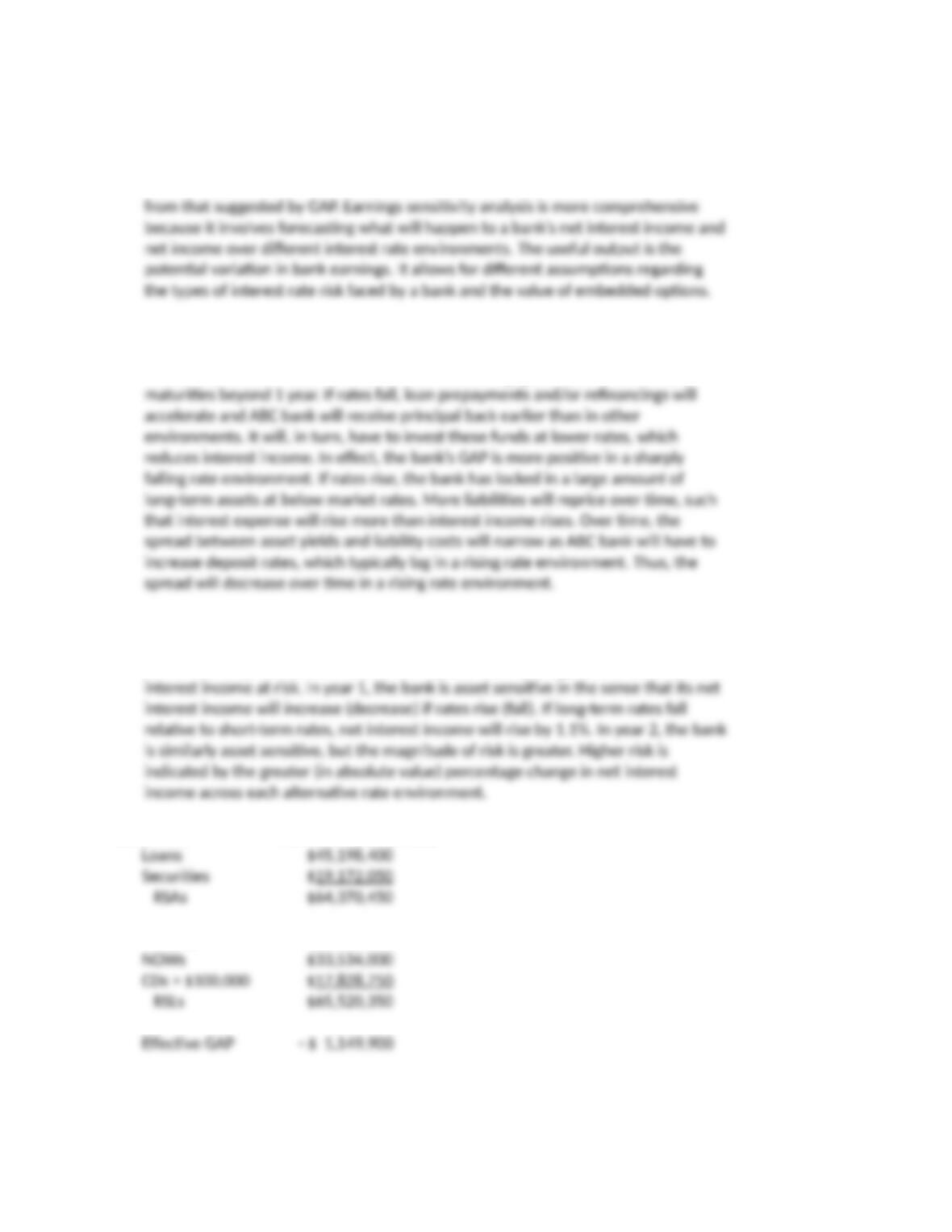
12. Static GAP analysis provides just a snapshot of a bank’s risk exposure and expected
net interest income given a specific interest rate environment. If interest rates differ
from the assumed environment, then a bank’s actual interest rate risk will differ
13. FSB bank will lose in a falling rate environment because of the prepayment risk
assumed on-
balance sheet in the form of 30-year fixed-rate mortgages and other loans with
14. The earnings-at-risk data indicate the percentage change in earnings from some
base level if the general level of interest rates is 1% higher, 1% lower, and if the yield
curve inverts by 1% from the base level. Assume that earnings-at-risk refers to net
15. E-Bank Income Statement Gap
MMDAs $14,157,600
If rates change by an average of –1%, the bank’s net interest income will rise by:
4
© 2010 Cengage Learning. All Rights Reserved. May not be scanned, copied or duplicated, or posted to a publicly
accessible website, in whole or in part.

Problem: Synovus Corporation
1. The average earning asset yield in 2007 was 7.71% versus 7.62% in 2006, for an
2. In 2007, the bank’s spread was 7.71% – 4.36% = 3.35%. The bank’s net interest
3. Earning assets increased from $26,623,033 in 2006 to $29,113,665 in 2007 for an
increase of $2,490,632. Interest-bearing liabilities increased from $22,853,799 in
5
© 2010 Cengage Learning. All Rights Reserved. May not be scanned, copied or duplicated, or posted to a publicly
accessible website, in whole or in part.