Answers to End of Chapter Questions
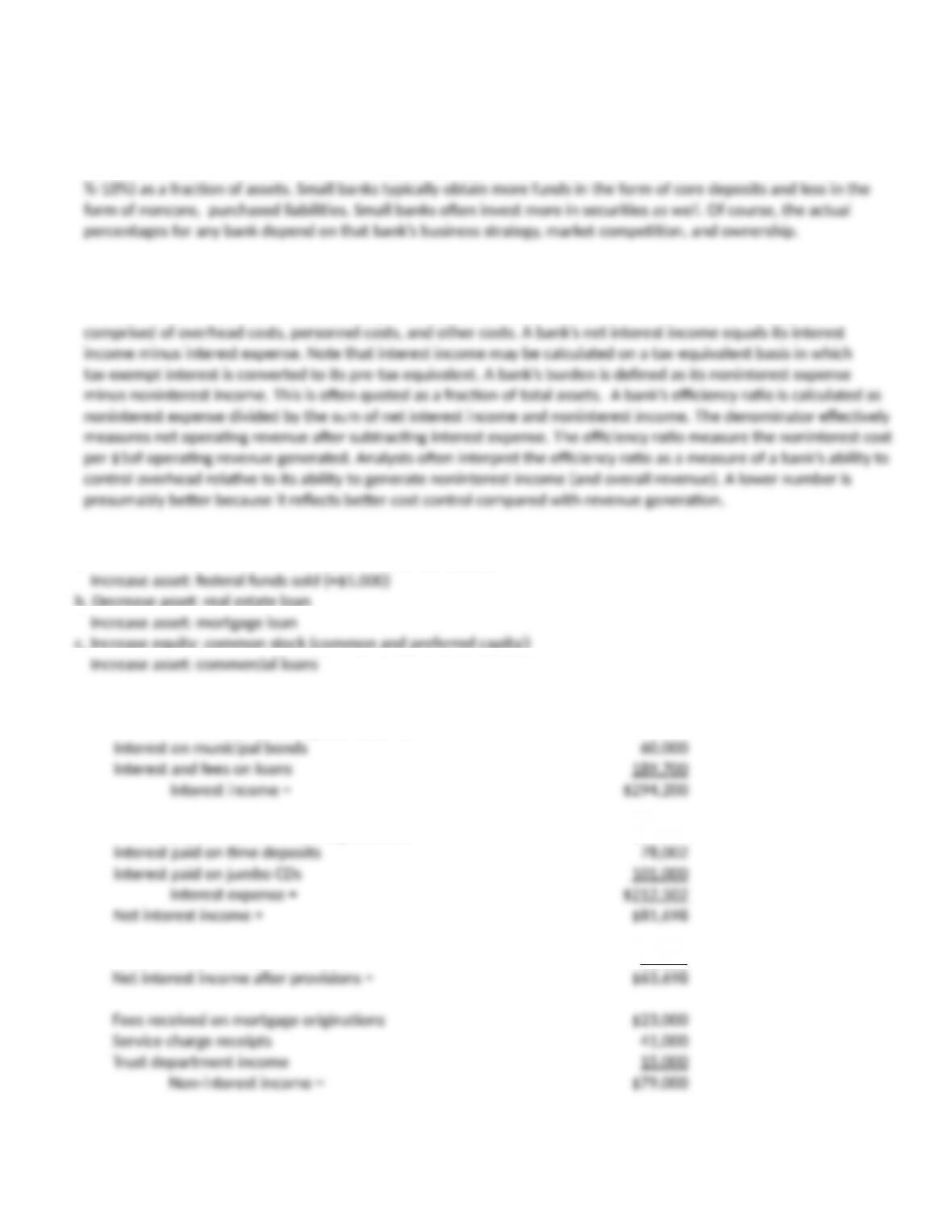
1. For a large bank, assets consist approximately of marketable securities (20%), loans (70%), and other assets (10%).
Liabilities consist of core deposits (40%-60%), noncore, purchased liabilities (20%-40%), and other liabilities (5
2. A bank’s interest income consists of interest earned on loans and securities while noninterest income includes
revenues from deposit service charges, trust department fees, fees from nonbank subsidiaries, etc. Interest expense
consists of interest paid on interest-bearing core deposits and noncore liabilities while noninterest expense is
3. Balance sheet accounts:
a. Increase liability: money market deposit account (+$5,000)
b. Decrease asset: real estate loan
c. Increase equity: common stock (common and preferred capital)
4. Income statement
Interest on U.S. Treasury & agency securities $44,500
Interest paid on interest-checking accounts $33,500
Provisions for loan losses = $ 18 ,000
1
© 2010 Cengage Learning. All Rights Reserved. May not be scanned, copied or duplicated, or posted to a publicly accessible website,
in whole or in part.
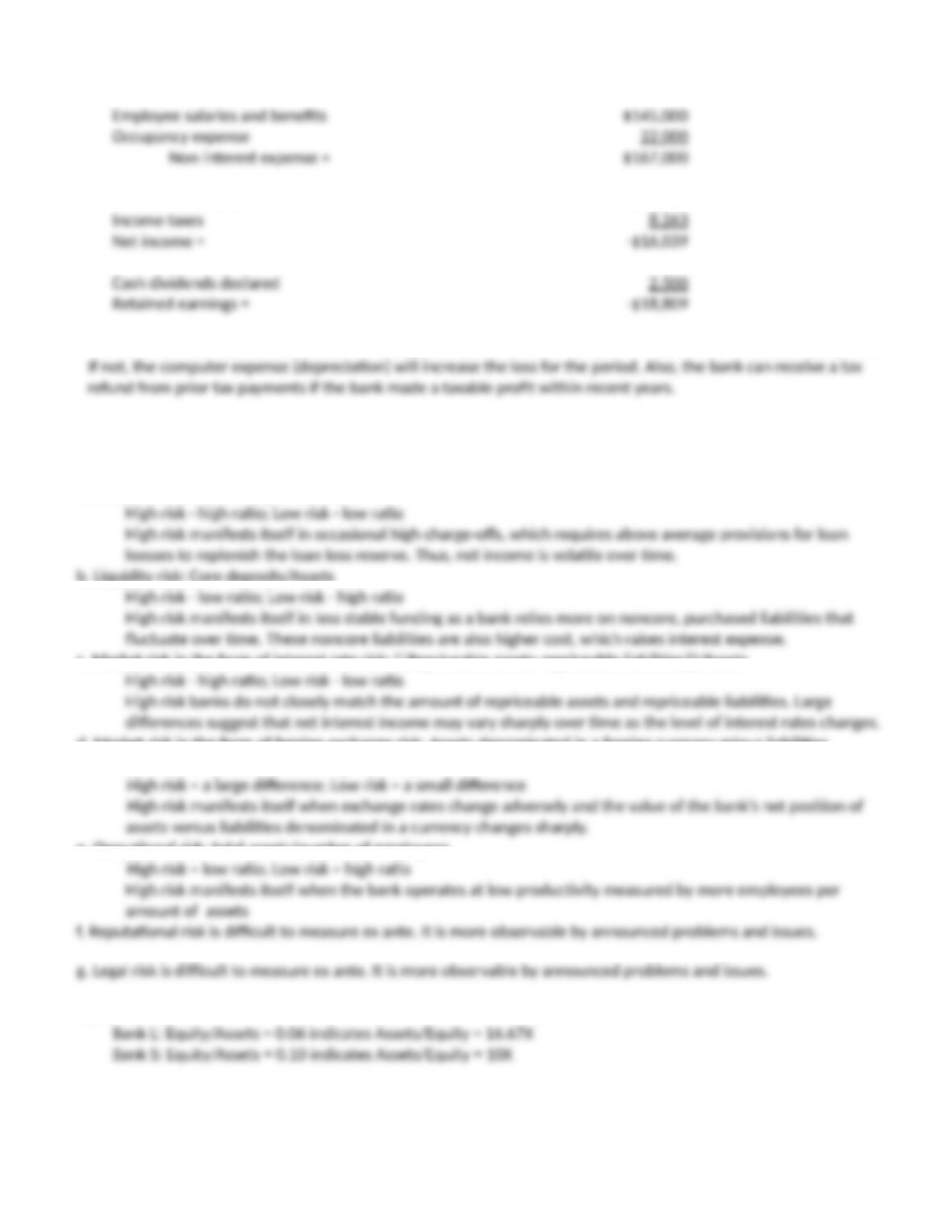
Income before income taxes -$24,302
This assumes that expenses associated with the purchase of the new computer are included in occupancy expense.
5. The primary risks faced by banks are credit risk, liquidity risk, market risk (as interest rate risk and foreign exchange
risk), operational risk, reputational risk, and legal risk. In general, promised, or expected, returns should be higher for
banks that assume increased risk. There should also be greater volatility in returns over time.
a. Credit risk: Net loan charge-o5s/Loans
b. Liquidity risk: Core deposits/Assets
c. Market risk in the form of interest rate risk: (|Repriceable assets-repriceable liabilities|)/Assets
d. Market risk in the form of foreign exchange risk: Assets denominated in a foreign currency minus liabilities
denominated in the same foreign currency.
e. Operational risk: total assets/number of employees
6. Equity multiplier
2
© 2010 Cengage Learning. All Rights Reserved. May not be scanned, copied or duplicated, or posted to a publicly accessible website,
in whole or in part.
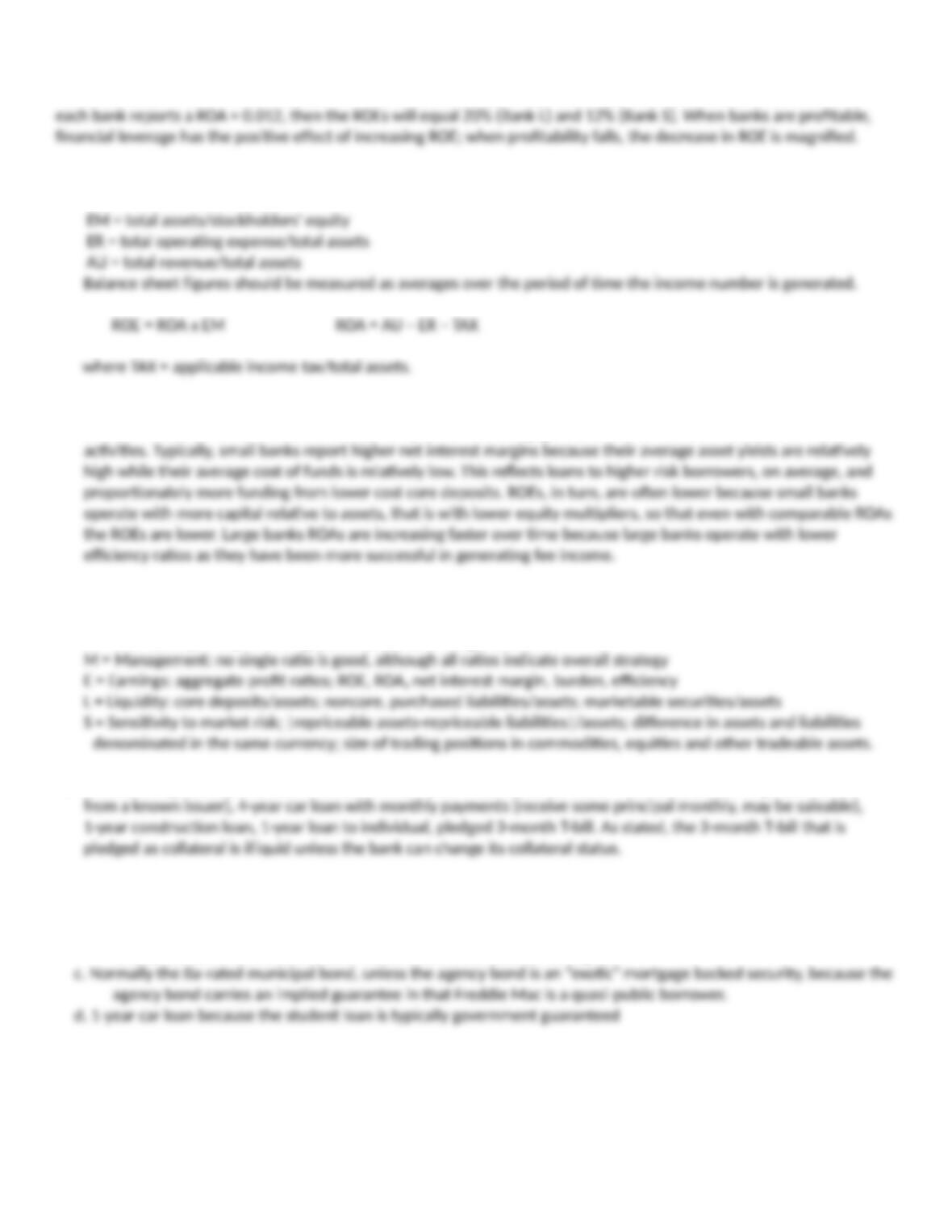
If each bank earns 1.5% on assets (ROA = 0.015), then the ROEs will equal 25% (Bank L) and 15% (Bank S). If, instead,
7. ROE = net income/stockholders’ equity
ROA = net income/total assets
8. profitability ratios differ across banks of different size as measured by assets. The primary reasons are that different
size banks have different asset and liability compositions and engage in different amounts of o5-balance sheet
9. CAMELS
C = Capital adequacy: equity/assets
A = Asset quality: nonperforming loans/loans; loan charge-o5s/loans
10. Lowest to highest liquidity risk: 3-month T-bills, 5-year Treasury bond, 5-year municipal bond (if high quality and
11. Comparative credit risk
a. The loan to a comer grocery store representing a li7le known borrower with uncertain financials
b. The loan collateralized with inventory (work in process) because the collateral is less liquid and more difficult to
value; this assumes that the receivables are still viable and not too aged.
12. For the balance sheet: high core deposits/assets; high equity/assets; low noncore, purchased liabilities/assets; high
investment securities/assets; high agriculture loans/assets (the value refers to that for small banks); For the income
3
© 2010 Cengage Learning. All Rights Reserved. May not be scanned, copied or duplicated, or posted to a publicly accessible website,
in whole or in part.
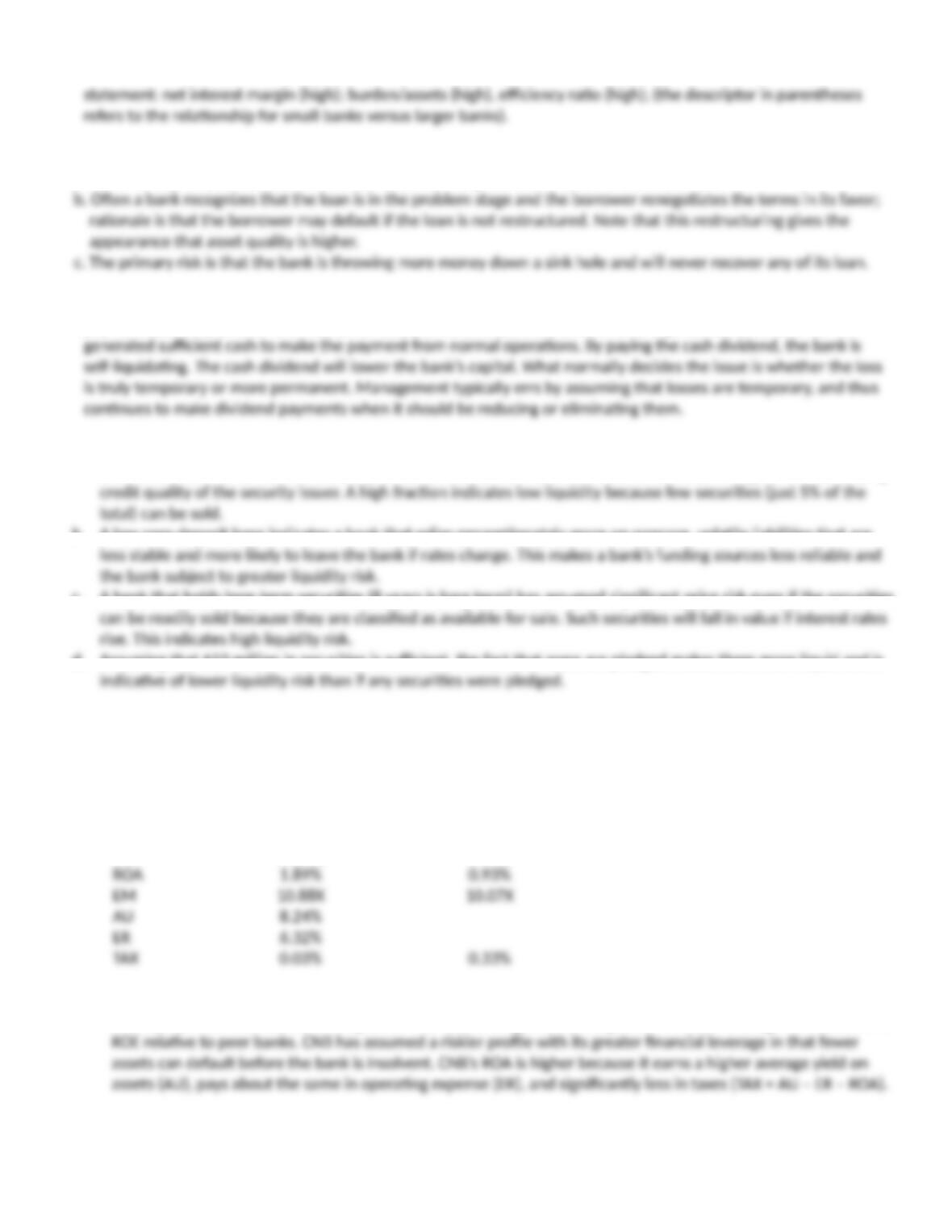
13. Extending a loan
a. The new loan is typically not classified as nonperforming because no payments are past due
14. Dividend payment: For: the loss is temporary and stockholders expect the dividend payment. Failure to make the
payment will sharply lower the stock price because stockholders will be alienated. Against: the bank has not
15. Liquidity risk:
a. Securities classified as held-to-maturity cannot be sold unless there has been an unusual change in the underlying
b. A low core deposit base indicates a bank that relies proportionately more on noncore, volatile liabilities that are
c. A bank that holds long-term securities (8 years is long term) has assumed signiticant price risk even if the securities
d. Assuming that $10 million in securities is suffcient, the fact that none are pledged makes them more liquid and is
Problems
1. Community National Bank (CNB)
1. profitability analysis for 2007 using UBPR figure:
RATIO Community National Bank Peer Banks
ROE 20.68% 9.43%
a. Aggregate profitability for CNB is substantially higher measured both by both ROE and ROA. Because CNB has
less equity relative to assets, it has greater financial leverage. Thus, the greater financial leverage increases CNB’s
4
© 2010 Cengage Learning. All Rights Reserved. May not be scanned, copied or duplicated, or posted to a publicly accessible website,
in whole or in part.
b. Risk Comparison
Credit risk: Lower net charge-o5s, lower non-current loans, slightly higher loan loss allowance. Overall, the ratios
Liquidity risk: Slightly higher core deposits, lower short-term non-core funding, higher short-term investments,
Operational risk: Lower efficiency ratio and indicate lower operational risk while fewer assets and loans per
c. Recommendations: Overall, the bank is doing well. They could improve the number of loans and assets per
employee.
2. Citibank UBPR
a. In 2007, Citibank’s Tier One Leverage Capital was 6.65% versus peers’ at 8.03%. Thus, Citibank has a higher degree
of financial leverage than their peers.
b. Citibank’s non-interest expense is 2.68% of average total assets compared to peers’ at 2.61%. Interest expense is
d. Citibank’s liquidity risk appears high as the bank less Tier 1 leverage capital than peers and relies much more on
e. Recommendations:
Carefully assess credit risk; realign porSolio where appropriate.
5
© 2010 Cengage Learning. All Rights Reserved. May not be scanned, copied or duplicated, or posted to a publicly accessible website,
in whole or in part.