Answers to End of Chapter Questions
1. A bank makes a profit when it sells securities for a higher price than it pays for the securities.
2. Managers are o!en reluctant to take a loss on security sales because losses lower reported
net income and thus lower ROA and EPS. Stockholders and investors may not understand the
4. Banks may not invest in non-investment grade debt securities, those originally nonrated or
rated below Baa, unless they can demonstrate that the effective rating is at least Baa
5. Small banks hold more securities in percentage terms than do large banks, and concentrate
6. Time trends: 1) declining holdings of Treasury securities, 2) increasing holdings of agency
securities, which includes most mortgage-backed securities, 3) declining holdings of
7. A callable bond gives the issuer the right to call the bond, or pay the principal back prior to
maturity, a!er the call deferment period has expired. The longer is the call deferment
period, the greater is the protection to the buyer of the callable bond because the issuer
8. Objectives:
1) Safety and preservation of capital: low credit risk in securities
2) Liquidity: most securities owned by banks can be readily sold in well-established
secondary markets; thus, securities can be used to meet liquidity needs
9. A reverse RP is effectively a collateralized federal funds sold transaction. The only difference
10. Trading: carried at market value on the balance sheet; unrealized gains and losses are
included as income.
Market value accounting, because it would require that banks report changes in asset values
whenever interest rates change, would increase the volatility of reported asset values and
11. Prepayment risk
a. When mortgage rates fall, prepayments on high-coupon MBSs will increase relative to
prepayments on low-coupon MBSs because the rate di1erential and refinancing
b. Prepayments generally increase over time the longer the underlying mortgages are
outstanding, up to a point. Generally, newly issued mortgages don’t prepay quickly
c. Prepayments are typically higher in markets that are booming with high growth as
12. The term ‘tranche’ refers to a class of securities. First tranche securities in a CMO have the
lowest prepayment risk of any tranche because principal is first allocated there to repay
13. Treasuries are normally stripped into multiple zero coupon securities, one for each distinct
14. Mortgage-backed securities are typically stripped into one IO and one PO. The PO differ
from that for a Treasury because it represents a stream of partial principal payments for
15. Large banks do not normally hold securities to meet liquidity needs. They simply buy
liquidity by issuing new liabilities. These are not o1seKng risk positions, but instead
16. The laddered maturity strategy involves buying securities such that a constant proportion
matures each year. As such, the investor must only decide what the maximum holding
period is and which securities to buy with that maturity each year. The barbell strategy
involves buying short-term securities for liquidity purposes and longer-term securities for
17. The Treasury yield curve is normally upsloping during the expansion phase of the business
cycle and later contractionary phase as economic activity is strong (expansion) and the Fed
18. With a contracyclical investment strategy, banks will generally buy longer-duration security
purchases when interest rates are relatively high. This means buying long-term instruments
19. In light of the contracyclical investment strategy, a porPolio manager should lengthen
20. For: improve returns if banks can time the business cycle and future rate movements.
An eBcient markets proponent generally believes that an investor cannot outperform the
21. Reducing earnings sensitivity suggests that the bank should hedge its interest rate risk. In
this context, a porPolio manager would have to buy short-term securities to increase asset
22. Riding the yield curve is based on the theory that long-term securities carry a maturity
premium. Investors buy securities with maturities longer than their holding period and
23. Options
a. The bank as buyer of the security sells the option to call the bond to the security issuer.
b.The bank as buyer sells the prepayment option to the security issuer or underlying
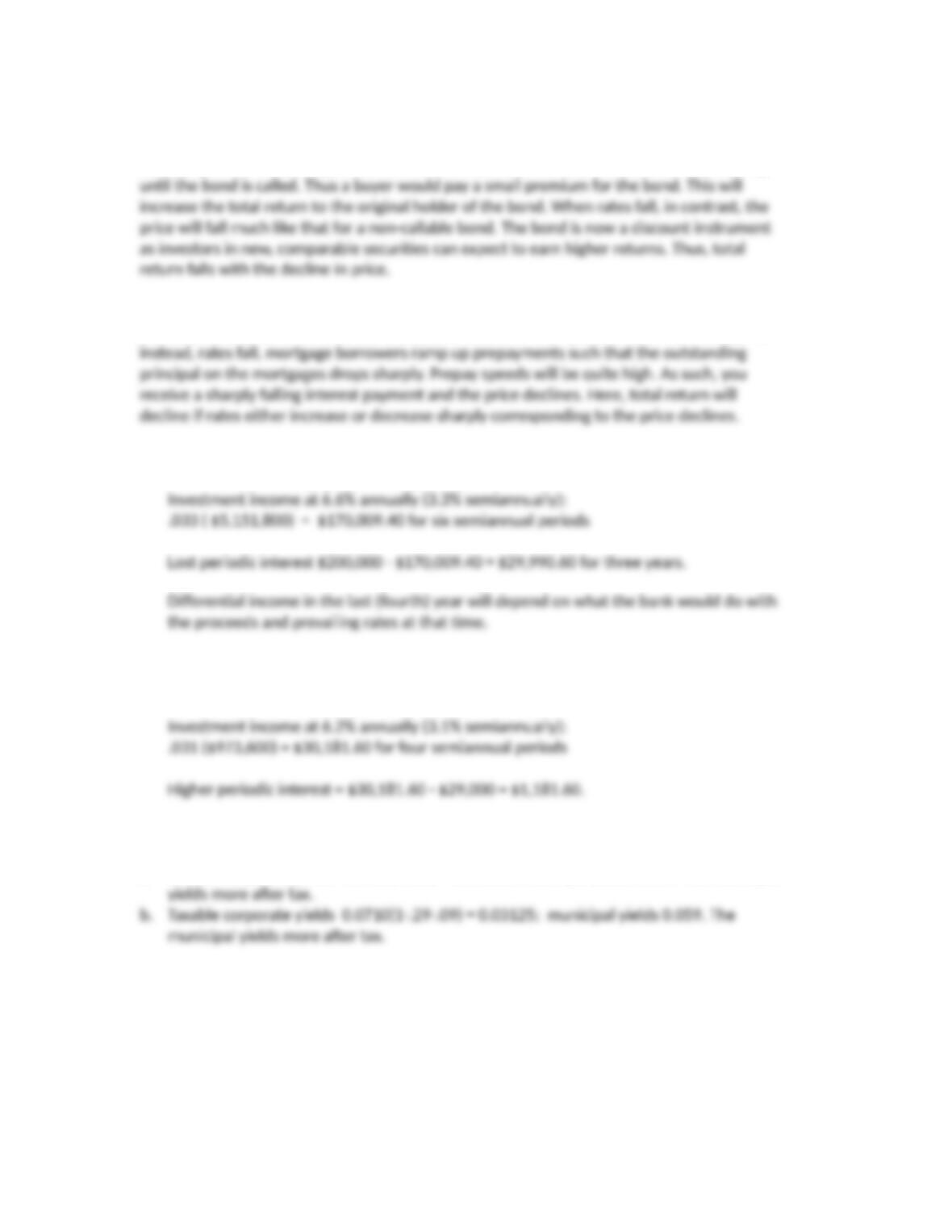
24. If you own the callable agency in Panel A and rates fall, the price will rise modestly (initially)
because you will be earning an above market return and the return should be relatively high
If you own the high-coupon IO in Panel B, you get the traditional price/yield response if rates
rise because the bond behaves like an option-free bond. The option is out of the money. If,
25. Sale of the bond produces $5.23 million – .34($0.23 million) = $5,151,800
Note that this bond pays an 8% coupon rate
26. Sale of bond produces $960,000 + .34($40,000) = $973,600
Note that this bond pays a 5.8% coupon rate
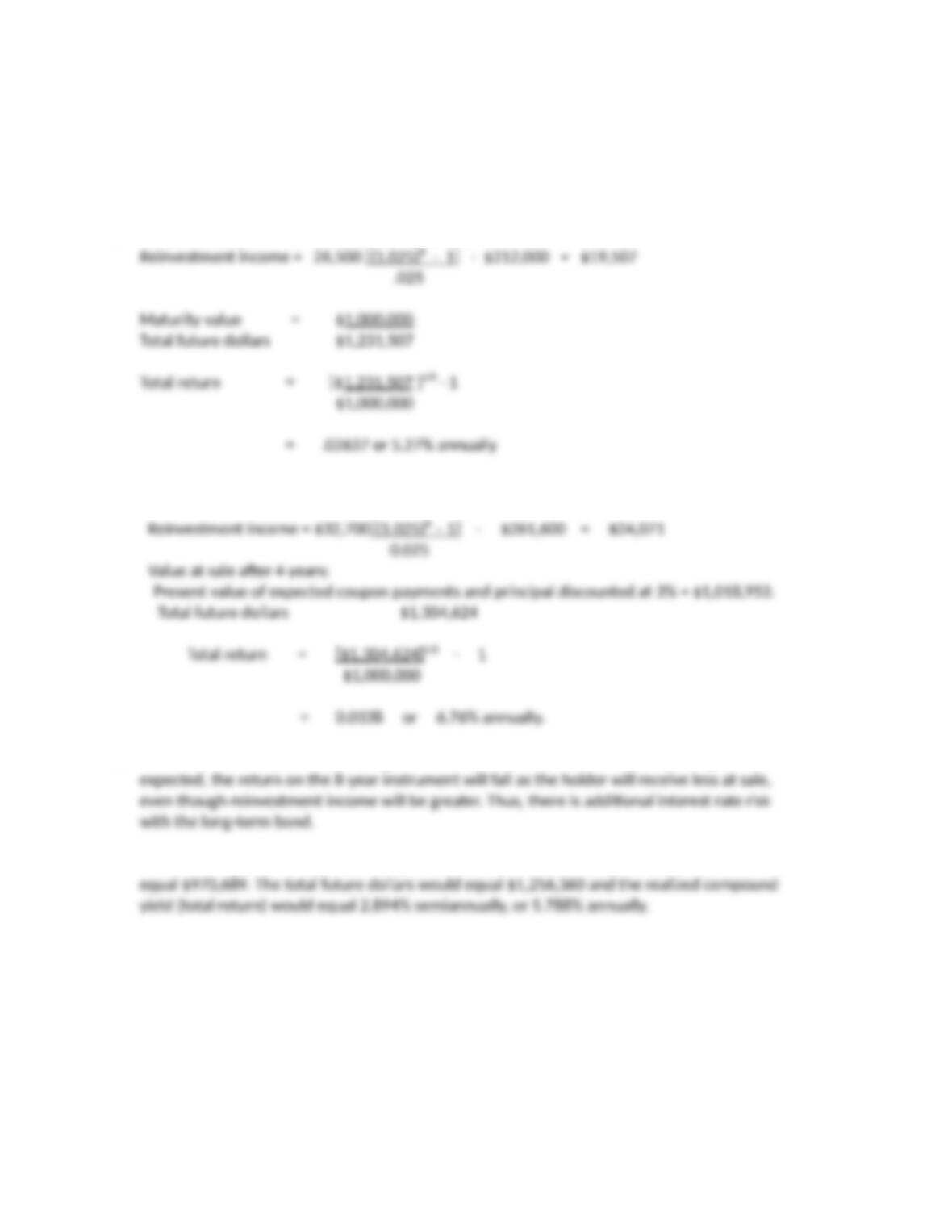
27. A!er-tax yields
a. Taxable corporate yields 0.0710(1-.28) = 0.05112; municipal yields 0.059. The municipal
Problems
II. Victory Bank: Assume that both bonds currently trade at par so that the coupons are $26,500
and $32,700 semiannually, respectively.
1. Coupon interest = 8 ($26,500) = $212,000
2. Coupon interest = 8($32,700) = $261,600
3. The 8-year security promises the higher return. Of course, if interest rates move higher than
4. If the market rate on a 4-year bond equals 7.4% (3.7% semiannually), the sale price would
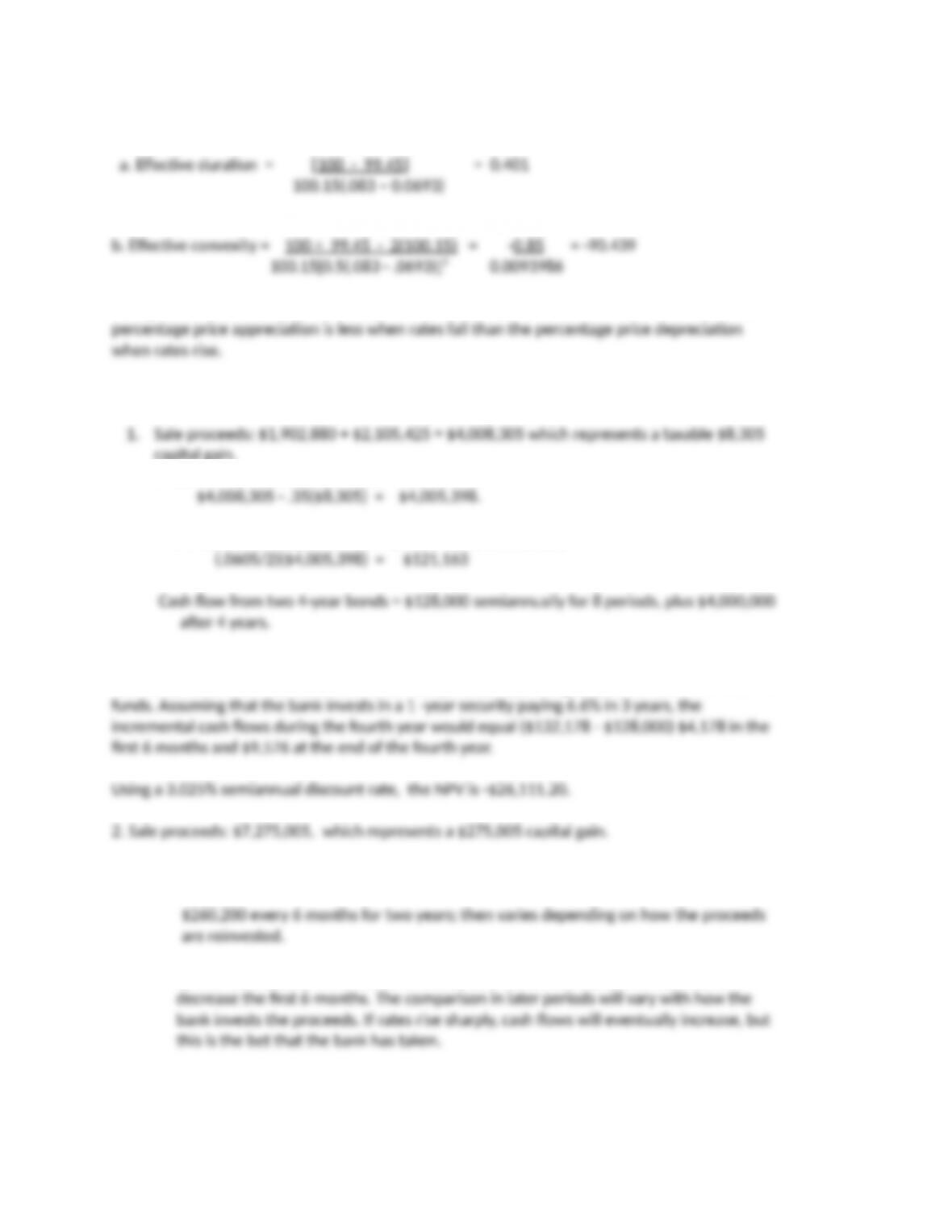
III. effective Duration and Convexity
c. Negative convexity: the price actually falls as rates fall; the price also falls as rates rise. The
IV. Security Swap: Jackson County Bank
capital gain.
Thus, the investable amount a!er-taxes is:
Semiannual interest payments on the FLB bond would equal:
Thus, the incremental cash Mows would equal -$6,837 for each of the next 6 semiannual periods,
and would di1er over the next two semiannual periods depending on how the bank invested the
Cash Mows from the three bonds currently owned:
1) with reinvestment in 6-month T-bills at 3.88% the bank will see its cash Mows
2) and 3) with reinvestment in 52-week T-bills or 2-year T-notes, the bank is facing the
same general risk profile. It has locked in a higher yield for the first period, but will only

3. CMOs entail prepayment risk. If rates are rising, prepayments will slow such that the amount
of outstanding principal increases. An investor will receive the promised interest for a longer