Answers to End of Chapter Questions
1. Installment loans are for specific purposes and have fixed payouts. Typically, they are
collateralized by the asset purchased with the loan proceeds. An example is a car loan where
2. Expenses include the cost of extending credit, personnel expense and overhead, loan losses,
and the cost of collecting loans plus record keeping. The average size of a consumer loan
3. Clearly, both net charge-o.s and personal bankruptcy filings have increased since 1994. Both
fell in 1999 and 2000 before increasing therea0er. The high level of charge-o.s and
bankruptcies is somewhat surprising given the strong growth in the U.S. economy through
2005. One argument is that the s#gma against declaring bankruptcy has slowly gone away
4. Home equity loans have been a9rac#ve since the passage of the Tax Reform Act of 1986
because individuals can deduct interest expense paid on these loans, but cannot deduct
5. With direct loans, lenders and borrowers negotiate the terms directly. With indirect loans,
6. Equal Credit Opportunity: formally specifies that it is illegal for lenders to discriminate
against potential borrowers due to race, religion, sex, marital status, age, and national origin.
7. Through an analysis of historical data, a bank iden#fies factors that represent key borrower
characteristic that dis#nguish between loans that were repaid in a timely fashion and loans
that were not. These factors are weighted a0er being certain that they do not violate equal
8. The data in Exhibit 15.12 indicate that the bulk of FICO scores are over 650, and that
delinquency rates, which indicate the highest likelihood of nonpayment, are much higher for
9. Credit card loans generate revenues from annual fees, charges against merchants (discounts)
who accept the cards, and interest paid by card users. The primary costs are operating
10. The interest spread between fixed-rate credit cards and a bank’s cost of funds widens when
rates fall because credit card rates are s#cky (rigid) and do not move quickly with market
11.
a. Interest = .10 ($5,000) = $500 per year for 2 years = $ 1,000.
b. $5,000 loan for 2 years, 10% add-on interest, 24 monthly payments
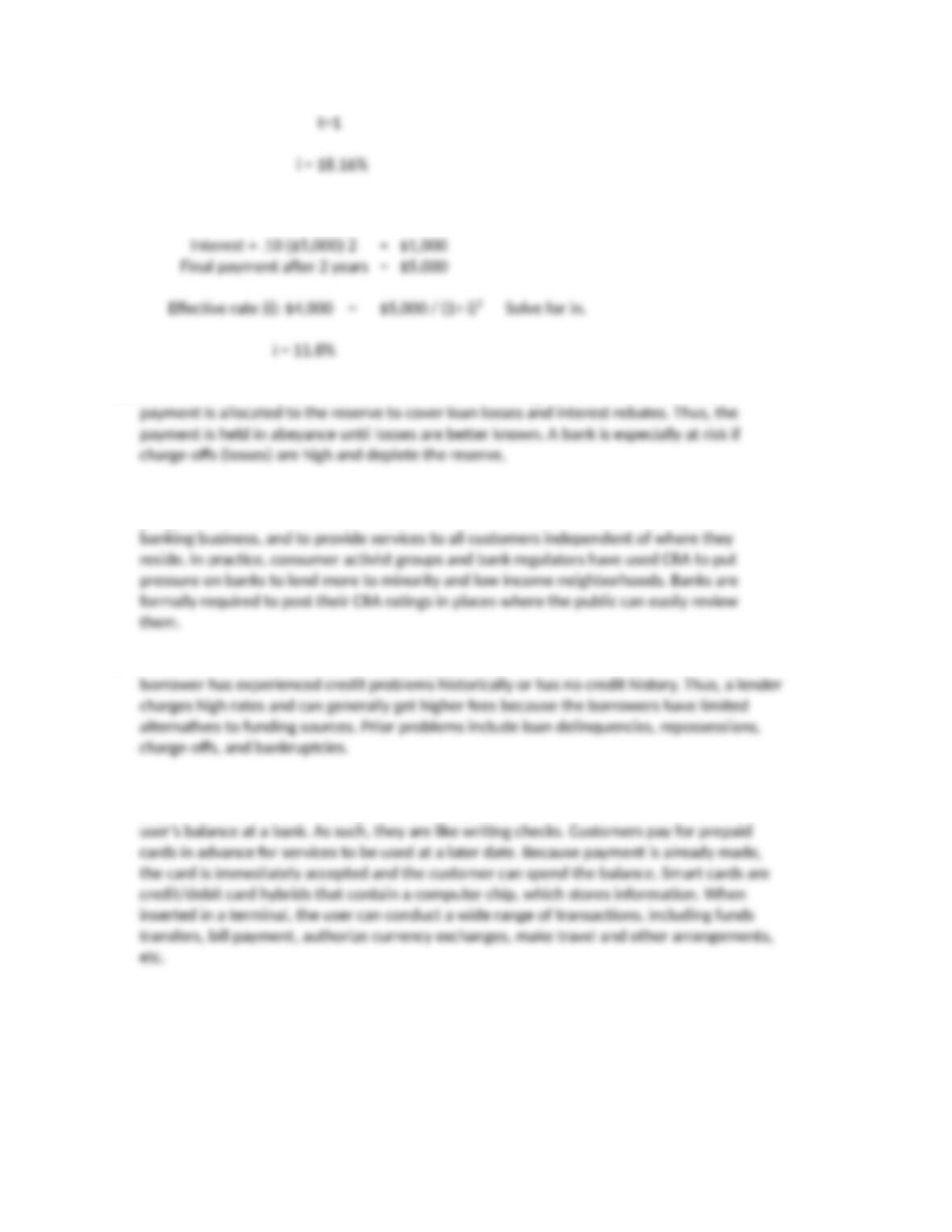
c. $5,000 repaid a0er 2 years, 10% discount rate
12. A dealer reserve helps protect the bank in indirect loan agreements. A portion of each
13. Community Reinvestment Act is intended to eliminate discrimination in lending based on
geographic markets. Lenders are expected to loan funds in all markets where they conduct
14. Many lenders like the risk versus return opportunities with subprime loans. The typical
15. Smart cards, debit cards, and prepaid cards di.er because they represent a di.erent type of
payment and information storage. Debit cards provide for the immediate reduction in the
Problems
I. Buying Paper from a Used-Car Dealer
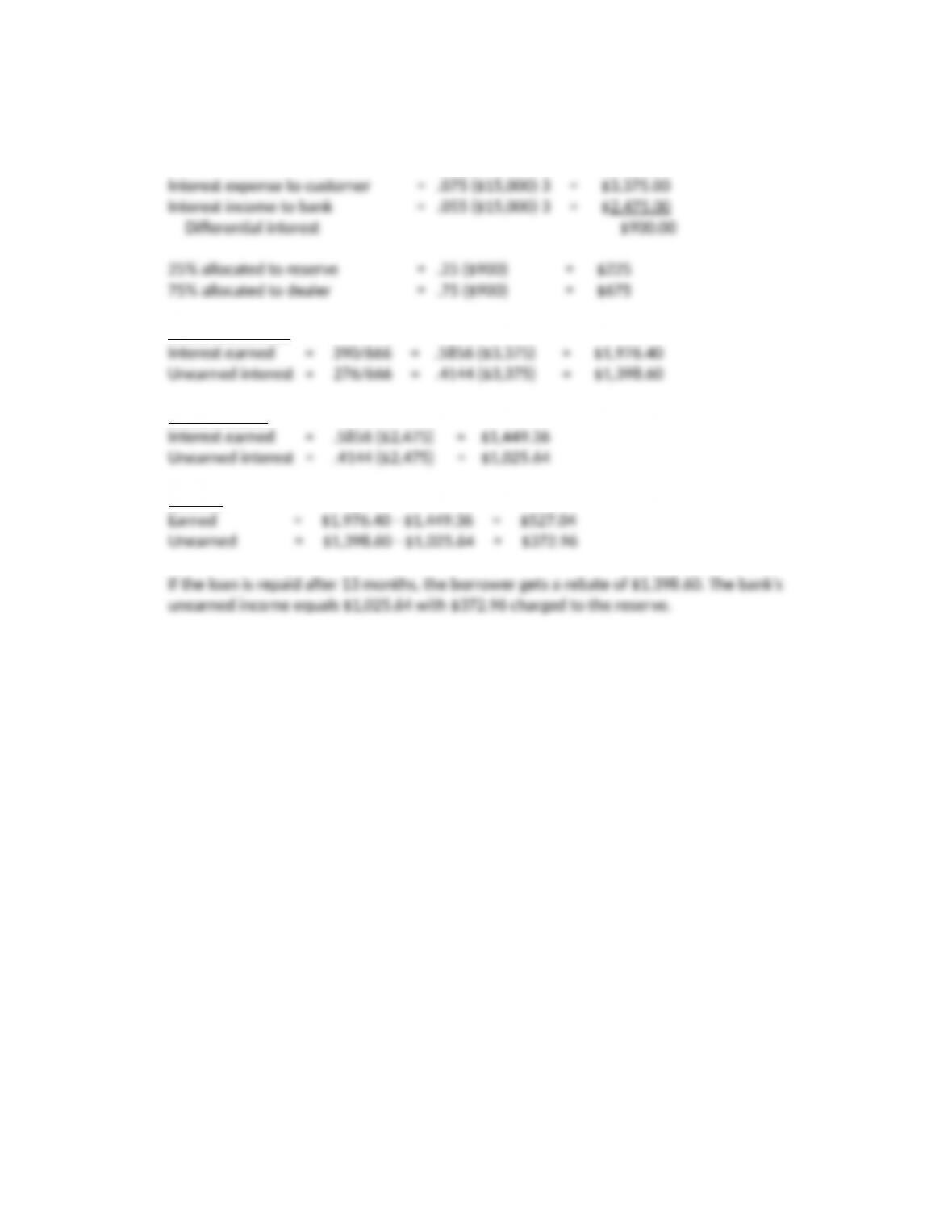
Terms: Bank buys dealer paper at 5.5% add-on rate; dealer charges customers a 7.5% add-on
rate on $15,000 over 36 months.
End of 13 months
Bank’s portion
Reserve
II. Credit Report
1. Data from Exhibit 15.9
a. Lenders prefer credit from a broad base of businesses, including
b. Older accounts have a longer history of whether the borrower
c. The date of last activity indicates whether an account is actively
d. The highest credit amount indicates the total availability of
credit. The greater is this figure across all credit sources, the
e. The greater is the outstanding balance, the greater is the
2. Courthouse records for John Doe indicate that a lien was filed against