Answers to End of Chapter Questions
1. Banks must have sufficient cash assets on hand to meet clearing needs. Liquidity
2. Advantage: reduced liquidity risk
3. Banks are allowed to meet minimum daily average reserve requirements. Thus, on any day
4.
a. Time deposits are not currently subject to required reserves. The vault cash can be used to
b. Increases required reserves because of the different required reserves, 10% for NOWs
5. A correspondent bank sells services to respondent banks who buy the services. A bankers
6. Corporate borrowing
Assets Liabilities + Equity
|
7.
a. Not discretionary, but predictable.
b. Not discretionary, but predictable.
8. The bank needs to replace $150 million of the $180 million liquidity need (expected cash
outflow) with the projected funding sources identified, plus obtain an additional $30 million
9. Trend component: regular, periodic growth component; identifies projected deposits and
loans if no seasonal or cyclical impacts appear.
10. The key components of a bank’s contingency funding plan are the narrative section, the
quantitative section, and section that summarizes the key risks and potential sources of
funding. The narrative section that addresses the senior officers who are responsible for
11.
a. The large regional bank may conclude that the bank’s risk has increased significantly, and
is therefore unwilling to advance the line..
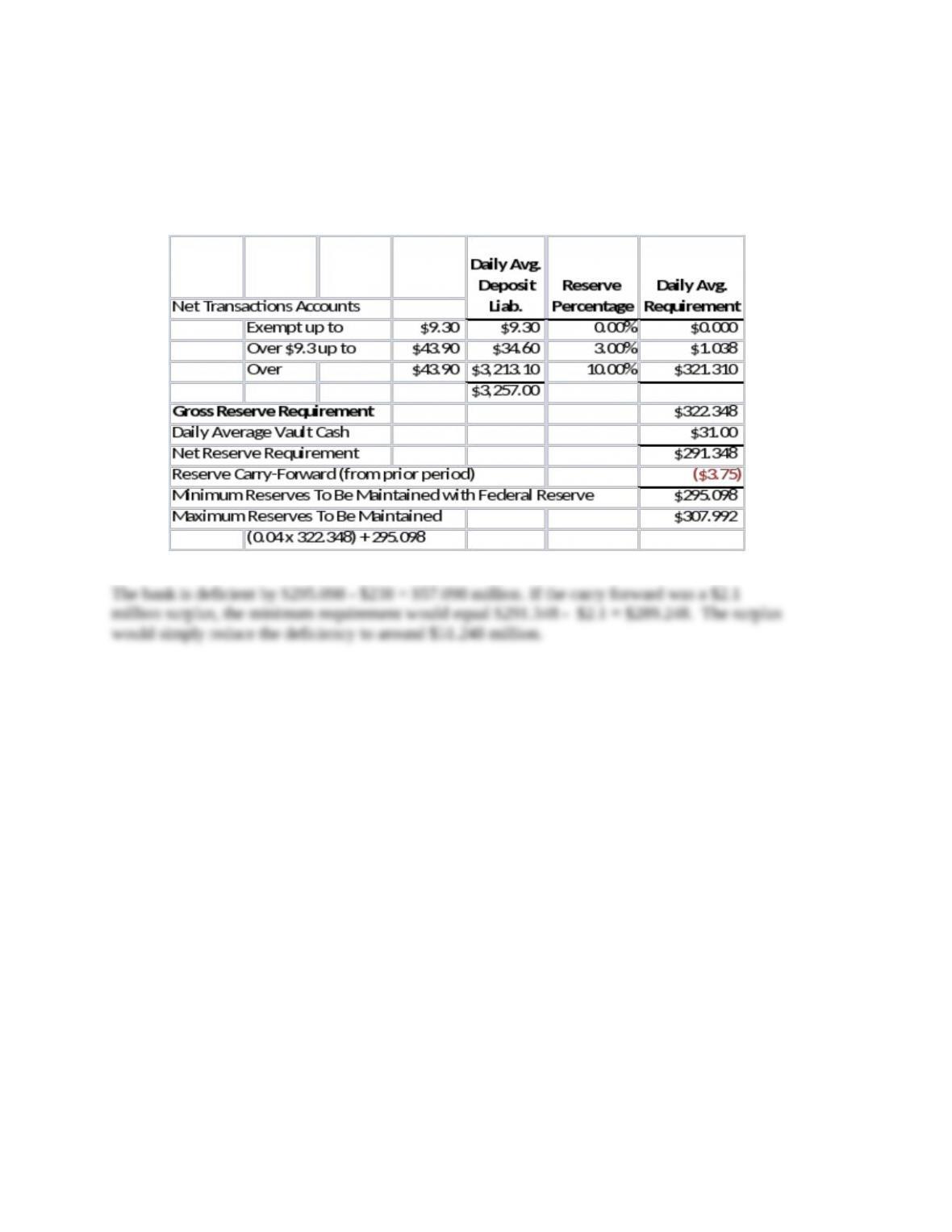
Activity
Calculation of Required Reserves
1. Calculation of required reserves