Answers to End of Chapter Questions
1. Liquidity risk (low to high):
a. DDAs, NOWs, MMDAs, small time deposits, Federal Home Loan Bank
b. Cost (low to high):
2. Core deposits represent relatively stable sources of funds. When rates change, few deposits
will leave the bank in search of higher yields relative to volatile liabilities. Thus, the interest
elasticity of core deposits is much lower than that for volatile liabilities. The key factor in
Break even deposit balance (X):
When checks are not returned, the account is labeled as ‘truncated.’ Most students will not
keep balances nearly as high as the break-even amount of $1,575. Banks make a profit on
4. Reasonable: there is a cost in officer time to research balance inquiries.
5. Eurodollars
a. TIB: asset: Eurodollar deposit at Barclays; reduces demand deposit at NY Money
Center
b. Barclays Bank:
c. Bank of England:
d. NY Money Center Bank:
6. Variable rate CD over fixed-rate CD: Expect market interest rates to rise, or as a hedger you
7. Insured deposits
a. no uninsured deposits
8. Average (A) or marginal (M)
a. M
9. Loan rates would generally not be set at market rates. If interest rates were rising, the historical rate
10. Servicing costs are highest on transactions accounts because checks are costly to process. The
11. Effective marginal cost of the CD:
1 – .00
12. The marginal weighted average cost of funds reflects the risk of the bank. A loan of average risk
might be of the same risk as the bank and thus need no adjustment for risk. However, it is possible
13. Vault cash: to meet customer withdrawals
Demand deposits held at the Federal Reserve: to meet clearing needs and reserve
14. Absent a substitute check authorized under Check 21, a bank needs to verify that a
deposited check is good in that there are funds supporting it. A hold reduces the risk of loss
15. Core deposits are deposits that a bank can reasonably expect to retain, regardless of changes
in interest rates and general economic activity. Core deposits are often measured as a bank’s
16. Impact on deposit balances
a. decrease
b. decrease
17. Banks pledge collateral against borrowings from Federal Reserve Banks, borrowings from
Federal Home Loan Banks, public deposits (such as Treasury tax and loan accounts), and
securities sold under agreement to repurchase (RPs). The qualifying collateral is determined
18. Banks that assume large amounts of credit or interest rate risk accept greater volatility in
19. Lowest risk to highest risk:
a. local schoolchildren
20. Banks that maintain their deposit base typically offer a full range of quality service so that
moving an account is costly in terms of effort, time, and entails the loss of a personal
21. If bank’s have sufficient capital, failure is not likely. In the extreme, a bank that is entirely
equity financed will not fail. Thus, capital adequacy and asset quality, which affects capital,
are essential to maintaining bank liquidity. The sequence of events leading to failure starts
Problems
Analyzing Profitability
1. Low-balance customer
2. High-balance customer (Personal checking)
a. Monthly expense on the NOW account: $0.1073(21) + $0.2188(13) + $0.16(4) +
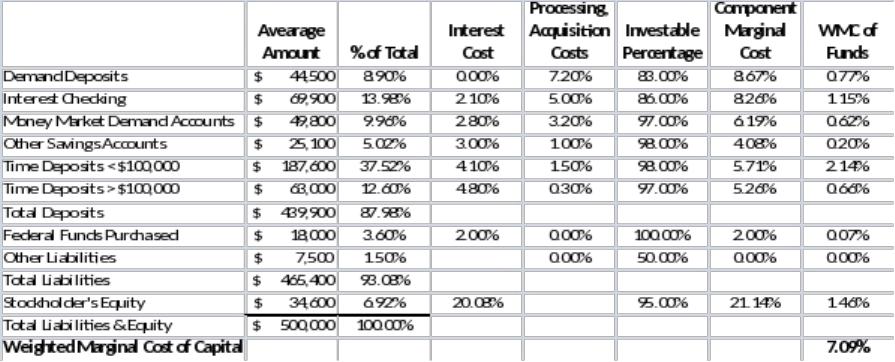
Weighted marginal cost of funds for Northwestern National Bank