110
Problem 5-3 Continued
(In Percentage)
Liabilities and Stockholders’ Equity
2010
2009
Current liabilities:
Short-term borrowings and current portion of long-
term debt
5.8
6.1
Accounts payable and accrued liabilities
13.3
13.9
Accrued payroll and related taxes
17.8
15.9
Accrued insurance
2.3
1.7
Income and other taxes
4.1
3.6
Total current liabilities
43.2
41.2
Noncurrent liabilities
Long-term debt
—-
4.4
Accrued insurance
3.9
4.2
Accrued retirement benefits
6.2
5.9
Other long-term liabilities
1.1
1.2
Total noncurrent liabilities
11.2
15.6
Stockholders’ equity
Capital stocks $1.00 par value
Class A common stock
2.7
2.8
Class B common stock
.3
.3
Treasury stock, at cost
Class A common stock
(5.1)
(8.1)
Class B common stock
(0.0)
(0.0)
Paid-in capital
2.0
2.8
Earnings invested in the business
43.7
43.5
Accumulated other comprehensive income
2.1
1.9
Total stockholders’ equity
45.6
43.2
Total liabilities and stockholders’ equity
100.0
100.0
* There are some rounding differences
111
Problem 5-3 Continued
b.
Kelly Services, Inc. and Subsidiaries
Balance Sheets
December 31, 2010 and December 31, 2009
Horizontal Common-Size Analysis
In Percentage
Assets
2010
2009
Current assets
Cash and equivalents
90.6
100.0
Trade accounts receivable
113.0
100.0
Prepaid expenses and other current assets
63.5
100.0
Deferred taxes
106.7
100.0
Total current assets
106.7
100.0
Property and equipment
Land and buildings
100.3
100.0
Computer hardware, software and other
98.6
100.0
Accumulated depreciation
110.0
100.0
Net property and equipment
81.8
100.0
Noncurrent deferred taxes
108.4
100.0
Goodwill, net
100.0
100.0
Other assets
108.6
100.0
Total assets
104.3
100.0
112
Problem 5-3 Continued
In Percentage
Liabilities and Stockholders’ Equity
2010
2009
Current liabilities
Short-term borrowings and current portion of long-
term debt
99.0
100.0
Accounts payable and accrued liabilities
99.5
100.0
Accrued payroll and related taxes
116.8
100.0
Accrued insurance
136.7
100.0
Income and other taxes
118.1
100.0
Total current liabilities
109.3
100.0
Noncurrent Liabilities
Long-term debt
0.0
100.0
Accrued insurance
97.6
100.0
Accrued retirement benefits
111.1
100.0
Other long term liabilities
91.3
100.0
Total noncurrent liabilities
74.8
100.0
Stockholders’ Equity
Capital stocks $1.00 par value
Class A common stock
100.0
100.0
Class B common stock
100.0
100.0
Treasury stock, at cost
Class A common stock
65.9
100.0
Class B common stock
100.0
100.0
Paid-in capital
75.9
100.0
Earnings invested in the business
104.6
100.0
Accumulated other comprehensive income
115.5
100.0
Total stockholders’ equity
110.1
100.0
Total liabilities and stockholders’ equity
104.3
100.0
113
Problem 5-3 Continued
c. Vertical Common-Size Analysis
Assets
Noncurrent deferred taxes increased materially.
Liabilities and Stockholders’ Equity
taxes, 2) accrued insurance, and 3) income and other taxes.
Stockholders’ Equity
114
PROBLEM 5-4
a.
Kelly Services, Inc. and Subsidiaries
Consolidated Statement of Earnings
For the three fiscal years ended December 31, 2010
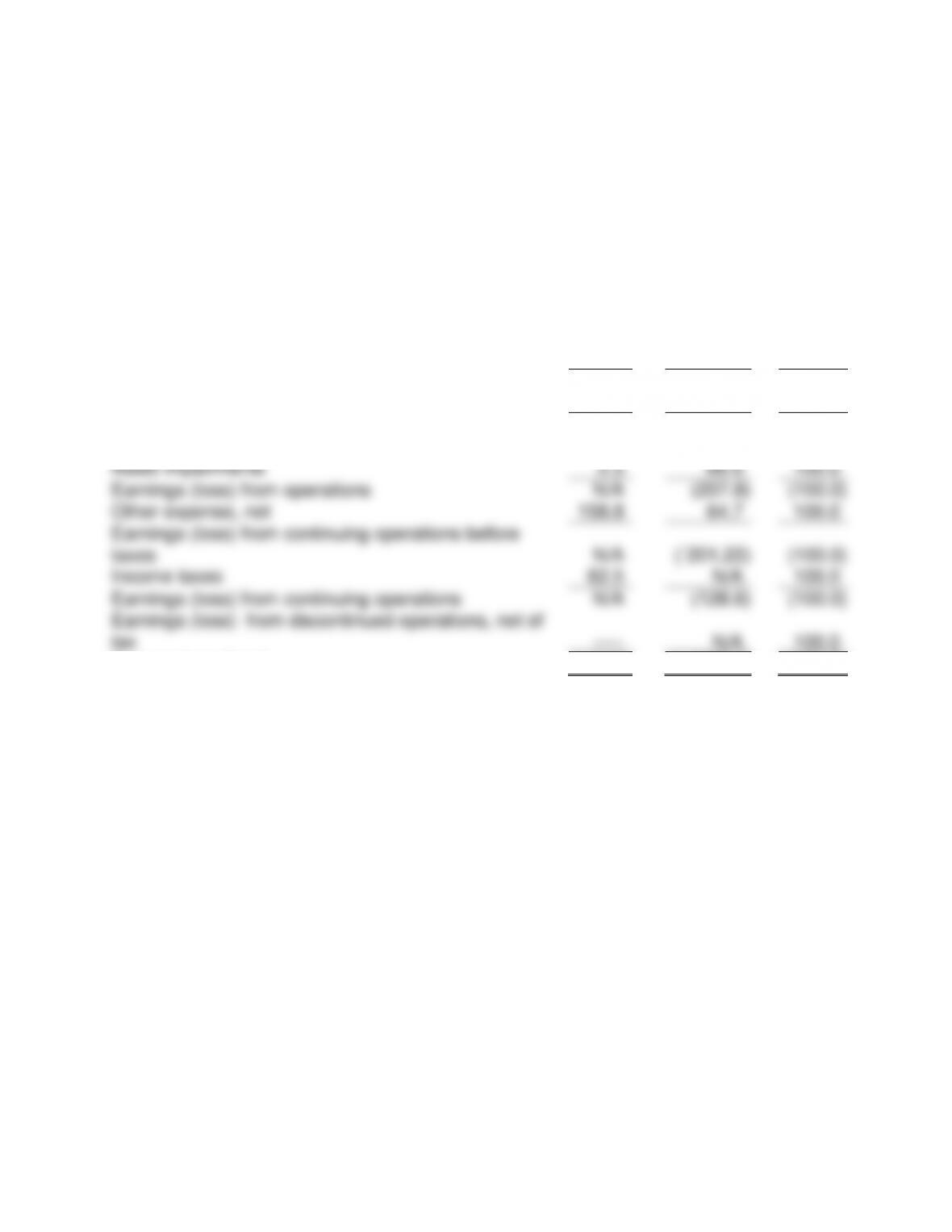
Vertical Common-Size Analysis*
2010
2009(1)
2008
Revenue from services
100.0
100.0
100.0
Cost of services
84.0
83.7
82.3
Gross Profit
16.0
16.3
17.7
Selling, general, and administrative expenses
15.2
18.4
17.5
Asset impairments
0.0
1.2
1.5
Earnings (loss) from operations
0.8
(3.4)
(1.3)
Other expense, net
(0.1)
(0.0)
(0.0)
Earnings (loss) from continuing operations before taxes
0.7
(3.4)
(1.3)
Income taxes
(0.1)
1.0
(0.1)
Earnings (loss) from continuing operations
0.5
(2.4)
(1.5)
Earnings (loss) from discontinued operations, net of tax
—–
0.0
0.0
Net earnings (loss)
0.5
(2.4)
(1.5)
(1) Fiscal year included 53 weeks
*Some rounding differences
115
Problem 5-4 Continued
b.
Kelly Services, Inc. and Subsidiaries
Consolidated Statements of Earnings
For the three fiscal years ended December 31, 2010
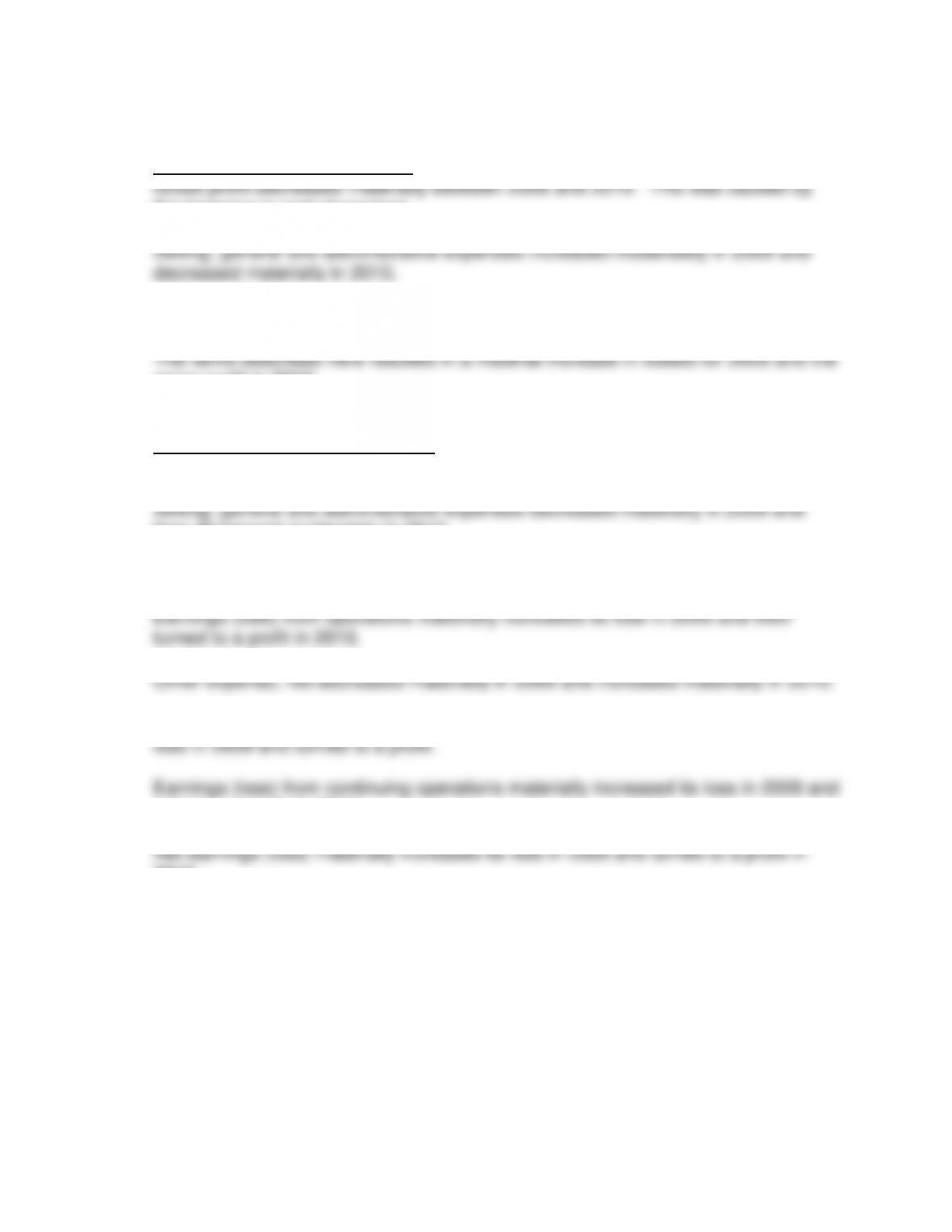
Horizontal Common-Size Analysis
2010
2009(1)
2008
Revenues from services
89.7
78.2
100.0
Cost of services
91.5
79.6
100.0
Gross Profit
81.3
71.8
100.0
Selling, general, and administrative expense
78.0
82.1
100.0
Asset impairments
2.5
66.0
100.0
Earnings (loss) from operations
N/A
(207.8)
(100.0)
Other expense, net
158.8
64.7
100.0
Earnings (loss) from continuing operations before
taxes
N/A
(`201.22)
(100.0)
Income taxes
82.5
N/A
100.0
Earnings (loss) from continuing operations
N/A
(128.6)
(100.0)
Earnings (loss) from discontinued operations, net of
tax
—–
N/A
100.0
Net earnings (loss)
N/A
(127.1)
100.0
(1) Fiscal year included 53 weeks
116
Problem 5-4 Continued
c. Vertical Common-Size Analysis
the increase in cost of services.
Asset impairments decreased materially between 2008 and 2010.
minor profit in 2010.
Horizontal Common-Size Analysis
Gross profit decreased materially in 2009 and then increased materially in 2010.
then decreased moderately in 2010.
Asset impairments decreased materially in both 2009 and 2010.
Earnings (loss) from continuing operations before taxes materially increased its
turned to a profit in 2010.
2010.
117
PROBLEM 5-5
Change Analysis
Item
Year 1
Year 2
Amount
Percent
1
—–
3,000
3,000
—–
2
6,000
(4,000)
(10,000)
3
(7,000)
4,000
11,000
4
4,000
—–
(4,000)
100
5
8,000
10,000
2,000
25
PROBLEM 5-6
Change Analysis
Item
Year 1
Year 2
Amount
Percent
1
4,000
—–
(4,000)
100
2
5,000
(3,000)
(8,000)
—–
3
(9,000)
2,000
11,000
—–
4
7,000
—–
(7,000)
100
5
—–
15,000
15,000
—–
PROBLEM 5-7
a.
December 31,
Increase
(Decrease)
2011
2010
Dollars
Percent
Net sales
$30,000
$28,000
$2,000
107.1
Cost of goods sold
20,000
19,500
500
102.6
Gross profit
10,000
8,500
1,500
117.6
Selling, general, and
administrative expense
3,000
2,900
100
103.4
Operating income
7,000
5,600
1,400
125.0
Interest expense
100
80
20
125.0
Income before taxes
6,900
5,520
1,380
125.0
Income tax expense
2,000
1,600
400
125.0
Net income
4,900
3,920
980
125.0
Net Sales increased substantially more than Selling, General, and Administrative
Expense.
118
PROBLEM 5-8
a.
5
Most ratios are computed comparing selected income statement and
balance sheet numbers.
b.
1
A figure from the year’s statement is compared with a base selected from
the current year. This would be described as a vertical common-size
statement.
c.
3
Since we do not know the resources employed, Fremont Electronics could
be more profitable than Columbus Electronics in relation to resources
employed.
d.
5
The fact that financial services may be private independent firms does not
relate to industry ratios being considered as absolute norms for a given
industry.
e.
5
The Department of Commerce Financial Report is a publication of the
federal government for manufacturing, mining, and trade corporations.
f.
3
The Almanac of Business and Industrial Financial Ratios represents a
compilation of corporate tax return data.
g.
4
Industry Norms and Key Business Ratios, desktop edition, includes over
800 different lines of business.
h.
2
A horizontal analysis compares each amount with a base amount for a
selected base year.
i.
1
Relative numbers would be most meaningful for comparing two firms in
the coal industry.
j.
1
The statement “management is not interested in the view of investors”
does not represent a fair statement as to the management perspective.