58
PROBLEM 3-8
$10,000.
PROBLEM 3-9
a.
Preferred
Common
Year 1
0
0
Year 2
Preferred
Cumulative from year 1
10,000 shares x $100 par value =
$1,000,000 x 10%
$
100,000
Year 2 dividend
10,000 shares x $100 par value =
$1,000,000 x 10%
100,000
Total
$
200,000
0
Year 3
Preferred
Year 3 dividend
10,000 shares x $100 par value =
$1,000,000 x 10%
$
100,000
Common
The common gets the remaining
dividends because the preferred
is nonparticipating
$
120,000
Total
$
100,000
$
120,000
59
b.
Preferred
Common
Year 1
0
0
Year 2
Preferred
Arrears [See computation in (a)]
$
100,000
Year 2 dividend
[See computation in (a)]
100,000
Total
$
200,000
0
Year 3
Preferred
Year 3 dividend
[See computation in (a)]
$
100,000
Common
80,000 shares x $5 = $400,000
x 10% = 40,000
$
40,000
2% to preferred
(2% x $1,000,000)
20,000
2% to common
(2% x $400,000)
8,000
Remaining dividend to common
52,000
Total
$
120,000
$
100,000
c.
Preferred
Common
Year 1
0
0
Year 2
Preferred
Arrears [See computation in (a)]
$
100,000
Year 2 Dividend
[See computation in (a)]
100,000
Total
$
200,000
0
Year 3
Preferred
Year 3 dividend
[See computation in (a)]
$
100,000
Common
80,000 shares x $5 = $400,000
x 10% = 40,000
$
40,000
60
Fully participating; therefore, the
remaining dividend will be split
between preferred and common in
proportion to their outstanding
stock at total par value.
Total par value of preferred
$1,000,000 71.43%
Total par value of common
$ 400,000 28.57%
Total $1,400,000 100.00%
Preferred 71.43% x $80,000 =
57,144
Common 28.57% x $80,000 =
22,856
Total
$
157,144
$
62,856
d.
Preferred
Common
Year 1
0
0
Year 2
Preferred
Year 2 dividend
[See computation in (a)]
$
100,000
Common
Remainder to common
$
100,000
Total
$
100,000
$
100,000
Year 3
Preferred
Year 3 dividend
[See computation in (a)]
$
100,000
Common
Remainder to common
$
120,000
Total
$
100,000
$
120,000
61
PROBLEM 3-10
a.
Preferred
Common
Year 1
Preferred
5,000 x $100 x 9% = $45,000
$
40,000
0
Year 2
Preferred
Cumulative
$
5,000
5,000 x $100 x 9% = $45,000
45,000
Common
10,000 x $10 x 9% = 9,000
$
9,000
Fully participating; therefore, the
remaining dividend will be split
between preferred and common in
proportion to their outstanding
stock at total par value.
Total par value of preferred
$500,000 83.3%
Total par value of common
$ 100,000 16.7%
Total $ 600,000 100.00%
$65,000 – $5,000 – $45,000 – $9,000
= $6,000
5,000
1,000
$
55,000
$
10,000
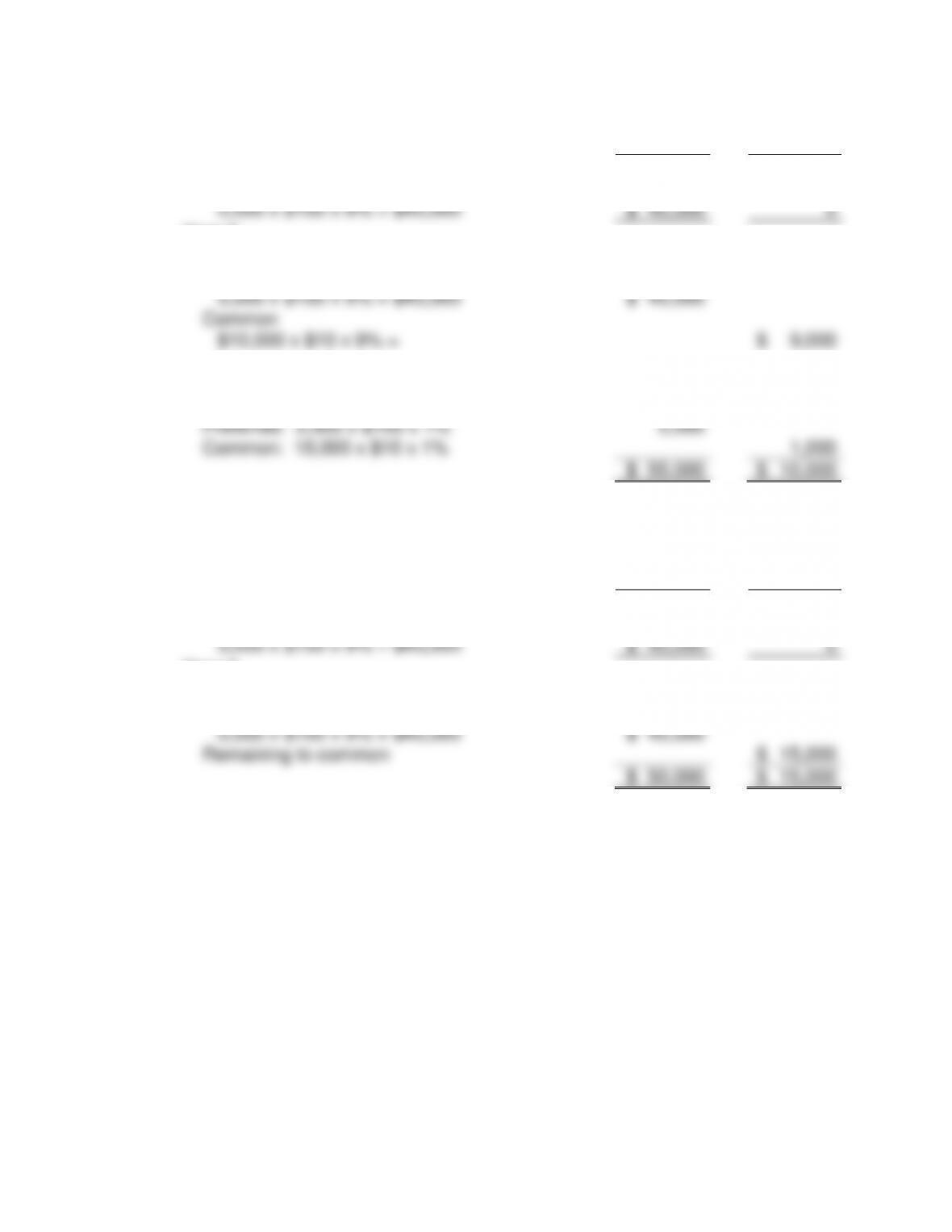
b.
Preferred
Common
Year 1
Preferred
5,000 x $100 x 9% = $45,000
$
40,000
0
Year 2
Preferred
5,000 x $100 x 9% = $45,000
$
45,000
Common
Remaining divided to common
$
20,000
($65,000 – $45,000)
$
45,000
$
20,000
62
c.
Preferred
Common
Year 1
Preferred
5,000 x $100 x 9% = $45,000
$
40,000
0
Year 2
Preferred
Cumulative
$
5,000
5,000 x $100 x 9% = $45,000
$
45,000
Common
$10,000 x $10 x 9% =
$
9,000
Additional % to preferred and common:
Preferred: 5,000 x $100 x 1%
5,000
Common: 10,000 x $10 x 1%
1,000
$
55,000
$
10,000
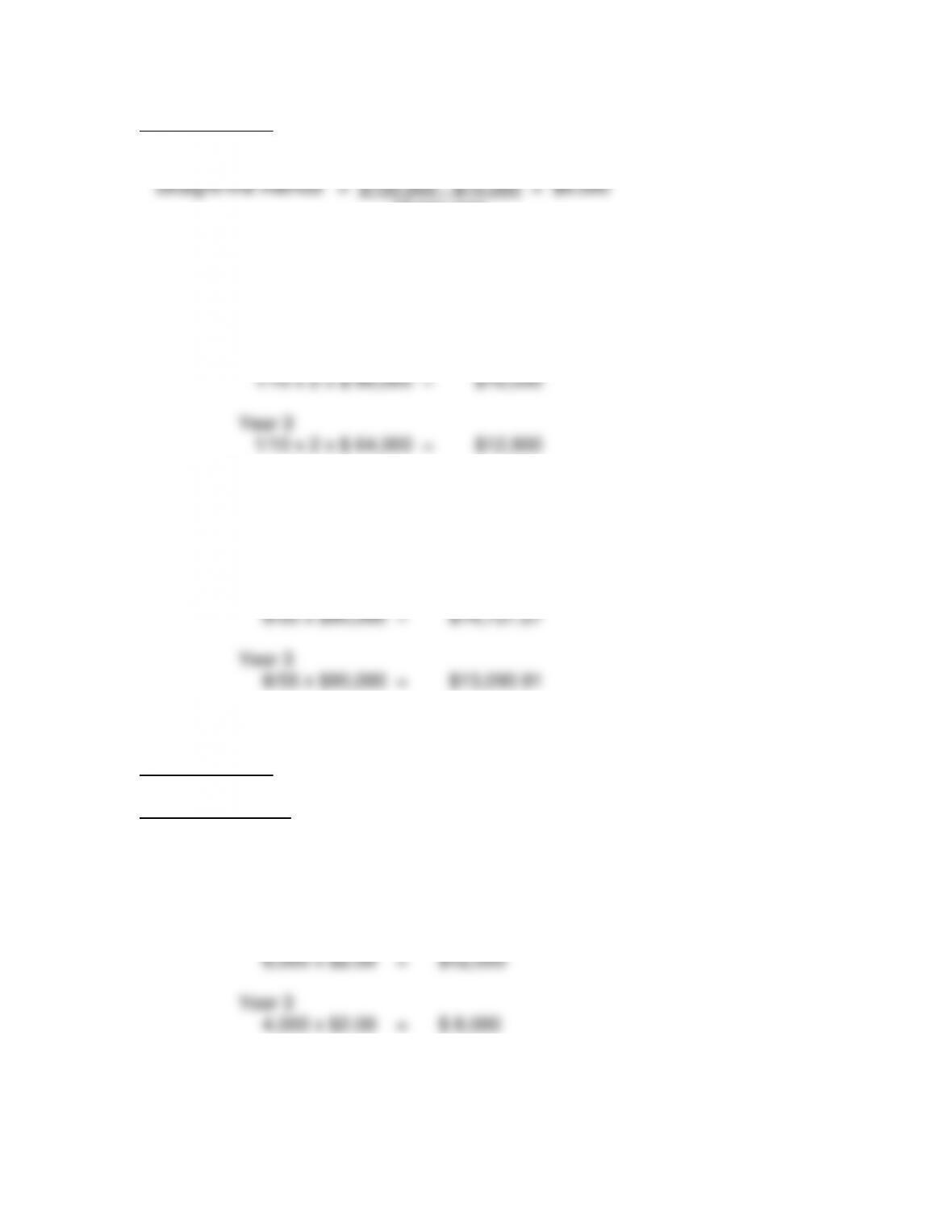
d.
Preferred
Common
Year 1
Preferred
5,000 x $100 x 9% = $45,000
$
40,000
0
Year 2
Preferred
Cumulative
$
5,000
5,000 x $100 x 9% = $45,000
$
45,000
Remaining to common
$
15,000
$
50,000
$
15,000
63
PROBLEM 3-11
a.
10 per year
b.
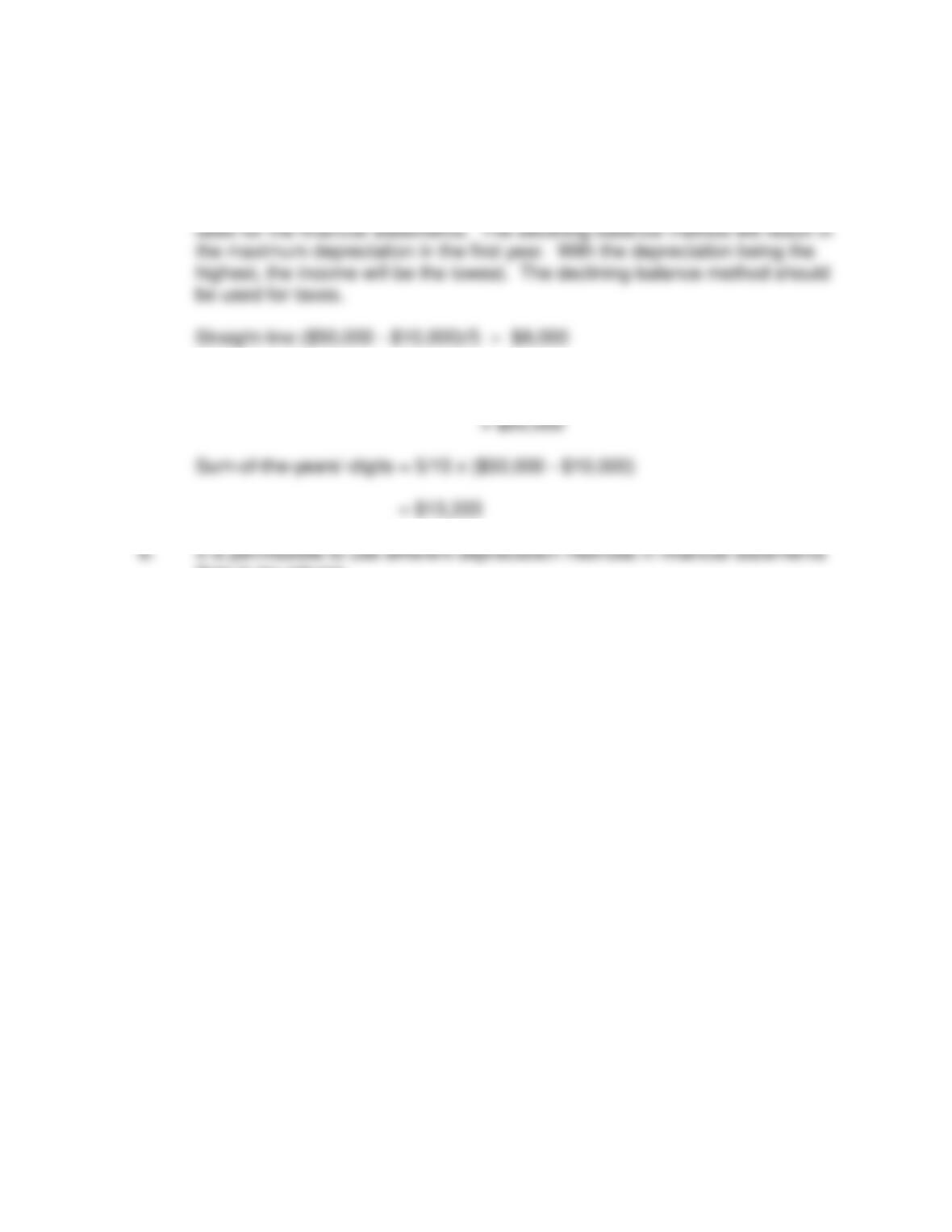
Declining-balance method
Year 1
1/10 x 2 x $100,000 = $20,000
Year 2
c.
Sum-of-the-years’-digits method
Year 1
10/55 x $90,000 = $16,363.63
Year 2
PROBLEM 3-12
$60,000 – $10,000 = $2.00 per hour
25,000 hrs.
Year 1
5,000 x $2.00 = $10,000
Year 2
64
PROBLEM 3-13
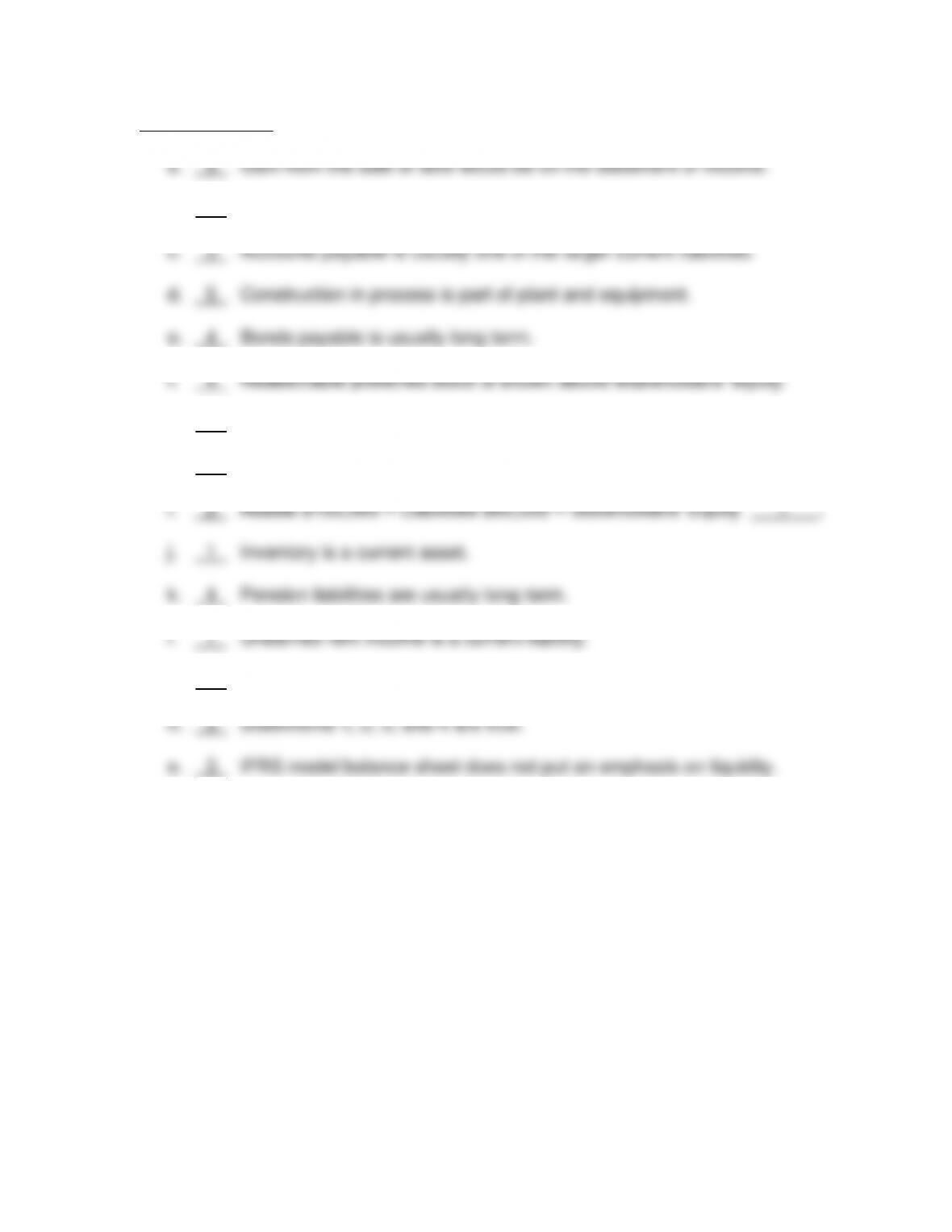
a. The straight line method will result in the lowest depreciation in the first year.
With the depreciation being the lowest for straight-line, the income will be the
highest using the straight-line method. The straight-line method should be
Double-declining-balance method = 1/5 x 2 x $50,000
than in tax returns.
65
PROBLEM 3-14
b. 1 Cash restricted for the retirement of bonds would be under other assets.
g. 3 Accounts receivable is a current asset.
h. 1 Research and development is expensed.
m. 3 Treasury stock represents a reduction of stockholders’ equity.