
Theo Chocolate Teaching Note Sample Copy Do Not Distribute
Theo Chocolate Teaching Note
Case Synopsis (Abstract)
Theo Chocolate is a small start–up chocolate manufacturer struggling to establish brand
recognition in the highly competitive branded gourmet chocolate segment. Theo’s unique value
proposition, of being “the only organic, Fair–Trade, bean–to–bar chocolate factory in the United
States”, drives its business. The company was started and operates under the premise that
socially responsible business practices are cornerstones of Theo’s operations.
Since its inception, Theo has built a loyal and growing following, especially in the Pacific
Northwest region of the United States. Its first three years were spent building this customer
base and forging a brand based on its value proposition and everyday business practices.
However, despite steady improvements in all financial indicators, to date Theo has not been
profitable – the company expects to break “into the black” in its fourth year.
The case explores the challenges Joe Whinney and Debra Music (the Founder/CEO and VP of
Sales and Marketing, respectively) face as they emerge from the first stage of the entrepreneurial
venture. The key decision facing the company, and Debra in particular, is whether Theo can in
fact afford to stay true to the strategy and value proposition that has defined its existence. It is
trying to establish a unique brand in a marketplace that is dominated by large well–established
competitors with significant resources at their disposal. It has not been profitable in doing so.
The case provides students an opportunity to wrestle with very real issues that idealistic
entrepreneurs face – compromising principles, brand–building, managing cash flow, and
planning for the future.
Appropriate Courses and Levels
The case can be used in an MBA brand management course to explore the complexities and
nuances associated with developing, establishing and sustaining a brand in a highly competitive
environment. It is equally as effective in an introductory marketing MBA course, where it can be
used to explore the challenges of assessing and capitalizing on a marketing opportunity. In that
capacity, it is well suited to an analysis and discussion of the basic building blocks of marketing
strategy: segmentation, targeting, positioning, and what it takes to execute against that position.
The case is also well suited for use in a course or discussion on the social implications of business.
It is an excellent vehicle for exploring the economic viability of socially responsible organizations,
and how they compare against more conventional business models.
Learning Objectives
The following describe the key themes contained in the case:
Zacharakis, A., Corbett, A., & Bygrave, W. (2020) Entrepreneurship, 5th Edition. Hoboken, NJ: Wiley
1. Competitive Analysis. The case affords students an opportunity to analyze an emergent
market segment characterized by rapid entry of numerous start–ups as well as via
acquisition of established scale competitors. Students can develop an understanding of
the difficulty of establishing a sustainable competitive position in a consumer product
market segment even in a space with excellent market growth opportunities.
be made on a daily basis in order to build and strengthen brand equity over many years.
The case also provides ample opportunity to explore the impact of those decisions, and
the inherent challenges of establishing a brand name from scratch. There is opportunity
to explore the differences between building and managing a brand in a business–to–
consumer space vs. a business–to–business situation (Theo is involved in both).
brand and CSR in the context of the overall corporate motivation for integrating CSR into
the firm business model.
developed linking tangible health benefits with intangible more abstract benefits
associated with environmental consciousness and corporate social responsibility.
industry. Students can develop quantitative data to understand the differential extracted
along the value chain by the various participants involved from farm gate to consumer
goods purchase.
channels. The case allows students to develop an understanding of the challenges
associated with establishing a brand identity for firms operating under capital
constraints.
Theory Application
MIKE: Insert some strategy frameworks/theory here
Standard marketing models, such as the product life cycle model, the 4Ps, the 6Ms of marketing
communication, and the AIDA (i.e., Attention, Interest, Desire and Action) framework for
communication, can be used by instructors to analyze the case.
If an instructor chooses to focus on the social responsibility positioning of the case, the following
journal articles provide a solid foundation for analyzing this case.
• Auger, P., Devinney, T., Louviere, J., & Burke, P. (2008). Do social product features have
value to consumers? International Journal of Research In Marketing, 25, 183–191.
• Bhattacharya, C.B., & Korschun, D. (2008). Stakeholder Marketing: Beyond the 4Ps and
the customer. Journal of Public Policy and Marketing, 27 (1), 113–116.
• Bhattacharya, C.B., & Sen, S. (2004). Doing Better at Doing Good: When, Why, and How
Consumers Respond to Corporate Social Initiatives. California Management Review, 47 (1),
9-24

Theo Chocolate Teaching Note Sample Copy Do Not Distribute
• Du, S., Bhattacharya, C.B., & Sen, S. (2007). Reaping Relational Rewards From Corporate
Social Responsibility: The role of competitive positioning. International Journal of Research
In Marketing, 24, 224–241
• Lacy, P. (2010). Investors Don’t Care About Sustainability. Retrieved November 13, 2010,
from
http://www.businessweek.com/managing/content/nov2010/ca2010118_925615.htm
• Newell, A. (2010). Do U.S. Consumers Have Green Fatigue? Retrieved November 17, 2010
from http://www.triplepundit.com/2010/11/do-u-s-consumers–have–green–fatigue/
• Schumpeter. (2010). Companies Aren’t Charities. Retrieved on October 27, 2010 from
http://www.economist.com/node/17305554
• Sisodia, R., Wolfe, D., & Sheth, J. (2007). Firms of Endearment: How world–class companies
profit from passion and purpose. Upper Saddle River: Wharton School Publishing.
• Trudel, R., & Cotte, J. (2009). Does It Pay To Be Good? Sloan Management Review, 50 (1),
61–68
• Wright, D., (2010). Efforts at sustainability by companies go largely unnoticed by consumers.
Retrieved November 27, 2010, from http://www.guardian.co.uk/sustainable–
business/blog/sustainability–efforts–companies–consumers–unnoticed
Instructors may want to juxtapose the hypotheses described in the academic journal articles and
the Sisodia, Wolfe and Sheth book with the ideas expounded in the more recent articles from
BusinessWeek.com, Economist.com, and Guardian.co.uk. This makes for a spirited debate that
gets to the heart of the decision facing Debra and Theo Chocolate: should a for–profit firm
consider anything other than the bottom line; and if so, how should it do so?
Research Methods
Research was conducted via field interviews with the case protagonists, key staff at Theo
Chocolate, and personal observations. Industry data came from secondary publications,
including government sources, and field research.
Suggested Discussion Questions and Teaching Approach
Discussion Questions
1. Should Theo compromise the principles on which it has built its reputation and value
proposition going forward? Can it be made profitable doing so?
2. Where do you think the opportunities for growth for the company lie? How do you analyze
the options? Which would you choose?
3. What should be the objectives for the Theo brand over the next five years? Based upon your
choice above; how should Debra Music manage the brand? To what extent should CSR
principles drive this brand message? What marketing and sales tactics should she employ to
achieve these objectives?
a. What should be the objectives for the Theo consumer brand over the next five years?

Theo Chocolate Teaching Note Sample Copy Do Not Distribute
b. Based upon your choice above, how should Debra Music manage the consumer
brand? What marketing and sales tactics should she employ to achieve these
objectives?
c. Should Debra Music attempt to build B2B brand? How should she go about doing
this?
d. What are the challenges Theo might face in managing brands in both the B2C and
B2B spaces?
Teaching Approach (120 minute class)
Competitive Environment (20 minutes)
The intent of this is to focus student attention on what exactly has Theo achieved. The most
obvious achievements are the construction of a complete functioning factory, the development of
a full product line recognized for its quality and the establishment of a tenuous and some–what
narrowly focused distribution network. As Joe and Debra manage Theo toward initial
profitability challenges loom with respect to their ability to capitalize on their hard work.
Before delving into opportunities, we focus student attention on the competitive environment.
Here students should recognize almost 25 firms are now competing in the segment and larger
players are taking an active role in securing a position in the gourmet chocolate category. The
overall market structure is changing as intermediate producers exit down–stream final product
production and sales to concentrate on their up–steam production, branded consumer product
firms such as Mars and Hershey are exiting bar production to concentrate on down-stream value
added production and marketing activities, and across the product spectrum commodity goods
markets are pressuring costs along the value chain.
Students should also recognize barriers to initial entry are not particularly high in the gourmet
segment of this industry. Firms can simply buy bar chocolate from intermediate processers to
produce final product. It is sustainability of market entry that is the key, of course – and therefore
development of brand is crucial to achieving sustainable success.
Case Exhibit 4 lists the number and time of entry of competitors. As noted in the section ‘Niche
and Regional Competitors’, firms are entering via retailers, finished product manufacturers, and
in rare cases full blown bean–to–bar producers. Theo’s entry into the industry with a bean–to–bar
business model is clearly moving against industry trends.
Industry structure with respect to distribution activities is not undergoing significant changes.
Here students need to understand that this is the most challenging aspect of Theo’s business.
Brokers are highly fragmented, regionally or locally oriented, and have limited power to
influence the retailer. Distributors that control large retail accounts are more powerful; however
in most cases they provide products requested by the retailer versus products sold to the retailer.
Finished goods producers such as Theo have little ability to “push” product through the channel.
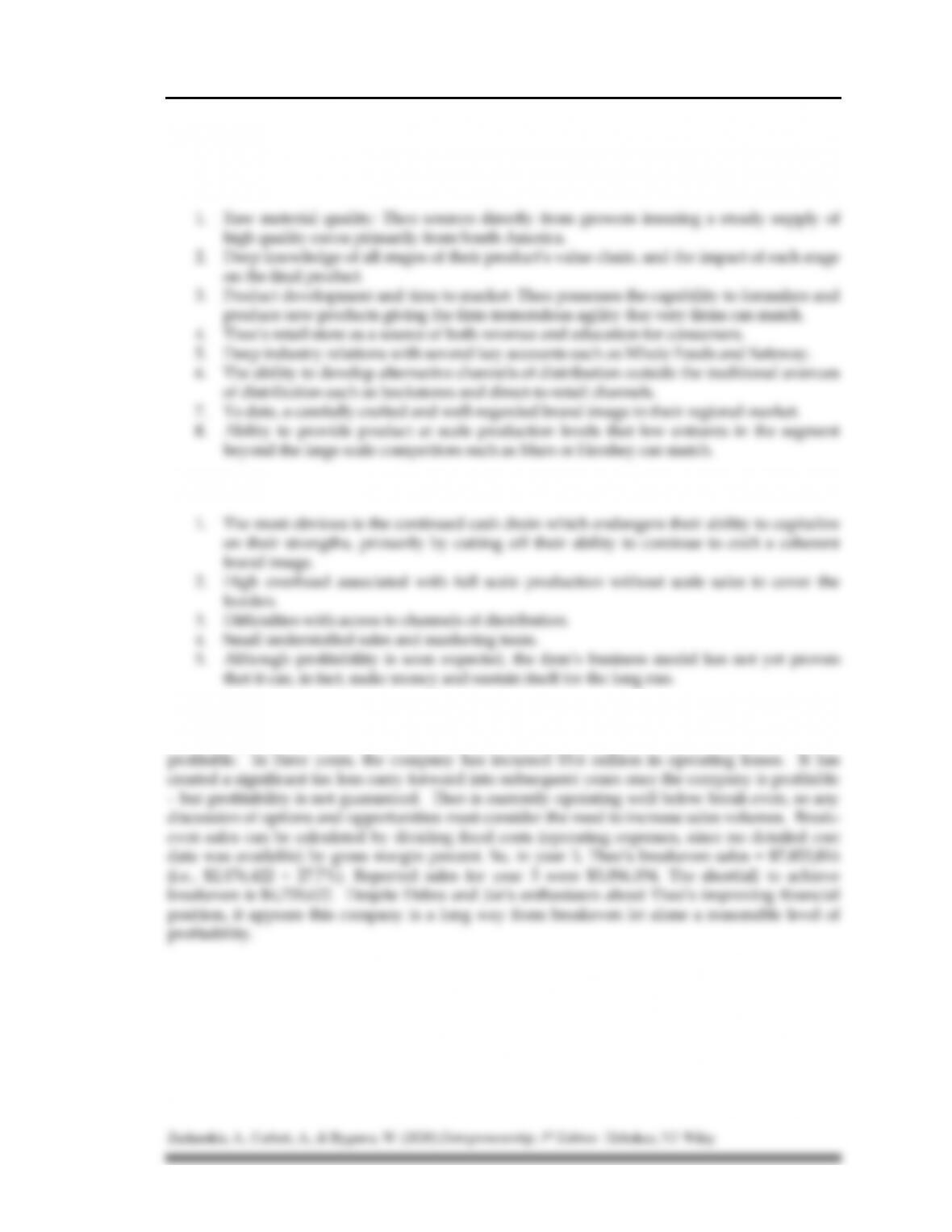
Theo Strengths and Weakness (20 minutes)
Theo Chocolate Teaching Note Sample Copy Do Not Distribute
Joe chose to enter the market in an unusual manner by building the factory in an effort to control
quality from “bean to bar”. Here students need to recognize the trade–offs associated with
greater control of the production end of the value chain versus less expensive modes of market
entry. Theo possesses unique and potentially powerful strengths that can be exploited.
Theo has some weaknesses as well.
The company’s financial situation is its main weakness, and one that should not be glossed over
when analyzing the case; it is central to the issue of what Theo may have to do in order to become
Marketing and Brand Development (Discussion Time: 30 Minutes)
After concluding the discussion of the competitive environment and assessing Theo’s strengths
and weakness, we move into a discussion on their opportunities. Here we concentrate on the
most critical aspects of the case.
1. What is the “meaning” of Theo’s brand? 1
2. What brand image has Debra constructed over the past three years?
3. Is it consistent? Is it sustainable?
Here we challenge students to look at the evidence in the case to begin the process of clearly
articulating what the Theo brand means. We first concentrate on the tangible aspects of the Theo
brand. Starting with the cognitive aspects of brand development allows the instructor to build an
initial concept of the Theo brand around easily identifiable and tangible benefits of the product.
We find that while MBAs are well aware of the general concept of brand, they are less able to
initial articulate the emotional aspects of brand.
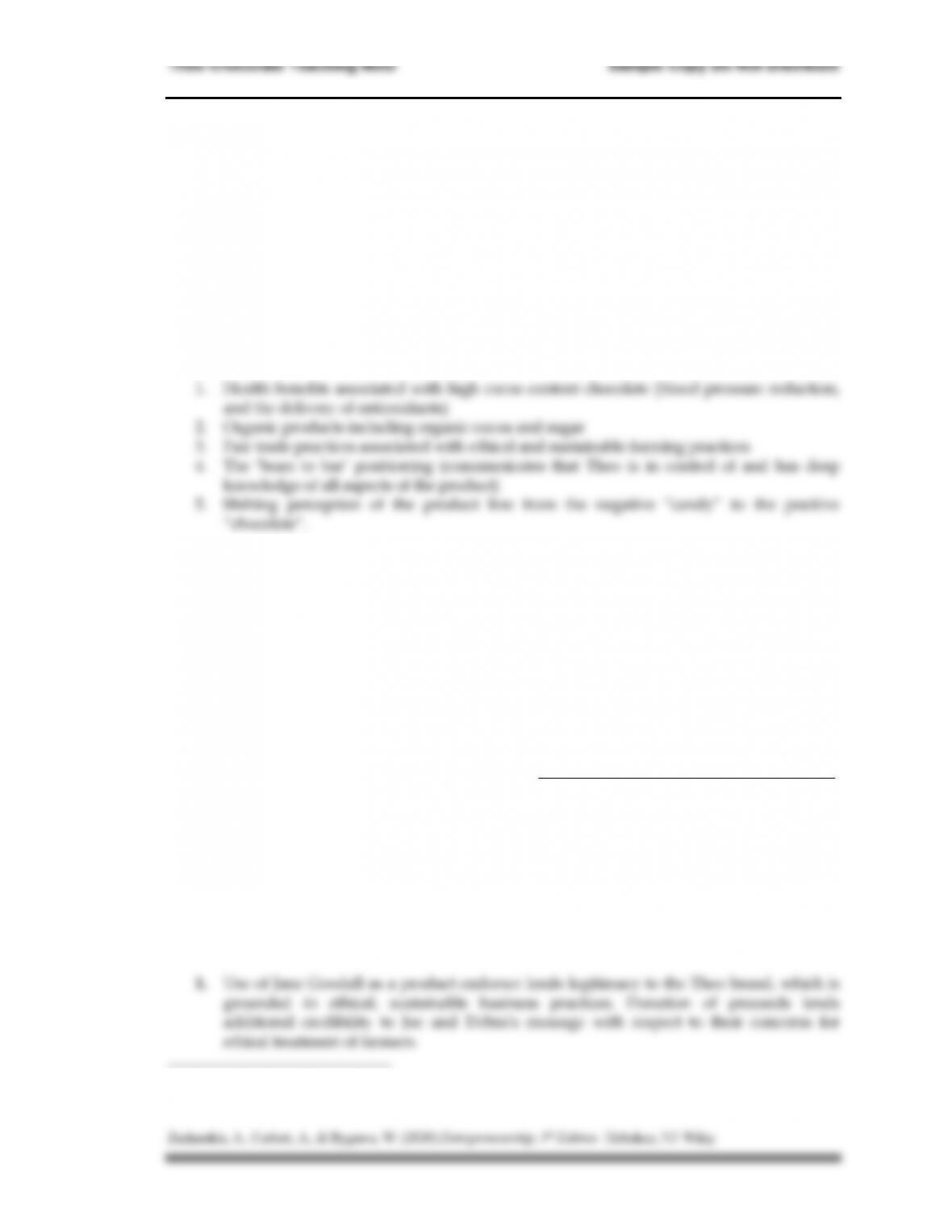
We draw out the following tangible benefits associated with the Theo brand:
Here students may counter that chocolate is indeed a high calorie product, questioning the reality
of the health claims. If it is not brought up by students, the instructor may introduce the
potential inconsistency in creating the brand. Students bring up evidence in the case under the
Large Competitor section that indicates child obesity is an industry issue. This allows the
discussion to expand into the area of Theo’s targeted demographic. Exhibits indicate that Theo’s
SRP is significantly higher than chocolate bars sold by scale producers. The target market for
Theo is an adult with a higher level of both education and income. Children are not their target
market nor do they advertise to children.
What actions has Debra taken to create these tangible benefits?
The intent here is for students to understand that a brand is created and actively managed.
Profitability has in fact been sacrificed thus far in order to build a brand. This is typical of
entrepreneurial ventures, which may run at a loss for a significant period before turning a profit.
Now that profitability is literally around the corner, further developing the meaning of the Theo
brand, and figuring out a way to capitalize on the brand’s strengths is the next big task for the
company. Now that she has built and honed that brand message, Debra must now use that
message to reach an ever–growing base of consumers.
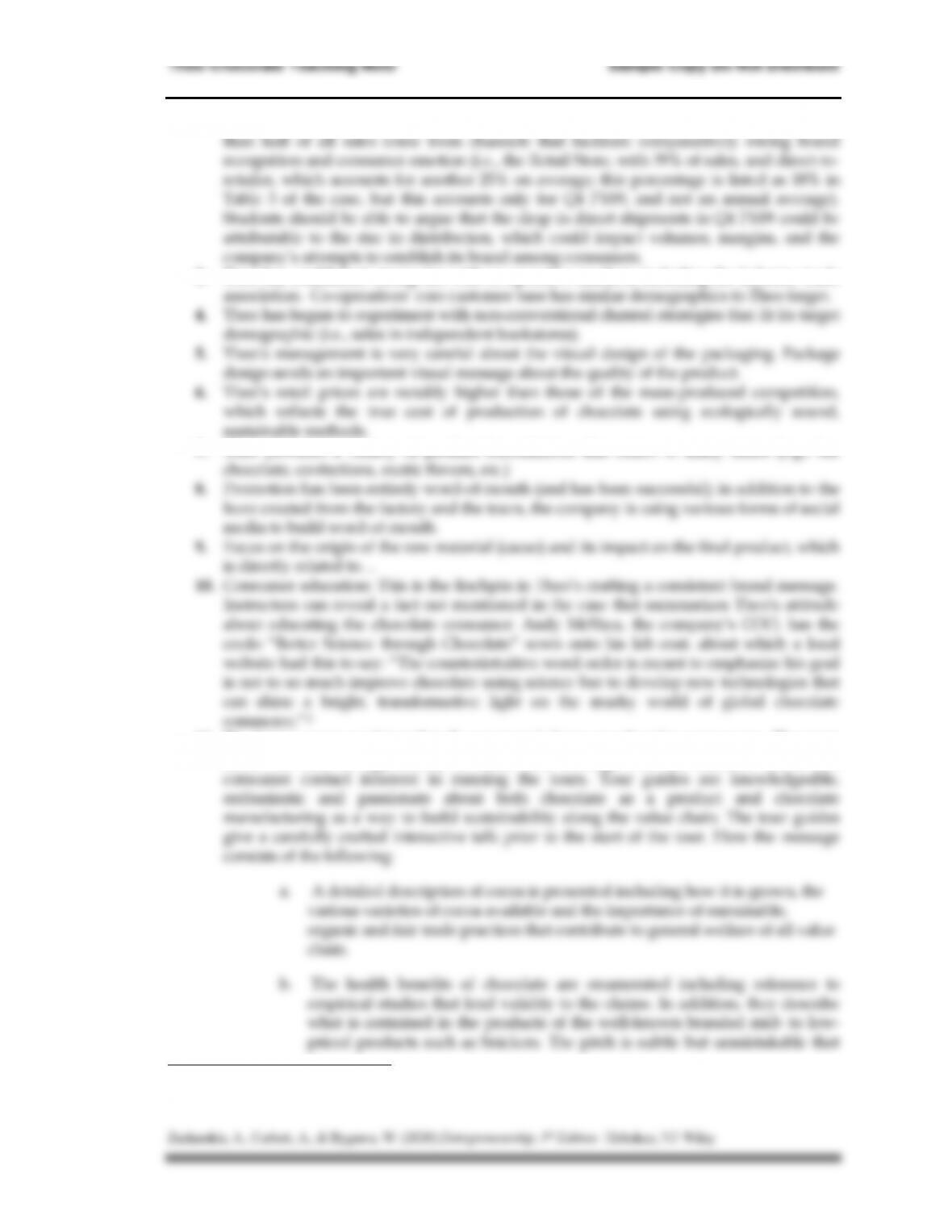
Students should be guided to discuss the impact of the following branding–related tactics that the
company has employed thus far:
1 Understanding Brands, 2006, Keinan, Anat & Avery, Jill Harvard Business School
2. Brand recognition is strong in part because of the company’s channel strategy. More
3. Theo has established strong ties with co–operative markets, including the industry trade
7. Theo provides a variety of product formulations that caters to many tastes (e.g., bar
11. The factory tours are integral to the company’s focus on educating consumers. The tours
afford the firm an opportunity to refine their message with the constant face–to–face
2 Tom Paulson, seattlepi.com, November 19th 2008
Theo Chocolate Teaching Note Sample Copy Do Not Distribute
Zacharakis, A., Corbett, A., & Bygrave, W. (2020) Entrepreneurship, 5th Edition. Hoboken, NJ: Wiley
the quality of the most well known chocolate candy bars is substandard at
best containing little if any health benefits.
c. Most importantly, guides then begin to describe the intangible but equally
important “great indulgence” associated with moderate consumption of high
quality chocolate.
d. The instructor may point out the empirical data contained in the case with
respect to the tours’ effectiveness given the higher product purchased
amounts associated with tour participants. In other words, the brand
message is being effectively communicated by the tour guides.
12. Theo’s location in Seattle (and especially in Fremont) lends additional credence to the
Here we push students to articulate the more subtle but equally important intangible aspects of
the Theo brand. Since the associations here tend to imagery and abstraction, the discussion may
need direction from the instructor.
Students may articulate other intangible aspects of what they perceive as important aspects of the
Theo brand we have not enumerated in this note. Given the idiosyncratic nature of brand
meaning as it develops among recipients of the brand message, perception of Theo brand
intangibles among students may differ.
Distribution and Channel Management
Distribution is one of Theo’s key concerns, and rightly so; more than 60% of its products are sold
outside of its Retail Store. Instructors may wish to spend some time analyzing Theo’s current
distribution practices, as a stage–setter for making a strategic decision about what the company
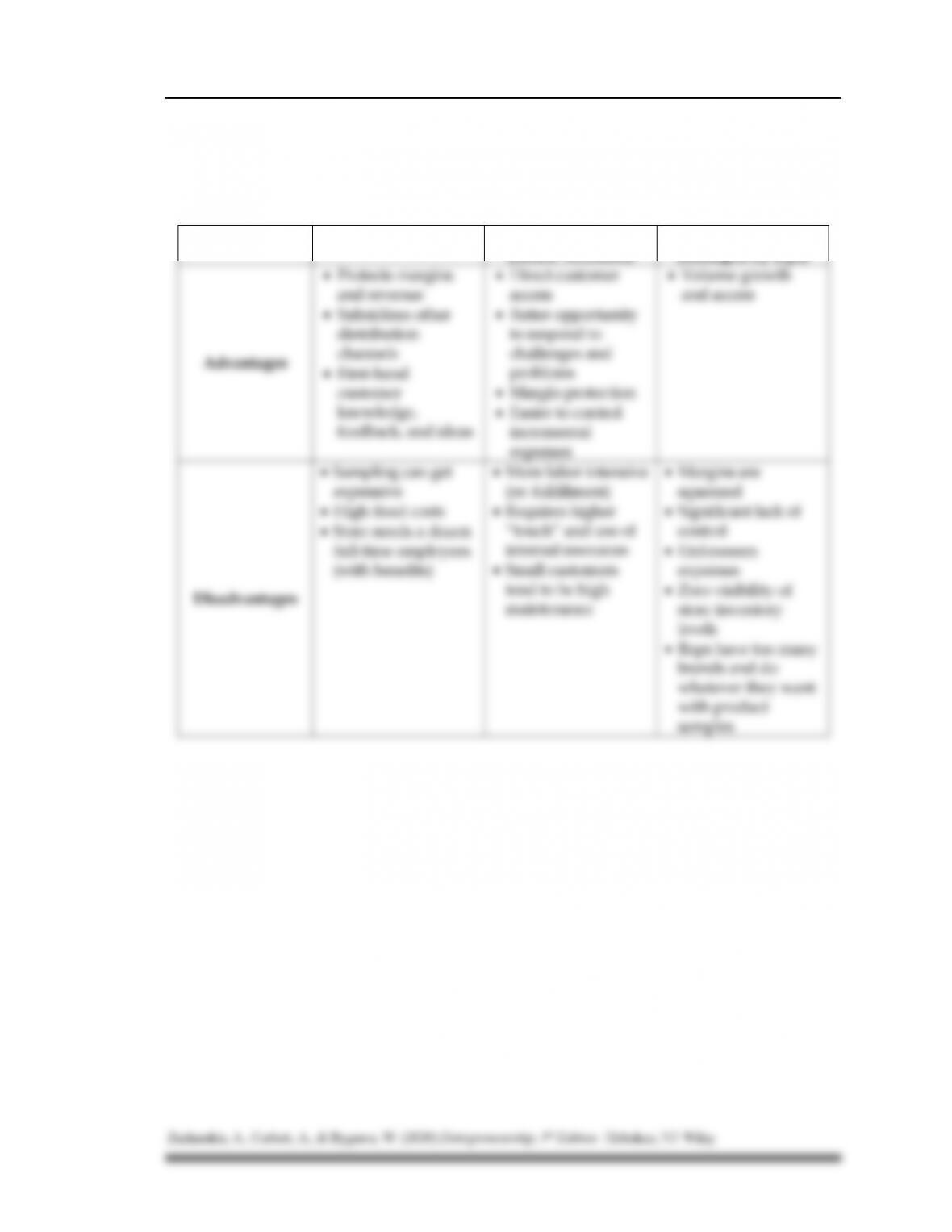
need to do (i.e., the next section). Exhibit TN1 lists Theo’s current key distribution practices and
the advantages and disadvantages of each.
Pricing
Common–sizing the Year 3 income statement will yield the following:
Sales
100.0%
3 Maloni, Michael & Brown, Michael, Corporate Social Responsibility in the Supply Chain: An Application in the
Food Industry, Journal of Business Ethics, 2006 Volume 68, Pages 35–52

Zacharakis, A., Corbett, A., & Bygrave, W. (2020) Entrepreneurship, 5th Edition. Hoboken, NJ: Wiley
COGS
72.3%
Gross Margin
27.7%
Sales & Marketing
35.4%
General & Administrative
34.9%
Operating Loss
–42.6%
Excluding the gross margin, the costs add to 100% (i.e., 72.3% + 35.4% + 34.9% – 42.6% = 100.0%).
Theo is selling its chocolate bars for $4.00 apiece (see Case Table 5). The case states that COGS of
a bar is between $1.20 and $1.25. However, more astute students will see that cost of goods sold
is actually $2.89 (i.e., $4.00 x [1 – 27.7% = 72.3%]) = $2.89), gross margin = $1.11, sales & marketing
= $1.42, general & administrative = $1.39, and operating loss = –$1.70 (i.e., $4.00 x – 42.6% = –
$1.70). Thus, in Year 3, Theo lost $1.70 on every bar it sold. According to Table 5 on page 15,
Cadbury sells its comparable 3-ounce bar for $3.69/bar. In Year 3, Theo sold 774,049 bars (i.e.,
sales of $3,096,194 ÷ $4.00/bar = $774,049). At $4.00/bar, Theo would have to sell 1,963,954 bars
to reach breakeven (i.e., $7,855,816 ÷ $4.00/bar = 1,963,954 bars). Theo would have to sell its bars
for at least $5.70/bar to breakeven (i.e., cost of goods sold = $2.89 + sales & marketing = $1.42 +
general & administrative = $1.39 = $5.70/bar). Again, Cadbury sells its comparable 3–ounce bar
for $3.69/bar. The foregoing analysis assumes there were no additional cash costs (e.g., interest,
principal, etc.), which is unlikely. To the extent these costs exist, Theo would have to raise its
price to breakeven. As a result, Theo’s breakeven is probably close to $6.00/bar. This, again, has
major implications for the main strategic decision facing Debra and Theo Chocolate.
Theo’s Options (20 minutes)
This section students may find challenging. We suggest as time permits that the instructor link
Theo’s firm level value proposition to the brand level proposition. Theo’s firm level value
proposition while generally consistent has suffered some minor inconsistencies due to Joe and
Debra’s pressure to bring in additional sales. Private label, while filling capacity, brings at least
some risk by introducing quality / cost issues as they produce high per unit cost products at
relatively low revenue per unit sales. Pressure on margins is considerable when producing for
private label.
At the brand level however, the Theo message has been consistent since day one. Students
should recognize the hallmark of sound brand management is consistency of message over time.
Debra and Joe have done an excellent job weaving into the brand message the classic appeal to
quality and health with the more subjective messages of chocolate as an individual indulgence
and fair trade practices as a social responsibility. Education of consumers about the health
benefits of chocolate, and of the impact of production methods and sustainable practices, on the
taste, quality and price of the product, remains a central focus for the company as it grows.
Theo’s challenge here is figuring out how it will ensure the consistency of this message as it
grows – and indeed, how they will push that message out past its local sphere of influence (and
of course, how that will be financed).
The real question facing Joe and Debra now that they have carefully crafted a message about their
brand that resonates with consumers locally is; how do we reach beyond our local market place
in the face of capital constraints? (In 2008, the firm was running at 33% capacity, and Andy
McShea estimated that capacity limitations would become very relevant in 2011.)

Theo Chocolate Teaching Note Sample Copy Do Not Distribute
Here we suggest that there is no magic bullet. Brand management for Theo will continue to be a
challenge as they try in various ways to get the message out to a large population. Absent
advertising funds, they will continue to use creative but inexpensive methods to reach the target
consumer. Here students may question the viability of communicating messages via social media
outlets such as Twitter or Facebook. Inherent in brand development is creating the all–important
“willingness to pay”. Implicit in creating WTP is the creation of barriers to entry for competitors
seeking share of the same market space. Given that the barriers to entry into the social media
spaces are near to zero, we question the long term viability of using the “cash strapped” method.
An alternative that Joe has consistently been unwilling to explore has been market expansion via
firm–owned retail. Astute students will recognize the following from the data: Approximately
40% of sales come from the retail store or $2.8 million. The case also indicated distribution can
typically claim between 40% and 45% of the SRP. The retail price of a typical Theo bar was about
$4; Single Origin bars were about 25% more expensive, while the smaller 3400 Phinney bars sold
for between $3 and $3.50 each. There was no significant difference in COGS among the bars, but
where and how a bar was sold had a large impact on Theo’s bottom line. Distribution and direct–
to–retail costs, including discounts and chargebacks, could run as much as 50% of the price of a
bar (although they typically accounted for 40%–45%). Students should be able to deduce that a
retail/distributor SRP could be between $1.60 (Phinney bars sold through distributors) and $2.20
(direct–to–retail). Theo realized per unit revenue of $2.10 on a $3.50 bar or $1.40 per unit. This is a
key consideration if students are going to be asked to estimate the financial impact of their
choices of action. We have found that many students will in fact fixate on the average retail price
of a Theo chocolate bar (around $4), and will neglect that going through distributors for growth
will necessitate a much lower per–bar revenue number for the company.
While we do not provide exact product margins, the case does indicate the store operates with 10
employees. Most are part–time so wages and benefits are reasonable. Using an approximation of
$15k or an annual $150k cost, Theo needs to sell about 105K bars to cover this burden or about
420 bars per day (250 days). Once past breakeven, profits rise rapidly absent distribution costs,
sales charge backs and shrinkage in transit.
The store and tours are in most cases oversubscribed which suggests demand is not an issue. In
addition, we did not factor in tour charges which although low are an additional revenue source.
Control of the retail experience allows Joe and Debra complete control over the brand message.
Joe’s counter claim to the financial logic of retail is that without the factory a retail store is not
sustainable (see next paragraph). Debra has pushed Joe to consider additional retail without
success.
Students may invariably recommend that Theo attempt to replicate its store in other cities and
locations in order to duplicate the revenue the store achieves. 40% of total sales is nothing to
scoff at. However, the instructor should be ready to counter this recommendation with the
question “what is driving this 40% of sales?” The answer is, of course, the factory tour (to a large
degree) – meaning that if Theo wants to duplicate the revenues from its retail store, it would need
to build a factory and offer tours at each store location. The challenges involved in significant
fixed plant investments – especially for a small entrepreneurial venture – have been discussed as
part of this note. If students recommend this course of action, instructors should be prepared to
challenge them with the aforementioned facts, with the question “can Theo in fact replicate the
retail store experience – and revenues – in other locations?”

Theo Chocolate Teaching Note Sample Copy Do Not Distribute
Students may also disregard the very important B2B channels that will be vital to Theo’s growth
in the future, and instructors need to be watchful for this tendency to focus on the more–visible
direct–to–consumer channels. As stated before, the margins of a distributor strategy are
challenging, and students should be made to account for the reduction in margin that will come
from a pursuit of this strategy. Instructors would do well to bring up a point made by Debra
Music in our research, but one that is not included in the case; that, in general and in her opinion,
“grocery distribution is dysfunctional” – meaning that it does not easily lend itself to the
development of a brand. Distributors are not interested in whether you want to build a brand;
they are focused on volume, and as such focus on already–established brands. Grocery chains
contract with one or a few distributors, who take on all of the transportation burden on behalf of
the chain.
Strategy and Corporate Social Responsibility and Epilogue (30 minutes)
Instructors are encouraged to anchor the discussion of Theo’s brand development in the larger
context of corporate social responsibility. Here we would expect a wide range of thoughts and
opinions on the efficacy, necessity and responsibility of firms to engage in socially responsible
behavior4. (The referenced journal article by Garriga and Domenec categories and summarizes the
various theories on CSR. Instructors can gain general insights into the theories and approaches various
disciplines have proposed on CSR. If the instructor wishes to explore an alternative set of theories to
anchor the discussion, we suggest Resource Dependence Theory for a power dependence perspective and
Institutional Theory for a normative perspective.) There is ample information in the case for a
foundation of a discussion on what it will take for a company to challenge the status–quo of an
established industry with more stakeholder–centric, CSR–focused strategies.
Instructors can direct students to http://www.youtube.com/watch?v=IQUaUirxnwo, or show it
in the class. The 21–minute video showcases both Joe and Debra at a TEDx event – they speak
about the birth of and reason for Theo Chocolate. TED (short for Technology, Entertainment,
Design) is a U.S. private non–profit foundation that is best known for its conferences, held in the
U.S., Europe and Asia, which devoted to what it calls “ideas worth spreading”. In that spirit,
TEDx is a program of local, self–organized events that bring people together to share a TED–like
experience. At a TEDx event, TEDTalks video and live speakers combine to spark deep
discussion and connection in a small group. These local, self–organized events are branded
TEDx, where x = independently organized TED event.
Epilogue
In the fourth calendar quarter of 2009, Theo had its best quarter to date. Net sales exceeded
$1.4M and – despite a rocky economy – posted 47% growth over the same quarter a year before.
With larger volume to cover fixed costs, the company’s gross margins exceeded 40% (its highest
ever). Also, operating expenses as a percentage of sales fell to lowest level ever. EBITDA was
positive for the first time; however, there was still a small net loss (approaching breakeven).
While not yet profitable on a true GAAP “P&L” basis, this quarter was important because it
validated that Theo could and should be a profitable business. The missing piece is sales volume
4 Garriga, E and Mele, Domenec, Corporate Social Responsibility Theories: Mapping the Territory, Journal of Business

Theo Chocolate Teaching Note Sample Copy Do Not Distribute
and – given the Theo’s continuing sales growth – achieving profitable sales volume is close at
hand.
As we conclude the case writing, Joe and Debra continue to struggle to gain the widespread
distribution and brand recognition necessary to achieve scale production. Debra’s main concern
has shifted to finding ways to ensure that profitability is maintained for the long term – which of
course is the main focus of this case.
By early 2010, Debra had made some additional brand management decisions that might be
interesting to students.
• Realizing that the name ‘3400 Phinney’ was creating brand confusion among customers –
who had no idea that those bars were in fact Theo Chocolate products – the company
retired the 3400 Phinney name and called the bars ‘Fantasy Flavors’. Debra concedes
that “we were overly ambitious launching two brands at once”.
• The Costco–branded product never materialized. Costco determined that Theo was too
small with respect to capital equipment to do what it wanted, and Theo was unwilling to
invest in any additional capital equipment (i.e., add to its capacity and fixed costs).
• Theo hired more brokers to expend its reach into the Midwest, southwest and southern
regions of the U.S.
• Emphasis has been placed on social media customer interaction – Facebook, Twitter, and
blogs. The company spends money on reaching and sends product to bloggers for
product reviews ($40K annual sampling total cost). Theo has not engaged in consumer–
facing, deliberate (i.e., traditional) advertising.
• Brand Ambassadors have become more important to the company’s outreach. Brand
Ambassadors are paid to research, organize, and carry out events in various cities where
Theo may be showcased. These include (but are not limited to) chocolate and wine
pairings, sampling at Whole Foods and other retailers, and participation in “green”
festivals.
Theo Chocolate Teaching Note Sample Copy Do Not Distribute
Teaching Note Exhibit 1
Analysis of Distribution Options
Retail Store
Direct Distribution
(House Accounts)
Distributors
(managed by reps)
• Protects margins
and revenue
• Subsidizes other
distribution
channels
• Direct customer
access
• Better opportunity
to respond to
challenges and
• Volume growth
and access