
TEACHING NOTE
VEDAVOO
Synopsis
The Vedavoo Case tells a story about Scott Hunter, a driven entrepreneur, who is passionate
about fly fishing and the great outdoors. The case follows Scott as he develops his opportunity,
resources, and team to build a potentially scalable enterprise in a competitive field of outdoor
adventure sports accessories (backpacks and customized bags for climbing, fly fishing, and a
variety of outdoor experiences). After several frustrating attempts to find manufacturers that
could make the intricately designed Vedavoo sling pack product, Scott heeds Yvon Chouinard’s
(founder and CEO of Patagonia) advice to learn all aspects of the business by learning how to do
everything himself, including the making of the product, in order to learn all of the ins and outs
of each business process of the product and venture. Ultimately, Scott undergoes many of the
tests facing an entrepreneur attempting to build a new venture: building a line of products with
unique characteristics that customers value, building a team and strong culture to operate
effectively, and finding resources to define and grow the venture throughout the startup and early
growth process.
Use in Class
Scott Hunter is on a journey to find out if he has the characteristics to be a successful
entrepreneur. At points during the class, students will find themselves imagining what it is like to
be in the entrepreneur’s shoes, facing the challenges that Scott faces. Would the students persist,
endure, and believe in their own ideas strongly enough to find and shape an opportunity for a
venture as challenges arise?
Throughout Scott’s journey in becoming an entrepreneur, Scott’s personal attributes and values
are put to the entrepreneurial test. The case develops as Scott’s abilities to design, build, and
garner a team to produce a high–quality product that customers will love adapt to meet each
hurdle as he shapes his opportunity into a going-concern business.
This case can be used at both the undergrad and MBA level. It is focused primarily on
identifying personal characteristics of the entrepreneur as well as describing the entrepreneurial
process of identifying an opportunity, team, and resources to create and grow a successful startup
venture. The case can be used in a foundation entrepreneurship, new venture creation, or social
entrepreneurship course.
Class Teaching Plan
1. ASK THE STUDENTS WHAT ENTREPRENEURIAL CHARACTERISTICS SCOTT
HAS THAT HAS LED TO SCOTT’S DECISION TO START A VENTURE
a. Personal Attributes
i. Scott identifies, articulates, and lives his values.
Zacharakis, A., Corbett, A., & Bygrave, W. (2020) Entrepreneurship, 5th Edition. Hoboken, NJ: Wiley.
organization (project/account management developing wireless
communications systems in an oil company). In other words, Scott has
career options but chooses to try to start a new venture.
b. Strong Values
i. The need to find “personal value” in his work led Scott to leave a good job
post college to pursue his dream of creating a product for outdoor
vi. AUTHENTICITY
1. Even Yvon Chouinard recognized Scott’s authentic interest in
creating the best equipment for an outdoor sport. Chouinard
c. Triggering event?
i. Scott grew up fishing in Wyoming. His love of the outdoors led to his
interest in sports that celebrate human/nature interactions.
d. Characteristics – Refer to Figure 2.2 “The 10 Ds – The most important
characteristics of a successful entrepreneur.”
i. Ask the students if they think Scott has many of the “10 Ds:” Ability to
Zacharakis, A., Corbett, A., & Bygrave, W. (2020) Entrepreneurship, 5th Edition. Hoboken, NJ: Wiley.
tirelessly, Devotion and loving what he does, attention to Details, desiring
control of his own Destiny, and that the reward for Scott is more about
being successful than making dollars. He believes that pursuing success
through excellent products and the processes he builds into the venture
will bring economic reward, i.e., Dollars, and Distributes ownership of
businesses with key employees.
ii. Scott is driven by his passion, creating opportunities for Vedavoo,
customers, and employees.
2. HAVE THE CLASS EXPLORE SCOTT’S ENTREPRENEURIAL PROCESS
a. What business functions did he initially create? What are the important aspects of
these functions?
i. Scott initially does everything himself.
b. How is Scott building a brand that differentiates in the crowded backpack market?
i. “Building with your own hands” as Yvon Chouinard advises Scott to do,
c. Manufacturing Vedavoo Products
i. Scott invests time and money in trying to find a manufacturer for his
iii. It is important to Scott that the products be customizable for customers,
i.e., that each customer participates in choosing his/her product build.
iv. Scott found a potential supplier in California although the manufacturing
process would take place in China.
1. Manufacturing with this vendor would mean giving up on value of
Zacharakis, A., Corbett, A., & Bygrave, W. (2020) Entrepreneurship, 5th Edition. Hoboken, NJ: Wiley.
2. The firm took his design and possibly reverse engineered the
product through their suppliers in China and never contacted Scott
again.
vii. Return to Self-Reliance & Finding a Niche
1. “Learn to Sew” – Yvon’s words ring true. Scott concludes that
“Learning to Sew” and producing in-house is his best option to
create the high quality, best performance bags and backpacks he
desires to make.
a. Learning to make
i. Scott decides to take up the challenge of learning
how to make his own products.
ii. Scott becomes highly resourceful. Scott buys a
sewing machine, and with supplies from used
backpacks, e.g., Goodwill, paper bags for patterns,
Scott begins making his backpacks.
iii. Scott realizes what the intricacies are in making his
high-performance products, e.g., what a precise
curved line in design meant for how the backpack
would have to be made. Design developments
essential to Vedavoo’s products necessitate careful
design of the processes used to make the products.
iv. By building and make his own products, Scott
finally achieves his own patterns, prototypes, and
designs.
v. By making in-house, Scott can now offer
customizable products – products can be altered
during the making process to be precisely what a
customer wants.
d. Attends Trade Show 2 – Outdoor Retailer Show 2011 & International Fly Tackle
Dealer Show
i. Outdoor Retailer Show 2011
1. One lone observer is excited about Scott’s own Sling Pack – made
by Scott for himself that was hanging on the back wall of Scott’s
Zacharakis, A., Corbett, A., & Bygrave, W. (2020) Entrepreneurship, 5th Edition. Hoboken, NJ: Wiley.
i. What functions and activities did Scott not focus on that students feel he
should have?
ii. Was Scott’s somewhat painful learning journey necessary?
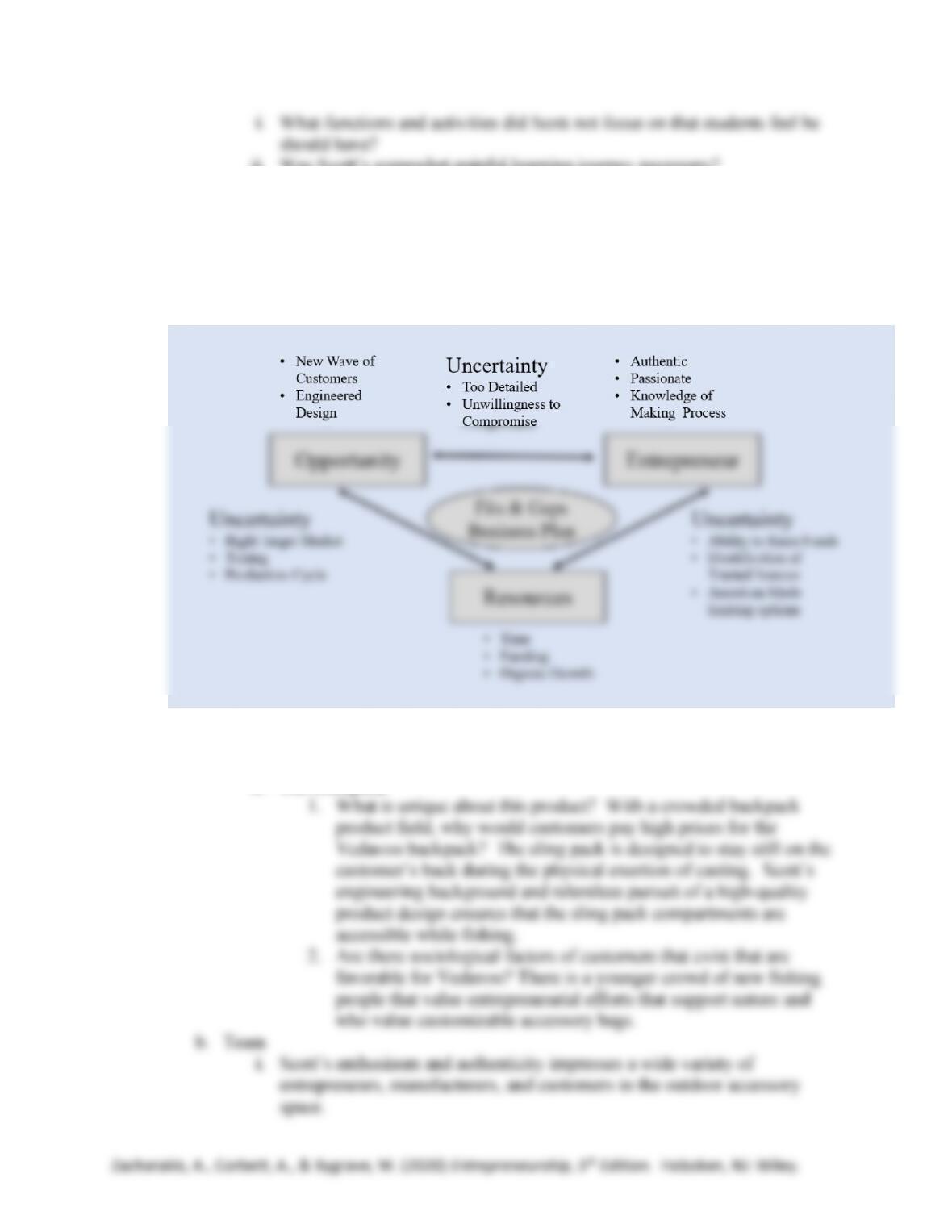
3. DRAWING THE THREE DRIVING FORCES/TIMMONS MODEL FOR VEDAVOO
Use of the “Three Driving Forces based on Jeffrey Timmons framework” may be useful
in discussing the dynamics of building Vedavoo.
a. Opportunity
i. Ask the students why Vedavoo products might succeed/fail?
ii. The Backpack
ii. Scott builds a retail network that can enthusiastically sell his products. He
decides to create a wait list of retailers rather than increase his in-house
services (not in case).
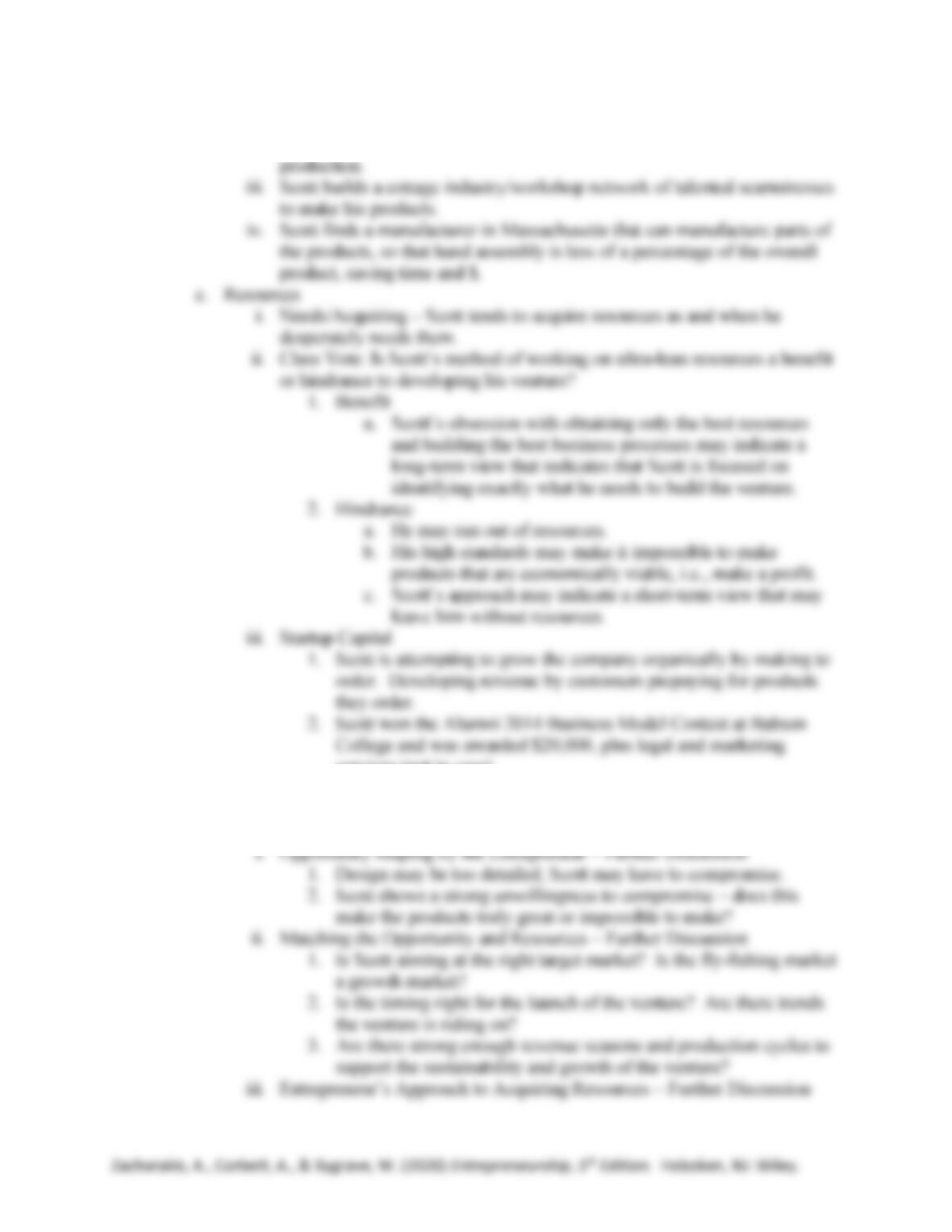
3. Debt/Equity – Scott’s Rules for organic growth meant that he
would not acquire debt.
d. Uncertainties & Risks
Zacharakis, A., Corbett, A., & Bygrave, W. (2020) Entrepreneurship, 5th Edition. Hoboken, NJ: Wiley.
1. Does Scott have the ability to raise funds if needed?
2. Is the revenue from prepaid orders enough to support the business?
3. Can Scott find and engage trusted business partners in production?
4. Are Scott’s values supporting or weighing down the growth of the
venture, e.g., is holding to the American Made value
helping/hurting the venture?
4. ADDITIONAL DISCUSSION POINTS FOR CLASS
a. How do Vedavoo’s products and Scott’s leadership as well as the culture he is
building appeal to the customer in a unique way?
b. Is the appeal to the customer strong enough to create revenue to support a going
concern venture and position Vedavoo for growth?
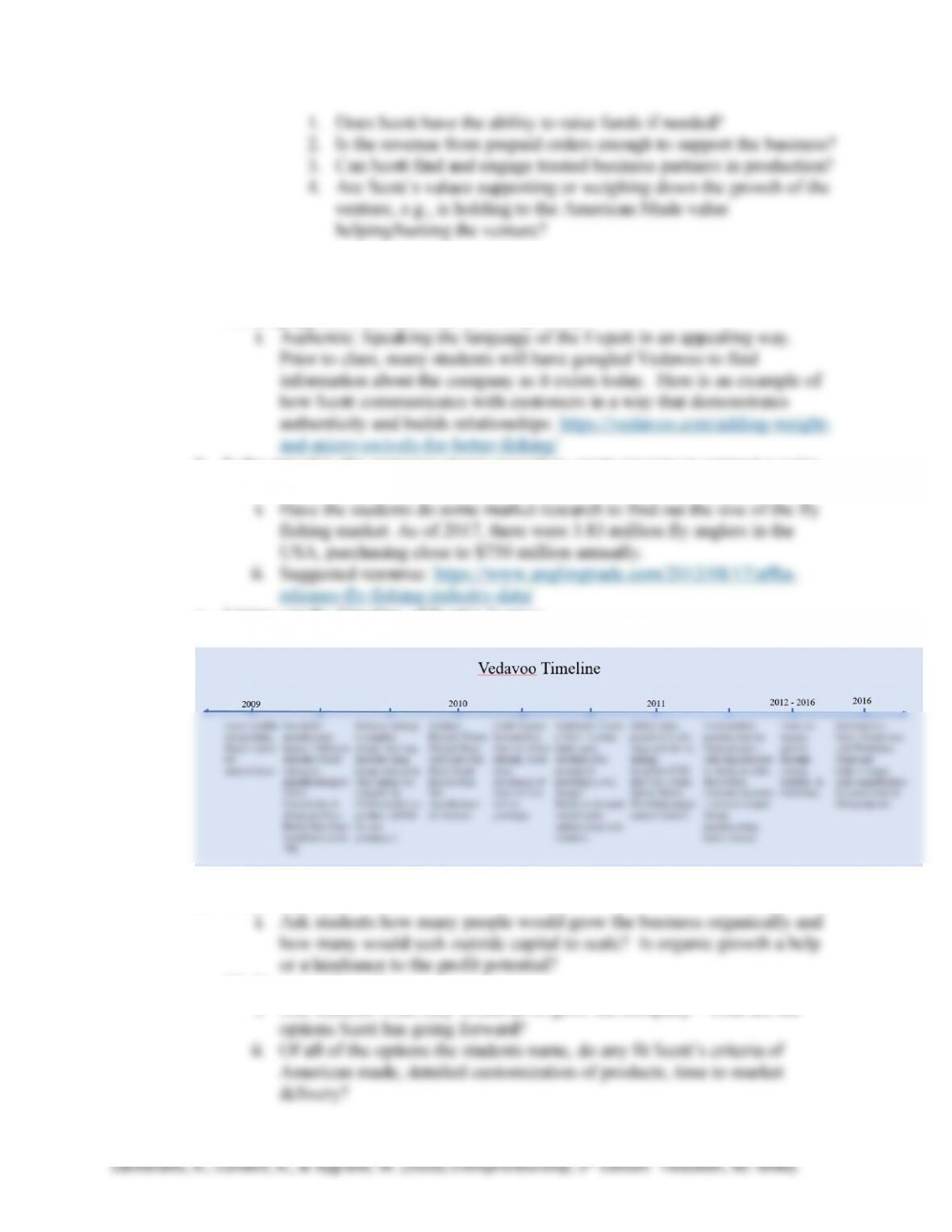
c. Listing out the Timeline of Scott’s Journey
d. Profit Potential
e. Challenges to Growth
i. Ask students what they would do to grow the company – what are the

Zacharakis, A., Corbett, A., & Bygrave, W. (2020) Entrepreneurship, 5th Edition. Hoboken, NJ: Wiley.
iii. Not mentioned in case – 2014 Scott won the Babson BETA contest –
$20,000. One of the judges described one of the reasons Vedavoo won;
they knew he would stretch every penny as far as it would go. Scott’s
answers to the Competition Judge’s questions illustrated that Scott was
one of the most resourceful entrepreneurs he had ever seen.