
InnerCity Weightlifting Teaching Note
Mary Gale and Andrew Zacharakis
Case Summary
Jon Feinman founded InnerCity Weightlifting (ICW) in 2010 to improve the lives of young, active,
urban gang members in the Boston area. He conceived of this venture after college when he began
to apply his skills as a college soccer player and certified weight trainer to work with disadvantaged
K-8 students in the AmeriCorps program, Athletes in Service in America. He was drawn to a
subgroup in the AmeriCorps program which most of his fellow counselors avoided and warned him
away from, young MS-13 gang members who were considered too dangerous and unwilling to
change. After earning their trust by teaching them soccer skills, Jon developed a relationship with
this group, shattering his preconceptions of their motivations and needs.
Jon began to develop a plan to devote his life’s work to bringing hope and opportunity to the group
of young inner-city men identified as most likely to kill or be killed. He began his prototype
operation in Boston. The vehicle was a free gym in the inner city where “student trainees” could
begin to develop formal weightlifting training skills as a means to a new livelihood, experience a
more positive community of mentors and peers, and through paid weight training sessions for
clients (typically white and wealthy), form a bridge between two very different socioeconomic
groups.
Publicity, notably through an ESPN video feature in 2012, created national and international
awareness and demand for ICW gyms in different cities. Jon wanted to satisfy this demand, but he
understood that his high-touch, locally focused, carefully managed program could not be exported
quickly or formulaically without significant risk of failure and reputation damage. At the time of the
case, Jon had carefully added a second, successful gym whose location straddled prosperous and
dangerous neighborhoods in Cambridge, Massachusetts. He had also launched a corporate training
program and begun to build out his organization and fundraising to support growth. Seven years
after founding ICW, Jon is now ready to contemplate expansion to his first new city, Philadelphia.

Nature of the Case
All information contained within this case, including names and company financial data, is factual
and has not been altered. All data for this case was obtained between July and August, 2017, via
personal interviews with board members, managers, employees, and student trainers involved with
ICW.
The case fits well within graduate or undergraduate business courses focused on decision-making,
growth, and social entrepreneurship.
Teaching Objective
• Primary Lesson: Challenges of scaling social ventures that address “wicked problems”
• Secondary Lessons: Understanding the advantages and disadvantages of a nonprofit;
anatomy of a ground-breaking venture that challenges and overcomes prevailing stereotypes
(of customers, beneficiaries, and business models); power of an alternative “educational”
lifeline that doesn’t force pace of change, choices, or expected outcomes; dependence on
leadership where nuance and local sensitivity represent a fragile, fine line between success
and failure; need to focus on multiple stakeholders who initially have little in common.
Learning Objectives
• Understanding the complexity of social change where the solutions seem intractable
• Making a risky recommendation for a bold, new step
• Understanding the social and business impacts of rolling out this model
• Understanding the need for careful stakeholder identification and management
• Understanding the difficulty of financial sustainability for a nonprofit
Teaching Strategy
• Introduction
o A great way to introduce students to ICW is to play a clip of the ESPN video
“Redefining Strength” https://www.youtube.com/watch?v=FEtI6QCmS-4. The clip is
13 minutes long.

o You can also refer students to the ICW Facebook page if they want to learn more
and see other video clips.
o Finally, the authors have created a video during interviews with various stakeholders.
Segments show a student or student-now-employee extolling the virtues of ICW.
o After the ESPN video, ask students to reflect on what they’ve seen. Most have not
experienced gang life and violence. Most have not grown up in poverty with limited
life choices. The video is very powerful, and students will likely see the value of ICW
and what an impact it can have on its students.
o This can lead to a discussion on social entrepreneurship. Ask the students how social
entrepreneurship differs from economically oriented entrepreneurship with
companies such as Uber. How is it similar?
The discussion will focus on the entrepreneur creating something that offers
value to customers. Whereas Uber creates economic returns for its founders,
ICW creates social returns. Both companies have identified a problem/need
and then developed a business to help customers solve that need.
Provide a definition of a social enterprise. This is not easy, since there is no
general agreement – and quite a bit of disagreement – about the definition.
We take a simple view: Social entrepreneurship involves using business
strategies and a sustainable financial model to solve human and
environmental problems. In this definition, social ventures can be nonprofit
or for–profit, as long as they are driven by a social mission. For more
information about the definition debate, you might wish to study and assign
one or more of these readings:
• Martin, Roger L., and Sally Osberg, “Social Entrepreneurship: The
Case for Definition,” Stanford Social Innovation Review, Spring 2007: 28–
39.
• Neck, Heidi, Candida Brush, and Elaine Allen, (2009_ The landscape
of social entrepreneurship, Business Horizons, 52(1): 13–19.
• Ramus, Tommaso, and Antonino Vaccaro, “Blurring the Boundaries
Between For Profit and Nonprofit Organizations: The Social
Enterprises’ Model.” Background Note, April 10, 2012, Harvard
Business Publishing. Source: IESE Business School, Barcelona, Spain.
o Ask students to identify ICW’s business model. Again, a comparison to a company
like Uber can help draw out its distinct differences.

o Customers – for ICW, its primary customer is the 1% of gang members most likely
to kill or be killed. It has a secondary customer, upper-middle and upper class clients
who want personal training. Like Uber, it is a double-sided platform. Uber customers
are people seeking a ride and people willing to provide that ride.
o Revenue Model – whereas Uber and most economically driven companies earn
money by having customers pay for service, social enterprises like ICW often have
more complex revenue models:
Donations
Client payment for training
Corporate wellness events
o Thus, we might count a third customer for ICW. Individuals, foundations, and
corporations that believe in its social mission and donate to support its efforts.
o The above discussion leads to the following questions:
Should ICW be a nonprofit or for-profit business? What are the advantages
and disadvantages?
You may want to assign an article that talks the pros and cons of for-profit
and nonprofit social enterprises. This is an article written by a social
entrepreneur with experience in both forms:
Chen, J. (2013) Should Your Business Be Nonprofit or For-Profit? Harvard
Business Review Online. https://hbr.org/2013/02/should–your–business–be–
nonpro. Retrieved March 6, 2018.
• Once we understand ICW, have the students think about the entrepreneur. What are Jon’s
motivations for starting and running ICW? What personal characteristics help him in this
effort?
o What were his initial goals? How have they changed? What do you think of Jon’s
strategy of a gym?
This question will lead to a discussion on how ventures evolve over time, as
entrepreneurs learn from “acting” and adjust to fit their customers. The key
Zacharakis, A., Corbett, A., & Bygrave, W. (2020) Entrepreneurship, 5th Edition. Hoboken, NJ: Wiley
misguided. He had to LISTEN to his customers to build a business that
solved their problems.
o Is Jon the right leader? What are the leadership factors needed for success in social
entrepreneurship? For ICW? Does he meet them? Where is he short?
Students will likely admire Jon and what he has accomplished. It may be
Clearly, Jon has demonstrated strong leadership in building a venture and
o Has he changed during his seven years as founder and leader? How?
This relates to the question above, but note how he has evolved. He has
• Have the students dig deeper into ICW’s process. What do you think about his view of the
“four stages: Trust, Hope, Social Capital, Opportunity?” Are these just buzzwords, or do
they work in practice?
o Most students will say that the stages are right. Push students to justify their answer.
Why is this the order? Are there other stages that should be included?
o In the end, these seem like the appropriate stages. Point out that a program which is
simple to articulate is important. While there are many steps within each stage, the

four-stage framework can be easily communicated and taught. This will be critically
important as ICW looks to grow beyond Boston.
• Is ICW a strong solution for inner-city gang violence? Why or why not?
o Take a vote on whether it is a good solution.
o Idealistic students will likely say yes, and they can point to data that shows strong
impact metrics.
o However, there are plenty of issues with this solution. Jon may have built a venture
that is too “Jon-centric,” one that “only he can lead.” For ICW to be truly successful,
this model needs to be replicated beyond Boston so that it can accomplish its
mission.
o Since ICW has not expanded to new cities, there are many unknowns about the
transferability and success of the concept. This may be a good time to ask if anyone
knows of differences between Boston and other potential rollout cities. At this
juncture, you could ask students to pull out their computers, and in teams, do five
minutes of online research on gang violence in Chicago, Los Angeles, and New
York, looking for similarities and differences compared to Boston. They can report
out to the class.
o Make a chart of stakeholders for ICW. Who are in which quadrant? How easy or
hard to win them over? How should ICW do this? How should ICW maintain the
relationships over time?
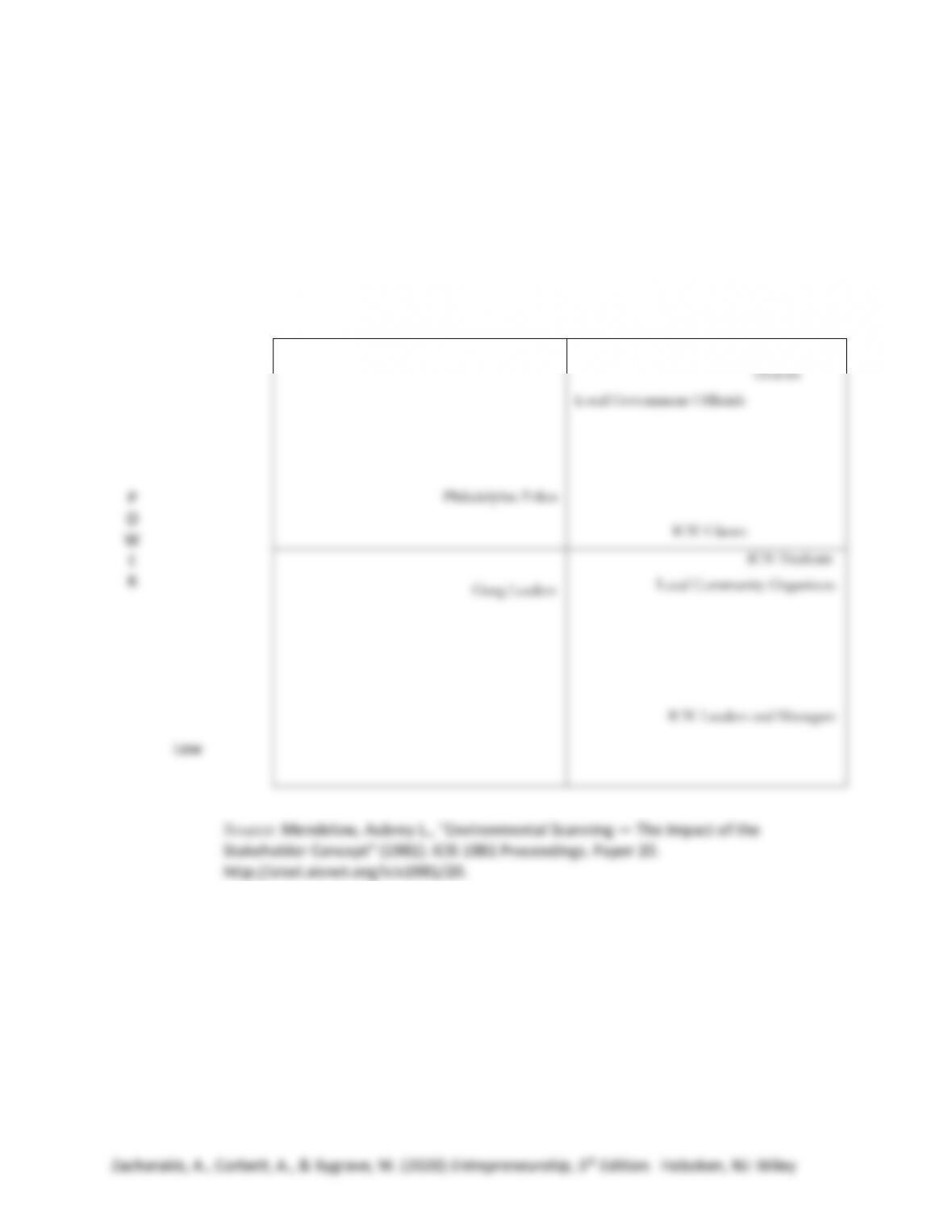
Mendelow’s Power–Interest matrix is an easily applied tool that students can use to
categorize different stakeholders on two axes: interest in the company and power
over the company. Once categorized, students can decide how the company should
manage each of the stakeholders.
LEVEL OF INTEREST
Low High
High

Part 1: Identify the list of likely ICW stakeholders in Philadelphia. This can be done
by recording class suggestions on the board. (5 minutes)
Part 2: Categorize each stakeholder into one of the quadrants. Divide the class into
groups of three or four students. Ask each group to categorize stakeholders on easel
paper, ideally the kind that can be lightly stuck to the classroom wall. (10 minutes)
Part 3: Discuss team categorizations. Choose one of the maps. Call on students to
disagree with one of the stakeholder categorizations. Ask the group who developed
the chosen map to defend their choice. Repeat with two or three other maps and
different stakeholders. At this point, emphasize that this is not only difficult, but that
erroneous categorization may jeopardize a social venture’s success. (5–10 minutes)
Part 4: Look for areas of general agreement across the maps. For example, there may
be consensus that local community officials are a low interest (not top of mind
priority) /strong power (zoning, community interest) stakeholder. The instructor can
point out that officials from ICW’s first Boston location forced the company out.
It is important for ICW to develop relationships with these officials well before the
Philadelphia gym opens its doors. ICW may choose to collaborate with community
officials as informal partners, for example on location, parking, signage, and other
elements. Afterwards, ICW needs to find ways to maintain these relationships such
as by having regular meetings, gaining favorable publicity for the town, or sharing
positive impact data on lower crime rates, lower recidivism, and grass roots
community approval. Students should hypothesize engagement tactics for each
group.
• Should ICW move to Philadelphia?
o Take a vote: Yes – No.
o Discuss reasons for a Yes and No vote.
o The following pros and cons may be captured on the board.
Pros
Zacharakis, A., Corbett, A., & Bygrave, W. (2020) Entrepreneurship, 5th Edition. Hoboken, NJ: Wiley
• Takes a first step toward national expansion of the mission and ICW
approach to social change
• Provides a lab to test factors that need to be adapted to new locations
• Philadelphia has a moderate-sized target population
• Philadelphia is close to Boston, making it easier to manage
• Business model based on a model of financial sustainability (raise
funds in advance)
• Slow, careful plan already underway to establish feasibility of
Philadelphia; and connect and enlist stakeholders and the target
audience
• Josh is an experienced, trusted choice for leader
Cons and Issues
A majority of students will likely be in favor of the expansion. It is important
to tease out potential negative consequences (predictable and unintended).
Expanding social ventures is very difficult, especially in the case of

nonprofits requiring strong, local focus. While Jon will inevitably make an
expansion move, the timing may be premature because of the unknowns in
Philadelphia and a management structure that might be stretched too far,
especially if a third location is opened in Boston.
o Take another vote: What do you think now about the probability of success in
Philadelphia? Why?
o Is the reward worth the risk? (Sub-vote) Why or why not?
o What else needs to be in place to maximize success? What do you think Jon hasn’t
thought of, or what blind spots might he have?
o What should be Jon’s next steps?
Epilogue:
As of the date of the case, ICW was ending its biggest year of programmatic growth in Boston. The
organization is actively planning the expansion to Philadelphia, with space identified and a growing
list of supporters. That said, Jon is taking care not to spread management too thin with expansion
efforts in both Boston and Philadelphia.
ICW in Boston is still planning to add locations. Jon is talking with potential new donors who have
differing opinions about the timing of Boston build-out and the Philadelphia expansion; these
opinions will likely be factors in the ultimate pace of expansion in both cities.
Additional Readings: