
Wefunder Teaching Note
Overview
The Wefunder case, an example of regulatory entrepreneurship, presents multifaceted
challenges associated with leading the growth of a new industry. Opposite to pursuing an
entrepreneurial opportunity in an established or mature industry, there is far–reaching
uncertainty about the regulatory environment in the equity crowdfunding industry and if
new regulations, which might support the growth of the industry, will ever emerge.
Moreover, Wefunder’s existing success and market leadership, have generated an array of
pressing operational/bandwidth challenges and business model viability questions.
Topics examined in the case include:
• crowdfunding campaign dynamics
• types of crowdfunding, with an emphasis on equity crowdfunding
• new industry creation
• entrepreneurial finance
• operations and scaling challenges of a new venture
Broadly, the case has value in intermediate and advanced entrepreneurship courses which
might examine:
• ambiguity and uncertainty in the face of entrepreneurial action
• the creation (versus discovery) of entrepreneurial opportunities
• challenges educating customers/consumers/users when introducing a new
innovation
• engaging in government relations—and at the extreme, regulatory leadership and
lobbying—to create and enlarge an entrepreneurial opportunity
The case is suitable for both undergraduate and graduate students. However, graduate
students may be more equipped to have far–ranging discussions about the topics raised
above.
The case offers an integrated view of the four types of crowdfunding, painting a broad
picture of this relatively new and developing area of entrepreneurial finance. Moreover, the
case examines vital relationship–dimensions between entrepreneurs who choose to
crowdfund (i.e., Creators) and Backers. Namely, the case analyzes the motivations of
backers to support a given entrepreneur, project or cause, and how community is built
around a campaign. The case is a multimedia case in that it links to several lively
crowdfunding pitch videos and campaigns which animate the topic.

Legalities of Equity Crowdfunding for Non–Accredited Investors
Nick’s frustration with the inability of small businesses to raise money from numerous
small investors was legally justified at the time. The problem stemmed from Section 5 of
the Securities Act of 1933 (the “33 Act”) which in effect requires any company desiring to
sell any of its securities in interstate commerce to go through the process of creating and
filing a registration statement with Securities and Exchange Commission (“SEC”), a process
that can take upwards of 6 months and cost over $1 million. Fortunately, the 33 Act
contained a number of exceptions to this registration requirement.
Possibly the most useful was the exception contained in Section 4(2) of the 33 Act
exempting from the registration requirement “transactions by an issuer not involving any
public offering.” This welcome exception for so–called “private placements” nonetheless
left much to interpretation. Just what exactly is a “transaction…not involving any public
offering?” Over the years, courts have relied on a number of factors to distinguish
qualifying private offerings from public ones, attempting to differentiate investors who
“need the protection of the Act” from others who might have “access to the kind of
information which registration would disclose.” These factors included the identity of the
offerees and their relationship to the issuer and each other, the size of the offering, the
number of investment units (shares) offered, the methods of communication and
distribution employed, and the length of time the securities were held before resale. All of
these factors are at least somewhat subjective so the SEC had issued a safe harbor,
Regulation D.
Under that regulation, as long as all offers were made in states which imposed their own
disclosure regulations, an issuer could raise as much as $1 million by simply filing a one–
page notification with the SEC (“Form D”). If an offering raised over $1 million, further
restrictions applied, including limits on the number and nature of investors, requirements
for disclosure of material information and limits on the manner of solicitation of investors.
One more commonly used exception to the registration requirement which was equally if
not more inapt derived from the SEC’s general exemptive authority contained in Section 3
(b) 1 of the 33 Act. Pursuant to this authority, the SEC had issued Regulation A, which
allowed issuers raising up to $5 million to file a “simplified” form of registration statement
(an “offering circular”), rather than a full–blown registration. However, it was generally
believed that the amount of disclosure still necessary to comply with Regulation A, the cost
of creating such an offering circular, and the amount of time it took to create and gain SEC
approval for such a document made use of Regulation A impractical, especially in light of
the $5 million dollar limitation. 1
Nick was, therefore, generally correct that there was no practical method under the
securities laws as they then existed for a small company to raise a relatively small amount
1 Regulation A has since been amended to, among other things, increase the size of eligible offerings to
$50,000,000.
Zacharakis, A., Corbett, A., & Bygrave, W. (2020) Entrepreneurship, 5th Edition. Hoboken, NJ: Wiley
of money from a relatively large number of small unaccredited investors. The JOBS Act and
Wefunder’s Participation
The efforts of Wefunder’s founders paid off in the form of Title III of the Jumpstart Our
Business Startups (JOBS) Act, enacted on April 12, 2012. That Act created a crowdfunding
exemption from registration under the 33 Act (and from state securities regulation) of
offerings of securities which complied with the following limitations:
a) The aggregate amount raised under the crowdfunding exemption by any offeror within
any 12 month period cannot exceed $1 million.
b) The amount raised from any individual investor within said 12 month period generally
cannot exceed the greater of $2000 or 5 percent of the annual income or net worth of the
investor with some exceptions.for wealthier individuals; and
c) The transaction is conducted through a registered broker/dealer or the newly created
concept known as a “funding portal.” Thus, crowdfunding offerings cannot be conducted
directly by issuers; highly regulagted third party “intermediaries” are necessary.
Further, the JOBS Act imposed significant restrictions on crowdfunding issuers. Including
a) Issuers are required to provide both the potential investors and the SEC with required,
material disclosures ; and b) Following a successful offering, issuers must provide annual
reports to the investors and SEC including financial statements.
Lastly, the JOBS Act provided that any securities purchased under the crowdfunding
exemption could not be resold (with certain limited exceptions) for one year from the date
of purchase.
With this major legislative victory, all eyes turned to the SEC, without whose rulemaking,
the crowdfunding exemption could not go into effect. Unfortunately for those interested, it
turned out to be a long wait. Proposed rules were not released until October 23, 2013, and
final rules, providing all the clarifications required by the JOBS Act, were finally
promulgated on October 30, 2015, with an effective date of May 16, 2016.
Wefunder actively participated in this rulemaking, in the process providing the SEC with a
formal comment letter after the proposed rules were released. The letter praised the SEC
for not requiring investors to prove their net worth and annual incomes with tax returns,
etc. Such disclosure would be a powerful deterrent in context of such small investment
amounts. It also approved of the SEC’s position that the $1 million limit on monies raised
through crowdfunding would not count against any monies raised by an issuer pursuant to
other 33 Act exemptions.
However, Wefunder requested that the SEC reconsider its decision not to allow
intermediaries to take a financial interest in issuers in exchange for its services, thereby
aligning the interests of the intermediaries with that of investors. It further requested the
SEC to allow the “special purpose entities” described erlir in this case. And Wefunder also
requested the SEC to reconsider its stance against allowing intermediaries to “rate” issuers.
Only the request regarding taking a financial interest in the issuer as compensation was
granted, conditioned on full disclosure to the investors and SEC. Otherwise, the final
regulations largely tracked the proposed rules with some further clarifications.
Case Questions
Below are notes to support a discussion and debrief of the five questions presented at the
end of the case. Nonetheless, the case discussion can be taken in many directions.
Question 1: What is regulatory entrepreneurship?
Other prominent examples of entrepreneurial ventures engaging in regulatory
entrepreneurship include:
Arguably, there are ethical questions raised by regulatory entrepreneurship. Namely, is it
ethical to act outside of existing regulatory frameworks in an effort to change those
Zacharakis, A., Corbett, A., & Bygrave, W. (2020) Entrepreneurship, 5th Edition. Hoboken, NJ: Wiley
house/room of the host). On the other hand, the aggressive growth of Airbnb in some cities,
and associated speculation in real estate to offer Airbnb lodging, have worsened the
affordable housing problem. Analogously, the rise of equity crowdfunding arguably has
diluted the protections included in prior law for smaller, unsophisticated investors.
In sum, not all local, regional and national regulations are just, but the entrepreneurial
team is pursuing a unique type of growth strategy when lobbying for new regulations is
central to the entrepreneurial opportunity.
Question 2: Given that equity crowdfunding industry growth is much lower than
anticipated, what should Wefunder’s immediate and longer term strategy be?
Relatedly, in your view, what competitive actions will separate winners from losers
in this new industry?
Clearly, the ability to intake and promote quality campaigns is central to Wefunder’s
strategy, as growth is driven by generating deal flow, commissions and fees. However, as
noted in the case, the desire to cultivate and seize a long–term growth opportunity requires
Question 3: How, if at all, will the emergence of crowdfunding impact angels and
venture capitalists?
Question 4: In what cases should an entrepreneur consider—and not consider—
equity crowdfunding? How should equity crowdfunding be evaluated and compared
to other sources of capital?
Zacharakis, A., Corbett, A., & Bygrave, W. (2020) Entrepreneurship, 5th Edition. Hoboken, NJ: Wiley
Question 5: How are backer motivations similar—and different—when comparing
rewards–based crowdfunding versus equity crowdfunding?
On the surface, there appears to be a significant difference between backers of equity
crowdfunding campaigns and rewards–based campaigns, where equity investors seek
riches, and rewards backers seek only products. The thinking goes that the former
Appendix A. Key Dates and Milestones
2012 – Congress passes the Jumpstart Our Business Startups (JOBS) Act in response to the
2008 economic crisis. Wefunder is invited to the White House Rose Garden to see Obama
sign the bill into law.
2012 – The Wefunder founders raise $530,000 from 60 investors and begin “crowdfunding
for rich people”/accredited investors while waiting for new crowdfunding regulations to be
developed.
2013 – Nick Tommarello, Greg Belote and Mike Norman participate in the business
incubator Y–Combinator in Cambridge, Massachusetts.
Zacharakis, A., Corbett, A., & Bygrave, W. (2020) Entrepreneurship, 5th Edition. Hoboken, NJ: Wiley
2012–2016 – The Wefunder founders offer extensive comments and input to shape the
development of regulations meeting with U.S. Congress members.
May 16, 2016 – Forty months after the Congressional deadline, the SEC crowdfunding rules
go into effect.
May–July, 2016 – 70,000 investors sign up; 5,000 investors commit over $5 million; 29% of
investors put the minimum of $100
October 2016 – Over 77,000 investors are registered with Wefunder; Wefunder has helped
raise funds for 134 companies
October 2016 – Wefunder becomes the first equity crowdfunding platform to accept
Bitcoin
April 2017 – The Wefunder platform accounts for over 80% of all funds raised in the non–
accredited equity crowdfunding space.
May 16, 2017 – One year in, 335 companies have filed offerings on all operating portals, 43
percent of which were funded, 30 percent of which had failing campaigns, and the
remainder were still fundraising; total capital invested is just above $40 million with the
average successful campaign raising $282,000 from about 312 investors, or slightly under
$1,000 per contributing investor. Of the 26 portals registered with FINRA, 9 have already
closed.
October 2017 – StartEngine and Wefunder are neck–and–neck, each with 40% of total funds
raised.
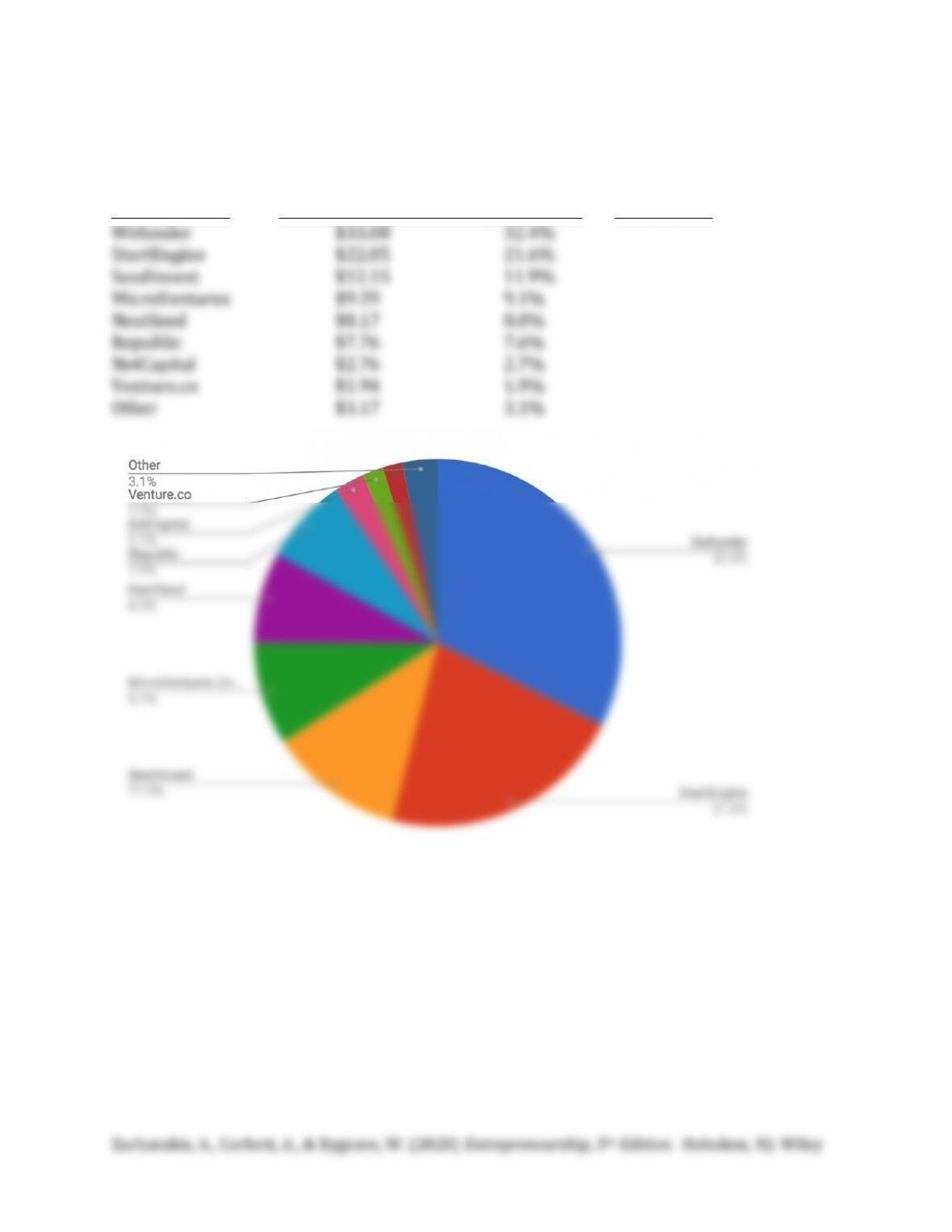
Teaching Note Appendix B. Dollar Volume by Platform
Through March 31, 2018
Funding Portal Amount of Capital Raised (in millions) % as of total
Source: Startengine.com

Teaching Note Appendix C. Platforms Listed with FINRA
As of 11/18/18
Avonto, LLC
Buy The Block
CollectiveSun, LLC
Crowd Ignition, Inc.
CrowdsourceFunded.com
EnergyFunders Marketplace
Equifund Crowd Funding Portal Inc.
EquityBender LLC
First Democracy VC
FlashFunders Funding Portal, LLC
Funding Wonder Crowd, LLC
Fundme.com, Inc.
Fundpaas Inc
Good Capital Ventures
Gridshare LLC
GrowthFountain Capital, LLC
Honeycomb Portal LLC
Hycrowd LLC
Indie Crowd Funder, LLC.
Jumpstart Micro, Inc
Ksdaq Inc.
Merging Traffic Portal llc
MinnowCFunding LLC
Neighbor Capital
NetCapital Funding Portal Inc.
NextSeed US LLC
NSSC Funding Portal, LLC
OpenDeal Inc.
Razitall, Inc.
SI Portal, LLC
Silicon Prairie Holdings, Inc.
Slice Capital
Sprowtt CrowdFunding, Inc.
StartEngine Capital LLC
StartWise, Inc.
STL Critical Technologies JV I, LLC
Thrivera Ventures Fund I, LLC
title3funds.com
Trucrowd INC
Venture Capital 500, LLC
Wefunder Portal LLC