
Feed Resources
Teaching Note
Andrew Zacharakis
3/28/08
Synopsis
The Feed Resources case tracks the entrepreneurial journey of Shane Eten. Shane chose to go
back for his MBA to help him launch a venture. Feed Resources goal is to develop and sell anaerobic
digestion systems to grocery stores and restaurants. At the time of the case, Shane has developed his
concept and pitched it at several business plan competitions, generally placing in the top 3. His success
encourages him to pursue this business, but in order to develop the prototype; Shane needs to raise
$250,000. The case focus is on how and from who Shane can raise the needed capital.
Use in Class
This case can be used at both the undergrad and MBA level. It is focused primarily on raising
seed capital, but it also covers an industry that is of high interest to students. Therefore, this case can
be used in a foundation entrepreneurship, new venture creation, entrepreneurial finance or social
entrepreneurship course. I currently use it in New Venture Creation about ¾’s of the way through the
class as we talk about bootstrapping, building a team and non–conventional ways to raise capital.
Class Teaching Plan
This teaching plan is for a 45–75minute case discussion. There is also a video available of the
entrepreneur debriefing the case and answering questions during an undergraduate new venture class.
Zacharakis, A., Corbett, A., & Bygrave, W. (2020) Entrepreneurship, 5th Edition. Hoboken, NJ: Wiley
FEED
I. Have a student explain what anaerobic digestion is and how the Feed System is expected to
work. This will make sure that everybody understands what Shane is proposing.
A. Ask the class to detail the revenue model. I find it is useful for students to think about
how a concept makes money.
B. Ask the class to explore the value proposition for the customer. This helps students
understand how easy it will be to identify and sell the product.
II. [VOTE] Ask the students to vote on whether they would invest $250,000 into feed?
A. The vote in my class usually comes out 70% against and 30% for investing. Follow up
and ask why students voted the way they did.
1. For (I usually start with the minority vote just to make sure they don’t get
Zacharakis, A., Corbett, A., & Bygrave, W. (2020) Entrepreneurship, 5th Edition. Hoboken, NJ: Wiley
c. Aside from the strong VC market, Shane has seen interest from VCs,
business plan competitions and customers he has spoken with.
2. Against. I’ve categorized the against in different terms than the student will likely
use, but I like these terms because they are similar to what you might see in a
III. How can Shane raise the $250,000? If this is the first case on the topic, it is useful to go
through the various sources and analyze them.
A. Debt. This isn’t a strong option because feed has no collateral or cash flows (i.e.,
B. Grants.
1. SBIRs (Small Business Innovation Research Program)– Grants to fund R&D
http://grants.nih.gov/grants/funding/sbirsttr_programs.htm
C. Equity. This is the most likely source. This is a good place to talk about the equity food–
2. Angels – this is a strong possibility. The trick is how do you identify angels and how
3. FFFs – can reach families through private placements.
4. Other Sources – there are several creative sources. I don’t push the students here
IV. Valuation – to highlight dilution, I step them through a simple Market–Comparable
Valuation method (see page 387 in the Bygrave&Zacharakis textbook). I start by asking
them “how much is feed worth?”
A. MarketComparable Method basically captures the future value of the investment and
the company and then brings it back to the present time.
1. Future Value of Investment
Zacharakis, A., Corbett, A., & Bygrave, W. (2020) Entrepreneurship, 5th Edition. Hoboken, NJ: Wiley
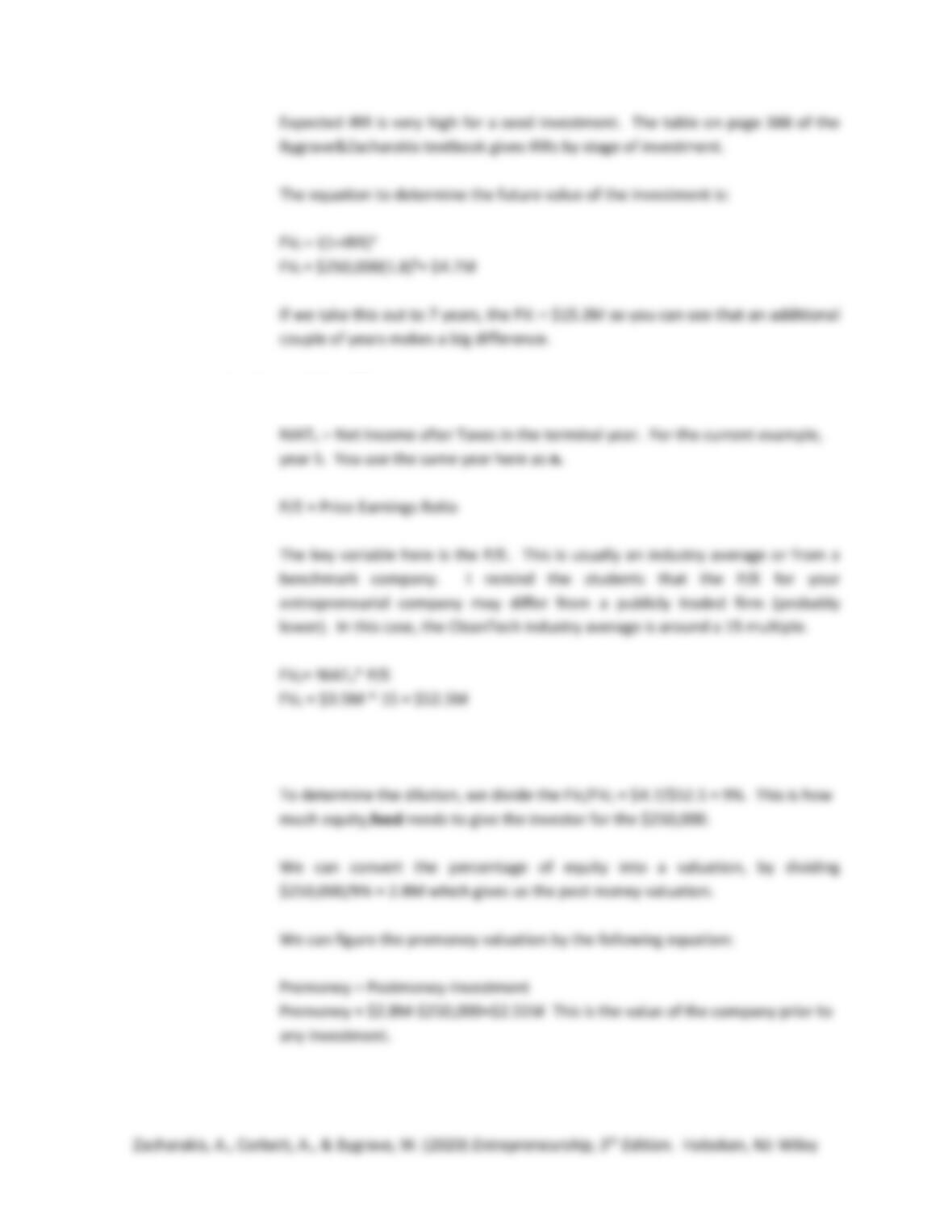
Expected IRR is very high for a seed investment. The table on page 388 of the
Bygrave&Zacharakis textbook gives IRRs by stage of investment.
The equation to determine the future value of the investment is:
FVI = I(1+IRR)n
FVI = $250,000(1.8)5= $4.7M
If we take this out to 7 years, the FVI = $15.3M so you can see that an additional
couple of years makes a big difference.
2. Future Value of Company
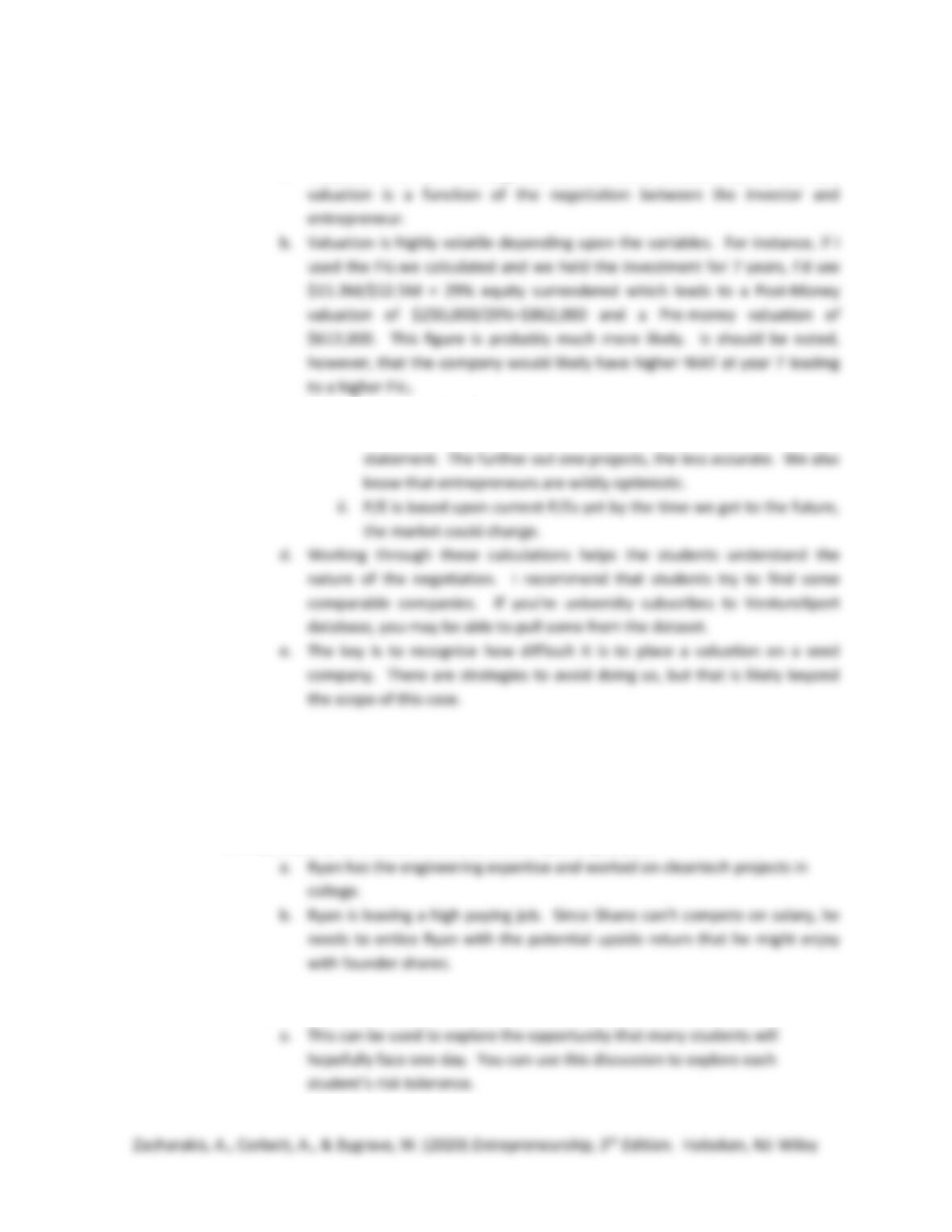
3. Dilution and Valuation
4. Issues
a. Valuation is an art. Although we can run some calculations, the ultimate
c. Other variables that make this calculation volatile:
i. NIATn is based upon the entrepreneur’s pro forma income
V. Team [IF TIME PERMITS] – in all likelihood, the above discussion will take most of the time
and you probably have covered Team issues with another case, but if you have time and
want to, you can layer in some discussion here.
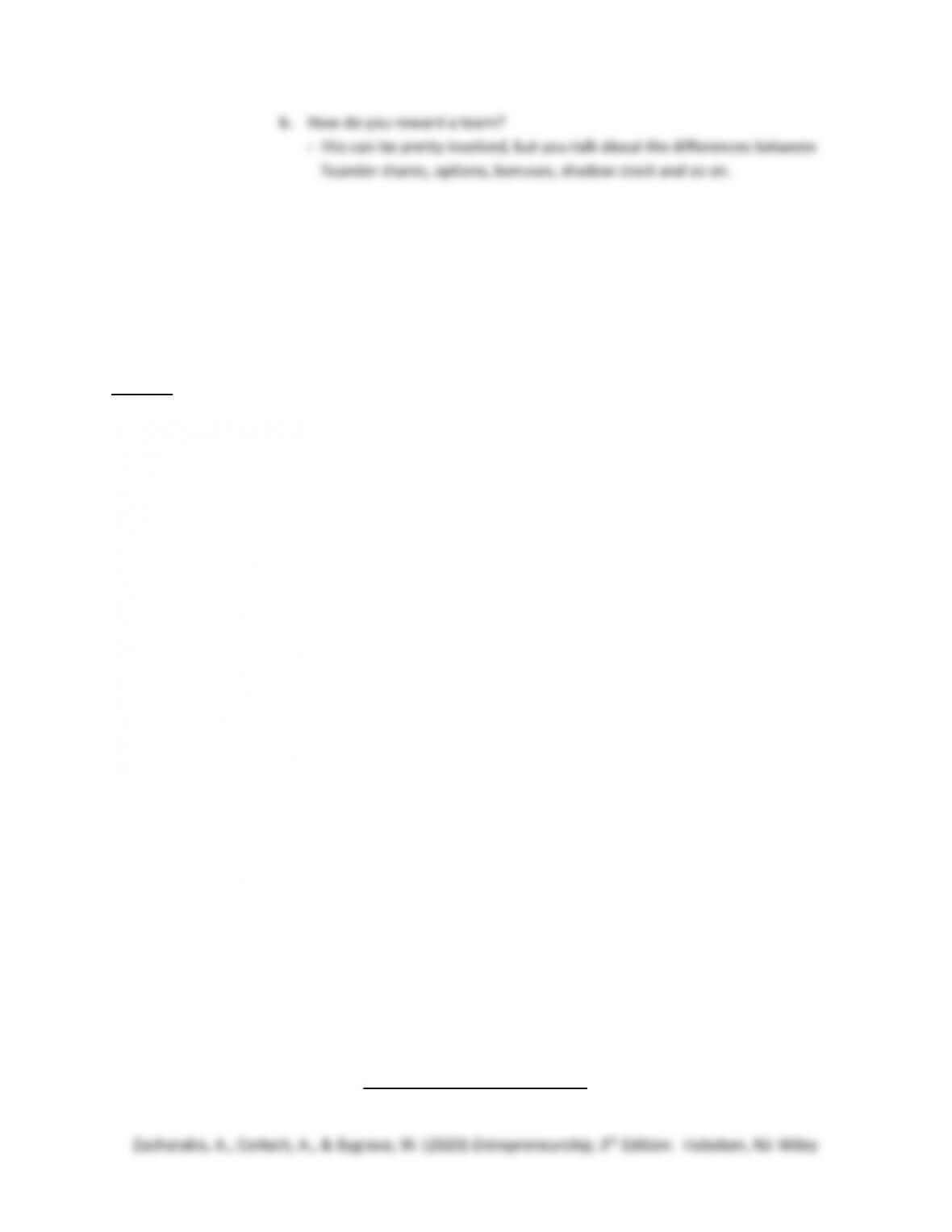
A. Shane has successfully recruited Ryan.
1. Would you offer founder shares to entice Ryan to join you?
2. If you were Ryan, would you leave Raytheon for a seed stage startup?
Zacharakis, A., Corbett, A., & Bygrave, W. (2020) Entrepreneurship, 5th Edition. Hoboken, NJ: Wiley
b. How do you reward a team?
– this can be pretty involved, but you talk about the differences between
founder shares, options, bonuses, shadow stock and so on.
VI. End of case – show video. The video shows Shane debriefing the case, updating the
students on how he financed feed and what next phases of financing he is seeking. He also
answers questions for the group. I then wrap up by discussing how Shane creatively
financed the development of the prototype without any dilution (see epilogue).
Epilogue – as of 3/28/08
Shane successfully secured seed financing from a large New England grocery store chain to
develop the prototype.1 Moreover, the grocery store chain basically pre–bought the prototype for
$410,000 meaning that feed didn’t have to relinquish any equity for the capital. In return, feed has
given the chain an exclusive for the Northeast and the chain agrees to buy the prototype (with delivery
expected by August 4, 2008), 7 units the first year, 15 the second and 30 the third. Assuming that
development proceeds as planned and that the grocery chain fulfills its commitment, feed will generate
$20M by year three which greatly exceeds its projections in the case. Moreover, the nature of the
contract allows feed to line up other customers outside of the Northeast. As such, Shane has had
preliminary conversations with a large chain located on the West coast.
Although Shane projected it would cost him $250,000 to build the first prototype, that number
is low. feed has had to hire more members to its team and pay market salaries. In addition, they have
contracted the actual production of the prototype to an engineering firm who has the capabilities to
build the unit. Within a month after pre–selling the first unit, Shane was out raising an Angel round of
financing.
As of the writing of this epilogue, the angel has committed $300,000 in convertible debt. The
deal is expected to close shortly. In addition, the grocery store chain is very interested in speeding the
production of the first and subsequent units. They are currently considering putting $850,000 more in
advance purchases (again meaning no relinquishing of equity). There seems to be a couple of motives
driving the chain. First, they have a capital budget line focused on developing green technologies.
Second, they want to be the first chain with this type of product to show their “green” credentials. They
plan to heavily promote the anaerobic digestion system in their marketing plan. Shane expects to close
this deal by April 2008.
The importance of the pre–bought financing is that Shane and his co–founders not only avoid
dilution, but this pre–bought financing now provides a basis for developing a solid valuation once Shane
1 The name of the chain cannot be released until the prototype is delivered.