
MetaCarta
Teaching Note
Zacharakis
7/19/2012
Synopsis
The MetaCarta case MetaCarta: Growing a Company, Do We Take the VC Money? tells the
startup story of Doug Brenhouse, John Frank and Erik Rauch. The trio develops a new search
technology that coverts text names into geographic maps. When the project was initiated in
1999, the business model was going to be advertisement-driven, but with the dot-com bust,
Meta–Carta ends up selling the platform to government agencies and businesses, particularly in
the oil and gas sector. The main focus of the case is financing. We follow the company through
multiple rounds of financing and track the impact on equity dilution. The case ends with an offer
from Sevin Rosen, a premier venture capital firm, that has significant implications on the
founders and earlier round investors’ equity. The founders must decide if they should take the
VC money and if so, on what terms.
Learning Objectives
1. Understand the financing process of new ventures.
2. Learn about different types of investors, from angels, the government to venture capital.
3. Decipher a capitalization table (cap table) that tracks the impact on equity dilution for the
founders and early round investors.
Use in Class
This case is particularly useful to illustrate Capitalization Tables. It shows how equity is diluted
over subsequent rounds and what the implied value of the company is at various stages. This
case can be used for both MBA and advanced undergraduates. The case is best suited for
entrepreneurial finance courses, but can also be used in other entrepreneurship courses that have
a class or more on raising capital. The case may also be useful for finance courses that cover VC
financing.

Zacharakis, A., Corbett, A., & Bygrave, W. (2020) Entrepreneurship, 5th Edition. Hoboken, NJ: Wiley
Class Plan
Prior to class, students should read and prepare the case. To assist in their understanding, they
should read a chapter on entrepreneurial finance, especially on venture capital. If using the text
by Bygrave and Zacharakis, Entrepreneurship, 2nd edition, Chapter 10, Raising Money for
Starting and Growing Businesses, is directly relevant. It may also be useful to have students
review the National Venture Capital Association website (www.NVCA.org) where they can find
data on current VC activity.
This case can be covered in anywhere from 45-90 minutes depending on the level of depth and
topic covered.
I. Describe MetaCarta
A. The product – a search engine that converts text into maps (see wine example in
the case, p. 3-4.)
B. What was its original business model? Why didn’t it work?
C. Entrepreneurs need to be nimble to market and customer conditions. Have the
students examine the new business model in relation to the original vision and ask
them to explain what the changes were and explore why these were good changes.
2. Why would oil and gas companies buy this platform? What advantages does
the platform provide for government agencies?
II. Overview of the Capitalization Table, round by round. Students are likely
unfamiliar with capitalization tables. While they have a general sense of what
dilution is, the capitalization table makes the concept concrete. A useful exercise
derived from this case would be to have students build a capitalization table for a
venture that they are planning to launch (if applicable).
A. Pre-round
1. Point out the DARPA alternative financing on page 8 of the case and ask
students: what are the advantages of accepting the DARPA money?
2. Angel round – This deal raises $1 million as convertible debt. At the next
institutional round – the trigger – the note converts to equity at a 20% discount
off the price that the next round’s investor pays.

c. Example:
d. Ask the students the advantages and disadvantages of convertible debt
to both angel and entrepreneur. Responses should include the
following.
B. Series A One year later, founders set the share price at $.64 based on the number
of shares they had previously transferred to themselves and the pre-money
valuation negotiated with the investors. The share price could have just as easily
been set at $1/share – very common in first round financing – and then adjust the
number of issued shares to reflect the relative percentage of the company that the
founders would retain). There are a number of things to inquire/explain about this
round:
angel round, an 80% discount off share price. Thus, their share price is $.51
($.64 * .80). The convertible debt holders also accrued interest prior to the
conversion (8% per annum accruing). Since it has been one year since the
C. Series B (Proposed VC financing one year later). The main decision in the case is
whether the founders should accept the VC financing offered by Sevin Rosen
(SR). Before delving into that question, make sure students understand the
implications of the proposed offer.
1. Again, ask what is the pre-money valuation and how was this determined? At
this point, SR has submitted an offer of $6.5 million as the pre-money
valuation. The final valuation will be determined by negotiation between
entrepreneurs and SR. This is the starting point for the analysis and the case
asks whether the entrepreneurs can negotiate a better deal. Note that this pre–
money valuation does not have any relation to the previous rounds of post-
money valuation. It is determined independently of previous rounds based
upon these factors:
2. Ask the students to explain the impact of the current proposal. Most students
will note the significant dilution to the founders (from 63% to 16%). Some
will fixate on the dilution, ignoring that dilution is inevitable when seeking
new funding. The dilution is bad for entrepreneurs, but the more important
3. Ask students what is causing that cram down. Examining previous rounds of
post-money valuation ($6080) and comparing them to the current round’s pre-
money ($6500), the company has increased in value, although not very much.
The big factor driving the “cram down” is the inclusion of an option pool.
4. Ask any students if they’ve ever had options. This leads into an explanation
of an option pool. Basically, options are set aside to attract future key
employees and to reward existing employees who continue to perform well.
A couple of further points:
III. [VOTE] Should Meta Carta take the VC money? – I like to take an initial vote to see
where the class stands. Usually, 70% say don’t take the money, 30% say take it.

IV. Role Play – break the class into three groups (I usually have subgroups within the
main group where 2-3 people discuss the issues that each party is facing). I pose the
questions below and give the groups 10-15 minutes to think through their positions.
1. Group 1 – John, Doug and Erik
a. Do you take the money? Why or why not?
b. Can you negotiate better terms? What levers can you pull?
2. Group 2 – Angels; I make the assumption that the earlier round investors (angels)
have a board seat and can influence the founders on the decision.
a. How would you advise the founders?
b. In hindsight, what terms could you have imposed to protect your earlier
round investment?
3. Group 3 – VCs (Sevin Rosen and syndicate)
a. Why do you like MetaCarta?
b. Why did you structure the deal the way that you did? What are the
implications to the founders?
c. If a deal can be negotiated, what role will you take going forward?
4. Before the role play, I ask the VC group why they like MetaCarta. This helps set
the stage for what VCs look at when finding and investing in companies. In
MetaCarta’s case, a couple of issues come to the forefront.
a. Validation – The team has strong earlier investors (In-Q-Tel); they have
customers (government and oil and gas companies); if Sevin Rosen
invests, it is easy to envision how MetaCarta can gain many more
customers.
b. Progress to date – The founders have demonstrated their adaptability;
changing the business model after macro factors eliminated the
advertisement model; the technology is proven.
5. Role Play – I call on a spokesperson from each of the three groups and have him
or her engage in a negotiation.
a. I track the main points on the board and then discuss them afterwards,
dividing the board in half. On one half, I write the VC’s questions and
concerns, and on the other half I write how the entrepreneur addresses the
question. I try to do this as inconspicuously as possible so that it does not
distract the role players.

b. The role play usually shows that the VC has most of the power. The main
drivers of that power include:
i. Meta Carta is almost OOC (out of cash) and it takes time to get
another investor on the hook. If it turns down Sevin Rosen, it
could take another six months to get another investor.
ii. The macro environment is unfavorable and VC and angel
financing are down, meaning lower valuations in general. Waiting
might improve macro conditions, but since MetaCarta is OOC, that
is a luxury it cannot afford.
c. Engage students in a discussion on the areas where founders have
negotiating room. All these areas have positives and negatives and can
lead to a rich discussion.
i. Size of option pool – smart entrepreneurs will track the newly–
hired employees and performance-based awards they expect to
give out over the coming funding period (usually a year or so) and
then negotiate a smaller option pool.
ii. Options set aside for founders – founders may also be able to
negotiate some options reserved for founders based upon their
continued performance.
iii. Founders may be able to get the Sevin Rosen to have the options
equally dilute entrepreneurs and Sevin Rosen, although this is
unlikely.
iv. Amount of money raised (grow slower approach) – this can be
risky in that it may lengthen time to exit and may mean that the
entrepreneur is out raising money again sooner (without the
environment having improved) and the company does not appeaer
as exciting because growth has slowed.
v. Earlier round angels may invest because of the severe dilution they
face if Sevin Rosen invests. While that would protect the angel’s
equity position, the question becomes whether the added value of
Sevin Rosen offsets the dilution. Sevin Rosen is a premier VC
firm with a strong rolodex, experience taking companies public
and/or selling them for a strong return, and deep pockets to lead
any future rounds of financing. These value added aspects
increase the overall valuation of the firm going forward.
d. At the end of the role play, the issues in the table below are often
highlighted. If not, consider raising them as discussion points.
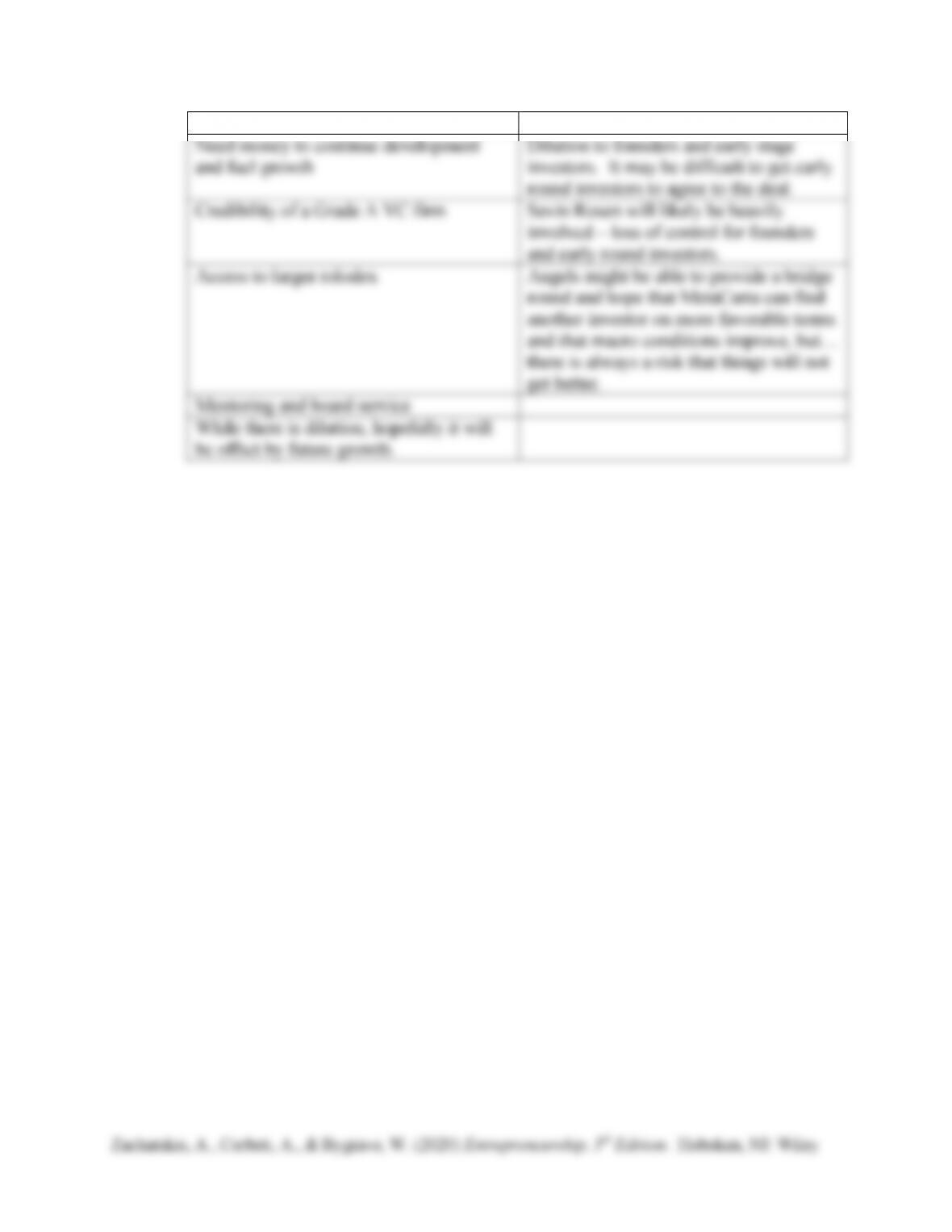
PROS
CONS
Need money to continue development
and fuel growth
Dilution to founders and early stage
investors. It may be difficult to get early
round investors to agree to the deal.
Credibility of a Grade A VC firm
Sevin Rosen will likely be heavily
involved – loss of control for founders
and early round investors.
Access to larger rolodex
Angels might be able to provide a bridge
round and hope that MetaCarta can find
another investor on more favorable terms
and that macro conditions improve, but…
there is always a risk that things will not
get better.
Mentoring and board service
While there is dilution, hopefully it will
be offset by future growth.
V. Founders – If time permits, consider talking about how the founders came together.
A. Talk through how the founders came together. They met at a networking function
at MIT. Is this a good approach? Or should you work with people who you
already know well?
B. What is the value of having co-founders? It offers validation of your idea,
provides more bandwidth and offers founder support as others join and share in
the highs and lows of a startup.
C. How do you ensure a good fit (marriage)? A trial period (dating) is often a good
idea so that the parties can see how they work together. It is important to be clear
that you are doing this on a trial basis so everyone has similar expectations.
D. How would you divide up the founder shares? Why? Generally, two factors
drive equity split: contribution to date and expected contribution going forward.
John and Erik would have more equity based upon work done prior to Doug
joining, and then the trio should take into account future expectations for their
respective contribution. For example, Erik is planning on working part-time, so
his equity share would be lower. John will assume the CEO position and Doug
will take on other executive positions. Thus, John would likely demand more
equity than Doug or Erik. Interestingly, John used a rather unique system
counting email correspondence between the three founders. His presumption was
that the more email correspondence, the more equity that party should get.

E. It seems like they have a strategy to replace/demote themselves later. Why? The
founders likely realized that they may need a more experience executive team to
foster faster growth. In fact, after this case, the trio hired a more experienced
CEO. This topic is address in a Bcase that looks at the liquidity event MetaCarta
ultimately pursues.
F. How do you reward future hires? This can be used to reiterate the topic of
options, along with salary and bonuses.
VI. Epilogue – MetaCarta did take the VC money, believing that they would make up
the dilution with an attractive harvest. Ultimately, the company was acquired by
Nokia. The deal was large enough that all the early round investors were made whole
(meaning they recovered their investment) and earned reasonable returns. The
founders and Sevin Rosen earned better returns. Nokia was only interested in the
technology and allowed Doug the opportunity to sell the customer-facing portion of
the business, which he did to QBase. Thus, all parties came out ahead in the
transaction. A side note: tragedy befell the founders when Erik Rauch died in a freak
hiking accident in 2005. Although Erik was not full-time in the venture, it was hard
on John and Doug.