
MIGHTYWELL™ TEACHING NOTE
ANDREW ZACHARAKIS
CASE SUMMARY
A college entrepreneur named Emily Levy founded MightyWell™ when she faced a personal
challenge following her diagnosis with chronic, or more properly called, Post-treatment Lyme
disease. Emily identified the need for an improved fabric cover to protect and fashionably hide a
Peripherally Inserted Central Catheter (PICC) line that was inserted in her arm to deliver antibiotics
to her heart. Over the course of two years, while completing her undergraduate degree, Emily
designed, developed, manufactured, and sold her product while bootstrapping1 her venture. She
competed in 17 business competitions and won prizes in 15, before being awarded $250,000 as the
2016 winner of the Babson Breakaway Challenge. Emily is now rebranding and pursuing a product
expansion initiative to transform her company from a single product to a brand of wellness wear2
and products attractive to a larger base of medical patients.
NATURE OF THE CASE
All information contained within this case, including names and company financial data, is factual
and has not been altered. All data for this case was obtained between October 2016 and March 2017
via first hand interviews with authorized representatives from the subject company, unless otherwise
noted.
The nature of this case is Entrepreneurial Decision–Making Case and is appropriate for both
undergraduate and graduate entrepreneurship classes.
TEACHING OBJECTIVE

• Primary Lesson: Opportunity assessment.
• Secondary Lessons: (1) Transforming from a single product company to a brand, (2)
Bootstrapping via business competitions, (3) Educating the market/customer about the
company’s product
LEARNING OBJECTIVES
• Identifying a pain point for a potential customer
• Designing a solution
• Assessing the nature of the opportunity
• Understanding the value of bootstrapping

TEACHING STRATEGY
• Start the case by asking if students are familiar with Lyme disease and its treatment?
o Point out that some patients need long-term antibiotics via a PICC Line, and may
feel uncomfortable wearing a sock to cover the entry point.
o Ask whether it is important to have a fashionable cover for the PICC line.
Students will likely talk about how appearance is critical in their age group.
Students will also likely talk about how self-esteem is often tied to one’s
perception of how others view them.
In sum, the class will likely agree with Emily that the PICCPerfect is a great
idea.
o Point out that entrepreneurs often find ideas related to problems they themselves
face. However, just because they would be a customer does not mean that there are
enough other customers to make this work.
• Is the PICCPerfect an attractive opportunity? Take a VOTE. Generally, a strong
majority of the class believes it to be an opportunity.
o Have the class use the Opportunity Checklist (in Zacharakis, Bygrave, Corbett 2017
Entrepreneurship, 4th Edition; see TN Exhibit A) to assess the strength of the
Have each group identify the three factors on which PICCPerfect is
strongest and three factors on which it is weakest.
The groups usually identify a wide variety of factors, which is okay because
this initial analysis is based upon one’s perception.
On occasion, different groups will view the same criteria in opposite
directions. For example, one group will view the 3 million PICC lines
• Would this be a more attractive opportunity if Emily added product lines? Most
people will say yes, but probe deeper. What are the issues with adding product lines? Outline
a strategy to do so.
o Major issues are costs, although she has just raised capital, and focus. While she has
experienced initial success with PICCPerfect, it is still early. Has she gained sufficient
• If Emily decides to pursue the students’ growth plan, what issues will she face? How
should she deal with them?
o Focus–While the funds MightyWell™ has raised should provide capital to start new
products, there is also the issue of bandwidth. As an early–stage startup, the team is
o Supply Chain and Manufacturing–Ideally, MightyWell™ should be able to leverage
its existing supply chain, assuming that new products will be similar medical fashion.
• How has Emily raised capital? What else should she be doing here?
o $ 11,000 Initial capital – investment from founders Emily and Yousef
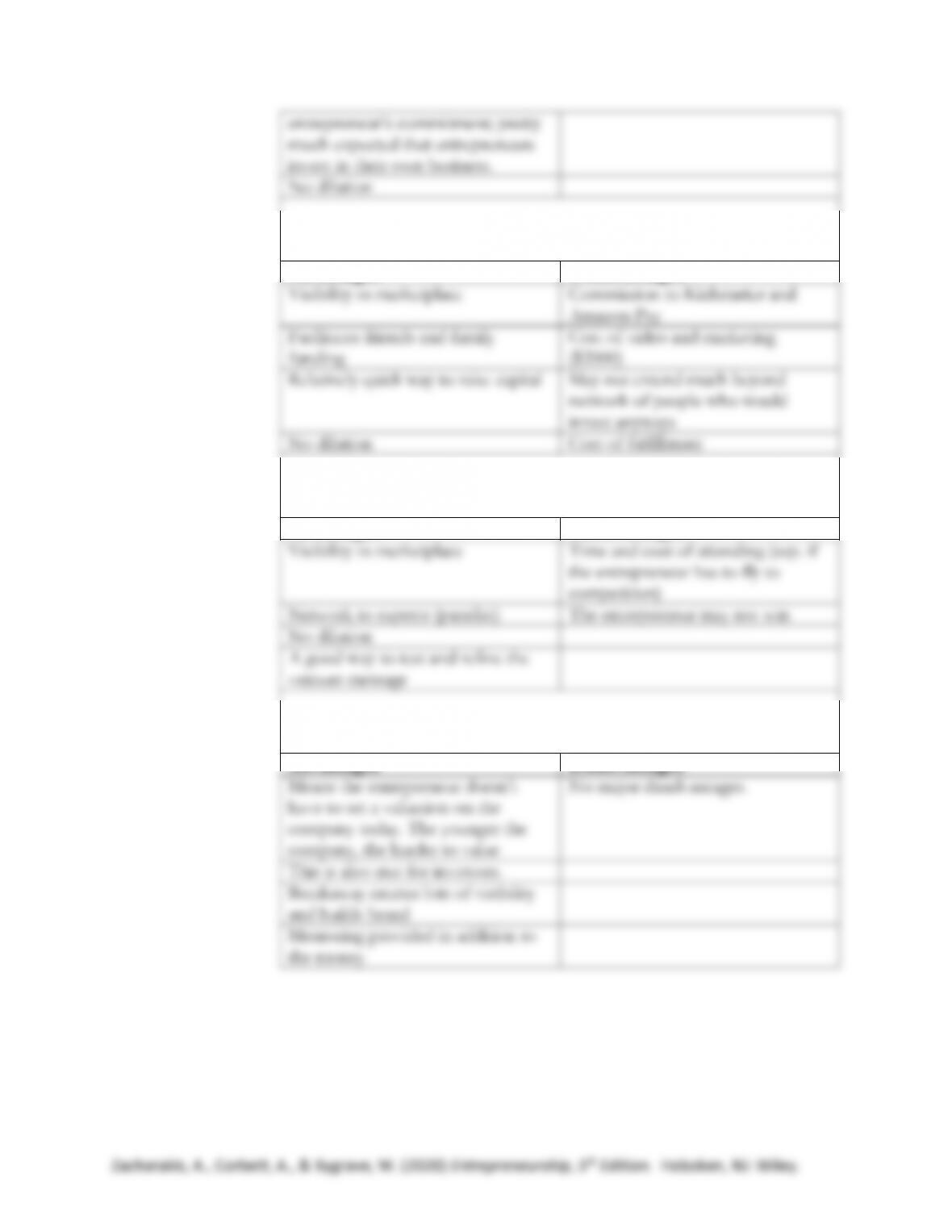
TN Table 1
Advantages and Disadvantages of Different Fund Raising Sources
Self-Financing
Advantages
Disadvantages
Commits the entrepreneur to work
hard on venture
May strain the entrepreneur’s
personal cash flow, especially since
you likely won’t be able to pay
yourself in the early years
Commits co-founders. Less likely to
leave for a job or other opportunity
Send a signal to subsequent
investors and stakeholders of the
entrepreneur’s commitment; pretty
much expected that entrepreneurs
invest in their own business.
No dilution
Kickstarter
Advantages
Disadvantages
Visibility in marketplace
Commission to Kickstarter and
Amazon Pay
Facilitates friends and family
funding
Cost of video and marketing
($2000)
Relatively quick way to raise capital
May not extend much beyond
network of people who would
invest anyways
No dilution
Cost of fulfillment
Business Plan Competitions
Advantages
Disadvantages
Visibility in marketplace
Time and cost of attending (esp. if
the entrepreneur has to fly to
competition)
Network to experts (panelist)
The entrepreneur may not win
No dilution
A good way to test and refine the
venture message
Convertible Debt
Advantages
Disadvantages
Means the entrepreneur doesn’t
have to set a valuation on the
company today. The younger the
company, the harder to value
No major disadvantages.
This is also true for investors.
Breakaway creates lots of visibility
and builds brand
Mentoring provided in addition to
the money

QUESTIONS FOR DISCUSSIONS
1. What are the advantages/disadvantages of adding new product lines?
2. When should Emily go forward with new product lines?
3. If she goes forward, how would students advise Emily to identify these lines?
4. What criteria should Emily use in deciding which products to add?
5. Is there a cost to educating different target end-customer groups for each product line?
6. How can Emily balance expanding her existing base of PICCPerfect customers while
educating new markets of customers with other medical needs?
7. Does a hybrid market opportunity exist for MightyWell™’s wellness wear?
8. What are the positive and negatives for the way in which Emily has bootstrapped her
company up to this point?
9. What other companies have successfully transitioned from a single product to a brand
with multiple product lines (examples: Crocs, Spanx)?
BACKGROUND READING
• An overview of PICC lines and their uses from WebMD.com: www.webmd.com/pain–
management/tc/central-venous-catheters-topic-overview#1
• Carlotti, S., Coe, M., & Perrey, J. (2004) Making Brand Portfolios Work. McKinsey Quarterly,
November (2004), www.mckinsey.com/business-functions/marketing-and-sales/our-
insights/making-brand-portfolios-work, accessed June 15, 2017.
KICKSTARTER LINKS TO PICCPERFECT CAMPAIGN
• Kickstarter: www.kickstarter.com/projects/piccperfect/piccperfect-fashion-meets-function-
for-picc-line-c
• Kickstarter Marketing Video: ksr–video.imgix.net/projects/1713911/video–515512–
h264_high.mp4

WHAT REALLY HAPPENED

TN Exhibit A: Opportunity Checklist
Customer
Better Opportunities
Weaker Opportunities
Identifiable
Defined core customer
Undefined customer
Demographics
Clearly defined and focused
Fuzzy definition and unfocused
Psychographics
Clearly defined and focused
Fuzzy definition and unfocused
Trends
Macro market
Multiple and converging
Few and disparate
Target market
Multiple and converging
Few and disparate
Window of opportunity
Opening
Closing
Market structure
Emerging/Fragmented
Mature/Decline
Market size
How many
Large core customer group
Small, unclear customer groups
Demand
Greater than supply
Less than supply
Market growth
Rate
20% or greater
Less than 20%
Price/Frequency/Value
Price
Gross Margin > 40%
Gross Margin < 40%
Frequency
Often and repeated
One time
Value
Fully reflected in price
Penetration pricing
Operating expenses
Low and variable
Large and fixed
Net Profit Margin
>10%
<10%
Volume
Very high
moderate
Distribution
Where are you in value chain?
High margin, high power
Low margin, low power
Competition
Market structure
Emerging
Mature
Number of direct competitors
Few
Many
Number of indirect competitors
Few
Many
Number of substitutes
Few
Many
Stealth competitors
Unlikely
Likely
Strength of competitors
Weak
Strong
Key Success Factors
Relative Position
Strong
Weak
Vendors
Relative power
Weak
Strong
Gross margins they control in
value chain
Low
High
Government
Regulations
Low
High
Taxes
Low
High
Global Environment
Customers
Interested and accessible
Not interested or accessible
Competition
Nonexistent or weak
Existing and strong
Vendors
Eager
Unavailable
Source: Zacharakis, A., Bygrave, W, & Corbett, A. (2017) Entrepreneurship, 4th edition. New York: Wiley. Used with
permission.