Chapter 9: Interest Rate Risk
9.15.
Suppose that a bank has $10 billion of one-year loans and $30 billion of five-year loans. These
are financed by $35 billion of one-year deposits and $5 billion of five-year deposits. The bank
has equity totaling $2 billion and its return on equity is currently 12%. Estimate what change in
interest rates next year would lead to the bank’s return on equity being reduced to zero. Assume
that the bank is subject to a tax rate of 30%.
The bank has an asset-liability mismatch of $25 billion. The profit after tax is currently 12% of
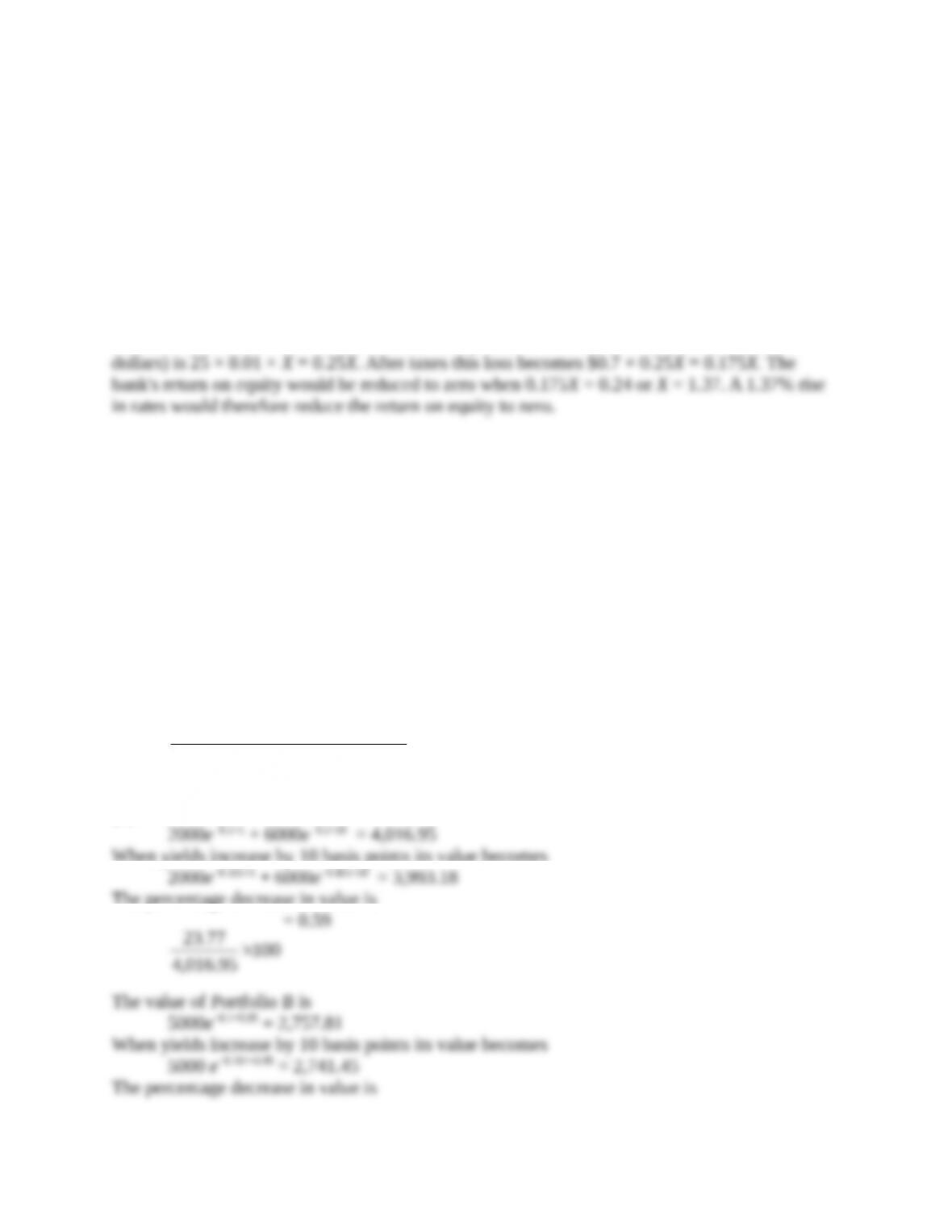
$2 billion or $0.24 billion. If interest rates rise by X% the bank’s before-tax loss (in billions of
9.16.
Portfolio A consists of a one-year zero-coupon bond with a face value of $2,000 and a 10-year
zero-coupon bond with a face value of $6,000. Portfolio B consists of a 5.95-year zero-coupon
bond with a face value of $5,000. The current yield on all bonds is 10% per annum (continuously
compounded)
(a) Show that both portfolios have the same duration.
(b) Show that the percentage changes in the values of the two portfolios for a 0.1% per annum
increase in yields are the same.
(c) What are the percentage changes in the values of the two portfolios for a 5% per annum
increase in yields?
(a) The duration of Portfolio A is
95.5
60002000
60001020001
101.011.0
101.011.0
ee
ee
Since this is also the duration of Portfolio B, the two portfolios do have the same duration.
(b) The value of Portfolio A is
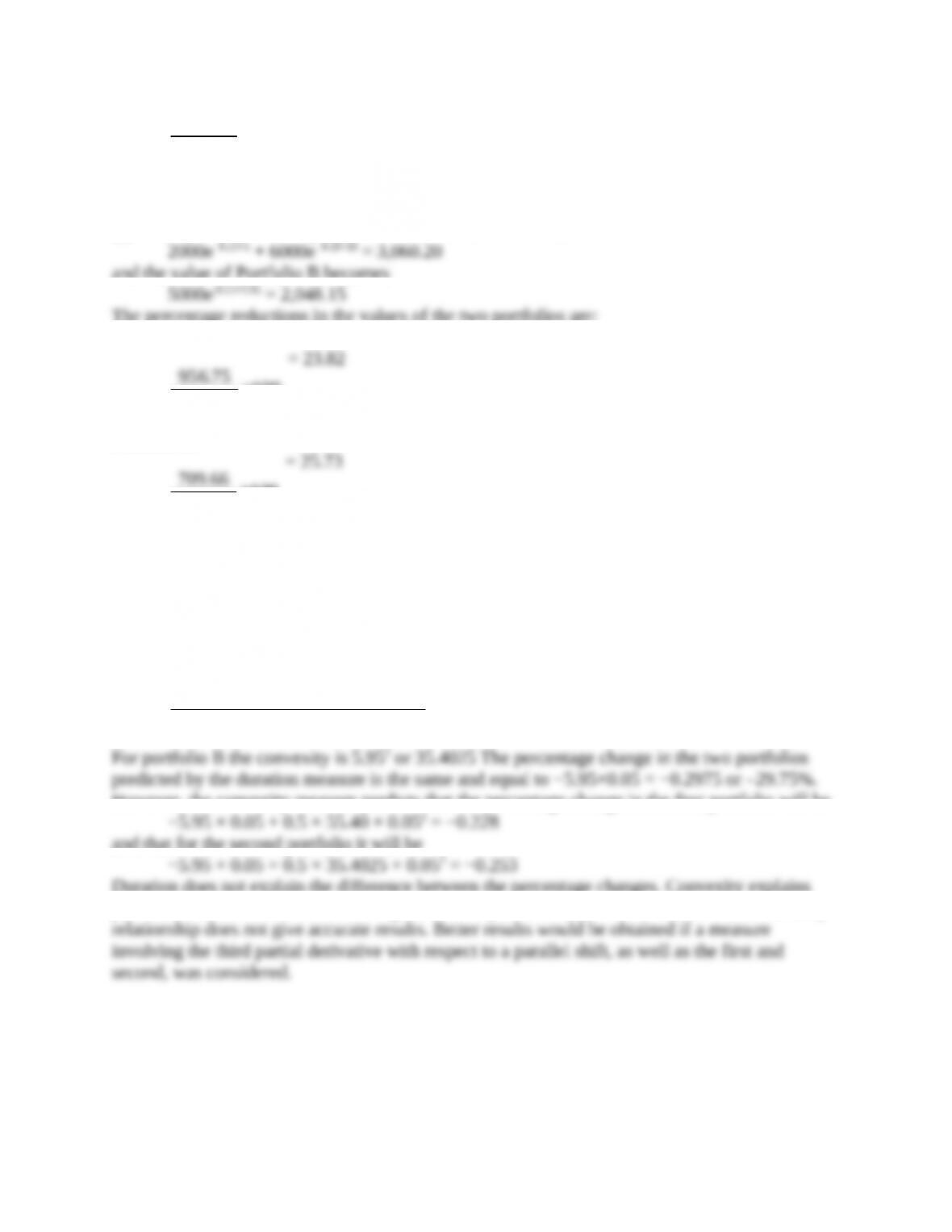
When yields increase by 10 basis points its value becomes
The percentage decrease in value is
100
95.016,4
77.23
= 0.59
The value of Portfolio B is
5000e−0.1×5.95 = 2,757.81
When yields increase by 10 basis points its value becomes
The percentage decrease in value is
59.0100
81.757,2
36.16
The percentage changes in the values of the two portfolios for a 10 basis point increase in yields
are therefore the same.
(c) When yields increase by 5% the value of Portfolio A becomes
2000e−0.15×1 + 6000e−0.15×10 = 3,060.20
and the value of Portfolio B becomes
The percentage reductions in the values of the two portfolios are:
Portfolio A:
100
95.016,4
75.956
= 23.82
Portfolio B:
100
81.757,2
66.709
= 25.73
9.17.
What are the convexities of the portfolios in Problem 9.16? To what extent
does (a) duration and (b) convexity explain the di!erence between the
percentage changes calculated in part (c) of Problem 9.16?
For Portfolio A the convexity is
40.55
60002000
60001020001
101.011.0
101.0211.02
ee
ee
However, the convexity measure predicts that the percentage change in the first portfolio will be
and that for the second portfolio it will be
Duration does not explain the difference between the percentage changes. Convexity explains
part of the difference. 5% is such a big shift in the yield curve that even the use of the convexity
9.18.
When the partial durations are as in Table 9.5, estimate the effect of a shift in the yield curve
where the ten-year rate stays the same, the one-year rate moves up by 9e, and the movements in
intermediate rates are calculated by interpolation between 9e and 0. How could your answer be
calculated from the results for the rotation calculated in Section 9.6?
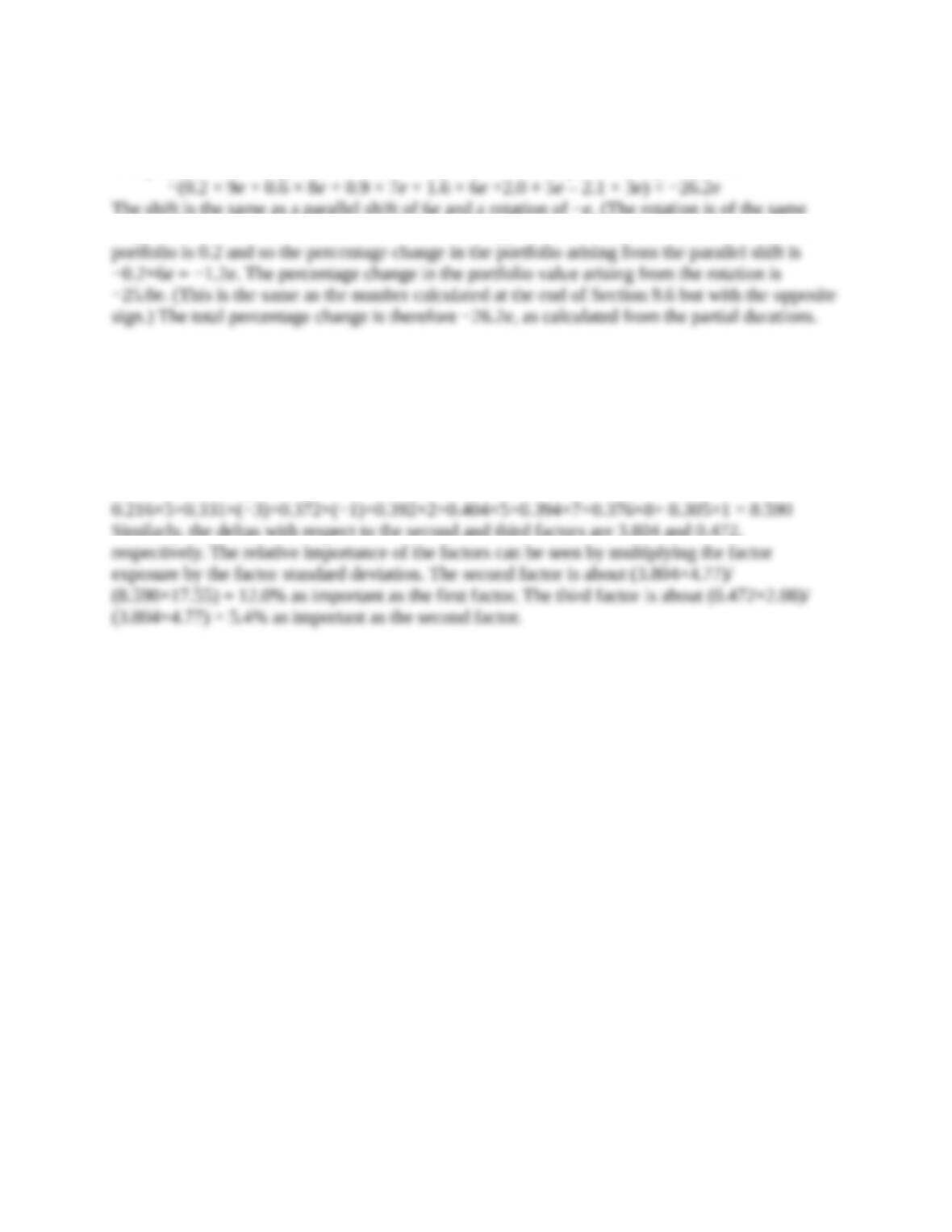
The proportional change in the value of the portfolio resulting from the specified shift is
The shift is the same as a parallel shift of 6e and a rotation of −e. (The rotation is of the same
magnitude as that considered in the text but in the opposite direction). The total duration of the
9.19. (Spreadsheet Provided)
Suppose that the change in a portfolio value for a one-basis-point shift in the 1-year, 2-year,
3-year, 4-year, 5-year, 7-year, 10-year, and 30-year rates are (in $ million) +5, –3, –1, +2, +5,
+7, +8, and +1, respectively. Estimate the delta of the portfolio with respect to the first three
factors in Table 8.7. Quantify the relative importance of the three factors for this portfolio.
The delta with respect to the first factor is
Similarly, the deltas with respect to the second and third factors are 3.804 and 0.472,