Chapter 8: How Traders Manage Their Risks
8.15.
The gamma and vega of a delta-neutral portfolio are 50 per $ per $ and 25 per %, respectively.
Estimate what happens to the value of the portfolio when there is a shock to the market causing
the underlying asset price to decrease by $3 and its volatility to increase by 4%.
With the notation of the text, the increase in the value of the portfolio is
vegaSgamma 2
)(5.0
This is
The result should be an increase in the value of the portfolio of $325.
8.16.
Consider a one-year European call option on a stock when the stock price is $30, the strike price
is $30, the risk-free rate is 5%, and the volatility is 25% per annum. Use the DerivaGem
software to calculate the price, delta, gamma, vega, theta, and rho of the option. Verify that delta
is correct by changing the stock price to $30.1 and recomputing the option price. Verify that
gamma is correct by recomputing the delta for the situation where the stock price is $30.1. Carry
out similar calculations to verify that vega, theta, and rho are correct.
The price, delta, gamma, vega, theta, and rho of the option are 3.7008, 0.6274, 0.050, 0.1135,
−0.00596, and 0.1512. When the stock price increases to 30.1, the option price increases to
8.17.
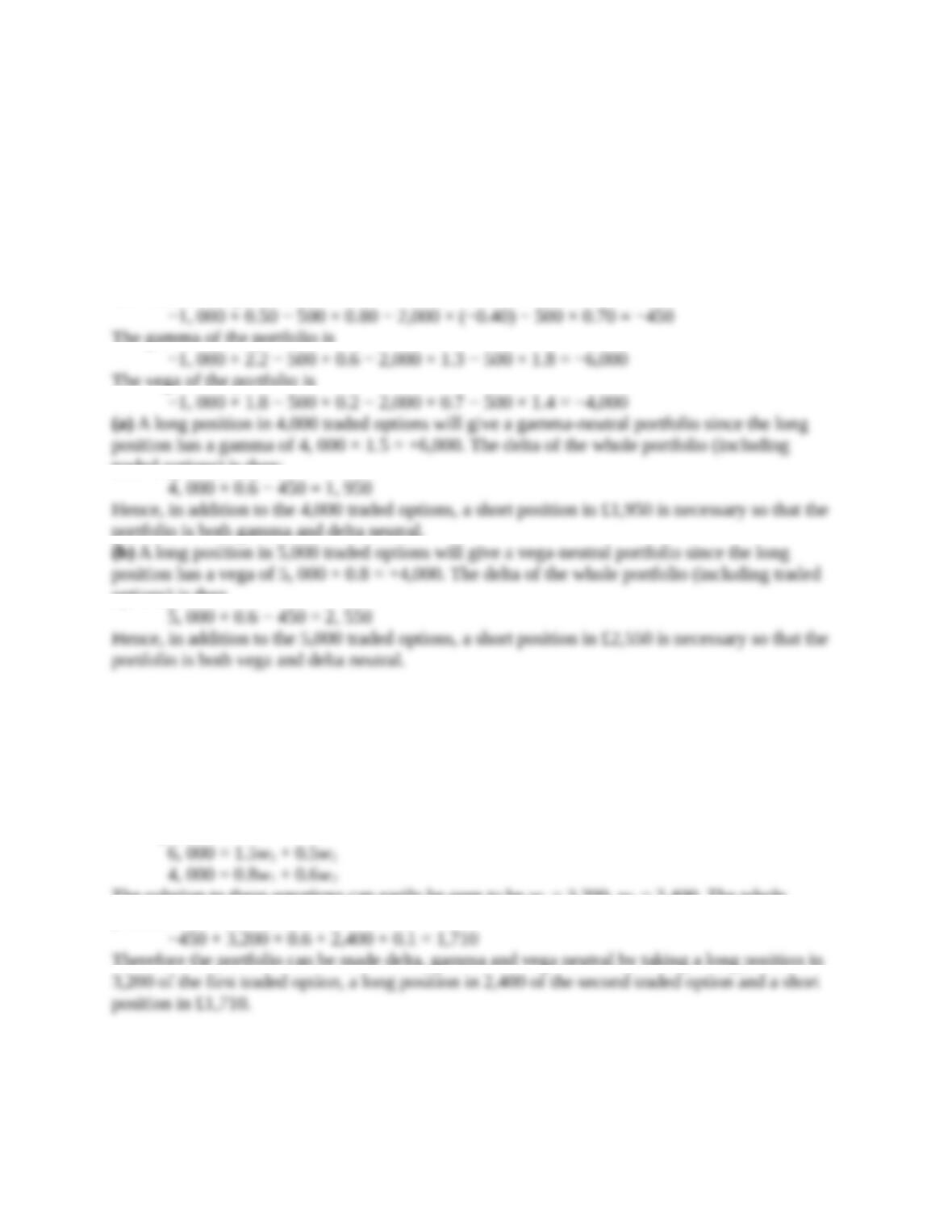
A financial institution has the following portfolio of over-the-counter options
on sterling:
Type Position Delta of
Option
Gamma of
Option
Vega of
Option
Call −1,000 0.50 2.2 1.8
A traded option is available with a delta of 0.6, a gamma of 1.5, and a vega
of 0.8.
(a) What position in the traded option and in sterling would make the portfolio
both gamma neutral and delta neutral?
(b) What position in the traded option and in sterling would make the portfolio
both vega neutral and delta neutral?
The delta of the portfolio is
The gamma of the portfolio is
The vega of the portfolio is
traded options) is then:
portfolio is both gamma and delta neutral.
options) is then
8.18.
Consider again the situation in Problem 8.17. Suppose that a second traded option with a delta
of 0.1, a gamma of 0.5, and a vega of 0.6 is available. How could the portfolio be made delta,
gamma, and vega neutral?
Let w1 be the position in the first traded option and w2 be the position in the second traded option.
We require:
The solution to these equations can easily be seen to be w1 = 3,200, w2 = 2,400. The whole
portfolio then has a delta of
Therefore the portfolio can be made delta, gamma and vega neutral by taking a long position in
8.19. (Spreadsheet Provided)
Reproduce Table 8.2. (In Table 8.2, the stock position is rounded to the
nearest 100 shares.) Calculate the gamma and theta of the position each
week. Using the DerivaGem Applications Builders to calculate the change in
the value of the portfolio each week (before the rebalancing at the end of
the week) and check whether equation (8.2) is approximately satistied.
(Note: DerivaGem produces a value of theta “per calendar day.” The theta in
equation 8.2 is “per year.”)
Consider the first week. The portfolio consists of a short position in 100,000 options and a long
position in 52,200 shares. The value of the option changes from $240,053 at the beginning of the
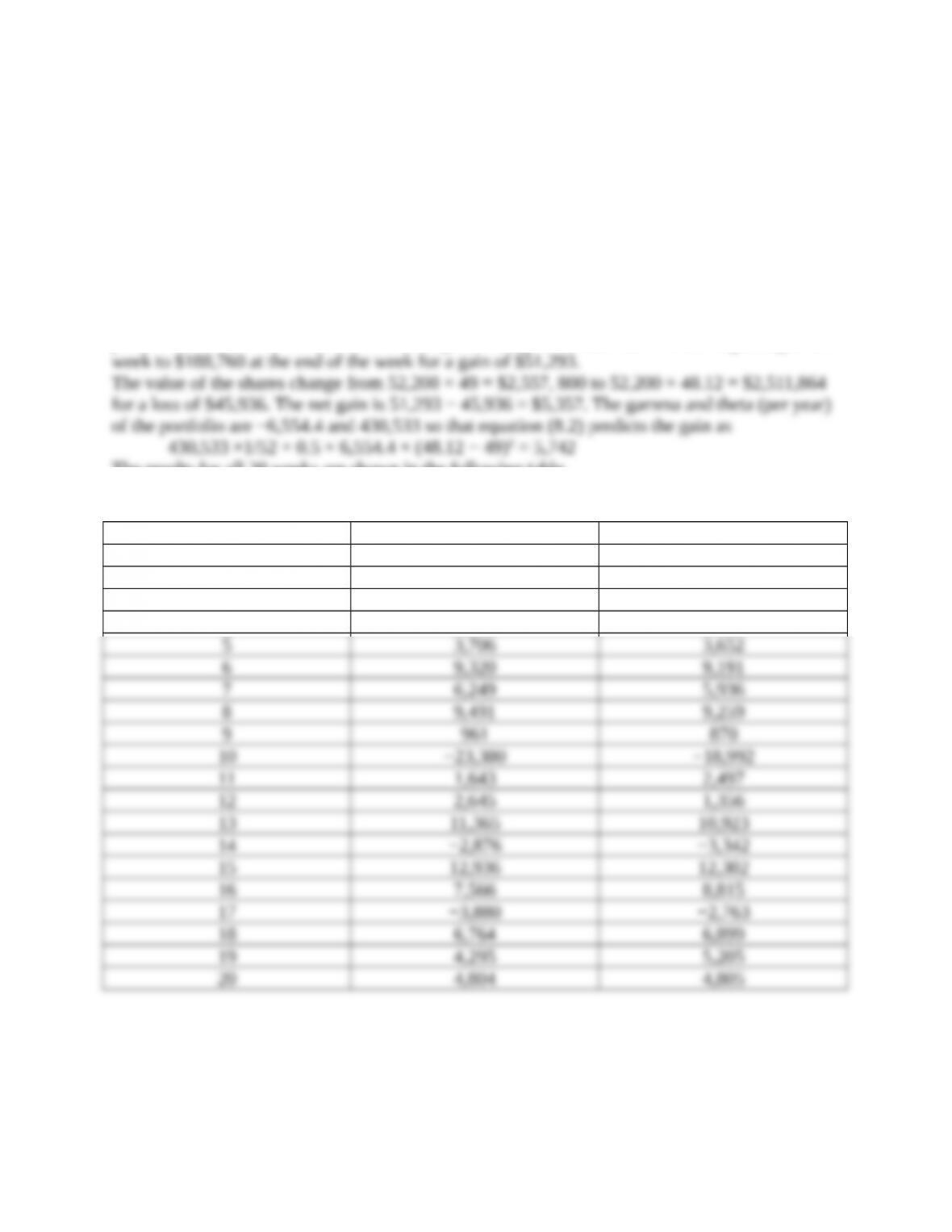
The results for all 20 weeks are shown in the following table.
Week Actual Gain ($) Predicted Gain ($)
1 5,357 5,742
2 5,689 6,093
3 −19,742 −21,084
4 1,941 1,572