Chapter 5: Trading in Financial Markets
5.28.
The current price of a stock is $94, and three-month European call options with a strike price of
$95 currently sell for $4.70. An investor who feels that the price of the stock will increase is
trying to decide between buying 100 shares and buying 2,000 call options (= 20 contracts). Both
strategies involve an investment of $9,400. What advice would you give? How high does the
stock price have to rise for the option strategy to be more profitable?
The investment in call options entails higher risks but can lead to higher returns. If the stock
price stays at $94, an investor who buys call options loses $9,400 whereas an investor who buys
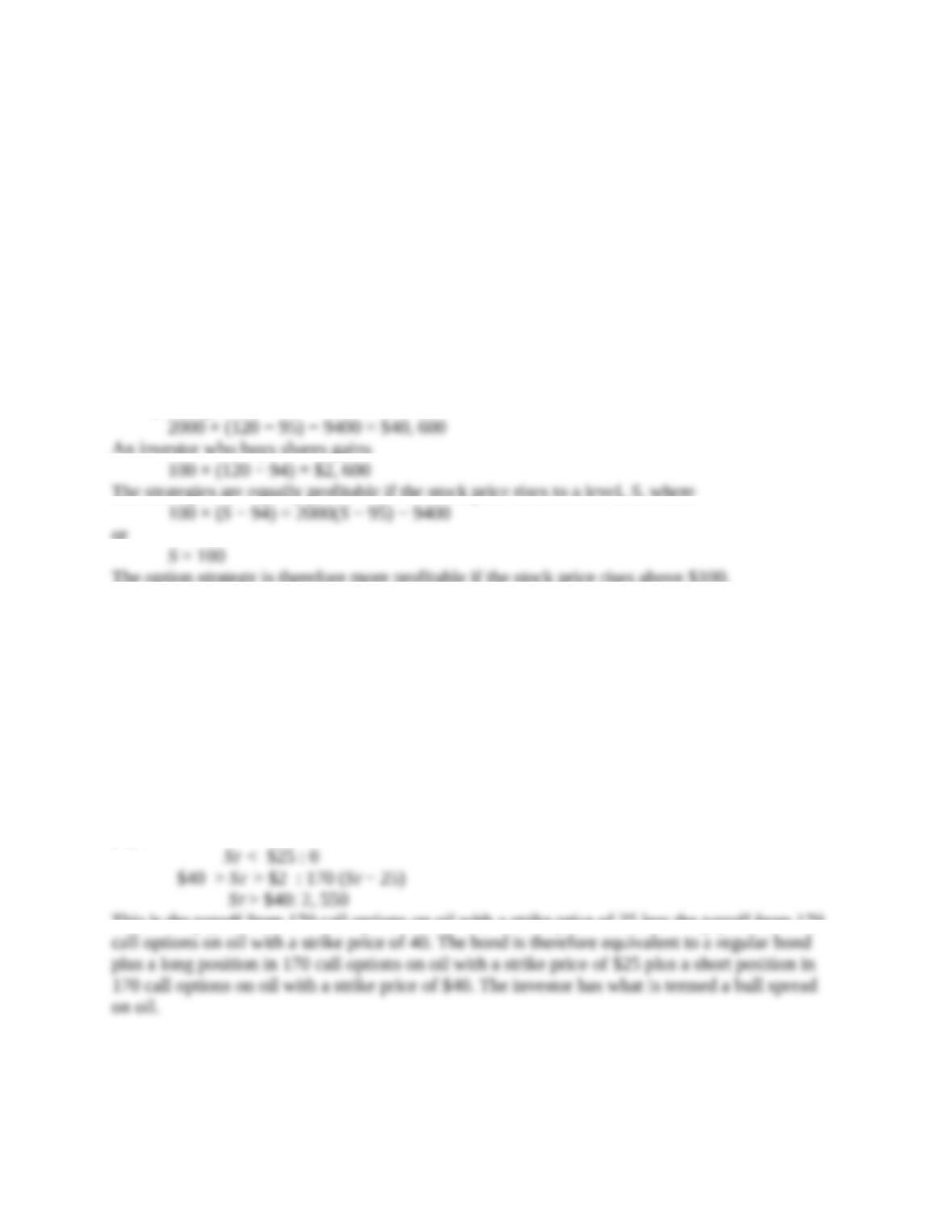
shares neither gains nor loses anything. If the stock price rises to $120, the investor who buys
call options gains
An investor who buys shares gains
The strategies are equally profitable if the stock price rises to a level, S, where
or
The option strategy is therefore more profitable if the stock price rises above $100.
5.29.
A bond issued by Standard Oil worked as follows. The holder received no interest. At the bond’s
maturity the company promised to pay $1,000 plus an additional amount based on the price of
oil at that time. The additional amount was equal to the product of 170 and the excess (if any) of
the price of a barrel of oil at maturity over $25. The maximum additional amount paid was
$2,550 (which corresponds to a price of $40 per barrel). Show that the bond is a combination of
a regular bond, a long position in call options on oil with a strike price of $25, and a short
position in call options on oil with a strike price of $40.
Suppose ST is the price of oil at the bond’s maturity. In addition to $1000 the Standard Oil bond
pays:
This is the payoff from 170 call options on oil with a strike price of 25 less the payoff from 170
5.30.
The price of gold is currently $1,500 per ounce. The forward price for delivery in one year is
$1,700. An arbitrageur can borrow money at 10% per annum. What should the arbitrageur do?
Assume that the cost of storing gold is zero and that gold provides no income.
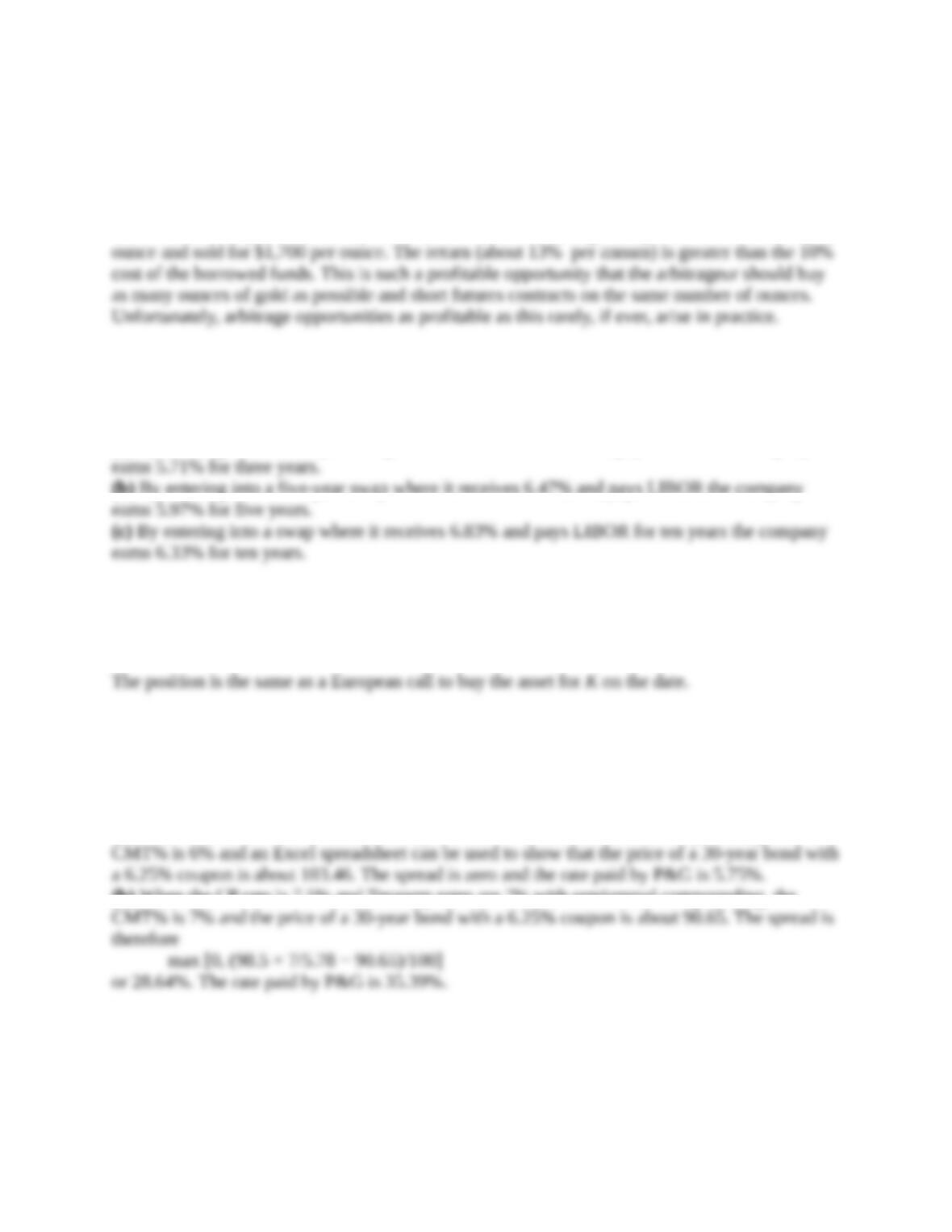
The arbitrageur could borrow money to buy 100 ounces of gold today and short futures contracts
on 100 ounces of gold for delivery in one year. This means that gold is purchased for $1,500 per
5.31.
A company’s investments earn LIBOR minus 0.5%. Explain how it can use the quotes in Table
5.5 to convert them to (a) three-, (b) five-, and (c) ten-year fixed-rate investments.
(a) By entering into a three-year swap where it receives 6.21% and pays LIBOR the company
(b) By entering into a five-year swap where it receives 6.47% and pays LIBOR the company
5.32.
What position is equivalent to a long forward contract to buy an asset at K on a certain date and
a long position in a European put option to sell it for K on that date?
5.33.
Estimate the interest rate paid by P&G on the 5/30 swap in Business Snapshot 5.4 if (a) the CP
rate is 6.5% and the Treasury yield curve is flat at 6% and (b) the CP rate is 7.5% and the
Treasury yield curve is flat at 7% with semiannual compounding.
(a) When the CP rate is 6.5% and Treasury rates are 6% with semiannual compounding, the
(b) When the CP rate is 7.5% and Treasury rates are 7% with semiannual compounding, the
.