Chapter 4: Mutual Funds and Hedge Funds
4.15.
An investor buys 100 shares in a mutual fund on January 1, 2015, for $50 each. The fund earns
dividends of $2 and $3 per share during 2015 and 2016. These are reinvested in the fund. The
fund’s realized capital gains in 2015 and 2016 are $5 per share and $3 per share, respectively.
The investor sells the shares in the fund during 2017 for $59 per share. Explain how the investor
is taxed.
The investor pays tax on dividends of $200 and $300 in year 2015 and 2016, respectively. The
investor also has to pay tax on realized capital gains by the fund. This means tax will be paid on
4.16.
Good years are followed by equally bad years for a mutual fund. It earns +8%, –8%, +12%,
–12% in successive years. What is the investor’s overall return for the four years?
The investors overall return is
4.17.
A fund of funds divides its money between five hedge funds that earn –5%, 1%, 10%, 15%, and
20% before fees in a particular year. The fund of funds charges 1 plus 10% and the hedge funds
charge 2 plus 20%. The hedge funds’ incentive fees are calculated on the return after
management fees. The fund of funds incentive fee is calculated on the net (after management fees
and incentive fees) average return of the hedge funds in which it invests and after its own
management fee has been subtracted. What is the overall return on the investments? How is it
divided between the fund of funds, the hedge funds, and investors in the fund of funds?
The overall return on the investments is the average of −5%, 1%, 10%, 15%, and 20% or 8.2%.
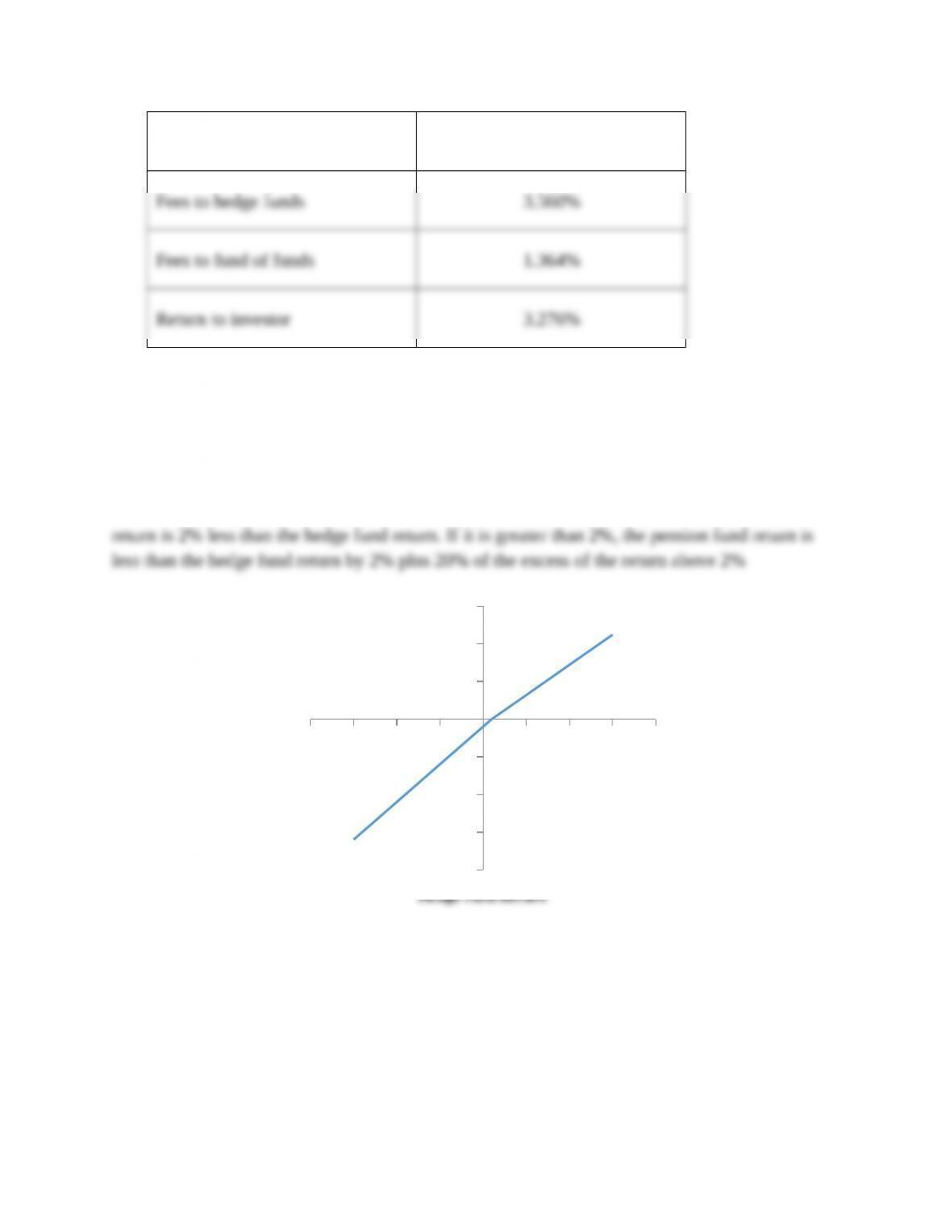
Return earned by hedge funds 8.200%
4.18.
A hedge funds charges 2 plus 20%. A pension fund invests in the hedge fund. Plot the return to
the pension fund as a function of the return to the hedge fund.
The plot is shown in the chart below. If the hedge fund return is less than 2% , the pension fund
-40% -30% -20% -10% 0% 10% 20% 30% 40%
-40.00%
-30.00%
-20.00%
-10.00%
0.00%
10.00%
20.00%
30.00%
Hedge Fund Ret urn
Pension Fund Ret urn