Chapter 26: Economic Capital and RAROC
26.10.
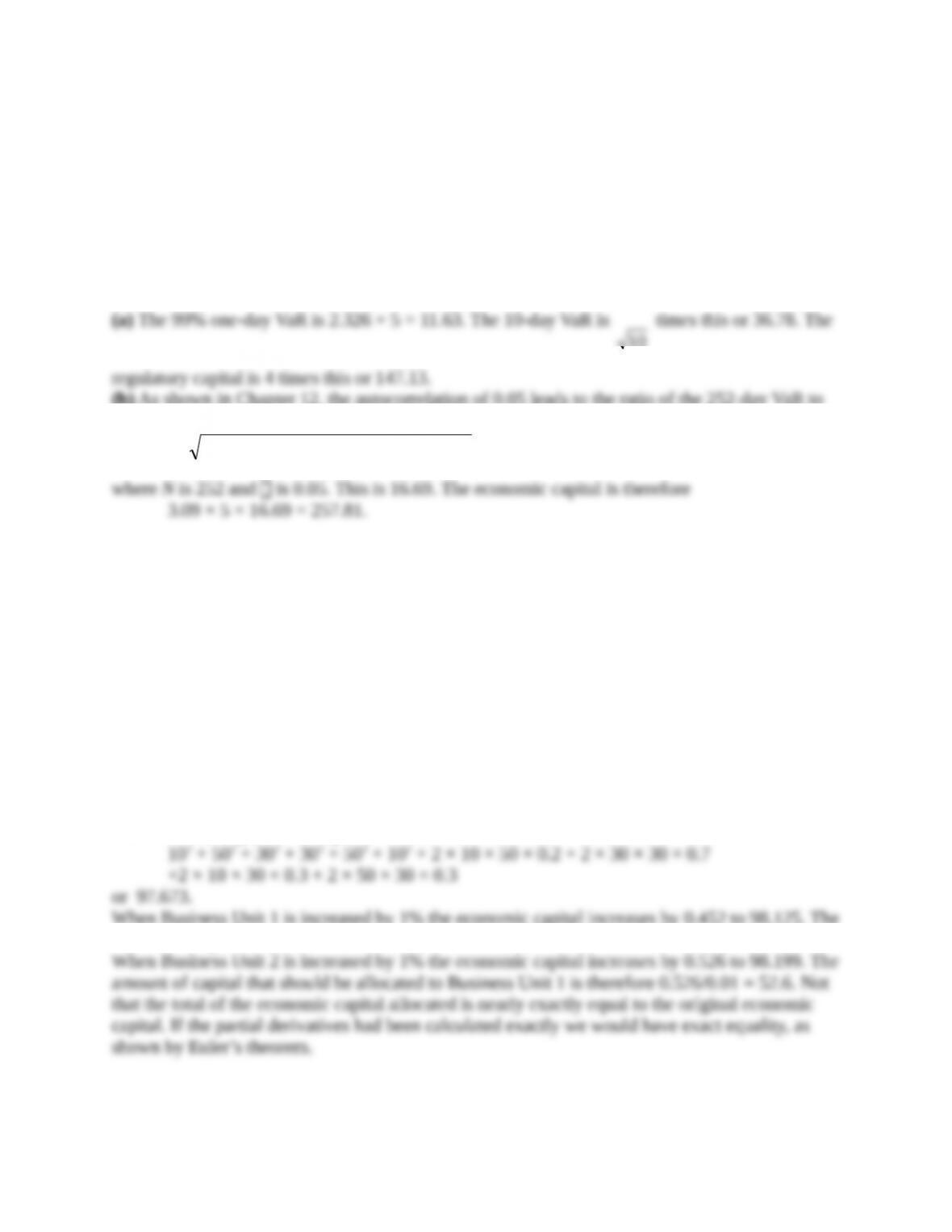
Suppose that daily gains (losses) are normally distributed with standard deviation of $5 million.
(a) Estimate the minimum regulatory capital the bank is required to hold. (Assume a
multiplicative factor of 4.0.)
(a) Estimate the economic capital using a one-year time horizon and a 99.9% confidence level
assuming that there is a correlation of 0.05 between gains (losses) on successive days.
10
(b) As shown in Chapter 12, the autocorrelation of 0.05 leads to the ratio of the 252-day VaR to
the one-day VaR being
12
2)2(2)1(2
N
NNN
where N is 252 and is 0.05. This is 16.69. The economic capital is therefore
3.09 × 5 × 16.69 = 257.81.
26.11.
Suppose that the economic capital estimates for two business units are
Business Units
1 2
Market Risk 10 50
Credit Risk 30 30
Operational Risk 50 10
The correlation between market risk and credit risk in the same business unit is 0.3. The
correlation between credit risk in one business unit and credit risk in another is 0.7. The
correlation between market risk in one business unit and market risk in the other is 0.2. All other
correlations are zero. Calculate the total economic capital. How much should be allocated to
each business unit?
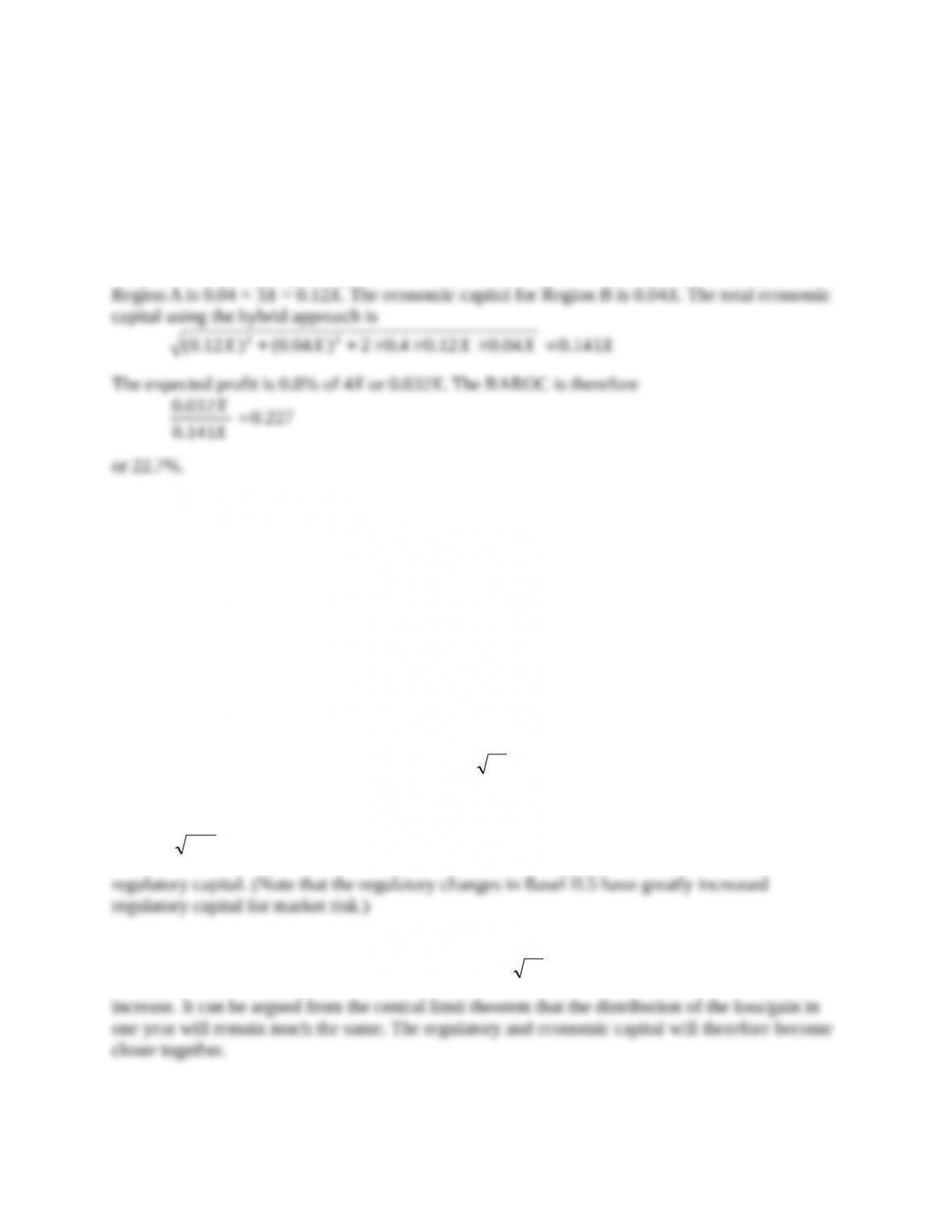
The economic capital is the square root of
When Business Unit 1 is increased by 1% the economic capital increases by 0.452 to 98.125. The
amount of capital that should be allocated to Business Unit 1 is therefore 0.452/0.01 = 45.2.
26.12.
Suppose that a bank’s sole business is to lend in two regions of the world. The lending in each
region has the same characteristics as in Example 26.5 of Section 26.8. Lending to Region A is
three times as great as lending to Region B. The correlation between loan losses in the two
regions is 0.4. Estimate the total RAROC.
Suppose that the lending to Region A is 3X and that to Region B is X. The economic capital for
26.13.
Suppose daily losses (gains) from trading are independent and normally distributed with mean
zero. Calculate in terms of the standard deviation of the daily losses (gains) (a) the basic Basel I
regulatory capital requirement assuming calculated as 3 times the ten-day VaR and (b) the
economic capital calculated using a 99.97% confidence level and a one-year time horizon.
Would you expect the economic and regulatory capital to become closer together or further
apart if daily losses/gains are generated by a distribution with much heavier tails than the
normal distribution? What would you expect to be the impact of the daily losses/gains exhibiting
positive autocorrelation.
The Basel I regulatory capital requirement is
07.22)99.0(103
1
N
where is the
standard deviation of daily gains/losses. The economic capital (assuming 252 trading days in a
year) is
.48.54)9997.0(252
1
N
The economic capital is therefore greater tahn the
Heavy tails will increase the daily VaR and, when the
10
rule is used, regulatory capital will

Autocorrelation will not affect regulatory capital because it is in essence based on the one-day