Chapter 25: Model Risk
25.13.
Suppose that all options traders decide to switch from Black–Scholes to another model that
makes different assumptions about the behavior of asset prices. What effect do you think this
would have on (a) the pricing of standard options and (b) the hedging of standard options?
(a) As explained in the chapter the Black–Scholes model is used as an interpolation tool. It is
25.14.
Using Table 25.1, calculate the volatility a trader would use for an 11-month option with a strike
price of 0.98.
Interpolation gives the volatility for a six-month option with a strike price of 0.98 as
25.15.
Suppose that a financial institution uses an imprecise model for pricing and hedging a particular
type of structured product. Discuss how, if at all, it is likely to realize its mistake.
Suppose that a bank’s price for the product is too high. If other market participants are using a
If it has no interaction on pricing with the rest of the market or if the rest of the market is pricing
the product in the same way, it might never realize its mistake. In theory, its hedging should lead
25.16.
A futures price is currently at $40. The risk-free interest rate is 5%. Some news is expected
tomorrow that will cause the volatility over the next three months to be either 10% or 30%.
There is a 60% chance of the first outcome and a 40% chance of the second outcome. Use the
DerivaGem software to calculate a volatility smile for three-month options.
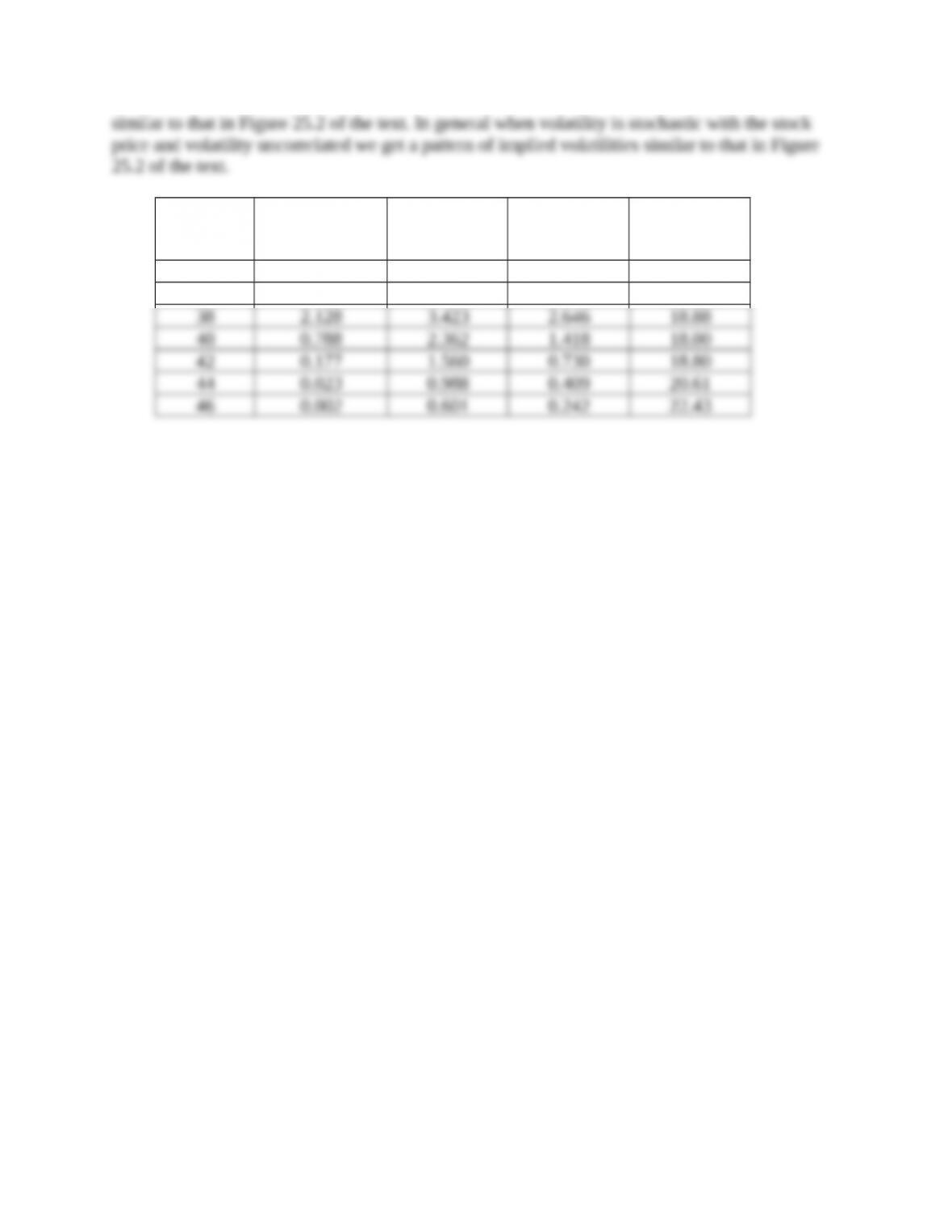
The calculations are shown in the following table. For example, when the strike price is 34, the
price of a call option with a volatility of 10% is 5.926, and the price of 40 a call option when the
Strike
price
Call Price
(10% Vol)
Call price
(30% Vol)
Weighted
Price
Implied
Vol
34 5.926 6.312 6.080 23.21
36 3.962 4.749 4.277 21.03