Chapter 20: CVA and DVA
20.13. (Spreadsheet Provided)
Extend Example 20.3 to calculate CVA when default can happen in the middle of each month.
Assume that the default probability during the first year is 0.001667 per month and the default
probability during the second year is 0.0025 per month..
20.14 (Spreadsheet Provided)
Calculate DVA for the bank in Example 20.2. Assume that the bank can default in the middle of
each month and that the default probability is 0.001 per month for the two years. Assume that
the recovery rate for the counterparty when the bank defaults is 40%.
20.15
Consider a European call option on a non-dividend-paying stock where the stock price is $52,
the strike price $50, the risk-free rate is 5%, the volatility is 30%, and the time to maturity is one
year. Answer the following questions assuming no recovery in the event of default, that the
probability of default is independent of the option valuation, no collateral is posted, and no other
transactions between the parties are outstanding.
(a) What is the value of the option assuming no possibility of a default?
(b) What is the value of the option to the buyer if there is a 2% chance that the option seller will
default at maturity?
(c) Suppose that, instead of paying the option price up front, the option buyer agrees to pay the
forward value of the option price at the end of option’s life. By how much does this reduce the
cost of defaults to the option buyer in the case where there is a 2% chance of the option seller
defaulting?
(d) If in case (c) the option buyer has a 1% chance of defaulting at the end of the life of the
option, what is the default risk to the option seller? Discuss the two-sided nature of default risk
in the case and the value of the option to each side.
(a) From DerivaGem the value is $8.41
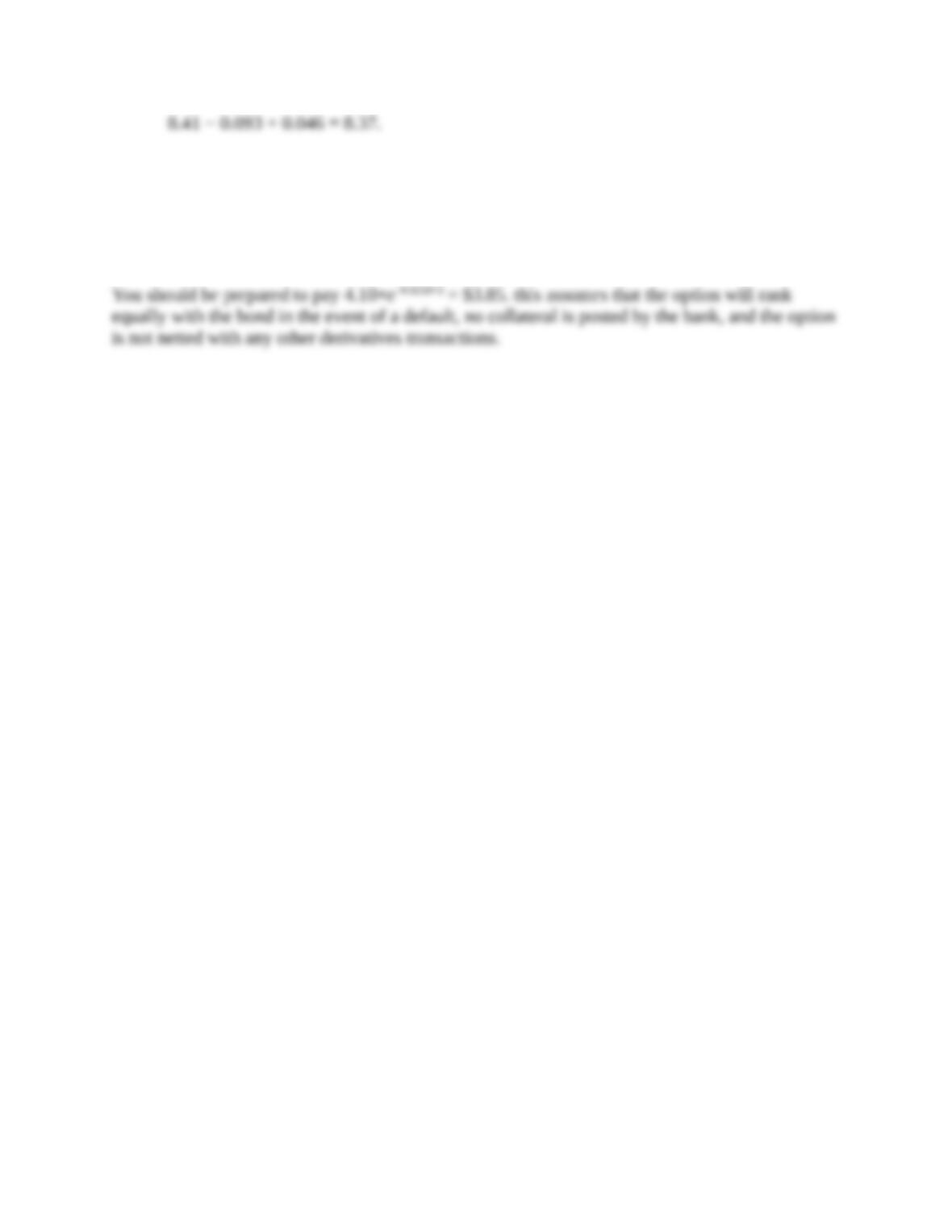
(d) In the event that the buyer defaults the seller of the option loses when the stock price is less
than 58.845 at maturity. The seller loses 8.845 when the stock price is less than 50 and 58.845 –
20.16
Suppose that the spread between the yield on a three-year riskless zero-coupon bond and a
three-year zero-coupon bond issued by a bank is 210 basis points. The Black-Scholes–Merton
price of an option is $4.10. How much should you be prepared to pay for it if you buy it from a
bank?