P9–2
a.
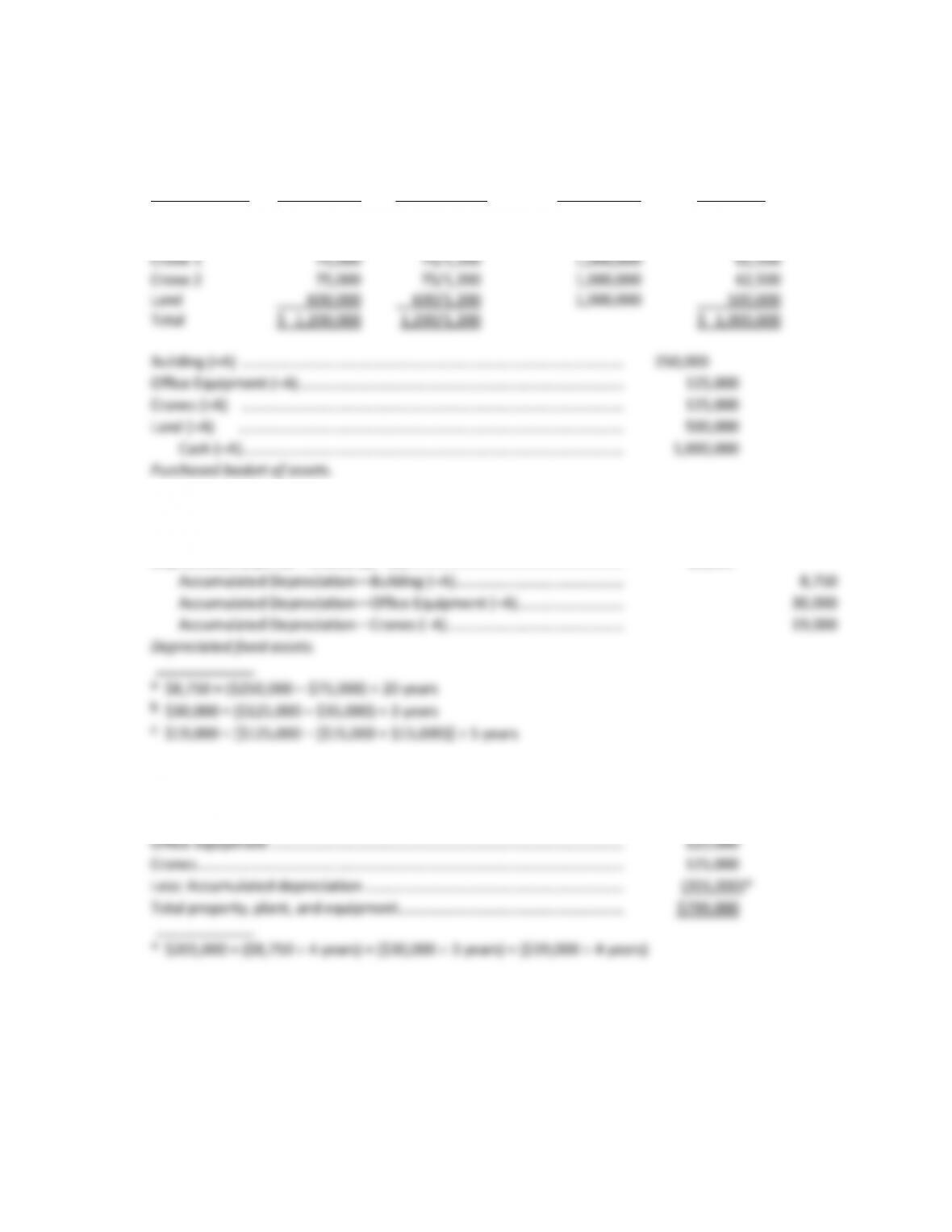
1/1/14 Relative Purchase Cost
Asset FMV FMV Price = Allocation
Building $ 300,000 300/1,200 $1,000,000 $ 250,000
Office equip. 150,000 150/1,200 1,000,000 125,000
b. Depreciation Expense—Building (E, –SE) ………………………………………….. 8,750a
Depreciation Expense—Office Equipment (E, –SE) …………………………..… 30,000b
Depreciation Expense—Cranes (E, –SE) ……………………………………………. 19,000c
c. Property, plant, and equipment:
Land …………………………………………………………………………………………….. $500,000
Building ……………………………………………………….……………………………….. 250,000
P9–3
a. Cost = Purchase Price + Transportation + Installation
= $950,000 + $100,000 + $130,000 = $1,180,000
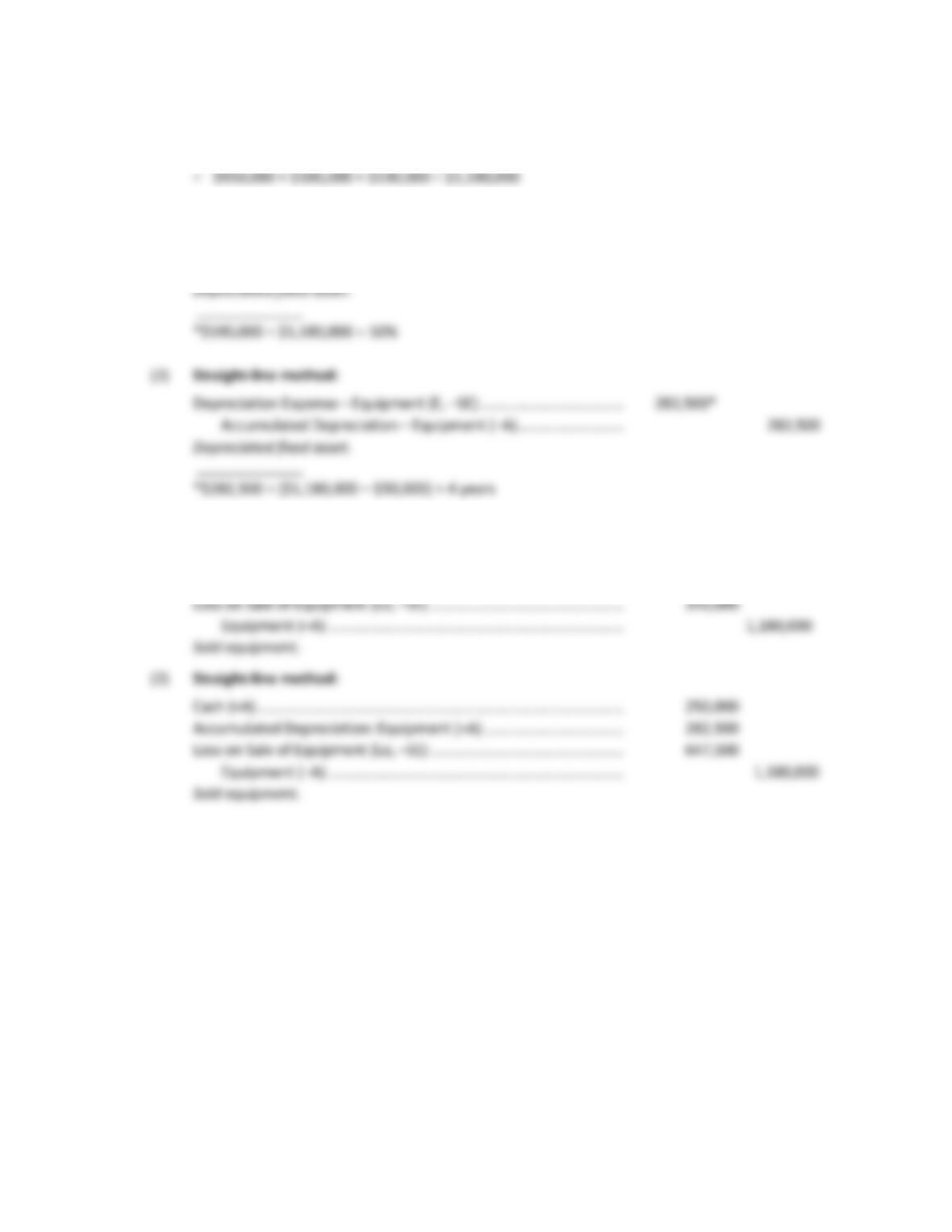
b. (1) Double-declining-balance method:
Depreciation Expense—Equipment (E, –SE) …………………………….. 590,000*
Accumulated Depreciation—Equipment (–A) …………………….. 590,000
c. (1) Double-declining-balance method:
Cash (+A) …………………………………………………………………………….. 250,000
Accumulated Depreciation: Equipment (+A) ……………………………. 590,000
P9–4
a. Truck (+A)……………………………………………………………………………………. 48,000
b.
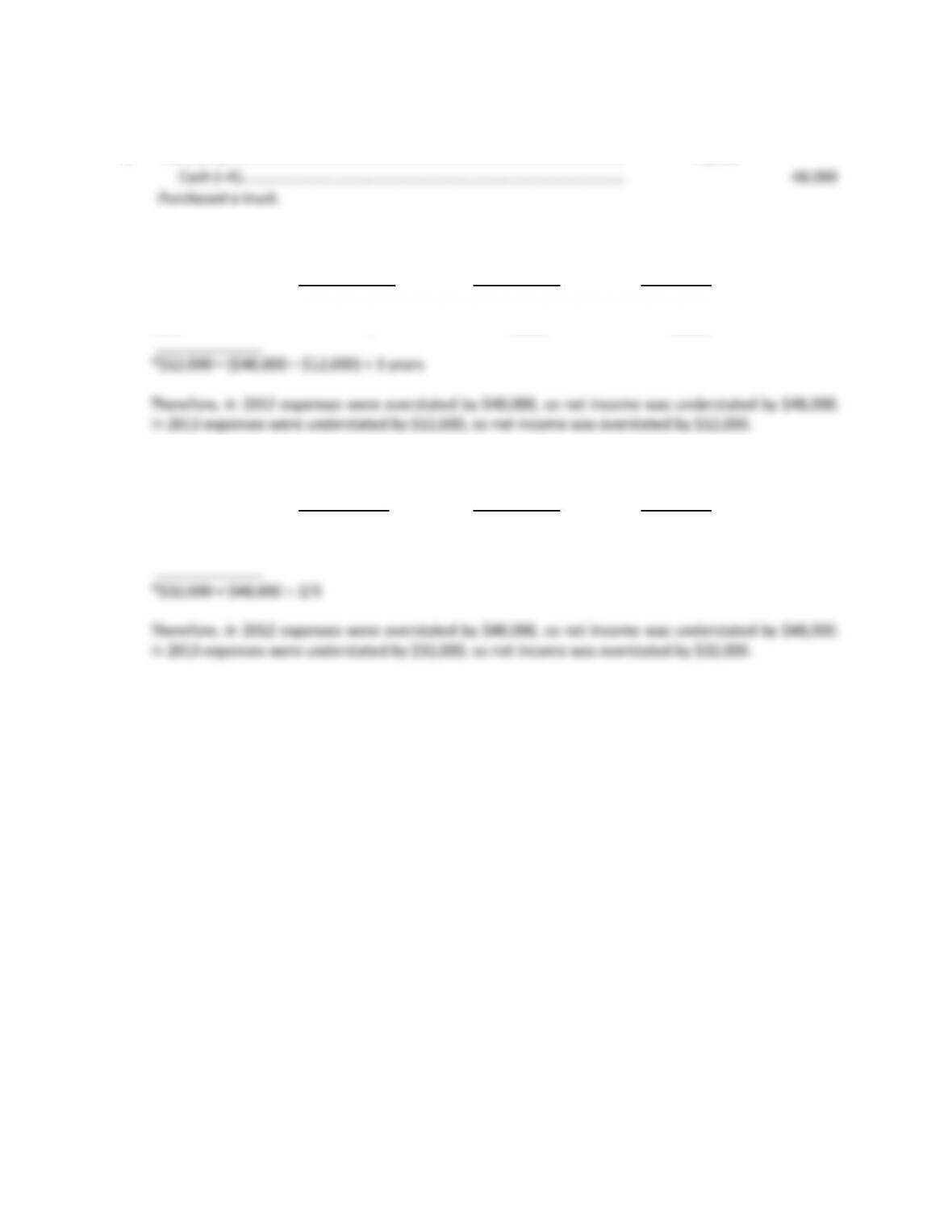
Depreciation Correct
Per Books Depreciation Difference
2012 $48,000 $ 0 $48,000
2013 0 12,000* 12,000
c.
Depreciation Correct
Per Books Depreciation Difference
2012 $48,000 $ 0 $48,000
2013 0 32,000* 32,000
P9–5
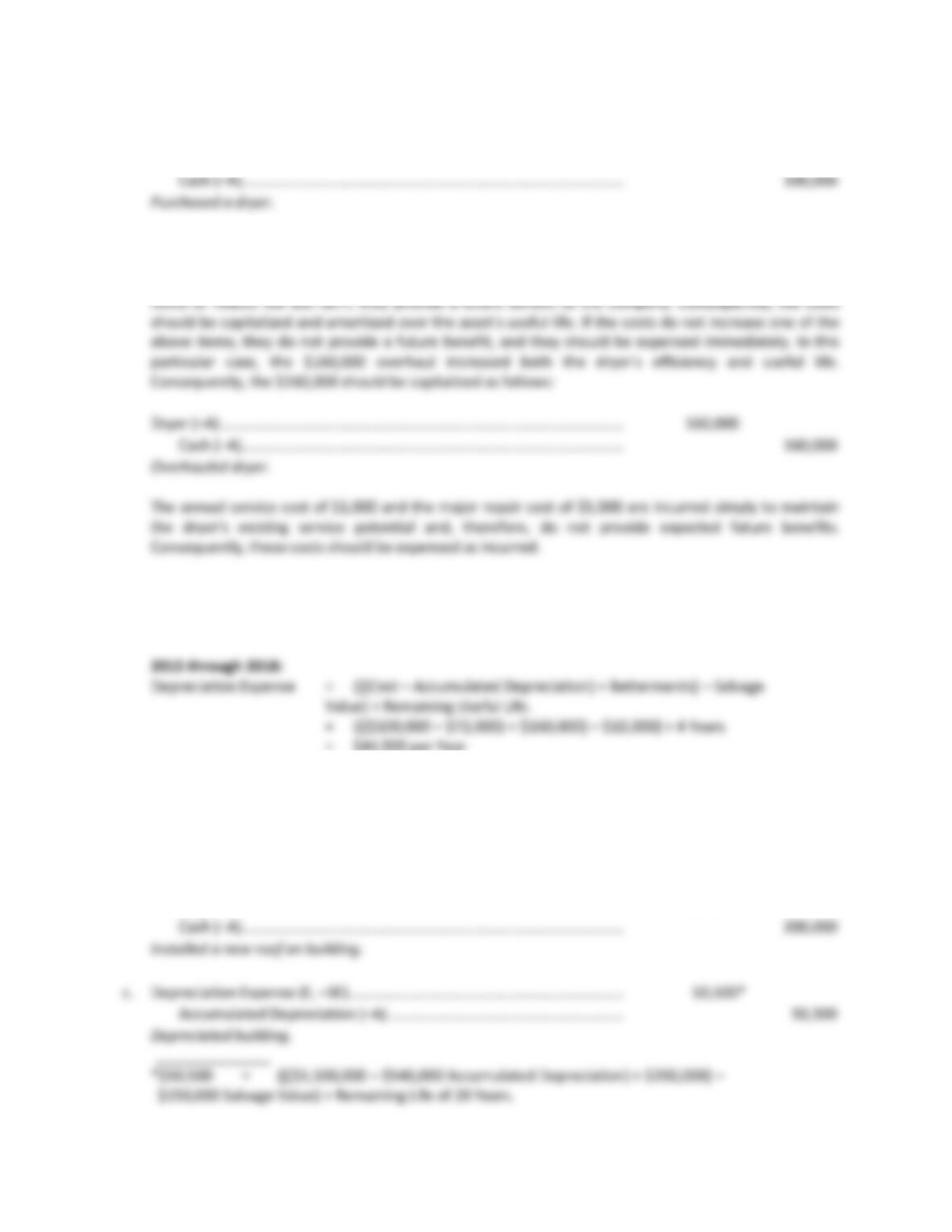
a. Dryer (+A) …………………………………………………………………………………….. 100,000
b. In deciding how to account for service and repair costs, one must consider the effect of the cost on (1)
the useful life of the asset, (2) the quality of units produced by the asset, (3) the quantity of units
produced by the asset, or (4) the cost of operating the asset. If the costs increase one of the first three
c. 2011 through 2014:
Depreciation Expense = (Cost – Salvage Value) ÷ Useful Life
= ($100,000 – $10,000) ÷ 5 Years = $18,000 per Year
= $44,500 per Year
P9–6
a. Building (+A) …………………………………………………………………………………. 1,500,000
Cash (–A) ………………………………………………………………………………… 1,500,000
Purchased a building.
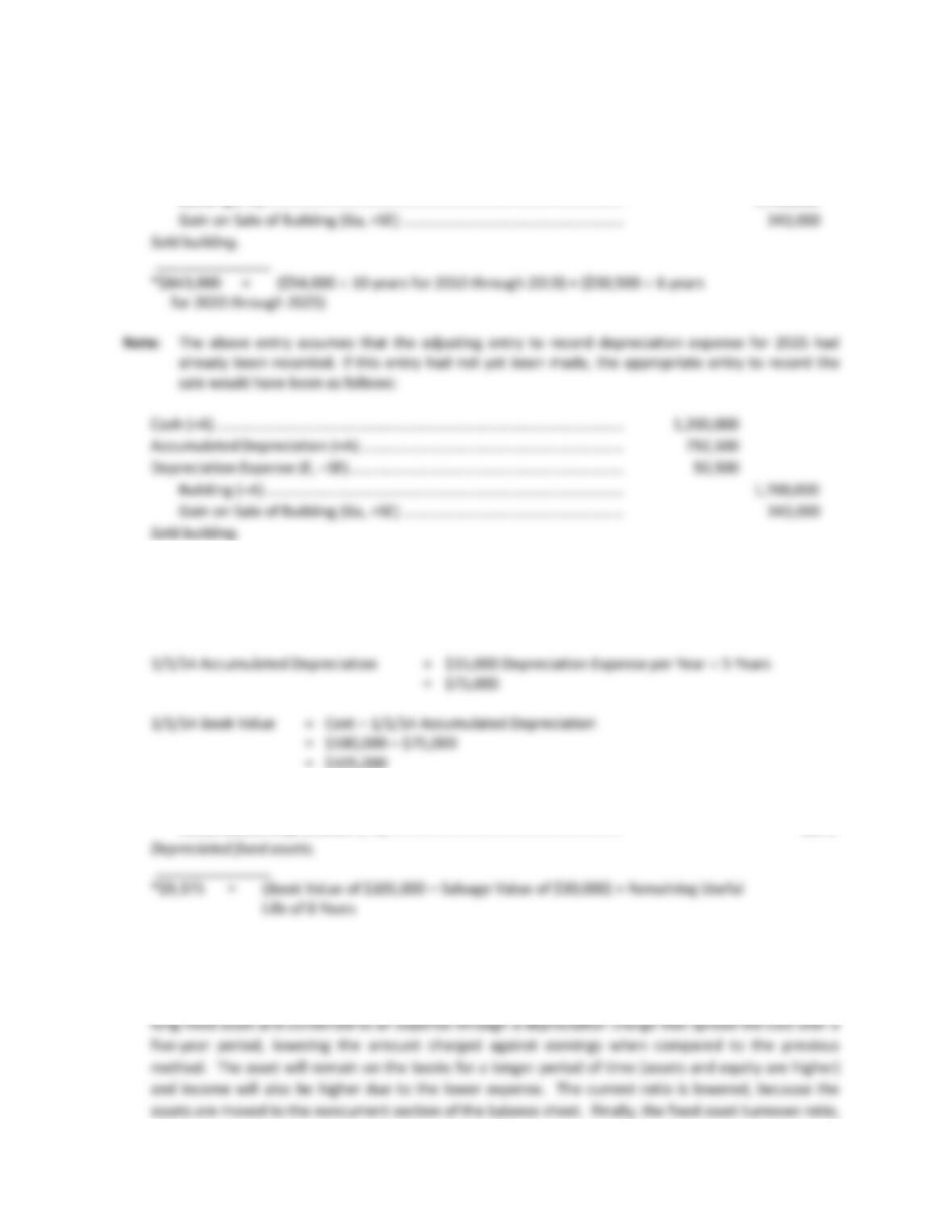
b. Building (+A) …………………………………………………………………………………. 200,000
P9–6 Concluded
d. Cash (+A) ……………………………………………………………………………………… 1,200,000
Accumulated Depreciation (+A) ………………………………………………………. 843,000*
Building (–A) …………………………………………………………………………… 1,700,000
P9–7
a. Depreciation Expense per Year = ($180,000 – $30,000) ÷ 10 Years
= $15,000 per Year
= $105,000
b. Depreciation Expense (E, –SE) …………………………………………………………. 9,375
Accumulated Depreciation (–A) ………………………………………………… 9,375
P9–8
When the hand-held instruments were capitalized as a prepaid expense, they were carried as Current
Assets and converted to an expense as used. After the accounting change, the asset was carried as a
P9–9
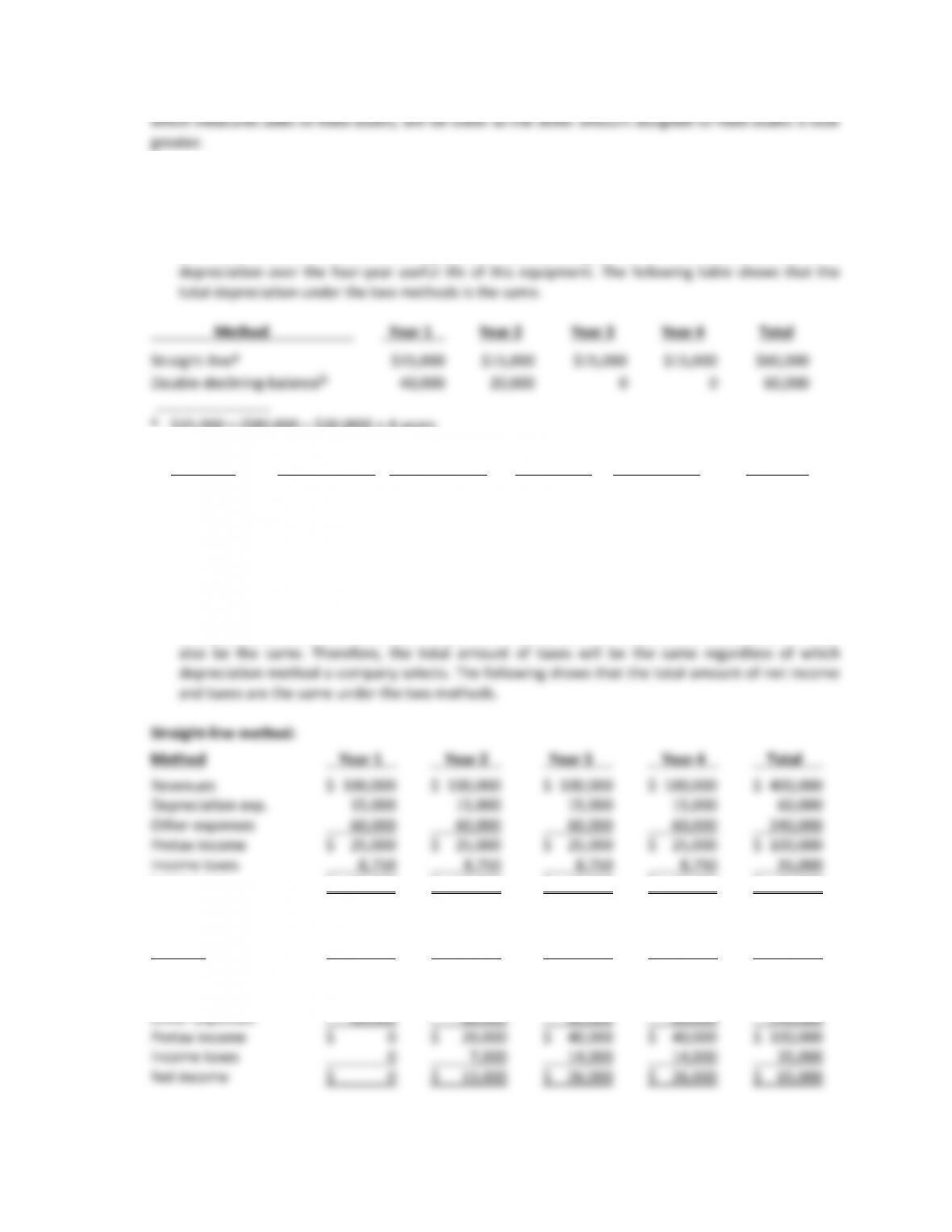
a. Every depreciation method depreciates the same amount over the useful life of a fixed asset.
Depreciation methods only vary the timing of depreciation charges. Therefore, both the straight-
line method and the double-declining-balance method will give rise to the same total amount of
b Depreciation Depreciation Historical Accumulated Book
Date Factor Expense Cost Depreciation Value
1/1/14 $80,000 $ 0 $80,000
12/31/14 50% $40,000 80,000 40,000 40,000
12/31/15 50% 20,000 80,000 60,000 20,000
12/31/16 50% 0 80,000 60,000 20,000
12/31/17 50% 0 80,000 60,000 20,000
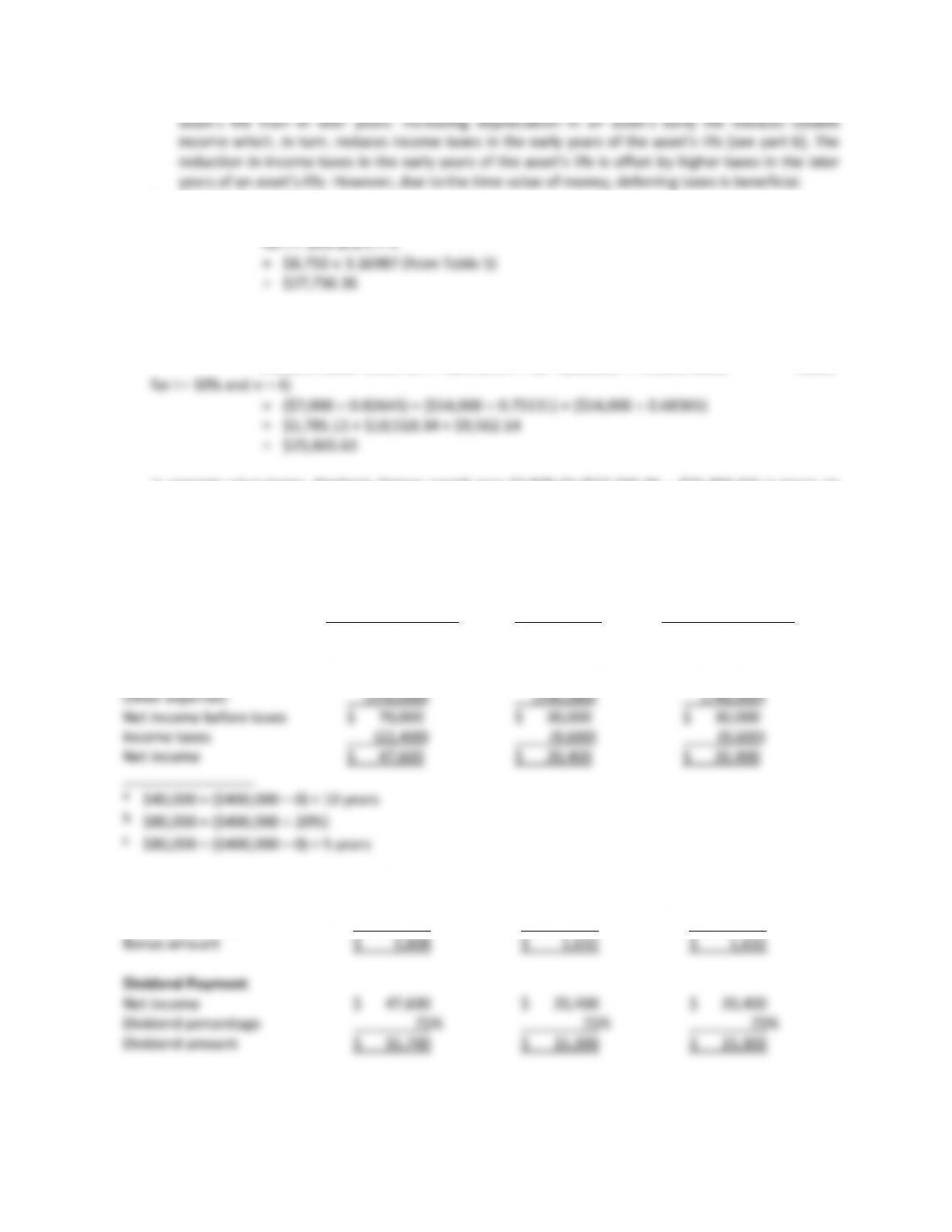
b. Since, as demonstrated in part (a), both depreciation methods give rise to the same total amount
of depreciation over the fixed asset’s life, the total amount of net income over the asset’s life must
Net income $ 16,250 $ 16,250 $ 16,250 $ 16,250 $ 65,000
Double-declining-balance:
Method Year 1 Year 2 Year 3 Year 4 Total
Revenues $ 100,000 $ 100,000 $ 100,000 $ 100,000 $ 400,000
Depreciation exp. 40,000 20,000 0 0 60,000
Other expenses 60,000 60,000 60,000 60,000 240,000
c. The double-declining–balance method is preferred for tax purposes because this method defers tax
payments. Under this depreciation method, more depreciation is taken in the early years of an
d. Straight-line method:
Present Value = $8,750 from part (b) Present Value of an Ordinary Annuity Factor
Double-declining-balance method:
Present Value = ($7,000 Present Value Factor for i = 10% and n = 2) + ($14,000
Present Value Factor for i = 10% and n = 3) + ($14,000 Present Value Factor
In present value terms, Kimberly Sisters would save $1,870.73 ($27,736.36 – $25,865.63) in taxes on
this one asset by selecting the double-declining-balance method over the straight-line method.
P9–10
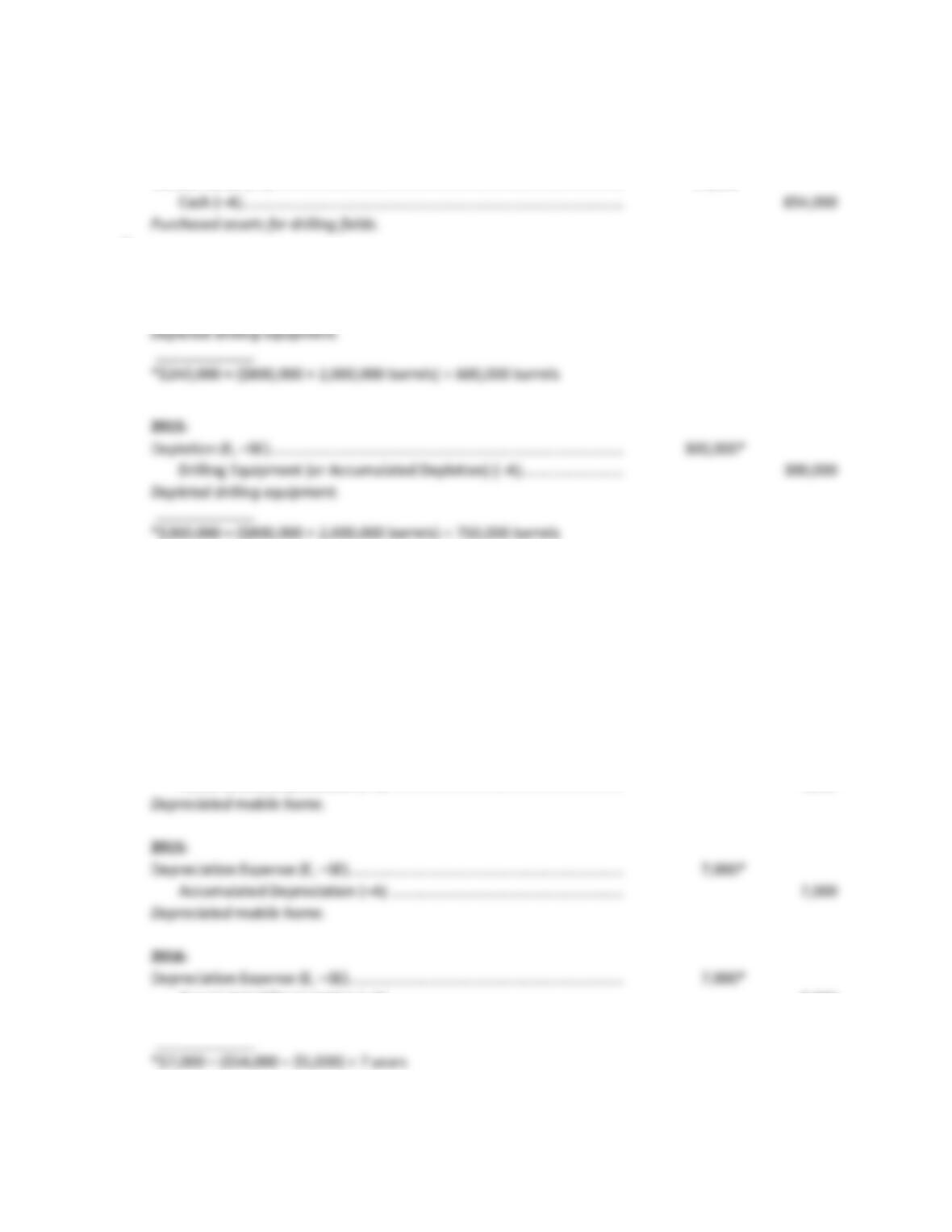
(a) (b) (c)
S-L Depreciation DDB S-L Depreciation
(10-year life) Depreciation (5-year life)
Tax Payments:
Revenues $ 250,000 $ 250,000 $ 250,000
Depreciation expense (40,000)a (80,000)b (80,000)c
Bonus Payment:
Net income $ 47,600 $ 20,400 $ 20,400
Bonus percentage 8% 8% 8%
P9–11
a. Drilling Equipment (+A) ………………………………………………………………….. 800,000
Mobile Home (+A) …………………………………………………………………………. 54,000
b.
2014:
Depletion (E, –SE) ………………………………………………………………………….. 240,000*
Drilling Equipment (or Accumulated Depletion) (–A) ……………………. 240,000
2016:
Depletion (E, –SE) ………………………………………………………………………….. 260,000*
Drilling Equipment (or Accumulated Depletion) (–A) ……………………. 260,000
Depleted drilling equipment.
____________
*$260,000 = ($800,000 ÷ 2,000,000 barrels) 650,000 barrels
c.
2014:
Depreciation Expense (E, –SE) …………………………………………………………. 7,000*
Accumulated Depreciation (–A) ………………………………………………… 7,000
Accumulated Depreciation (–A) ………………………………………………… 7,000
Depreciated mobile home.
P9–11 Concluded
Different methods are used to allocate the costs of the drilling equipment and the mobile home based
upon the link between the asset and the oil field. The drilling equipment is site-specific. Hence, its
useful life is identical to the productive life of the oil field. Under the matching principle, the activity
d.
Depletion:
2014:
Depletion (E, –SE) ………………………………………………………………………….. 240,000
Drilling Equipment (or Accumulated Depletion) (–A) ……………………. 240,000
Depleted drilling equipment.
2015:
P9–12
a. Cash (+A) ……………………………………………………………………………………… 325,000
Accumulated Depreciation (+A) ………………………………………………………. 240,000*
*$240,000 = [($500,000 – $100,000) ÷ 5 years] 3 years used
b. Depreciation Expense (E, –SE) …………………………………………………………. 40,000*
Accumulated Depreciation (–A) ………………………………………………… 40,000
Depreciated machinery for January 1 – June 30.
____________
c. FMV of asset received:
Land (+A) …………………………..…………………………………………………………. 210,000
Accumulated Depreciation (+A) ………………………………………………………. 240,000
Loss on Trade-in (Lo, –SE) ……………………………………………………….………. 225,000
Machinery (–A) …………………………..…………………………………………… 500,000
P9–13
a. Most assets are reported on the balance sheet at historical cost or at historical cost less accumulated
b. Diversified would pay more for Specialists due to goodwill (i.e., synergy). Specialists’ assets considered
as a package are worth more than the sum of their individual values. Goodwill arises because certain
c. Assets (+A) ……………………………………………………………………………………. 1,350,000
Goodwill (+A) ………………………………………………………………………………… 700,000
d. Until recently under GAAP, goodwill was capitalized at the time of acquisition and then amortized over
a maximum of 40 years. The school of thought holding the opposite viewpoint espouses that goodwill
P9–14
a. Goodwill would be calculated by taking the purchase price less the fair value of the net assets. In this
b. There may be a number of reasons why Zimmer paid over the fair value of Centerplus. There may be
assets that are not recorded on Centerplus’s books. This usually would be the value of the brand name
or a high quality workforce. Another reason could be that Zimmer foresees that there will be
ISSUES FOR DISCUSSION
ID9–1
a. Gains and losses resulting from the disposal of fixed assets are based on the difference between the
proceeds received from the disposal and the asset’s book value. Thus, one would have to know the
book value of each individual casino and the land to be able to determine the gain or loss from selling
one of the casinos. Book value equals the original cost of the fixed asset less any accumulated
b. Cash (+A) ……………………………………………………………………………………… 110,000,000
Casino (–A) …………………………..…………………………………………………. 75,000,000
c. For the purchasing company, it would be necessary to allocate the total $110 million cost to the casino
and land. This could be done based on an appraised fair market value. The land without the casino
d. Cost of hotel: $110,000,000 – $43,000,000 = $67,000,000
ID9–2
One of the underlying goals of an accounting system is to properly match revenues with expenses.
There are many marketing costs that will help to produce revenue for the company over multiple
periods. If the company expenses all of these marketing expenses in the first year, then net income for
ID9–2 Concluded
expenditures. Auditors also tend to be conservative when there is uncertainty as to the future value of
an asset. Will these marketing costs from this year truly have value in future years? Since this is a
ID9–3
a. The main issue to be considered is whether the capital expenditure is a betterment or simply
b. The amount may be immaterial.
c. Depreciation per year represents the remaining net cost of an asset allocated over the asset’s
estimated remaining useful life. In this particular case, the remaining net cost equals the sum of the
ID9–4
a. EADS is expensing a portion of its research and development costs, but the company is not
ID9–5
One of the underlying goals of an accounting system is to properly match revenues with expenses.
There are many advertising and research & development costs that will help to produce revenue for
the company over multiple periods. If the company expenses all of these expenses in the first year,
then net income for the first year will be understated and then overstated in future years when the
revenue produced is not matched with the expenses incurred to generate it. At the same time it is very
ID9–6
a. The effect on profits from increased capital spending will come from increased depreciation charges.
Capitalized expenditures for fixed assets will eventually hit the income statement as depreciation
expense.
b. The balance sheet will reflect growth in the property, plant and equipment, as well future growth in the
contra asset accumulated depreciation account. The income statement will show increased
receive a return on their investment in the company.
ID9–7
a. The most likely scenario causing a restaurant’s value to be impaired is a loss in the desirability of
the location. If a McDonald’s restaurant was located at a certain intersection and traffic patterns in the
b. McDonald’s will record the impairment by first determining the fair value of the asset. Then, the
company will record an impairment expense and reduce the asset from its current carrying value down
to the (new) fair value.
c. As with other expenses that are somewhat at management’s discretion, shareholders are vulnerable
ID9–8
a. It seems GE is engaging in income-smoothing. Whenever GE has a one-time reporting gain due to any
unusual events, it also tries to book a related expense or a charge to offset that gain. This ensures that
earnings do not rise so high that they cannot be topped the following year.
b. Discretionary restructuring charges are used by GE to offset the one–time gains in order to avoid an
abnormal peak in the company’s earnings for the year. It seems that GE’s management strongly
c. Since the proliferation of total quality movement, restructuring is usually perceived by the investors
ID9–9
a. The problem with using current costs is trying to determine what the current cost is. That is, how does
one determine the current cost of a specialized piece of manufacturing equipment or the current cost
of an office building in a slow-moving real estate market? This difficulty in determining current costs
b. Historical costs are sunk costs in that they represent the cost of an asset at the time the asset was
acquired; historical costs do not indicate the magnitude of cash or net assets that an asset will generate
in the future. Since sunk costs are irrelevant for decision-making purposes, historical costs are not
relevant for decision-making purposes. Alternatively, current costs provide a measure of the value of an
asset today. For example, the amount reported for Cost of Goods Sold and Depreciation Expense under
c. The argument comes down to reliability versus relevancy. Current cost information is more relevant
than historical cost information, but it is considerably more difficult to objectively determine current
costs than it is to determine historical costs. If individual financial statement users were able to dictate
ID9–10
a. Asset write-downs allow Kellogg to manage earnings by reducing depreciation expenses in future
b. The accounting profession in general tends to prefer conservative accounting practices. By carrying the
c. The FASB has come out against this policy of “taking a bath” by companies when they have had a really
bad quarter to begin with. Some companies will then go ahead and write down assets so that in future
ID9–11
a. The write-off of an outdated technology system would reduce assets and equity; equity is reduced
because of the write-off expense, which reduces Retained Earnings through lower profits.
b. The most likely factor in determining that a system is overvalued is the introduction of new
ID9–12
According to U.S. GAAP, long-lived assets are recorded at original cost less accumulated depreciation. If the
market value of the asset permanently falls below the balance sheet carrying value, an impairment charge
must be recorded, and cannot be reversed in later periods, even if the value of the asset recovers. Under
ID9–13
a. Property, plant and equipment make up 12.6% ($11,854/$93,798) of total assets. Other long-lived
assets make up 22.9% ($21,490/$93,798) of total assets.
b. According to Note 5, Information Technology Assets is the largest category within property, plant and
equipment.
c. Depreciation expense (from the Statement of Cash Flow) is 3.96% ($1,988/$50,175) of Net Revenue.