1
CHAPTER 9
LONG-LIVED ASSETS
BRIEF EXERCISES
BE9–1
a. The new method, straight-line depreciation, will increase net income in the early years and reduce
income in the later years versus using an accelerated method. An accelerated method of depreciation
increases the depreciation charges in the early years of the life of an asset and reduces the
depreciation charges in the later years.
b. Allegheny may have decided that it wanted depreciation charges to be spread evenly over the life of an
statements.
BE9–2
a. The recognition of depreciation and amortization affects the basic accounting equation by reducing
assets and reducing retained earnings in the stockholders’ equity section. Fixed assets such as
b. Boeing recognized a loss of $11 million, computed as follows:
Accumulated depreciation 2011 $13,993 million
+ Depreciation charges for 2012 1,248 million
Cost of PP&E $704 million
– Accumulated depreciation on assets sold 596 million
Net book value of PP&E sold 108 million
BE9–3
a. Johnson and Johnson invested $39 million ($793– $754) of land during 2012.
b. Accumulated depreciation increased during 2012 because of depreciation expense taken by Johnson
BE9–4
a. The Depreciation & Amortization adjustment and the Impairment adjustment both were recorded
by charging an expense to earnings and lowering the carrying value of the long-term assets. The
conversion of accrual earnings to actual cash flow.) The gain is a deduction because activities
involving long-term assets are not included in the Operating section.
c. The gain is adjusted out of the Operating section of the statement of cash flow because the cash
d. If the company followed U.S. GAAP, similar adjustments would appear.
EXERCISES
E9–1
a. Lowery, Inc., should capitalize all costs associated with getting the equipment in a serviceable condition
$62,000, and the insurance cost of $10,000. Therefore, the total cost of the equipment is $992,000.
b. The depreciation base equals the dollar amount of a fixed asset’s cost that the company does not
c. The amount that will be depreciated over the life of the plant equipment is its depreciation base. The
depreciation base equals the amount of the equipment’s future benefits that the company will
E9–2
Lot 1 Lot 2 Lot 3 Lot 4
Revenue $ 160,000 $ 120,000 $ 60,000 $ 60,000
________________
* Expenses were calculated as follows:
2. Allocate costs to each lot based upon relative market values.
Lot 1 = $320,000 (160,000/400,000) = $128,000
E9–3
a. All costs that are necessary and reasonable to get an asset ready for its intended use should be
capitalized as part of the cost of that asset. In the case of property, plant, and equipment, “ready for its
intended use” means that the asset is in a serviceable condition and location.
Land
Item Land Improvements Building
Tract of land $90,000
b. Land:
Since land is assumed to have an indefinite life, it is never depreciated.
Depreciated building.
E9–4
i. Betterment
Note: The classification of these expenditures can be quite subjective. Some accountants might very well
classify some of these expenditures differently. For example, one might argue that the cost of the
muffler in (h) is actually a betterment expenditure if the reduced noise allows workers to work
more efficiently, thereby increasing the productive capacity of the machine.
E9–5
a. (1) Expensed immediately:
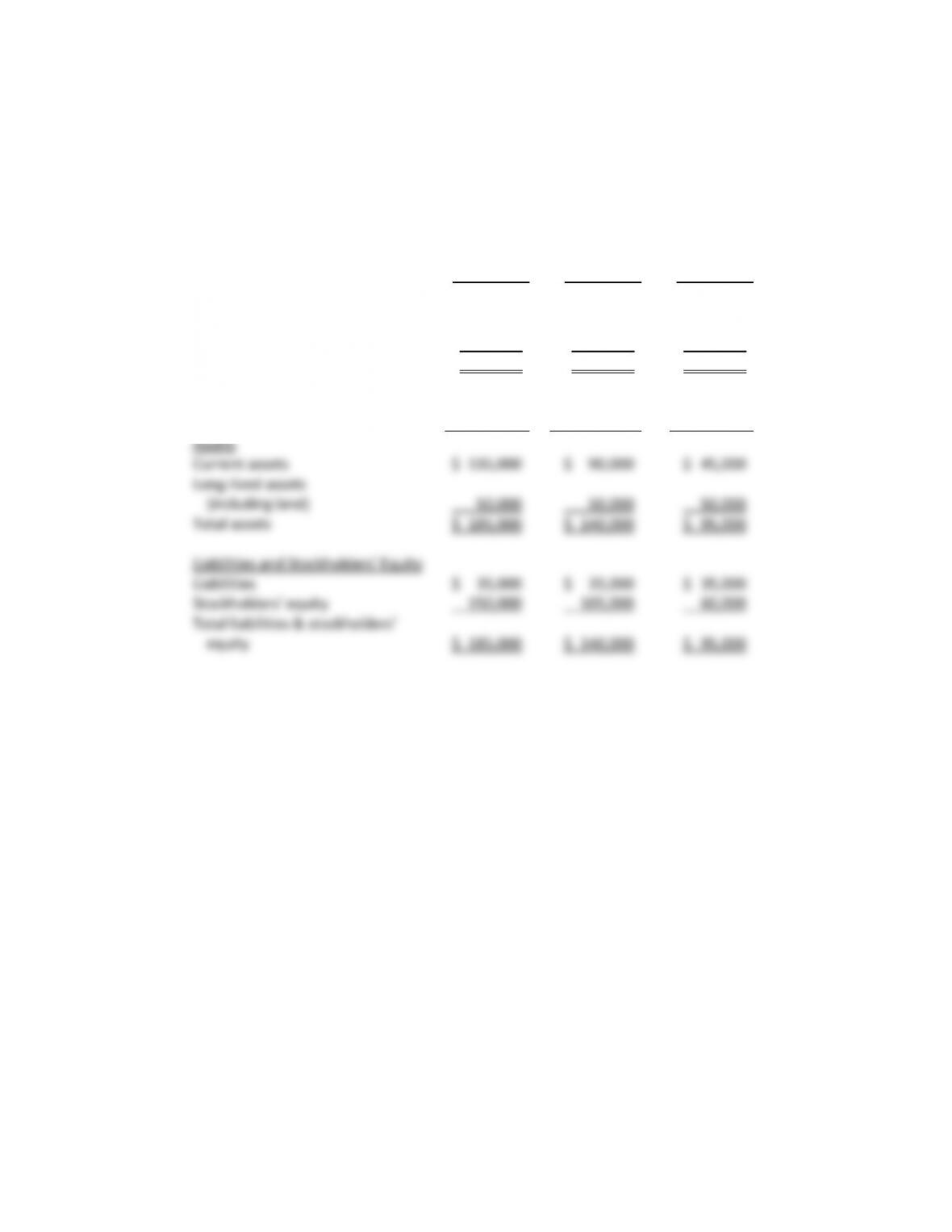
Income Statement
2017 2016 2015
Revenues $ 65,000 $ 65,000 $ 65,000
Amortization 0 0 40,000
Other expenses 20,000 20,000 20,000
Net income $ 45,000 $ 45,000 $ 5,000
Balance Sheet
12/31/17 12/31/16 12/31/15
E9–5 Continued
(2) Amortized over two years:
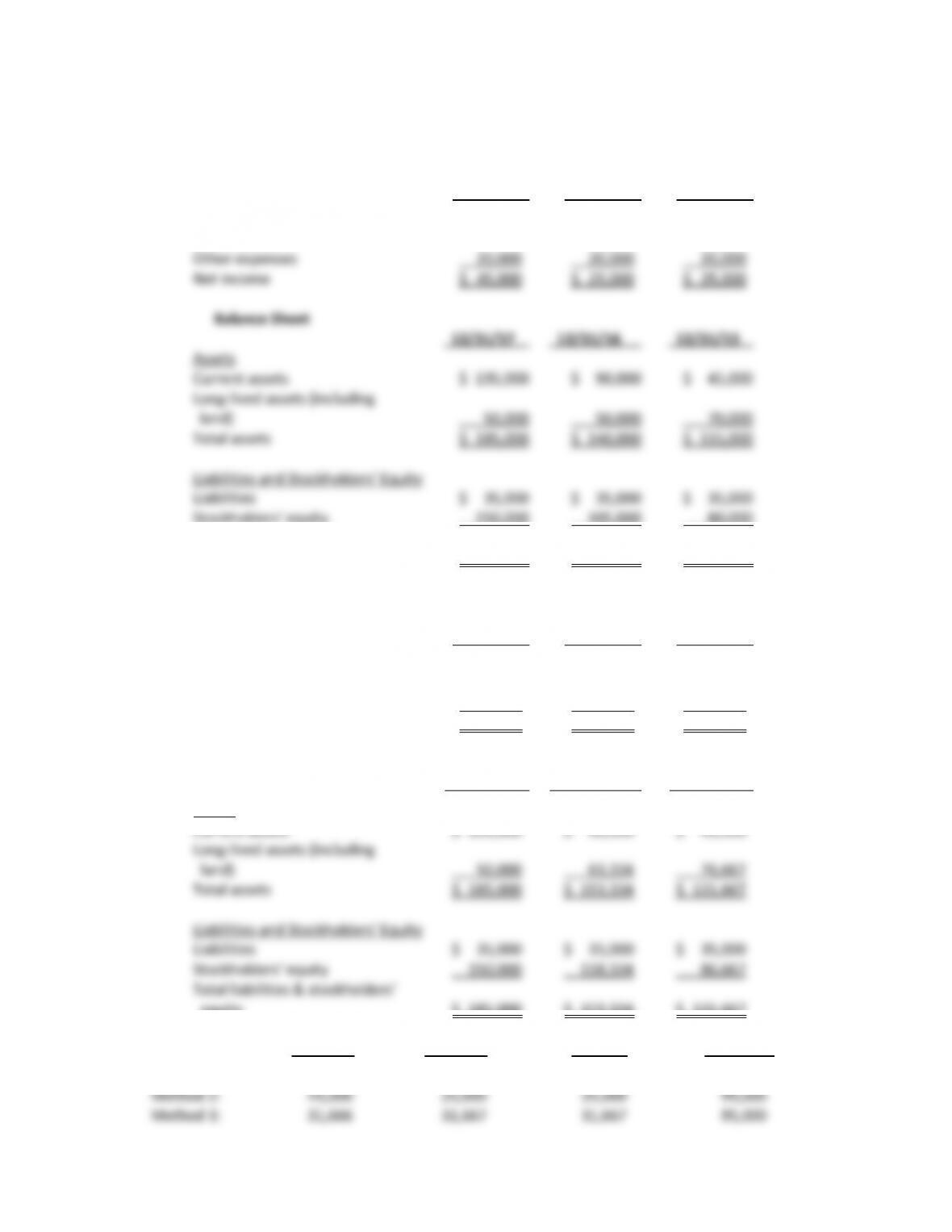
Income Statement
2017 2016 2015
Revenues $ 65,000 $ 65,000 $ 65,000
Amortization 0 20,000 20,000
Stockholders’ equity 150,000 105,000 80,000
Total liabilities & stockholders‘
equity $ 185,000 $ 140,000 $ 115,000
(3) Amortized over three years:
Income Statement
2017 2016 2015
Revenues $ 65,000 $ 65,000 $ 65,000
Amortization 13,334 13,333 13,333
Other expenses 20,000 20,000 20,000
Net income $ 31,666 $ 31,667 $ 31,667
Balance Sheet
12/31/17 12/31/16 12/31/15
Assets
equity $ 185,000 $ 153,334 $ 121,667
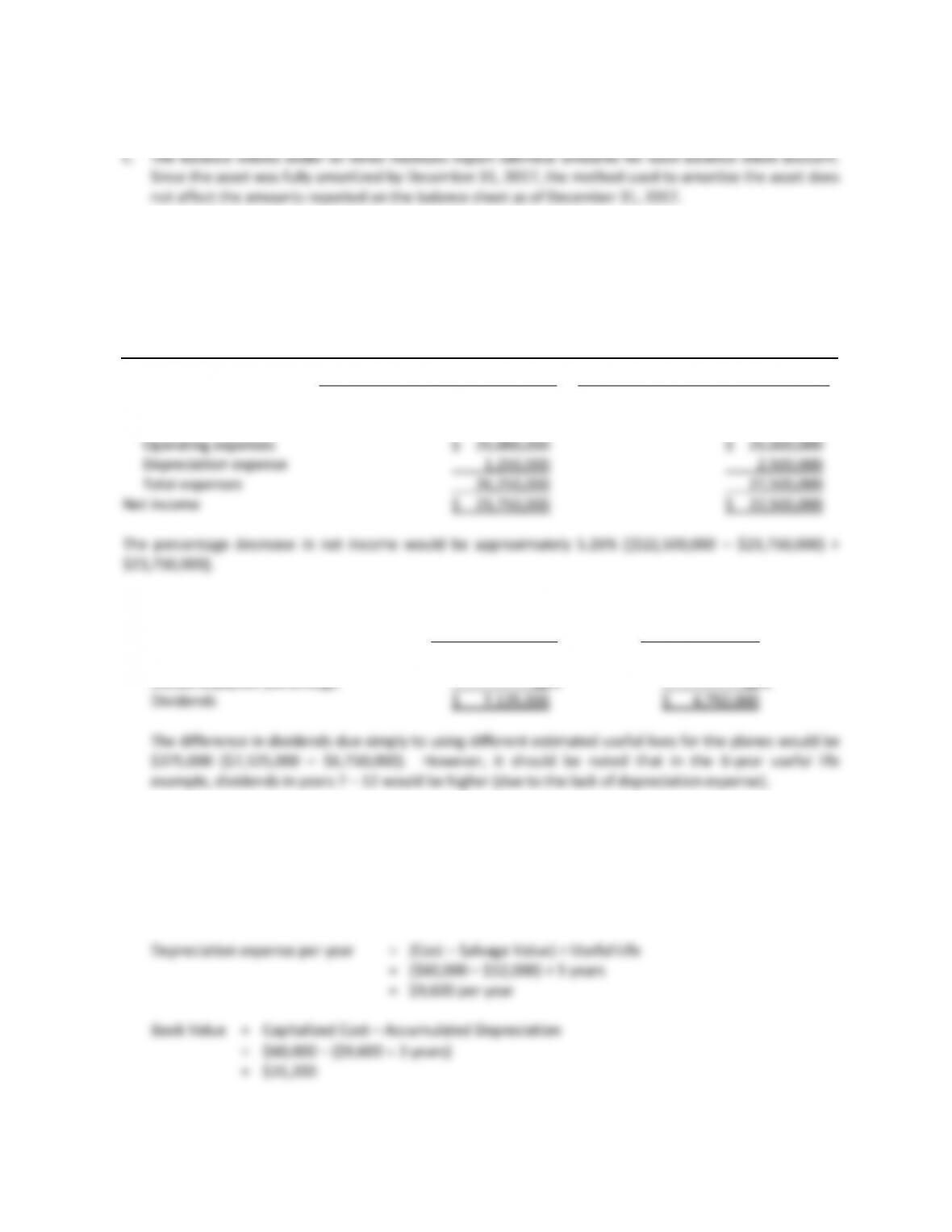
b. 2017 2016 2015 Total
Method 1: $45,000 $45,000 $ 5,000 $95,000
E9–5 Concluded
E9–6
a. and b.
Stork Freight Company
Income Statement
For the Year Ended December 31
12-Year Useful Life 6-Year Useful Life
Revenues $ 50,000,000 $ 50,000,000
Expenses:
c.
12-Year Useful Life 6-Year Useful Life
Net income $ 23,750,000 $ 22,500,000
Dividend payout percentage 30% 30%
E9–7
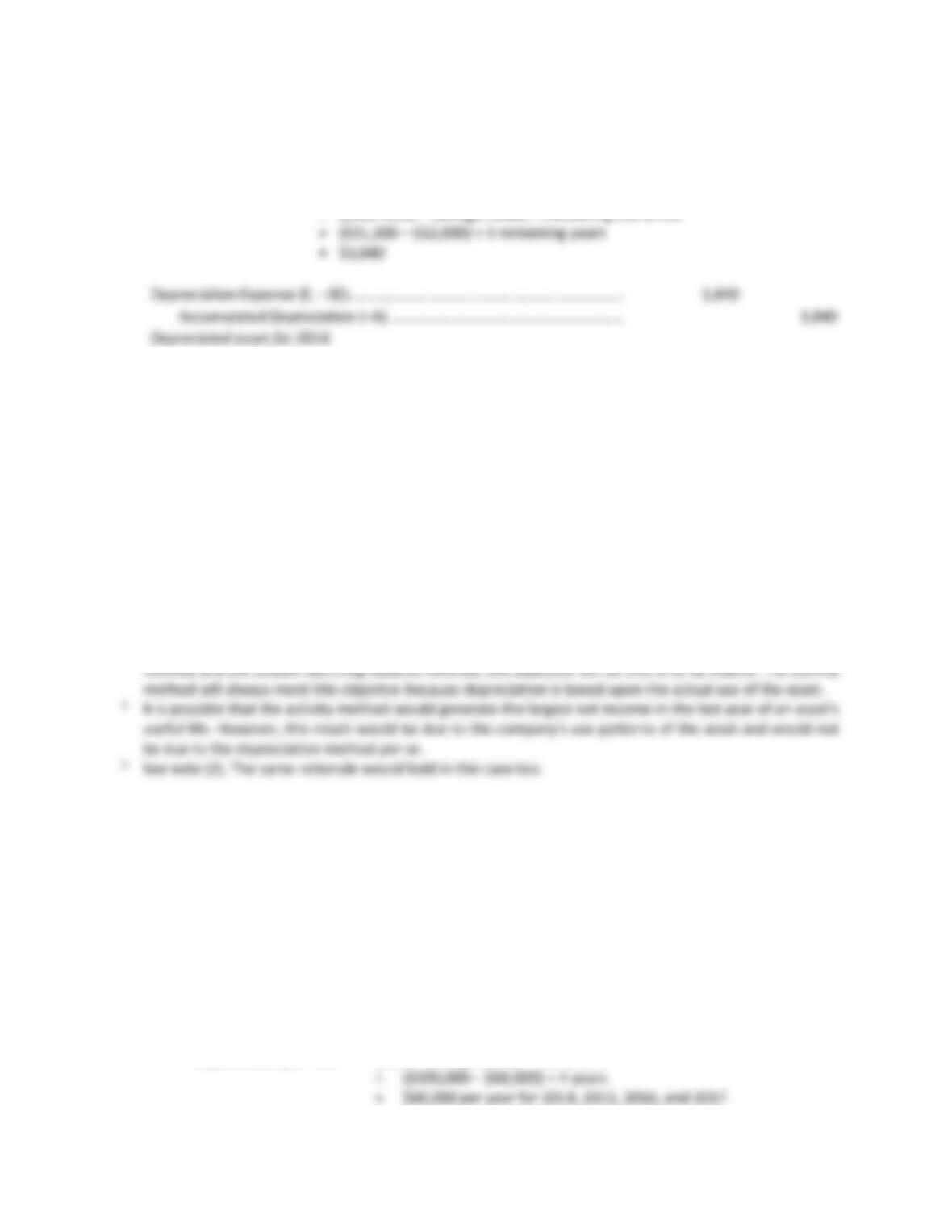
a. An asset’s book value equals the asset’s initial capitalized value less the associated accumulated
depreciation. With straight-line depreciation, accumulated depreciation equals depreciation expense
per year times the number of years the asset has been used. Therefore, the asset’s book value would
be calculated as follows:
E9–7 Concluded
b. Depreciation Expense = [(Cost – Accumulated Depreciation) – Salvage Value] ÷
Remaining Useful Life
= (Book value – Salvage value) ÷ Remaining useful life
E9–8
Straight- Double-Declining- Activity
Objective Line Balance Method
(a) x1 x1 x1
(b) x x x
(c) x x2
(d) x
(e) x
(f) x
(g) x x3
(h) x x x
1 Under certain conditions, all three methods could meet this objective. However, for the straight-line
E9–9
a. (1) Straight-line depreciation:
Depreciation per Year = (Cost – Salvage Value) ÷ Useful Life
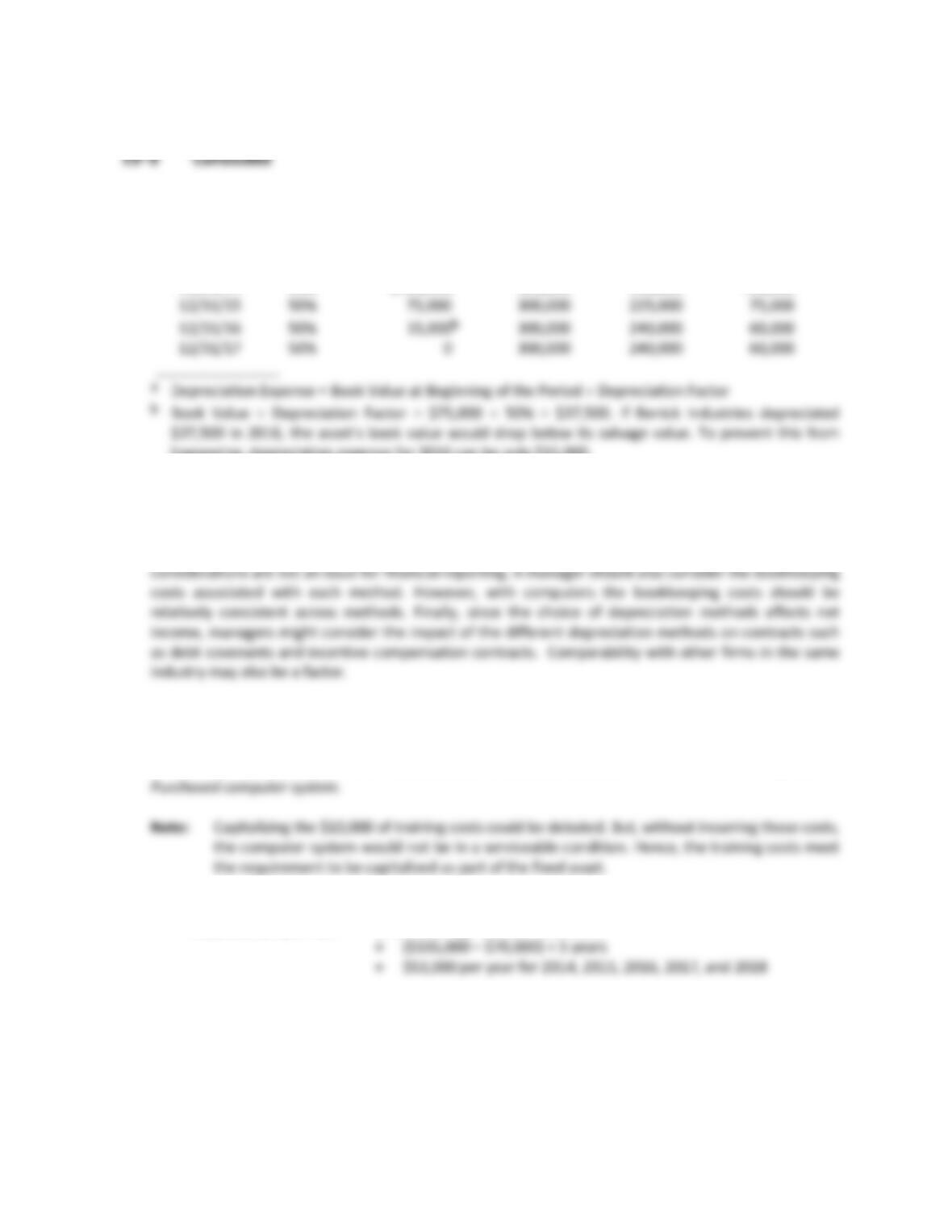
(2) Double-declining-balance depreciation:
Depreciation Depreciation Accumulated Book
Date Factor Expense Cost Depreciation Value
1/1/14 $300,000 $ 0 $300,000
12/31/14 50% $150,000a 300,000 150,000 150,000
happening, depreciation expense for 2016 can be only $15,000.
b. A manager should consider the costs and benefits associated with each depreciation method. The most
likely benefit is the impact of depreciation methods on income taxes. An accelerated method decreases
the present value of tax payments. However, since there is no requirement that a company use the
same depreciation method for financial reporting purposes as it does for tax reporting, tax
E9–10
a. Computer System (+A) …………………………..………………………………………. 335,000
Cash (–A) ………………………………………………………………………… 335,000
b. (1) Straight-line depreciation:
Depreciation per Year = (Cost – Salvage Value) ÷ Useful Life
E9–10 Concluded
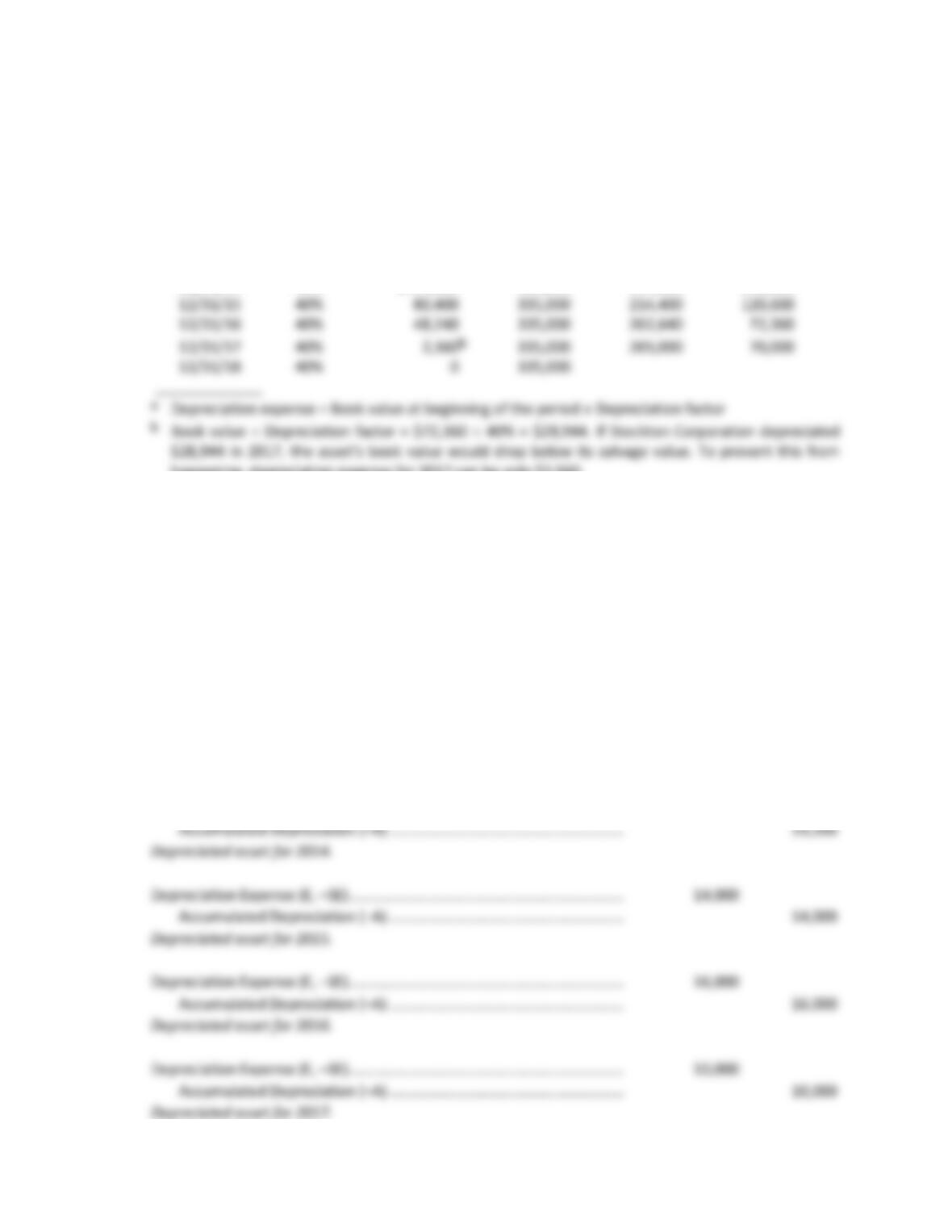
(2) Double-declining-balance depreciation:
Depreciation Depreciation Accumulated Book
Date Factor Expense Cost Depreciation Value
1/1/14 $335,000 $ 0 $335,000
12/31/14 40% $134,000a 335,000 134,000 201,000
happening, depreciation expense for 2017 can be only $2,360.
c. Depreciation Expense (E, –SE) …………………………………………………… 134,000
Accumulated Depreciation (–A) …………………………………………. 134,000
Depreciated fixed asset for 2014.
E9–11
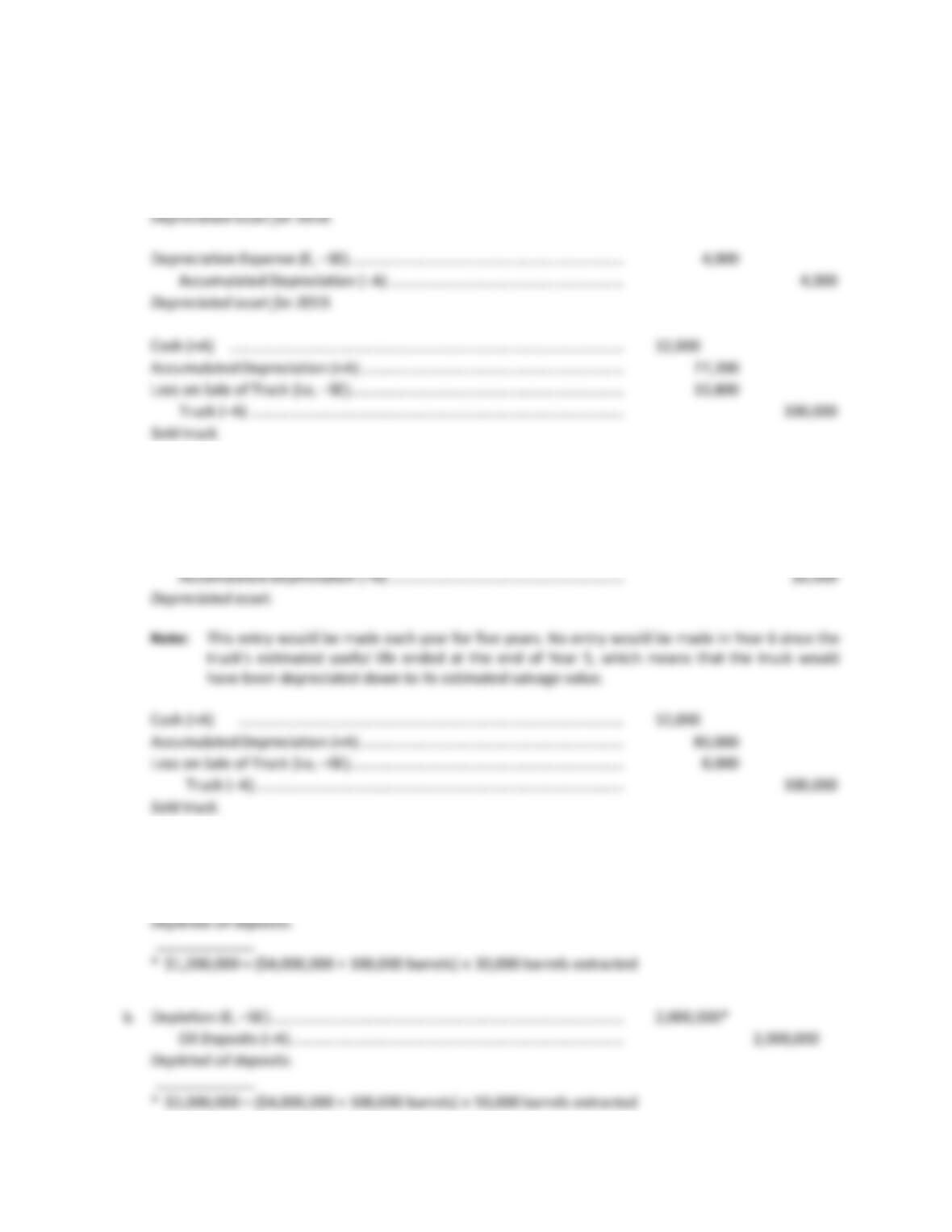
1. Activity Method:
Depreciation Expense per Mile = ($100,000 – $20,000) ÷ 200,000 Miles
= $0.4/Mile
Depreciation Expense (E, –SE) …………………………………………………………. 19,200
E9–11 Concluded
Depreciation Expense (E, –SE) …………………………………………………………. 14,000
Accumulated Depreciation (–A) ………………………………………………… 14,000
2. Straight-line Method:
Depreciation Expense per Year = ($100,000 – $20,000) ÷ 5 Years
= $16,000/year
Depreciation Expense (E, –SE) …………………………………………………………. 16,000
E9–12
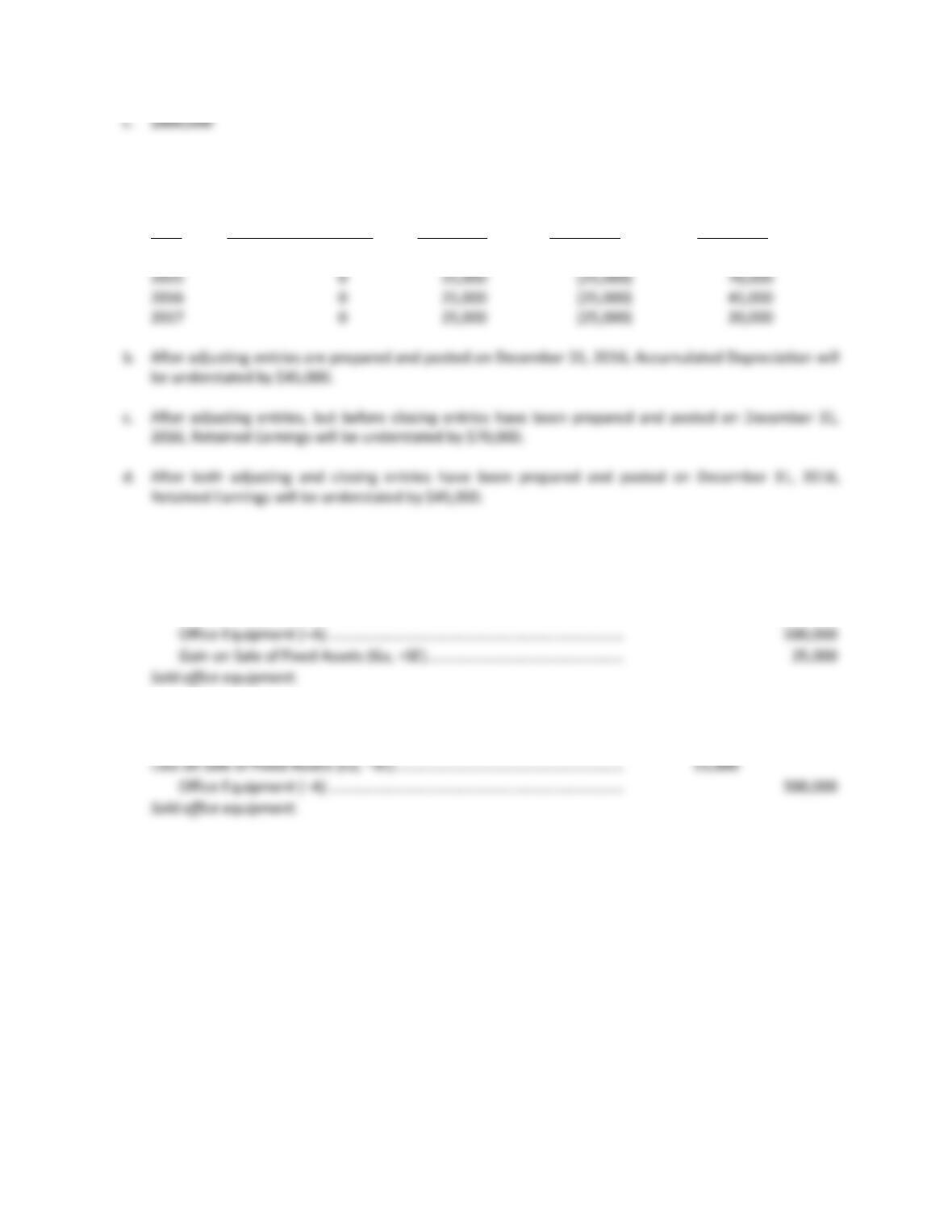
a. Depletion (E, –SE) ………………………………………………………………………….. 1,200,000*
Oil Deposits (–A) …………………………..…………………………………………. 1,200,000
E9–13
a.
Depreciation Expense Correct Annual Cumulative
Year Per Company’s Books Depr. Exp. Difference Difference
2014 $120,000 $25,000 $95,000 $95,000
E9–14
a. Cash (+A) ……………………………………………………….………………………… 235,000
Accumulated Depreciation—Office Equipment (+A) ………………………….. 300,000
b. Cash (+A) …………………………..………………………………………………………. 185,000
Accumulated Depreciation—Office Equipment (+A) ………………………….. 300,000
E9–15
Assuming that Paris Company kept the equipment for its entire five-year estimated useful life, the
depreciation schedule on the equipment would be as follows.
Depreciation Depreciation Accumulated Book
Date Factor Expense Cost Depreciation Value
1/1/12 $25,000 $ 0 $25,000
12/31/12 40% $10,000 25,000 10,000 15,000
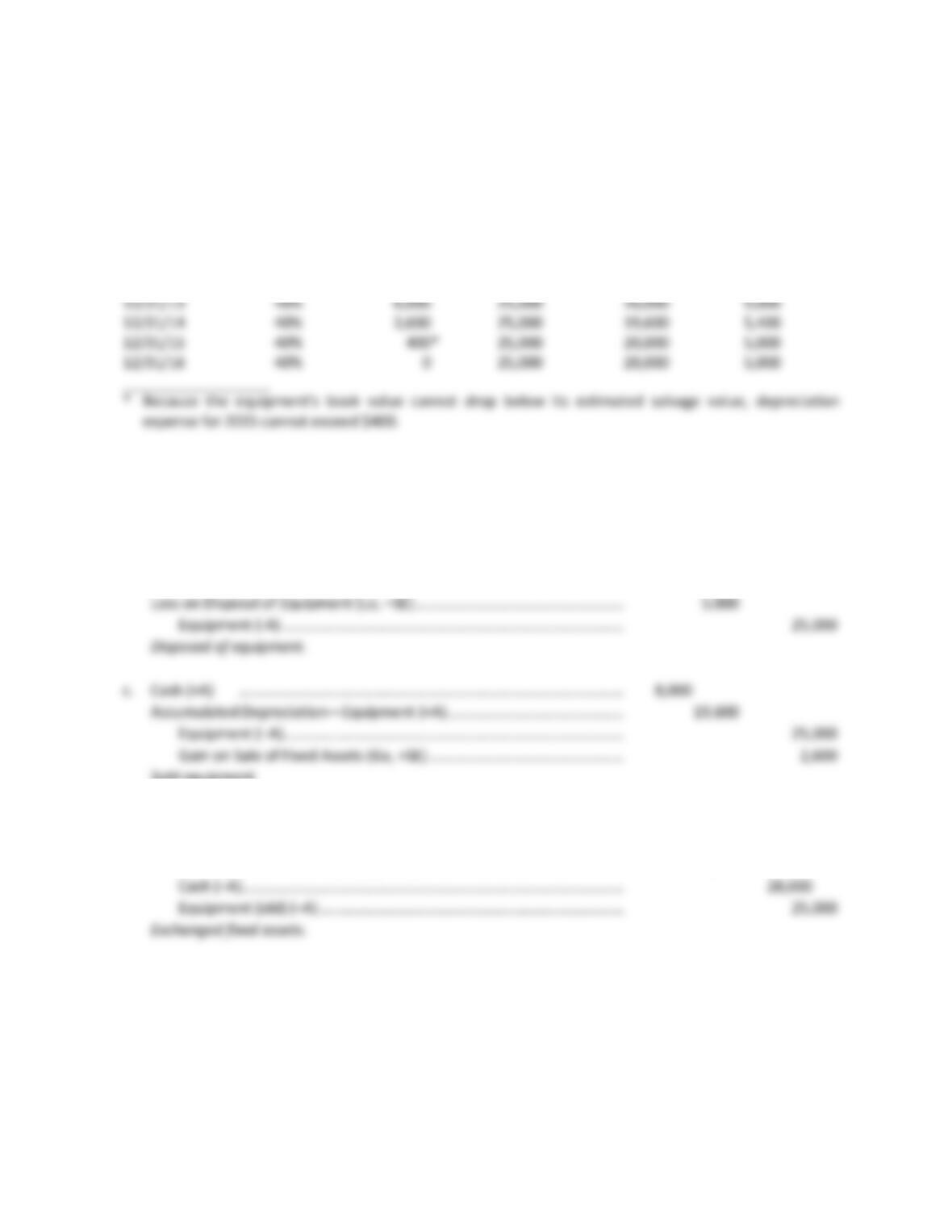
a. Accumulated Depreciation—Equipment (+A) ……………………………………. 19,600
Loss on Disposal of Equipment (Lo, –SE) …………………………………………… 5,400
Equipment (–A) …………………………..…………………………………………… 25,000
Disposed of equipment.
b. Accumulated Depreciation—Equipment (+A) ……………………………………. 20,000
Sold equipment.
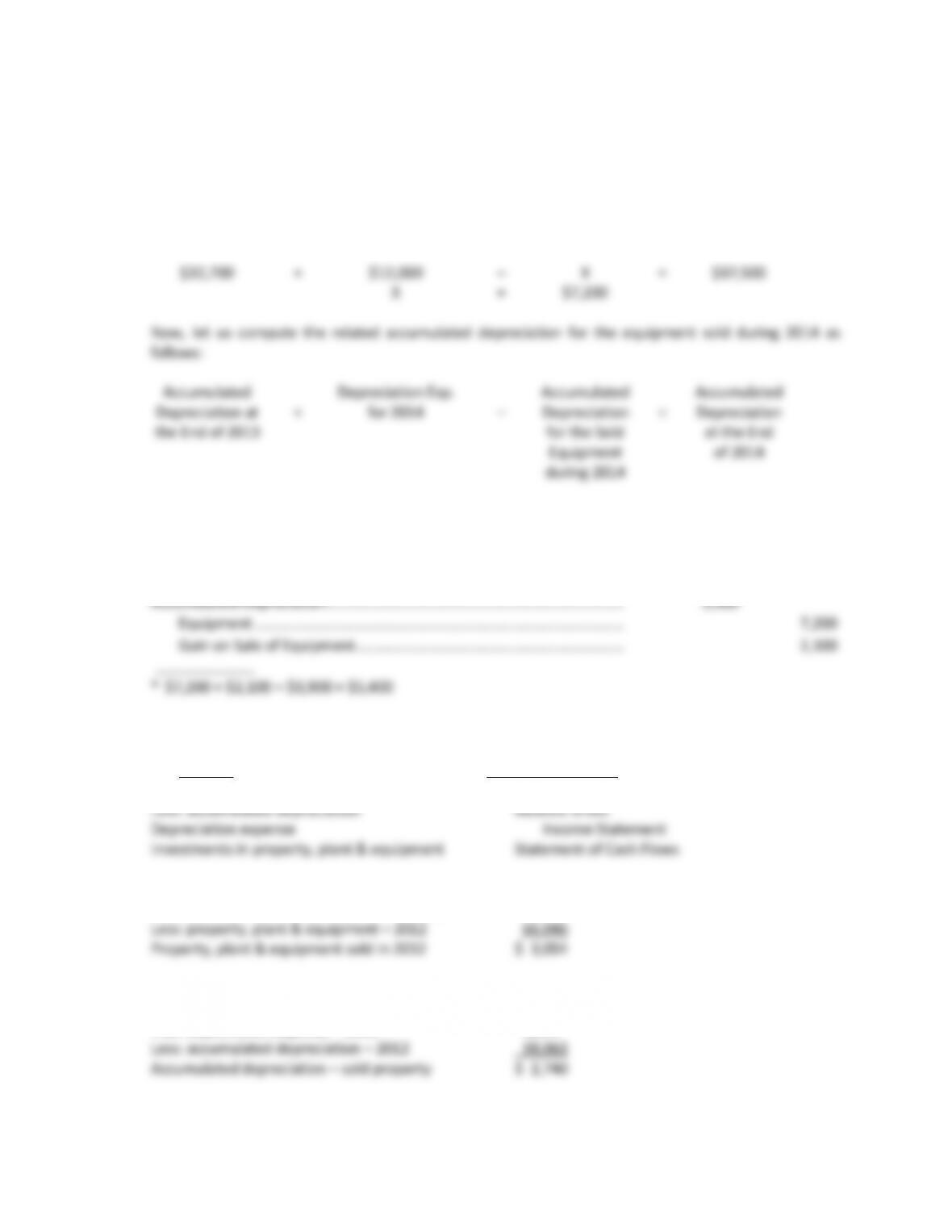
d. Fixed Asset (new) (+A) …………………………..……………………………………….. 30,000
Accumulated Depreciation—Equipment (+A) ……………………………………. 20,000
Loss on Disposal of Fixed Asset (Lo, –SE) ………………………………………….. 3,000
E9–16
a. and b. First, let us compute the original cost of the equipment that was sold in 2014 as follows:
Equipment Equipment Equipment Equipment
at the End + Purchased – sold during = at the End
of 2013 during 2014 2014 of 2014
$14,300 + $7,200 – X = $17,600
X = $ 3,900
Now, we can reconstruct the journal entry.
Cash ……………………………………………………….……………………………………. 5,400*
E9–17
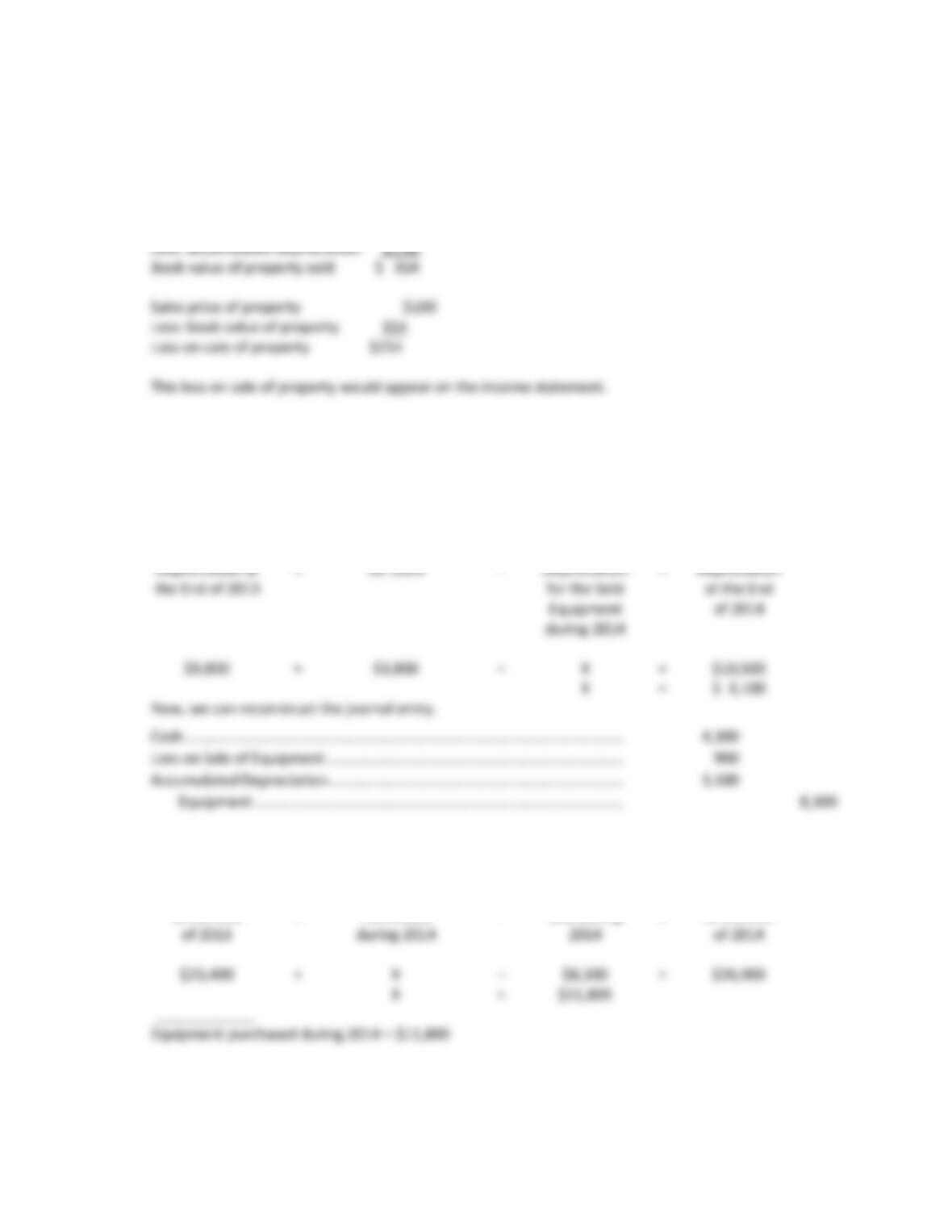
Account Financial Statement
a. Property, plant & equipment Balance Sheet
b. Property, plant & equipment – 2011 $58,073
Plus: investments in property, plant & equipment 11,027
c. Accumulated depreciation – 2011 $34,446
Plus: depreciation expense – 2012 6,357
E9–17 Concluded
d. Compute the gain on the sale:
Cost of property sold $3,054
E9–18
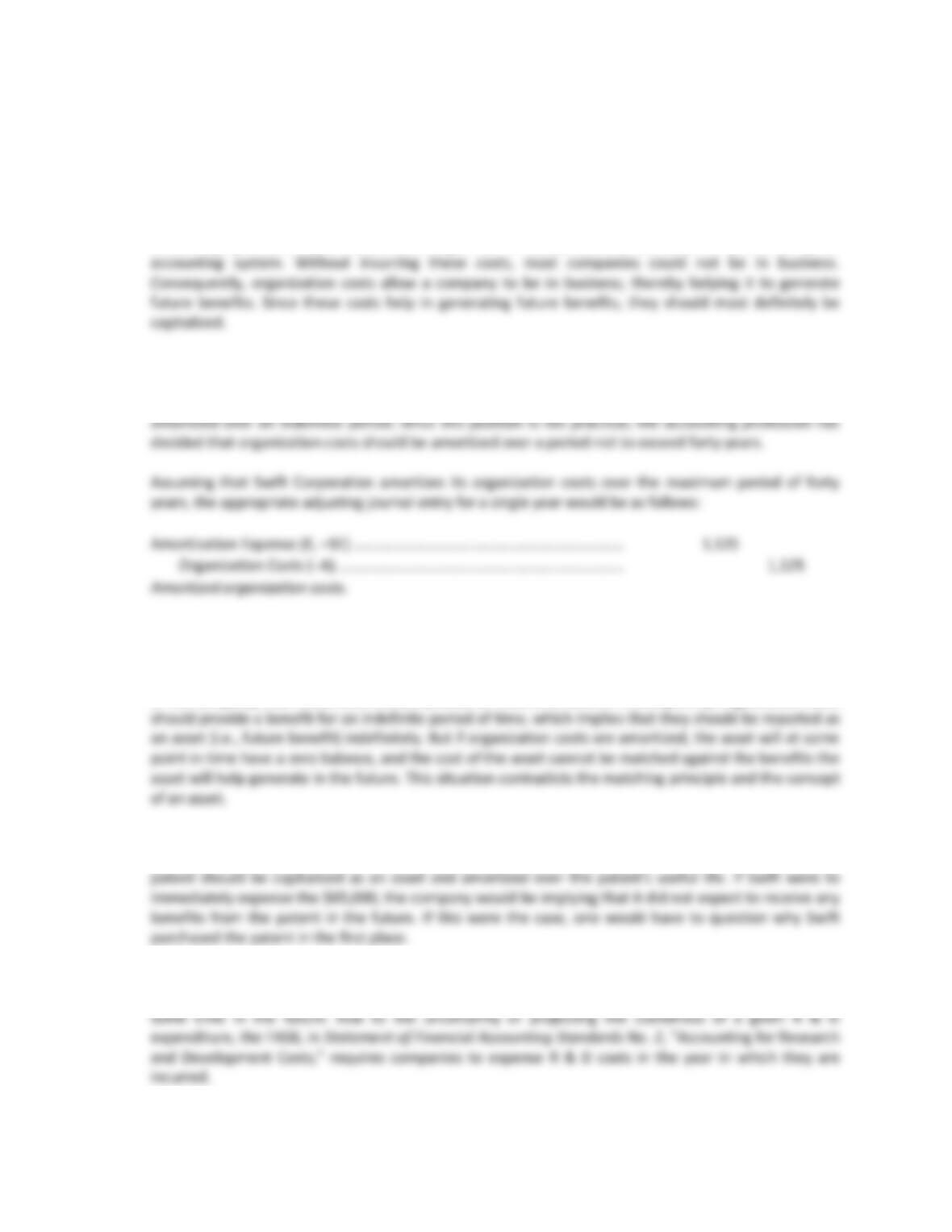
a. First, let us compute the related accumulated depreciation for the equipment sold during 2014 as
follows:
Accumulated Depreciation Cap. Accumulated Accumulated
b. Equipment Equipment Equipment Equipment
at the End + Purchased – sold during = at the End
E9–19
a. Swift Corporation should capitalize these costs. Assets are defined as items that are expected to
provide future economic benefits to the entity. Organization costs are costs incurred by an entity prior
to starting operations. Such costs include legal fees to incorporate and accountant’s fees to set up an
b. Theoretically, organization costs should be amortized over their useful life. In the extreme, organization
costs provide a benefit over the entire life of a company. Since under the going concern assumption
accountants assume that entities will exist indefinitely, it would seem that organization costs should be
c. As mentioned in part (b), organization costs theoretically provide benefits over the entire life of the
company. Under the going concern assumption, the company is assumed to exist indefinitely. If the
company is assumed to exist indefinitely and if organization costs provide benefits over the entire life
of the company, then these costs should provide an indefinite benefit. Consequently, organization costs
d. A patent gives a company the exclusive right to use or market a particular product or process, thereby
providing the company with an expected future benefit. Consequently, the costs incurred to acquire a
e. Research and development costs may or may not provide a company with future benefits. The
company will not know whether or not a particular R & D expenditure will provide a future benefit until
E9–19 Concluded
f. Engaging in research and development activities can lead companies to develop new products or
processes that will provide them with future benefits. In such cases, the R & D costs should,
theoretically, be capitalized. The R & D costs would then be allocated to those periods in which the
E9–20
a.
(1) Southern Robotics should report the costs incurred in acquiring the patent as an asset. Therefore,
(2) Since Southern Robotics successfully defended its patent, the patent is still expected to provide a
future benefit to the company. Hence, the company should continue to carry the patent on its
(3) Amortization Expense (E, –SE) …………………………………………………… 50,000
b.
(1) Since the lawsuit did not take place until 2015, the patent still had value to Southern Robotics as of
December 31, 2014. Therefore, the company should still report the patent at $50,000 on its books
(2) Since Southern Robotics was unsuccessful in defending its patent, the company no longer has the
(3) Loss on Patent (Lo, –SE) ……………………………………………………………. 50,000
Legal Expenses (E, –SE) …………………………………………………………….. 200,000
E9–21
a. The journal entry for the acquisition can be derived from the information provided and appears
below:
purchased.
b. Assets increased by a net $1.1 billion ($5.1 + 3.8 – 7.8) and liabilities increased by $1.1 billion.
E9–22
a. Under US GAAP, long-lived assets must be carried at original cost less accumulated depreciation
(amortization); if the market value of the asset permanently falls below the balance sheet carrying
PROBLEMS
P9–1
a. Stonebrecker should capitalize all costs that it incurred that were necessary and reasonable to get the
equipment in a serviceable condition and location. The capitalizable costs are (1) the $1,000,000
b. Equipment (+A) …………………………..………………………………………………… 1,093,000
Cash (–A) ………………………………………………………………………………… 1,093,000
Purchased equipment.
c. The depreciation base represents the capitalized cost of a fixed asset that the company does not expect
to recover over the asset’s estimated useful life. Since the capitalized cost of the equipment is
d. As discussed in part [c], the depreciation base represents the dollar amount of a fixed asset that the
company does not expect to recover from the asset at the end of the asset’s estimated useful life. This
implies that the depreciation base represents the dollar amount of a fixed asset that the company