P8–5
a. 6/15/14 Trading Securities (+A) …………………………………………………. 7,500
Cash (–A) ……………………………………………………………… 7,500
12/31/14 Trading Securities (+A) …………………………………………………. 1,500
Unrealized Price Increase (Ga, +SE) …………………………. 1,500
Trading Securities (–A) …………………………………………… 3,600
b. The entries would remain the same except the following: (1) one will debit or credit the Available–for-
Sale Securities account instead of the Trading Securities account; (2) all the price changes would flow
c. Cash Effect
Trading Available-for-Sale
Transactions Securities Securities
d. & e. Income Effect
Trading Available-for-Sale
Transactions Securities Securities
6/15/14 Purchase $ 0 $ 0
12/31/14 Mark-to–Market 1,500 0
P8–5 Concluded
f. Overall income statement effect for both the years (i.e., 2014 and 2015) would be the same whether
P8–6
a. and b. We assume that Orlean’s first investment in these securities occurred on 12/31/13.
Cost of the Atwater Investment
on a Per-Share Basis = $27,000 ÷ 1,800 Shares
P8–7
a. The net change in the investment in trading securities account from 2011 to 2012 was $450
b. The net change in the available-for-sale securities from 2011 to 2012 was $371.2 billion minus $364.8
P8–8
a. Under the mark-to-market method, the investment is carried on the books at the market value as of
(1)
Masonite Tires
(2) During 2014, Masonite Tires would make the following original and adjusting journal entries
under the mark-to-market method:
Cash (+A) …………………………………………………………………………….. 85,000
Revenues (R, +SE) …………………………………………………………… 85,000
Earned noninvestment revenues.
P8–8 Continued
Masonite Tires
Balance Sheet
December 31, 2014
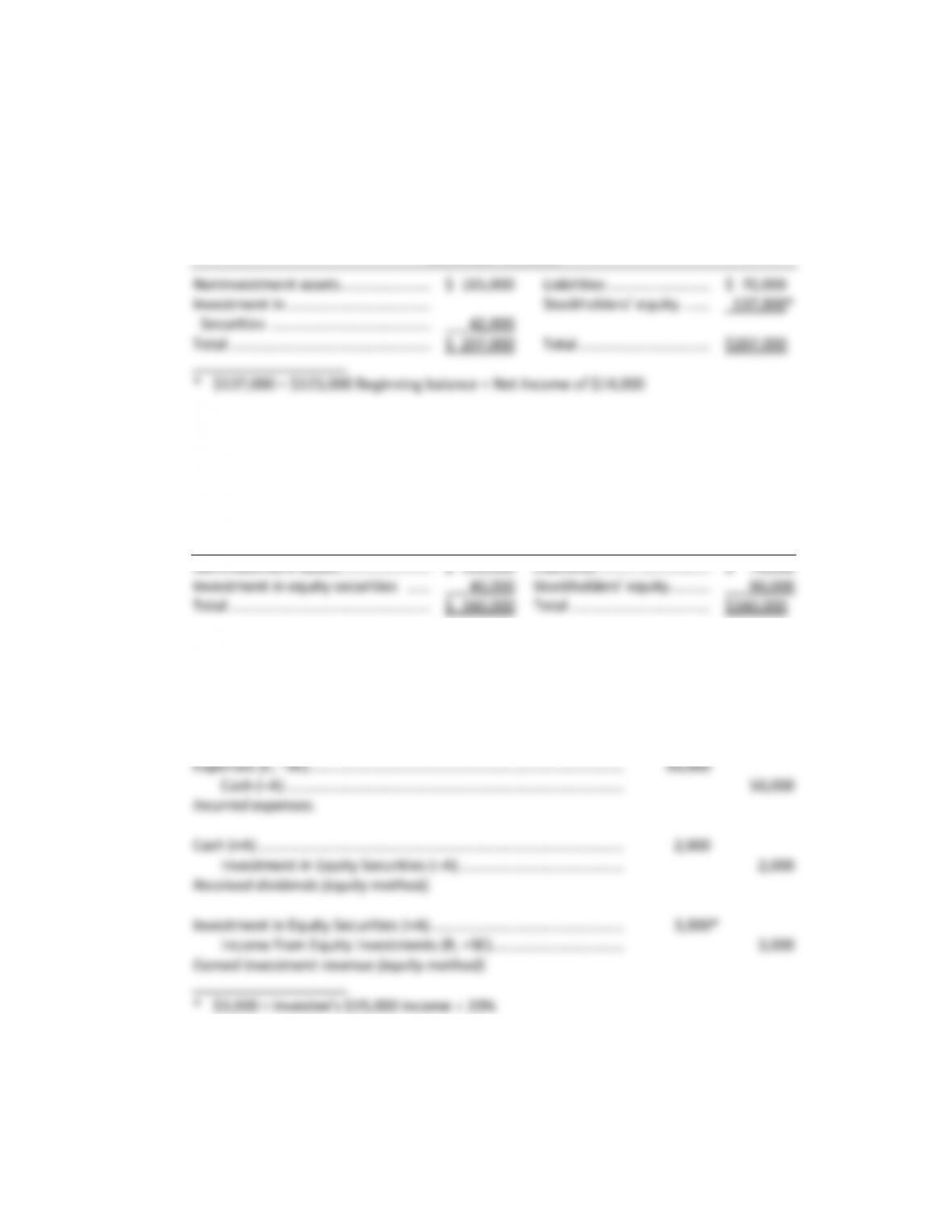
Noninvestment assets …………………. $157,000 Liabilities………………. $ 70,000
(3) During 2015, Masonite Tires would make the following original and adjusting journal entries:
Cash (+A) …………………………………………………………………………….. 75,000
Revenues (R, +SE) …………………………………………………………… 75,000
Earned noninvestment revenues.
Expenses (E, –SE) ………………………………………………………………….. 70,000
Adjusted securities to market.
Masonite Tires
Income Statement
For the Year Ended December 31, 2015
Revenues ……………………………………………………………………………………………….. $75,000
Dividend revenue ……………………………………………………………………………………. 3,000
P8–8 Continued
Masonite Tires
Balance Sheet
December 31, 2015
b. Under the equity method, an investment is initially recorded at its cost and subsequently adjusted for
changes in the investee’s net assets. Therefore, any net income or loss generated by the investee and
any dividends declared by the investee cause the investment account to be adjusted.
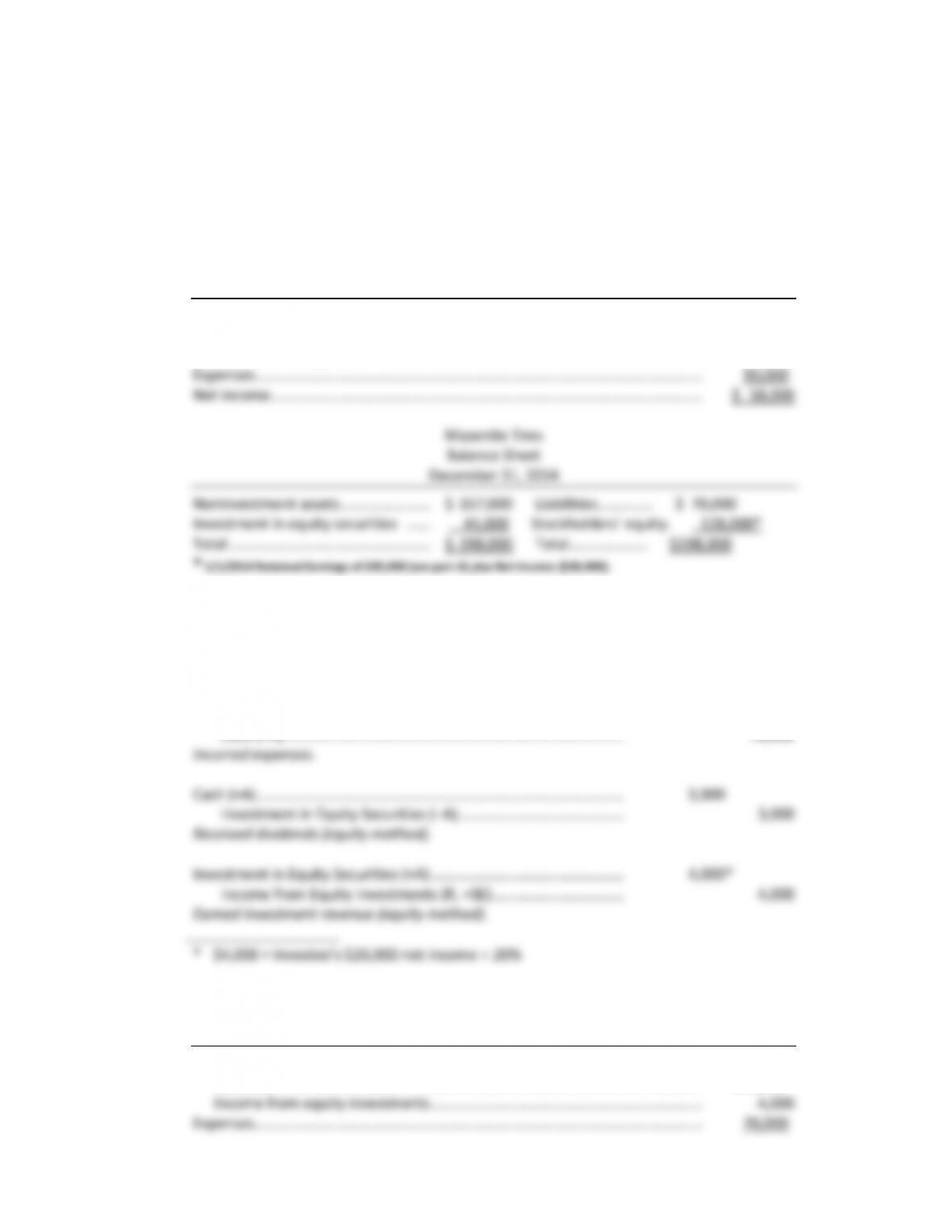
(1) Masonite Tires
Balance Sheet
January 1, 2014
(2) During 2014, Masonite Tires would make the following original and adjusting entries:
Cash (+A) …………………………………………………………………………….. 85,000
Revenues (R, +SE) …………………………………………………………… 85,000
Earned noninvestment revenues.
P8–8 Continued
Masonite Tires
Income Statement
For the Year Ended December 31, 2014
Revenues:
Revenue ………………………………………………………………………………………….. $ 85,000
Income from equity investments ………………………………………………………… 3,000
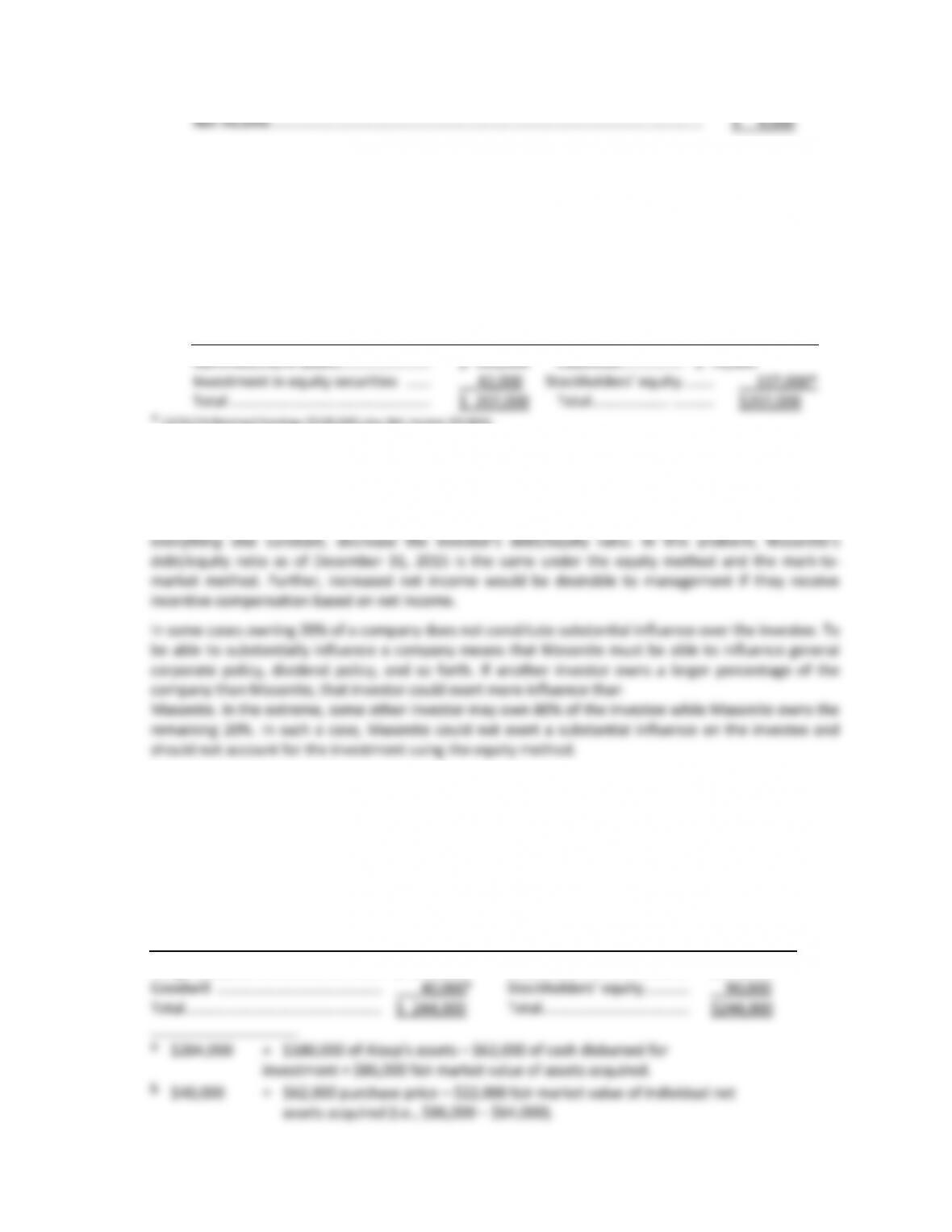
(3) During 2015, Masonite Tires would make the following original and adjusting entries:
Cash (+A) …………………………………………………………………………….. 75,000
Revenues (R, +SE) …………………………………………………………… 75,000
Earned noninvestment revenues.
Expenses (E, –SE) ………………………………………………………………….. 70,000
Cash (–A) ………………………………………………………………………. 70,000
Masonite Tires
Income Statement
For the Year Ended December 31, 2015
Revenues:
Revenue ………………………………………………………………………………………….. $75,000
P8–8 Concluded
Masonite Tires
Balance Sheet
December 31, 2015
* 12/31/14 Retained Earnings ($128,000) plus Net Income ($9,000).
c. Using the equity method versus the mark-to-market method may be desirable due to debt covenants
and incentive compensation, as long as the investee company is earning Net Income. Under the equity
method, a portion of the investee’s net income flows through to the investor‘s income statement and
through the closing process into stockholders’ equity. This increase in stockholders’ equity will, holding
P8–9
a. Investment in Subsidiary (+A) …………………………………………………………. 62,000
Cash (–A) ………………………………………………………………………………… 62,000
Purchased Martin Monthly.
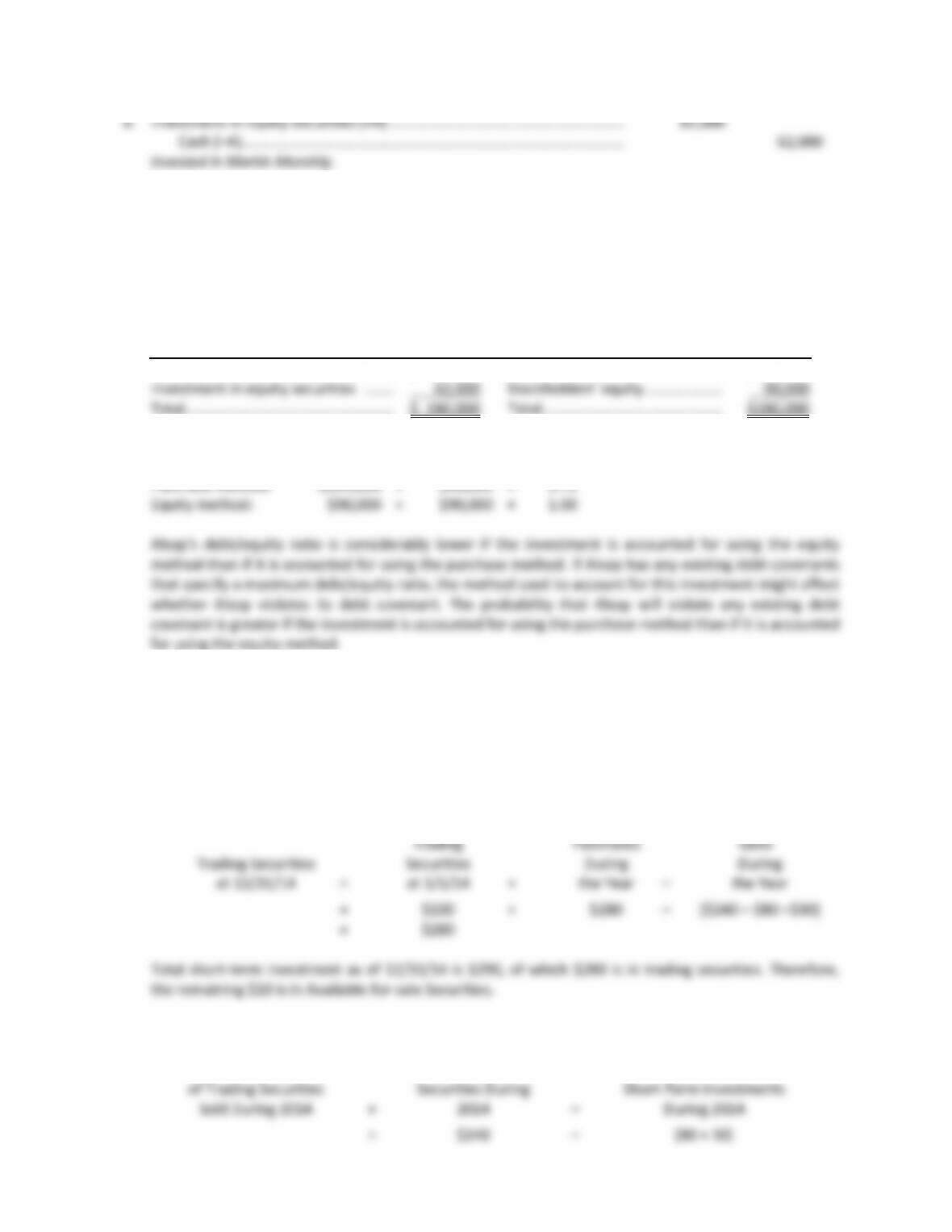
Alsop Ltd.
Consolidated Balance Sheet
December 31, 2014
Tangible assets …………………………. $ 204,000a Liabilities ……………………….. $154,000
P8–9 Concluded
Alsop Ltd.
Consolidated Balance Sheet
December 31, 2014
Noninvestment assets ………………….. $ 118,000 Liabilities …………………………..….. $ 90,000
c. Debt/equity ratio = Liabilities ÷ Stockholders’ equity
Purchase method: $154,000 ÷ $90,000 = 1.71
P8–10
a. Short-Term Trading Available-
Investments Securities for-Sale Securities
at 12/31/14 = at 12/31/14 + at 12/31/14
b. Cash Received Realized
Balance Sheet from the Sale and Unrealized
Carrying Value of Trading Gain on
= $130
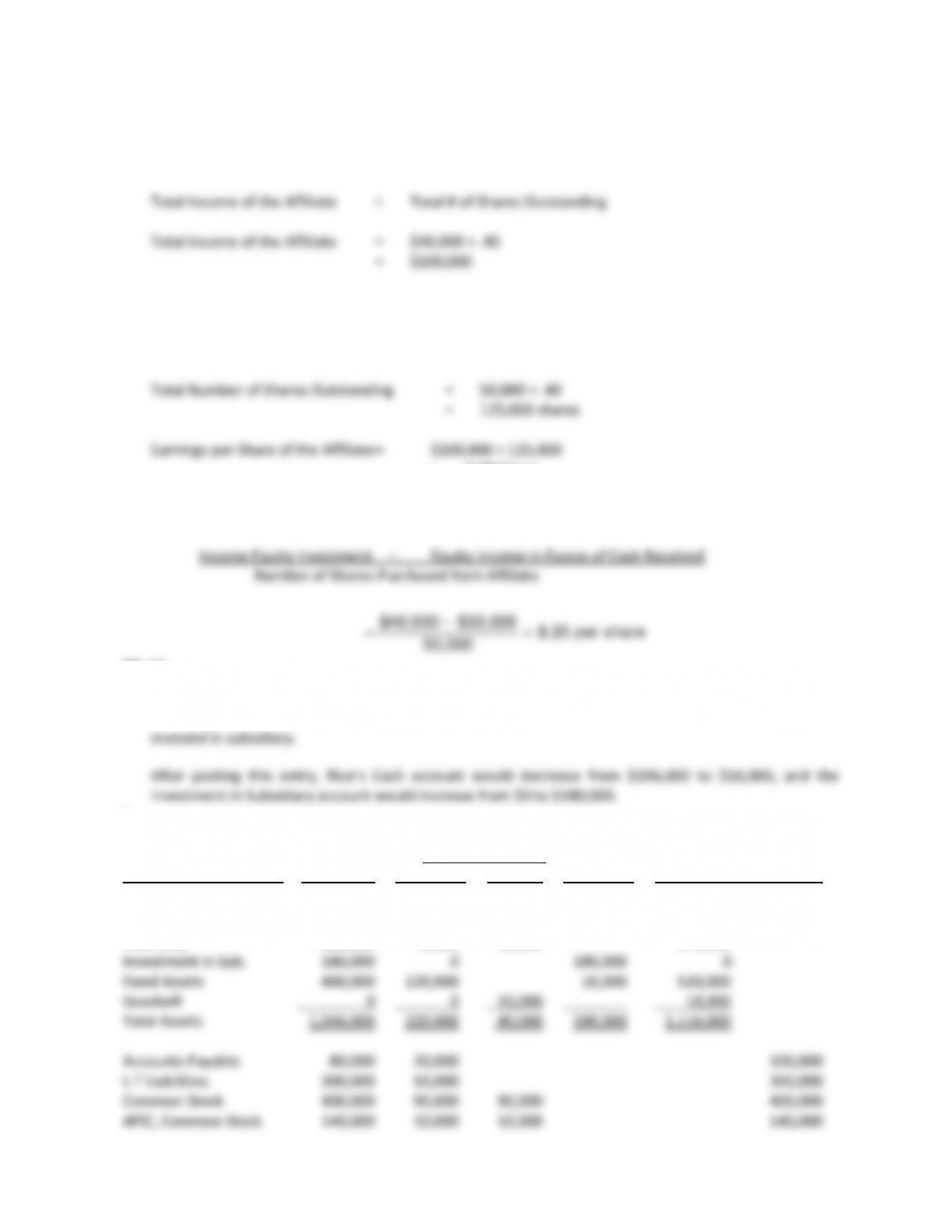
c. Earnings per share dollar amount reported by the affiliate:
P8–10 Concluded
= $.80/share
d. Per share dividend declared by the affiliate:
50,000 $.20 per share
P8–11
a. Investment in Subsidiary (+A) …………………………………………………………. 180,000
Cash (–A) ………………………………………………………………………………… 180,000
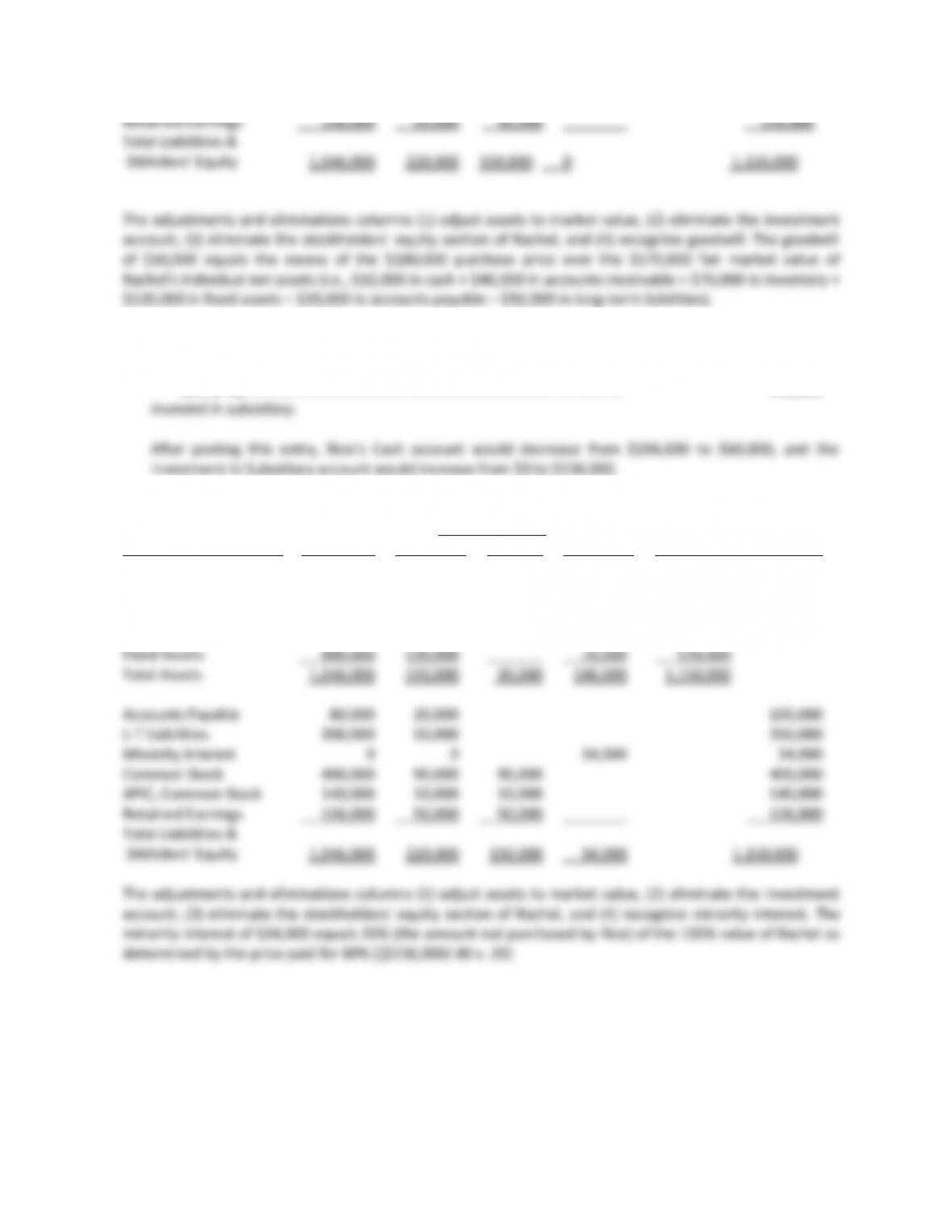
b.
Adjustments and
Eliminations Consolidated
Accounts Rice Rachel Debit Credit Balance Sheet
Cash 16,000 10,000 26,000
Accounts Receivable 150,000 40,000 190,000
Inventory 300,000 40,000 30,000 370,000
P8–12
a. Investment in Subsidiary (+A) …………………………………………………………. 136,000
Cash (–A) ………………………………………………………………………………… 136,000
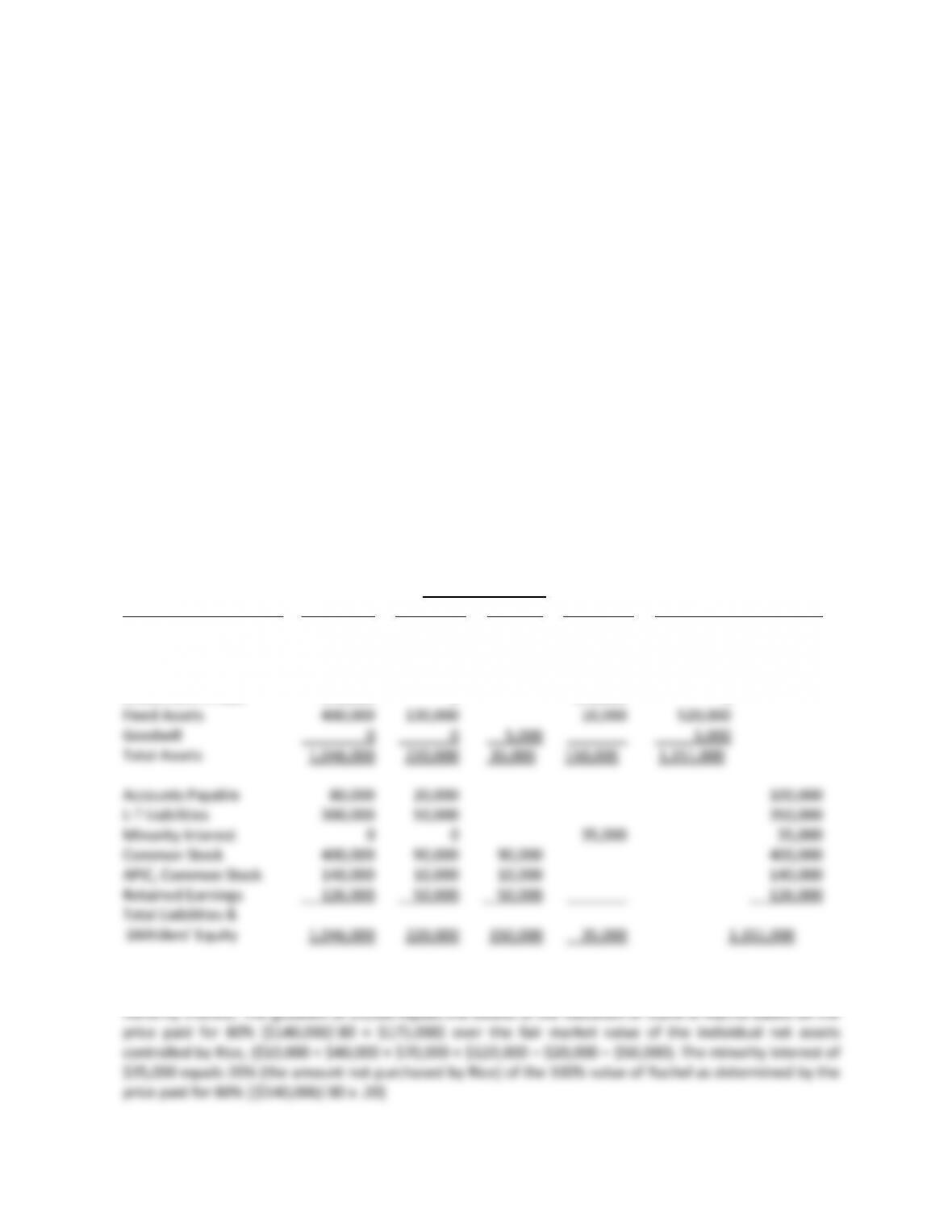
b.
Adjustments and
__Eliminations___ Consolidated
Accounts Rice Rachel Debit Credit Balance Sheet
Cash 60,000 10,000 70,000
Accounts Receivable 150,000 40,000 190,000
Inventory 300,000 40,000 30,000 370,000
Investment in Sub. 136,000 0 136,000 0
P8–13
a. Investment in Subsidiary (+A) …………………………………………………………. 140,000
Cash (–A) ………………………………………………………………………………… 140,000
Invested in subsidiary.
After posting this entry, Rice’s Cash account would decrease from $196,000 to $56,000, and the
Investment in Subsidiary account would increase from $0 to $140,000.
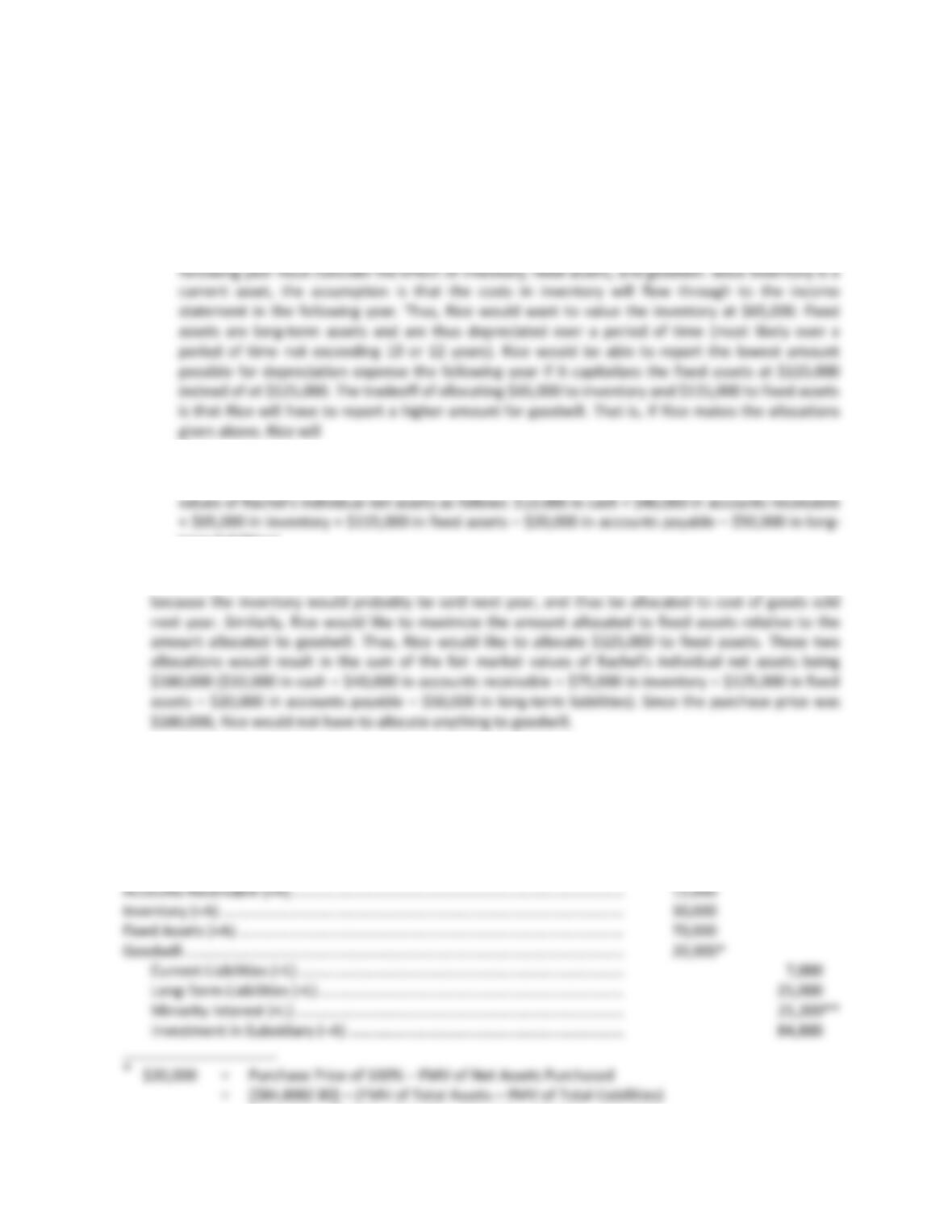
b.
Adjustments and
Eliminations Consolidated
Accounts Rice Rachel Debit Credit Balance Sheet
Cash 56,000 10,000 66,000
Accounts Receivable 150,000 40,000 190,000
Inventory 300,000 40,000 30,000 370,000
Investment in Sub. 140,000 0 140,000 0
The adjustments and eliminations columns (1) adjust assets to market value, (2) eliminate the Investment
account, (3) eliminate the stockholders’ equity section of Rachel, and (4) recognize both goodwill and
c. If Rice uses IFRS and assumes the minority shareholders have no equity in goodwill, then the
noncontrolling interest would be $34,000 (20% of the FMV of the net assets [$240,000 – $70,000])
and goodwill would be $4,000.
P8–14
a. Net income would be affected by the values reported for inventory (through cost of goods sold),
and fixed assets (through depreciation expense). Thus, any attempt to maximize net income in the
P8–14 Concluded
have to allocate $20,000 to goodwill (i.e., purchase price of $180,000 less sum of the fair market
term liabilities).
b. To minimize next year’s reported income for tax purposes, Rice would like to maximize the value of
assets that it will consume next year. Thus, Rice would like to maximize the value allocated to inventory
P8–15
Company X
Investment in Subsidiary (+A) ……………………………………………………………….. 84,800
Cash (–A) ……………………………………………………………………………………… 84,800
Cash (+A) ……………………………………………………………………………………………. 6,000
= $106,000 – ($6,000 + $12,000 + $30,000 + $70,000 – $32,000)
** $21,200 = Purchase Price of 100% Percentage Not Owned by Parent
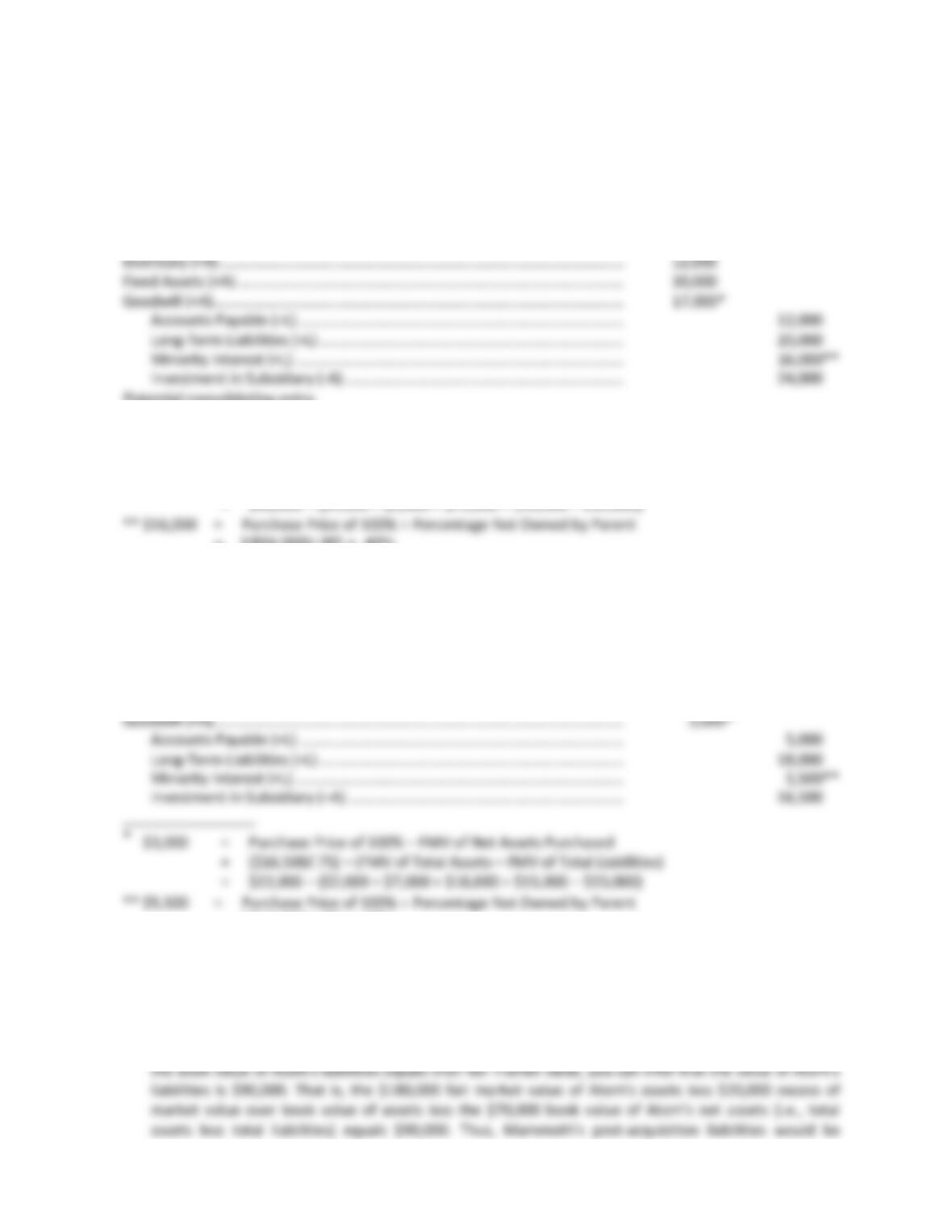
= [($84,800)/.80] x 20%
Company Y
Investment in Subsidiary (+A) ……………………………………………………………….. 24,000
Cash (–A) ……………………………………………………………………………………… 24,000
Cash (+A) ……………………………………………………………………………………………. 4,000
Accounts Receivable (+A) ……………………………………………………………………… 9,000
Potential consolidating entry.
__________________
* $17,000 = Purchase Price of 100% – FMV of Net Assets Purchased
P8–15 Concluded
= [$24,000/.60] – (FMV of Total Assets – FMV of Total Liabilities)
= $40,000 – ($4,000 + $9,000 + $12,000 + $30,000 – $32,000)
= [($24,000)/.60] x 40%
Company Z
Investment in Subsidiary (+A) ……………………………………………………………….. 16,500
Cash (–A) ……………………………………………………………………………………… 16,500
Cash (+A) ……………………………………………………………………………………………. 2,000
Accounts Receivable (+A) ……………………………………………………………………… 7,000
Inventory (+A) …………………………………………………………………………………….. 18,000
Fixed Assets (+A) …………………………………………………………………………………. 15,000
= [($16,500)/.75] x 25%
P8–16
a. Debt/Equity Ratio = Total Liabilities ÷ Total Stockholders’ Equity
Prior to the acquisition of Atom, Inc., Mammoth’s total liabilities were $230,000 and its total
stockholders’ equity was $270,000. Thus, Mammoth’s debt/equity ratio was .85.
By acquiring Atom, Inc., Mammoth would need to add Atom‘s liabilities to its own. If you assume that
would therefore be $380,000/$270,000 = 1.41.
b. If Mammoth accounted for this investment using the equity method, it would not have to combine
Atom, Inc.’s assets and liabilities with its own. Instead, Mammoth would simply report an asset (i.e.,
ISSUES FOR DISCUSSION
ID8–1
a. The market value of H&R Block’s marketable securities decreased in 2010 but increased in 2011 and
2012.
b. H&R Block could manage its earnings by selling marketable securities that have either a gain or a loss in
c. These gains or losses would be reflected in the statement of comprehensive income. Since1998
companies have been required to prepare a statement of comprehensive income.
ID8–2
a. Trading securities are bought and held principally for the purpose of selling them in the near future
b. Total comprehensive income includes all realized and unrealized gains and losses. The footnote
describes the realized gains/losses; the unrealized gains/losses would also factor into the calculation of
comprehensive income.
c. 2012 2010 .
ID8–3
a. Beginning LT Equity Investment + New Investments + Income from Affiliates – Dividends Received –
Investments Sold = Ending LT Equity Investment;
b. The statement of cash flow will deduct the $752 million in “equity in net income of affiliates” (because
the sale of investments, will also be disclosed.
c. Equity income is not a good measure of the cash AT & T received from its affiliates because there is no
ID8–4
a. “Share of profits from associates” represents EADS’ share of the earnings of the companies in
which EADS can assert significant influence. “Investment in associates” is the value that EADS
assigns to companies in which it has significant influence; under the equity method approach,
have been liquidated.
b. Ending Balance Investments in Associates = Beginning Balance Investments in Associates plus Share
of Profits from Associates + Payments for Investments in Associates – Dividends Received from
Associates – Balance Sheet Value of Associates Disposed; 2,662 = 2,677 + 241 + 328 – 0 – X; X = 584
ID8–5
a. The investment in associated companies on the balance sheet decreased in value because Sony
claimed a share of the associates’ losses as a decrease to the value of the investments and because
ID8–6
a. Under the equity method a substantive economic relationship exists between an investor and an
investee. The investor records the original investment at cost. For each subsequent period the investor
in analyzing financial statements that use the equity method of accounting.
b. Under the operating section on Chevron’s statement of cash flows, one will subtract “Equity income in
excess of Cash Received” from the total net income.
ID8–7
a. With consolidated financial statements, the assets and liabilities of the investee company (subsidiary)
are added to the assets and liabilities of the investing company (parent). Thus, the amount of assets
and liabilities reported by the consolidated entity will be greater than the assets and liabilities reported
by either the parent or subsidiary. Note, however, that the total amount of stockholders’ equity
implies that the equity method should not cause a company to have “difficulties with bond indenture
agreements.”
b. If users of financial statements are reasonably sophisticated, they should be able to understand more
complex business and reporting situations. This implies that as the users‘ sophistication increases, the
ID8–8
a. Unrealized losses for trading securities are reported on the income statement. If Starbucks’ $57.6
million portfolio of trading securities dropped in value by 50%, the income statement for the month of
b. Designating all marketable securities as available-for-sale would have eliminated the effect on the
ID8–9
a. Realized gains (when shares are sold) are always reported on the income statement, so the two articles
do not tell us whether the investments were designated as trading or available-for-sale securities.
b. Analysts are interested in earnings that are sustainable and can be repeated in future periods. Profits
ID8–10
Unrealized gains/losses are not reported on the income statement for available-for-sale securities. Firms
with large investment portfolios, such as banks, can therefore keep the fluctuations in the securities values
ID8–11
Comprehensive income includes all non-owner related changes in stockholders’ equity that do not appear
on the income statement and are not reflected in the retained earnings balance. As a global company, Eli
Lilly sells its pharmaceutical products in foreign countires for foreign currencies. In 2012, the value of those
ID8–12
a. Minority or noncontrolling interest is recognized on the balance sheet because the acquiring
company does not purchase 100% of the target company but does purchasing a controlling stake
(greater than 50%) and therefore consolidates financial statements with the target company. The
ID8–13
a. Google carries $33.3 billion of short-term investments as of the end of 2012 (versus $34.6 billion in
c. In May, 2012 Google acquired Motorola, a provider of mobile communication devices (Note 6). The
journal entry for the acquisition is summarized: ( dollars in billions)
Cash 2.9
Cash 12.4
d. Goodwill was $10,537 million and $7,346 million in 2012 and 2011, respectively. The Motorola
.