For the Year Ended December 31, 20XX
FIFO Averaging LIFO
Sales $ 55,000 $ 55,000 $ 55,000
Cost of goods sold 38,900 36,891 34,900
P7–5
a. Cost of Goods Available for Sale = Cost of Goods in Beginning Inventory + Cost of
Goods Purchased
= (500 units x $70) + (1,000 units $75) + (3,000 units
$80) + (4,000 units $82)
Cost of Goods Sold = Cost of Goods Available for Sale – Ending Inventory
= $678,000 – $205,000
= $473,000
LIFO:
Ending Inventory = (500 units $70) + (1,000 units x $75) + (1,000 units x $80)
P7–5 Continued
Laundryman’s Corporation
Income Statements
For the Year Ended December 31, 20XX
FIFO Averaging LIFO
Sales $ 900,000 $ 900,000 $ 900,000
Cost of goods sold 473,000 478,600 488,000
b. By using LIFO rather than FIFO, Laundryman’s would save $4,500 ($90,600 – $86,100) in taxes.
c. Ending inventory
FIFO Averaging LIFO
FIFO method:
Loss on Inventory Write-down (Lo, –SE) ……………………………………………….. 10,000
Inventory (–A) ……………………………………………………….…………………….. 10,000
Adjusted inventory to LCM.
Averaging method:
P7–5 Concluded
d. Cost of Goods Available for Sale = Cost of Goods in Beginning Inventory + Cost of
Goods Purchased
= (500 units x $80) + (1,000 units $78) + (3,000 units
$77) + (4,000 units $75)
= $649,000
Cost of Goods Sold = Cost of Goods Available for Sale – Ending Inventory
= $649,000 – $187,500
= $461,500
LIFO:
Ending Inventory = (500 units $80) + (1,000 units x $78) + (1,000 units x $77)
Averaging:
Cost per Unit = Cost of Goods Available for Sale ÷ Number of Units Available for Sale
= $649,000 ÷ 8,500 units
= $76.35 per unit
Laundryman’s Corporation
Income Statements
For the Year Ended December 31, 20XX
FIFO Averaging LIFO
Sales $ 900,000 $ 900,000 $ 900,000
Cost of goods sold 461,500 458,125 454,000
Gross profit $ 438,500 $ 441,875 $ 446,000
Other expenses 125,000 125,000 125,000
P7–6
a. LIFO cost flow assumption:
(1) 1/3 Purchases (+A) ……………………………………………………………. 140,000
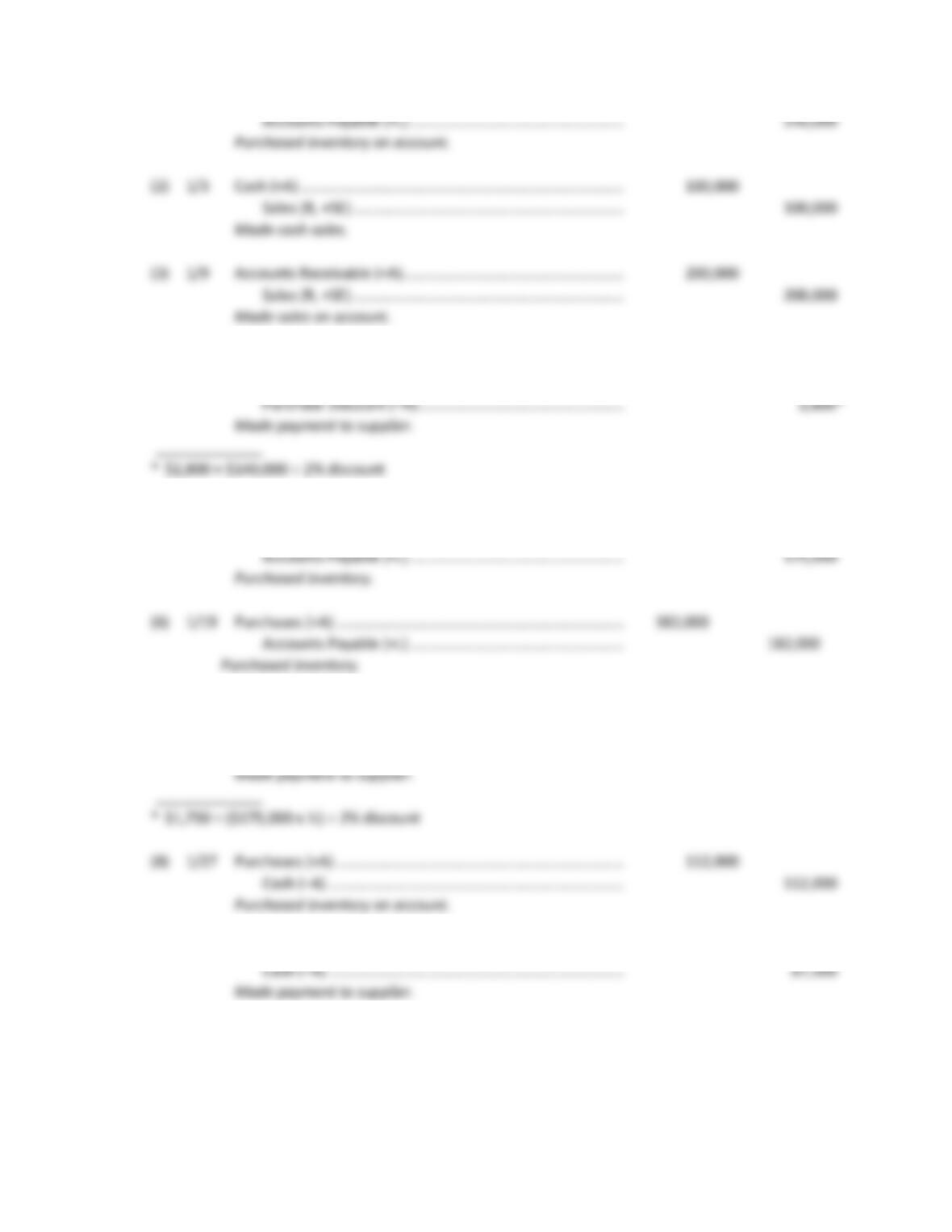
(4) 1/10 Accounts Payable (–L) ………………………………………………….. 140,000
Cash (–A) ……………………………………………………………… 137,200
(5) 1/15 Purchases (E, –SE) ……………………………………………………….. 248,500
Cash (–A) ……………………………………………………………… 73,500
(7) 1/23 Accounts Payable (–L) ………………………………………………….. 87,500
Cash (–A) ……………………………………………………………… 85,750
Purchase Discount (–A) ………………………………………….. 1,750*
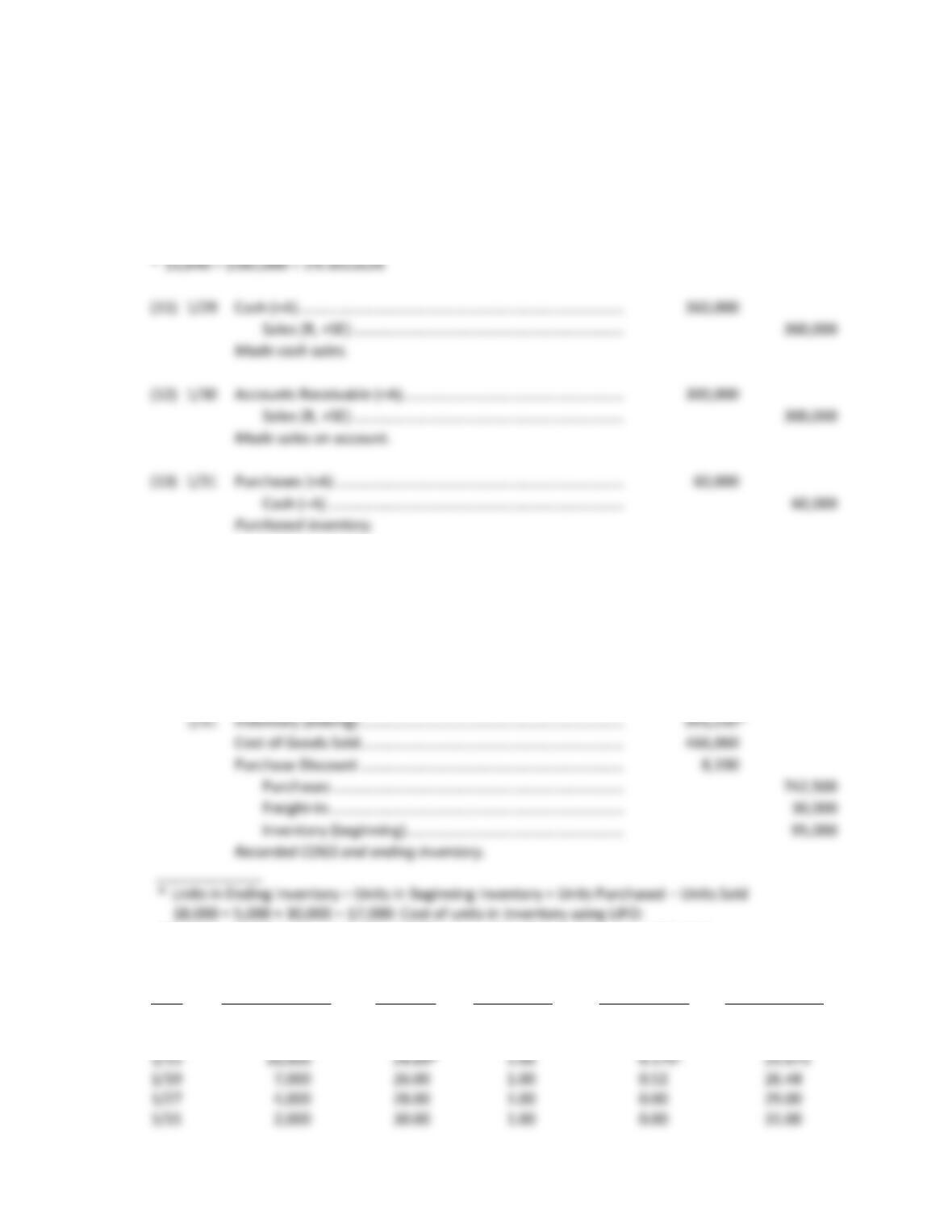
(9) 1/28 Accounts Payable (–L) ………………………………………………….. 87,500
P7–6 Continued
(10) 1/28 Accounts Payable (–L) ………………………………………………….. 182,000
Cash (–A) ……………………………………………………………… 178,360
Purchase Discount (–A) ………………………………………….. 3,640*
Made payment to supplier.
_____________
(14) 1/31 Freight-In (+A) …………………………..………………………………… 30,000
Accounts Payable (+L) ……………………………………………. 30,000
Incurred freight costs on inventory.
a. LIFO cost flow assumption ………………..
Adjusting entry
$393,250 = (5,000 units $19.00) + (7,000 units $20.60) + (6,000 units $25.675)
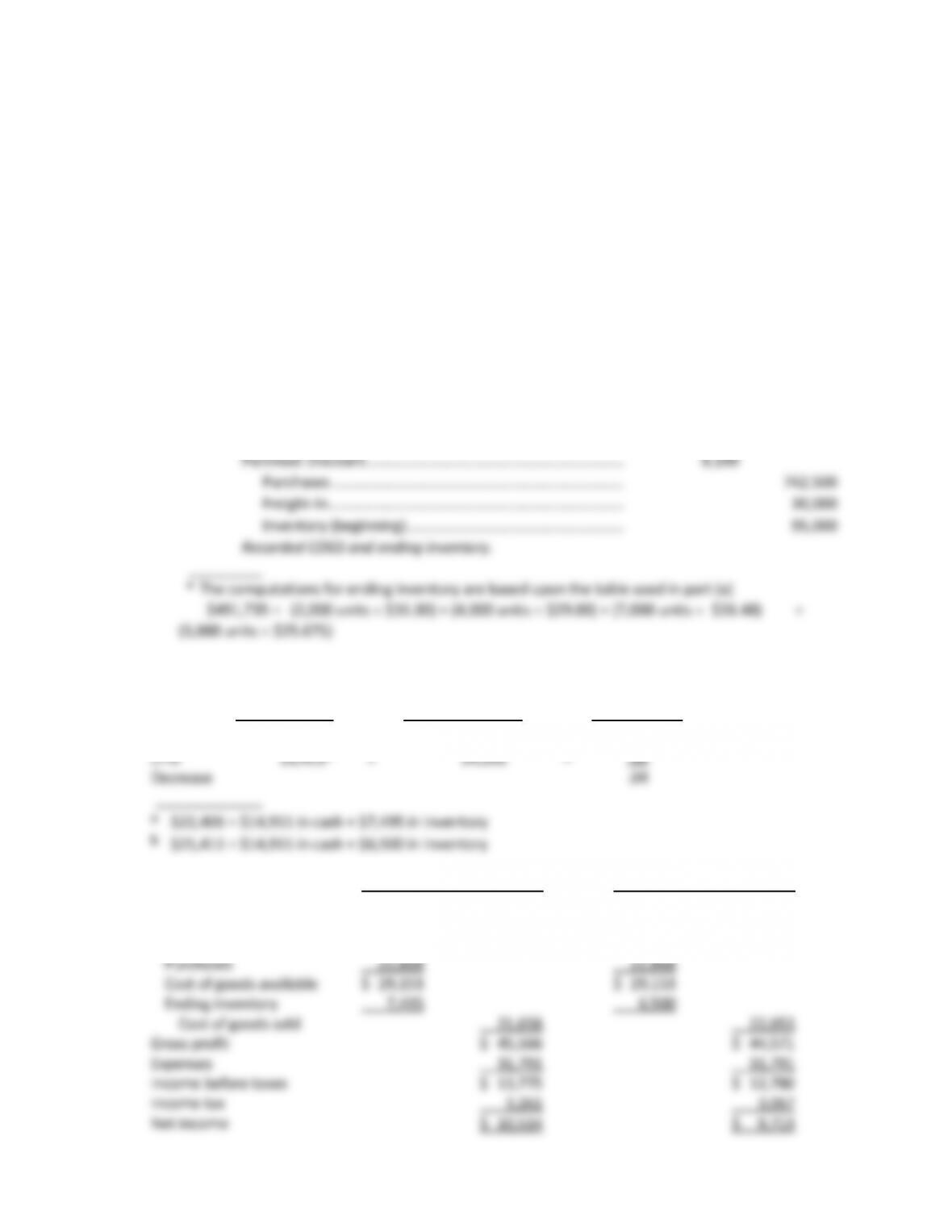
The unit costs used to calculate the $393,250 were taken from the following table.
Date Number of Units Unit Cost Unit Freighta Unit Discount Total Unit Cost
Beg. Inv. 5,000 $19.00 $0.00 $ 0.00 $19.00
1/3 7,000 20.00 1.00 0.40 20.60
P7–6 Concluded
a $1.00 = $30,000 freight bill ÷ 30,000 units purchased
b $24.85 unit cost = [(3,000 $24.50) + (7,000 $25.00)] ÷ 10,000 units
c $0.175 unit discount = Total discount of $1,750 ÷ 10,000 units
b. FIFO cost flow assumption:
All entries throughout January would be identical under the FIFO and LIFO cost flow assumptions using
the periodic method. The only difference would be in the adjusting entry to record COGS and ending
inventory.
Adjusting entry
1/31 Inventory (ending) ……………………………………………………… 491,735*
Cost of Goods Sold …………………………………………………….. 367,575
P7–7
a. Current Assets ÷ Current Liabilities = Current Ratio
FIFO $22,406a ÷ $24,262 = .92
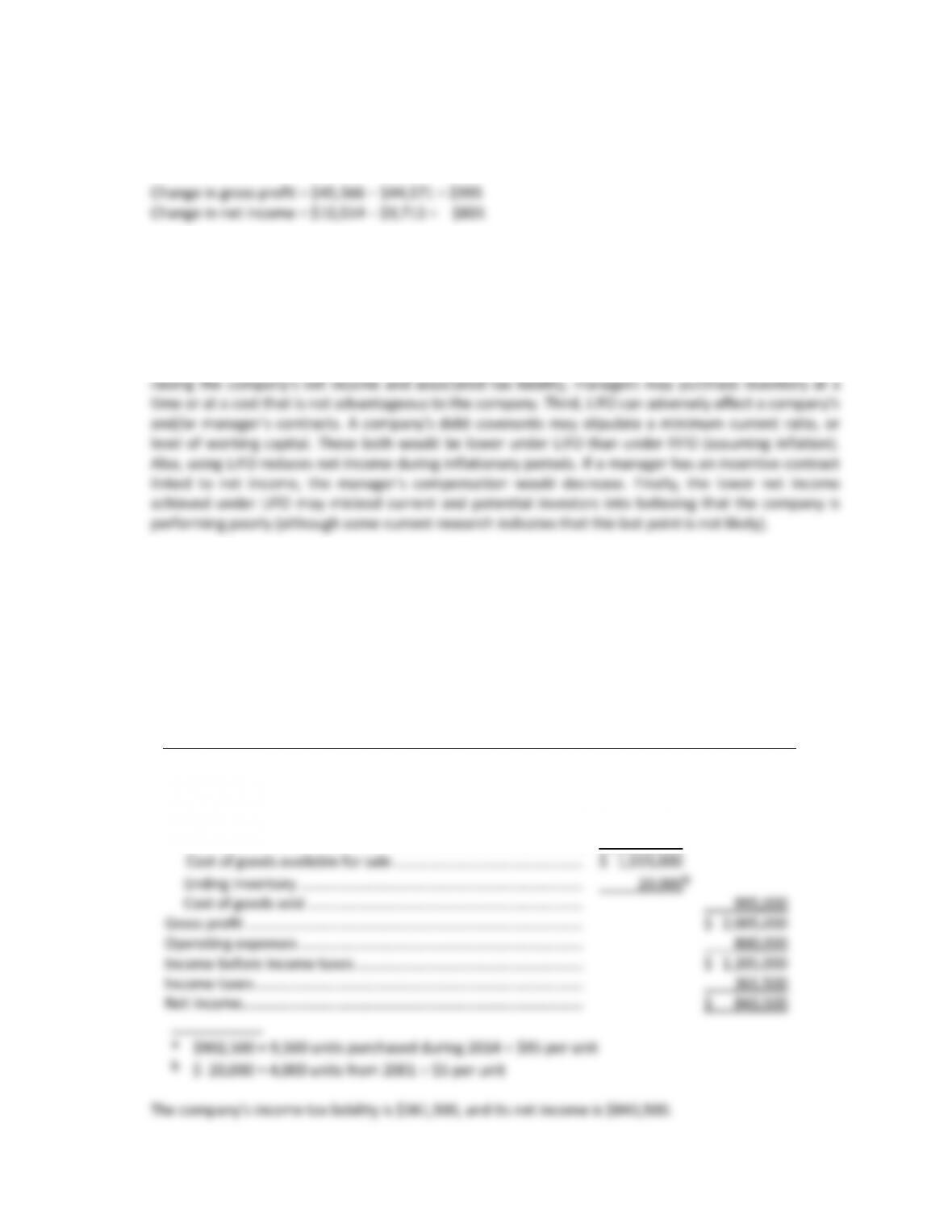
b. FIFO LIFO
Sales $ 67,224 $ 67,224
Cost of goods sold:
Beginning inventory $ 6,285 $ 6,285
P7–7 Concluded
c. Tax dollars saved = $3,261 – $3,067 = $194
d. Using LIFO can have several disadvantages. First, LIFO requires a company to maintain records for older
inventory acquisitions. This practice usually results in higher bookkeeping costs. Second, to avoid
“eating into” a LIFO layer, which would result in older, lower inventory costs flowing into COGS and
P7–8
a. Ending Inventory, 12/31/2014: LIFO layers:
2001 4,000 units x $5 per unit = $ 20,000
b.
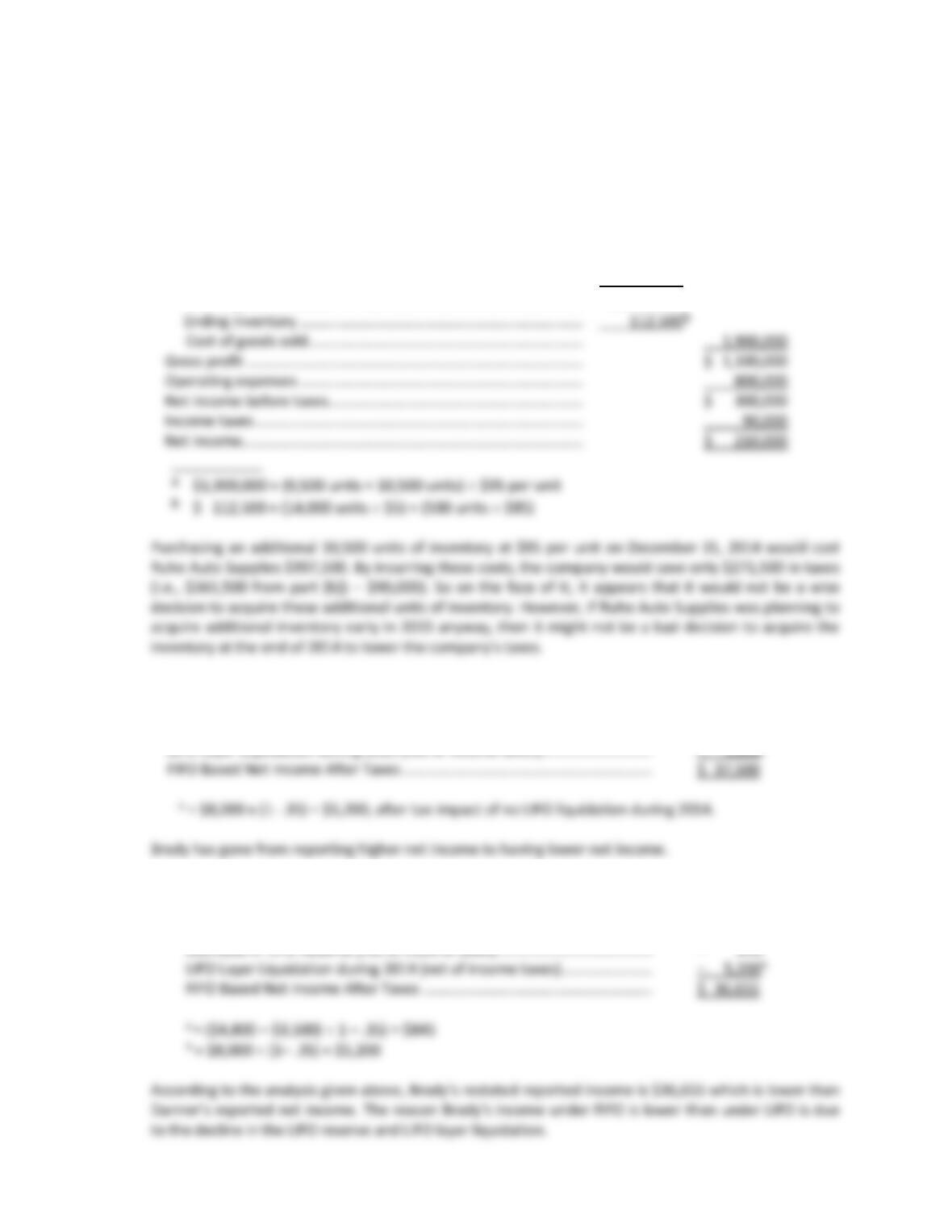
Ruhe Auto Supplies
Income Statement
For the Year Ended December 31, 2014
Revenue …………………………………………………………………………… $ 3,000,000
Cost of goods sold:
Beginning inventory ………………………………………………………. $ 112,500
Purchases …………………………………………………………………….. 902,500a
P7–8 Concluded
c.
Revenue …………………………………………………………………………… $ 3,000,000
Cost of goods sold:
Beginning inventory ………………………………………………………. $ 112,500
Purchases …………………………………………………………………….. 1,900,000a
Cost of goods available for sale ……………………………………….. $2,012,500
P7–9
a. Brady’s 2014 reported income under LIFO ………………………………………….. $ 42,700
LIFO Layer Liquidation during 2014 (net of income taxes)……………………… – 5,200a
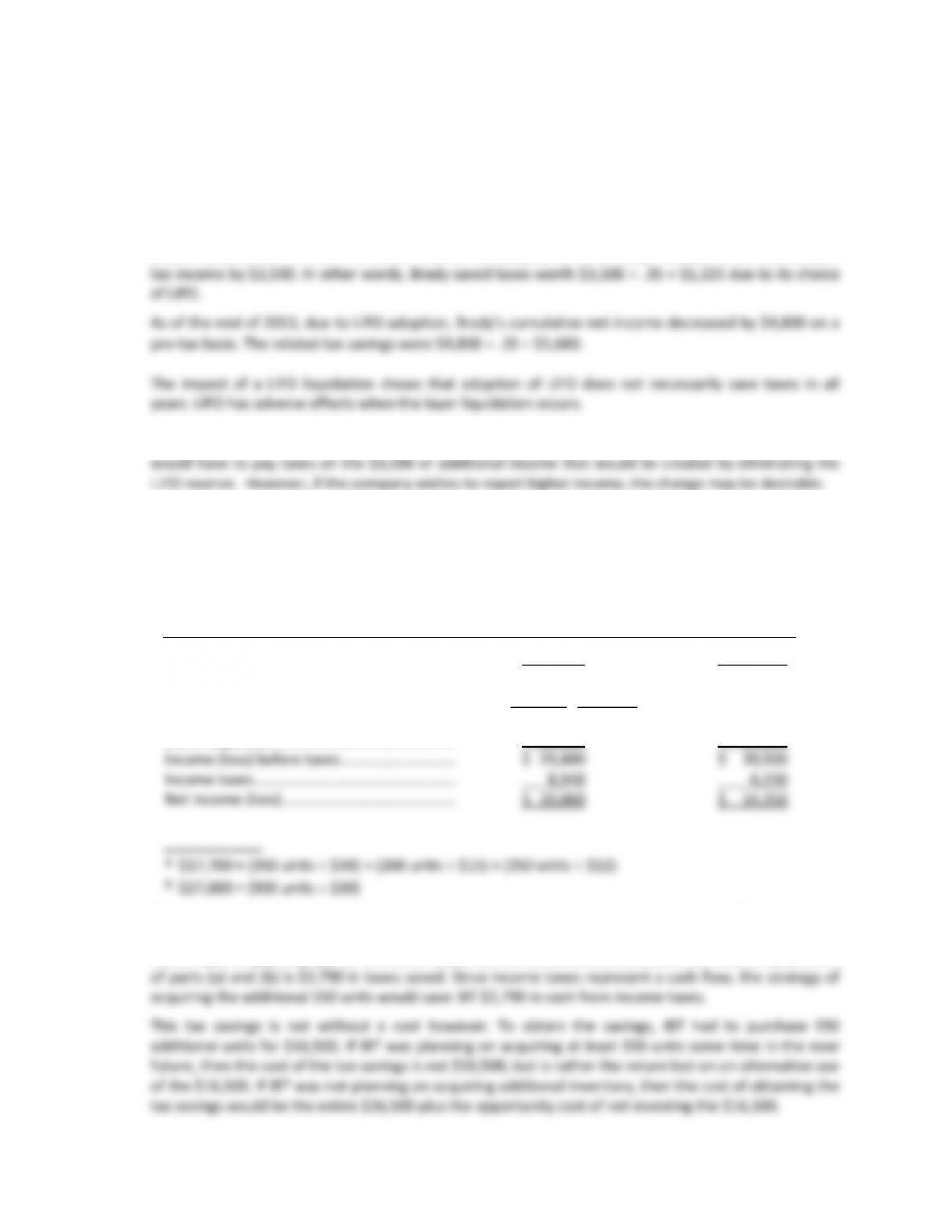
b. Restatement of Brady’s 2014 reported income, if it had always been a FIFO user, can be computed as
follows:
Brady’s 2014 reported income under LIFO ………………………………………… $ 42,700
Decrease in LIFO Reserve (net of income taxes) ………………………………. – 845a
P7–9 Concluded
c. As of the end of 2014 Brady had a LIFO reserve of $3,500. A LIFO reserve shows the accumulated
benefit derived from the LIFO method. Due to the adoption of LIFO Brady reduced its cumulative pre-
d. From an income tax point it is not advisable for Brady to change its cost flow assumption. If it did so, it
P7–10
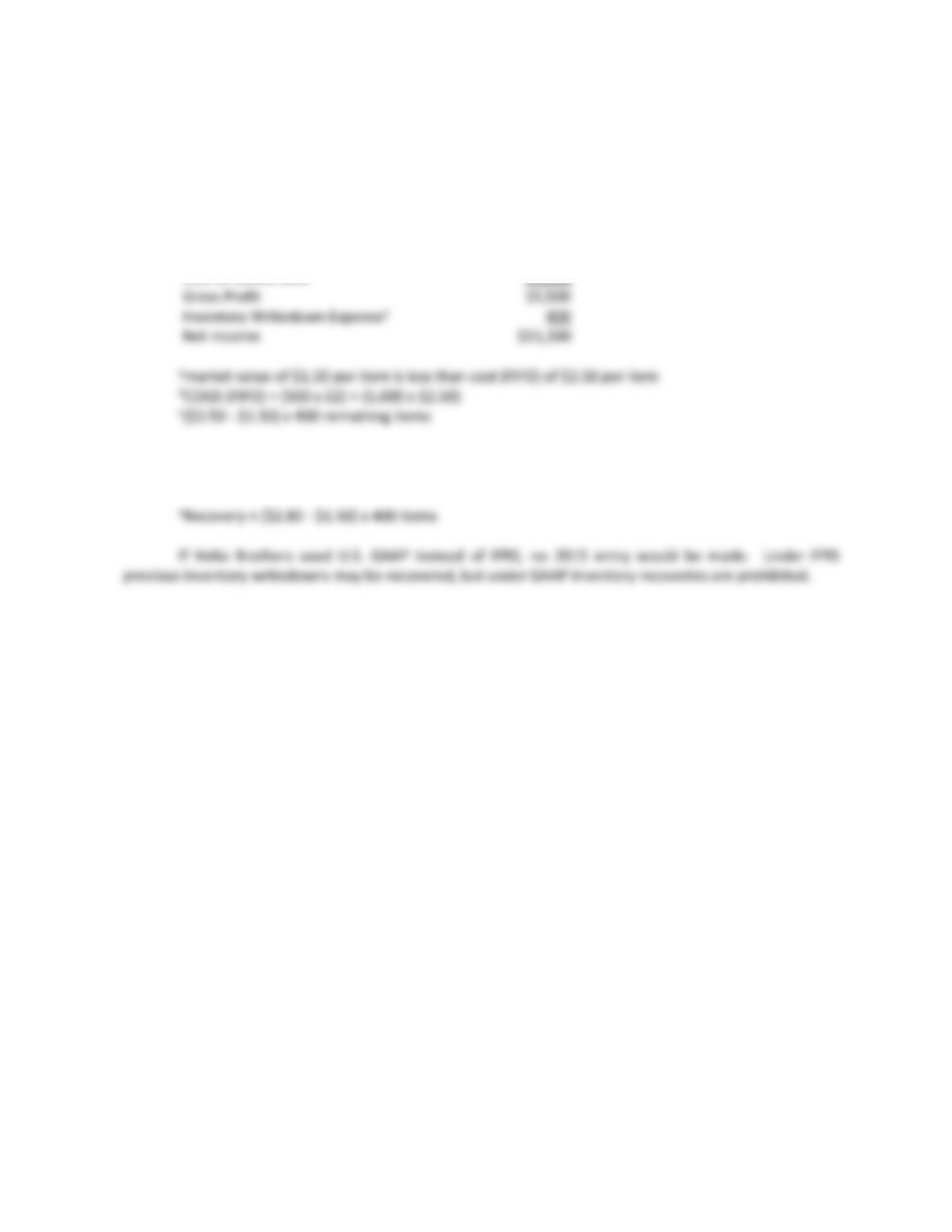
a. and b.
IBT
Income Statements
For the Year Ended December 31, 2014
Part (a) Part (b)
Sales …………………………..………………………….. $ 67,500 $ 67,500
Cost of sales ………………………………………….. 17,700 a 27,000 b
Gross profit …………………………………………… $ 49,800 $ 40,500
Other expenses …………………………..…………. 20,000 20,000
c. The primary advantage of purchasing the additional 550 units on December 20 is the effect on income
taxes. Under part (a), IBT would have to pay $8,940 in income taxes. However, under part (b), IBT
would have to pay only $6,150 in income taxes. So the net difference between the income statements
P7–11
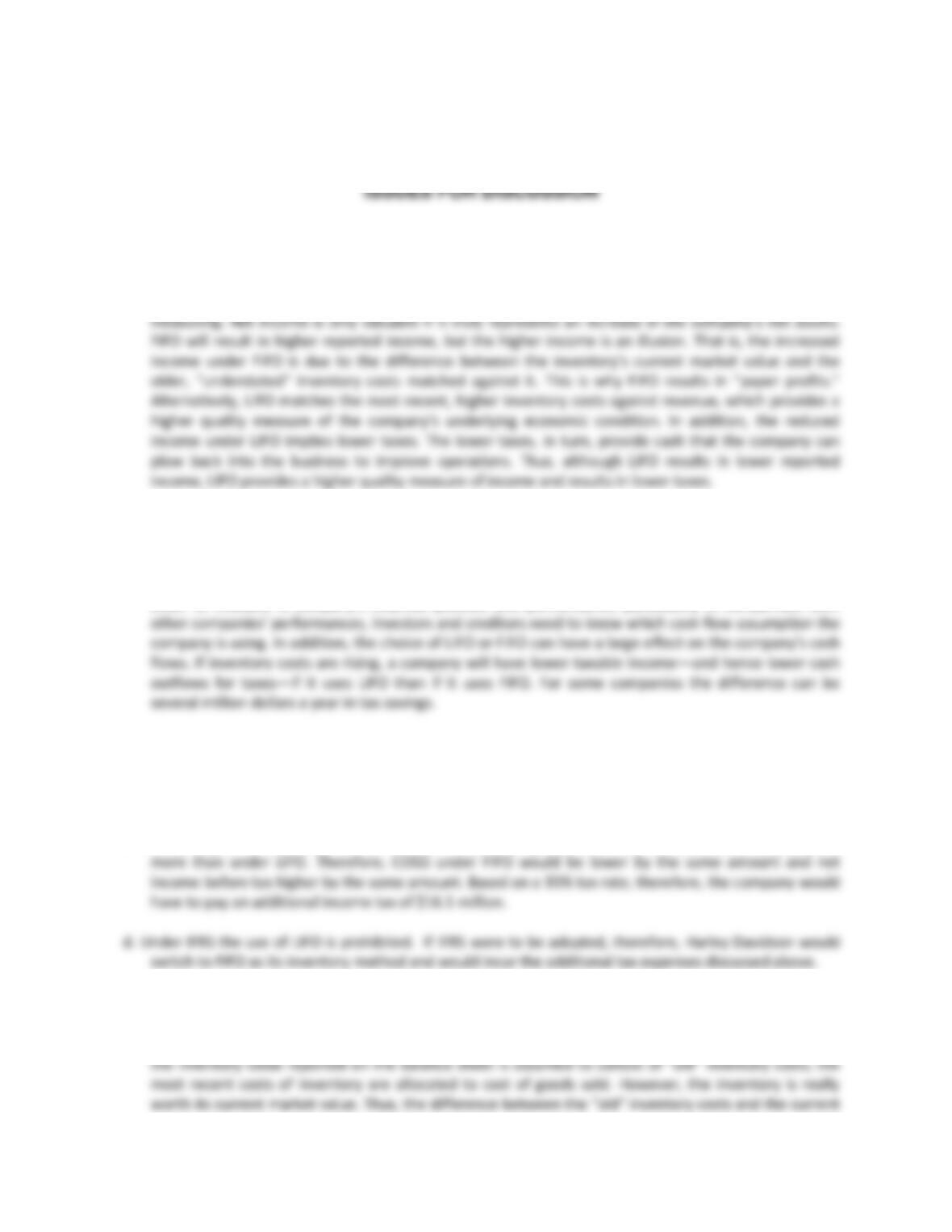
a. Ending Inventory = 400 x $1.50a = $600
Net Income: Sales $30,500
Cost of Goods Soldb 15,000
b. Inventory (+A) 520a
Inventory Recovery(R, +SE) 520
ID7–1
If investors are solely interested in net income, then the partner is probably correct, and companies
should select FIFO if they want to raise capital. However, this view is probably not valid. One must
remember that net income is simply a measurement; one must not lose sight of what accountants are
ID7–2
a. The choice of LIFO or FIFO will affect the amounts a company reports both in its balance sheet for
inventory and in its income statement for cost of goods sold (and consequently net income). Thus, in
order to evaluate a company’s financial position and performance, particularly in comparison with
b. Obsolete inventory, by definition, is inventory that has no value to the company; due to damage or
technological changes or other reasons, the company will not be able to convert this inventory into
cash. By deducting this line item from the balance sheet, the company is disclosing the value that it will
be able to realize from its inventory.
c. According to the footnote, Harley Davidson’s 2012 ending inventory under FIFO would be $45,889,000
ID7–3
In times of rising inventory costs, LIFO allows companies to “hide” the value of their inventory. That is,
ID7–4
a. Loss on Inventory Write–down (Lo, –SE) …………………………………… 12,000,000
Inventory (–A) ……………………………………………………….………… 12,000,000
Wrote down inventory to market value.
b. Period 1
Loss on Inventory Write–down (Lo, –SE) …………………………………… 12,000,000
c. Because the lower-of-cost-or-market rule gives differential treatment to price decreases and price
ID7–5
a. Valero is using the lower of cost or market exception to the historical cost principle that is applied to
inventory. If the market value of inventory is lower than the cost of that inventory, it must be written
down to the lower value.
b. The write-down will lower reported income, current assets and the equity of Valero.
c. Valero’s current ratio will decrease because inventory will be carried at a lower value, which lowers
e. Under U.S. GAAP, inventory is written down, if appropriate, but never written back up. Therefore,
Valero would simply leave the inventory at the written-down carrying cost, even if market prices
ID7–6
a. If Sherwin Williams reported inventories at the end of 2012 based on a FIFO system, the ending
inventory balance would have been $1,277,627 ($920,324 + $357,303).
b. The following were the tax effects to Sherwin Williams as a result of using LIFO.
2010 2011 2012
ID7–7
a. A company “thins” its inventory when it reduces the amount of inventory it owns at any given time.
Inventory is an asset that has a cost; lower levels of inventory mean lower costs to carry that iventory.
ID7–8
The entries on the statement of cash flows are intended to show the impact on cash of the changes in
the various balance sheet accounts. A change in an asset account impacts the statement of cash flows
because if the asset account increased it reduced the amount of cash, and if the asset account
ID7–9
a. Supervalu has a much larger difference between LIFO and FIFO inventories than does Safeway.
Supervalu’s LIFO Reserve of $211 is over 24 of the value of the inventory of $854, while Safeway’s
LIFO Reserve is under 3% of the total ($70.5 ÷ $2,562).
b. Supervalu: LIFO Inventory $854 + $211 = $1,065 FIFO Inventory
The adoption of FIFO, in this case, more closely matches the actual physical flow of the inventory.
ID7–10
a. When an asset such as inventory decreases, it frees up a company’s cash. A drop in an asset is a
“source” of cash for a company. Similarly, when a liability such as accounts payable increases (meaning
b. From the changes to inventory and accounts payable, it appears that Target was managing its business
to downsize inventory levels during a slow economic recovery (2012). The company also appeared to
ID7–11
a. The results from the policy shift will affect the balance sheet with higher Accounts Payable balances
and, therefore, higher Cash Balances; if the company maintains short-term working capital financing
shipping terms), the trade-off might be well worth it.
ID7–12
a & b. Inventory is a relatively small investment for Google, due to the company’s predominat business
line of advertising sales from internet searches; however, the recent acquisition of Motorola’s mobile