1
CHAPTER 7
MERCHANDISE INVENTORY
BRIEF EXERCISES
BE7–1
The inventory purchases made by Hewlett-Packard during 2012 can be calculated as follows:
Beginning inventory $ 7.5 billion
BE7–2
a. From the footnote it is apparent that Johnson & Johnson is a manufacturer. A retailer or a service
BE7–3
If General Electric used the FIFO inventory cost flow assumption instead of LIFO, its inventory balance
EXERCISES
E7–1
(1) Since the goods were shipped FOB shipping point, legal title to the goods passes to the buyer when the
(2) The goods were shipped FOB shipping point, so legal title passes to the buyer when the goods are
E7–1 Concluded
(3) Since the goods were shipped FOB destination, legal title to the goods passes to the buyer when the
goods reach their destination on January 2, 2015. Since Dallas is the seller, not the buyer, Dallas has
(4) The goods were shipped FOB destination, so legal title to the goods passes to the buyer when the
goods reach their destination on December 31, 2014. Since Dallas is the buyer, Dallas has legal title to
(5) The goods were shipped FOB destination, so legal title to the goods passes to the buyer when the
goods reach their destination on January 3, 2015. Since Dallas is the buyer, Dallas does not have legal
E7–2
10/10 Inventory (+A) ……………………………………………………………………….. 76,000
Accounts Payable (+L) ………………………………………………………. 76,000
Purchased inventory on account.
E7–3
3/3 Inventory (+A) ……………………………………………………………………….. 50,000
Accounts Payable (+L) ………………………………………………………. 50,000
Purchased inventory on account.
3/10 Inventory (+A) ……………………………………………………………………….. 140,000
Cash (–A) ………………………………………………………………………… 50,000
Paid supplier
E7–4
12/31/10:
Ending inventory:
Cost of Goods Sold = Goods available for sale – Ending Inventory
$13,831 = $16,986 – Ending Inventory
E7–5
With the perpetual method, the balance in the Cost of Goods Sold account is perpetually updated for
sales of inventory, as is the balance in the Inventory account for sales and acquisitions of inventory.
This implies that the balance in Cost of Goods Sold should correspond to a balance in the Inventory
E7–6
a. Error in Ending Inventory in 2011: The $50 understated error in the Ending inventory means that
the Ending Inventory should have been $220 + $50 = $270. This would change the Cost of goods sold to
E7–7
a. Net cash from operating activities is the sum of all cash inflows
and outflows that are related to the daily running of the company’s business operations. Net
income is the difference between revenues (which do not have to be collected in cash) and
expenses (which do not have to be paid out in cash). It is very possible for a company to show a
just as it is possible that cash inflows exceeded sales for the period (because, for example, cash was
also collected from sales from the prior period).
b. The basic form for the journal entry is:
Inventory Write Down Expense (E, -SE)
c. If Sony’s change to inventory (160,432) is being added back to
E7–8
a. If Marian wants to maximize profits and ending inventory, she should sell the customer the lowest
priced coat (i.e., Coat 4). If she sells Coat 4, Marian would report the following gross profit and ending
inventory.
Gross Profit Ending Inventory
Revenues $ 12,000 Coat 1 $ 8,400
she could maximize her bonus by maximizing profits.
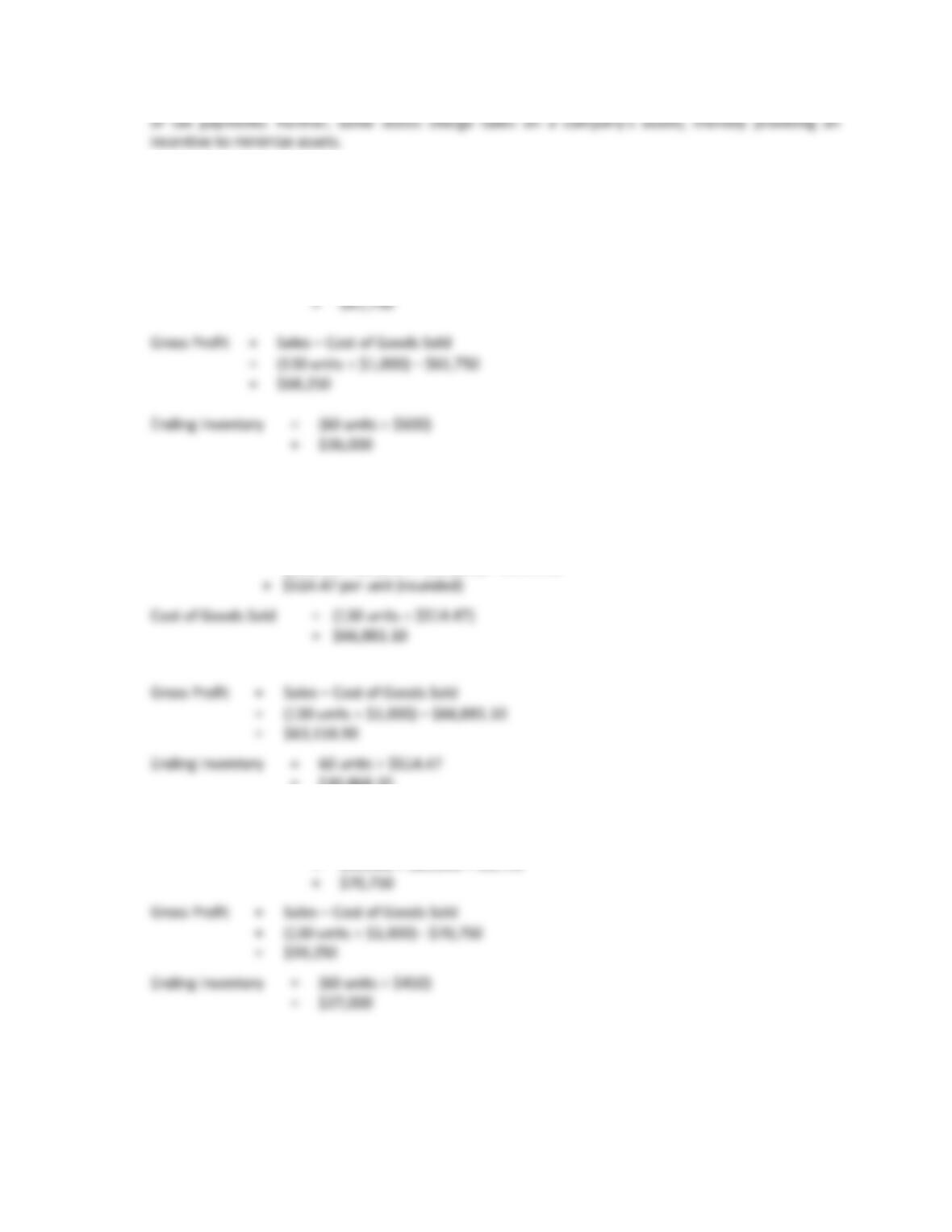
b. If Marian wants to minimize profits and ending inventory, she should sell the customer the highest
priced coat (i.e., Coat 1). If she sells Coat 1, Marian would report the following gross profit and ending
inventory.
E7–9
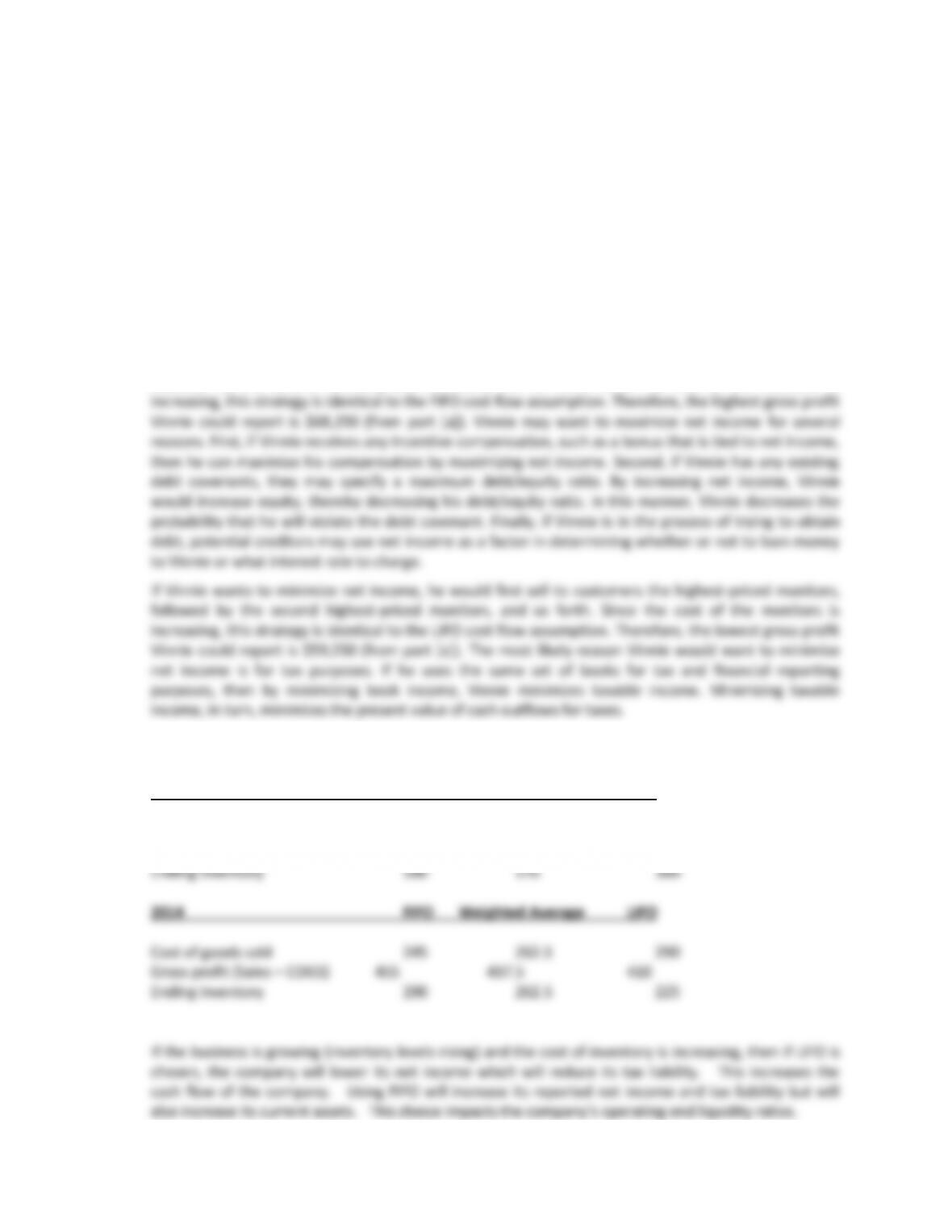
a. FIFO cost flow assumption:
Cost of Goods Sold = (75 units $450) + (50 units $500) + (5 units $600)
= $33,750 + $25,000 + $3,000
Averaging cost flow assumption:
Cost per Unit = [(75 units $450) + (50 units $500) + (65 units $600)] ÷ (75
units + 50 units + 65 units)
($33,750 + $25,000 + $39,000) ÷ 190 units
= $30,868.20
LIFO cost flow assumption:
Cost of Goods Sold = (65 units $600) + (50 units $500) + (15 units $450)
= $39,000 + $25,000 + $6,750
E7–9 Concluded
b. If the monitors are identical, customers would be indifferent between any two monitors. Hence, Vinnie
could simply give a customer the monitor that allows him to either minimize or maximize cost of goods
sold, thereby maximizing or minimizing gross profit.
If Vinnie wants to maximize net income, he would first sell to customers the lowest-priced monitors,
followed by the second lowest-priced monitors, and so forth. Since the cost of the monitors is
E7–10
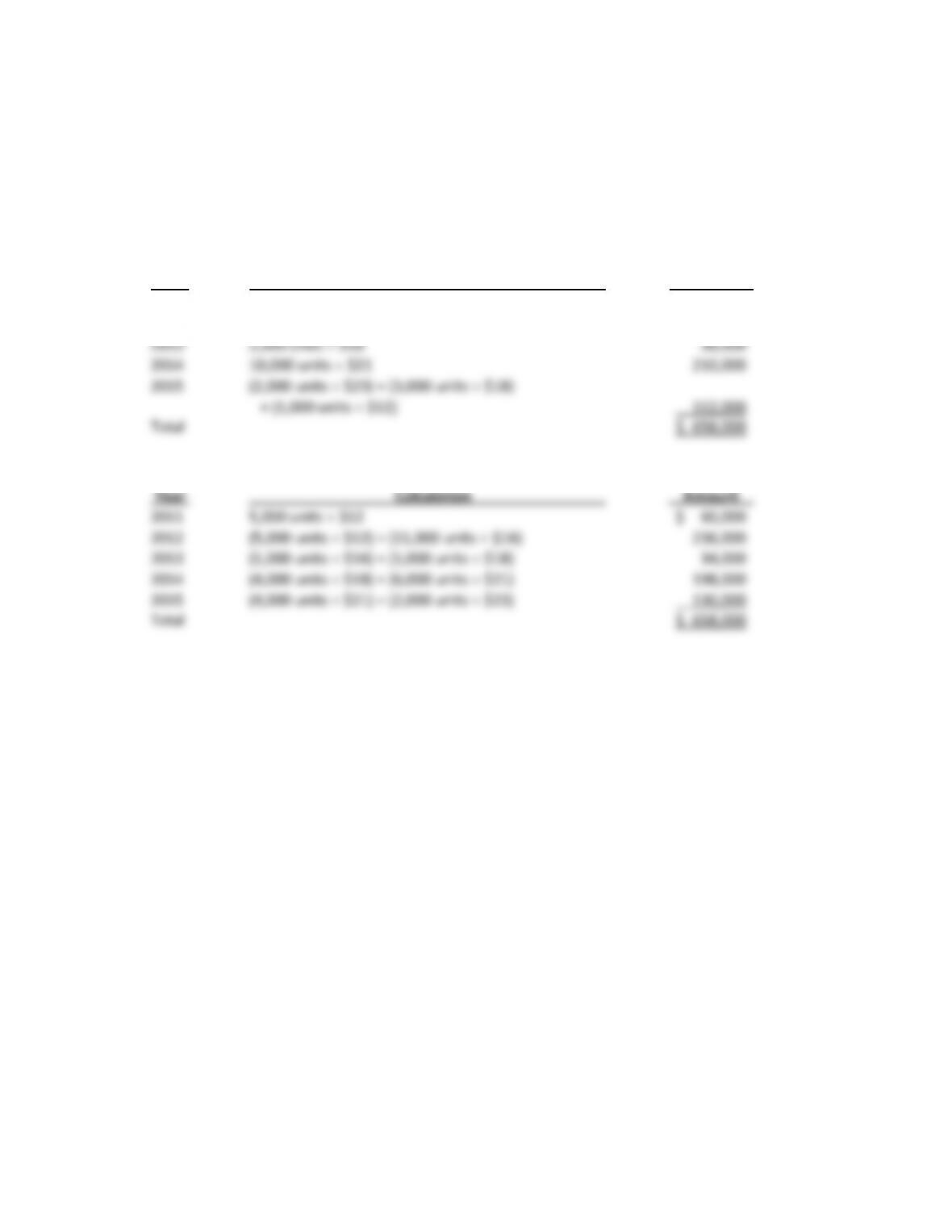
2013 FIFO Weighted Average LIFO
Cost of goods sold 160 170 180
Gross profit (Sales – COGS) 290 280 270
E7–11
a. LIFO cost flow assumption:
Year Calculation Amount
2011 5,000 units $12 $ 60,000
2012 (12,000 units $16) + (4,000 units $12) 240,000
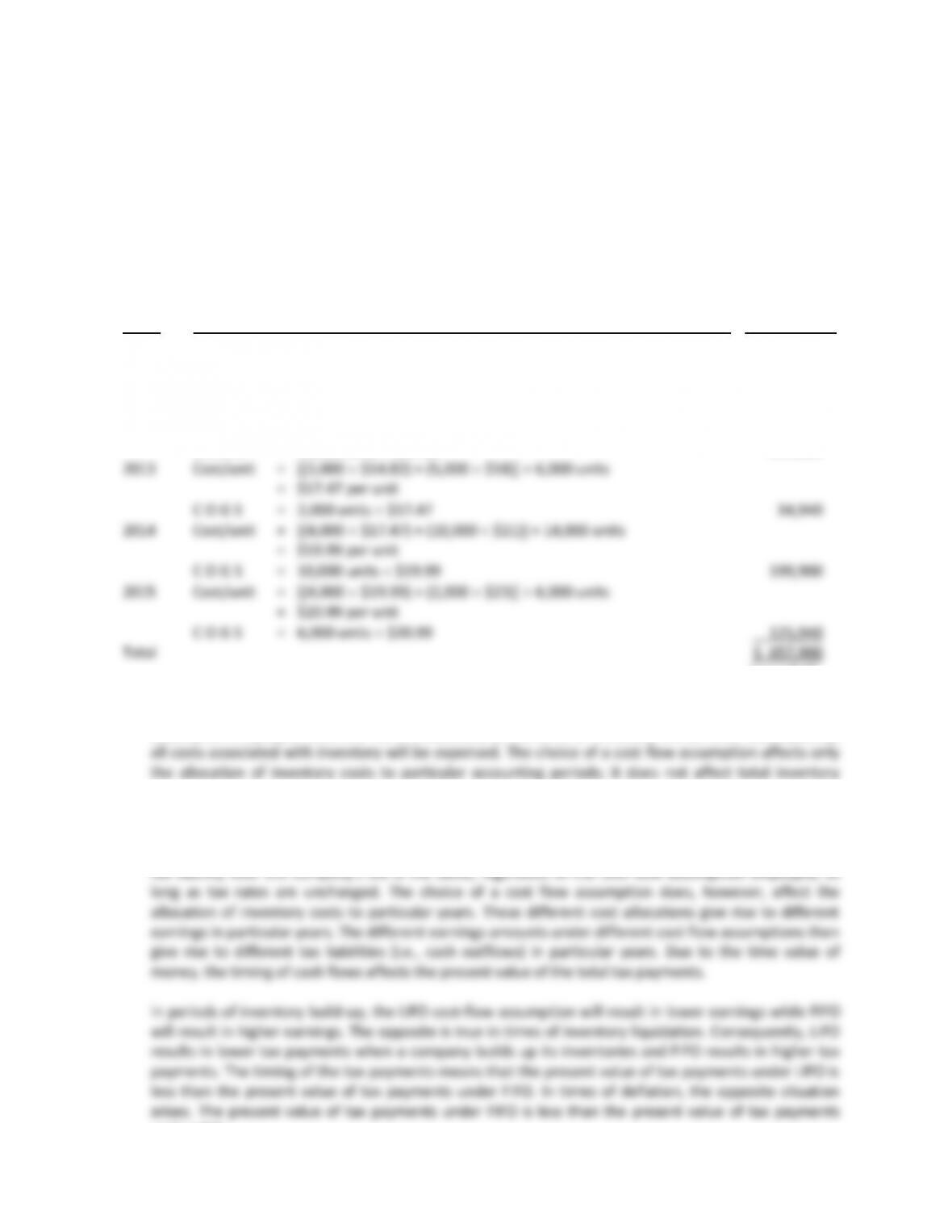
FIFO cost flow assumption:
E7–11 Concluded
Averaging cost flow assumption:
Year Calculation Amount
2011 Cost/unit = $120,000 ÷ 10,000 units
= $12 per unit
C O G S = 5,000 units $12 $ 60,000
2012 Cost/unit = [(5,000 $12) + (12,000 $16)] ÷ 17,000 units
= $14.82 per unit
C O G S = 16,000 units $14.82 237,120
(rounded)
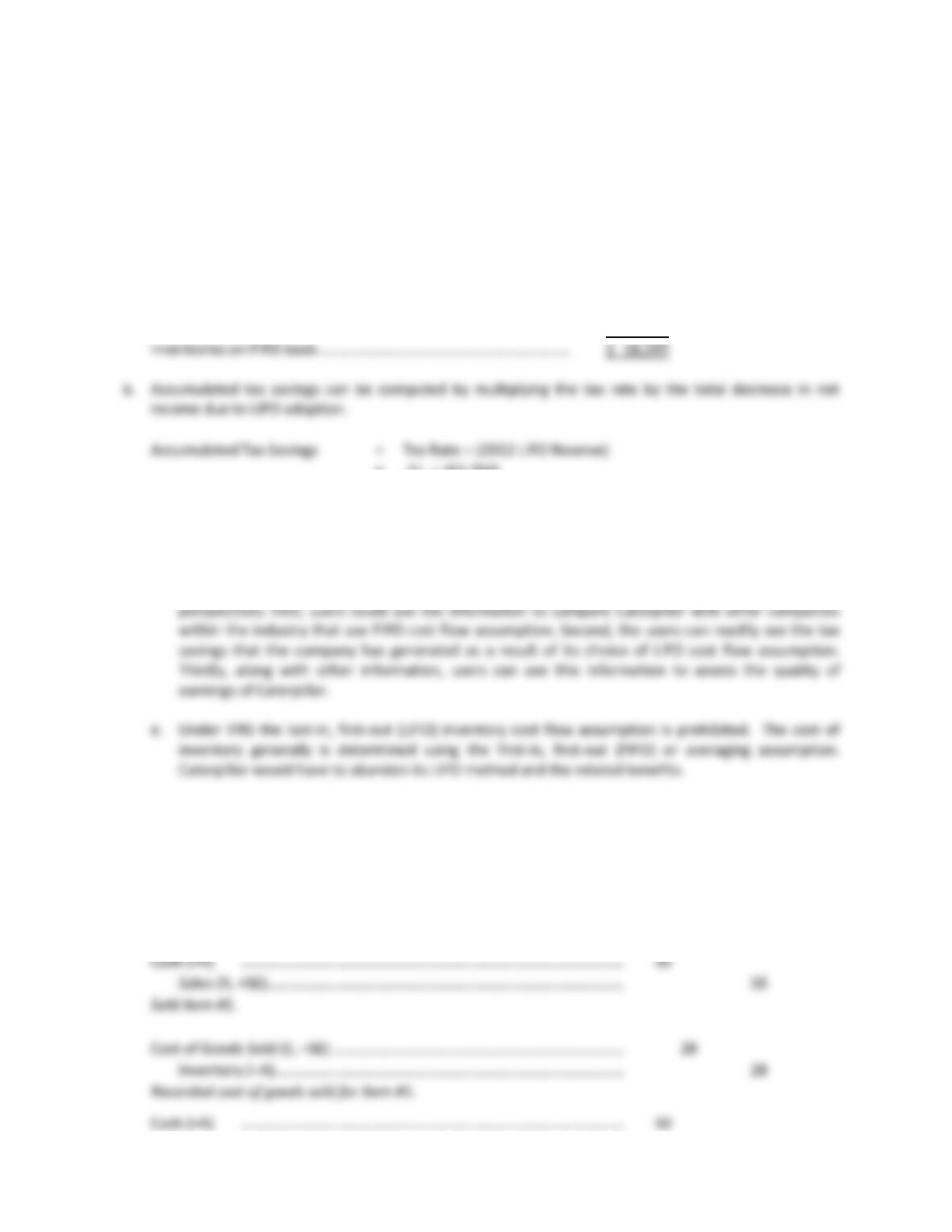
b. Over the life of a company, Cost of Goods Sold would be the same regardless of the cost flow
assumption employed. Over the life of a business, all the units of inventory will be sold. Consequently,
costs.
c. Assume that accounting earnings equals tax earnings. Over the life of a business, a company’s total
earnings are the same regardless of the cost flow assumption employed. Therefore, a company‘s total
under LIFO.
E7–12
a. Inventories on LIFO basis …………………………..……………………….. $15,547
Add: Adjustment to LIFO basis …………………………………………….. 2,750
= .31 ($2,750)
= $852.50
c. The 2012 reported net income under the FIFO cost flow assumption would be $5.907.32 ($5,681 +
($2,750 – 2,422)(1-.31)) if Caterpillar had chosen to change from LIFO to FIFO years earlier.
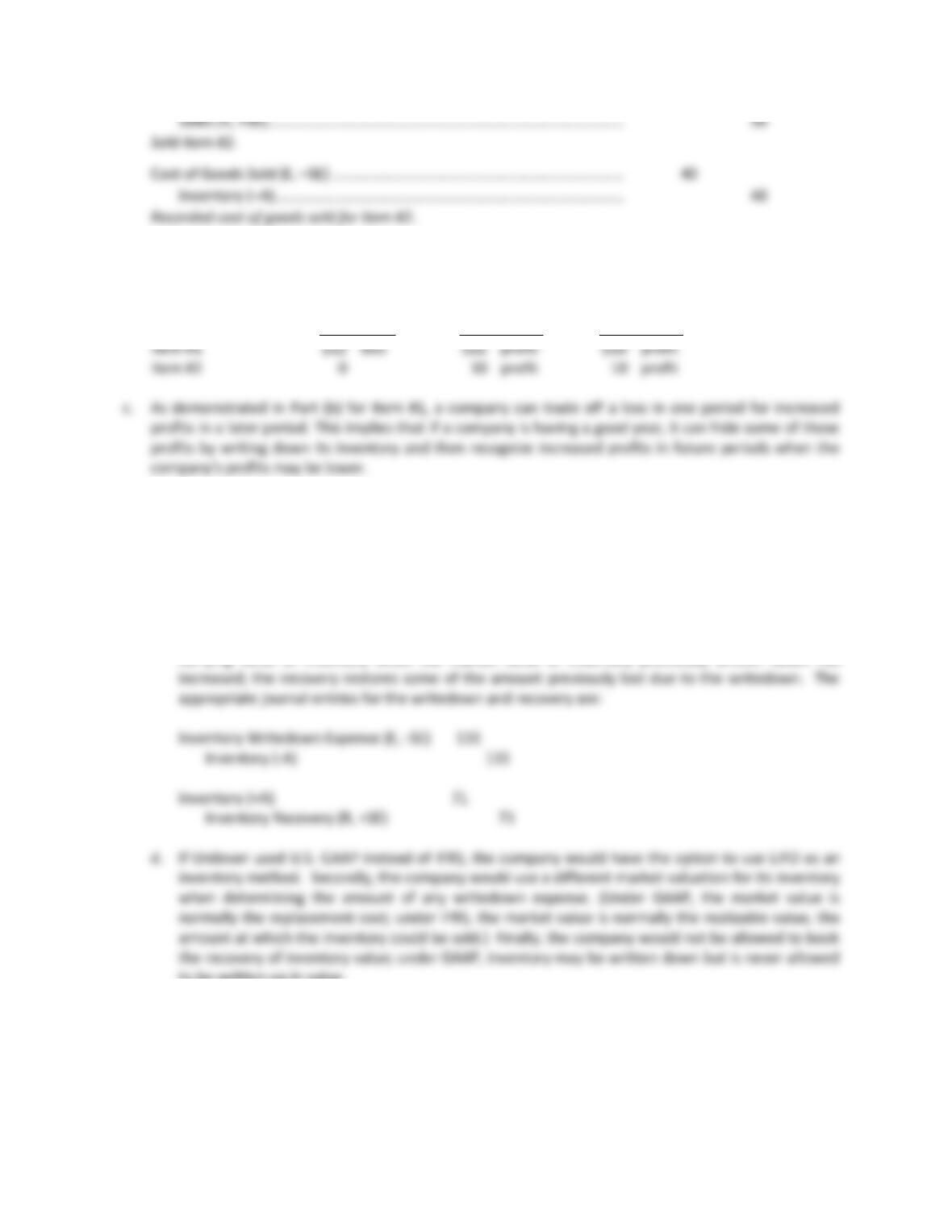
d. The information generated in parts (a), (b), and (c) could be useful to the users from several
E7–13
a. Loss on Inventory Write-down (Lo, –SE) …………………………………………… 12
Inventory (–A) …………………………………………………………………………. 12
Wrote inventory down to market value.
E7–13 Concluded
b. 2014 2015 Total
E7–14
a. Unilever is a manufacturer. Manufacturing companies carrying raw materials inventory in addition
to finished goods inventory, while retailers only carry finished goods.
b. Unilever uses the First-In, First-Out (FIFO) method; under IFRS, the Last-In, First-Out (LIFO) method
is prohibited.
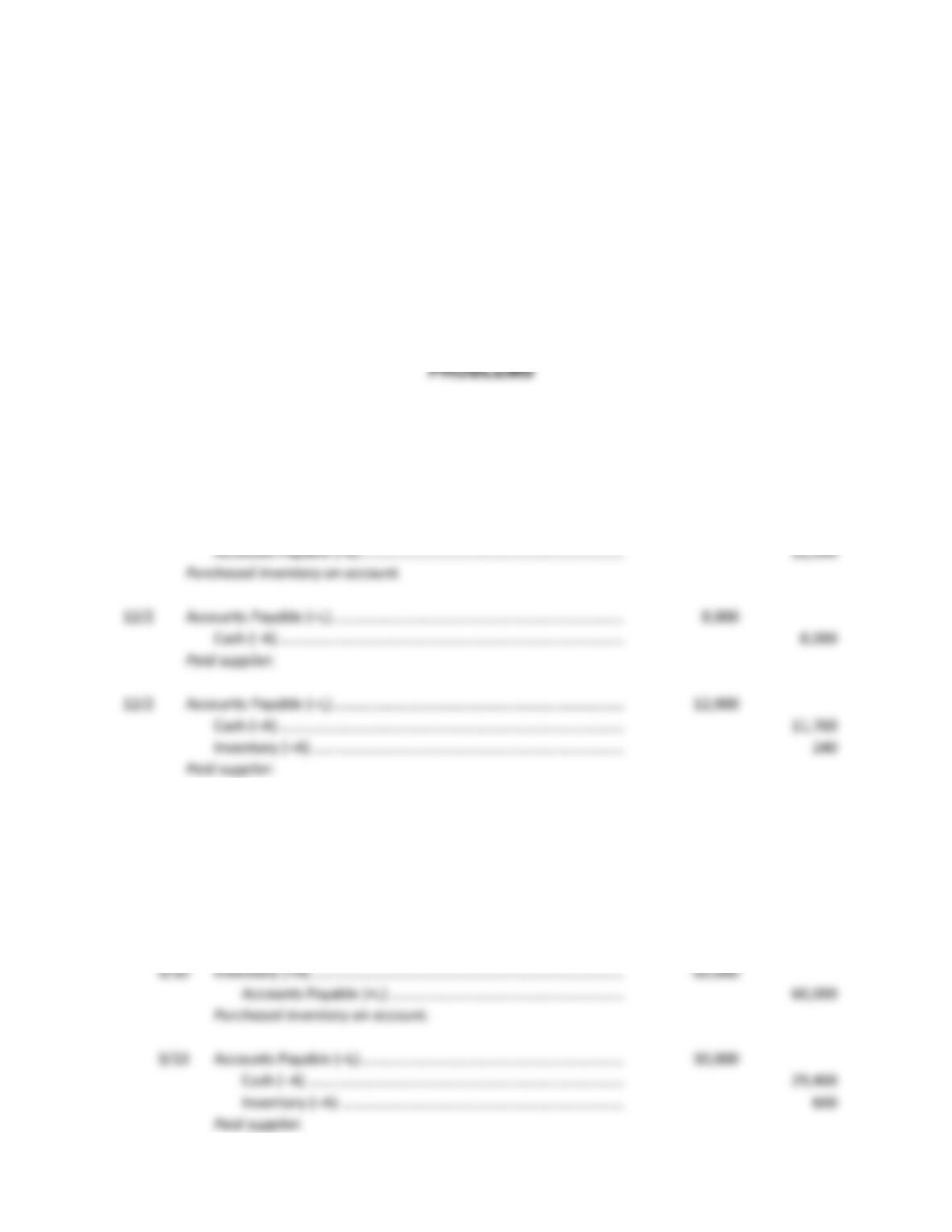
c. An inventory writedown is an adjustment to the carrying value of inventory when the market value
has decreased below the cost of the inventory. An inventory recovery is an adjustment to the
carrying value of inventory when the market value of inventory previously written down has
to be written up in value.
P7–1
11/15 Inventory (+A) ……………………………………………………………………….. 8,000
Accounts Payable (+L) ………………………………………………………. 8,000
Purchased inventory on account.
11/26 Inventory (+A) ……………………………………………………………………….. 12,000
P7–2
a. 3/5 Inventory (+A) …………………………………………………………………. 30,000
Accounts Payable (+L) ………………………………………………… 30,000
Purchased inventory on account.
P7–2 Concluded
b. 3/10 Inventory (+A) …………………………………………………………………. 60,000
Accounts Payable (+L) ………………………………………………… 60,000
Purchased inventory on account.
P7–3
The correct amount that should be reported for Cost of Goods Sold is calculated using the following
formula.
Error in Ending Inventory = Error in Beginning Inventory + Error in Purchases – Error in
COGS
P7–4
a. Cost of Goods Available for Sale = Cost of Goods in Beginning Inventory + Cost of
Goods Purchased
= (15,000 units x $1) + (6,000 units $1.30) + (9,000
units $1.50) + (7,000 units $1.60)
= $30,300
LIFO:
Ending Inventory = (11,000 Units $1.00)
= $11,000
Cost of Goods Sold = Cost of Goods Available for Sale – Ending Inventory
= $33,376
P7–4 Continued
Lumbermans and Associates
Income Statements
For the Year Ended December 31, 20XX
FIFO Averaging LIFO
Sales $ 55,000 $ 55,000 $ 55,000
Cost of goods sold 30,300 33,376 36,500
b. By using LIFO rather than FIFO, Lumbermans and Associates would save $1,860 ($2,910 – $1,050) in
taxes.
c. Ending inventory at market value = 11,000 units $1.35 per unit = $14,850
Lower-of-cost-or-market value:
FIFO Averaging LIFO
Cost $ 17,200 $ 14,124 $11,000
d. Cost of Goods Available for Sale = Cost of Goods in Beginning Inventory + Cost of
Goods Purchased
P7–4 Concluded
FIFO:
Ending Inventory = (7,000 units $1.20) + (4,000 units $1.30)
= $13,600
LIFO:
Ending Inventory = 11,000 units $1.60
= $17,600
Lumbermans and Associates
Income Statements