P6–9
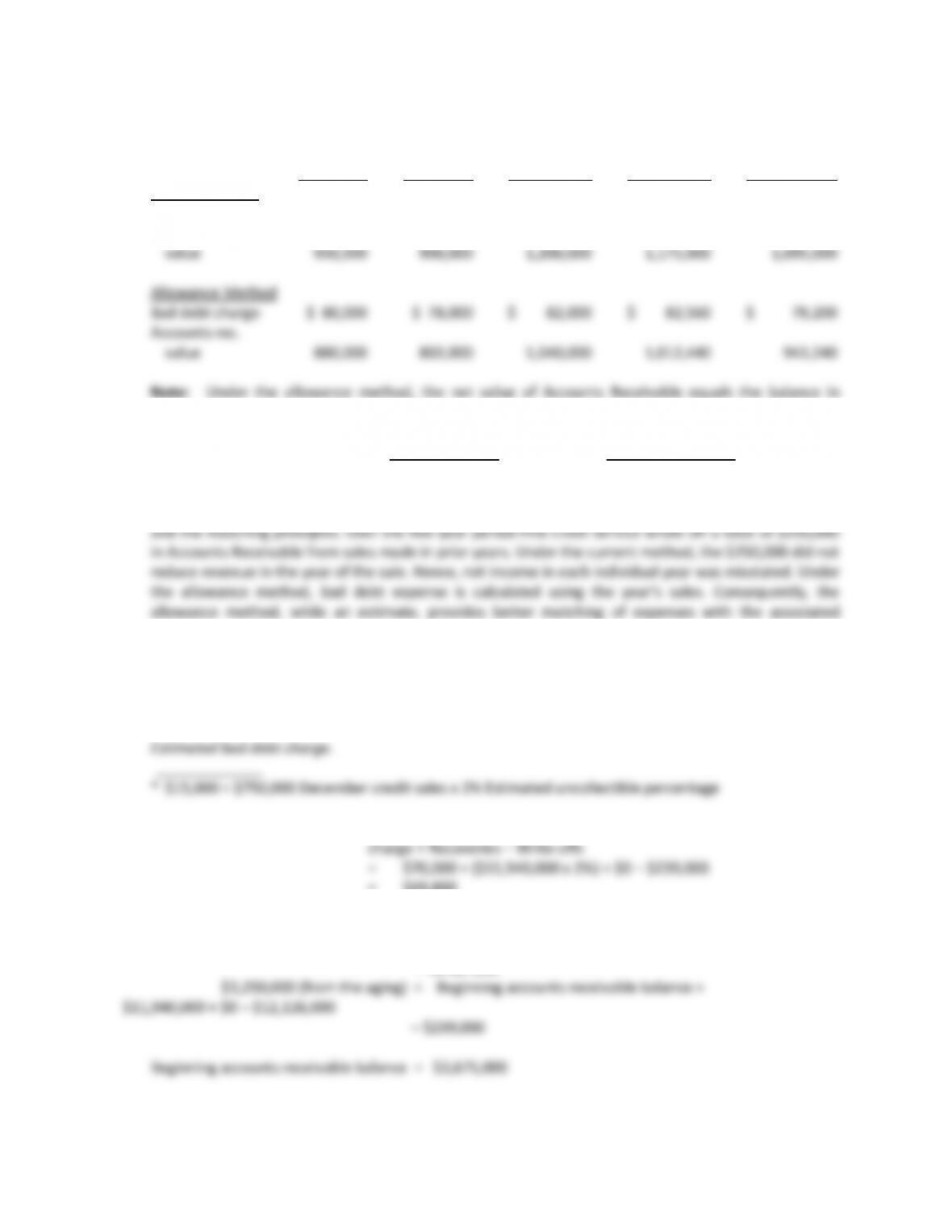
a. 2011 2012 2013 2014 2015
Current Method
Bad debt charge $ 10,000 $ 50,000 $ 20,000 $ 80,000 $ 90,000
Accounts rec.
Accounts Receivable less the balance in Allowance for Doubtful Accounts.
b. Current Method Allowance Method
Total bad debt charge $250,000 $401,760
The allowance method provides a measure of net income consistent with both the revenue recognition
revenues.
P6–10
a. Bad Debt Charge (E, –SE) ………………………………………………………………… 15,000*
Allowance for Doubtful Accounts (–A) ……………………………………….. 15,000
b. Ending allowance balance = Beginning allowance balance + Annual bad debt
= $69,800
c. Ending accounts receivable balance = Beginning accounts receivable balance +
Credit sales + Recoveries – Cash collections
– Write-Offs
P6–10 Concluded
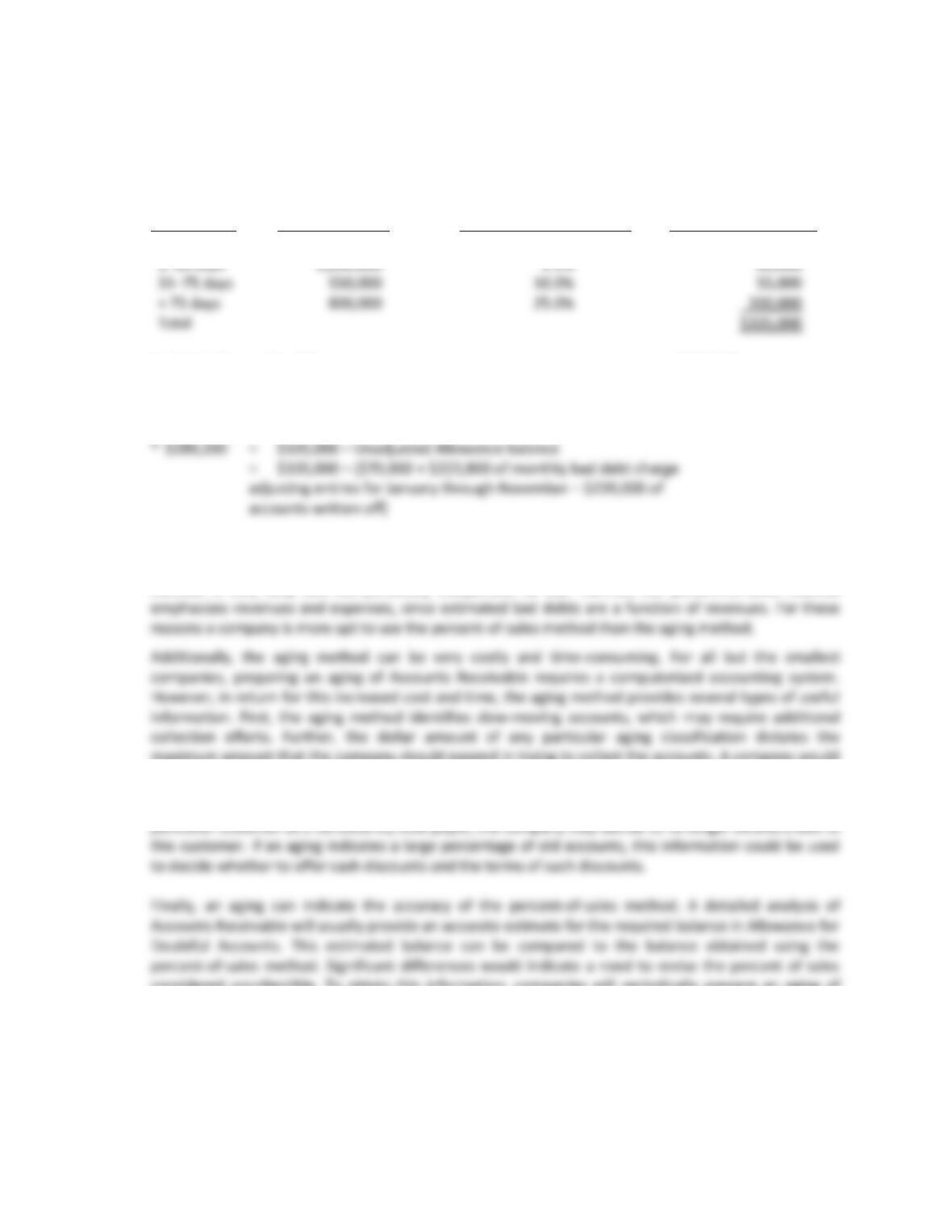
d. Account Age Account Balance Noncollection Probability Uncollectible Amount
Current $700,000 2.0% $ 14,000
1–30 days 1,200,000 5.5% 66,000
Bad Debt Charge (E, –SE) ………………………………………………………………… 280,200*
Allowance for Doubtful Accounts (–A) ……………………………………….. 280,200
Estimated bad debt charge.
_____________
e. Some companies use the percent-of-sales method to estimate bad debts but also periodically use the
aging method. Companies would use the two methods for several reasons. The percent-of-sales
method is very easy and comparatively inexpensive to use. Further, the percent-of-sales method
maximum amount that the company should expend in trying to collect the accounts. A company would
generally not want to spend more to collect an account than it expects to ultimately collect.
Second, an aging can help a company define its credit policies. For example, if an aging identifies a
particular customer as a consistently slow payer, the company may decide to no longer extend credit to
considered uncollectible. To obtain this information, companies will periodically prepare an aging of
Accounts Receivable.
P6–11
a. Looking at the net income for the years 2013, 2014, and 2015, it is true that Ticheley has reported
b. A company would establish such a system of rewarding the management only on the belief that an
increase in return on Stockholders’ equity (Net Income as a % of total Stockholders’ Equity) would lead
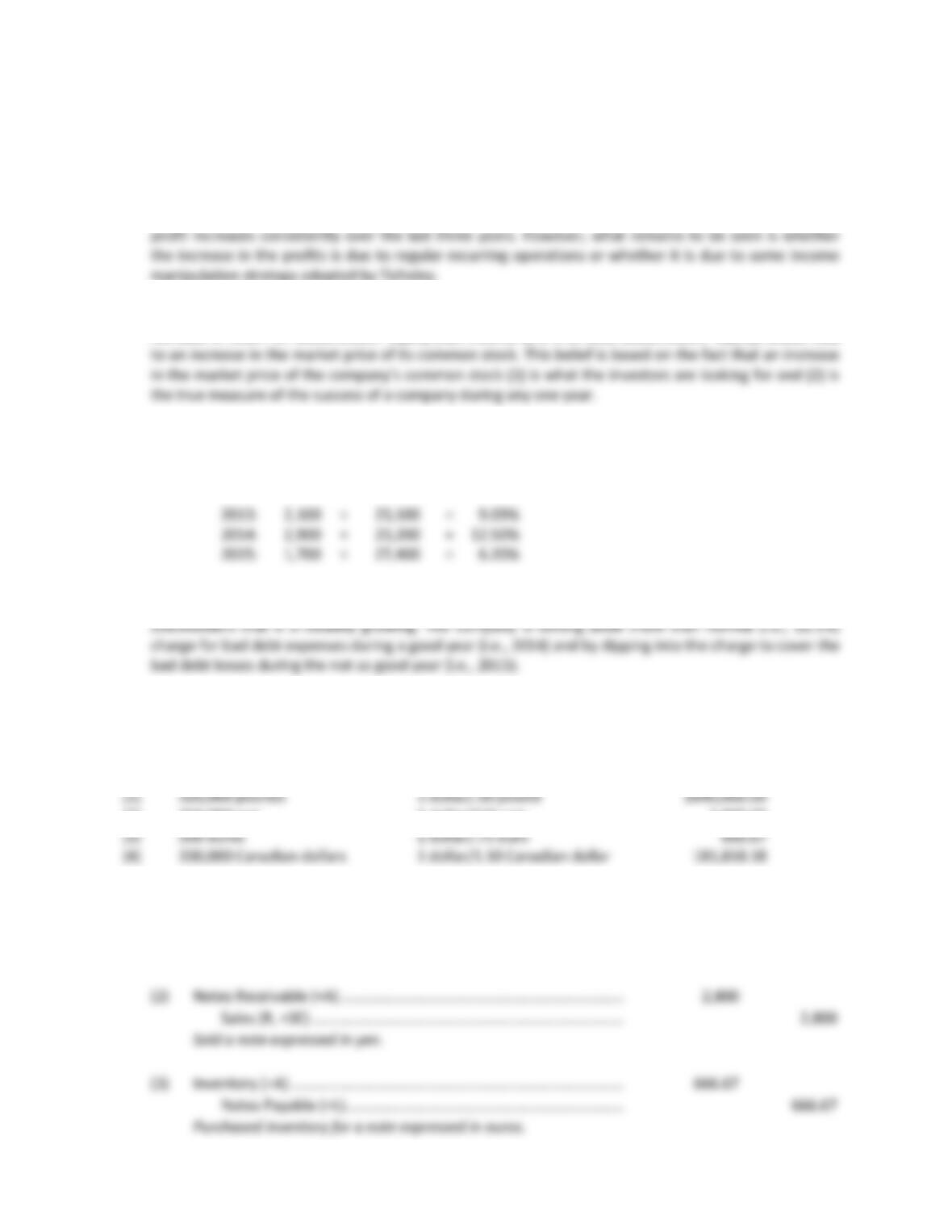
c. It appears that Ticheley is using an “income–smoothing” reporting strategy. Even though we have the
data only for 3 years, the fluctuating bad debt change as a percentage of accounts receivables points to
that conclusion.
d. Ticheley is probably using the “income–smoothing” reporting strategy to demonstrate to its
P6–12
a. Value of Transaction Value of Transaction
In Foreign Currency Exchange Rate in U.S. Dollars
(2) 350,000 yen 1 dollar/125 yen 2,800.00
b. (1) Accounts Receivable (+A) ………………………………………………………. 640,000
Sales (R, +SE) …………………………………………………………………. 640,000
Made a sale on account expressed in British pounds.
P6–12 Concluded
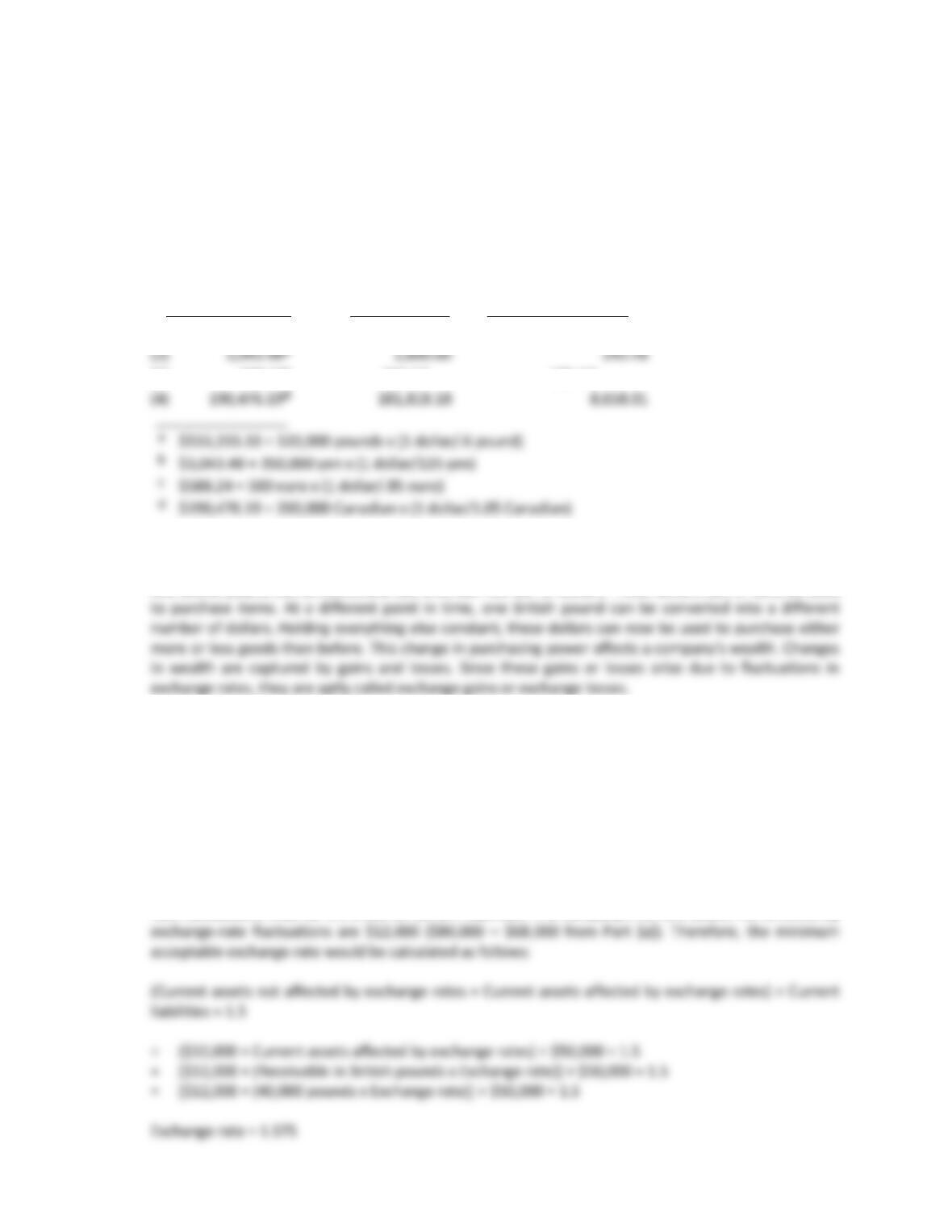
(4) Inventory (+A) …………………………..…………………………………………. 181,818.18
Accounts Payable (+L) …………………………………………………….. 181,818.18
Purchased inventory on account expressed in Canadian dollars.
c. Adjusted Value Carrying Value Exchange Gain (Loss)
(1) $533,333.33a $ 640,000.00 ($106,666.67)
(3) 588.24c 666.67 (78.43)
d. Receivables and payables are stated in a particular currency, for example, in British pounds. Assume
that money from the receivable/payable is to be converted into U.S. dollars. At a given point in time,
one British pound can be converted into a certain number of dollars. These dollars can, in turn, be used
P6–13
a. Carrying value of receivable = Receivable in British pounds x Exchange rate
= 40,000 British pounds x ($1.70/1 British pound)
= $68,000
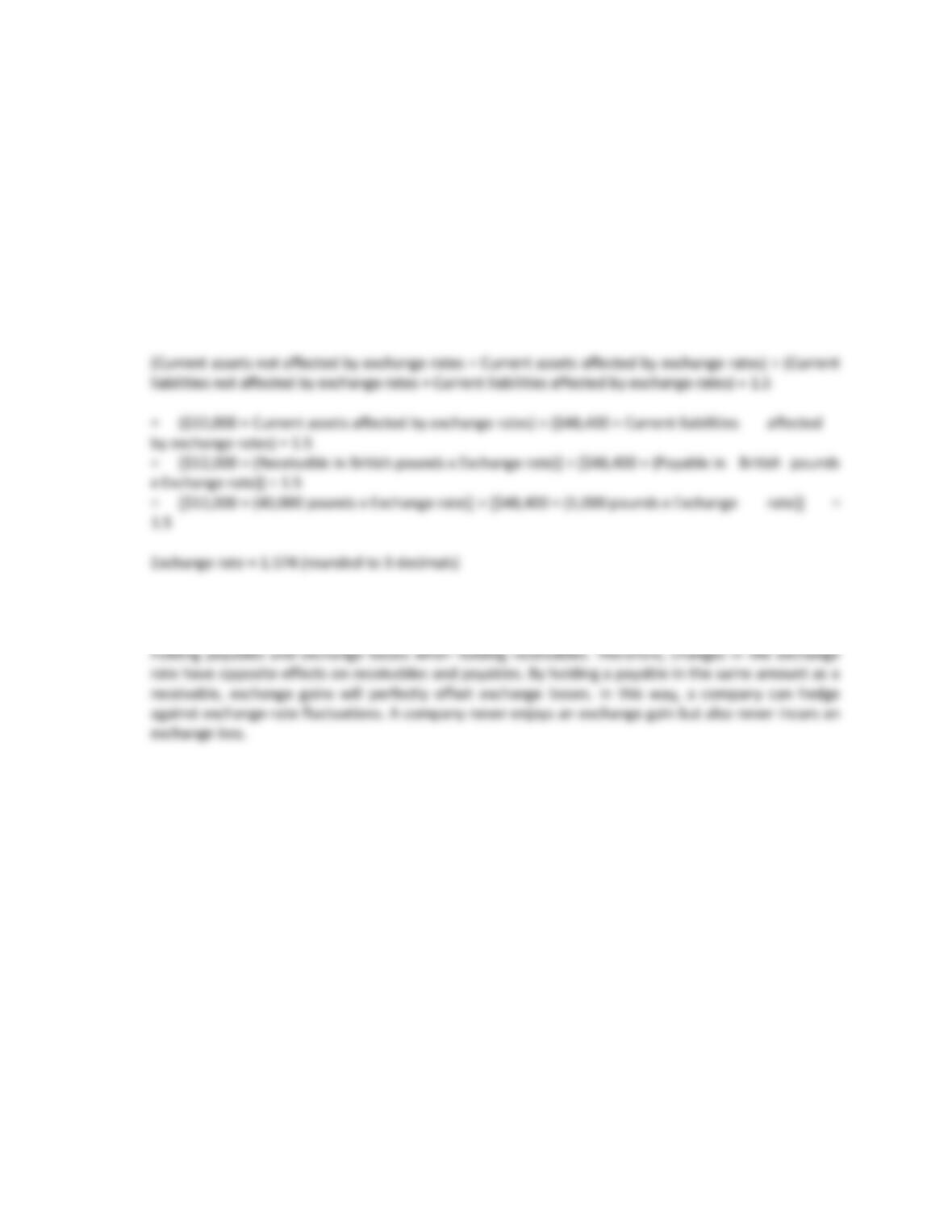
b. The current ratio is calculated as current assets divided by current liabilities. If International Services is
to maintain a current ratio of at least 1.5, its current assets after considering the effect of exchange-
rate fluctuations must be 1.5 times its current liabilities. The company’s current assets not affected by
P6–13 Concluded
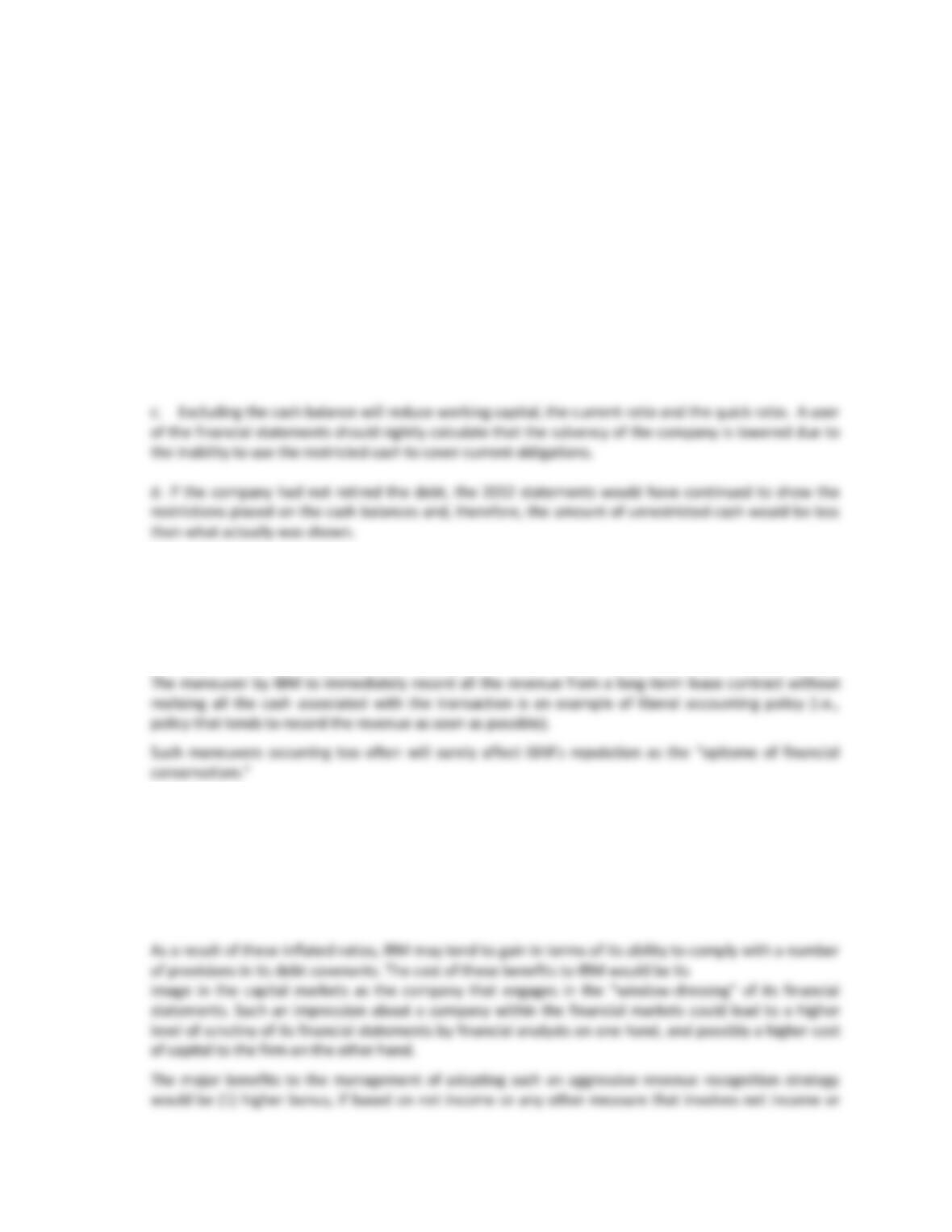
c. For International Services to maintain a current ratio of at least 1.5, its current assets after considering
the effect of exchange-rate fluctuations must be 1.5 times its current liabilities adjusted for the effects
of exchange-rate fluctuations. The company’s current liabilities not affected by exchange-rate
fluctuations are $48,400 ($50,000 – $1,600 payable to British bank). Therefore, the minimum
acceptable exchange rate would now be calculated as follows:
d. Increases in the exchange rate cause exchange gains when holding receivables and exchange losses
when holding payables. Alternatively, decreases in the exchange rate cause exchange gains when
ISSUES FOR DISCUSSION
ID6–1
a. A potential investor is interested in the solvency of a company. Since solvency is associated with the
availability of cash to pay off debts, an investor would want to know about any existing restrictions on a
reported cash balance.
b. The difference is due to the length of time the cash is restricted in its use. If the cash will remain
restricted for a time period longer than one year, it should be disclosed as noncurrent. If the cash will
not be available to cover current obligations, then it would be inaccurate to designate the balance as
current.
ID6–2
a. For a long time, IBM rightfully enjoyed the reputation as the “epitome of financial conservatism”. This
reputation was built by IBM by using conservative financial reporting practices. Such a reporting
strategy underestimates the revenues and overestimates the expenses.
b. The use of accelerated revenue recognition methods has its own costs and benefits to IBM and its
management.
Accelerated revenue recognition methods not only inflate the sales and net income on the income
statement but also tend to inflate receivables on the balance sheet. Therefore, a number of ratios, such
as return on stockholders’ equity, working capital, current ratio, and return on total assets are also
inflated.
c. IBM’s policy of requiring all employees to swear that they have read the company’s “Business Conduct
Guidelines” is in direct contrast to its own behavior. On one hand it discourages its employees from
ID6–3
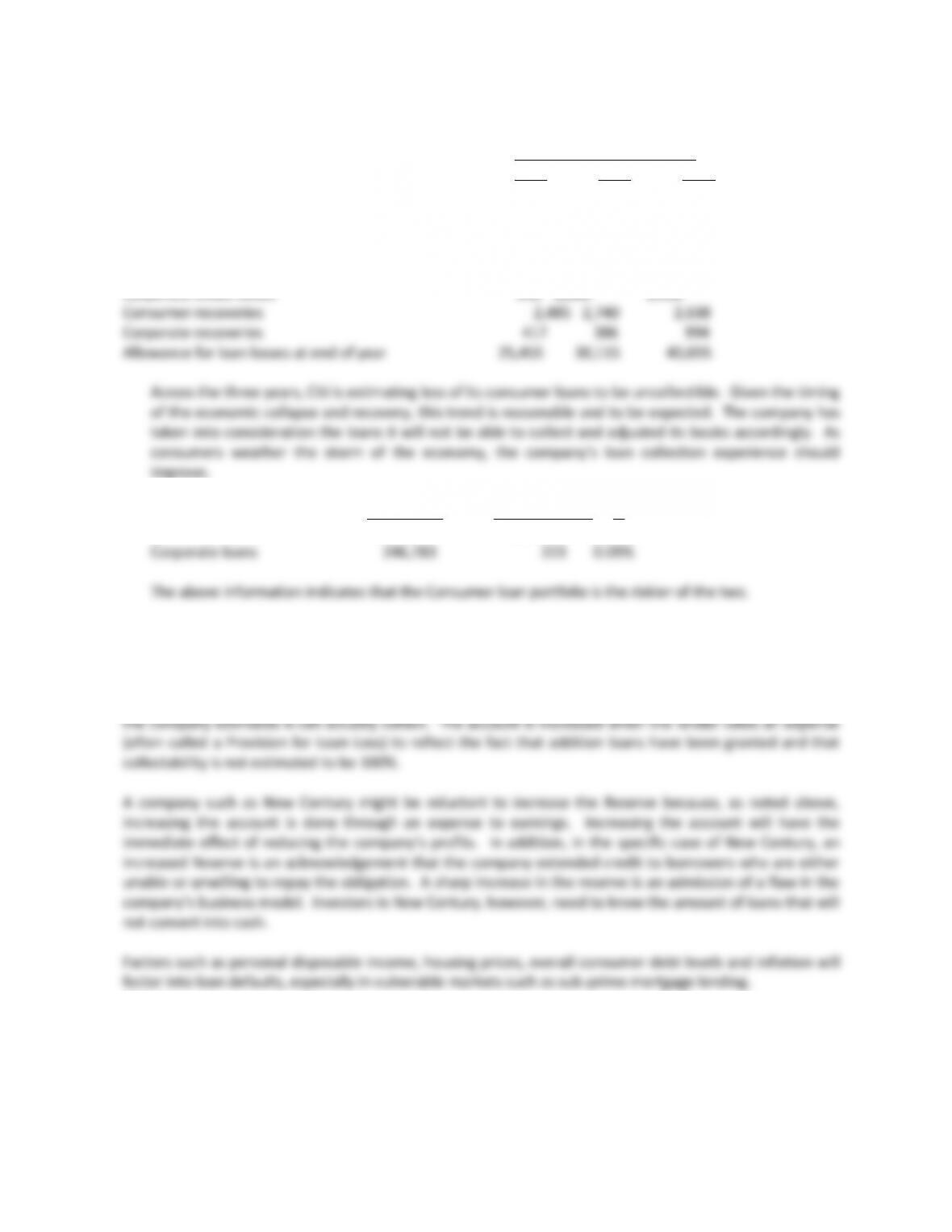
a. Working Capital = Current Assets – Current Liabilities
1992: $1,256.20 – $1,087.5 = $168.70
b. The 1994 annual report changes the restrictions from the Working Capital to the minimum
ID6–4
a. Allowance for Credit Losses
2012 2011 2010
Allowance for loan losses at beginning of year $30,115 $40,655 $36,033
Provision for credit losses—consumer 9,796 10,254 35,494
Provision for credit losses—corporate 120 (756) (13)
Consumer credit losses 16,838 21,164 31,073
Corporate credit losses 640 2,000 3,418
b. 2012 Loans Net Write-Offs %
Consumer loans $408,671 $14,353 3.51%
ID6–5
The Reserve for Loan Losses for a bank (or a mortgage company making home loans) is the same as the
Allowance for Uncollectibles account for a company carrying accounts receivable from customers. The
account is a contra asset account which lowers the carrying value of the loan portfolio to the amount that
ID6–6
The Provision for Loan Loss is the expense that feeds into a bank’s Allowance for Loan Losses, the
contra asset account that adjusts downward the carrying value of the bank’s loan portfolio. When
banks determine that their loans are less collectible, they bring the portfolio down in value by
increasing the Allowance with a higher Provision on the Income Statement.
A weakened housing market directly affects the collateral that supports the bank’s first mortgage home
loan. When a homeowner purchases a home by borrowing money from a bank, the bank takes the
In addition to the effect on the bank’s collateral, a weakened housing market may also affect the bank’s
customers and their ability to repay their loans. If the housing market suffers, all the individuals who
work in industries supporting that market (construction, real estate sales and development, mortgage
lending, insurance, retail, etc.) will suffer and collectively will have less available cash flow for debt
service. As discussed above, if bank customers have employment problems that weaken their monthly
in order to keep earnings high to support stock prices.
ID6–7
a. The Bad Debt Provision is an expense that represents management’s estimate of future
uncollectible receivables. Like other expenses, the provision can be found on the Income
Statement.
b. The statement of cash flow reconciles net income (an accrual accounting number) with cash
an increase in receivables, meaning that they have not yet collected all the cash due from sales; the
amount of the receivable increase is therefore subtracted away to help convert earnings to cash
from operations.
c. Both companies have large non-cash expenses (such as depreciation and the provision) that will
cause cash to be larger than earnings. In addiiton, current assets other than receivables (for these
ID6–8
Selling on account to customers who will not ultimately pay cash for the purchase will boost sales and
profits in the short-term but cause huge problems in the long-term. Many companies chase sales
growth by granting credit (selling today with the promise of receiving cash tomorrow) to customers
deemed to be uncollectible (because the company was granting credit to unworthy customers), then
the Allowance will need to be significantly increased with another Bad Debt Expense (which will
decrease Assets and Equity).
profits will hold up over time.
ID6–9
a. Sales concentration (having a large percentage of credit sales and accounts receivable with one
customer) is a risk simply due to the fact that if the customer fails to pay its account then a large bad debt
b. The failure of one large account would cause a company to increase its Allowance for Uncollectibles by
taking a large Bad Debt Expense. Earnings, assets and equity would all decline.
ID6–10
a. The company could reduce its bad debt reserve from $6.5 million to $5.39 million because its actual
writeoffs were lower than expected. If there was an increase in the credit quality of its loans it could
increase in sales this increase may have been the result of lowering the credit standards so that more
buyers could qualify to purchase time shares.
b. “that’s tomorrow’s problem?” means that in future years Fairfield may have to take very large charges
ID6–11
One of the issues in the recent real estate crisis was excess capacity, a situation caused by real estate
developers building too many projects (often due to the easy access those developers had to capital).
With too many projects built and not enough tenants to rent and occupy spaces, the real estate firms
ID6–12
a. If a company holds receivables or payables stated in a foreign currency (as would be the case for
companies that operate internationally), the receivables and payables must be converted to U.S. dollars
when preparing financial statements. As the value of the U.S. dollar fluctuates relative to other
currencies, the value of the receivables and payables in U.S. dollars also fluctuates. This gives rise to
b. The main strategy many U.S. companies use to reduce the risks of holding receivables or payables
stated in a foreign currency is hedging.
c. Hedging involves taking a position in a foreign currency in an equal and opposite amount to a particular
receivable or payable stated in that currency. For example, if IBM had a receivable for 100,000 British
pounds, it could hedge its position by creating a payable for 100,000 British pounds. The reason
ID6–13
a. Google’s current ratio in 2012 was 4.22 ($60,454/$14,337), down from the 2011 level of 5.92. The
company’s working capital in 2012 was $46,117 which changed from 2011’s working capital of $43,845.
c. Google’s net receivables comprise 13.0% (10.3% in 2011) of Current Assets and 8.41% (7.48% in 2011)
of Total Assets as of 12/31/2012. Receivables represent a significant investment by the company and
e. The increase in accounts receivable is an operating activity (dealing with the daily extension of credit to
and collection of cash from customers) that acted as a “use” of cash, meaning the company has yet to
collect some of the receivables from the credit sales on the income statement.