1
CHAPTER 6
THE CURRENT ASSET CLASSIFICATION, CASH,
AND ACCOUNTS RECEIVABLE
BRIEF EXERCISES
BE6–1
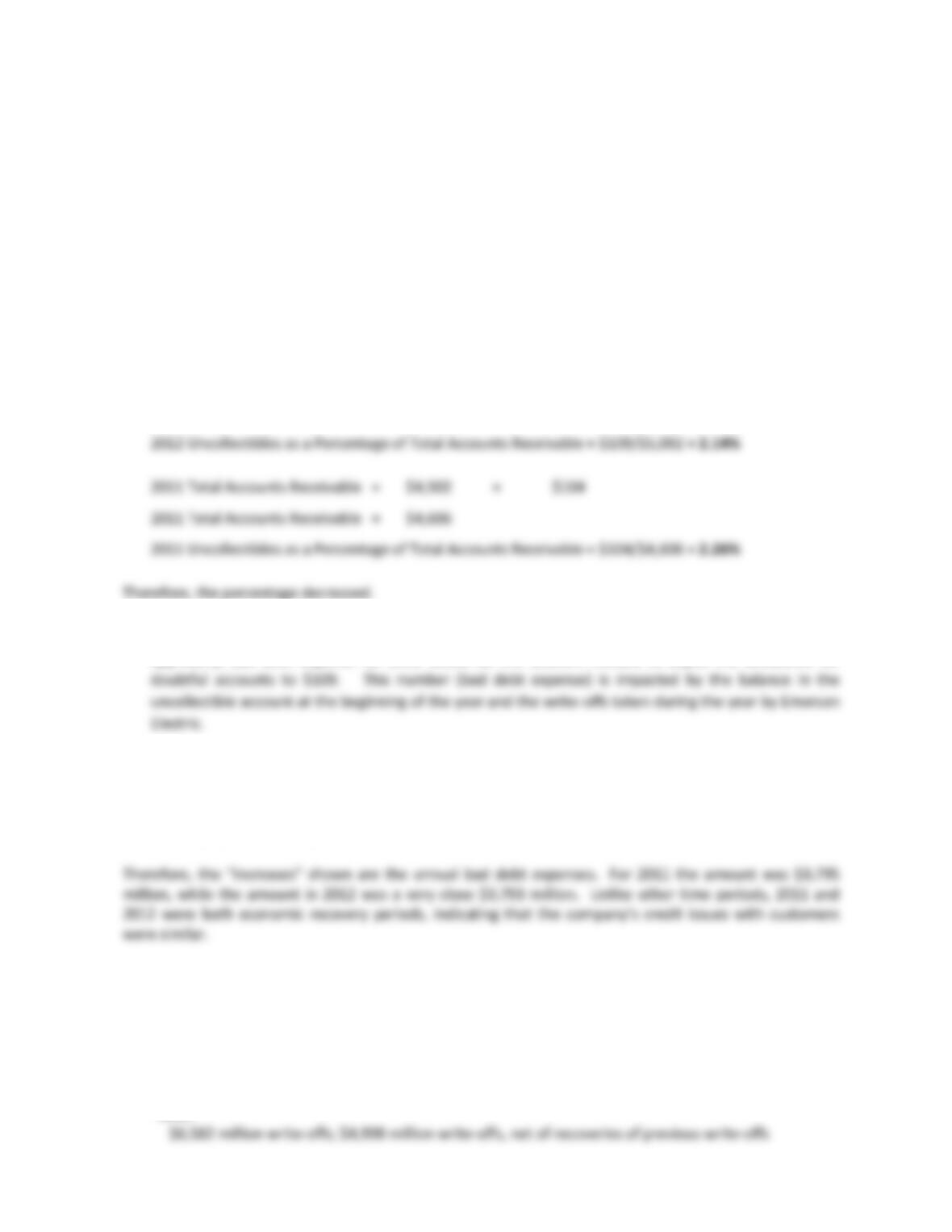
a. Total Accounts Receivable = Net Receivables + Allowance for Uncollectibles
2012 Total Accounts Receivable = $4,983 + $109
2012 Total Accounts Receivable = $5,092
b. Since Emerson Electric is using the percentage of accounts receivable method (balance sheet
approach), bad debt expense for 2012 would be the amount needed to adjust the allowance for
BE6–2
a. The changes to the Allowance account are:
Ending Allowance Balance = Beginning Allowance Balance + Bad Debt Charge –
Write-Offs + Recoveries
b. 2011:
$7,139 million write-offs; $5,524 million write-offs, net of recoveries of previous write-offs
2012:
BE6–3
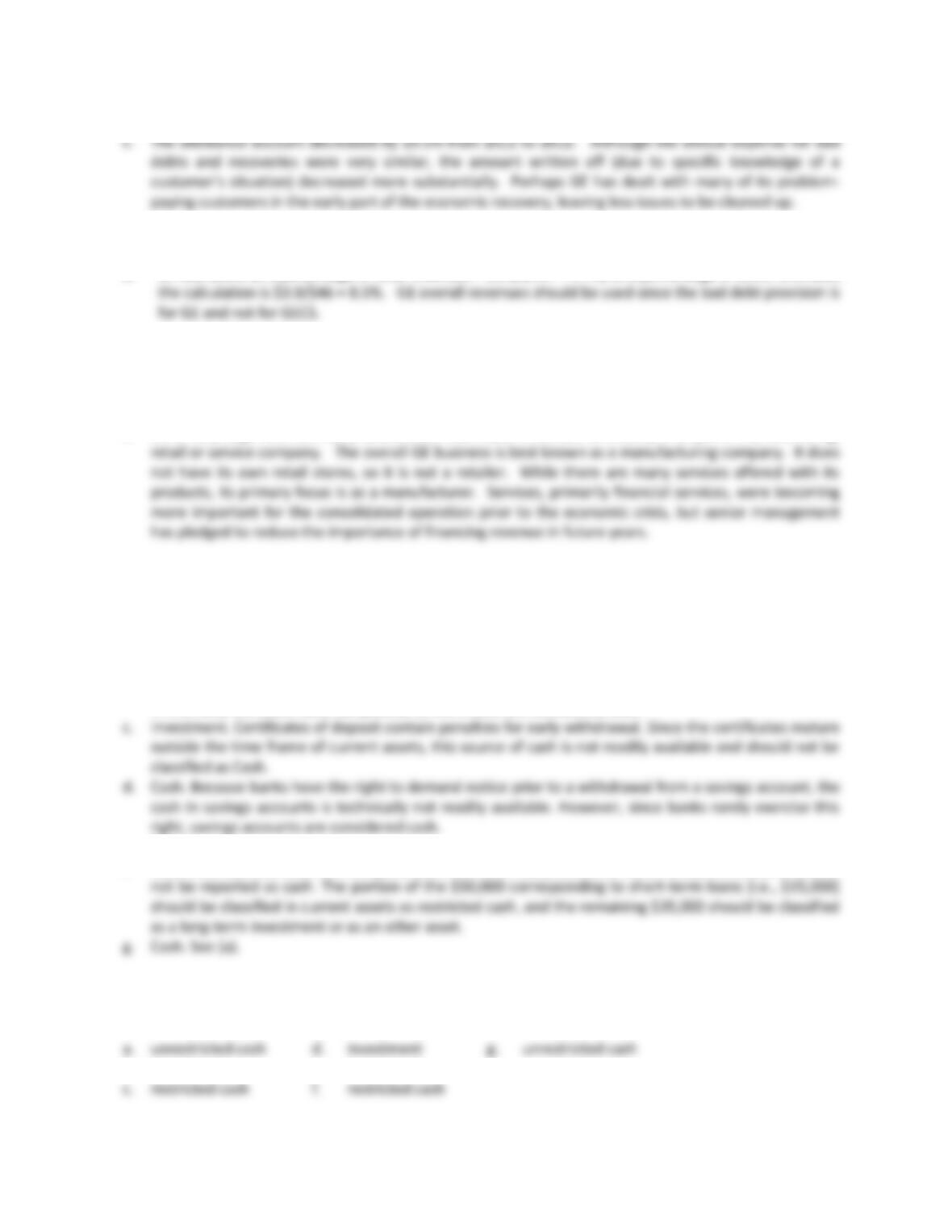
a. GE bad debts as a percentage of total revenues = $3.9/$147 = 2.7%; as a percentage of GECS revenues,
b. On a balance sheet for GECS accounts receivable would be expected to be the largest account. Its
primary role is as a financing company, and the receivables from the buyers of appliances would be a
large asset of GECS.
c. GE is very large and has many subsidiaries that make it difficult to classify it as just a manufacturing,
EXERCISES
E6–1
a. Cash. Money held in checking accounts is defined as cash, and there are no restrictions on the account.
b. Cash. Checks are considered cash unless the checks cannot be cashed until a later date (i.e., postdated).
In this case, the check date has passed, so the checks are considered cash.
e. Cash. Petty cash is always considered cash.
f. Restricted cash. Because the company does not have ready access to these funds, the $50,000 should
E6–2
b. investment e. investment
E6–3
a.
12/12 Accounts Receivable (+A) ………………………………………………….. 40,000
Sales (R, +SE) …………………………………………………………….. 40,000
Made sale on account.
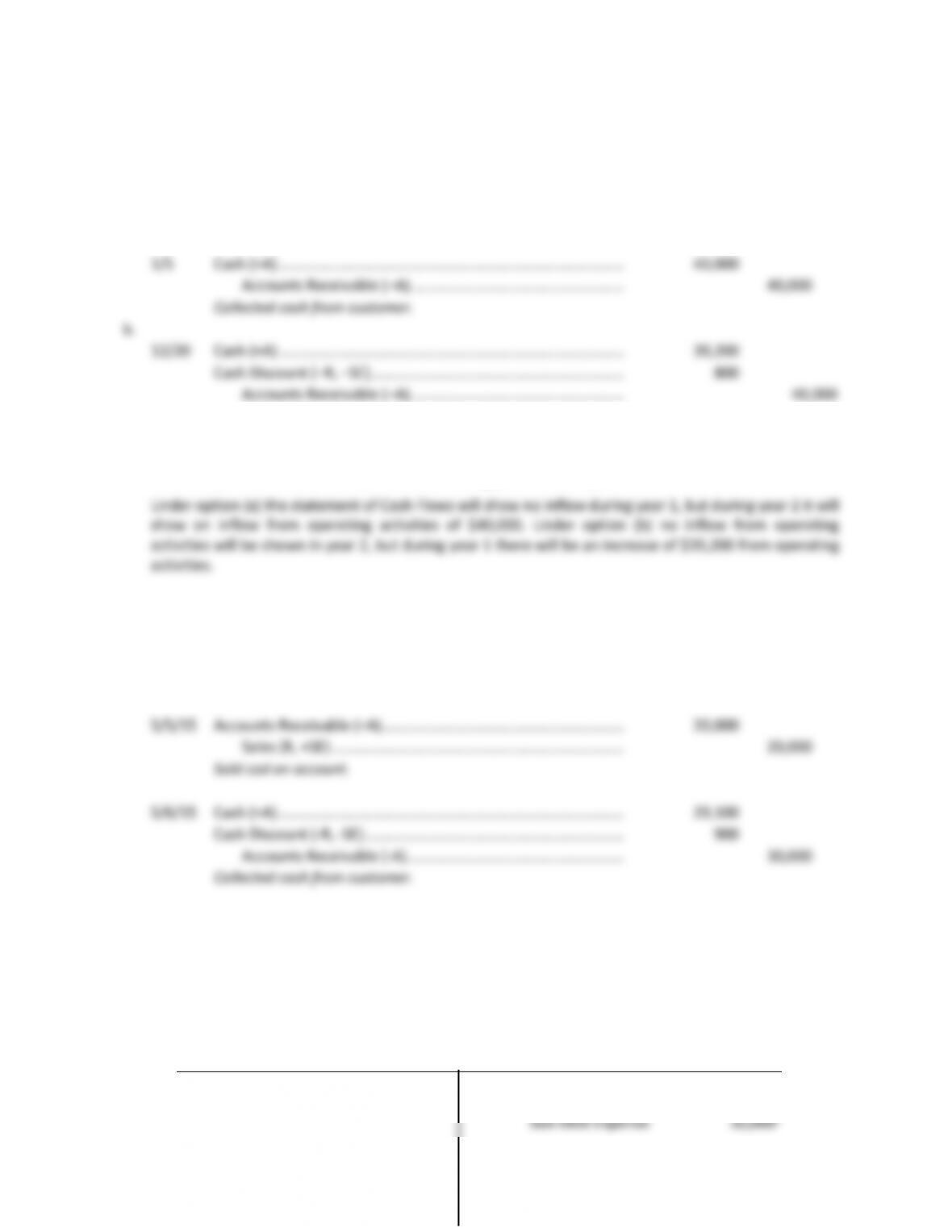
The timing of the cash receipts would affect the income statement due to the cash discount. Cash
discount is a contra sales account and is deducted from the sales revenue. Therefore, the net income is
reduced by the amount of the cash discount during year 1 in case (b).
E6–4
5/1/15 Accounts Receivable (+A) ………………………………………………….. 30,000
Sales (R, +SE) …………………………………………………………….. 30,000
Sold lobster on account.
5/31/15 Cash (+A) ………………………………………………………………………… 20,000
Accounts Receivable (-A) …………………………………………….. 20,000
Collected cash from customer.
E6–5
Allowance for Uncollectibles
2014 Write-Offs 10,000 12/31/14
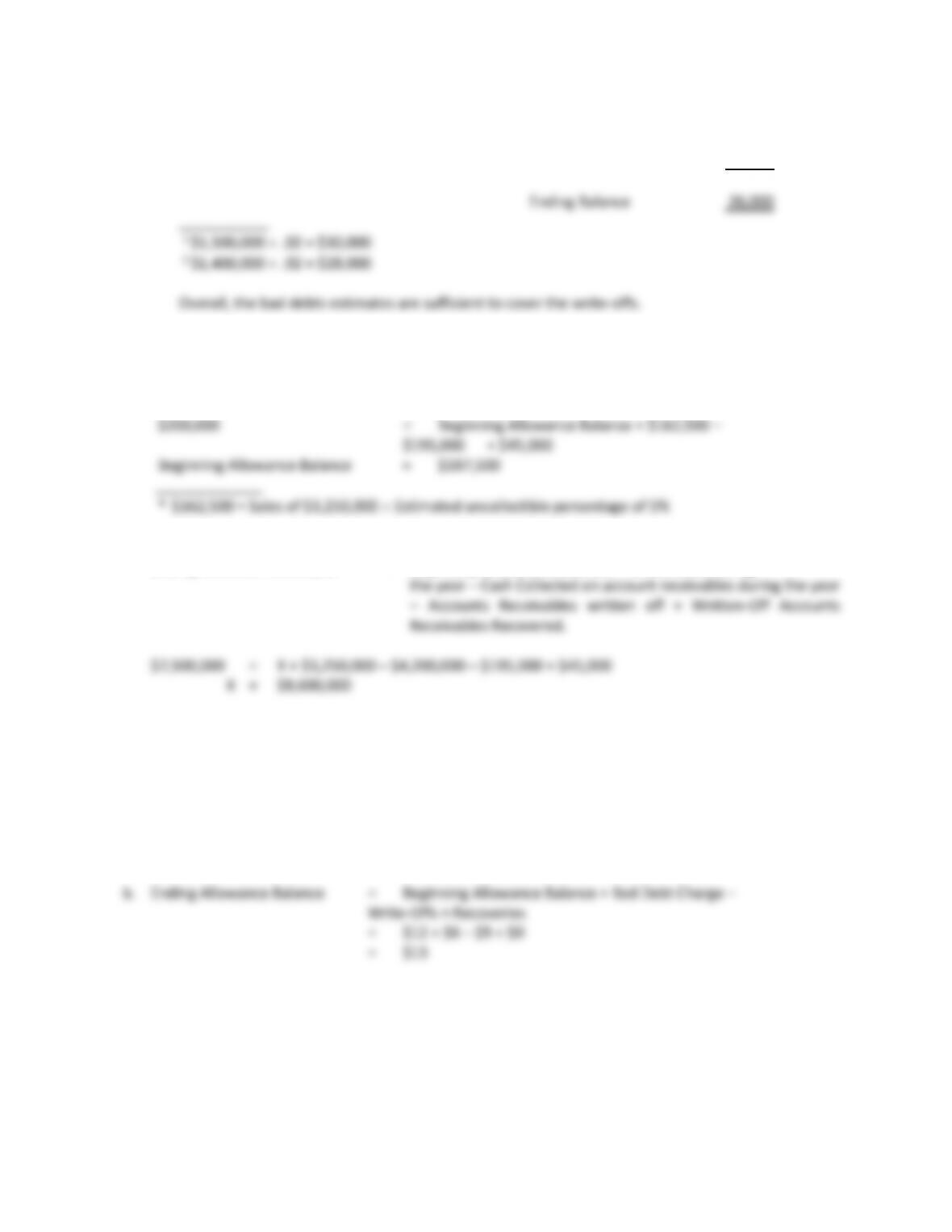
2015 Write-Offs 22,000 12/31/15
Bad Debt Expense 28,0002
E6–6
a. Ending Allowance Balance = Beginning Allowance Balance + Bad Debt Charge –
Write-Offs + Recoveries
b. [Assume the $4,200,000 cash collections includes the $45,000 recovery]
Ending Accounts Receivable = Beginning Accounts Receivable + Credit Sales during
E6–7
a. Bad Debt Charge (E, –SE) ………………………………………………………………… 6
Allowance for Doubtful Accounts (–A) ……………………………………….. 6
Recognized bad debt charge.
_____________
E6–8
a. Ending Allowance Balance = Beginning Allowance Balance + Bad Debt Charge –
Write-Offs + Recoveries
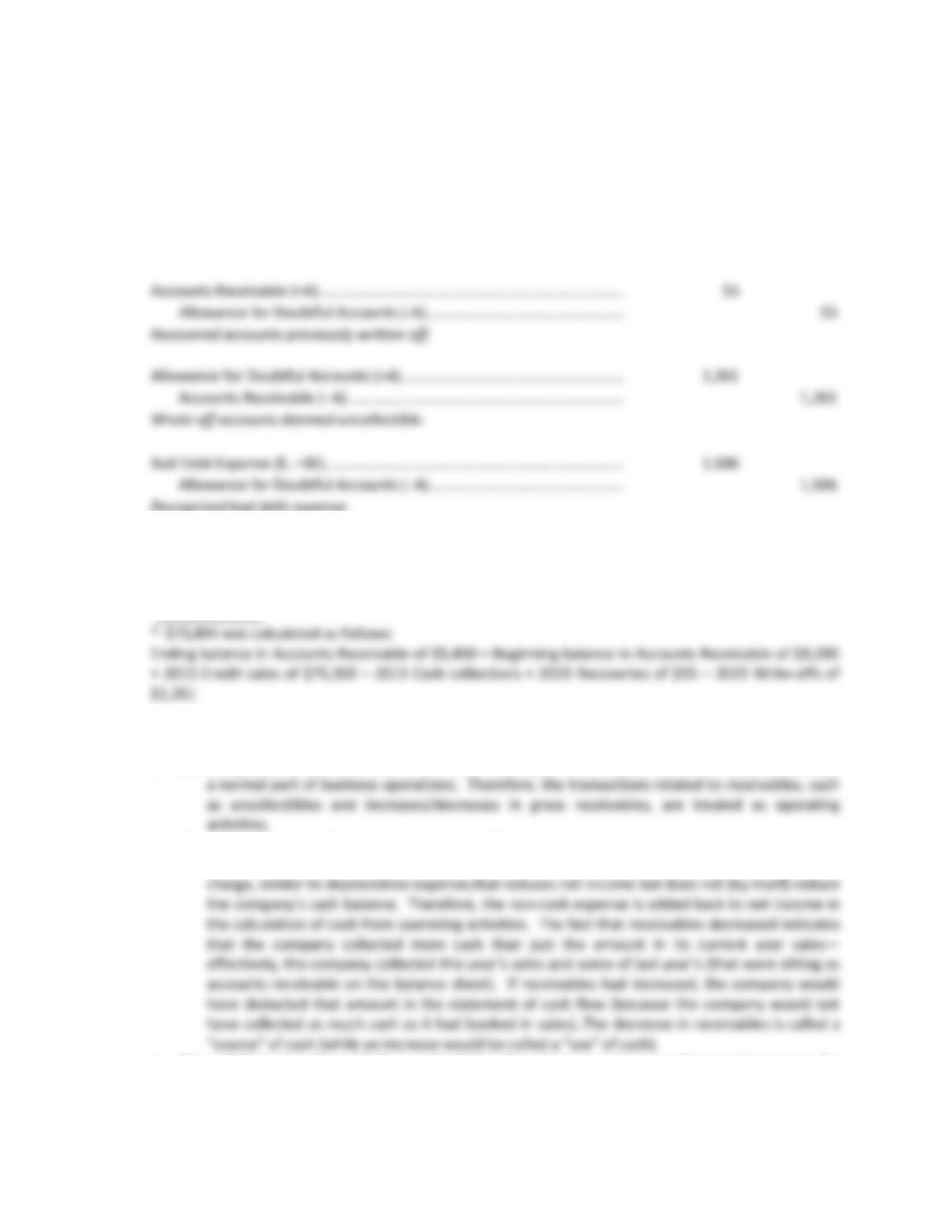
$1,300 = $1,000 + (Sales of $75,300 x Estimated uncollectible
percentage of 2%) – Write-Offs + $55
Write-Offs = $1,261
b. Accounts Receivable (+A) …………………………..…………………………………… 75,300
Sales (R, +SE) …………………………………………………………………………… 75,300
Made sales on account.
Cash (+A) ………………………………………………………………………………… 73,894*
Accounts Receivable (–A) …………………………………………………………. 73,894
Collected cash from customers.
_____________
E6–9
a. Extending credit to customers (and therefore creating accounts receivable on the balance sheet) is
b. The indirect format of the statement of cash flow is structured around converting net income (a
number based in accrual accounting) into a pure cash number. The provision is a non–cash
c. Net cash from operating activities can be higher than net income because of non-cash expenses (as
discussed above) and because of decreases in current assets (“sources” of cash as discussed
above) or increases in current liabilities (also “sources” of cash). If “uses” of cash (such as
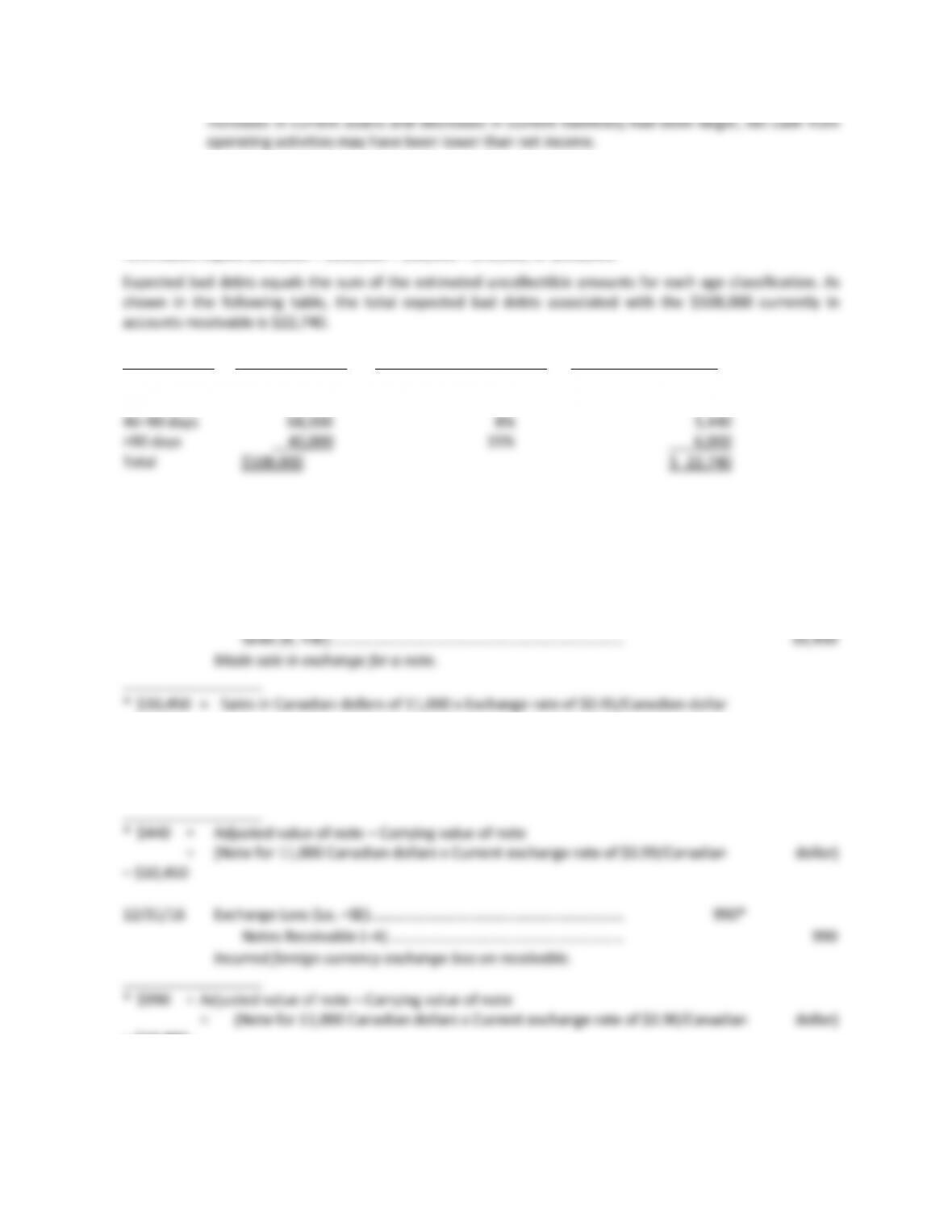
E6–10
Total receivables equals the sum of the receivable balances for each age classification. Therefore, total
receivables equals $290,000 + $110,000 + $68,000 + $40,000, or $508,000.
Age Account Balance Noncollection Probability Uncollectible Amount
Current $290,000 2% $ 5,800
1–45 days 110,000 5% 5,500
E6–11
1/1/15 Notes Receivable (+A) ………………………………………………………. 10,450*
12/31/15 Notes Receivable (+A) ………………………………………………………. 440*
Exchange Gain (Ga, +SE)……………………………………………… 440
Recorded foreign currency exchange gain on receivable.
– $10,890
E6–12
January 1, 2015
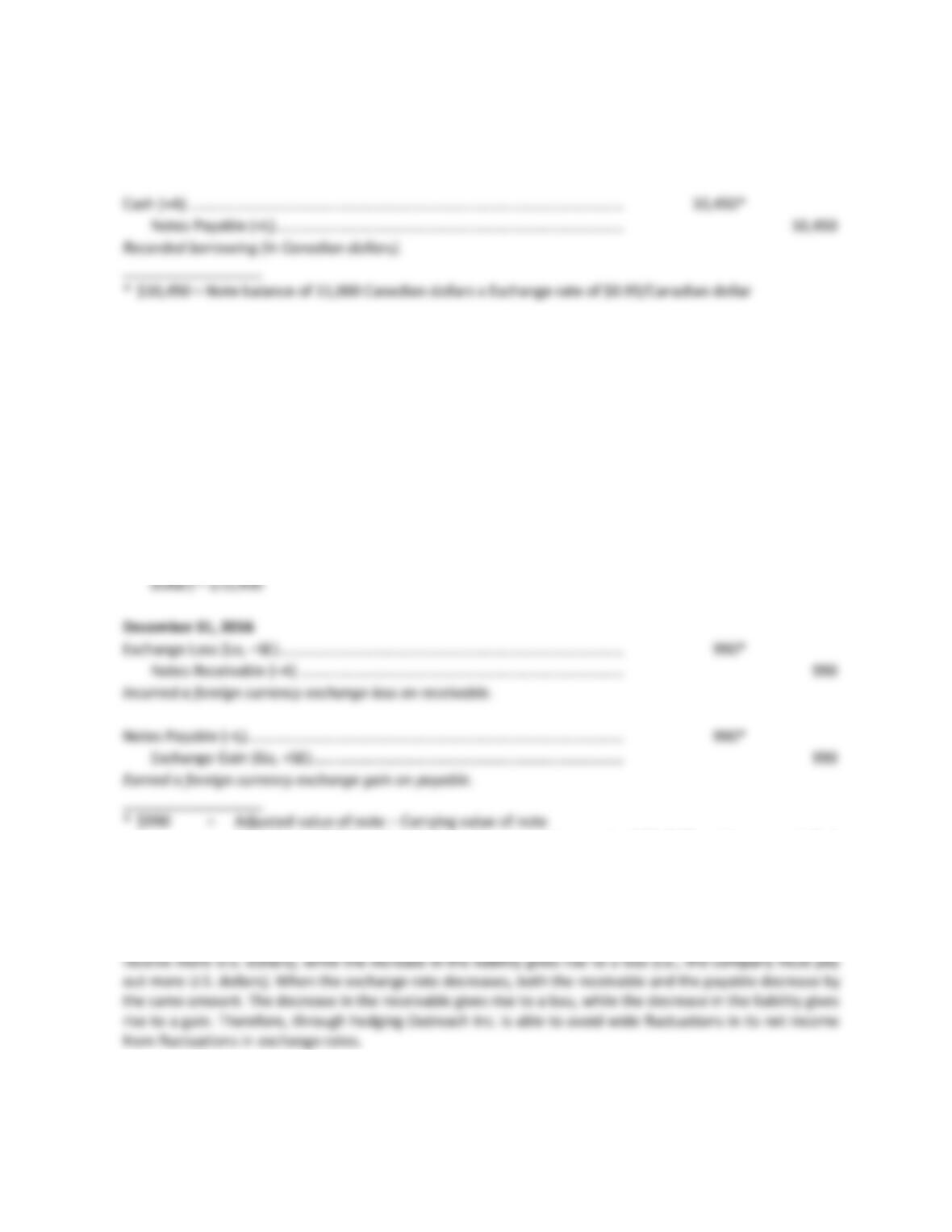
Notes Receivable (+A) ………………………………………………………………………….. 10,450*
Sales (R, +SE) ………………………………………………………………………………… 10,450
Made sale in exchange for a note.
December 31, 2015
Notes Receivable (+A) ………………………………………………………………………….. 440*
Exchange Gain (Ga, +SE) …………………………………………………………………. 440
Earned a foreign currency exchange gain on receivable.
Exchange Loss (Lo, –SE) ………………………………………………………………………… 440*
Notes Payable (+L) …………………………………………………………………………. 440
Incurred a foreign currency exchange loss on payable.
_________________
* $440 = Adjusted value of note – Carrying value of note
= (Note for 11,000 Canadian dollars x Current exchange rate of $0.99/Canadian
= (Note for 11,000 Canadian dollars x Current exchange rate of $0.90/Canadian dollar)
– $10,890
Exchange gains and losses on debt and receivables for the same amount and expressed in the same foreign
currency always offset each other. When the exchange rate increases, both the receivable and the payable
increase by the same amount. The increase in the receivable gives rise to a gain (i.e., the company will
PROBLEMS
P6–1
a. No. The $285,000 is comprised of the $225,000 in savings and checking accounts and the $60,000
2019. Consequently, the $60,000 will not become available within the time frame of current assets,
thereby not qualifying the $60,000 for classification as a current asset. The $60,000 should be classified
as a noncurrent asset.
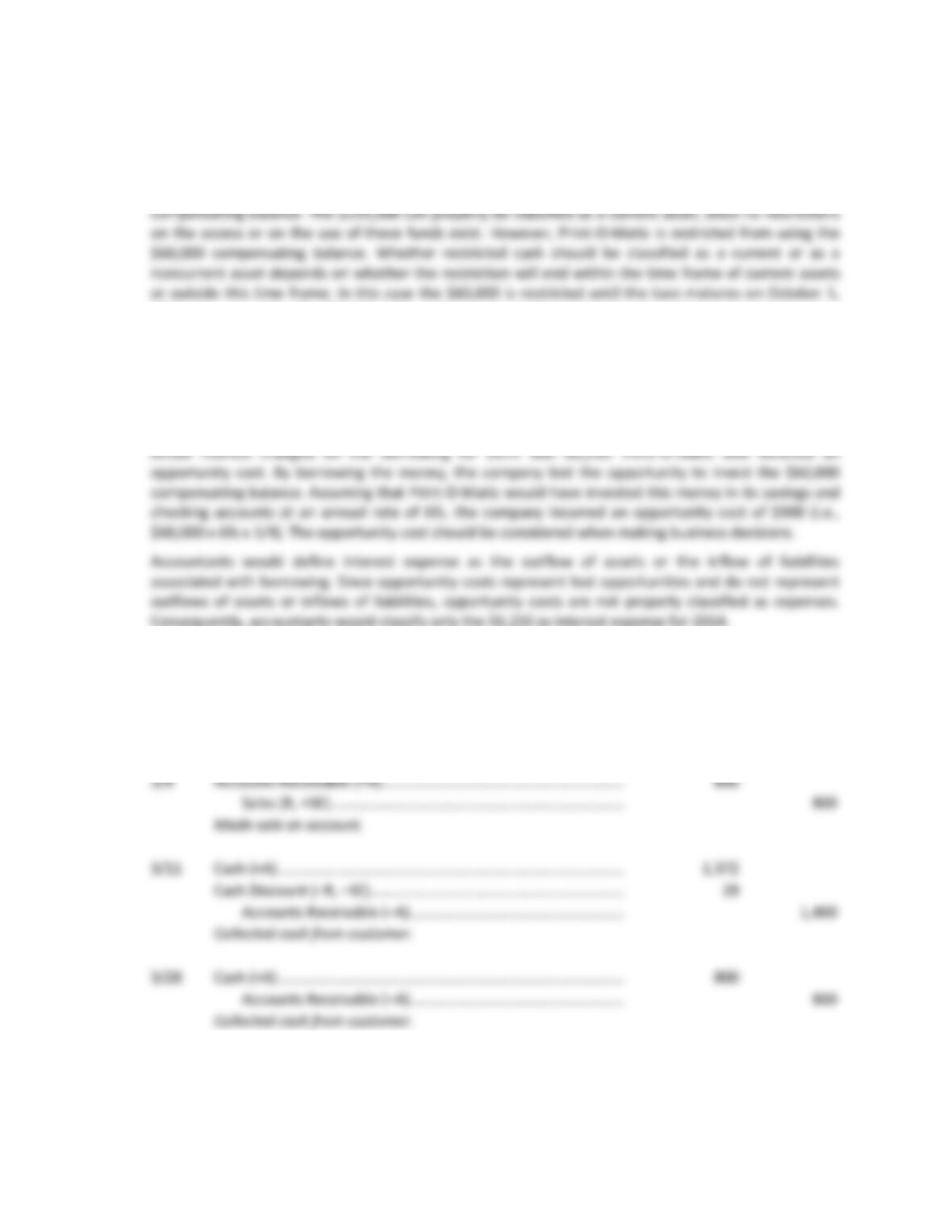
b. The concept of interest expense is viewed differently by economists and accountants. Economists
would define interest expense as the total cost of borrowing. Such costs would include the actual
interest charged on the borrowing plus an opportunity cost incurred from borrowing. In this case, the
P6–2
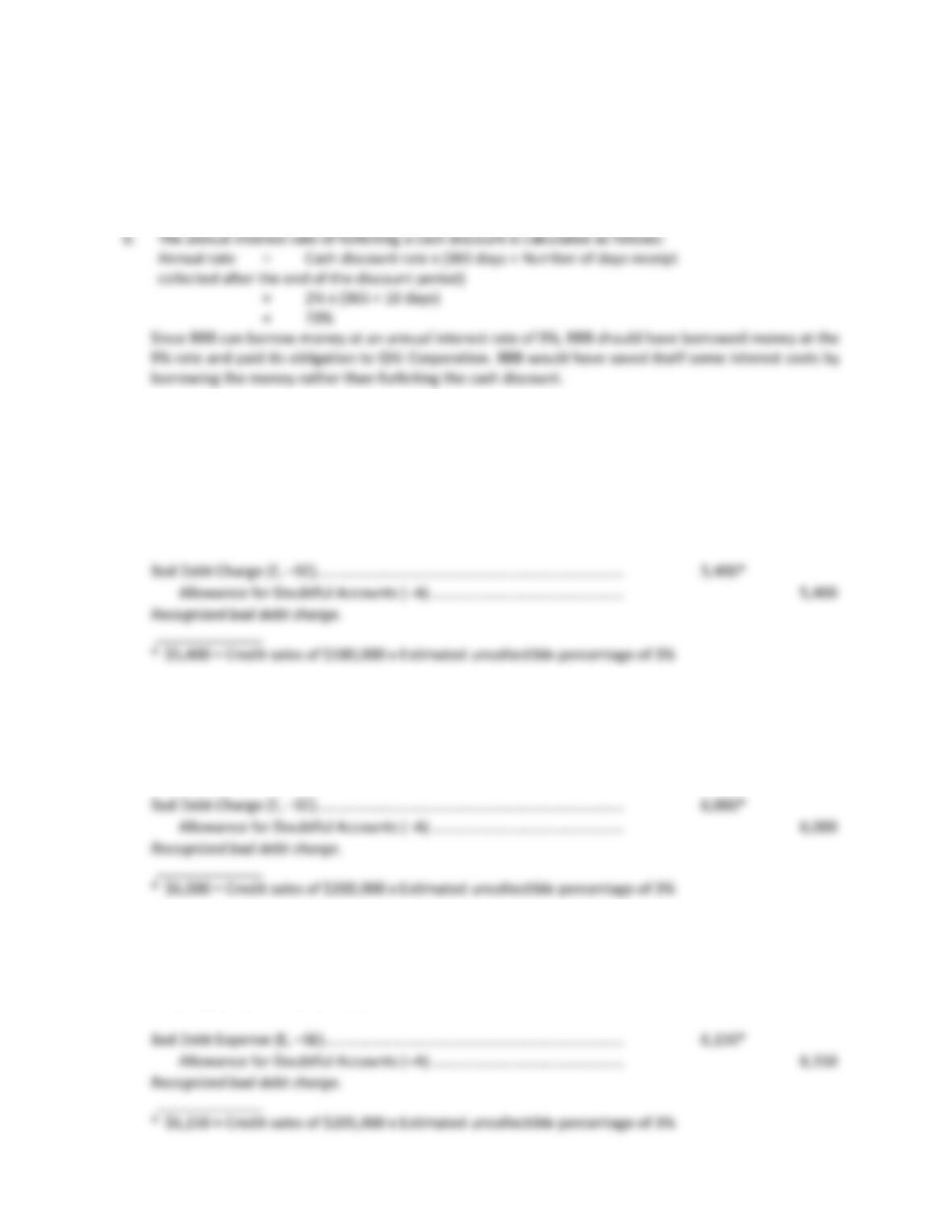
a. 3/3 Accounts Receivable (+A) ………………………………………………….. 1,400
Sales (R, +SE) …………………………………………………………….. 1,400
Made sale on account.
P6–2 Concluded
3/29 Accounts Receivable (+A) ………………………………………………….. 1,800
Sales (R, +SE) …………………………………………………………….. 1,800
Made sale on account.
P6–3
a. 2013
Allowance for Doubtful Accounts (+A) ……………………………………………… 6,000
Accounts Receivable (–A) …………………………………………………………. 6,000
Wrote off accounts deemed uncollectible.
2014
Allowance for Doubtful Accounts (+A) ……………………………………………… 10,000
Accounts Receivable (–A) …………………………………………………………. 10,000
Wrote off accounts deemed uncollectible.
2015
Allowance for Doubtful Accounts (+A) ……………………………………………… 11,000
Accounts Receivable (–A) …………………………………………………………. 11,000
Wrote off accounts deemed uncollectible.
P6–3 Concluded
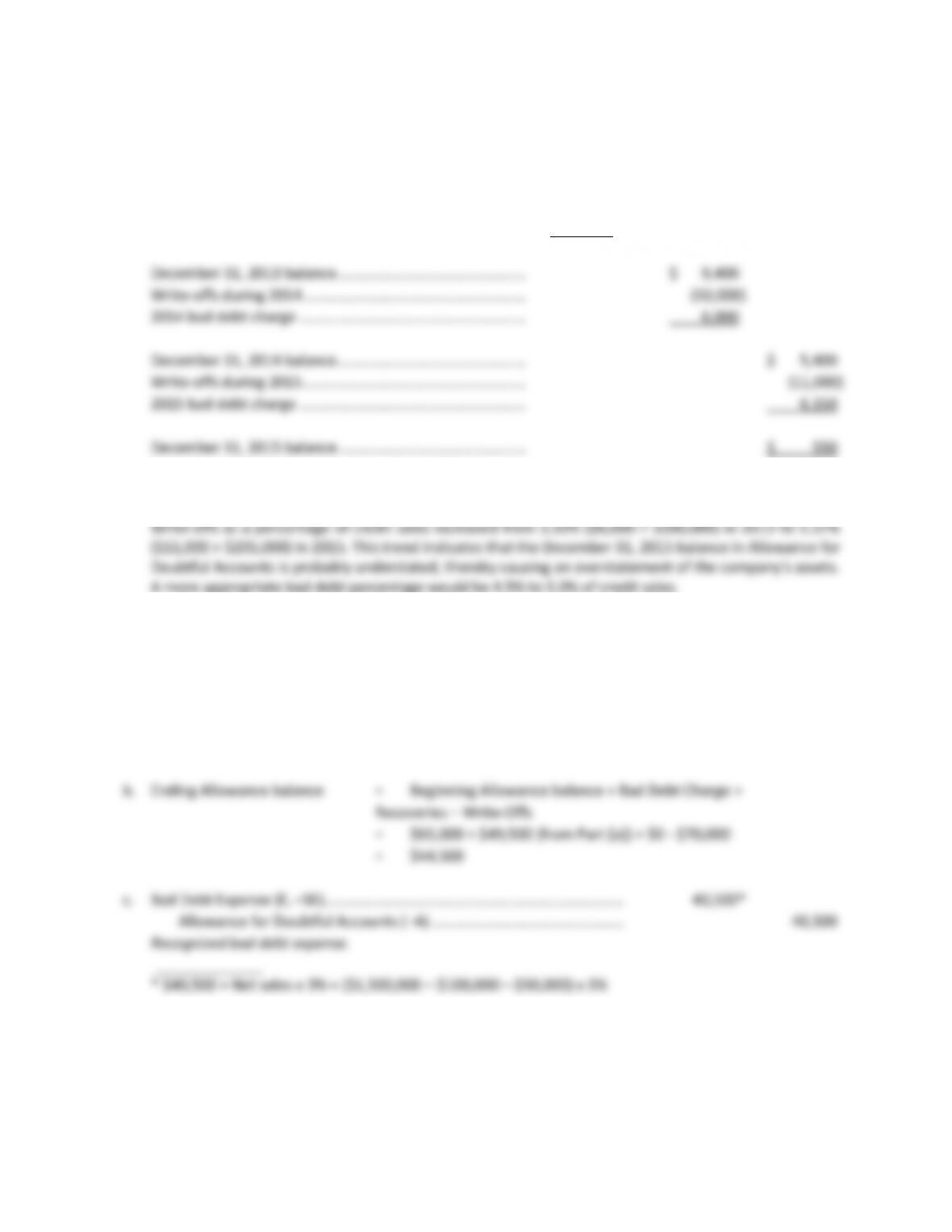
b. January 1, 2013 balance ……………………………………………. $10,000
Write-offs during 2013 ……………………………………………… (6,000)
2013 bad debt charge ………………………………………………. 5,400
c. CNG should consider increasing the percentage of credit sales that is considered uncollectible. From
2013 through 2015, write-offs exceeded bad debt expense, with the difference increasing over time.
P6–4
a. Bad Debt Charge (E, –SE) ………………………………………………………………… 49,500*
Allowance for Doubtful Accounts (–A) ……………………………………….. 49,500
Recognized bad debt expense.
_____________
* $49,500 = Net sales x 3% = ($1,800,000 – $130,000 – $20,000) x 3%
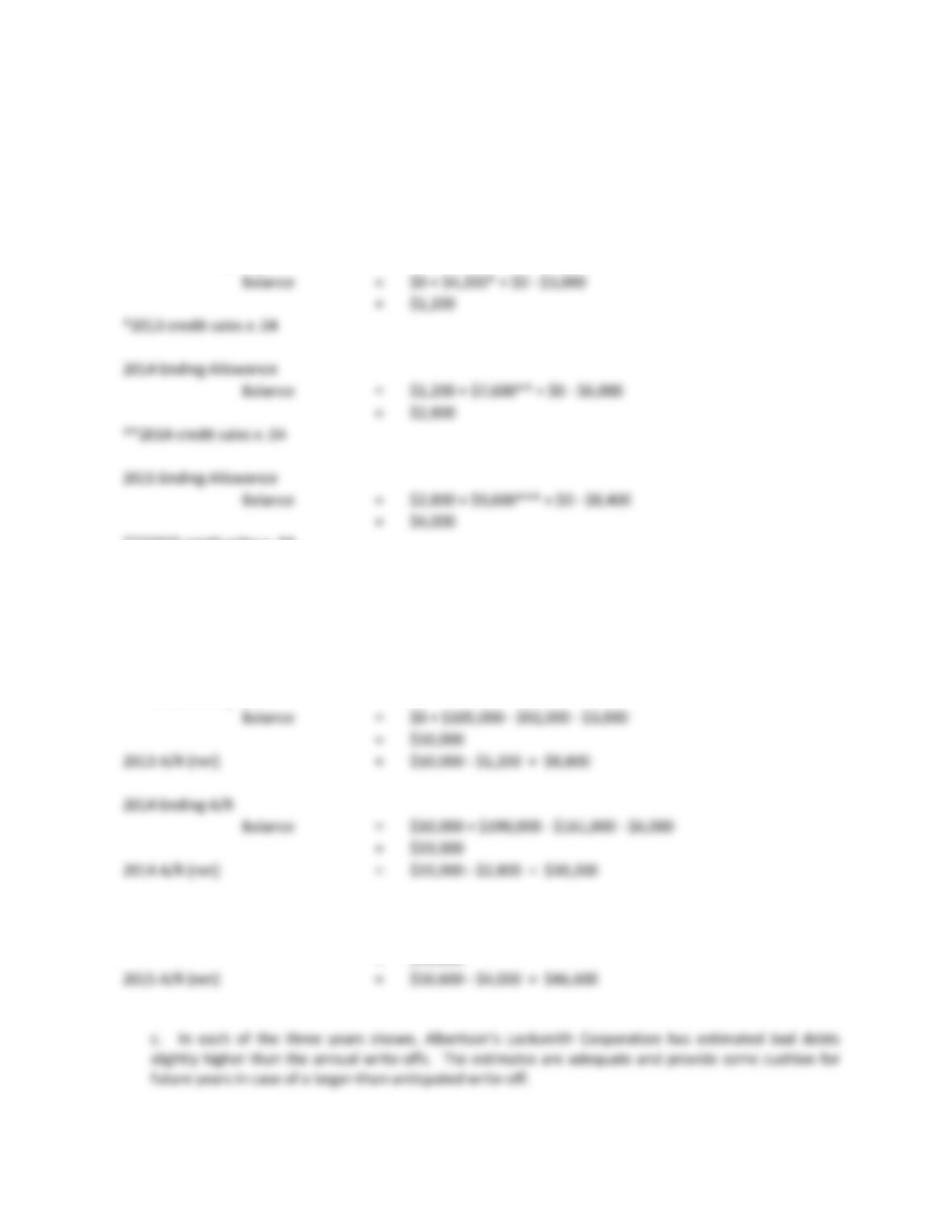
d. Ending Allowance balance = Beginning Allowance balance + Bad Debt Expense +
Recoveries – Write-Offs
= $44,500 (from Part [b]) + $40,500 (from Part [c]) +
$0 – $85,000
= $0
P6–5
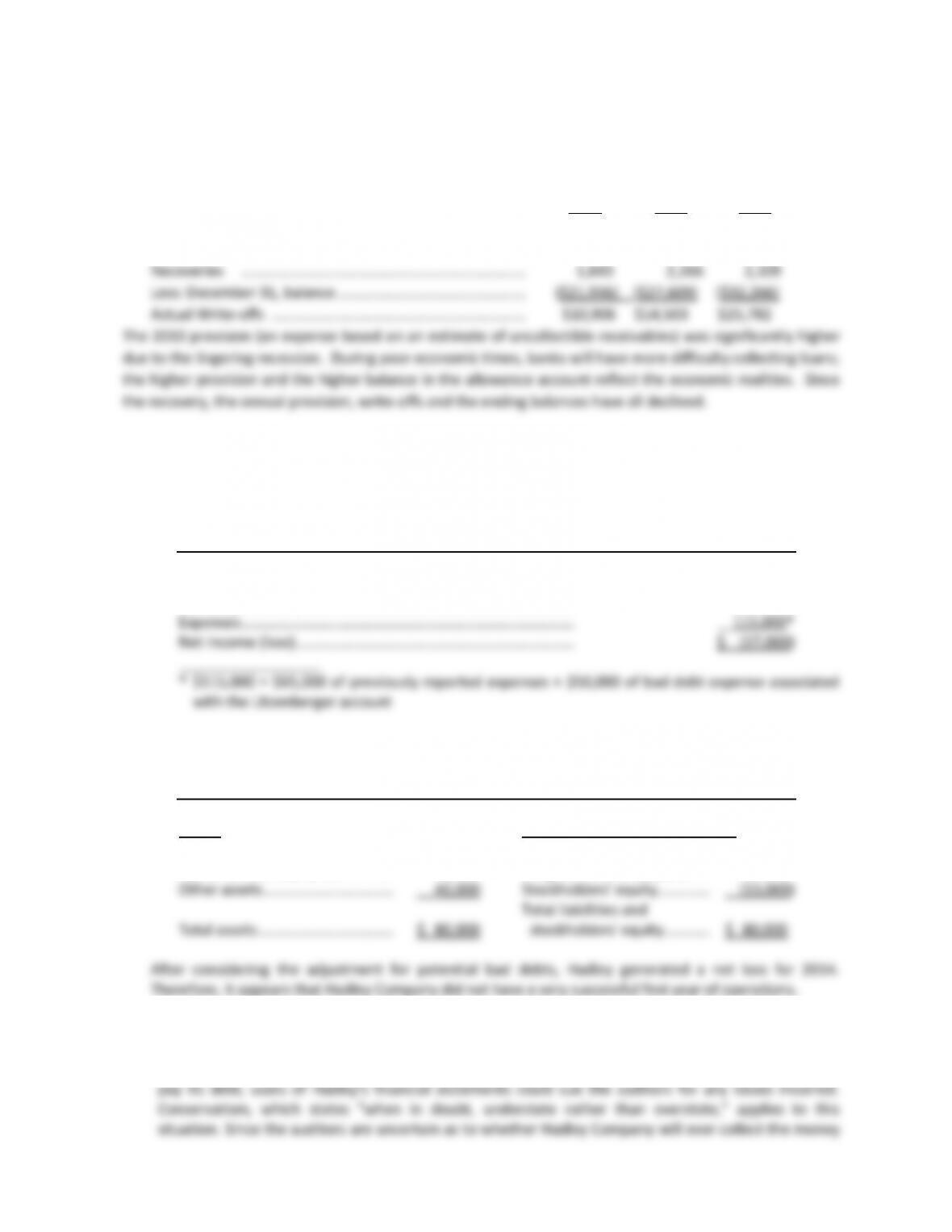
a. Ending Allowance balance = Beginning Allowance balance + Bad Debt Charge +
Recoveries – Write-Offs
2013 Ending Allowance
***2015 credit sales x .04
b. Ending A/R balance = Beginning A/R balance + Credit Sales –
Cash Collections – Write-Offs
A/R (net) = A/R balance – Allowance balance
2013 Ending A/R
2015 Ending A/R
Balance = $33,000 + $240,000 – $214,000 – $8,400
= $50,600
P6–6
2012 2011 2010
January 1, balance ……………………………………………………. $27,609 $32,266 $39,096
Provision for losses …………………………………………………… 3,390 7,580 16,843
P6–7
a. Hadley Company
Income Statement
For the Year Ended December 31, 2014
Sales ………………………………………………………………………….. $ 200,000
Cost of goods sold ………………………………………………………… 102,000
Hadley Company
Balance Sheet
December 31, 2014
Assets Liabilities & Stockholders’ Equity
Cash …………………………………… $ 5,000 Current liabilities ……………… $ 13,000
Accounts receivable, net ………… 35,000 Long-term notes payable ….. 80,000
b. Auditors have their own interests. They must consider factors affecting their own well-being. One item
that could adversely affect auditors‘ well-being is being the defendant in a lawsuit. If the auditors did
not require an adjustment for the Litzenberger account, and Litzenberger was subsequently unable to
than overstate it.
P6–7 Concluded
c. While it is true that Litzenberger is still operating, Hadley’s CFO is ignoring the revenue recognition
principle and the matching principle. Under the revenue recognition principle, revenue should not be
recognized if post-sales costs can not be adequately estimated (subject to materiality). In this case, the
actual bad debt cost associated with Litzenberger will not occur until a subsequent period. However, if
P6–8
a. The effect of the auditors’ findings on 2014 Fees Earned, Accounts Receivable, Allowance for Doubtful
Accounts, current ratio, working capital, and net income can be determined as follows.
Fees Earned: Fees Earned would decrease from $240,000 to $230,000.
Accounts Receivable: Accounts Receivable would decrease from $68,000 to $58,000.
Net Income: Net income would decrease by the reduction in Fees Earned of $10,000 and by the
increase in Bad Debt Charge of $2,400. The new net income would be $2,600.
b. Prior to the auditors’ findings, Finley, Ltd. was in compliance with its debt covenants. However, after
adjusting the books for the auditors’ findings, Finley, Ltd. has violated both requirements of its debt