CHAPTER 3
THE MEASUREMENT FUNDAMENTALS OF
FINANCIAL ACCOUNTING
BRIEF EXERCISE
BE3–1
2. Economic entity 7. Matching
5. Revenue recognition 10. Stable dollar
EXERCISES
E3–1
At the beginning of the period, $10 billion would allow the corporation to buy a “basket of goods.” Due to the
1. Compute the cost of the basket of goods at the end of the period:
2. Compute change in cost of the basket of goods for the period:
= $10,200,000,000 – $10,000,000,000 = $200,000,000
This decrease in purchasing power would not be reflected in the corporation’s financial statements.
E3–2
a. Each land acquisition would be recorded at its original cost of $15,000, for a total of $30,000.
b. No, the company could not purchase the same basket of goods for $15,000 in 2014 as in 1996. To
2
c. There are two alternatives for reporting the value of the land if the stable dollar assumption is ignored.
The first alternative is to report both pieces of land at 1996 dollars. The second alternative is to report
both pieces of land at 2014 dollars. The two alternatives are shown below.
E3–2 Concluded
1996 land in 1996 dollars $ 15,000 2014 land in 2014 dollars $ 15,000
E3–3
Fair
Original Cost Market Value Present Value Replacement Cost
Cash X
Short-Term Investments 1
Inventories 2 2 2
Prepaid Expenses X
Long-Term Investments 3 3 3
sheet at net book value, which equals original cost less the portion of original cost amortized to date.
E3–4
a. If Cisco were to determine that a portion of its inventory were obsolete, the company would lower the
value of the inventory (an asset on the balance sheet) and would book an expense on the current income
statement (which would ultimately lower stockholder equity on the balance sheet).
b. Ultimately, the management of Cisco is responsible for forecasting future demand for its products
3
c. Driving the valuation of inventory is the aim to not overstate the value of items yet to be sold. We do
not want financial statements to list the value of inventory at its cost if market forces have changed to
the point that the company could only sell the inventory for a price below its cost. In this sense,
E3–5
a. The most common point at which a company would recognize revenue is at the time of delivery. So in
this case McKey and Company would recognize revenue in February.
b. The four criteria for recognizing revenue are (1) the company has completed a significant portion of the
production and sales effort, (2) the amount of revenue can be objectively measured, (3) the company has
incurred the majority of costs, and remaining costs can be reasonably estimated, and (4) cash collection
c. Under the appropriate conditions, revenue can be recognized at several points in time. Revenue could be
recognized (1) during production, (2) at the completion of production, (3) at the point of delivery, or (4)
when the cash is collected. Case 1 normally arises in long-term construction projects such as office
buildings, bridges, and so forth. Case 2 arises where goods are manufactured to the exact specifications
E3–6
a. (1) Revenue recognized at the end of the project.
Lahmont Bridge Builders
Income Statement
For the Period Ended
Period 1 Period 2
Revenues from long-term contracts $ 0 $600,000
4
E3–6 Concluded
(2) Revenue recognized during production.
Lahmont Bridge Builders
Income Statement
For the Period Ended
Period 1 Period 2
Revenues from long-term contracts $ 450,000a $ 150,000b
(3) Revenue recognized when payments are received.
Lahmont Bridge Builders
Income Statement
For the Period Ended
Period 1 Period 2
Revenues from long-term contracts $ 400,000 $200,000
b. Assumption Period 1 Income Period 2 Income Total Income
(1) $ 0 $200,000 $200,000
5
E3–7
a. 2014 2015 2016 2017 2018
Original cost $25,000 $25,000 $25,000 $25,000 $25,000
b. Since the truck has an estimated useful life of five years, it is assumed that RDP and Brothers will receive
a benefit from using the truck in each of the five years. Consequently, RDP and Brothers expect to
receive benefits from the truck in the future. According to the matching principle, costs should be
matched against the benefits the costs help generate. Since the benefits from the truck will not be
when the expected benefits resulting from the cost are to be realized.
c. It is assumed that the truck will help generate a benefit (i.e., revenue) in each year of its useful life.
Under the matching principle, the cost of an item should be allocated to the period(s) in which the cost
E3–8
a. Costs that are expected to provide future benefits to a company are, by definition, assets. Hence, all such
costs should be capitalized. As these costs help generate benefits, such as revenue, the costs are
recognized as expenses and matched against the corresponding benefits.
b. Capitalizing expenditures and subsequently amortizing these costs are not costless activities. A company
incurs costs, such as bookkeepers’ salaries, supplies, and so forth, when engaging in such activities. In
certain instances, these bookkeeping costs may exceed the benefits derived from properly capitalizing
6
E3–9
a. (1) During 2013 the company changed depreciation methods. This change resulted in an increase of the
(2) During 2015 the company changed its method of inventory valuation, which also increased the book
b. 2012 2013 2014 2015
Net income as reported $ 21,000 $ 24,000 $ 23,000 $ 29,000
Effect of depreciation change 0 (5,000) (5,000) (5,000)
7
E3–9 Concluded
c. Companies should adhere to the principle of consistency. This principle states that a company should
use the same accounting principles and methods from year to year. Such a practice promotes the
E3–10
a. Under U.S. GAAP, conservatism and objectivity are important concepts in the valuation of assets
such as inventory. GAAP statements are going to list inventory at its historic cost (an objective
number), unless it can be documented objectively that market value has dropped below cost, in
which case the inventory will be carried at the lower (more conservative) market value figure. IFRS
b. It is possible that year-end adjustments for inventory at Adidas will be positive (that is, the carrying
amount of inventory will increase), due to management’s belief that its current ending inventory is
more valuable than previously thought. If, for example, Adidas has a shoe line that is very popular in
current youth fashion and the company is able to sell the shoes for a higher price (due to the
demand from its customers), the company could write up the value of the ending inventory to its
8
PROBLEMS
P3–1
a. The company would report a gain of $10,000.
b. No. During 2014 the purchasing power of money decreased by 10%. On December 31, 2014, it would
require $1,100 [$1,100 (1 + 10%)] to purchase the same basket of goods that $1,000 would have
purchased on January 1, 2014. The difference in purchasing power gives rise to an economic loss of $100.
c. The $10,000 gain can be broken down into two components: a gain due to the increase in the value of
the property and a gain due to general inflation. Since the inflation rate during 2014 is 10%, the value of
the land would be expected to increase during 2014 by 10%, or $1,000. The remaining $9,000 of the gain
is due to an increase in the value of the property, which represents an economic gain.
Accountants ignore the effects of inflation due to the stable dollar assumption. This assumption allows
financial statement users to compare financial statements from different points in time. Further, the
stable dollar assumption gives rise to more objective financial statements. In order to adjust for the
effects of inflation, the inflation rate must be known. Should the adjustment be based on wholesale,
retail, global, national, state, industry, or company-specific inflation rates? Company-specific rates are
9
P3–2
a. The Banking Corporation will recognize interest revenue of $240. The amount of cash given to Bush
Enterprises was $4,760 and in exchange Banking Corporation received a note receivable for $5,000. The
difference is the amount of interest revenue that Banking Corporation will recognize in its books on
December 31.
b. Banking Corporation is better off at the end of the year than if the company had not invested the $4,760
on January 1. Overall, however, the company is worse off financially on December 31 than on January 1.
To purchase the same basket of goods on December 31 as it could purchase for $4,760 on January 1,
c. As indicated in Part (b), Banking Corporation actually lost $236 of purchasing power during the year. On
the other hand, Bush Enterprises gained purchasing power during the year. Bush could have invested the
$4,760 it borrowed in a basket of goods on January 1. On December 31, Bush could sell the basket of
goods for $5,236, repay Banking Corporation $5,000, and still have $236 left over. Consequently, Bush
P3–3
a.
Cash Inflows Cash Outflow Future Total
From Sale for Replacement Cash Flows Cash Flows
Asset A:
Option 1 $1,500 $ 0 $ 0 $1,500
Option 2 1,500 (1,000) 5,000 5,500
Option 3 0 0 2,500 2,500
Asset B:
10
P3–3 Concluded
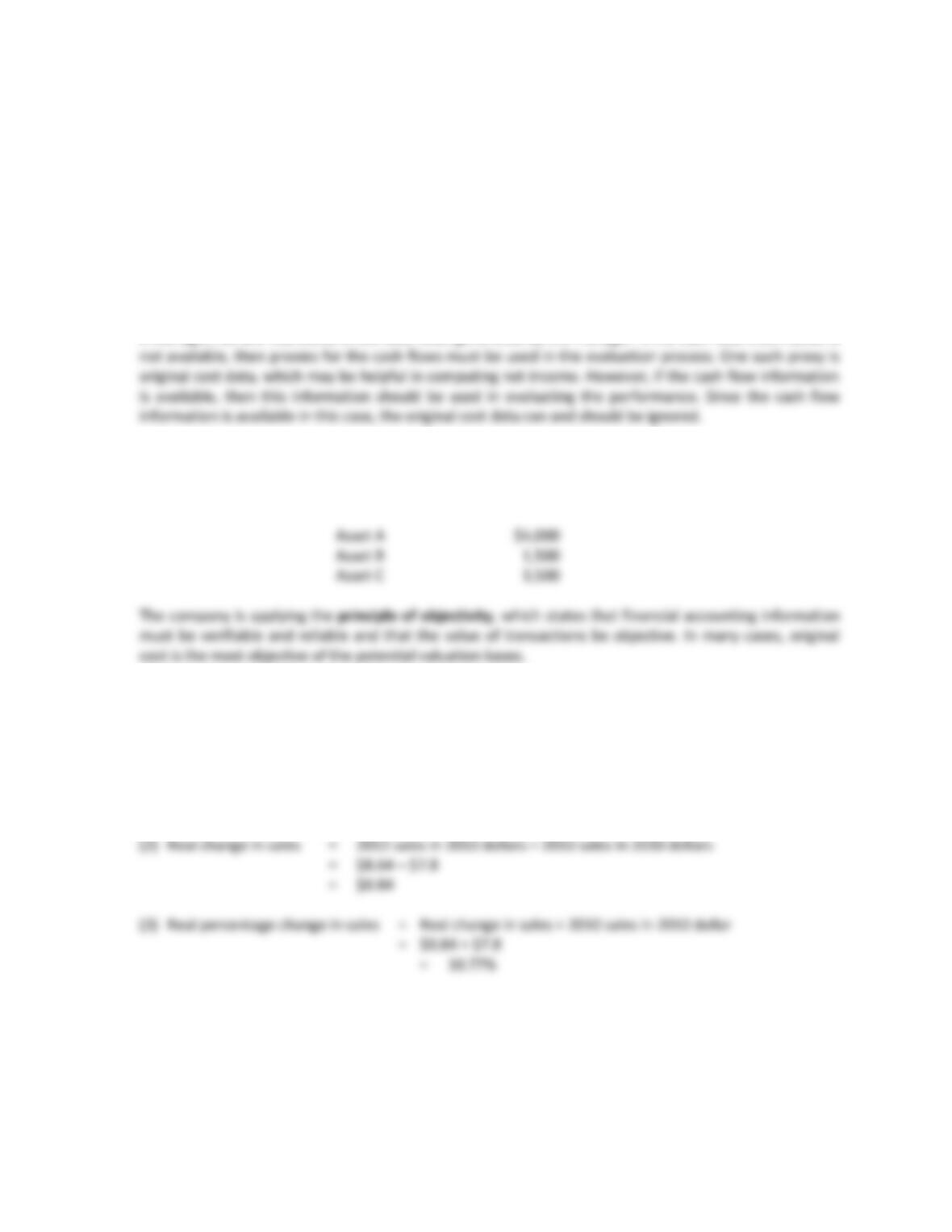
Kathy made the correct decision with respect to Assets B and C, but not to Asset A. As demonstrated
above, Option 3 (i.e., retaining the asset) yields the highest net cash flows for Asset B. For Asset C, Option
2 (i.e., selling and replacing the asset) yields the highest net cash flows. However, the best option for
Asset A is Option 2. If Kathy had selected this option, she would expect to generate a total of $5,500 in
net cash inflows, an increase of $3,000 over the net cash inflows that are expected under the option she
selected.
b. The original cost information should not be used in evaluating Kathy’s decisions. Original costs represent
sunk costs, and sunk costs should not be considered in future decisions. In evaluating the performance of
a manager, we are interested in the cash flows generated by the manager. If the cash flow information is
c. Under generally accepted accounting principles, assets should be carried on the balance sheet at original
cost. Assuming that Kathy proceeds with her decision and keeps Assets A and B and replaces Asset C, the
company should report the following amounts for each asset.
P3–4
a. Real sales did not actually increase by 22% from 2010 to 2012. To compute the real percentage change in
sales, inflation must be considered. Converting 2012 sales to 2010 dollars reveals that 2012 real sales
were actually $9.13 = [$9.5 ÷ (1 + 4%)]. Consequently, sales increased from 2010 to 2012 by $1.33
million, which is only a 17% increase in sales.
b. (1) 2012 sales in 2010 dollars = $9.5 ÷ (1 + 10%) = $8.64
11
P3–4 Concluded
c. The stable dollar assumption assumes that inflation does not exist. So under this assumption, sales
P3–5
a. The first step in a comparison across currencies is to convert the different statements into one
currency, using the latest available exchange rate. Converting the pounds of GlaxoSmithKline into
U.S. dollars is shown below:
Converting the Euros of Sanofi into U.S. dollars is shown below:
Sales 34.9 Euros x $1/.76 Euros = $ 45.9
Assets 100.4 Euros x $1/.76 Euros = $132.1
P3–6
a. In this case, the purchase price should equal the stream of future cash flows discounted to reflect the
time value of money. The purchase price would be calculated as follows (millions).
Purchase price = Present value of future cash flows
c. The purchase value of a company can be different from the book value of the company because the fair
market value of individual assets and liabilities may be different from the book value of individual assets
12
P3–7
a. The book value of the building equals the value of the building according to Barry Smith’s company’s
financial records. Long-lived assets are initially recorded at their cost, and then over time the assets are
reported at net book value, which is original cost less the portion of the asset’s cost amortized to date. In
Annual net cash flows
Present value = ($65,000 cash inflow – $45,000 cash outflow) Present value of an
ordinary annuity factor for i = 10% and n = 10
= $20,000 6.14457 (from Table 5)
= $122,891.40
Proceeds from sale of building
b.
Barry Smith
Income Statement
For the Year Ended December 31, 2014
Rental revenue ……………………………………………………………………………………… $ 65,000
Management expenses …………………………………………………………………………….. (45,000)
13
P3–7 Concluded
Barry Smith
Balance Sheet
As of December 31, 2014
Assets Liabilities & Stockholders’ Equity
Cash $ 20,000 Liabilities $ 0
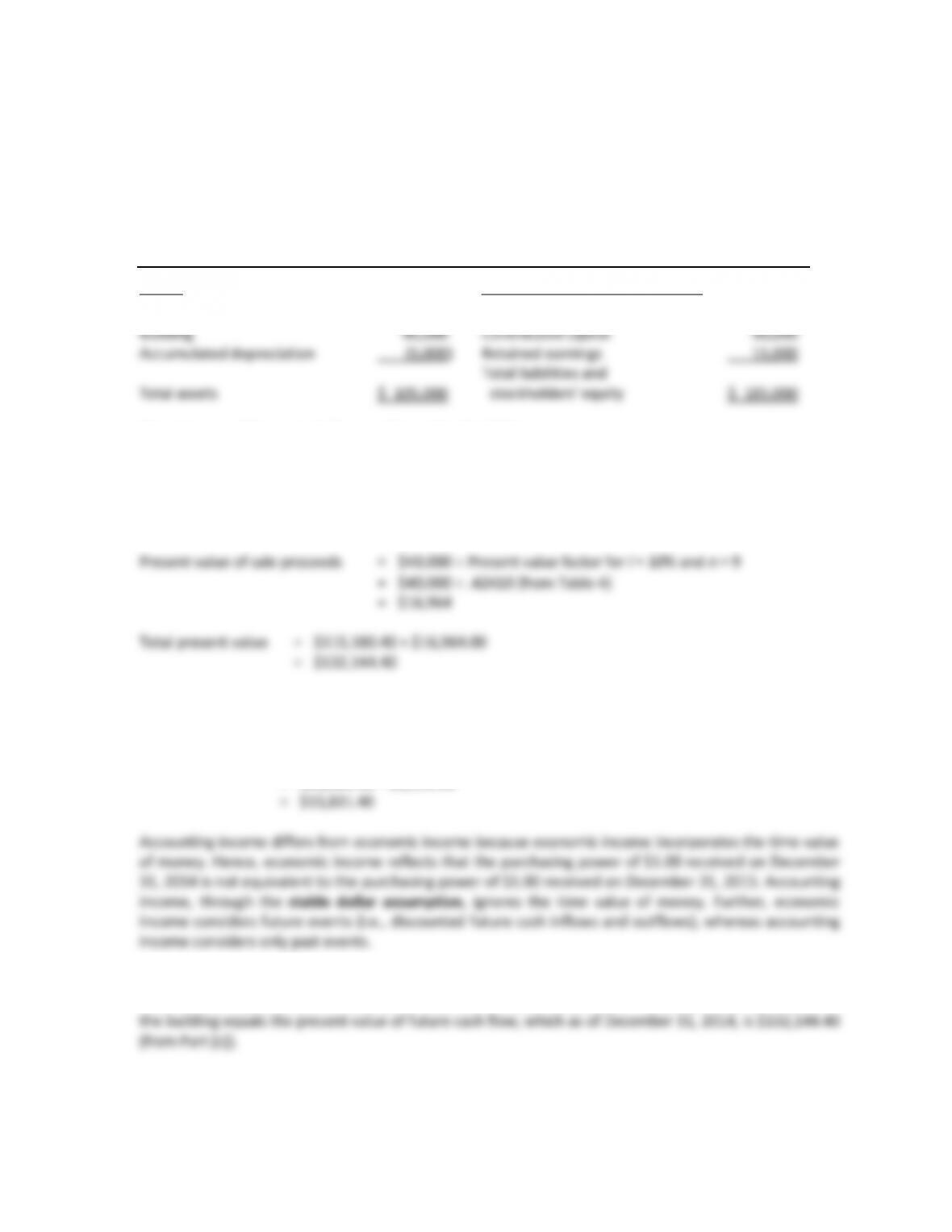
c. Present value of future cash flows on December 31, 2014:
Present value of annual net rentals = $20,000 Present value of an ordinary annuity
factor for i = 10% and n = 9
= $20,000 5.75902 (from Table 5)
= $115,180.40
Economic income = Net cash received during 2014 + (12/31/14 present value –
1/1/14 present value)
= ($65,000 cash inflow – $45,000 cash outflow) + ($132,144.40 –
$138,313.00 (from part [a])
= $20,000.00 – $6,168.60
d. The book value of the building on December 31, 2014 equals the cost of the building less the associated
accumulated depreciation. Therefore, the book value is $85,000 ($90,000 – $5,000). The present value of