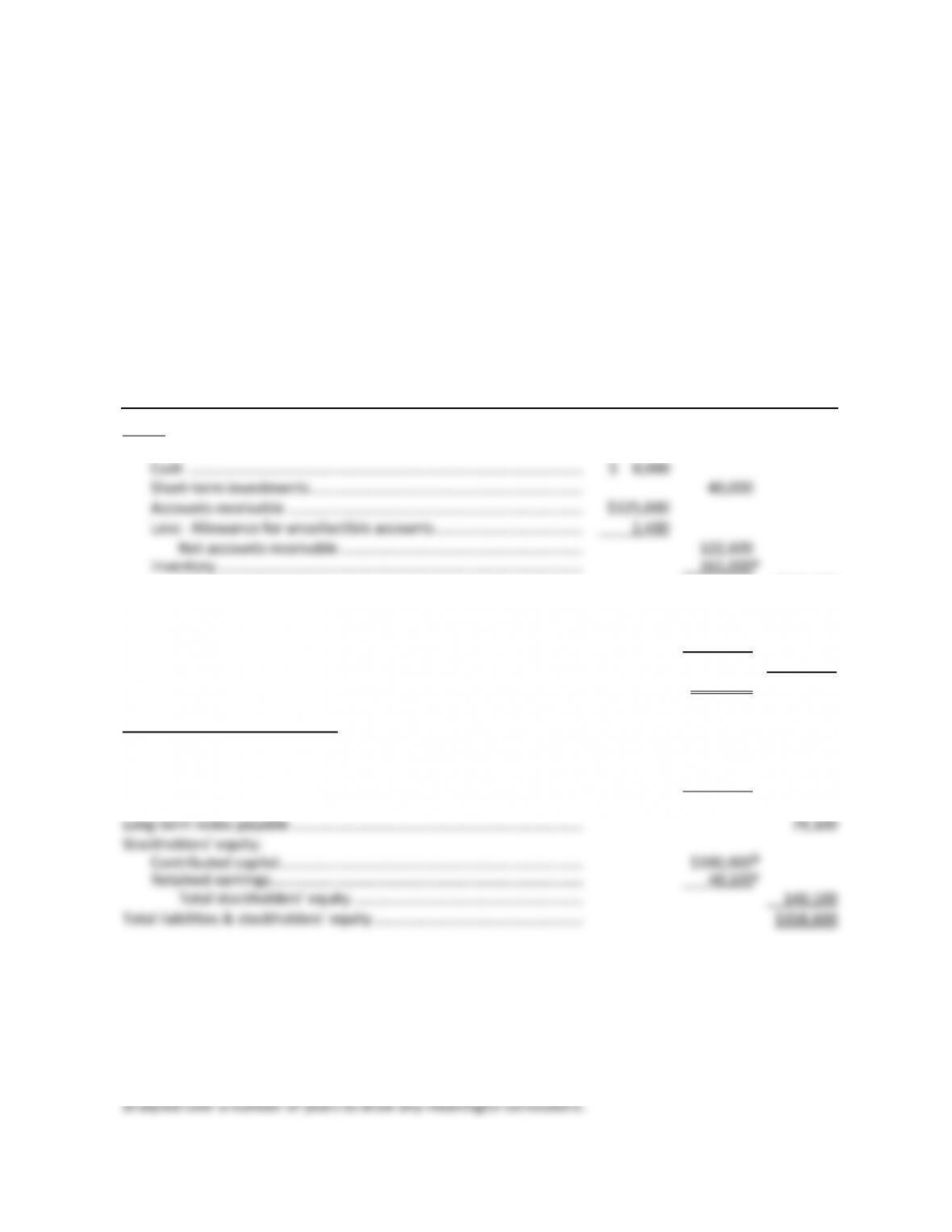
P2–4
Johnson Company
Balance Sheet
December 31, 2014
Assets
Current assets:
Total current assets ………………………………………………………… $331,600
Property, plant, & equipment:
Buildings ……………………………………………………………………………… $ 35,000
Less: Accumulated depreciation …………………………………………….. 8,000
Total property, plant, & equipment ………………………………….. 27,000
Total assets ………………………………………………………………………………. $358,600
Liabilities & Stockholders’ Equity
Current liabilities:
Accounts payable …………………………………………………………………. $110,000
Taxes payable ………………………………………………………………………. 29,400
Total current liabilities …………………………………………………….. $139,400
__________________
a Inventory is reported at the lower of its cost or its market value.
b $100,000 = $12,500 shares $8 per share.
c $40,100 = $65,000 cumulative earnings – $24,900 cumulative declared dividends.
Based on only one year’s balance sheet it is a very difficult question to answer. This fact proves the point
that (1) all the financial statements must be interpreted as a whole, and (2) that the information should be
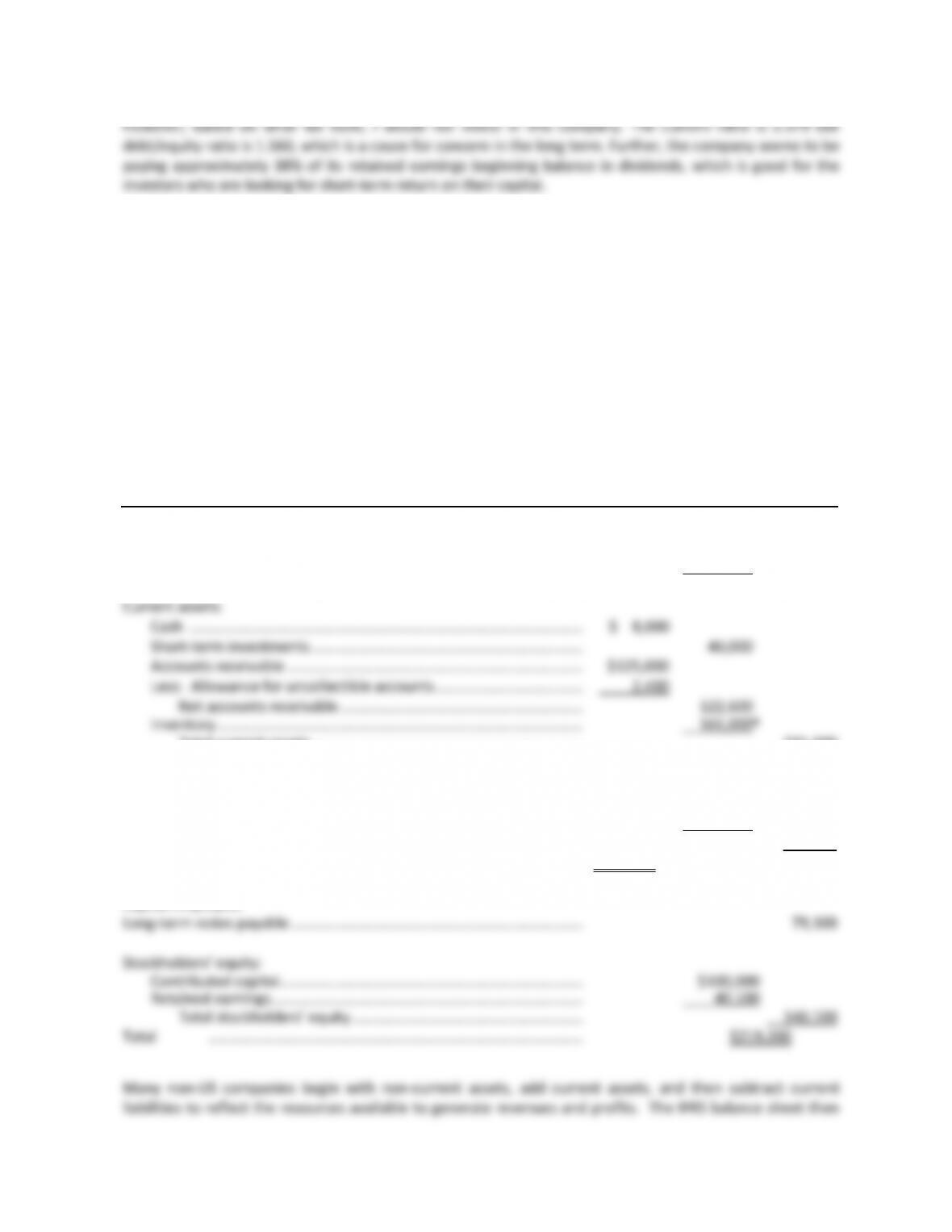
P2–4 Concluded
Johnson Company
Balance Sheet
December 31, 2014
Property, plant, & equipment:
Buildings ……………………………………………………………………………… $ 35,000
Less: Accumulated depreciation …………………………………………….. 8,000
Total property, plant, & equipment ………………………………….. $ 27,000
Total current assets ………………………………………………………… 331,600
Less:
Current liabilities:
Accounts payable …………………………………………………………………. $110,000
Taxes payable ………………………………………………………………………. 29,400
Total current liabilities …………………………………………………….. 139,400
Total…………………………………………………………………… $219,200
Capital Employed:

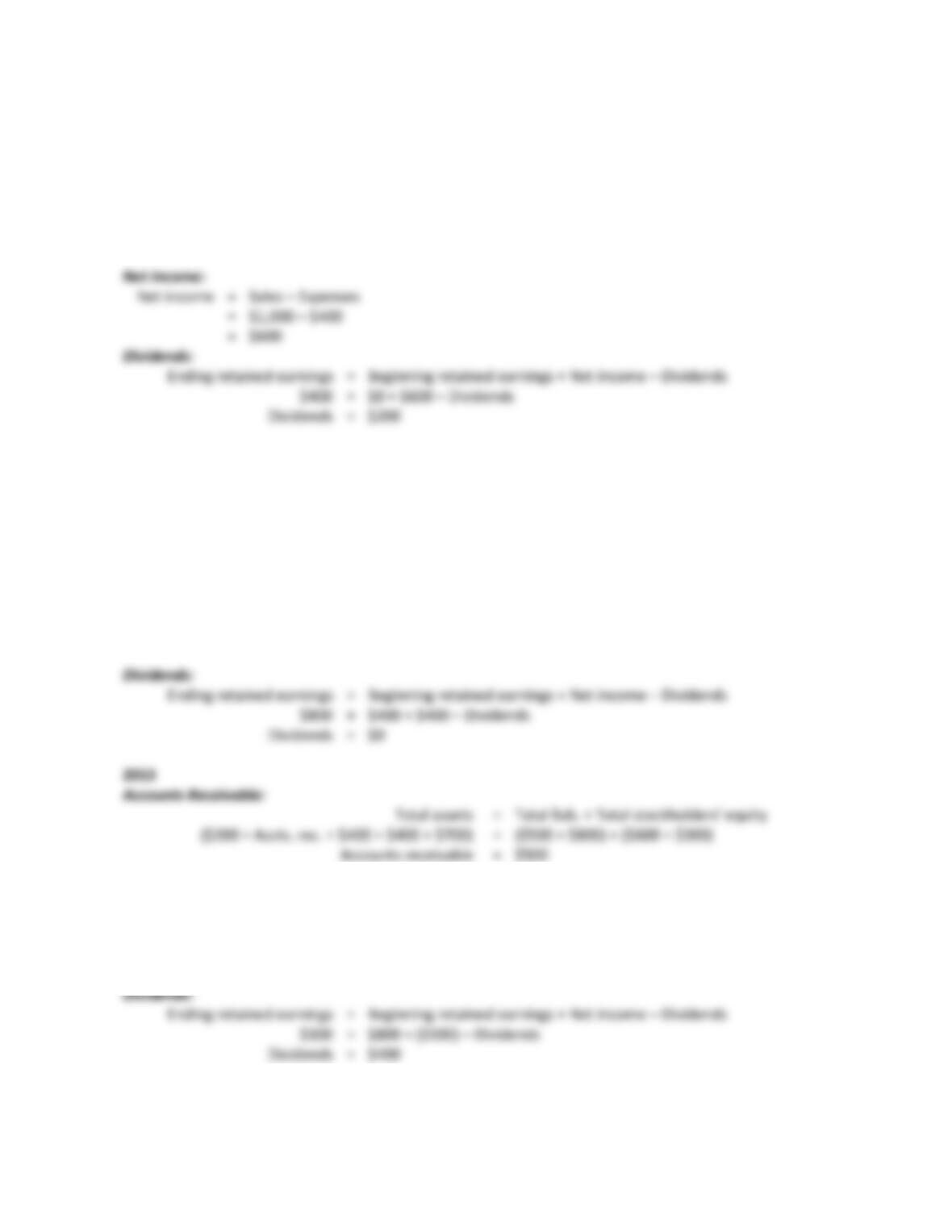
P2–5
2011
Contributed Capital:
Total assets = Total liabilities + Total stockholders‘ equity
($300 + $200 + $500 + $100 + $700) = ($200 + $500) + (Contributed cap. + $400)
Contributed capital = $700
2012
Inventory:
Total assets = Total liabilities + Total stockholders’ equity
($300 + $300 + Inventory + $200 + $600) = ($300 + $600) + ($400 + $800)
Inventory = $700
Expenses:
Net income = Sales – Expenses
$400 = $1,100 – Expenses
Expenses = $700
Expenses:
Net income = Sales – Expenses
($100) = $700 – Expenses
Expenses = $800
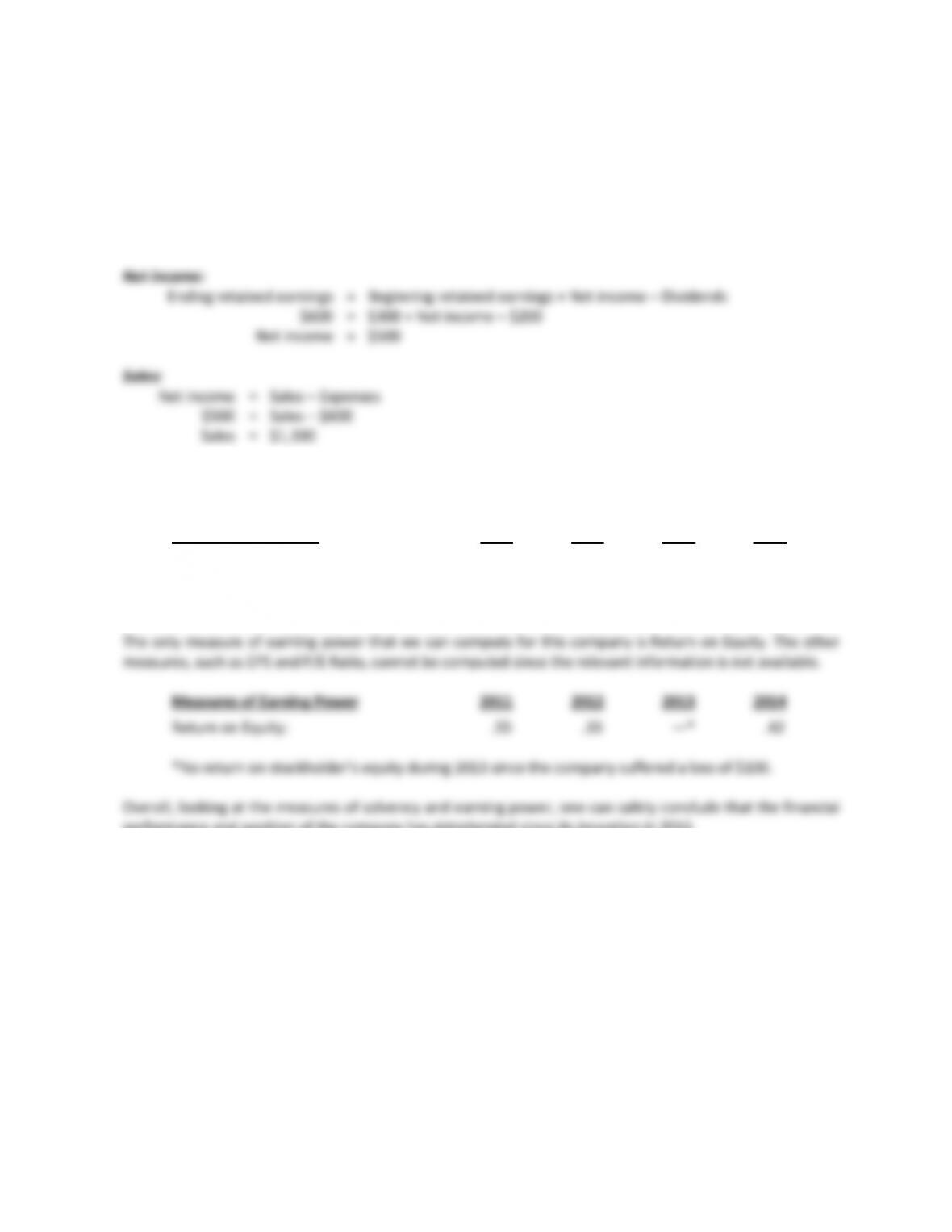
P2–5 Concluded
2014
Accounts Payable:
Total assets = Total liabilities + Total stockholders’ equity
($500 + $700 + $400 + $400 + $800) = (Accts. pay. + $700) + ($600 + $600)
Accounts payable = $900
In order to assess the financial performance of this company, we need to calculate the measures of
solvency and earning power. Respective measures are computed as follows:
Measures of Solvency 2011 2012 2013 2014
Current Ratio: 5 4.33 2.20 1.78
Working Capital: $800 $1,000 $600 $700
Debt/Equity Ratio: .64 .75 1.44 1.33
performance and position of the company has deteriorated since its inception in 2011.
The current ratio has continued to decline and working capital has also gone down. While the company has
taken more debt, it has been unable to leverage against the interest of the stockholders, since the return
on equity has declined considerably. In one year, 2013, the company even suffered a loss.
The company paid dividends even during the year of loss, indicating a poorly devised dividend policy.
P2–6
Kroger
Balance Sheet
December 31, 2012, 2011
2012 2011
Assets
Cash ………………………………………………………………………………… $ 1,193 $ 974
Accounts receivable ……………………………………………………….……. 1,051 949
Inventory ……………………………………………………………………………. 5,146 5,114
Stockholders’ Equity …………………………………………………………….. 4,214 3,966
Total liabilities and stockholders’ equity…………………………………. $ 24,652 $ 23,476
Kroger
Income Statement
For the Years Ended December 31, 2012, 2011
2012 2011
Sales ………………………………………………………………………………… $ 96,751 $ 90,374
Solvency refers to a company’s ability to pay its obligations as they come due. The current ratio provides a
measure of solvency by comparing those obligations that are coming due in the near future against those
assets that the company expects to convert into cash or consume in the near future. Based on its current
P2–7
a. Assets are, for the most part, recorded at original cost. Over a period of time, the value of an item will
change. For instance, the value of Eat and Run’s property, plant, and equipment will most likely change
as the items become older. Consequently, over time the cost of an item may have no relation to the
item’s market value. Since the cash received from selling an asset is based on the asset’s market value,
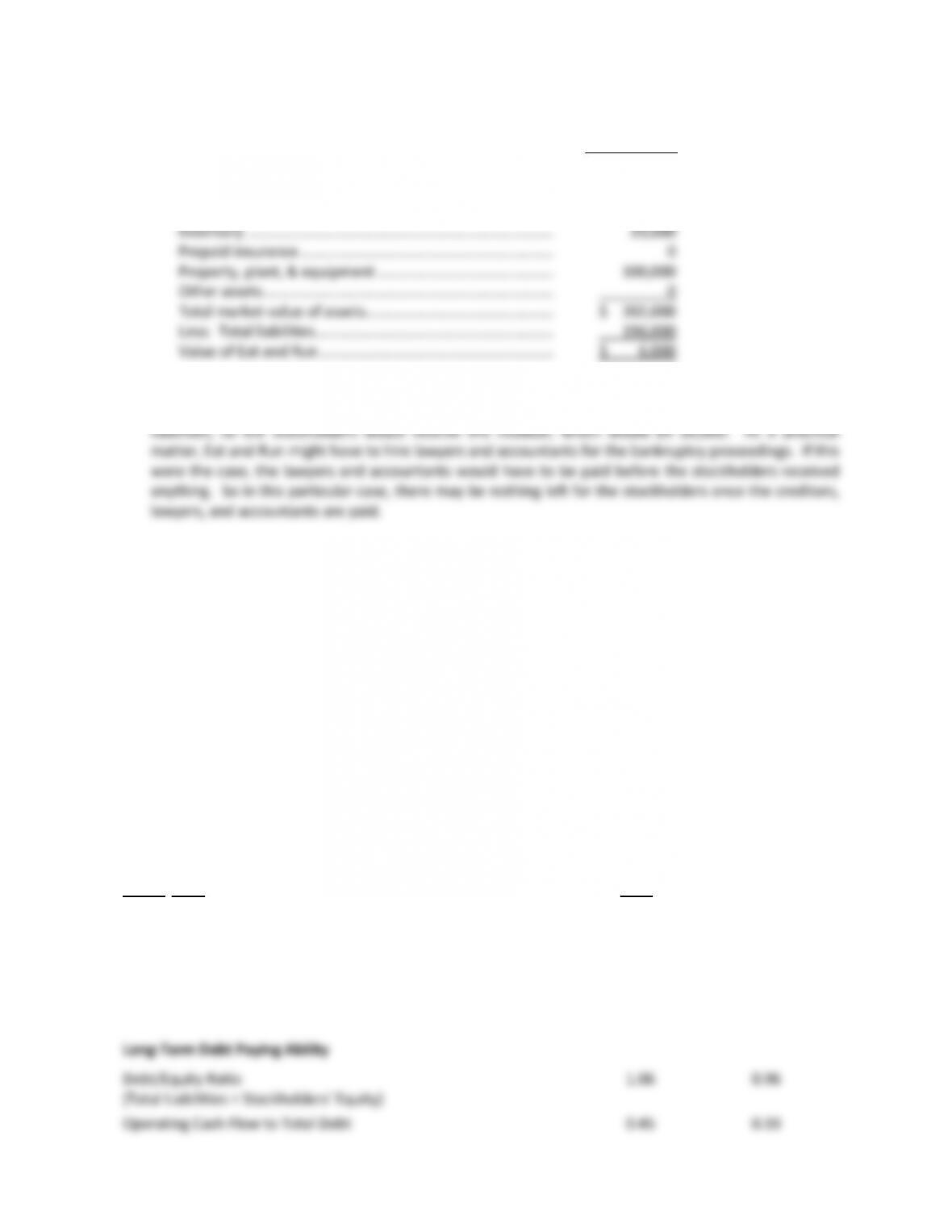
Market Value
Cash …………………………..…………………………………………… $ 25,000
Short-term investments ……………………………………………. 19,000
Accounts receivable………………………………………………….. 25,000
c. If Eat and Run were to go bankrupt, the stockholders would receive anything left after all the assets
were sold and the creditors were paid. In this case the fair market value of the assets exceeds the total
P2–8
First, let us compute some relevant ratios that would help to evaluate the financial statements submitted
by Romney Heights in support of its loan application to Acme Bank.
Ratios 2014 2013
Liquidity
Current Ratio 2.00 2.00
(Current Assets ÷ Current Liabilities)
Working Capital $7,000 $6,000
(Current Assets – Current Liabilities)
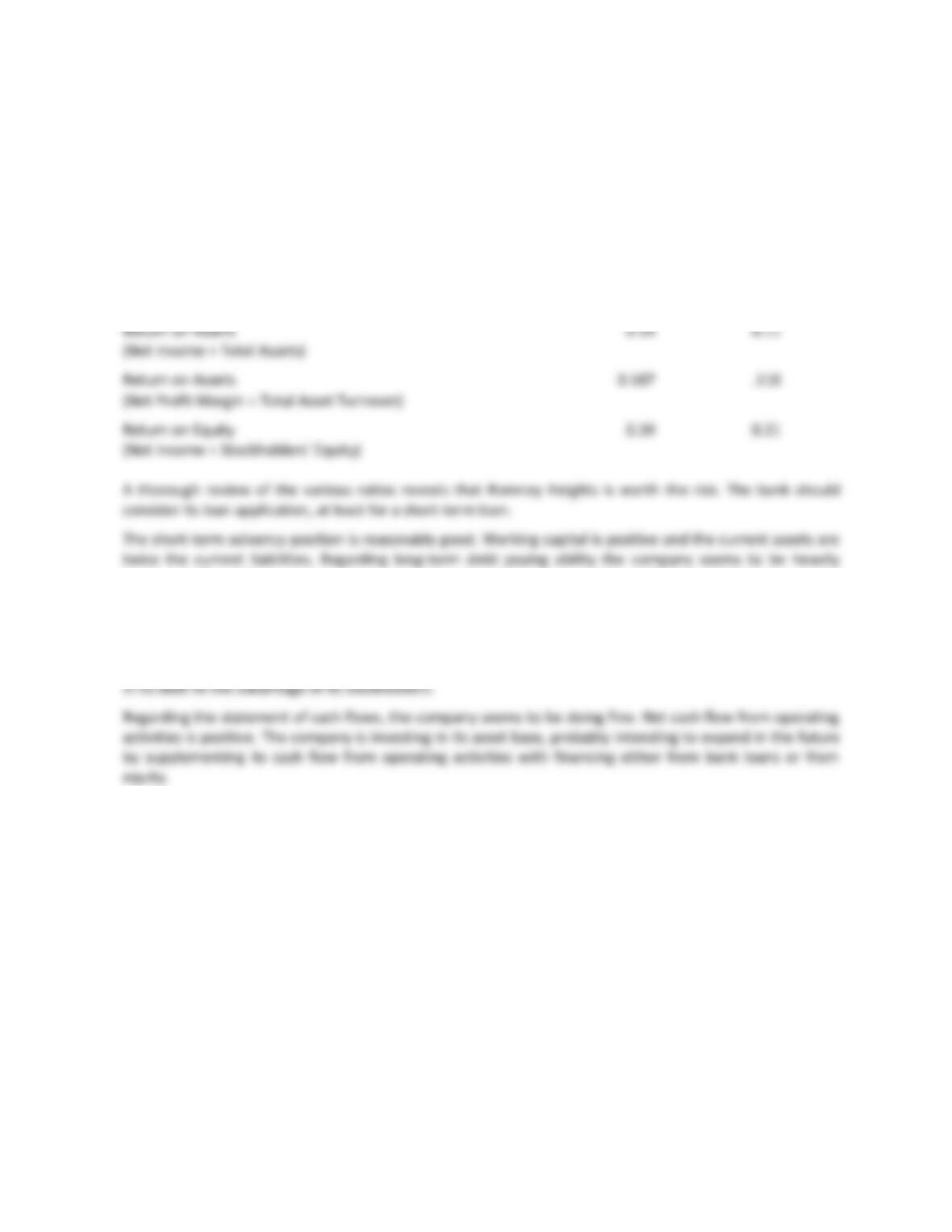
(Operating Cash Flow ÷ Total Debt)
Ratios 2014 2013
Profitability
Net Profit Margin 0.34 0.19
(Net Income ÷ Sales)
Total Asset Turnover 0.55 0.58
(Sales ÷ Total Assets)
leveraged. The debt to equity ratio is more than 1 and has increased from 2013 to 2014. However, the
concern is somewhat mitigated by a substantial increase in the proportion of operating cash flows to the
total debt held by the company.
The overall profitability of the company is on the rise, but the asset utilization is poor and flat. Since the
return on equity has almost doubled, the company seems to be able to effectively leverage the increment
P2–9
First, let us compute some relevant ratios that would help us evaluate the financial statements of Ted
Tooney.
Ratios 2014 2013
Liquidity
Current Ratio 1.29 2.00
Profitability
Net Profit Margin 0.15 0.19
(Net Income ÷ Sales)
Total Asset Turnover 3.41 3.87
(Sales ÷ Total Assets)
Return on Assets 0.52 0.74
P2–10
a. As of 12/31/14 the current asset balance of Ellington Industries is 1.33 times the current liability
balance.
b.
Ellington Industries
Balance Sheet
January 1, 2015
Assets
Current assets ………………………………………………………………. $ 18,000
Land investment …………………………………………………………… 89,000
Total assets ………………………………………………………………….. $ 107,000
c.
Ellington Industries
Balance Sheet
December 31, 2015
Assets
Current assets ………………………………………………………………. $ 36,000
Land investment …………………………………………………………… 89,000
Total assets ………………………………………………………………….. $ 125,000
Liabilities & Stockholders’ Equity
ISSUES FOR DISCUSSION
ID2–1
a. Net income represents the change in net assets (i.e., assets less liabilities) generated during the year
from operating activities. Alternatively, cash flows from operating activities is the amount of cash the
company generated during the year from operating activities. Since cash is simply one of many assets a
company has, it is obvious that net income and cash flows from operating activities are not the same.
Thus, it is quite possible for a company to have an increase in net assets from operating activities (i.e.,
net income) and at the same time have negative cash flows from operating activities.
ID2–2
Analysts and investors following Netflix would react positively to new subscribers, as well as leading
market share of subscribers in general. A critically acclaimed show, similarly, would have a positive
ID2–3
a. The excerpt indicates that the Cummins Engine Company’s creditors have imposed restrictions on
Cummins as part of the borrowing agreement. The covenants restrict Cummins‘ abilities to pay
dividends and borrow money and the relative amount of its current assets and current liabilities. If
ID2–4
Sears Holdings – Sears is a company struggling to survive in the competitive marketplace of retail sales.
The company lost cash in the basic operation of its stores, as well as in its needs to repay financing
resources. The only source of cash, and this is a troubling one for a company, has been its sale of long-
term assets. Most healthy companies (like the other two shown in this problem) invest cash in their
ID2–5
From the data given about the Goodrich Corporation it can be surmised that Goodrich has done a good
job of generating positive operating cash flow, especially in the most recent year shown. Given the fact
ID2–6
A U.S. GAAP balance sheet shows the most liquid accounts first and then lists accounts in the order that
they are convertible to cash. Those accounts being closest to cash are listed first. Secondly, liabilities
are not shown in parentheses. Finally, some of the equity accounts carry slightly different titles.
GlaxoSmithKline
Consolidated Balance Sheet
As of 12/31/2012
2012 2011
ASSETS:
Cash 4,184 5,714
Short term investments 130 254
Non-Current Assets
Investment in Affiliates 579 560
Property, Plant & Equipment 8,776 8,748
Other Investments 3,908 4,049
Total 13,263 13,357
Long term liabilities 20,913 17,243
Shareholders’ Equity
Common stock 1,349 1,387
Additional paid in capital 2,022 1,673
Minority Interest 937 795
ID2–7
Earnings according to GAAP are accrual numbers, meaning that they don’t represent cash. For example,
ID2–8
Both GE and Comcast are interested in focusing efforts on core business activities: for GE, running a
television network did not fit in with its manufacturing and financial businesses, while Comcast saw a
ID2–9
An analyst following both Nike (GAAP) and Adidas (IFRS) would not be pleased with the SEC decision. An
ID2–10
a. 2012 2011 2010 .
Sales $ 50,175 $ 37,905 $ 29,321
Cost of sales 20,634 41.1% 13,188 34.8% 10,417 35.5%
S G & A expenses 9,988 19.9% 7,313 19.3% 4,761 16.2%
b.
2012 2011 .
Current assets $ 60,454 64.5% $ 52,758 72.7%
c.
2012 2011 .
Current liabilities $14,337 15.3% $8,913 12.3%
d.
Google is rapidly growing and finances that growth with strong cash from operations as well as cash
garnered from financing sources. The company uses that cash to invest heavily in long term assets.
e.