1
CHAPTER 13
THE COMPLETE INCOME STATEMENT
BRIEF EXERCISES
BE13–1
To accurately compare a company’s performance from one year to the next, non-recurring items such as
debt retirements and accounting changes, as well as the activities of discontinued operations, should be
BE13–2
ASSETS = LIABILITIES + OWNERS’ EQUITY
Closure of Tampa Breweries:
BE13–3
Glancing only at Merck’s net income trend might give an analyst an incorrect impression regarding the
company’s operations. However, an analyst would like to exclude the special items that cannot be counted
on to recur in future periods. The large amount in “other income” (from $1.3 billion in 2010 to $1.1 billion
in 2012) contributes greatly to the company’s bottom line, but an analyst would certainly question if the
billion dollar level will happen again in 2013. Another one-time charge that affects the profit trend line is
BE13–3 Concluded
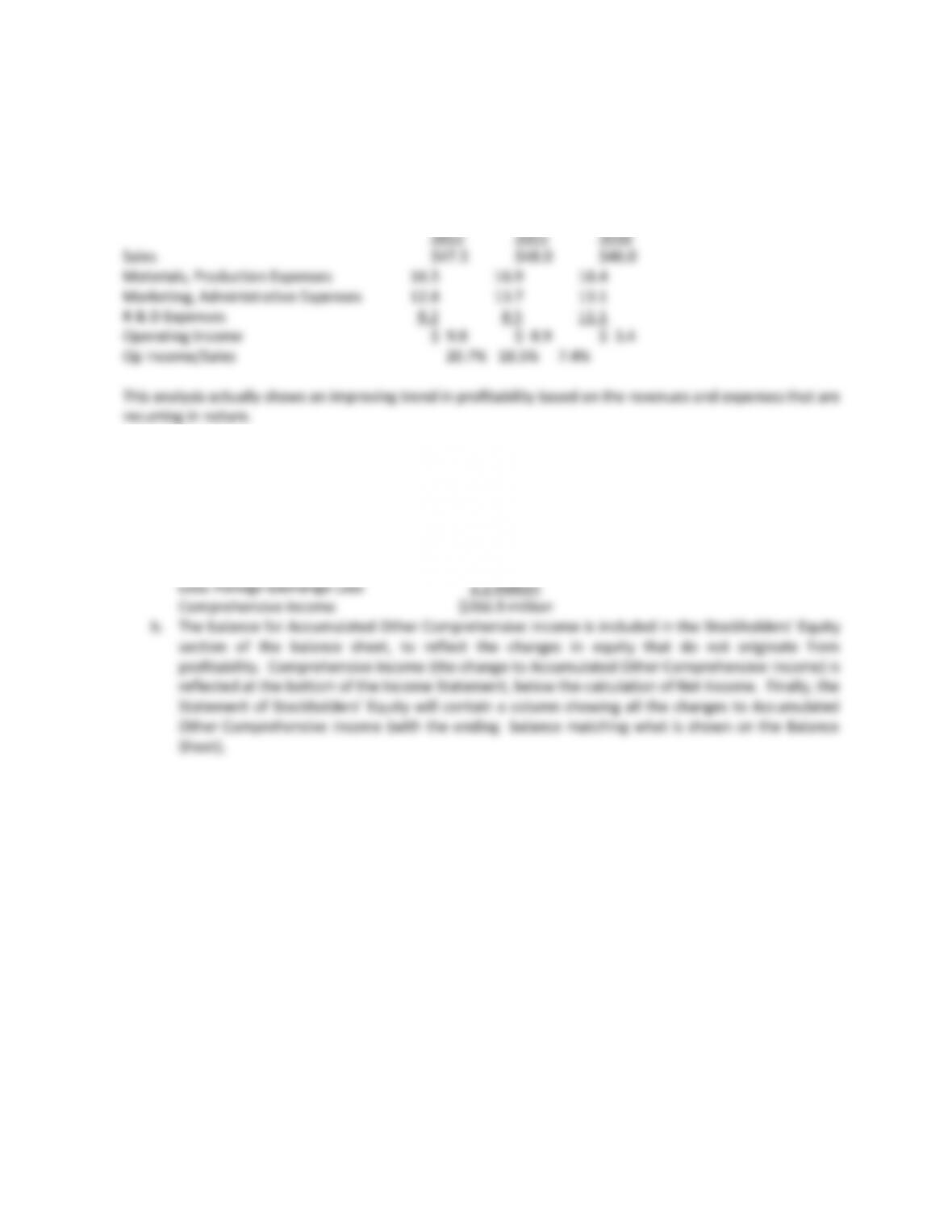
An analyst would certainly be interested in computing the recurring revenues and expenses from Merck’s
core business: (amount in billions)
.
BE13–4
a. Comprehensive Income can be calculated as:
Net Income $266 million
Add: Unrealized Gain AfS Securities 3.1 million
EXERCISES
E13–1
a. Statement b. Classification c. Explanation
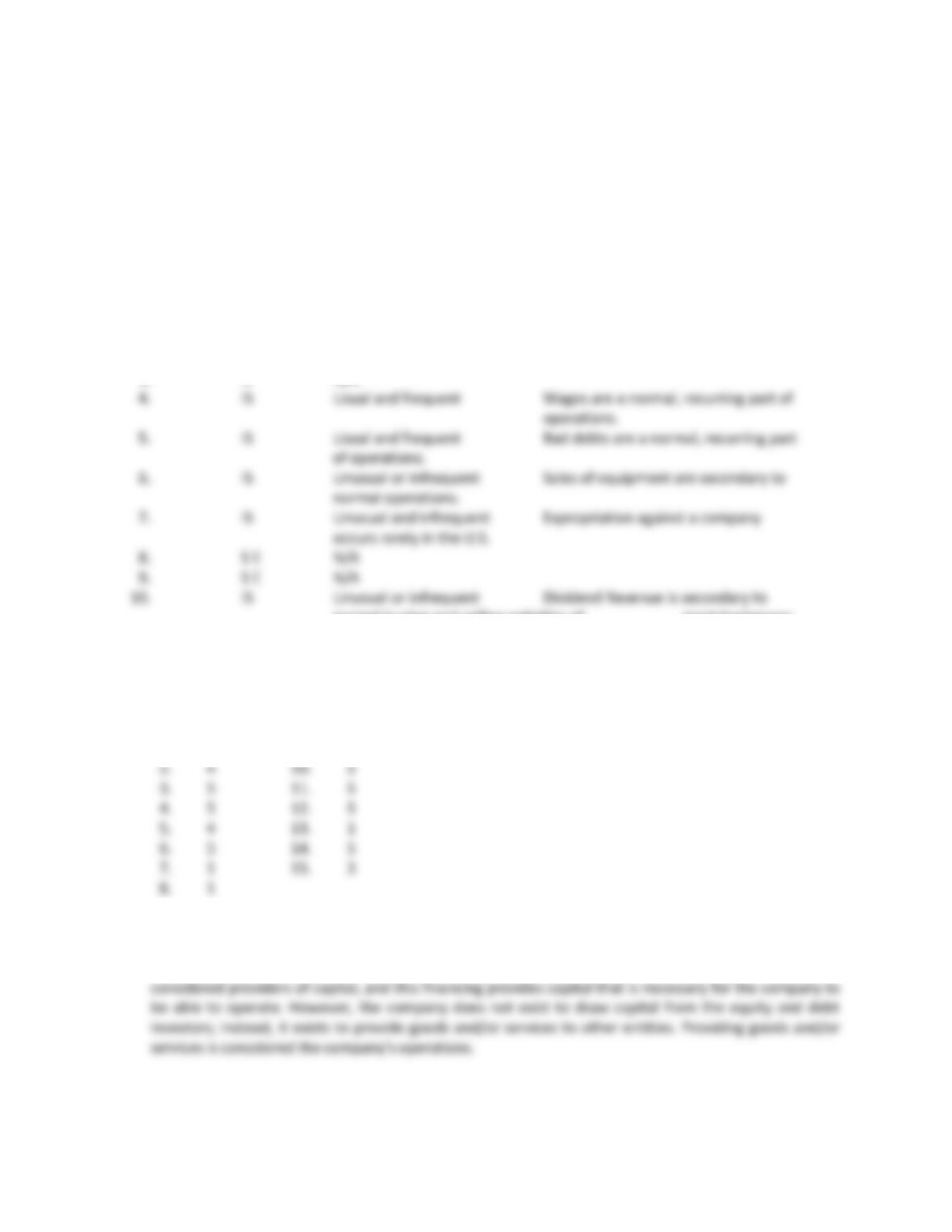
1. IS Other This is an example of a bookkeeping
entry without an underlying economic event. Some are
voluntary, some are involuntary.
2. N N/A
3. N N/A
normal buying and selling activities of most businesses.
11. IS Usual and frequent Cost of goods sold is part of normal
daily operations.
12. IS Usual and frequent Rent expense is part of normal
operations.
E13–2
a. 1. 1 9. 2
b. As the transactions move from 1 to 5, they move away from exchanges with owners toward exchanges
with third parties involving the company’s central, ongoing activities. Stockholders and creditors are
E13–3
a. (1) Financing
Smedley Company
Income Statement
For the Year Ended December 31, 2016
Fees earned …………………………..………………………………………………………………. $ 50,000
Expenses ……………………………………………………………………………………………… 24,000
Net income ……………………………………………………………………………………………. $ 26,000
b. Comprehensive Income = Change in Equity from Nonowner Sources
c. The two are equal because Smedley’s economic events/activities do not differ from those described in
the income statement.
E13–4
a. (1) Net income
Maximum Dividend = 20% $182,800
= $36,560
b. The bank requires restrictions on dividend payments to increase the probability that Morton
Manufacturing will have sufficient cash to meet its interest and principal payments. More stringent
restrictions on dividends decrease the amount that Morton Manufacturing can potentially pay out as
E13–5
a. Losses from equity investments: AT&T invested excess cash in the equity of other companies; the
value of these investments dropped during the course of the year;
b.
Year 1 Year 2 Year 3
Reported net income ($ in billions) $7.7 ($13) $1.9
Loss on equity investments 7.5 0.4 0.01
Each of these special items are not part of operating income, which represents the recurring activities of
the business. These special charges are one time gains or losses and so can mislead the users of financial
statements as to the future prospects of the company. The schedule above shows that the operating
E13–6
a. Cash (+A) ……………………………………………………………………………………… 625,000
E13–6 Concluded
Gain on Disposal of Business Segment (–Ga, –SE) ……………………………… 61,250*
Income Tax Liability (+L) …………………………………………………………… 61,250
b. Discontinued operations:
Income from operations of discontinued segment (net
E13–7
a. Mallory Services
Income Statement
For the Year Ended December 31, 2015
Income from continuing operations (before taxes) ………………. $ 950,000
Income tax expense ……………………………………………………….…. 332,500a
Income from continuing operations ……………………………………. $ 617,500
Discontinued operations:
Income earned by discontinued segment (net of
tax expense of $4,200)………………………………………………… $ 7,800b
Gain on disposal of discontinued segment (net of
E13–7 Concluded
b. Mallory Services
Income Statement
For the Year Ended December 31, 2015
Income from continuing operations (before taxes) …………………………………….. $ 962,000a
Income tax expense ……………………………………………………….……………………….. 336,700b
c. Sharon Sowers faces a number of trade-offs as she decides whether to complete the sale in 2015 or
2016. First, income is already positive and strong in 2015. The gain from the sale increases net income
by only $24,700. If Mallory Services expects a weaker 2016, it may be more beneficial to the income
statement to wait until 2016 in order to offset poorer performance. Also, by selling in 2015, recurring
E13–8
a. Carmich Industries
Income Statement
For the Year Ended December 31, 2015
Income from continuing operations (before taxes) ………………. $ 1,930,000
Income tax expense ……………………………………………………….…. 675,500a
Income from continuing operations ……………………………………. $ 1,254,500
E13–8 Concluded
Earnings persistence reflects the extent to which a particular dollar of earnings can be expected to
continue in the future. A user would expect the income from continuing operations of $1,254,500
to continue in the future, but interpret the income and gain from the discontinued division to
reflect a one-time increase in earnings that is not expected to be realized in the future.
b.
Carmich Industries
Income Statement
For the Year Ended December 31, 2015
Income from continuing operations (before taxes) ………………………………….. $ 1,955,000a
Income tax expense ……………………………………………………….…………………….. 684,250b
c. Rob Blandig faces a number of trade-offs as he decides whether to complete the sale in 2015 or 2016.
First, income is already positive and strong in 2015. The gain from the sale increases net income by only
$85,150, only 6.7%,. If Carmich Industries anticipates a weaker 2016, it may be more beneficial to the
income statement to wait until 2016 in order to offset poorer performance. Also, by selling in 2015,
E13–9
a. Net Sales is the revenue generated by selling products/services to customers. Operating expenses are
those charges that make the revenue possible. Operating income is the profitability associated with
the basic (recurring) operations of the company. Net cost of debt is the interest expense net of any
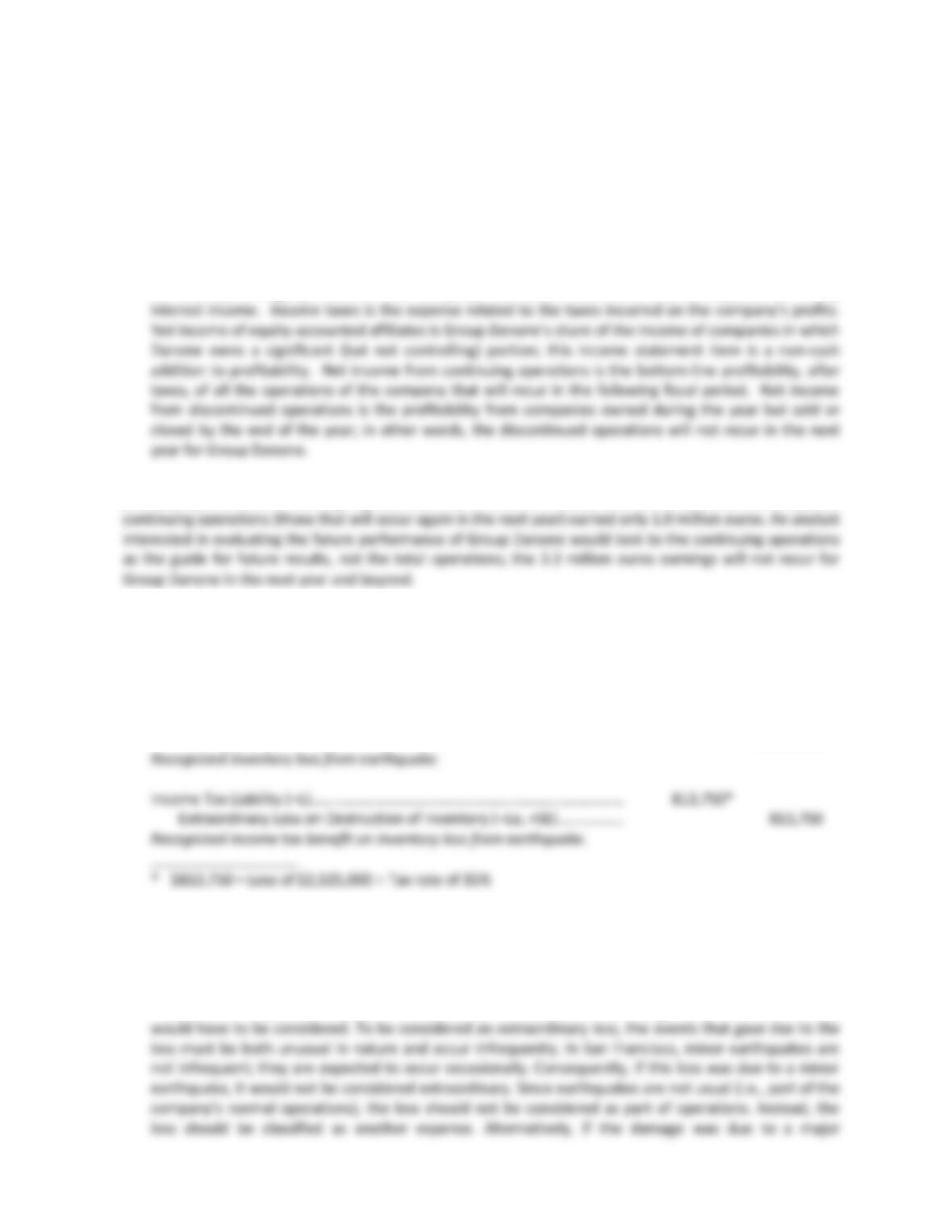
b. During the year Group Danone sold or closed operations that generated 3.3 million euros in
profitability; this level of earnings represented 76% of Danone’s total profits for the year, as the company’s
E13–10
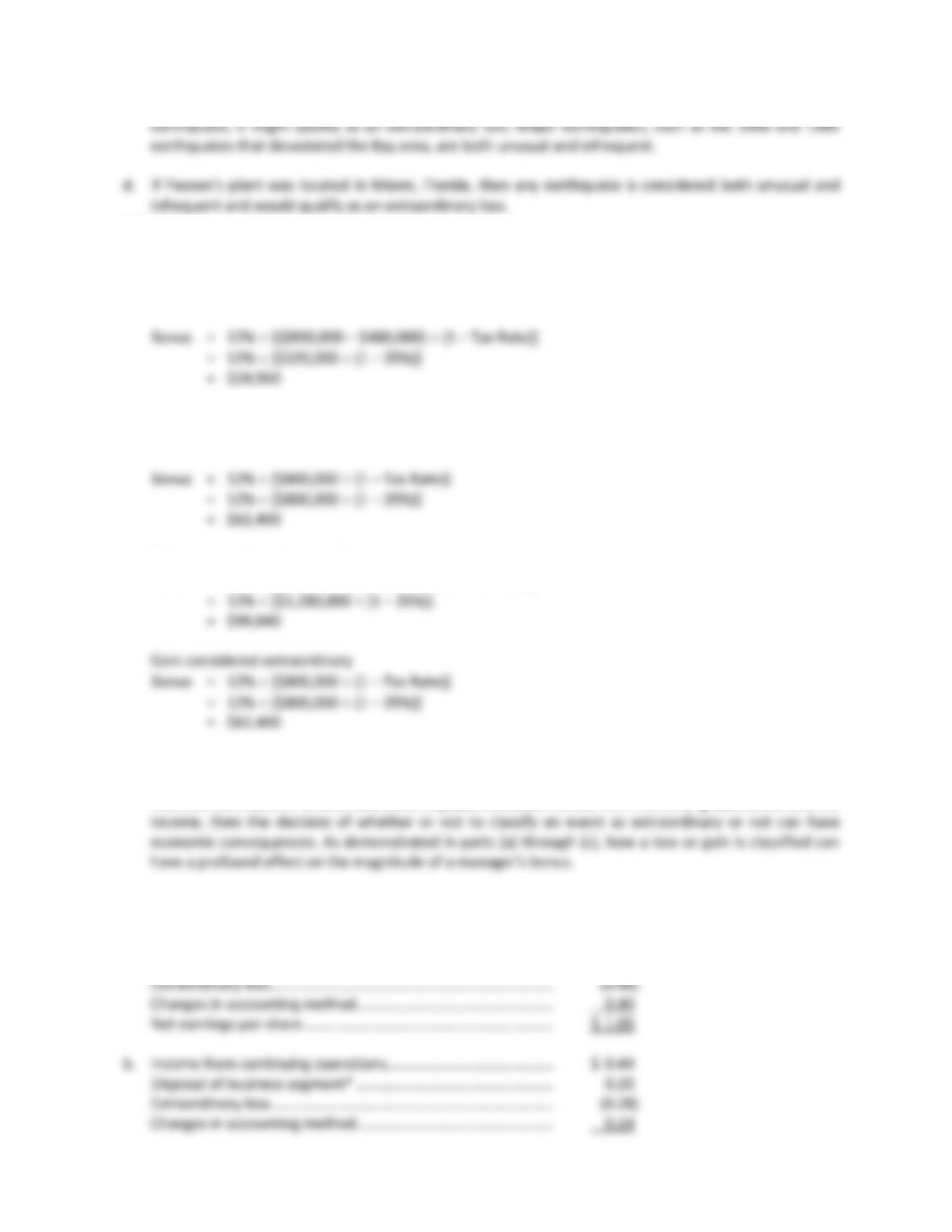
a. Loss on Destruction of Inventory (Lo, –SE)………………………………………… 2,325,000
Inventory (–A) …………………………………………………………………………. 2,325,000
Recognized inventory loss from earthquake.
b. Extraordinary Loss on Destruction of Inventory (Lo, –SE) ……………………. 2,325,000
Inventory (–A) …………………………………………………………………………. 2,325,000
c. If the earthquake is considered both an unusual and infrequent event, then the loss should be classified
as an extraordinary loss. However, if the loss is considered unusual or infrequent, but not both, then it
should be classified as other revenues and expenses. If the loss is considered both usual and frequent,
then it should be disclosed as part of operations.
Since Paxson Corporation’s plant is located in San Francisco, then the magnitude of the earthquake
E13–11
a. If a lawsuit is considered unusual but not infrequent, then it would be classified under other expenses
and losses. Consequently, the loss from the lawsuit would be used to compute net income from
continuing operations.
b. If the loss from the lawsuit is considered extraordinary, then the loss would not be used to compute net
income from continuing operations.
c. Gain not considered extraordinary
Bonus = 12% [($800,000 + $480,000) (1 – Tax Rate)]
d. Income figures are often used as the basis for awarding incentive compensation to managers, or
included in ratios which are, in turn, incorporated into debt covenants. If the income figures included in
incentive contracts or in debt covenants stipulate between income from continuing operations and net
E13–12
a. Income from continuing operations………………………………….. $ 0.73
Disposal of business segment* ………………………………………… 0.33
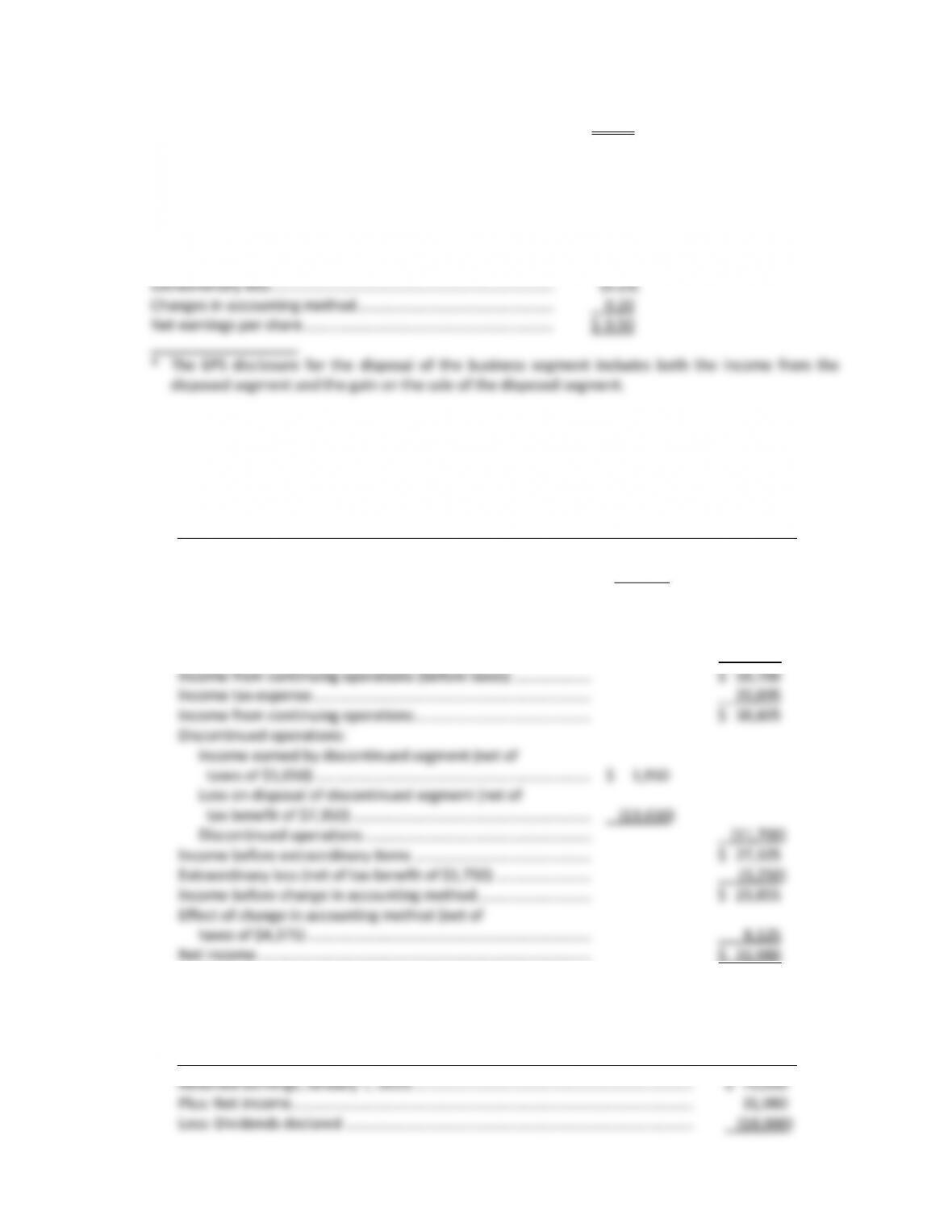
Net earnings per share ……………………………………………………. $ 0.60
c. Income from continuing operations………………………………….. $ 0.37
Disposal of business segment* ………………………………………… 0.16
E13–13
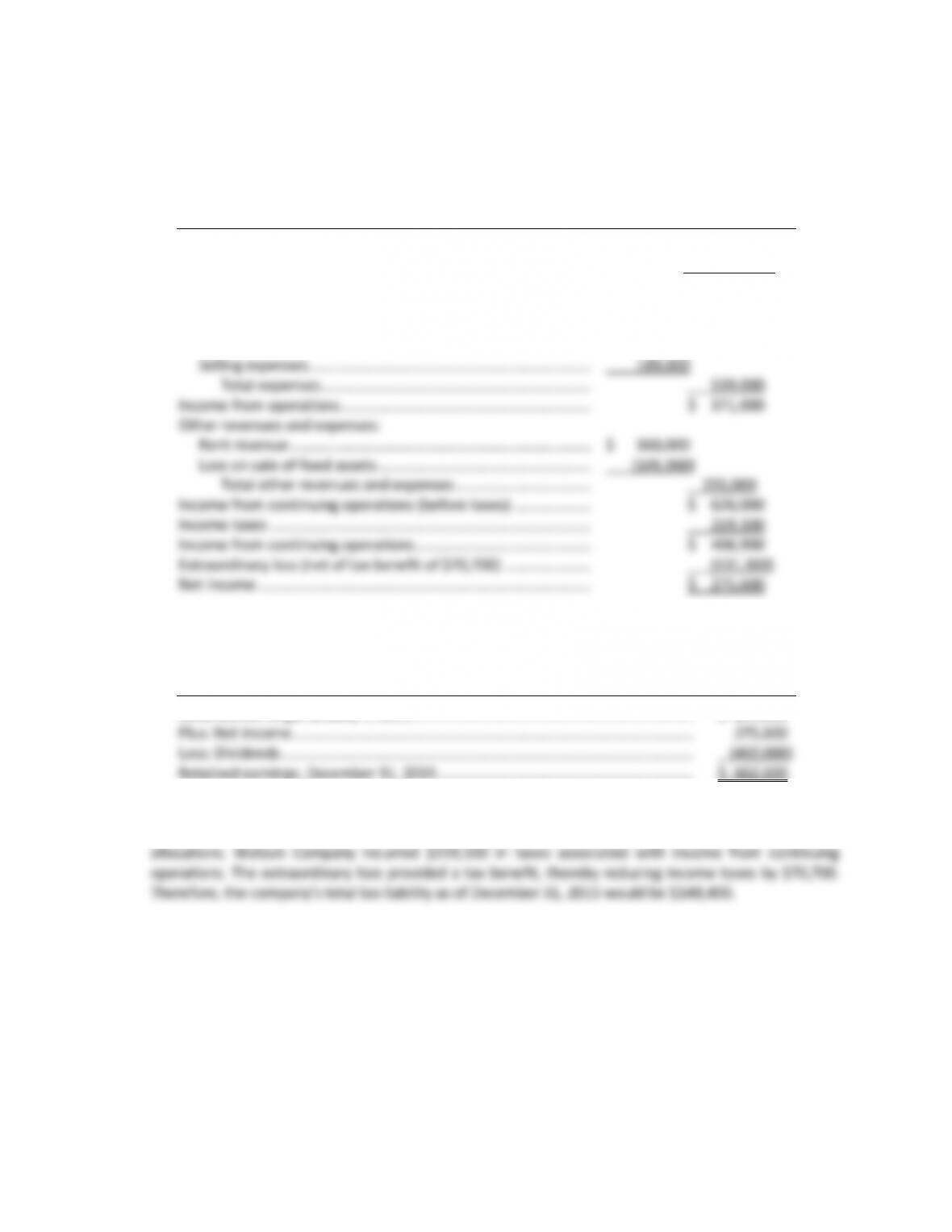
a.
Rothrock Consolidated
Income Statement
For the Year Ended December 31, 2015
Revenue:
Operating revenues ……………………………………………………… $ 87,000
Total revenue ………………………………………………………………. $ 87,000
Expenses:
Operating expenses ……………………………………………………… 32,500
Other revenue …………………………………………………………………. 5,200
b.
Rothrock Consolidated
Statement of Retained Earnings
For the Year Ended December 31, 2015

E13–14
a.
Watson Company
Income Statement
For the Year Ended December 31, 2015
Sales revenues …………………………………………………………………. $1,385,000
Cost of goods sold ……………………………………………………………. 475,000
Gross profit ……………………………………………………………………… $ 910,000
Operating expenses:
Administrative expenses ………………………………………………. $ 100,000
Depreciation expense …………………………………………………… 250,000
b.
Watson Company
Statement of Retained Earnings
For the Year Ended December 31, 2015
Retained earnings, January 1, 2015…………………………………………………………… $ 847,000
c. If Watson Company had no tax liability as of January 1, 2015, and made no tax payments during 2015,
then the company‘s tax liability as of December 31, 2015 would equal the sum of the intraperiod tax
E13–15
a.
Kennington Company
Income Statement
For the Year Ended December 31, 2015
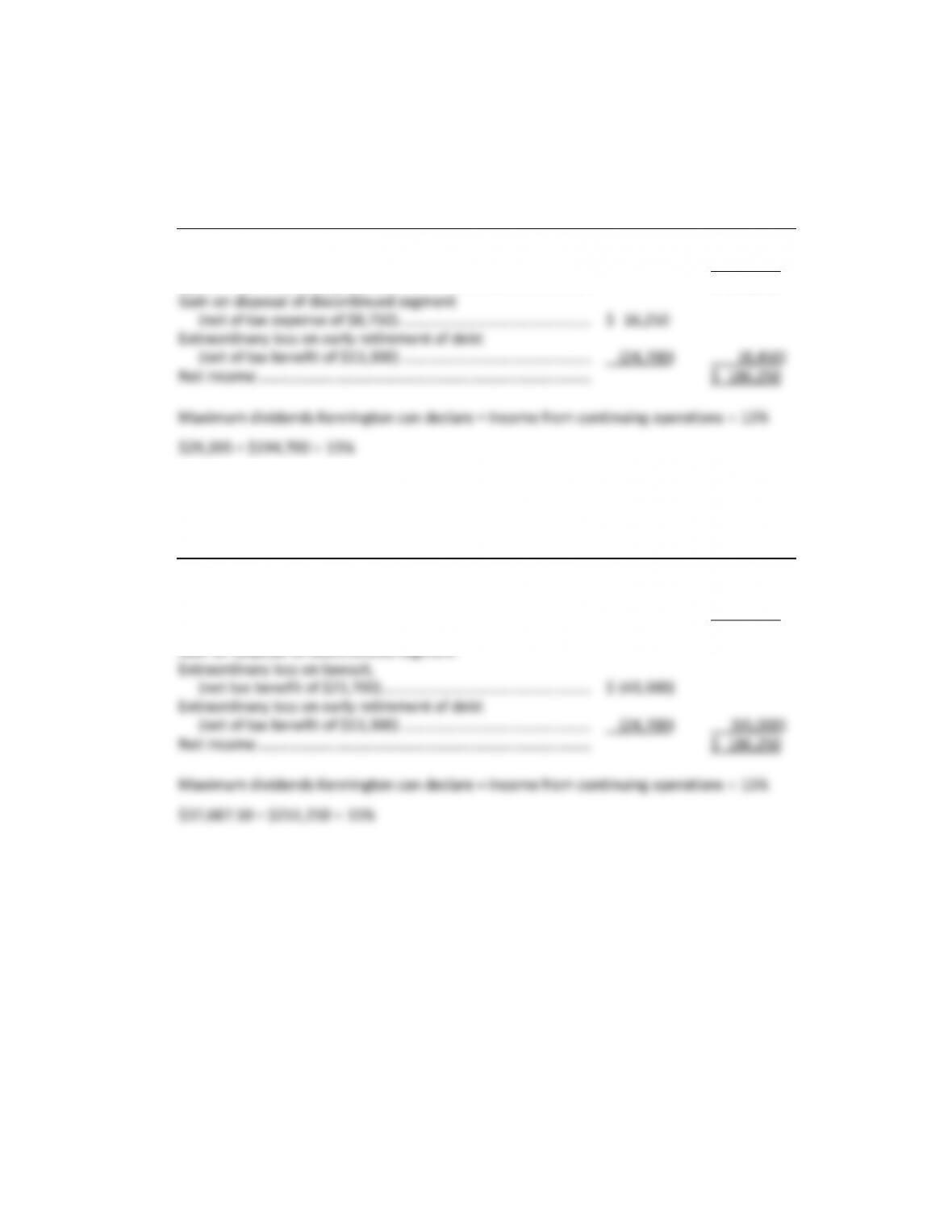
Income from continuing operations (after taxes) …………………. $ 235,000
Loss on lawsuit (net of tax benefit of $21,700) …………………….. (40,300)
Income from continuing operations ……………………………………. $ 194,700
b.
Kennington Company
Income Statement
For the Year Ended December 31, 2015
Income from continuing operations (after taxes) …………………. $ 235,000
Gain from sale of short-term investment
(net of tax expense of $8,750) ……………………………………….. 16,250
Income from continuing operations ……………………………………. $ 251,250
Gain on disposal of discontinued segment
E13–16
a.
Madigan International
Income Statement
For the Year Ended December 31, 2015
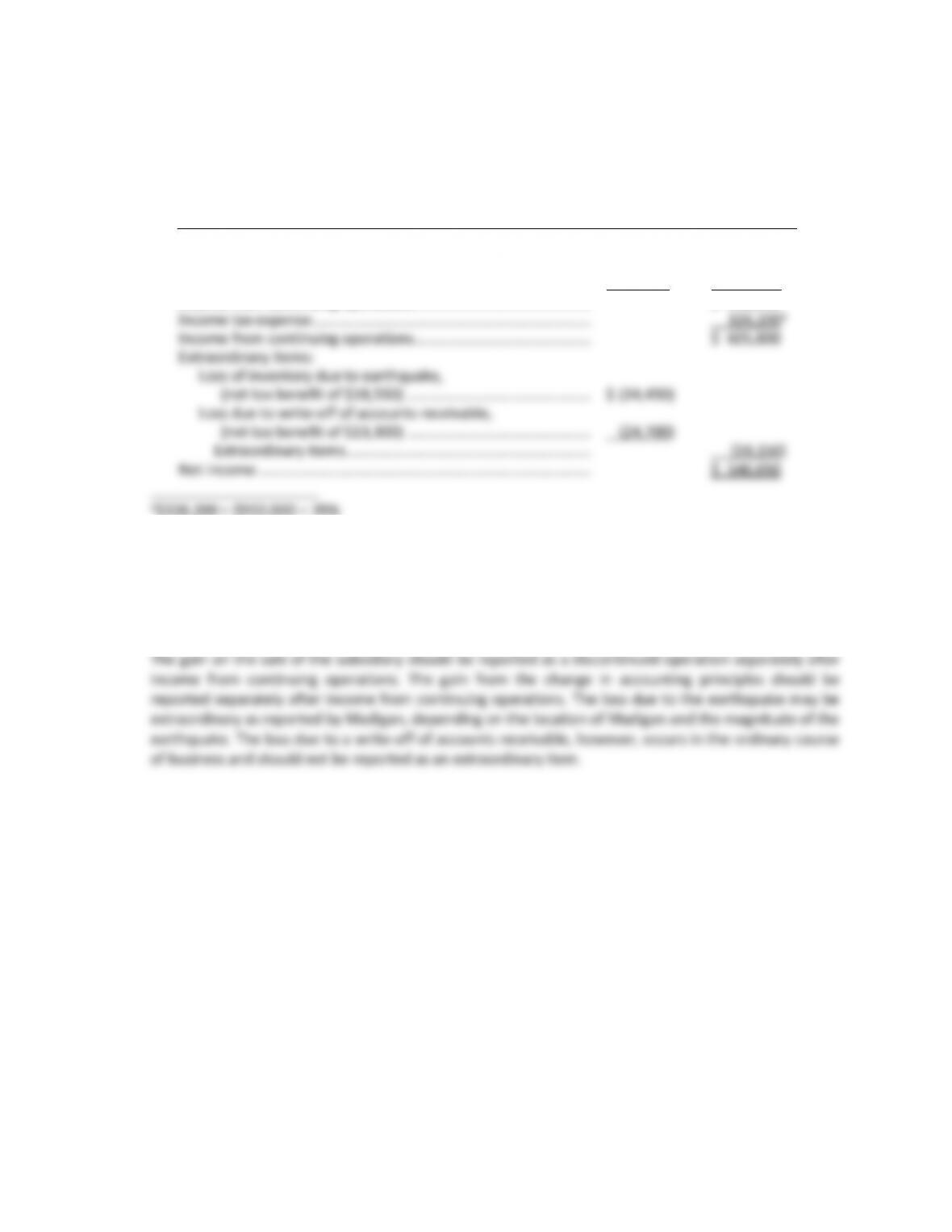
Income from continuing operations (before taxes) ………………. $ 865,000
Gain on sale of subsidiary ………………………………………………….. $ 42,000
Gain due to change in accounting principle …………………………. 25,000 67,000
Income from continuing operations ……………………………………. $ 932,000
a$326,200 = $932,000 35%
b. Madigan’s accountants are not presenting income statement items in accordance with generally
accepted accounting principles. Instead, they are presenting all the gain items as part of income from
continuing operations and all the loss items as extraordinary. The intention is to represent to investors
and other users a higher income from continuing operations than actually exists. The greater is income
from continuing operations, the more income investors and users expect will exist in the future.
E13–16 Concluded
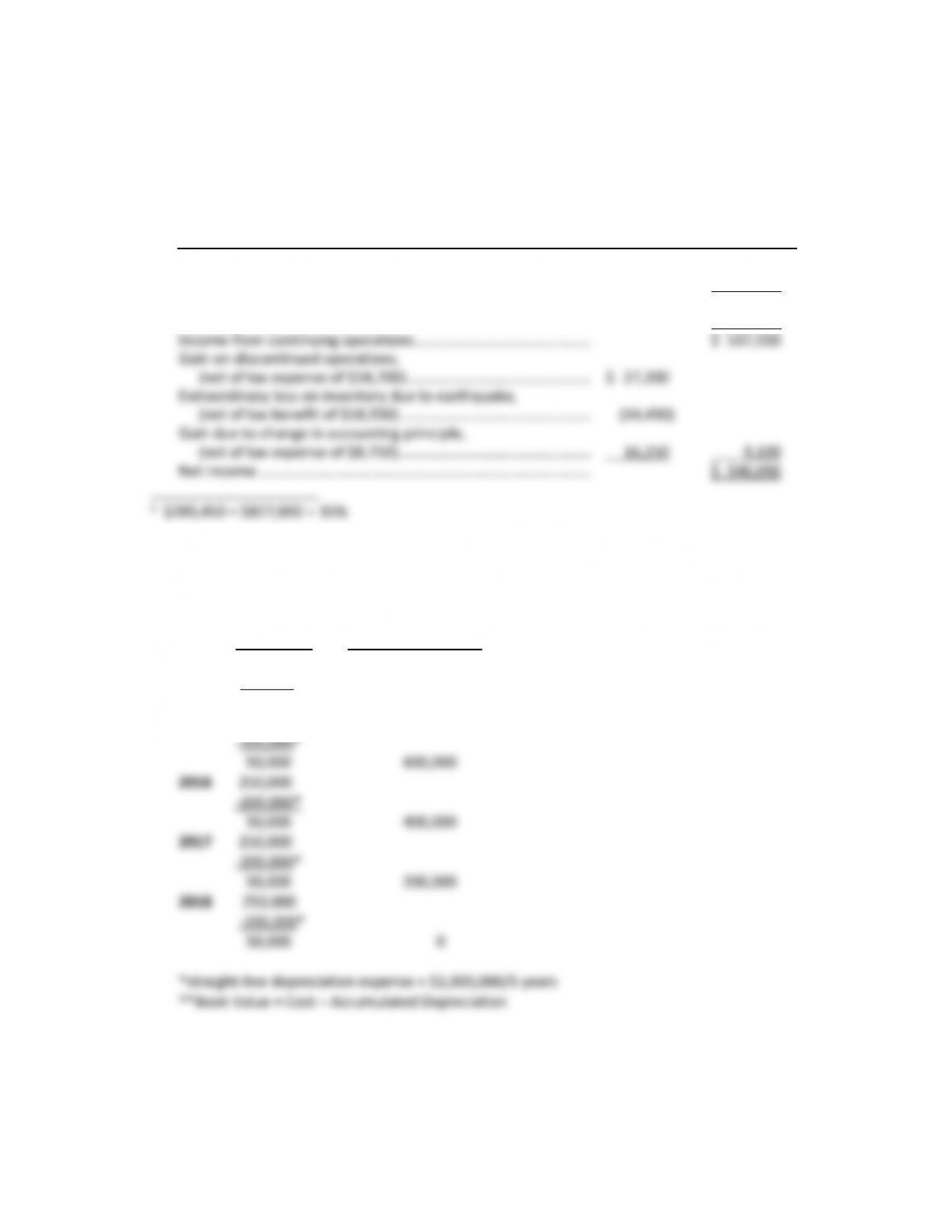
The income statement that is consistent with GAAP follows.
Madigan International
Income Statement
For the Year Ended December 31, 2015
Income from continuing operations (before taxes) ………………. $ 865,000
Loss due to write-off of accounts receivable ……………………….. (38,000)
Income from continuing operations ……………………………………. $ 827,000
Income tax expense …………………………..……………………………… 289,450a
c. Madigan’s original treatment makes future income look more favorable. Stock prices tend to follow a
multiple of earnings, so higher future income would lead to a higher future stock price.
E13–17
a. Net Income Balance Sheet Value
2014 250,000
-200,000*
50,000 800,000**
2015 250,000
E13–17 Concluded
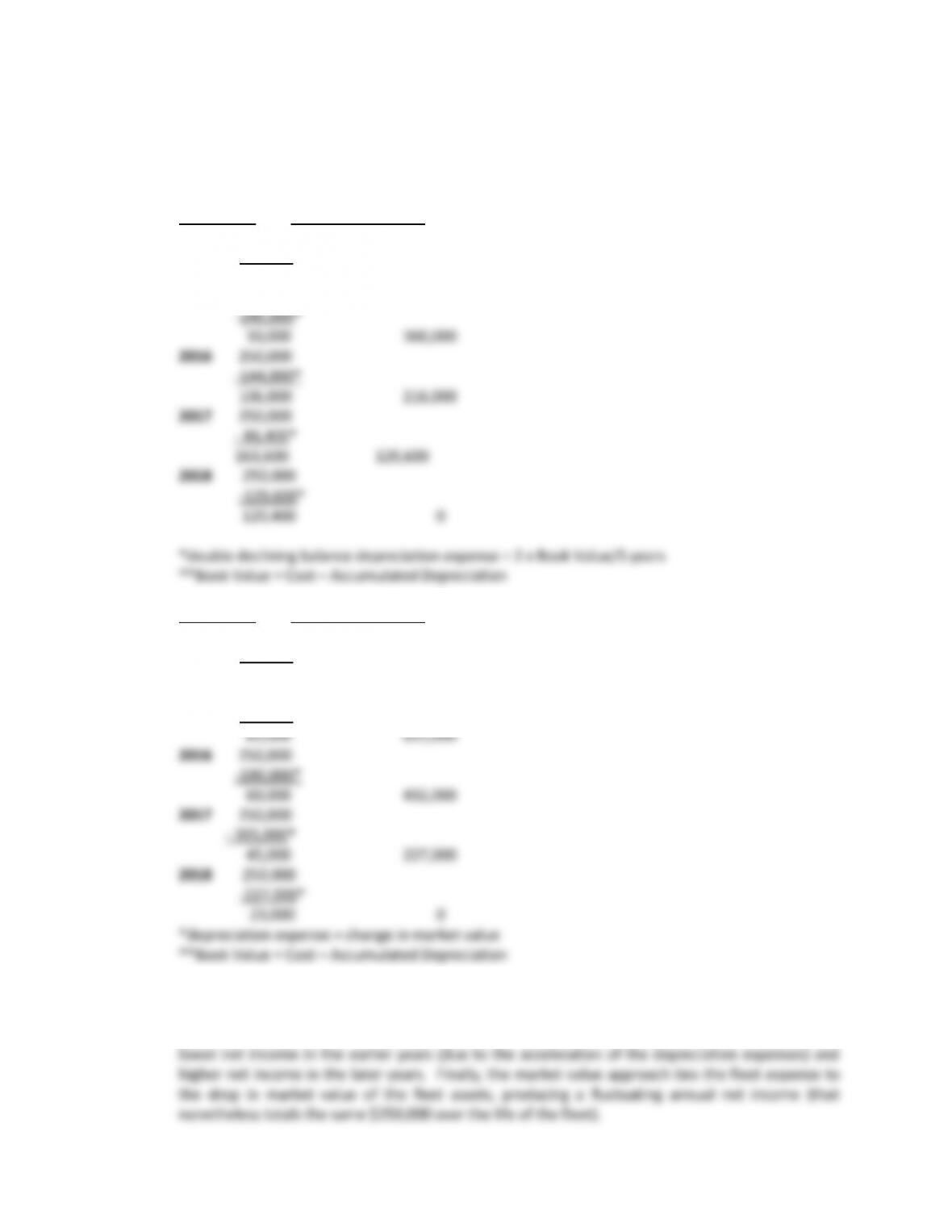
b. Net Income Balance Sheet Value
2014 250,000
-400,000*
(150,000) 600,000**
2015 250,000
c. Net Income Balance Sheet Value
2014 250,000
–210,000*
40,000 790,000**
2015 250,000
–168,000*
d. All three approaches yield the same total profitability over five years (each method totals $250,000
in profitability), but the methods allocate those profits differently. The straight-line method
produces equal profits of $50,000 per year, while the double-declining balance method results in
PROBLEMS
P13–1
a. 1. Operating
2. Operating
b. 1. Normal and recurring
2. Normal and recurring
c. Items (2), (3), (5), (6), (7), and (9) would all be disclosed on the income statement as follows.
(2) The $500,000 would be disclosed as operating revenues, and the $375,000 would be disclosed as
cost of goods sold, which is an operating expense.