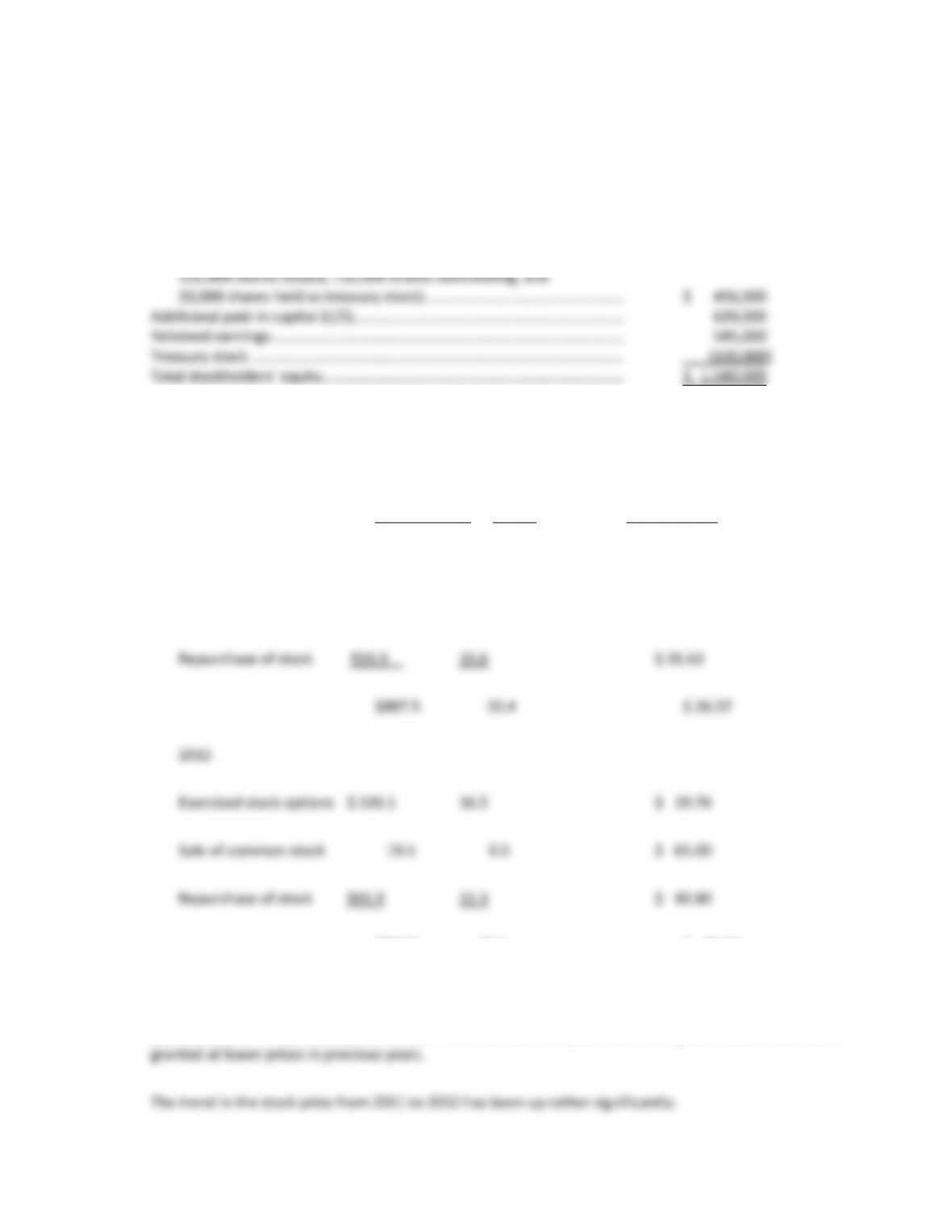
P12–7 Concluded
Stockholders’ equity:
Common stock ($3 par value, 1,300,000 shares authorized,
P12–8
a. 2011 Dollar Amount / Shares = Average price
Exercised stock options $312.5 17.3 $ 18.06
Sale of common stock 19.1 0.5 $ 38.20
$847.5 29.1 $ 29.12
b. The common stock shares were issued at a higher price than the options. Stock options typically have a
life of 5-10 years. So it is very likely that the stock options that were exercised this year were granted in
previous years. If the stock price has risen over the last few years then the options would have been
P12–9
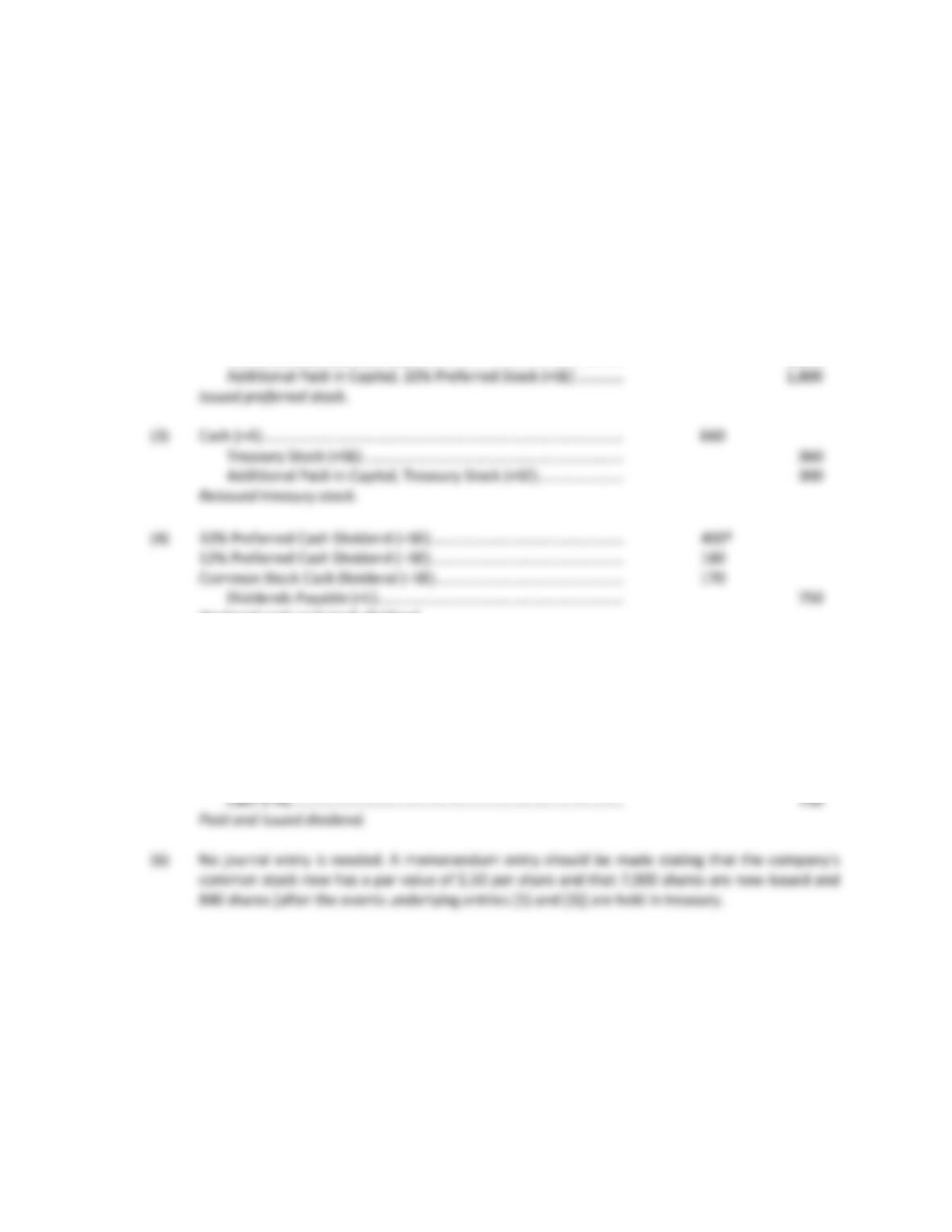
a. (1) Treasury Stock (–SE) ……………………………………………………………. 1,000
Cash (–A) ……………………………………………………………………… 1,000
Purchased treasury stock.
(2) Cash (+A) ……………………………………………………………………………. 3,800
Preferred Stock (10%) (+SE) ……………………………………………. 2,000
Declared cash and stock dividend.
a Cumulative preferred dividends are paid first. Since no dividends have been paid since 2013,
dividends in arrears in the amount of $200 (2 years of 10% of par value) on the 10% cumulative
Preferred stock must be paid before any dividends can be paid on any other shares. The new shares
of the 10% issue also receive dividends on a priority basis. The $750 payment goes to the cumulative
shares first, with the remainder spread over the other preferred issue and then the common shares.
(5) Dividends Payable (–L) …………………………………………………………. 750
P12–9 Concluded
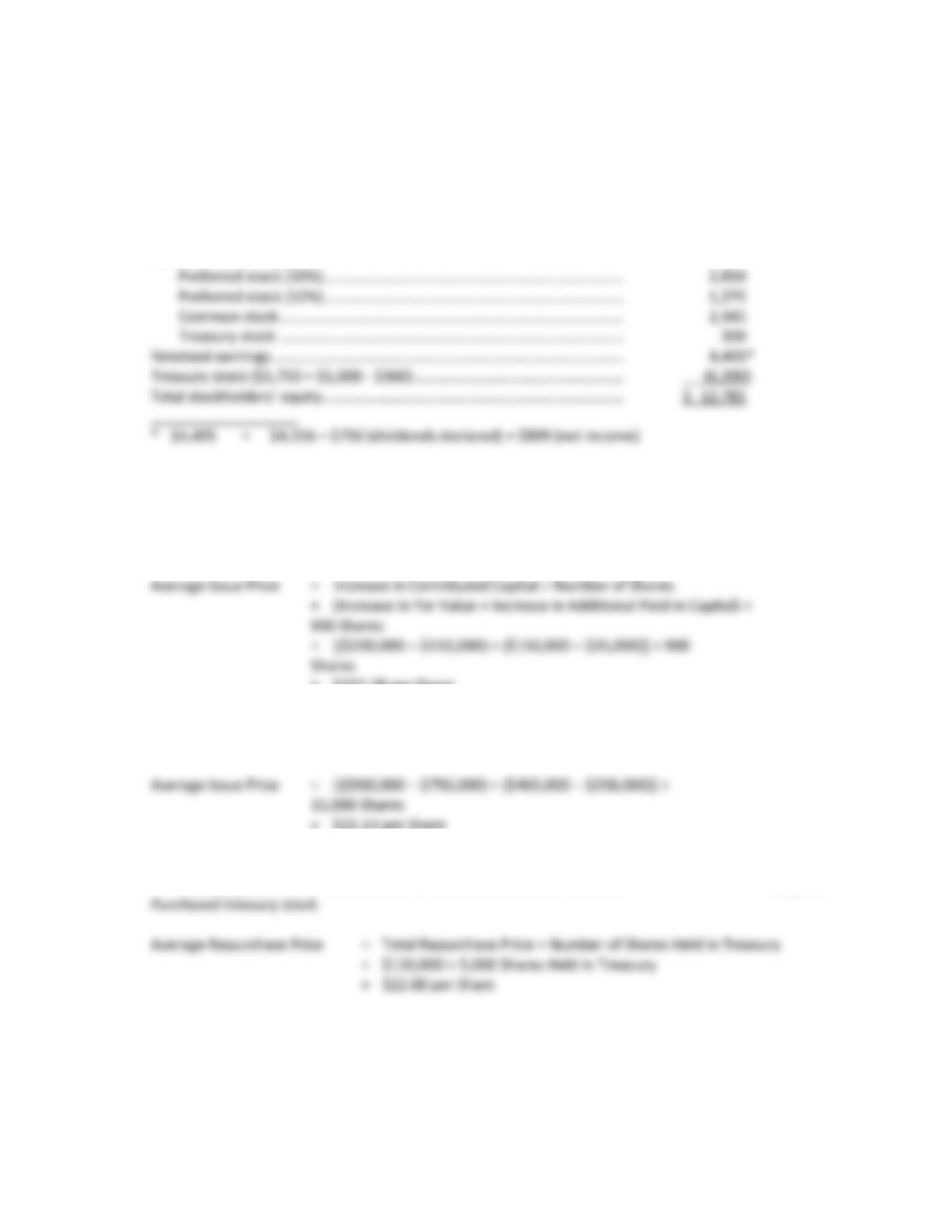
b. Preferred stock (10%, $10 par value, cumulative) ……………………………… $ 3,000
Preferred stock (12%, $10 par value, noncumulative) ………………………… 1,500
Common stock ($0.50 par value, 10,000 shares authorized,
7,000 shares issued, and 840 shares held in treasury) ………………….. 3,500
Additional paid-in capital:
P12–10
a. Number of Shares Issued = Increase in Par Value ÷ Par Value per Share
= ($200,000 – $110,000) ÷ $100 per Share
= 900 Shares
= $227.78 per Share
b. Number of Shares Issued = ($900,000 – $750,000) ÷ $10 per Share
= 15,000 Shares
= $21.13 per Share
c. Treasury Stock (–SE) ………………………………………………………………………. 110,000
Cash (–A) ………………………………………………………………………………… 110,000
P12–10 Concluded
d. Book value equals total common stockholders’ equity divided by the total number of common shares
outstanding. To determine total common stockholders’ equity prior to the acquisition of the treasury
stock, the value of the 5,000 shares of treasury stock must be added back to total stockholders’ equity,
per share by $0.03.
P12–11
a. Number of Shares Issued = Change in Total Par Value ÷ Par Value per Share
= ($110,000 – $70,000) ÷ $10 per Share
= 4,000 Shares
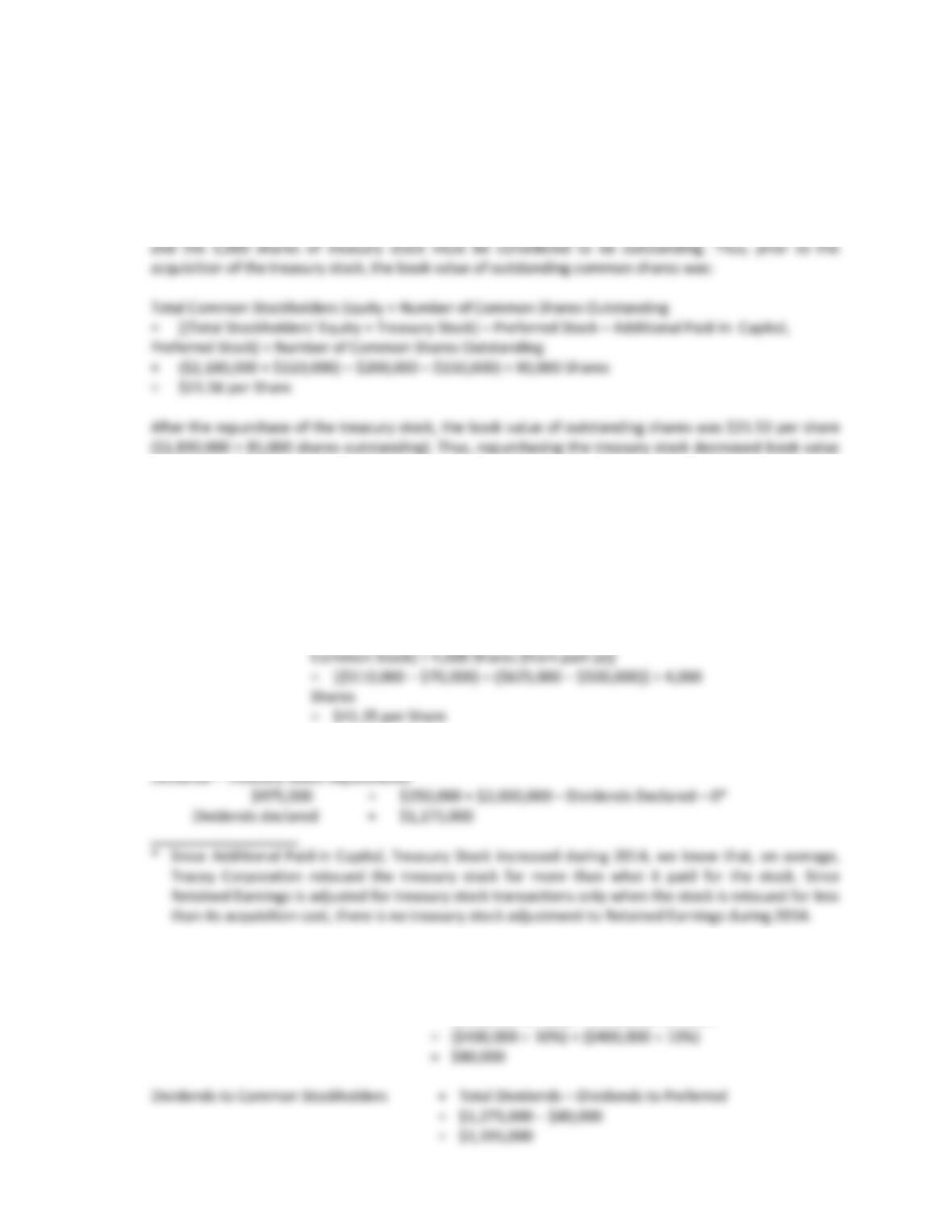
b. Average Issue Price = Cash Received ÷ Number of Shares Issued
= [Change in Total Par Value + Change in Additional Paid-In Capital,
c. Ending Retained Earnings = Beginning Retained Earnings + Net Income – Dividends
d. Total dividends declared = $1,275,000 [from Part (c)]
Dividends to Preferred Stockholders = Dividends in Arrears + Current Dividends =
Dividends for 2013 + Dividends for 2014
P12–11 Concluded
e. Treasury Stock (–SE) ………………………………………………………………………. 105,000
Cash (–A) ………………………………………………………………………………… 105,000
Purchased treasury stock.
f. Cash (+A) ……………………………………………………………………………………… 90,000
* The 300 shares reissued is computed as follows:
1. Cost of shares = $105,000 ÷ 1,500 shares = $70 per share
2. Number of shares reissued = Change in treasury stock balance ÷ $70 per share
= ($105,000 – $84,000) ÷ $70 per share
= 300 shares
P12–12
a. (1) Cash (+A) ……………………………………………………………………………. 750,000
Common Stock (+SE) ……………………………………………………… 300,000
Additional Paid-in Capital, Common Stock (+SE) ……………….. 450,000
Issued common stock.
(2) Stock Dividend (–SE) ……………………………………………………………. 90,000*
Common Stock (+SE) ……………………………………………………… 30,000
(4) Treasury Stock (–SE) ……………………………………………………………. 375,000
Cash (–A) ……………………………………………………………………… 375,000
Purchased treasury stock.
(5) Cash (+A) ……………………………………………………………………………. 135,000
P12–12 Concluded
(7) Cash (+A) ……………………………………………………………………………. 80,000
Treasury Stock (+SE) ……………………………………………………… 66,640*
Additional Paid-In Capital, Treasury Stock (+SE) ………………… 13,360
(9) Dividend Payable (–L) ……………………………………………………….…. 50,000
Cash (–A) ……………………………………………………………………… 50,000
* $16,660 = 2,000 shares Adjusted acquisition price of $8.33 per share
b. Common stock ($2 par value, 1,000,000 shares authorized,
345,000 shares issued, and 20,000 shares held in treasury) ………….. $690,000
Additional paid-in capital:
Common stock ………………………………………………………………………… 1,470,000
P12–13
a. Only investors of shares that are both issued and outstanding are eligible to vote to elect a board of
directors. If the current board could reduce the number of shares held by investors other than
P12–13 Concluded
If the current board could consolidate its ownership so that it controlled 50% plus one share of the
2) – 1 share]. Since 260,000 shares are currently held by non-board investors, and the non-board
members can control a total of only 139,999 shares (279,999 shares – 140,000 shares held by board
members), the company would have to repurchase 120,001 shares of the company’s stock.
b. The company will need to pay $50 per share for 120,001 shares [from part (a)]. Consequently, the
stock
d. Debt/Equity Ratio = Total Liabilities ÷ Total Stockholders’ Equity
Before
$1,250,000 ÷ ($8,000,000 in Common Stock + $6,320,000 in Retained Earnings) = .087
After
$4,000,000 borrowed.
P12–14
a. Loss on Write-Down of Fixed Assets (Lo, –SE) …………………………………… 50,000
Fixed Assets (–A) ……………………………………………………………………… 50,000
Wrote down obsolete fixed assets.
b. Alternative 1
Cash (+A) ……………………………………………………………………………………… 650,000
Current Assets (–A) ……………………………………………………….…………. 200,000
Fixed Assets (–A) ……………………………………………………………………… 450,000
Liquidated assets.
Fixed Assets (–A) ……………………………………………………………………… 450,000
Liquidated assets.
Cash Dividends (–SE) ……………………………………………………………………… 400,000
Cash (–A) ………………………………………………………………………………… 400,000
Declared and paid cash dividend.
P12–14 Concluded
Alternative 4
Cash (+A) ……………………………………………………………………………………… 650,000
Current Assets (–A) ………………………………………………………………….. 200,000
c. In the event of a liquidation, creditors have the first claim on the company’s assets. Consequently,
obligations to creditors should be settled in full before the stockholders receive any residual assets. In
alternatives (2) and (4), the board of directors has proposed circumventing the law and has planned to
ISSUES FOR DISCUSSION
ID12–1
a. A 100% stock dividend effectively means that the number of shares will be doubled. Therefore, if 149.5
b. Stock Dividend (–SE) …………………………..……………………………………….. 149,500a
Common Stock (+SE) …………………………………………………………….. 149,500
c. Total Value of Hershey = Number of Shares Outstanding Market Value per Share
= 149.5 Million Shares $46 per share = $6.877 Billion
Post dividend Value/Share = Total Value of Hershey ÷ Number of Shares Outstanding
= $6.877 Billion ÷ 299 Million Shares = $23 per Share
d. Prior to the stock dividend, Mr. Jones owned .669% of Hershey (1 million shares ÷ 149.5 million shares
outstanding), and Mr. Jones’ investment was worth $46 million (1 million shares $46 market value per
share). After the stock dividend, Mr. Jones would own 2,000,000 shares, and the total number of shares
ID12–2
There are two general situations that would lead a company to cut its dividend. The first scenario is when a
ID12–3
Since the stock price of a company is affected by the expected future cash inflows due to dividend
payments and capital appreciation, the price of Philip Morris (now known as Altria Group) stock rose in
ID12–4
a. Companies could use their cash to invest in the latest technology to improve the productivity of their
manufacturing operations. Companies could use their excess cash to perform research and
future success, the shareholders benefit from the improve long term prospects of the company.
b. Fewer shares in the market would imply that the market capitalization per share is higher, driving up
the stock price. If the company’s performance (profitability, cash flow, leverage, etc.) is not changed
reducing the number of shares outstanding is an artificial change as the company itself is no different.
c. A company purchasing its own stock is in essence no different than an investor purchasing stock in the
company. “Buy low, sell high” makes sense for any investor. If, due to current market levels, the stock
price is high, there is always the risk that the buyer—the company in this case—would be buying high
ID12–5
a. A hybrid security carries some of the properties of debt and some of the properties of equity. A
determination must be made as to which properties dominate the characteristics of the security. If
b. Equity securities typically carry more risk than debt securities but consequently offer higher rates
of return. If an investor was interested in accepting more risk than offered by a debt security, but
required more of a return to justify that risk, then the investor might have an interest in a hybrid
security. If the risk profile of a pure equity security was too great for the investor, but the returns
offered by debt securities insufficient for the investor’s needs, then a hybrid security would offer a
interest payments required each year under a debt issue.
c. Characteristics associated with debt include a higher priority toward receiving payments in case of a
company liquidation and some type of fixed requirement of periodic payments. Characteristics
ID12–6
The case describes a typical scenario that usually occurs while enforcing the debt covenant restrictions.
Many times such agreements or decrees explicitly specify how changes in the key performance indicators
will be treated due to an unanticipated change in the accounting standards. In the current case it is not
P12–6 Concluded
a federal government representative, he has to ensure that the terms of the decree are complied with.
From the perspective of a resident of Bloomington, Indiana, Westinghouse should place $325 million in an
ID12–7
c. An investor can make a return through 1) capital appreciation (the stock moving up in value), 2) receipt
of cash dividends from the company, or 3) both capital appreciation and dividends.
d. Companies that pay dividends are not necessarily under the same pressure to improve earnings and
cash flow as companies who opt not to pay dividends. Investors who are confident they can rely on a
steady stream of dividends are less likely to pressure management to take steps to continually boost
ID12–8
a. Book value of a stock is simply the equity on the balance sheet divided by the number of equity shares
outstanding. This figure is driven by Generally Accepted Accounting Principles. Market value is the
ID12–8 Concluded
c. Two reasons might explain the high offer for Dow Jones. First, News Corporation might see some
specific synergies of operation between its media businesses and those of Dow Jones (including the
Wall Street Journal and the popular WSJ website); the combined businesses might be worth more to
emerged, the $60 strategy may have been a sound approach to the acquisition.
d. External events (such as technological change) can cloud the future for companies and, since stock
prices are driven by valuing a company’s future, affect the stock valuation. When events beyond the
control of management change the prospects for a business, the market will react by pricing in those
ID12–9
a. “Net” proceeds mean the actual cash received by the company after commissions to underwriters
and expenses are paid. “Gross” proceeds would equal all the cash paid by investors buying the
offered shares.
b. Dividing the proceeds by the number of shares issued indicates that the stock price has been
ID12–10
a. Both Rhodia and Segway issued equity because of losses that would be evident on the Income
Statement. The influx of funds would be evident in the Financing Activities section of the Statement of
b. When companies issue new stock, the concept of ownership dilution must always be considered. If
Aventis wants to maintain its 15.3 percent ownership of Rhodia, it must purchase 15.3 percent of the
into the new offering.
c. Since both companies are experiencing profitability problems, before purchasing additional equity in
the companies, a sound investor would need to understand the steps taken by management to correct
ID12–11
a. A 4:1 stock split means that the corporation will replace every share of outstanding stock with 4 shares
of the stock. Because the corporation is simply splitting the ownership shares into smaller pieces,
b. The stock market often views the declaration of a stock split as a positive signal about the corporation.
For example, the market often perceives a stock split as a signal from management that they believe
that they can maintain the price of the stock despite the stock split. In addition, some companies
c. Theoretically, the value of a company’s stock equals the present value of the cash flows the stock
market expects an investor to generate from an equity investment in the company. Any information
ID12–12
a. When a stock price is discussed in terms of a multiple of earnings, say 45 times, it simply means
that the market price per share is 45 times the size of the earnings per share. Or, every penny of
b. A volatile market will challenge a company that is intent on repurchasing its own shares. As with
buyback program will be paying many different prices (some high, some low) for the shares it
repurchases.
c. Stock repurchases will reduce the company’s cash balances (affecting both liquidity and solvency)
on the other hand, the stock is re-issued for a higher price, then an increase in equity balances will occur.
d. Borrowing to repurchase shares has a double effect on a company’s leverage. The borrowing, of
e. Reissuing Treasury Stock is considered to be a capital transaction and, as such, does not affect a
ID12–13
a. Stock-based compensation expense is the expense related to the granting (and subsequent
exercise) of stock options to employees. If an employee is given the option to purchase shares of
b. As the shares are issued (or re-issued from treasury), the statement of stockholders’ equity must
c. If the options were not considered an expense, Microsoft’s net income would have been
considerably higher in the years shown, so the expense is definitely material to the company. Net
d. Many companies resisted the expensing of options due to the negative effect the move would have
on earnings. Many start-up and technology companies relied heavily on stock options for
ID12–14
The Statement of Stockholders’ Equity for Emerson Electric for three years is shown at the end of Chapter
12 in the textbook. Under the Retained Earnings section, the dividend history for 2010 – 2012 can be seen.
ID12–15
a. Companies can spend their cash balances on a number of areas: they can expand physical capacity,
they can acquire other businesses, they can invest in new technologies, they can pay cash
b. HP and Apple have been very successful companies, using cash balances to acquire other
c. Companies can create wealth for shareholders by building and running successful businesses
ID12–16
a. Net income is the difference between revenue and expenses for a given time period.
Comprehensive income includes net income but also includes any other changes to shareholders’
exchange rates).
b. Comprehensive income is for a given time period, such as a year, while accumulated other
comprehensive income is a running total of past comprehensive incomes. The difference between
c. Under U.S. GAAP, the information must be provided as either a separate statement or part of the
ID12–17
a.
As of 12/31/2012:
Liabilities ÷ Total Assets = 23.5%
b. Common Stock: 21 billion shares authorized and 654.874 million shares issued and outstanding.
c. Other than shares repurchased in an acquisition, the company spent no cash over the last three years
on either dividends or share buybacks.
j. Google’s accumulated other comprehensive income as of 12/31/2012 was $538 million. This balance
consists primarily of unrealized gains on available-for-sale securities. Comprehensive Income was
$10,999 million (slightly higher than net income of $10,737 million).