1
CHAPTER 12
STOCKHOLDERS’ EQUITY
BRIEF EXERCISES
BE12–1
a. 38.4% of net income was paid in dividends during the year ($1,743/$4,535).
b. The issuance of common stock affected the basic accounting equation by increasing assets (cash) and
BE12–2
a. The number of shares outstanding after the split would be 194 million shares (97 million x 2) and the
price per share would be approximately $50 ($100/2).
b. The company’s overall value or market capitalization is $9.7 billion ($50 x 194 million shares). The
BE12–3
a. During 2010 the company paid an average of $30.21 per share in its repurchase program ($2,961/98).
b. During 2011 the company paid an average of $35.54 per share in its repurchase program ($4,513/127).
c. With no information regarding 2013 treasury purchases, the balance in the treasury stock account will
be $33,809 ($35,009 – $1,200) .
EXERCISES
E12–1
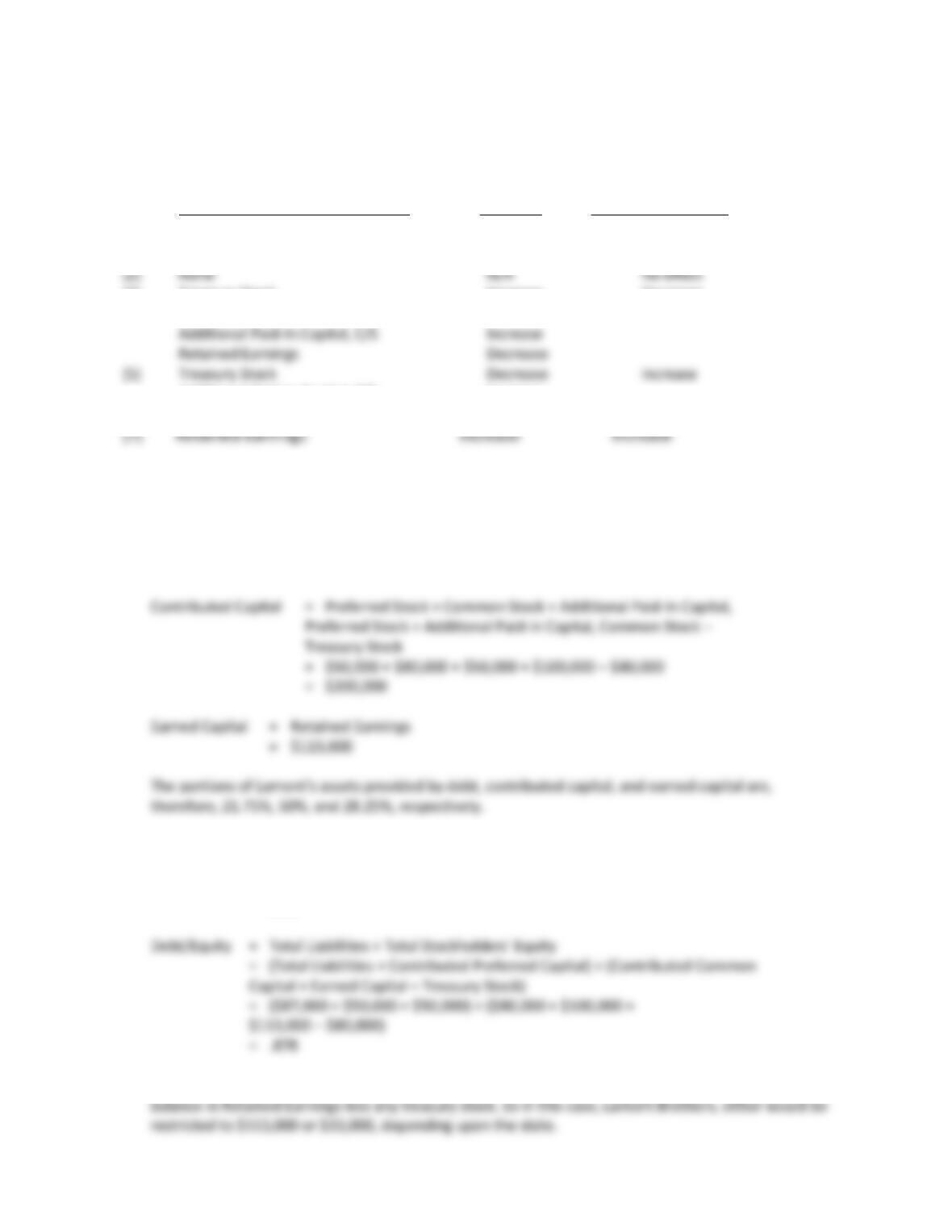
a.,b.,c.
Effect on Effect on Total
Accounts Account Stockholders’ Equity
(1) Common Stock Increase Increase
Additional Paid-In Capital, C/S Increase
(3) Treasury Stock Increase Decrease
(4) Common Stock Increase No effect
Additional Paid-In Capital, T/S Increase
(6) None N/A No effect
E12–2
a. Debt = Total Liabilities
= $52,000 + $35,000
= $87,000
b. Debt/Equity = Total Liabilities ÷ Stockholders’ Equity
= Total Liabilities ÷ (Contributed Capital + Earned Capital)
= $87,000 ÷ ($200,000 + $113,000)
= .278
c. Most states restrict the dollar amount of dividends to either the balance in Retained Earnings or the
E12–3
(1) No entry is necessary.
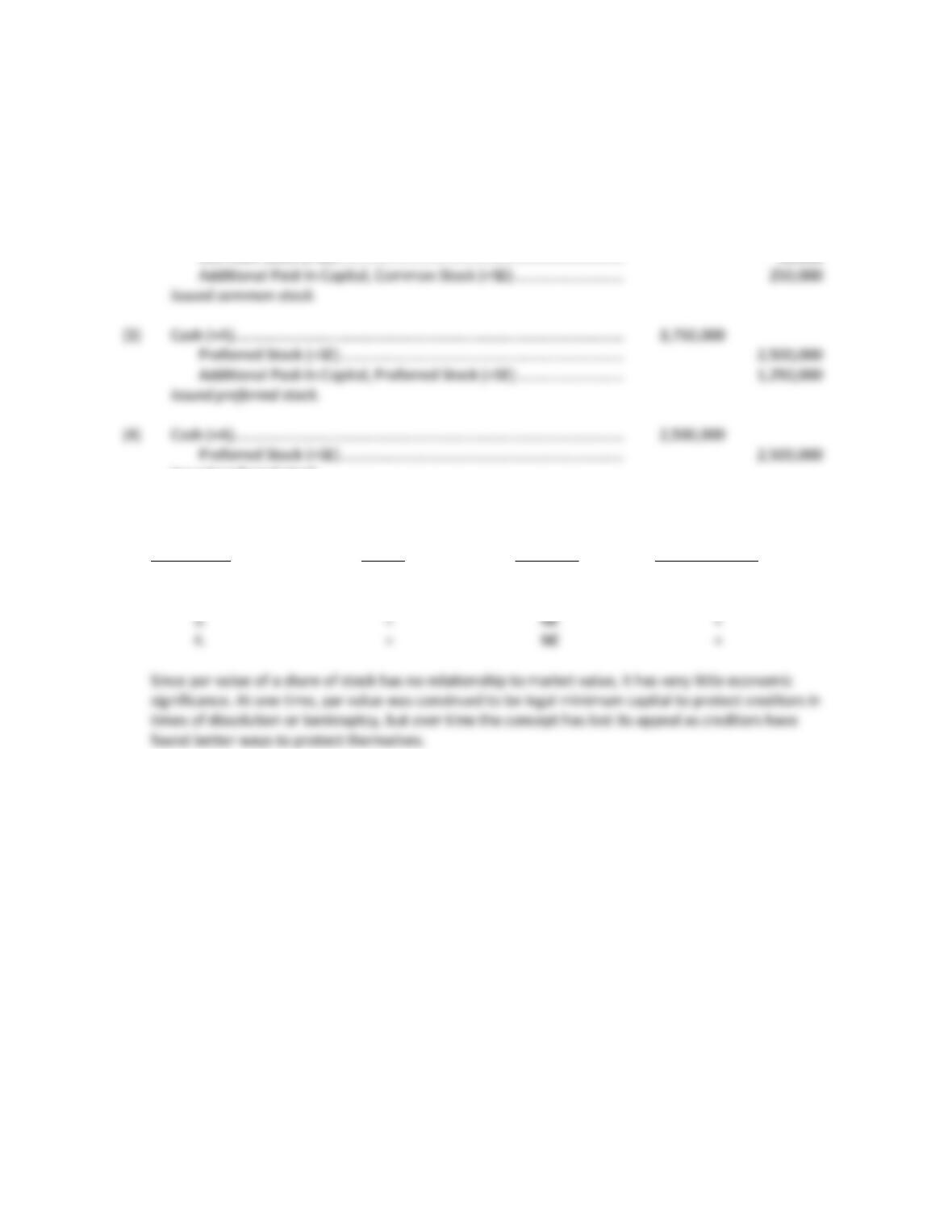
(2) Cash (+A)………………………………………………………………………………….. 300,000
Common Stock (+SE)……………………………………………………………. 50,000
Issued preferred stock.
Effect of each event on basic accounting equation:
Transaction Assets Liabilities Owner’s Equity
1. NE NE NE
2. + NE +
E12–4
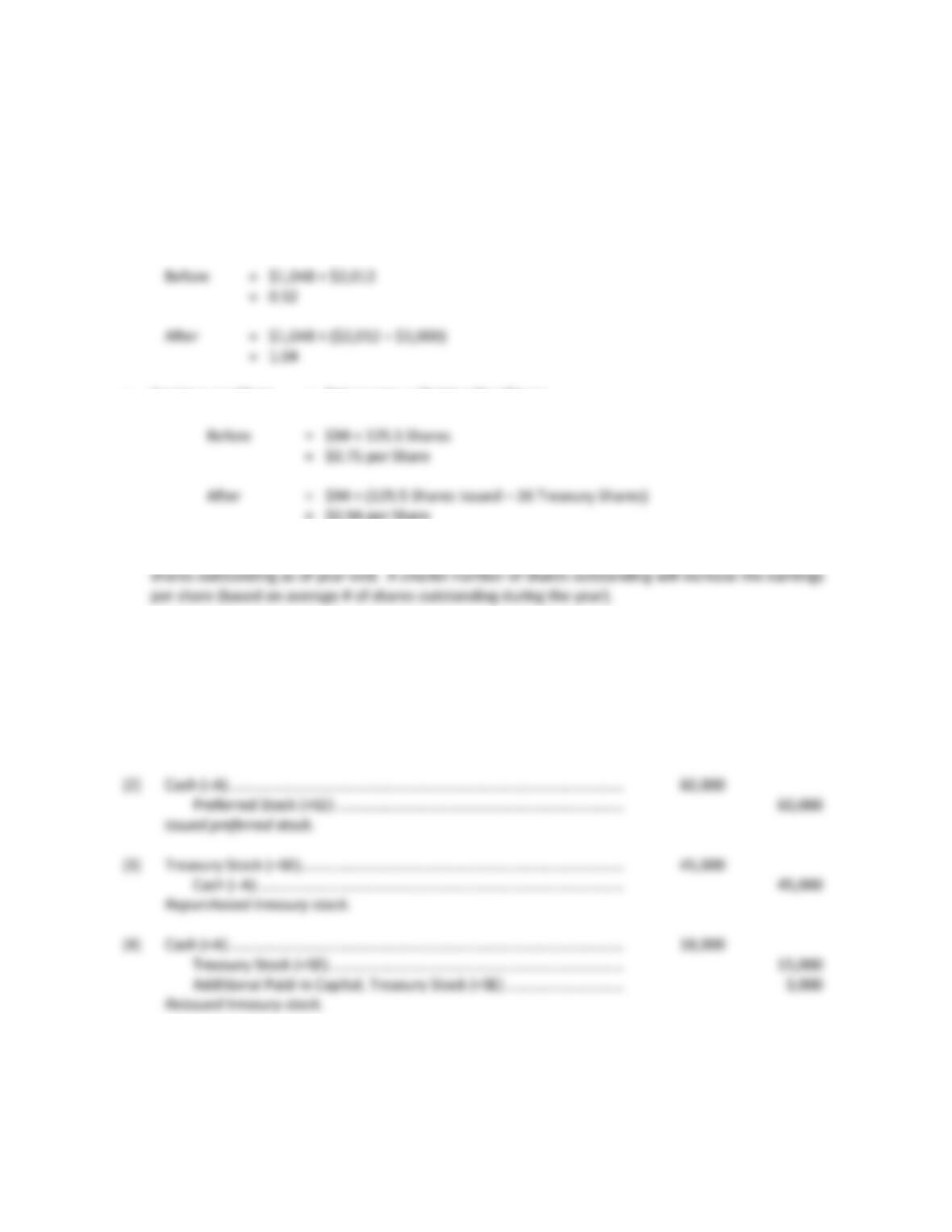
a. Treasury Stock (–SE) ………………………………………………………………………. 1,000
Cash (–A) ………………………………………………………………………………… 1,000
Acquired treasury stock. (Dollars in millions)
b. Debt/Equity = Total Liabilities ÷ Total Stockholders‘ Equity
c. Earnings per Share = Net Income ÷ Outstanding Shares
= $0.94 per Share
d. A company might choose to purchase treasury stock at year end in order to reduce the number of
E12–5
a.
(1) Cash (+A) …………………………………………………………………………………… 500,000
Common Stock (+SE) …………………………………………………………….. 125,000
Additional Paid-In Capital, Common Stock (+SE) ………………………. 375,000
Issued common stock.
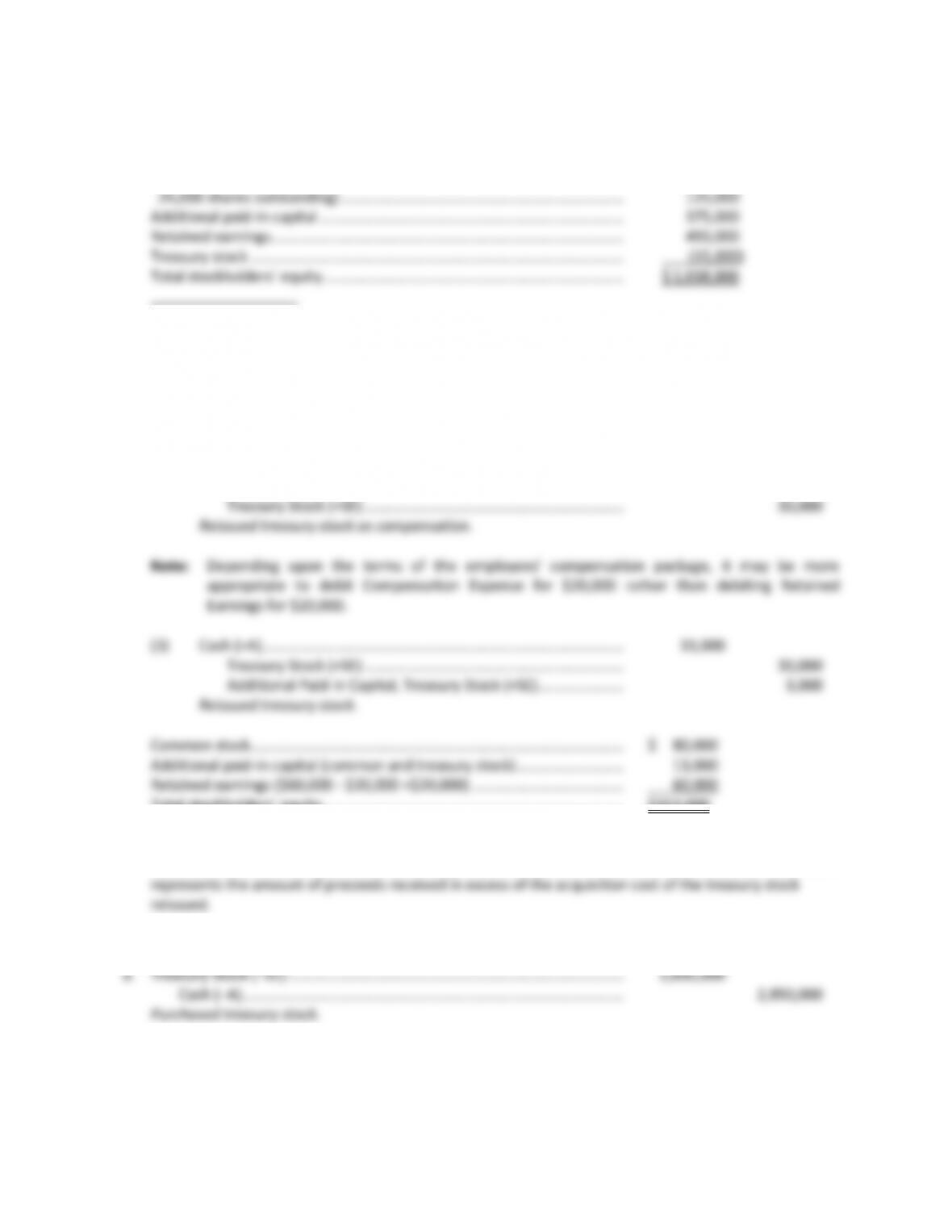
(5) Cash (+A) …………………………………………………………………………………… 5,000
Additional Paid-In Capital, Treasury Stock (–SE) ……………………………… 3,000
Retained Earnings (–SE) ………………………………………………………………. 7,000
Treasury Stock (+SE) ……………………………………………………………… 15,000
Reissued treasury stock.
E12–5 Concluded
b. Preferred stock ($8 par value, 5,000 shares outstanding) …………………… $ 60,000
Common stock ($5 par value, 25,000 shares issued,
E12–6
a. (1) Treasury Stock (–SE) ……………………………………………………………. 60,000
Cash (–A) ……………………………………………………………………… 60,000
Purchased treasury stock.
(2) Cash (+A) ……………………………………………………………………………. 10,000
Retained Earnings (–SE) ……………………………………………………….. 20,000
Total stockholders‘ equity ………………………………………………………………. $153,000
b. A total of $3,000 of additional paid-in capital is attributable to treasury stock. This amount would be
recorded in the account Additional Paid-In Capital, Treasury Stock. Under the cost method, this amount
E12–7
E12–7 Concluded
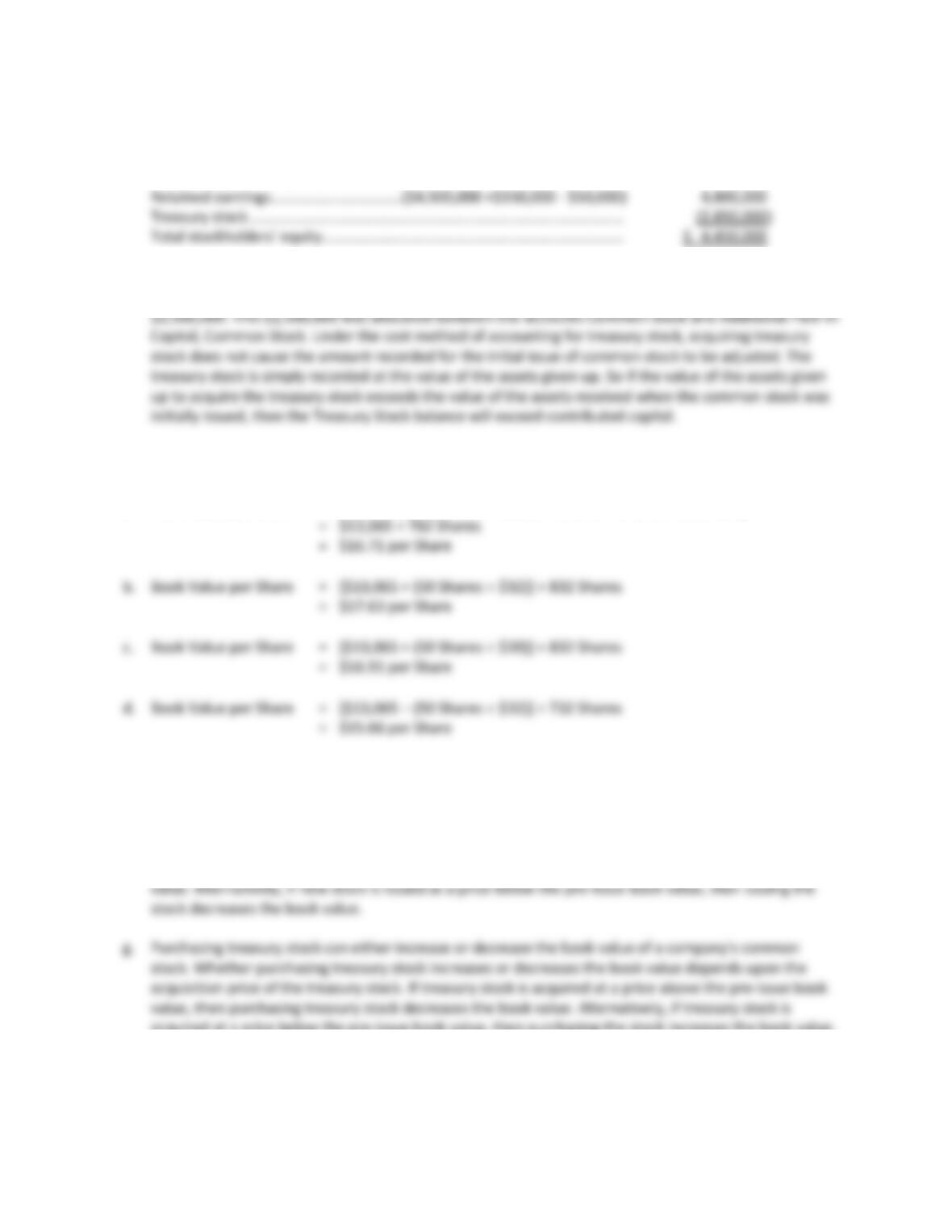
b. Common stock ………………………………………………………………………………. $ 100,000
Additional paid-in capital, common stock …………………………………………. 2,400,000
c. When common stock is initially issued, it is recorded at the value of the assets received. In this case
Stuart Corporation received $25 per share for 100,000 shares of common stock, for a total of
E12–8
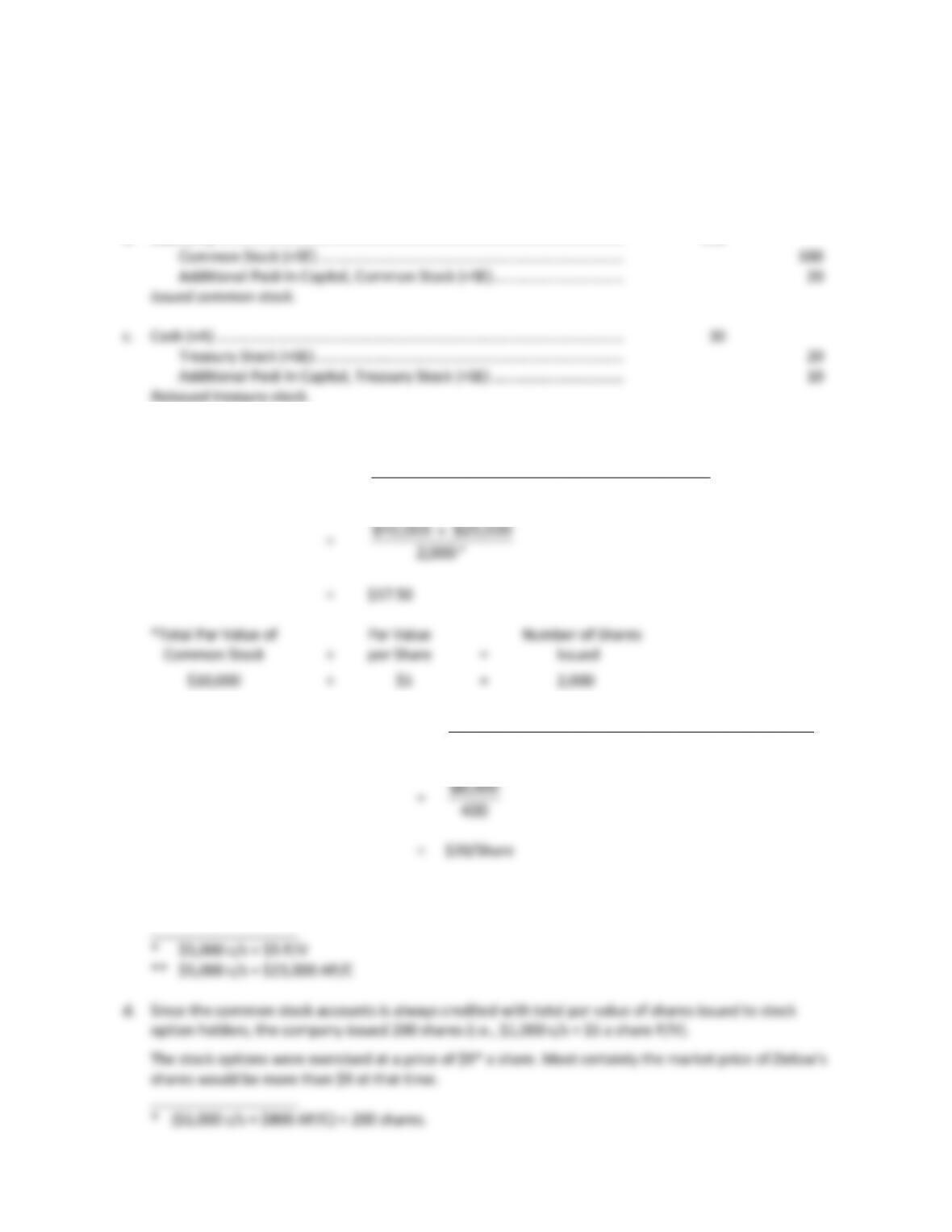
a. Book Value per Share = Common Stockholders’ Equity ÷ Common Shares Outstanding
e. Book Value per Share = [$13,065 – (50 Shares $20)] ÷ 732 Shares
= $16.48 per Share
f. Issuing stock can either increase or decrease the book value of a company’s common stock. Whether
issuing stock increases or decreases the book value depends upon the issue price of the new stock. If
new stock is issued at a price above the pre-issue book value, then issuing the stock increases the book
acquired at a price below the pre-issue book value, then purchasing the stock increases the book value.
E12–9
a. Cash (+A) ……………………………………………………………………………………… 300
Preferred Stock (+SE) ……………………………………………………………….. 300
Issued preferred stock.
b. Cash (+A) ……………………………………………………………………………………… 120
E12–10
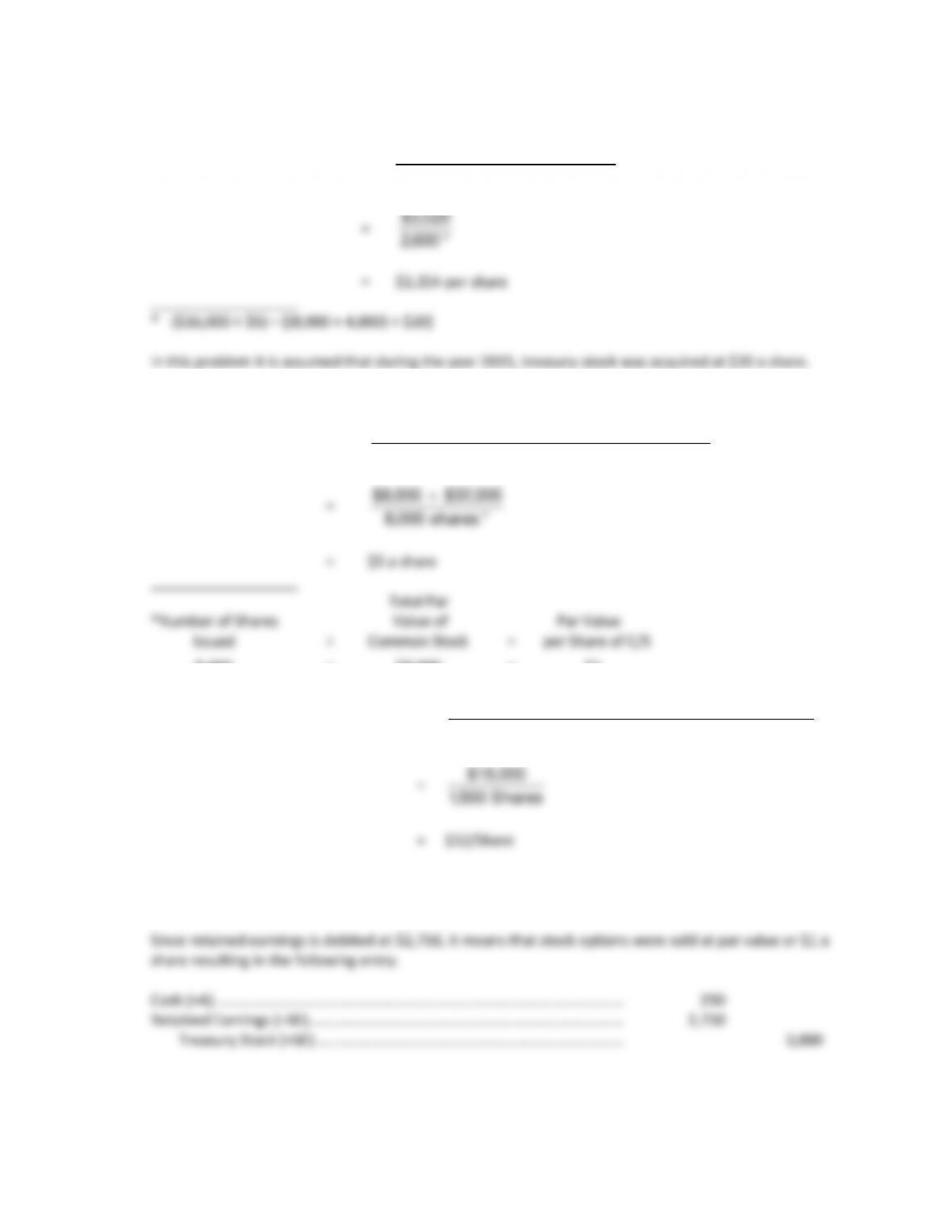
a. Issue Price per Share =
Common Stock + Additional Paid – in Capital
Number of Shares Issued
$10,$25,
000 000
+
b. Purchase Price of Treasury Stock =
Treasury Stock Carrying Value on Balance Sheet
Number of Treasury Stock Purchased
$8,000
c. To acquire Timeco, Zielow issued 1,000* shares and the market price of Timeco at the time of
acquisition was $28,000.**
E12–10 Concluded
e. Per Share Dividend Rate = Total Dividends Paid During 2015
Common Stock Outstanding
$3,
520
E12–11
a. Issue Price per Share =
Common Stock + Additional Paid – in Capital
Number of Shares Issued
$8,$32,
000 000
+
8,000 ÷ $8,000 = $1
b. Purchase Price of Treasury Stock =
Treasury Stock Carrying Value on Balance Sheet
Number of Treasury Stock Purchased
$18,
000
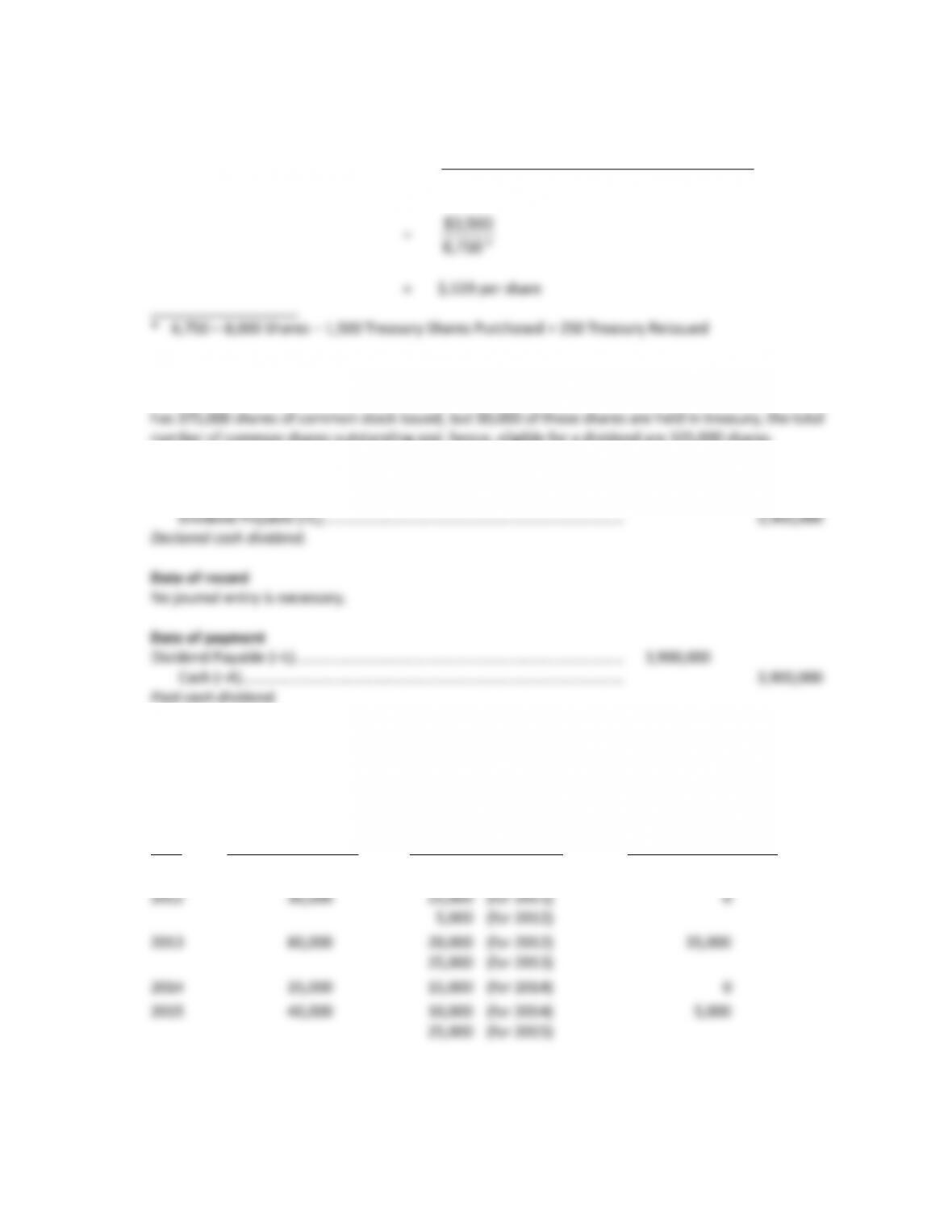
c. Since $3,000 worth of treasury stock was used to satisfy the stock options, at a price of $12 a share, a
total of 250 shares were issued through stock options.
E12–11 Concluded
d. Per Share Cash Dividend Rate =
Total Cash Dividends
Number of Common Shares Outstanding
$3,
500
E12–12
a. Only those shares that are both issued and outstanding are eligible to receive dividends. Since Enerson
number of common shares outstanding and, hence, eligible for a dividend are 325,000 shares.
b. Date of declaration
Cash Dividend (–SE) ………………………………………………………………………. 3,900,000
E12–13
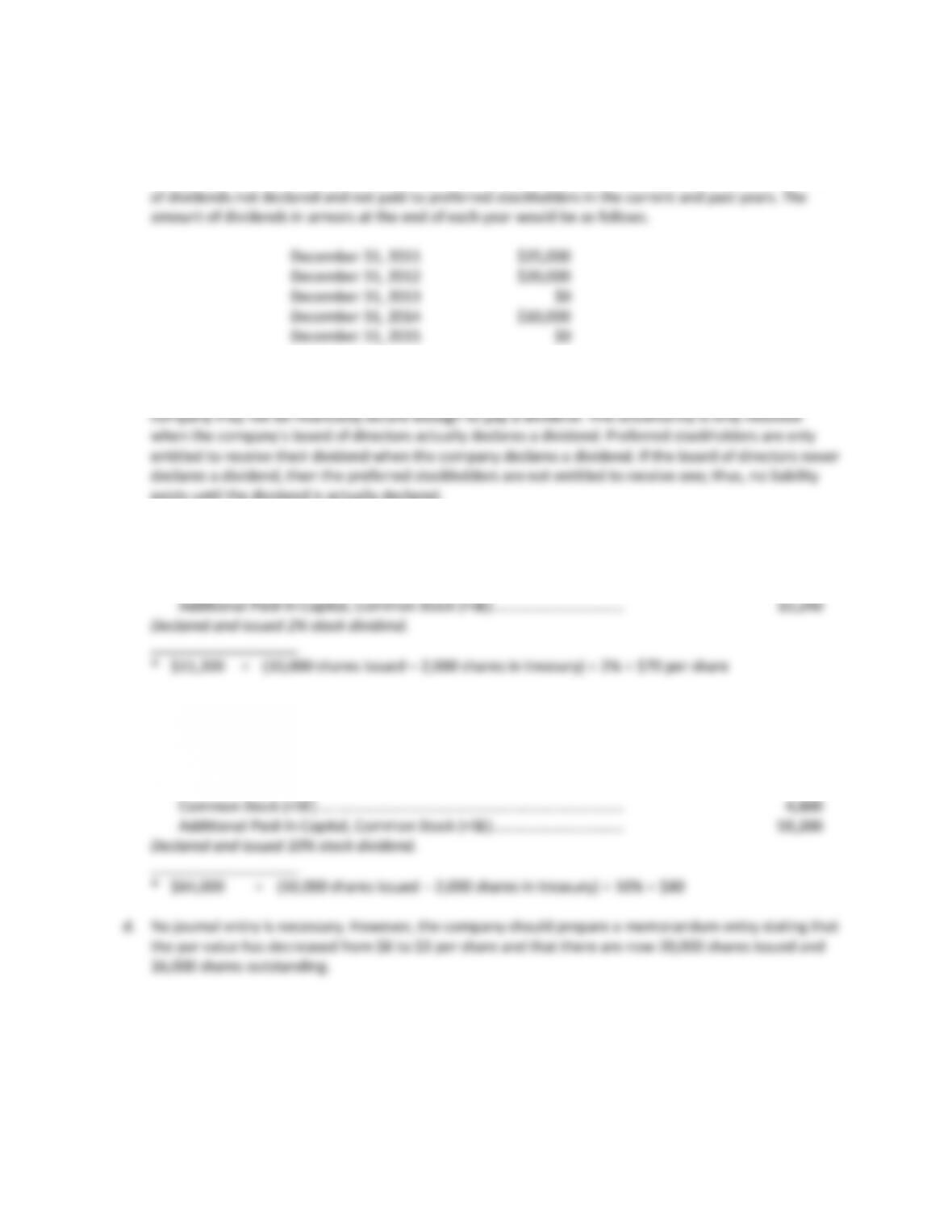
a. Each year the preferred stockholders are entitled to $5 for each share of preferred stock outstanding.
Since 5,000 shares are outstanding, total dividends to preferred stockholders should be $25,000 per
year.
Year Dividends Declared Dividends to Preferred Dividends to Common
2011 $ 0 $ 0 $ 0
E12–13 Concluded
b. Dividends in arrears are the dividends preferred stockholders are entitled to if and when the company‘s
board of directors declares a dividend. The amount of dividends in arrears equals the cumulative total
c. Dividends in arrears should not be considered a liability. A liability represents the probable future
sacrifice of assets. A company may choose to reinvest its profits back into the company, or the
exists until the dividend is actually declared.
E12–14
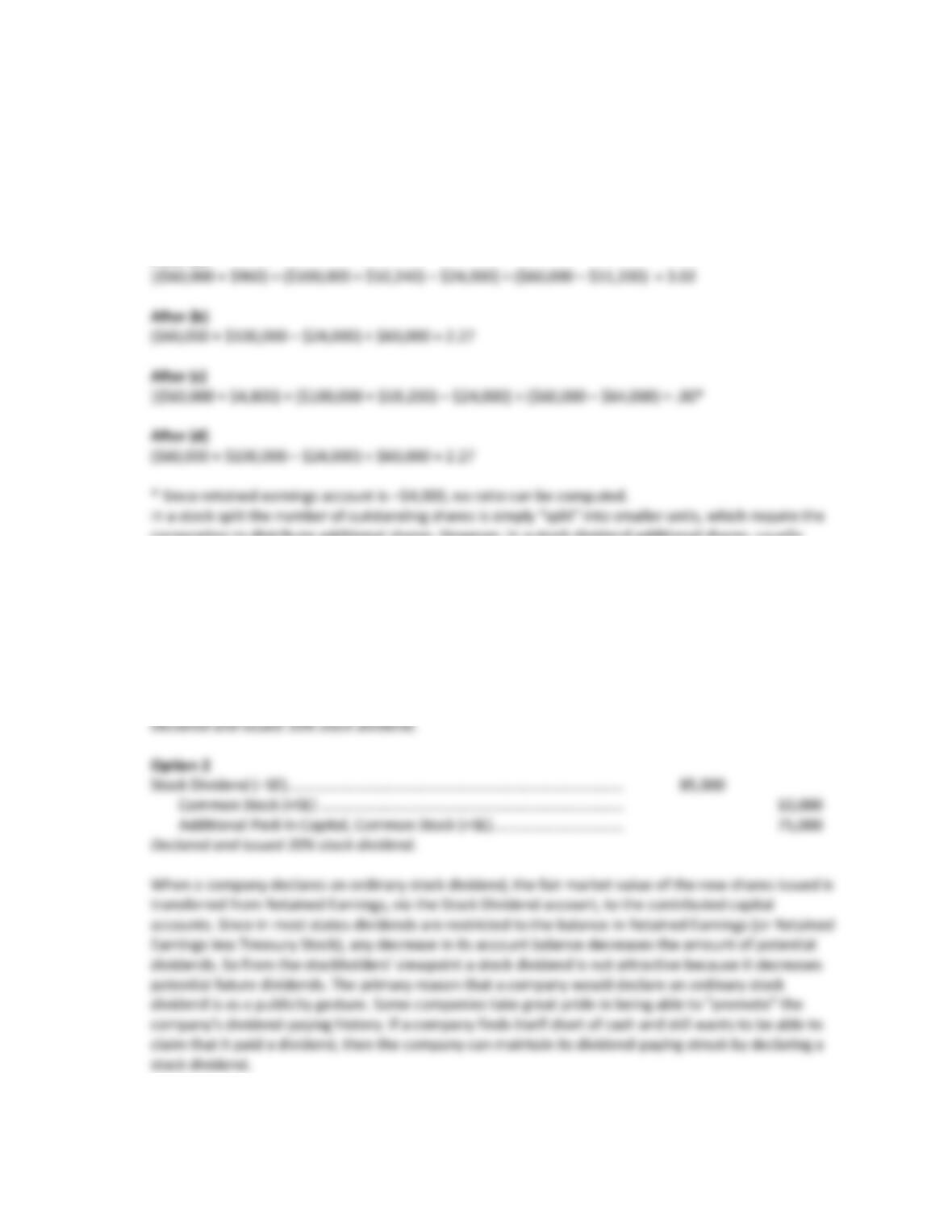
a. Stock Dividend (–SE) ………………………………………………………………………. 11,200*
Common Stock (+SE) ……………………………………………………………….. 960
b. No journal entry is necessary. However, the company should prepare a memorandum entry stating that
the par value has decreased from $6 to $4 per share and that there are now 15,000 shares issued and
12,000 shares outstanding.
c. Stock Dividend (–SE) …………………………..………………………………………….. 64,000*
E12–14 Concluded
e. Ratio = (Common Stk. + Additional Paid-In Capital – Treasury Stock) ÷ Retained Earnings
Prior to entries
($60,000 + $100,000 – $24,000) ÷ $60,000 = 2.27
After (a)
corporation to distribute additional shares. However, in a stock dividend additional shares, usually
expressed as a percentage of the outstanding shares, are issued to stockholders. Large stock dividends
have essentially the same effect as stock splits.
E12–15
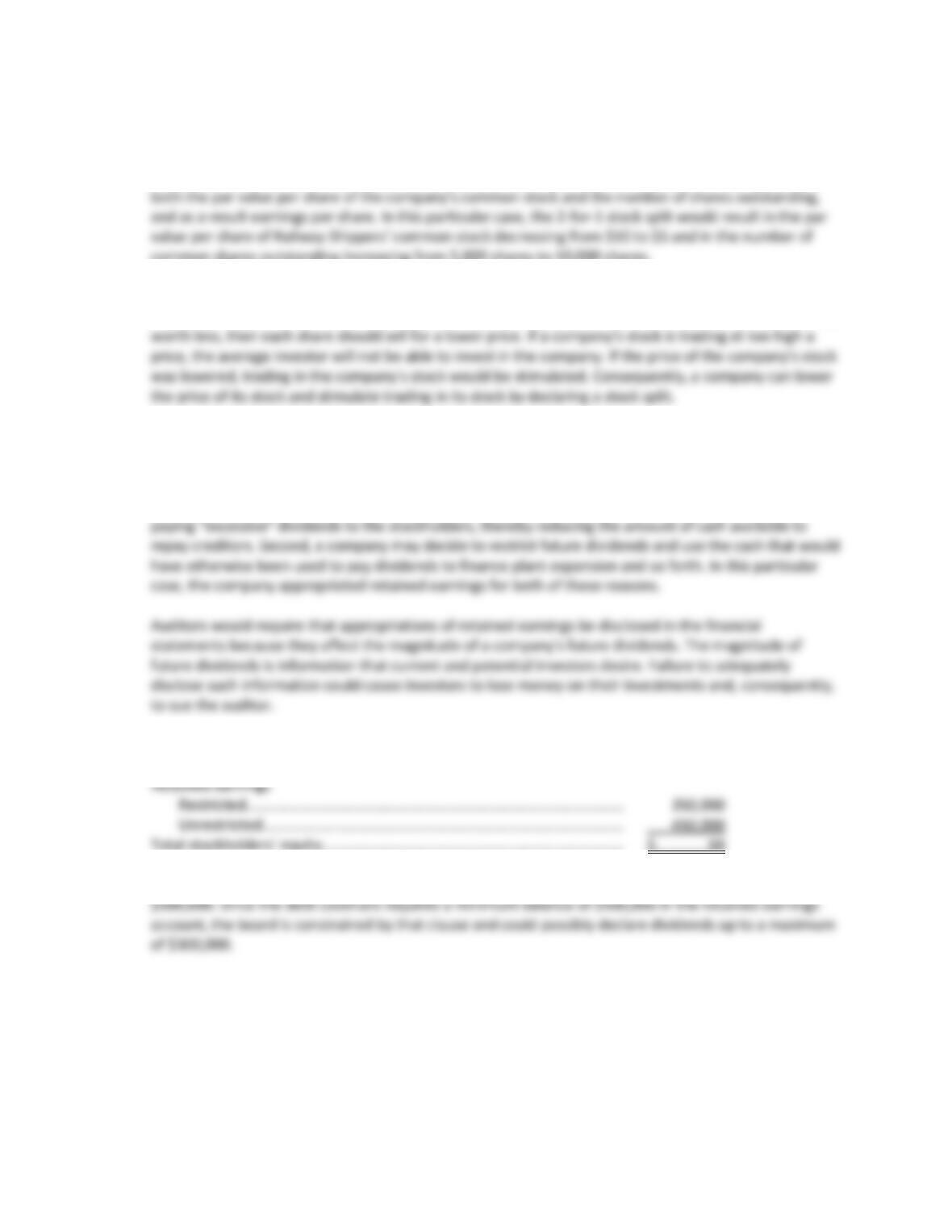
a. Option 1
Stock Dividend (–SE) ………………………………………………………………………. 42,500
Common Stock (+SE) ……………………………………………………………….. 5,000
Additional Paid-In Capital, Common Stock (+SE) ………………………….. 37,500
E12–15 Concluded
b. Option 3 would have no effect on any of the account balances reported in the financial statements
because a stock split does not affect a company‘s financial position. However, a stock split does affect
common shares outstanding increasing from 5,000 shares to 10,000 shares.
c. Declaring a stock split does not inherently increase or decrease a company‘s value. After a stock split, a
company’s value is allocated over a larger number of shares, so each share is worth less. If each share is
E12–16
a. Appropriating retained earnings serves to restrict a portion of retained earnings from the payment of
future dividends. Appropriations of retained earnings usually arise for two reasons. First, a creditor may
require the borrower to appropriate retained earnings. Such appropriations prevent the borrower from
b. Common stock ………………………………………………………………………………. XX
Additional paid-in capital ……………………………………………………………….. XX
Total stockholders‘ equity ………………………………………………………………. $ XX
c. The company can only declare a dividend equal only to the portion of retained earnings which exceed
P12–1
a. Cash (+A) ……………………………………………………………………………………… 100,000
Preferred Stock (+SE) ……………………………………………………………….. 100,000
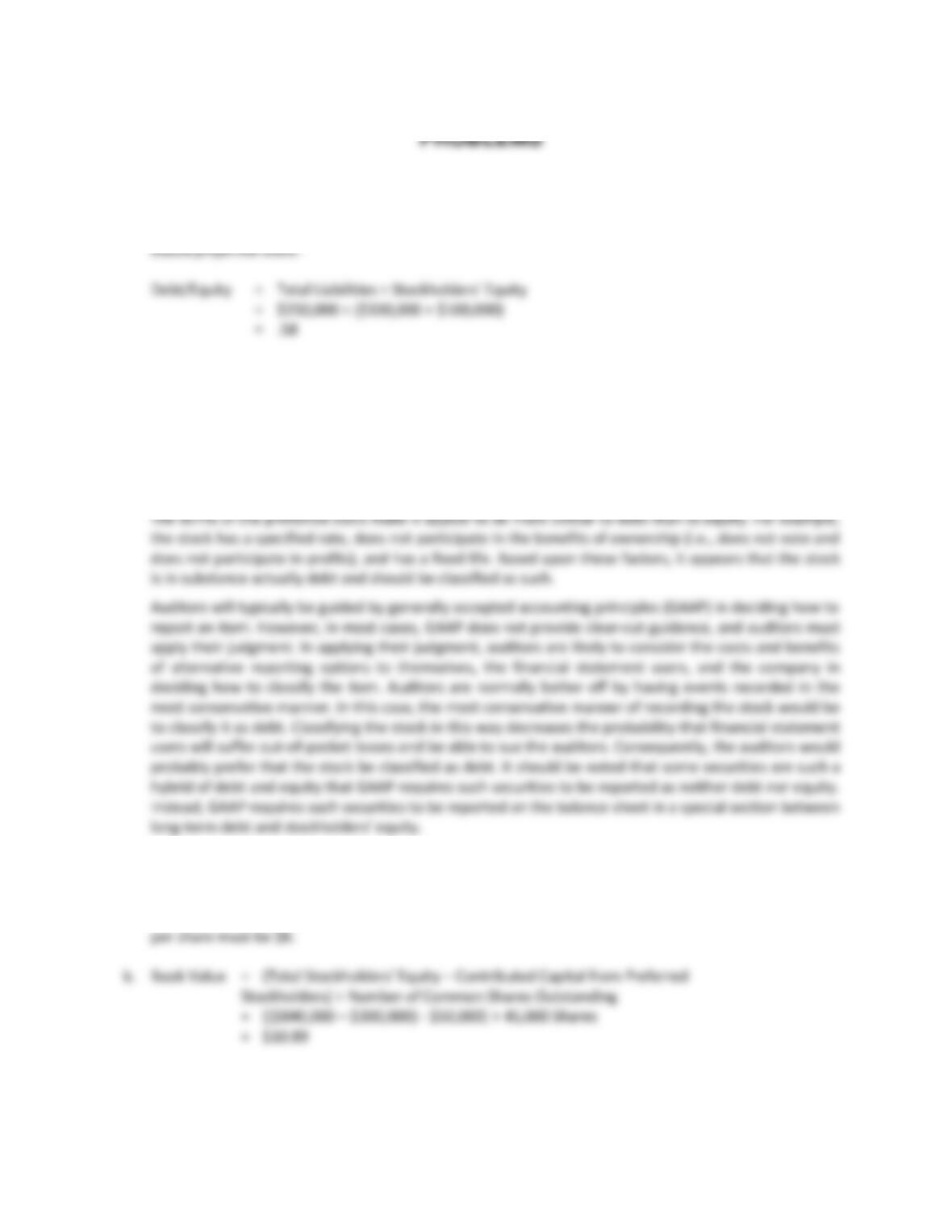
b. Debt/Equity = ($250,000 + $100,000) ÷ $330,000
= 1.06
c. If management classifies the stock as stockholders’ equity, then the company will not be in violation of
its debt agreement. However, if management classifies the stock as debt, then the company will be in
violation of its debt agreement. Since violating debt agreements can be quite costly to both the
company and managers, managers have incentives to classify the stock as stockholders’ equity.
P12–2
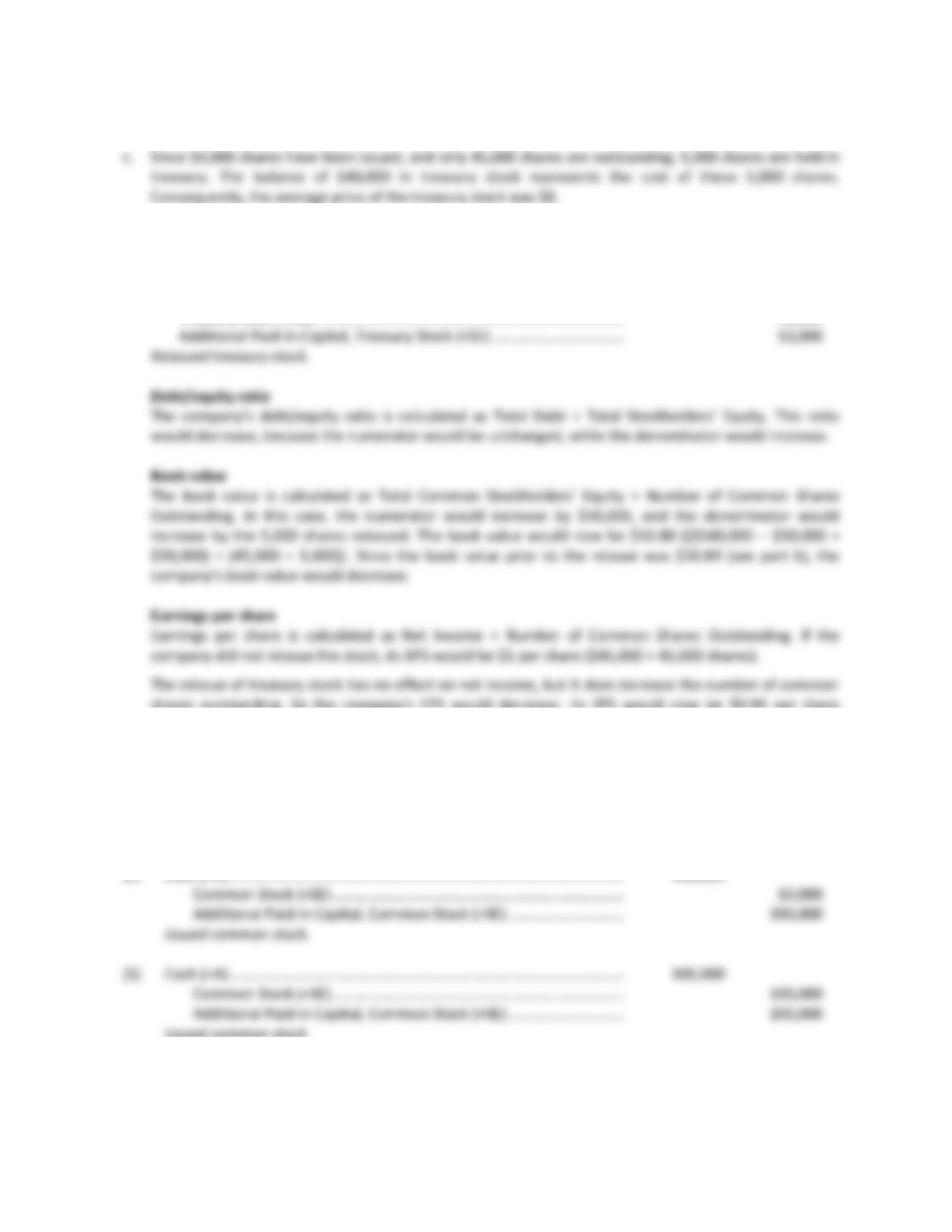
a. The balance in the Common Stock account represents the number of shares of common stock issued
times the par value per share. Since the balance of $300,000 represents 50,000 shares, the par value
P12–2 Concluded
d. If the company reissues the treasury stock at $10 per share, stockholders‘ equity would increase by
$50,000 and the company would make the following entry.
Cash (+A) ……………………………………………………………………………………… 50,000
Treasury Stock (+SE) ………………………………………………………………… 40,000
shares outstanding. So the company’s EPS would decrease. Its EPS would now be $0.90 per share
[$45,000 ÷ (45,000 + 5,000)].
P12–3
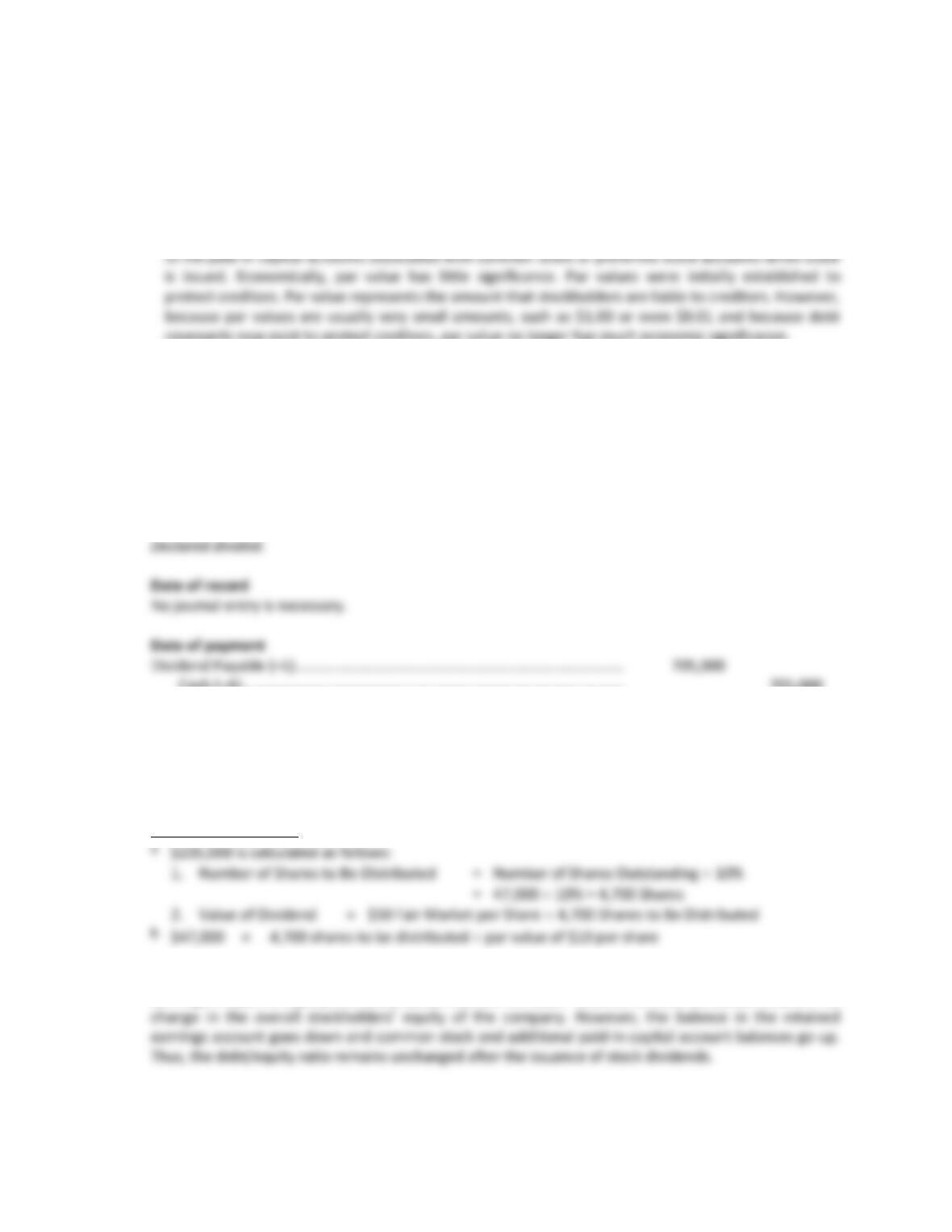
(1) Cash (+A) …………………………………………………………………………………… 500,000
Common Stock (+SE) …………………………………………………………….. 500,000
Issued common stock.
(2) Cash (+A) …………………………………………………………………………………… 400,000
Issued common stock.
P12–3 Concluded
(4) Cash (+A) …………………………………………………………………………………… 400,000
Preferred Stock (+SE) ……………………………………………………………. 400,000
Issued preferred stock.
b. Par value has accounting significance only in that it is used to determine the amount that is allocated
covenants now exist to protect creditors, par value no longer has much economic significance.
P12–4
a. Dividends are paid only on the shares that are both issued and outstanding. In this case, 55,000 shares
have been issued, but 8,000 of these shares are held as treasury stock. Thus, only 47,000 shares are
eligible to receive a dividend.
b. Date of declaration
Cash Dividend (–SE) …………………………..…………………………………………… 705,000
Dividend Payable (+L) ……………………………………………………….……… 705,000
Cash (–A) ………………………………………………………………………………… 705,000
Paid dividend.
c. Stock Dividend (–SE) …………………………..………………………………………….. 235,000a
Common Stock (+SE) ……………………………………………………………….. 47,000b
Additional Paid-in Capital, Common Stock (+SE) ………………………….. 188,000
Declared and issued stock dividend.
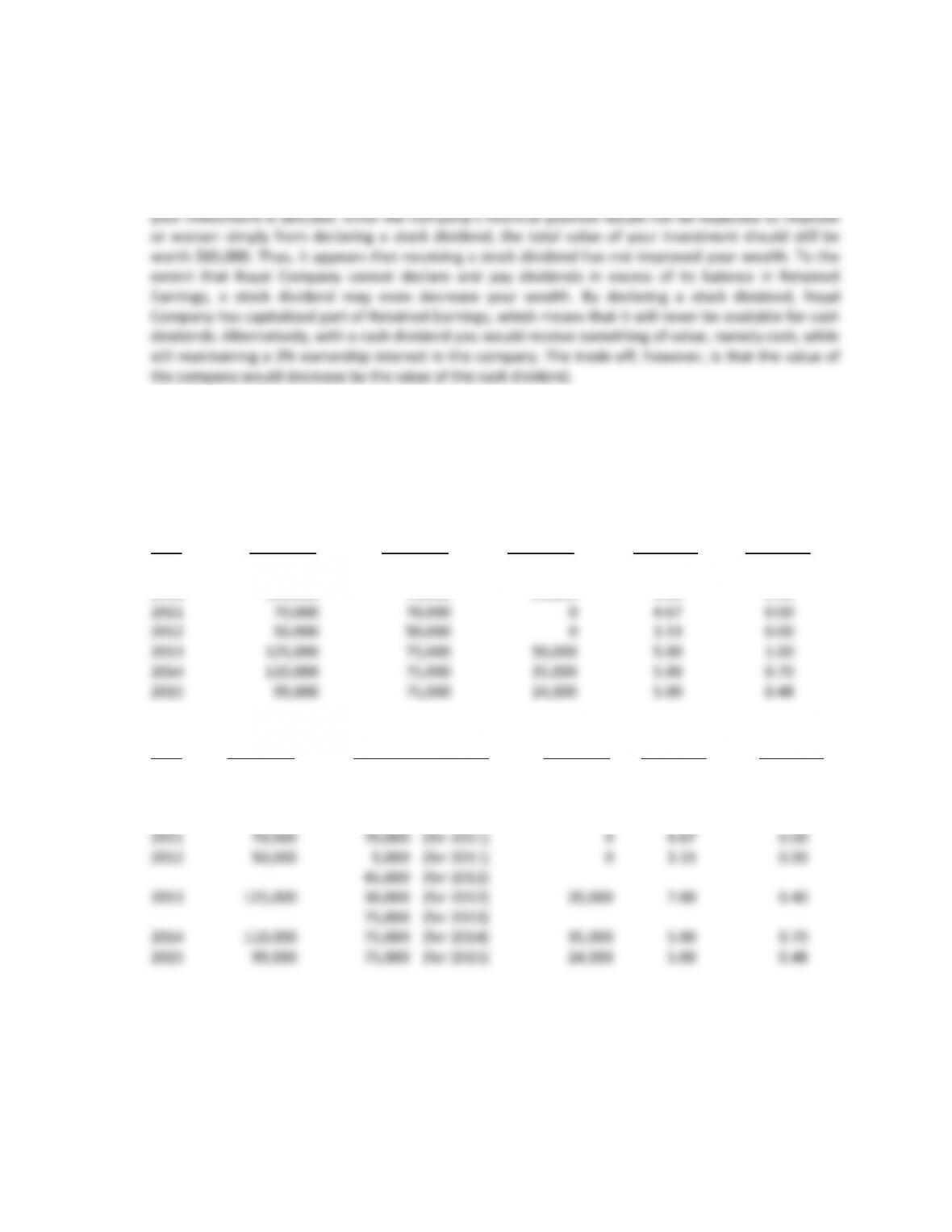
d. The overall impact of cash dividends is a decline in the Retained Earnings account. Since retained
earnings is a part of equity, the debt/equity ratio will increase. Issuance of stock dividends results in no
P12–4 Concluded
e. Stockholders would generally prefer a cash dividend over a stock dividend. Assume that you own 1,300
shares of Royal Company’s common stock prior to any dividend. Since there are 47,000 shares
outstanding, you own 3% of the company. In addition, since each share is worth $50, the total value of
P12–5
a. Each preferred stockholder is entitled to 10% of the par value, or $5.00. Thus, the 15,000 preferred
stockholders are entitled to a total of $75,000 in any particular year.
Total Preferred Common Preferred Common
Year Dividends Dividends Dividends per Share per Share
2009 $ 65,000 $65,000 $ 0 $4.33 $0.00
2010 100,000 75,000 25,000 5.00 0.50
b. Total Common Preferred Common
Year Dividends Preferred Dividends Dividends per Share per Share
2009 $ 65,000 $65,000 (for 2009) $ 0 $4.33 $0.00
2010 100,000 10,000 (for 2009) 15,000 5.67 0.30
75,000 (for 2010)
P12–6
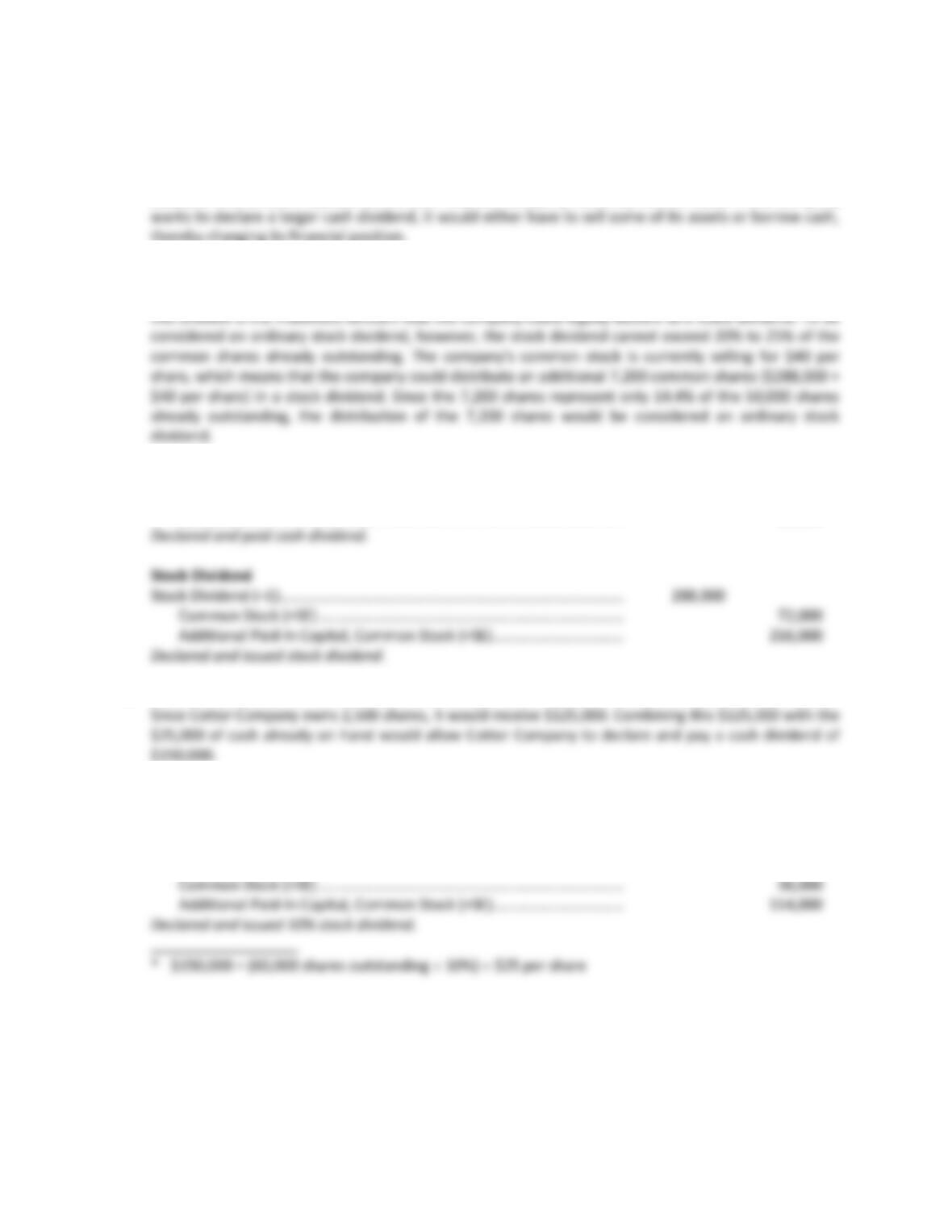
a. The maximum cash dividend that Cotter Company could declare given its current financial position is
$25,000. This amount represents the cash that the company currently has on hand. If the company
thereby changing its financial position.
b. In most states a company can not legally declare a dividend that exceeds the balance in Retained
Earnings. Since Cotter Company has a balance in Retained Earnings (after closing entries) of $288,000,
c. Cash Dividend
Cash Dividend (–E) …………………………………………………………………………. 25,000
Cash (–) ………………………………………………………………………………….. 25,000
d. If Cotter Company sold its marketable securities, it would receive the market value of $50 per share.
P12–7
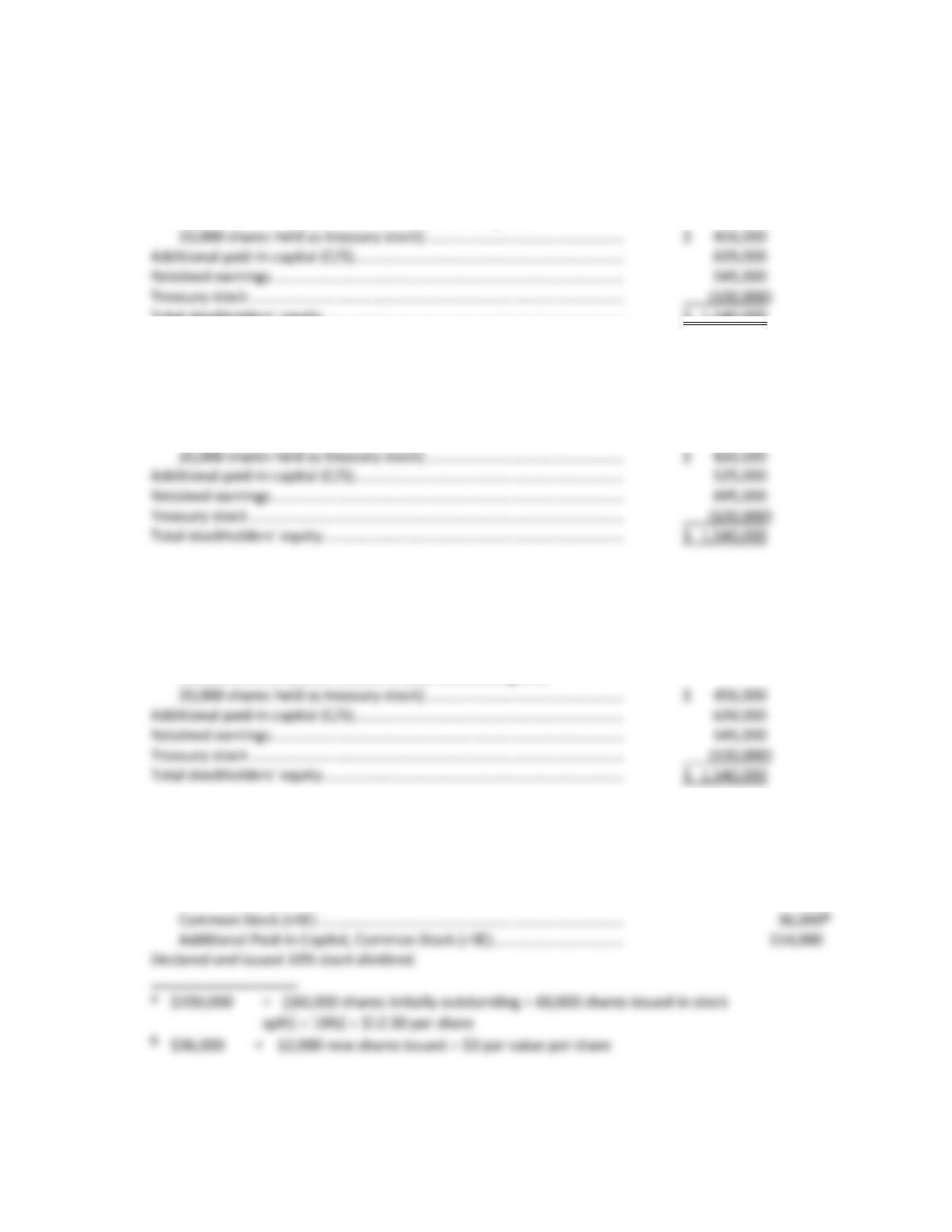
a. Stevenson Enterprises would make the following journal entry for the stock dividend.
Stock Dividend (–SE) ………………………………………………………………………. 150,000*
P12–7 Continued
Stockholders’ equity:
Common stock ($6 par value, 650,000 shares authorized,
76,000 shares issued, 66,000 shares outstanding, and
Total stockholders‘ equity ………………………………………………………………. $ 1,540,000
b. If Stevenson Enterprises declares a 2-for-1 stock split, no journal entry is necessary.
Stockholders’ equity:
Common stock ($3 par value, 1,300,000 shares authorized,
140,000 shares issued, 120,000 shares outstanding, and
c. If Stevenson Enterprises declares the stock dividend and then a stock split, the only journal entry the
company would have to make would be the journal entry given in Part (a).
Stockholders’ equity:
Common stock ($3 par value, 1,300,000 shares authorized,
152,000 shares issued, 132,000 shares outstanding, and
d. Stevenson Enterprises does not need to prepare any journal entry for the stock split. If Stevenson
Enterprises subsequently declares and pays a 10% stock dividend, the company would have to make
the following entry.
Stock Dividend (–SE) ………………………………………………………………………. 150,000a