P11–10 Concluded
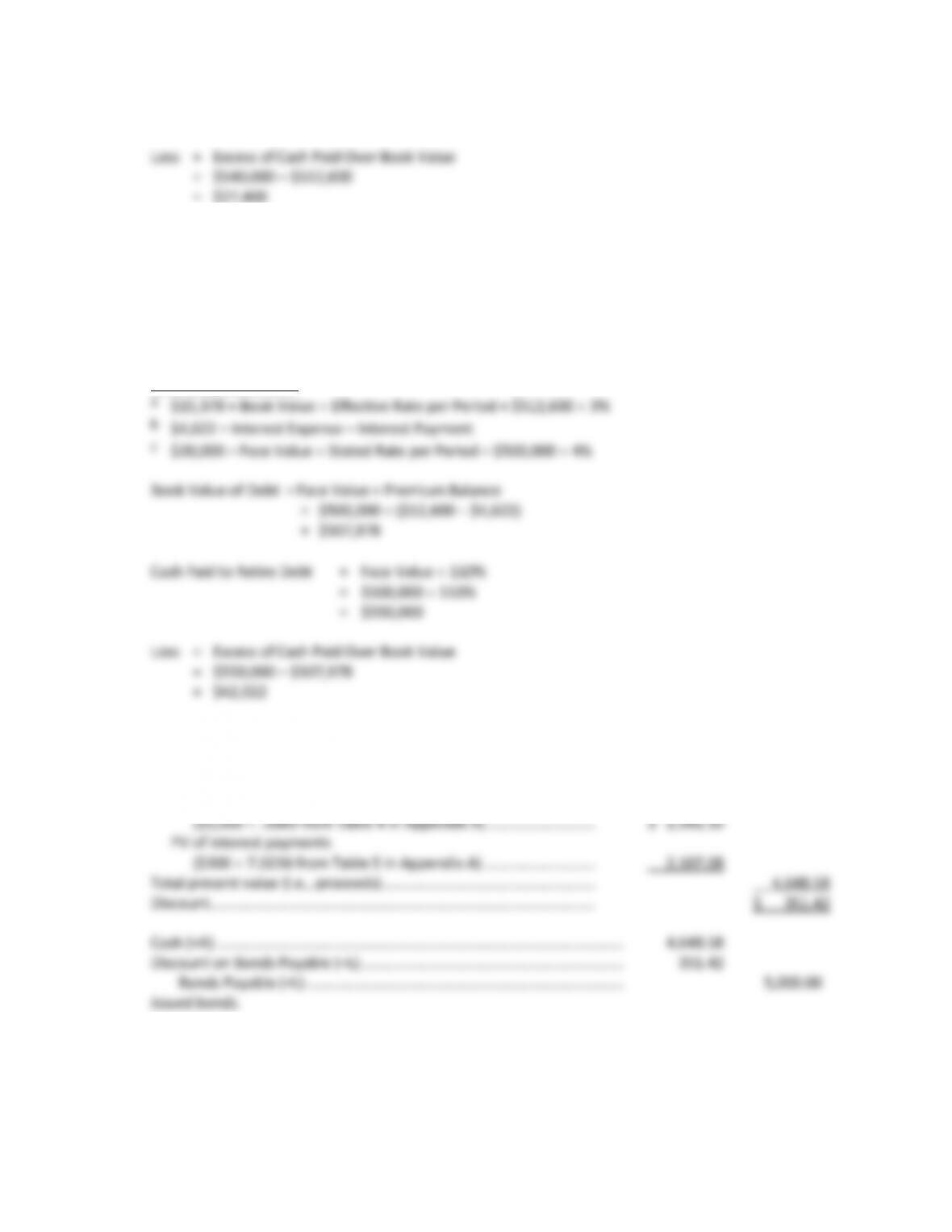
c. Ginny and Bill Eateries is required to make an interest payment on June 30, 2015 under the terms of
the debt agreement. The entry to record this payment would be:
Interest Expense (E, –SE) ………………………………………………………………… 15,378a
Premium on Bonds Payable (–L) ……………………………………………………… 4,622b
Cash (–A) ………………………………………………………………………………… 20,000c
Incurred and paid interest.
P11–11
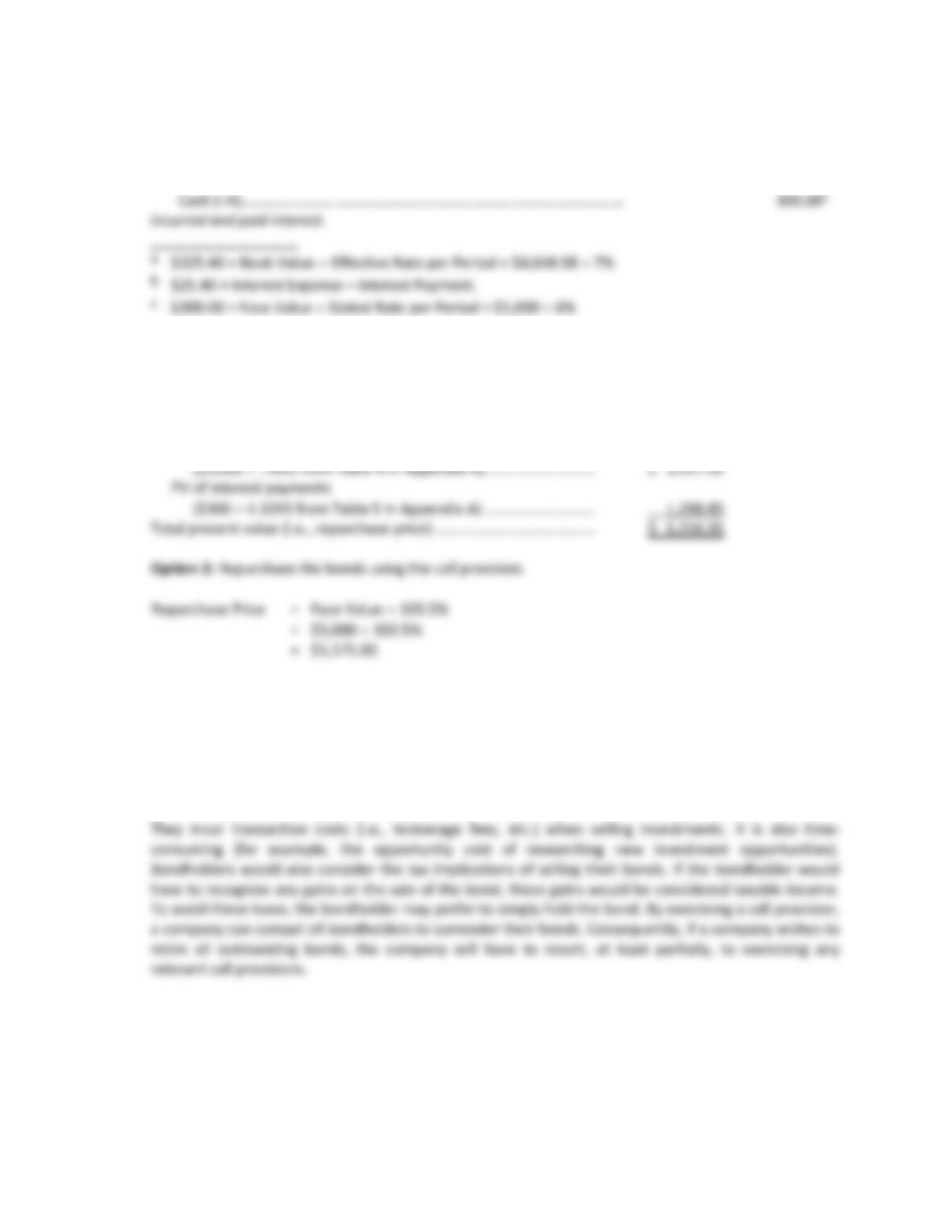
a. Face value ………………………………………………………………………………. $ 5,000.00
Present value (i = 7%, n = 10)
PV of face value
P11–11 Continued
b. Interest Expense (E, –SE) ………………………………………………………………… 325.40a
Discount on Bonds Payable (+L) ………………………………………………… 25.40b
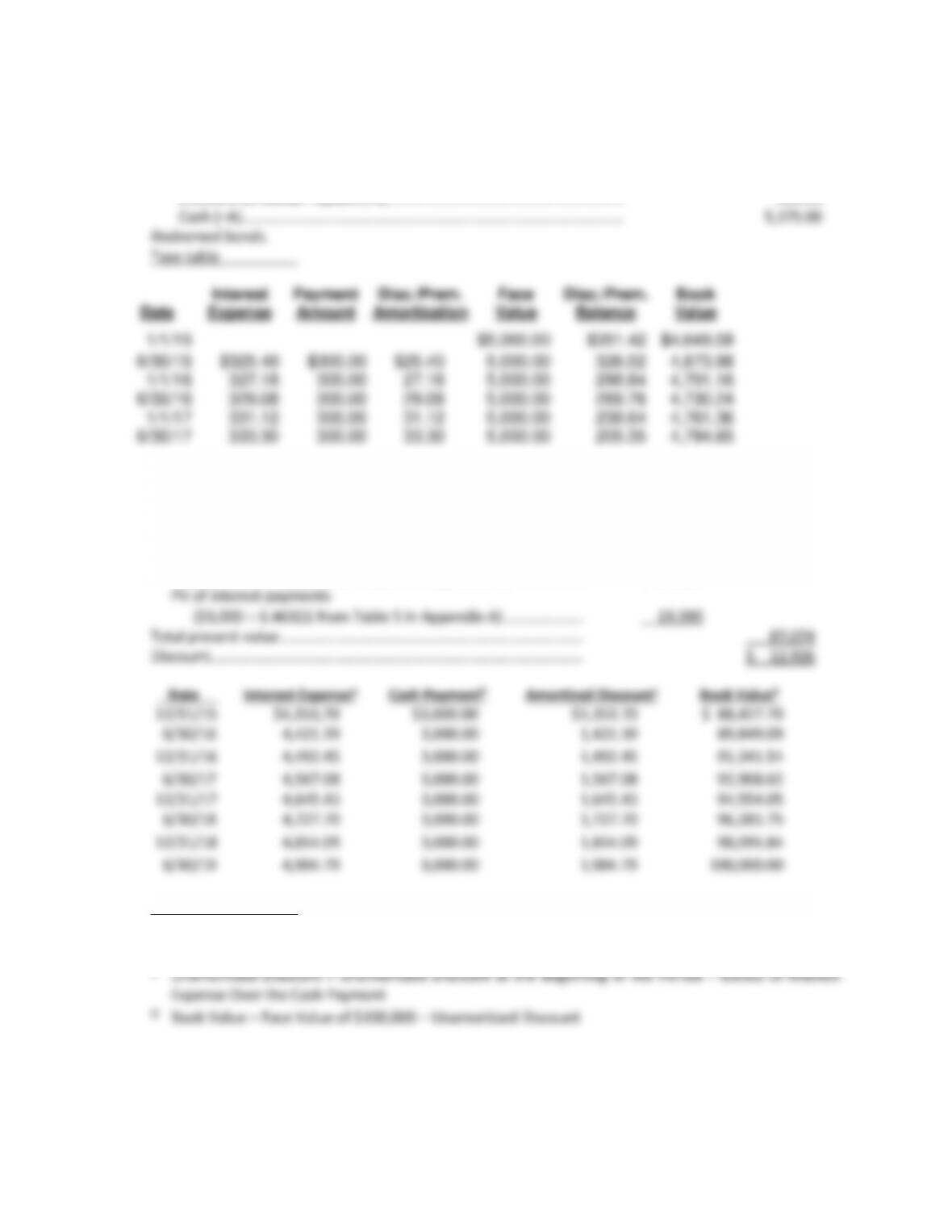
c. As of June 30, 2017, the bonds have a remaining life of five six-month periods until they mature.
Option 1: Repurchase the bonds through the bond market.
Present value (i = 5%, n = 5)
PV of face value
In this case, Ficus Tree Farm would have to use less cash to redeem the bonds using the call provision
than to repurchase them through the bond market. Consequently, the company should use the call
provision to redeem the bonds.
d. Assume that a company wishes to redeem all outstanding bonds prior to maturity. It is unlikely that it
could accomplish this goal by repurchasing the bonds through the bond market. Some bondholders
would simply be unwilling to sell the bonds. It is costly for bondholders to sell their bonds and reinvest.
P11–11 Concluded
e. Bonds Payable (–L) ………………………………………………………………………… 5,000.00
Extraordinary Loss on Redemption (E, –SE) ………………………………………. 380.35
Discount on Bonds Payable (+L) ………………………………………………… 205.35*
P11–12 Concluded
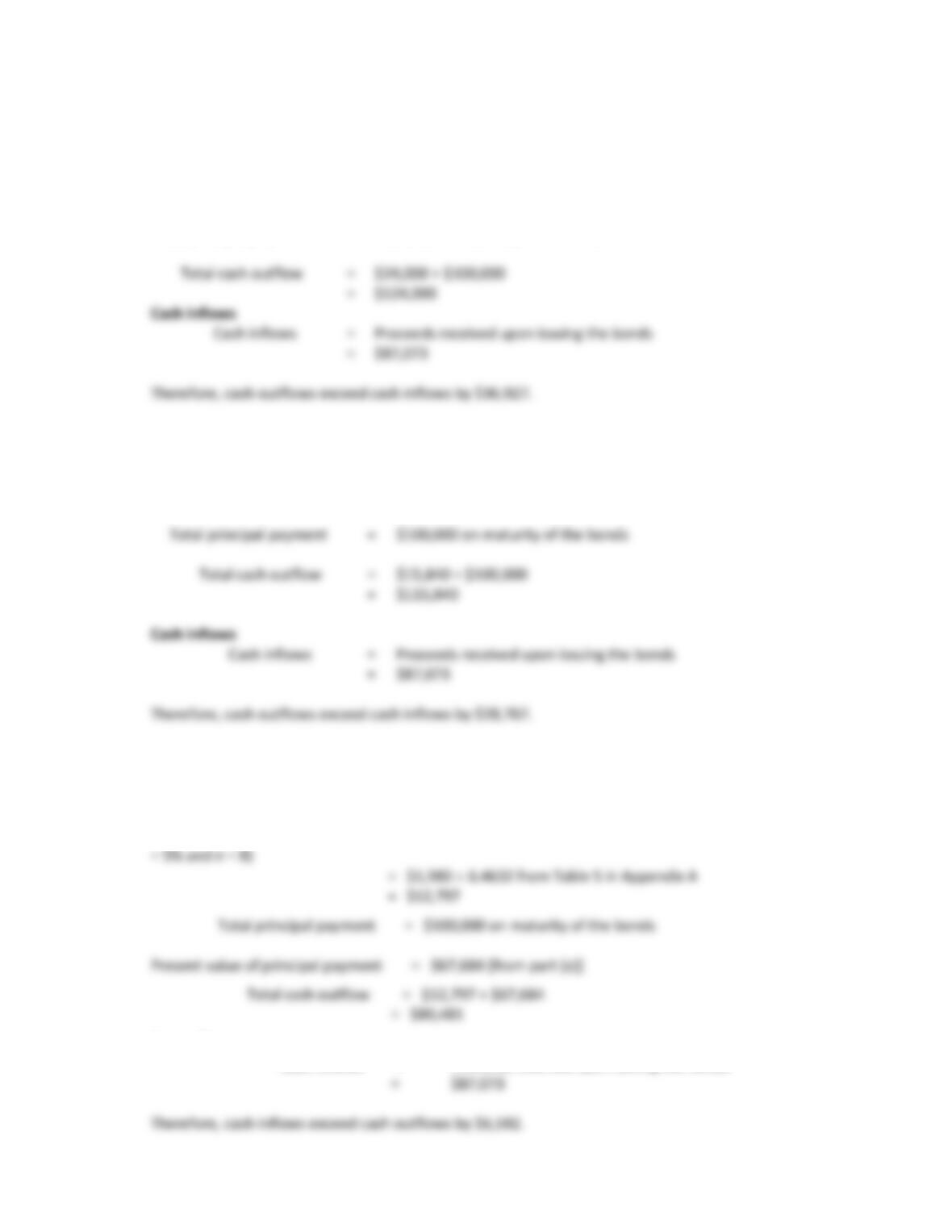
b. Cash outflows
Total interest payments = $3,000 8 payments
= $24,000
Total principal payment = $100,000 on maturity of the bonds
c. Cash outflows
Post-tax interest payments = [$3,000 (1 – tax rate)] 8 payments
= [$3,000 (1 – 34%)] 8 payments
= $15,840
d. Cash outflows
Individual post-tax interest payments = $3,000 (1 – tax rate)
= $1,980
Present value of post-tax payments = $1,980 Present value of an ordinary annuity for i
Cash inflows
Cash inflows = Proceeds received upon issuing the bonds
P11–13
a. On the financial statements a capital lease is treated like the company had purchased the fixed assets.
b. A company may want to treat leases as operating leases because there is no debt that is recorded on
c. total liability ÷ total asset ratio if Wal-Mart treats these leases as:
currently recorded: $121 ÷ $203 = 59.6%
d. An analyst needs to be able to compare companies that use different methods for accounting for
leases. If an analyst does not do this additional analysis there is a good chance that the analyst will be
P11–14
a. The initial balance sheet value of the equipment and the initial leasehold obligation both equal the
present value of the lease payments. This amount can be determined in the following ways.
Present value of lease payments = FMV of equipment
P11–14 Concluded
Balance Sheet
Value of
Leasehold
Interest
Depr.
Total
Date
Equipmenta
Obligationb
Expensec
Expensed
Expense
1/1/14
$119,781.30
$119,781.30
12/31/14
95,825.04
99,363.80
$9,582.50
$23,956.26
$33,538.76
12/31/15
71,868.78
77,312.91
7,949.10
23,956.26
31,905.36
12/31/16
47,912.52
53,497.94
6,185.03
23,956.26
30,141.29
12/31/17
23,956.26
27,777.78
4,279.84
23,956.26
28,236.10
12/31/18
(0.00)
(0.00)
2,222.22
23,956.26
26,178.48
Total
$30,218.70
$119,781.30
$150,000.00e
a Balance Sheet Value of Equipment = Value of Equipment on 1/1/14 – Accum. deprec.
b Leasehold Obligation = Leasehold Obligation at Beginning of the Period – ($30,000
Lease Payment – Interest Expense for the Period)
c Interest Expense = Leasehold Obligation at Beginning of the Period 8%
d Depreciation Expense = $119,781.30 ÷ 5 years
e Total has penny discrepancy due to rounding to even cents throughout lease term.
b. Total Rent Expense = Annual Rent Payments Number of Years of the Lease
c. If the lease is treated as a capital lease, total expenses would be $150,000 [from part (a)]. If the lease is
treated as an operating lease, total expenses would still be $150,000 [from part (b)]. Although total
P11–15
a. If the lease is treated as an operating lease, Thompkins Laundry would not have to report any liability
associated with the lease. Therefore, its debt/equity ratio would be as follows.
Debt/Equity Ratio = Total Liabilities ÷ Stockholders’ Equity
b. If the lease is treated as a capital lease, Thompkins Laundry would have to report a liability equal to the
present value of the future lease payments. Therefore, its debt/equity ratio would be affected.
P11–15 Concluded
c. Rent Interest Depreciation Total
Expense Expense ___Expense_ Expenses
Operating lease $5,000.00 $ 0.00 $ 0.00 $5,000.00
Capital lease 0.00 2,162.87 3,604.78 5,767.65
d. There are two primary reasons why Thompkins Laundry might want to arrange the terms of the lease
agreement so that the lease would be classified as an operating lease rather than as a capital lease.
First, lease obligations under an operating lease are not disclosed on the face of the balance sheet.
P11–16
a. Equipment (+A) …………………………………………………………………………….. 17,604
Discount on Notes Payable (–L)……………………………………………………….. 2,396
b. Present Value = Present Value of Maturity Payment + Present Value of Periodic Payments
$17,604 = ($20,000 Present Value Factor) + ($1,000 Present Value of an
Ordinary Annuity Factor)
Since the present value of $17,604 is less than the face value, we know that the note was issued at a
discount. Consequently, the effective rate is greater than the stated rate. We also know that the stated
P11–16 Concluded
c. Interest Expense (E, –SE) ………………………………………………………………… 1,408a
Discount on Notes Payable (+L) …………………………………………………. 408b
d. 12/31/15 Net Book Value = Face Value – 12/31/15 Discount on Notes Payable
P11–17
a. Since the bonds are selling at par value, the effective interest rate must be equal to the stated interest
rate of 9%. The effective interest rate is the sum of two components: a risk-free component and a risk
b. If the risk premium increased from 2% to 5%, the effective interest rate would increase to 12%. A single
bond would now be worth $889.59 to you, as calculated below. (Remember that bonds usually have a
face value of $1,000 and pay interest semiannually.)
Present value (i = 6%, n = 10)
c. A decrease in the prime interest rate would probably result in a drop in the effective interest rate used
to discount the future cash flows of Hodge Sports’ bonds. As the effective interest rate drops, the
stated interest rate looks relatively more attractive to investors. Thus, demand for the bonds should
increase, which, in turn, should drive up the selling price of the bonds. A single bond would now be
worth $1,040.55, as calculated below.
P11–18
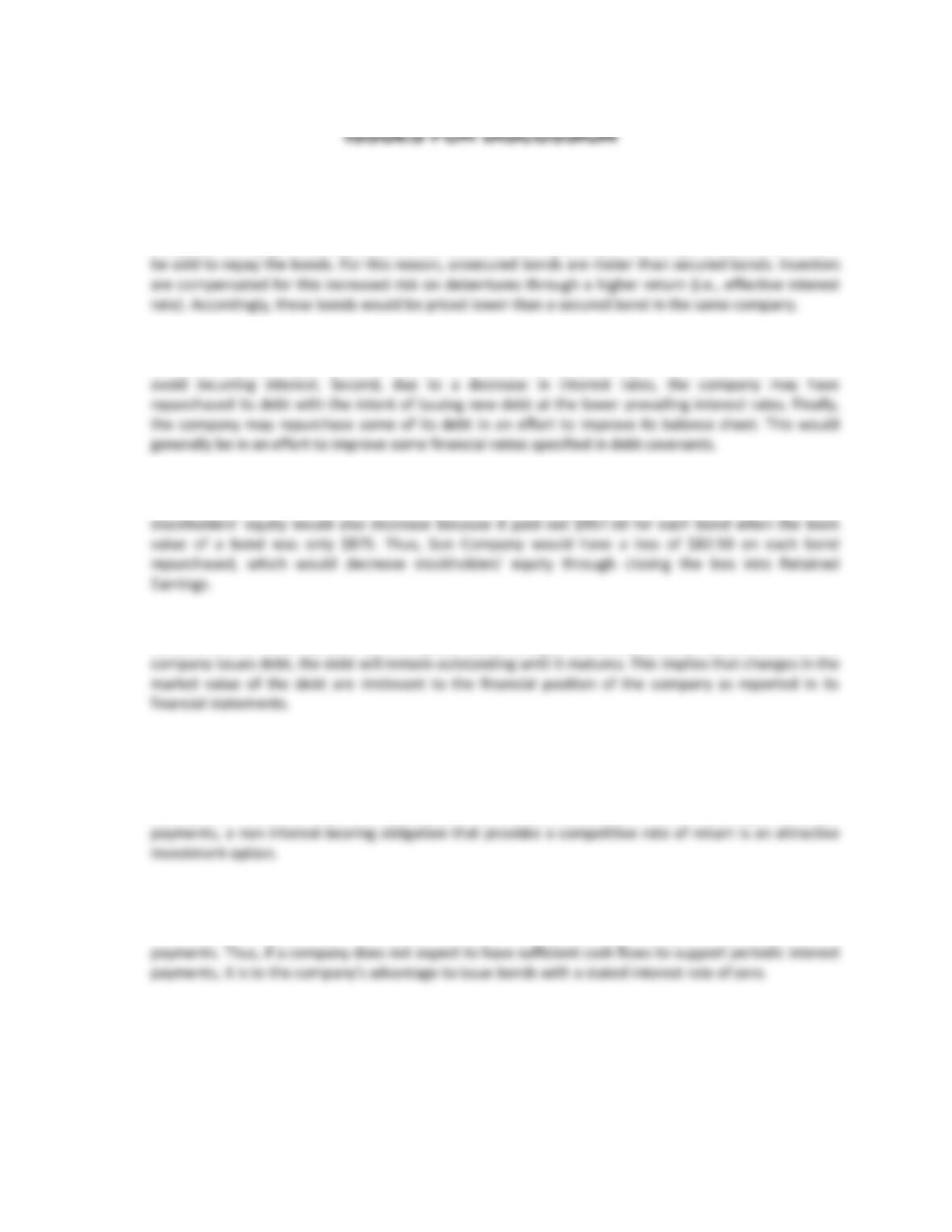
a. The effective interest rate on the bonds is 7.85%. The future value of the bond payments are
$2,000 (semi-annual interest payment based on the stated rate of 4%) for four periods and
b.
Cash 2,000
Bond Investment 1,650
Interest Revenue 3,650
Receipt of interest payment on 11/30/2014
(3,715 = Eff. Rate per period of 3.925% X [92,994 + 1,650])
c. On May 31, 2015 the book value of the investment is $96,359 (92,994 + 1,650 + 1,715). On the same
ID11–1
a. A debenture is an unsecured bond. That is, there is no collateral supporting the bond. Thus, should the
company not repay the bonds, investors do not have security in any of the company‘s assets that could
b. There are three general reasons why a company would repurchase its outstanding debt. First, the
company may no longer need the money it borrowed. By repurchasing the debt, the company could
c. Repurchasing debt would decrease both a company’s liabilities (due to the amount of debt
repurchased) and its assets (due to the cash paid out to repurchase the debt). For Sun Company, its
d. Sun Company would not have recognized any loss if it had not repurchased its debt. Unless there is
evidence to the contrary, such as a company repurchasing its debt, accountants assume that when a
ID11–2
a. The stated interest rate affects only the magnitude of periodic interest payments. What is important to
investors is the rate of return on their investments. Thus, if an investor is not in need of periodic cash
b. The rate that discounts $200 million due in eight years to a present value of $66.48 million is 14.75%.
c. If bonds have a stated rate, the company has to have sufficient cash flow to make the periodic interest
ID11–2 Concluded
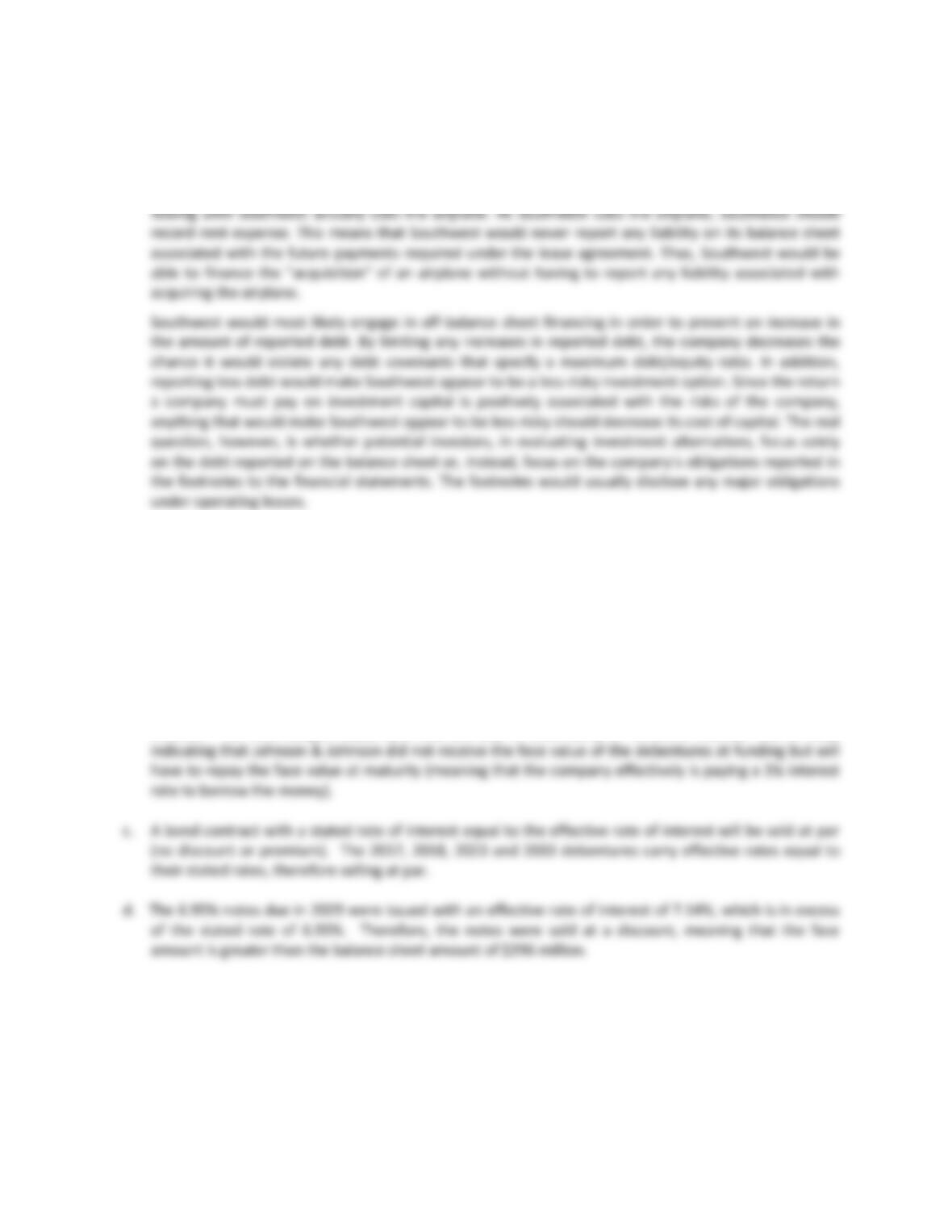
d. To simplify the calculations, the effective interest rate of 14.75% [see part (b)] is rounded to 15%.
5% stated rate
Present value of $200 million paid in 8 years
$200 million .32690 (from Table 4 in Appendix A) …………………………….. $ 65,380,000
Present value of periodic interest payments
ID11–3
a. The effective interest rate is the interest rate that equates the undiscounted future cash flows with the
present value of the future cash flows. For both alternatives, the undiscounted cash flows are only the
fifteen annual payments of $6 million each, and the present value of both alternatives is the
b. Cash (+A) ……………………………………………………………………………. 45,636,480
Note Payable (+L) ………………………………………………………….. 45,636,480
Issued note payable.
c. Airplanes Capitalized Under Leases (+A) …………………………..…….. 45,636,480
d. If Southwest Airlines borrows the necessary funds and then purchases the airplane, Southwest’s fixed
assets and liabilities would both increase by $45,636,480. In addition, Southwest would have to
ID11–3 Concluded
f. Structuring the leasing arrangement as an operating lease would be an example of off-balance sheet
financing. With an operating lease, the substance of the lease arrangement is that Southwest is renting
the airplane from the Boeing Company. Thus, Southwest is not considered to have any obligation to
ID11–4
a. The current portion of Long Term Debt ($1,512 million) appeared in the Current Liabilities section of
the balance sheet; the rest of the Long Term Debt, totaling $11,489 million, appeared in the long-term
liabilities section of Johnson & Johnson’s balance sheet.
b. A zero coupon debenture is a debt instrument that has a stated rate of interest of 0%. The debenture
contract only requires the repayment of the face amount at maturity. However, because no company
borrows at zero percent, the debentures are sold at a discount depending on the effective rate of
interest. The zero coupon debenture that are due in 2020 carry an effective interest rate of 3.00,
ID11–5
a. Investors are motivated by risk and return. If investors determine that the low returns available on
high quality bond issues are not sufficient for their income needs, those investors might be
risk, especially as returns on bond issues remained low.
b. In the case of a company’s failure, the debt holders are paid prior to the equity holders; therefore,
the risk of the debt holders is less and the required return of those debt holders is similarly lower.
will drive down the yield.
ID11–6
a. A large amount of debt forces a company’s management to place greater emphasis on generating cash
so that it has sufficient cash to make the required interest and principal payments. Thus, a company
may alter its operating, investing, and financing decisions to allow it to generate the cash it needs when
it needs it.
b. The massive borrowing activity during the 1980s would have manifested itself as increased liabilities on
the companies’ balance sheets. By analyzing different companies’ current ratios and debt/equity ratios,
which are measures of a company‘s solvency, potential investors may have been able to identify those
companies that were taking on an excessive amount of debt. However, even this type of analysis may
financing will be reflected on the statement of cash flows. The negative aspect of this analysis approach
is that the analysis cannot be adequately performed until the company is making interest and principal
payments. By this time it may be too late!
c. A debenture is an unsecured bond. That is, there is no collateral supporting the bond. Thus, should the
company not repay the bonds, investors in debentures, unlike investors in secured bonds, do not have
ID11–7
a. Home Depot Lowe’s
Liabilities $23 billion $19 billion
Total assets $41 billion $33 billion
Liabilities/total assets ratio 0.56 0.58
b. If all leases are capital leases:
Home Depot Lowe’s
Liabilities $23 billion $19 billion
+ Lease liabilities 5.4 billion 3.5 billion
Total liabilities $28.4 billion $22.5 billion
Assets $41 billion $33 billion
ID11–8
a. A ratings agency is a supposedly independent expert charged with the responsibility of analyzing the
risks associated with debt (and equity) securities. Once the risks have been analyzed and quantified,
the higher the risk, the lower the rating.
b. Investors interested in purchasing the security will perform their own analysis of the underlying risks
but will also look to the rating as guidance. If the ratings agency assigns a low rating (implying greater
c. The ratings agency should look at a number of areas, including: the income and credit history of the
ID11–9
a. The covenant limits the company’s borrowing capacity by stating that funded debt can be no more than
three times EBITDA (a rough estimation of annual cash flow). Since EBITDA was $1,604 million, funded
debt could be no more than $4,812 million. With existing debt at $3,505 million, the covenant limits
additional debt to no more than $1,307 million.
b. The creditors are trying to control the amount of debt that J.C. Penney has on its balance sheet by
limiting that debt to a multiple of annual cash flow. The thinking is that the debt will be repaid from
ID11–10
a. On the financial statements a capital lease (a lease that is “equivalent to purchasing an asset”) is
treated like the company had purchased the fixed asset. The asset and the related liability are recorded
b. The rule passed in 1981 was unpopular for 2 primary reasons. The first was that it forced companies to
capitalize some leases. This would have the impacts as described above. Capitalized leases would tend
amount of time and effort for companies to implement.
c. Financial engineers have sought to keep debt off the balance sheet by structuring contracts in such a
manner that the contract will qualify as an operational lease when the reality is that the fixed asset has
d. Mr. Holgate makes a good point. When two transactions, that are substantially the same, can be
recorded in significantly different ways on the financial statements then there is a problem. This is
ID11–11
a. During the severe economic recession, the likelihood that companies would not be able
to meet their obligations (the companies’ “default risk”) increased substantially. Investors,
b. A company that was able to purchase its own debt at a steep discount would be
c. On the financial statements, any company retiring debt by paying less than the current
ID11–12
Bristol-Myers Squibb is concerned that changes in interest rates could adversely impact the company’s
financial condition. To protect against this possibility—to manage its interest rate risk—the company has
ID11–13
a. The long-term debt / total asset ratio for Google was 7.6% in 2011 ($5,516/$72,574) and 8.3% in 2012
($7,746/$93,798). The ratio increased only slightly over this time period.
b. Footnote #4 indicates, “The effective interest yields of the 2014, 2016, and 2021 Notes were