would reduce net income by a total of $11,179.56 [from part (b)] for the interest expense associated
with the lease and for the depreciation associated with the capitalized asset.
Future obligations under operating leases are not disclosed in a company’s financial statements as a
liability. Consequently, an operating lease would not affect a company’s total liabilities. On the other
E11–23
a. Annual Rental Expense = Rental Expense per Car Number of Cars
b. Present Value of Lease Payments = $10,000 per Car 100 Cars x Present Value of an
Leased automobiles.
c. Interest Expense = Lease Obligation 10%
= $3,790,800 10%
= $379,080
d. Classifying the lease as an operating lease would give rise to both higher net income and a lower
debt/equity ratio. By classifying the lease as an operating lease, net income would be reduced during

E11–23 Concluded
e. Off-balance sheet financing refers to financing agreements that require future payments, yet are
structured so that the financing arrangement does not meet any of the criteria for the financing
E11–24
a. Since the face value of the bank loan equals the proceeds of the loan (i.e., $149,388), the effective
interest rate is equal to the stated interest rate. Therefore, the appropriate effective interest rate for
Watts Motors for a ten-year borrowing arrangement is 12%. This rate should also be used for the lease.
b. With the lease payment, Watts Motors would pay $26,439.32 at the end of each year for ten years.
With the bank loan, Watts Motors would make interest payments of $17,926.56 ($149,388 12%) at
c. Option 1
Building (+A) …………………………………………………………………………………. 149,388
Notes Payable (+L) …………………………………………………………………… 149,388
Purchased a building.
E11–24 Concluded
d. Payment Interest Expensea Principal Reductionb Principal
$149,388.00
$26,439.32 $17,926.56 $8,512.76 140,875.24
E11–25
Present Value = Present Value of Face Value + Present Value of Interest Payment
= (Face Value Present Value Factor) + (Periodic Interest Payment Present
Value of an Ordinary Annuity Factor)
Note 1
Since the proceeds (i.e., present value) equal the face value, we know that the effective rate equals the
stated rate. Consequently, the effective rate for Note 1 is 8%.
As proof:
E11–25 Concluded
Note 3
$922 = ($1,000 Present Value Factor) + [($1,000 7%) Present Value of an Ordinary
Annuity Factor]
Therefore, the annual effective interest rate must be 9%.
Bond 1
$11,635 = ($10,000 Present Value Factor) + [($10,000 3%) Present Value of an
Ordinary Annuity Factor]
Since the proceeds are greater than the face value, we know that the bond was issued at a premium.
Bond 2
$54,323 = ($50,000 Present Value Factor) + [($50,000 4.5%) Present Value of an
Ordinary Annuity Factor]
Since the proceeds (i.e., present value) are greater than the face value, we know that the bond was issued
E11–26
a. Since the bonds have a face value of $1,000 and they are selling for 89.16, an individual bond would
have a present value of $891.60 ($1,000 x 89.16%). For these bonds to be attractive to an investor who
requires an annual rate of return of 12%, the present value of the bonds’ future cash flows discounted
using a discount rate of 6% semiannually must be greater than or equal to $891.60. If the present value
b. The annual effective interest rate that would make an investor indifferent to purchasing the bonds at
89.16 would be 10%, which implies a six-month rate of 5%. As proof:
Present value (i = 5%, n = 16)
E11–27
a. Bonneville issued the debt at a fixed rate, meaning that its outlay for interest will not change even
if market interest rates change. A drop in market rates would not lower the interest paid by
contract.
b.
Bonneville could manage the risk of fluctuating interest rates (and debt values) by entering into a
hedging agreement known as an interest rate swap. Under a swap arrangement, Bonneville would
The fixed payment received under the swap agreement will match what the stated rate of interest
requires Bonneville to pay in the long term debt contract. The effect of the interest rate swap is to
hedge against changes in debt values due to changes in market rates; the variable interest
payments from the swap agreement effectively eliminate those market value changes.
PROBLEMS
P11–1
a. The present value of the future cash flows of this note equals $20,000. Since the effective rate of 10%
b. The present value of the future cash flows of this note equals $20,000. Since the effective rate of 10%
exceeds the stated rate of 0%, the note will be issued at a discount. The task is to determine what
Consequently, the face value of this note would be $24,202.
c. Note A
Cash (+A) ……………………………………………………………………………………… 20,000
Notes Payable (+L) …………………………………………………………………… 20,000
d. Note A
Interest Expense (E, –SE) ………………………………………………………………… 2,000*
Cash (–A) ………………………………………………………………………………… 2,000
Made interest payment.
Discount on Notes Payable (+L) …………………………………………………. 1,782
P11–2
a. The bonds will be issued at a discount. The bond market has determined that purchasers of Hartl
Enterprises’ bonds should earn an annual return on their investment of 10%. However, Hartl
b. Face value …………………………..……………………………………………………… $ 10,000
Present value (i = 5%, n = 20)
PV of maturity receipt
c. Interest Expense (E, –SE) ………………………………………………………………… 218.85a
Discount on Bonds Payable (+L) ………………………………………………… 18.85b
Interest Payable (+L) ………………………………………………………………… 200.00c
d. Interest Expense (E, –SE) ………………………………………………………………… 218.85
Interest Payable (–L)……………………………………………………….……………… 200.00
P11–3
a. L-T Debt/Equity Ratio = Total Long-Term Liabilities ÷ Total Stockholders’ Equity
b. Proceeds = Present Value of Future Cash Flows Discounted at 11% for 5 Periods
= $23,738
c. Proceeds = Present Value of Future Cash Flows Discounted at 4% for 40 Periods
= Present Value of the Face Value + Present Value of Interest Payments
P11–4
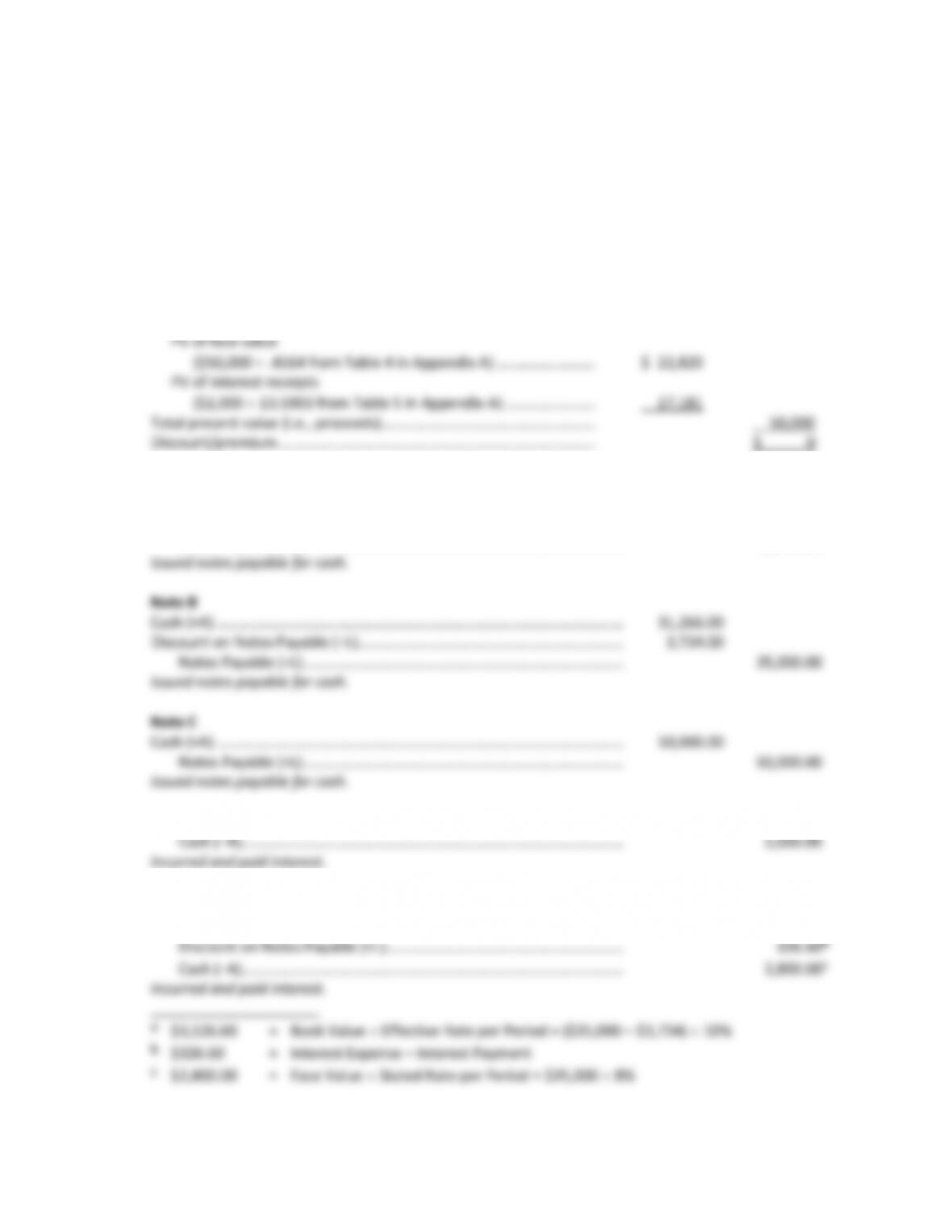
a. Note A
Face value …………………………..………………………………………………….. $ 20,000
Present value (i = 10%, n = 5)
PV of face value
($20,000 .6209 from Table 4 in Appendix A) …………………… $ 12,418
P11–4 Concluded
Note C
Face value …………………………..………………………………………………….. $ 50,000
Present value (i = 4%, n = 20)
b. Note A
Cash (+A) ……………………………………………………………………………………… 12,418.00
Discount on Notes Payable (–L)……………………………………………………….. 7,582.00
Notes Payable (+L) …………………………………………………………………… 20,000.00
c. Interest Expense (E, –SE) ………………………………………………………………… 2,000.00
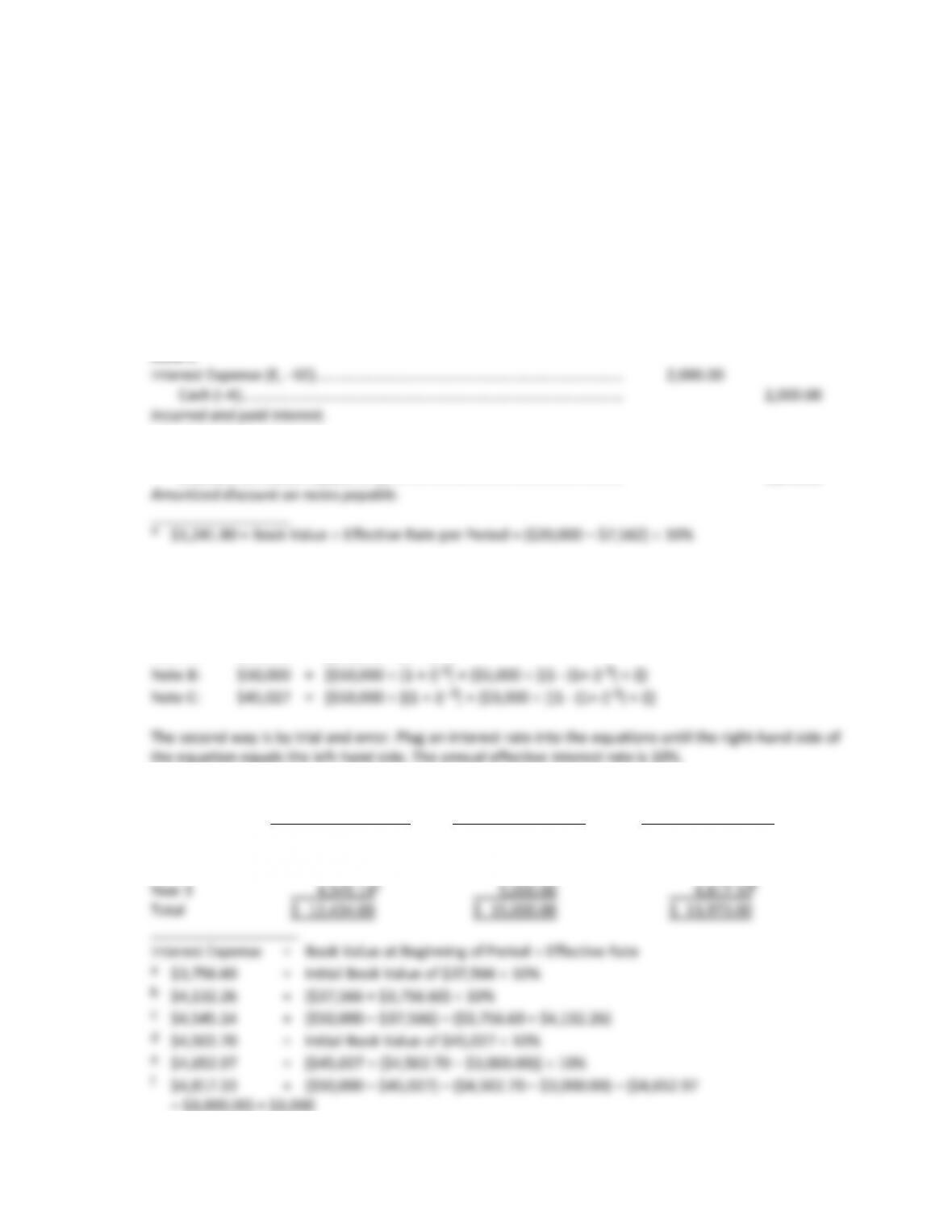
d. Note B
Interest Expense (E, –SE) ………………………………………………………………… 3,126.60a
P11–4 Continued
Note C
e. Interest Expense (E, –SE) ………………………………………………………………… 1,241.80*
Discount on Notes Payable (+L) …………………………………………………. 1,241.80
P11–5
a. The effective interest rate can be calculated in two ways. The first way is by solving for i in each of the
following equations.
Note A: $37,566 = [$50,000 (1 + i)-3]
b. Interest Expense Interest Expense Interest Expense
(Note A) (Note B) (Note C)
Year 1 $ 3,756.60a $ 5,000.00 $ 4,502.70d
Year 2 4,132.26b 5,000.00 4,652.97e
c. Note A
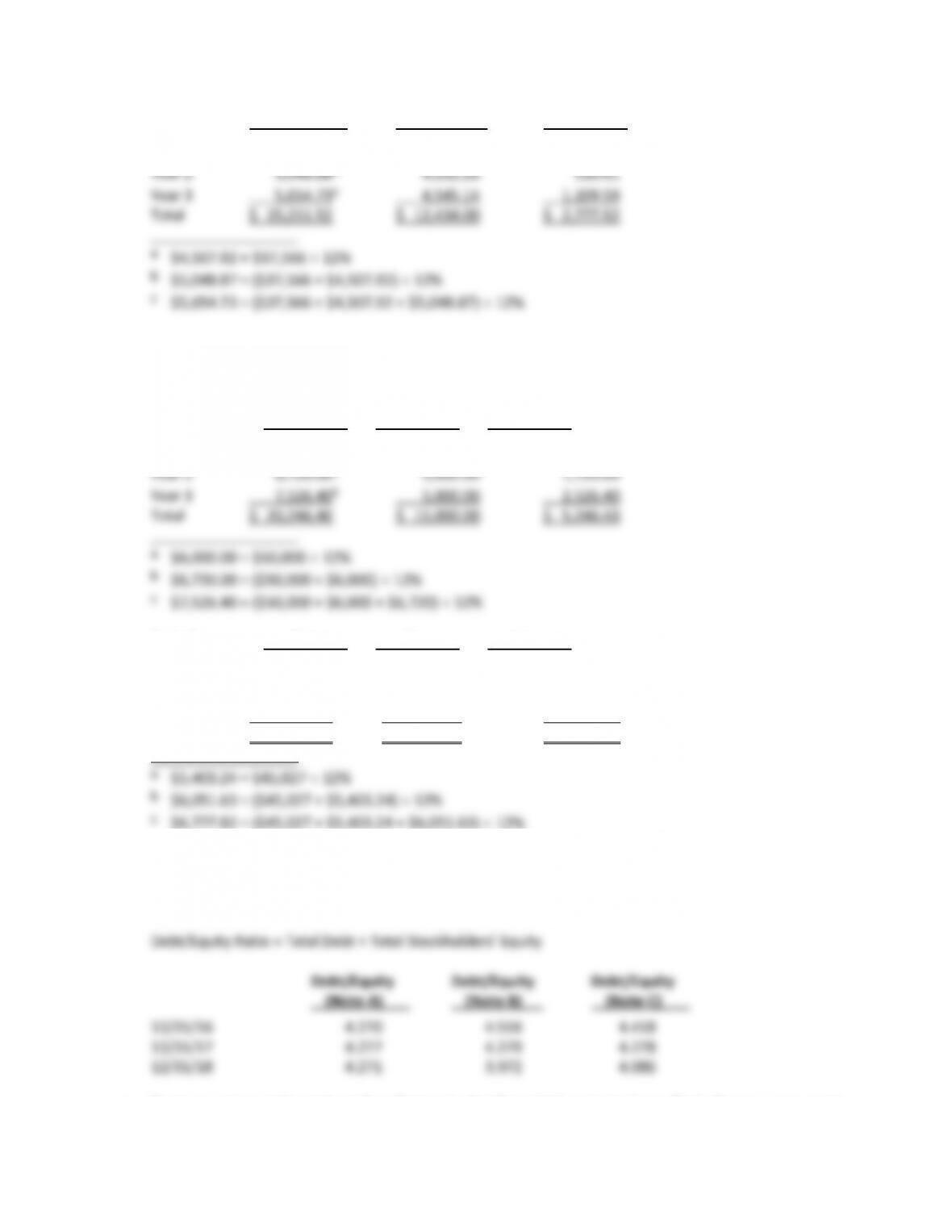
Return Expense Income
Year 1 $ 4,507.92a $ 3,756.60 $ 751.32
P11–5 Concluded
Note B Return Expense Income
Year 1 $ 6,000.00a $ 5,000.00 $ 1,000.00
Note C Return Expense Income
Year 1 $ 5,403.24a $ 4,502.70 $ 900.54
Year 2 6,051.63b 4,652.97 1,398.66
Year 3 6,777.82c 4,817.33 1,960.49
Total $ 18,232.69 $ 13,973.00 $ 4,259.69
d. Total Debt = Current Liabilities as of 12/31/15 + (Long-Term Liabilities as of
12/31/15 + Face Value of Notes Payable – Discount Balance)
Total Stockholders‘ Equity = Stockholders’ Equity as of 12/31/15 + Net Income
e. Boyton must consider at least four factors in deciding which note to issue. First, the company must
consider the income that can be earned from the proceeds. Since Note B provides the largest proceeds,
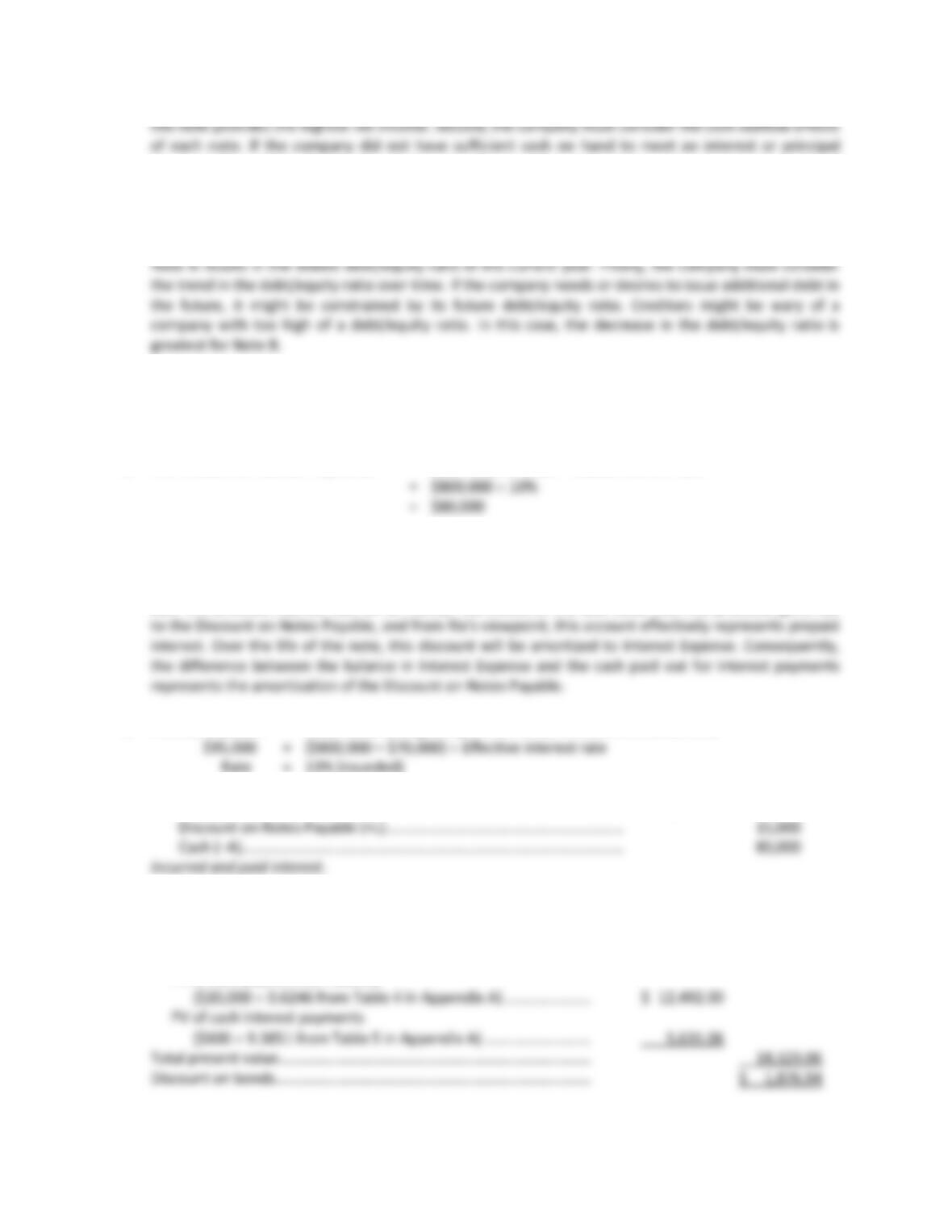
payment, it could be forced into bankruptcy. Since each note requires a payment at maturity of
$50,000, the only difference between the notes is the periodic interest payments. In this case, Note A
requires the lowest interest payments. Third, the company must consider the immediate effects on its
debt/equity ratio. If the company has any existing debt with a debt covenant that specifies a maximum
debt/equity ratio, one of the notes may cause the company to violate the debt covenant. In this case,
P11–6
a. The Amount of Interest Payments = Face Value of Debt Stated Interest Rate
b. When the note payable was issued, the stated interest rate did not equal the effective interest rate; the
effective interest rate exceeded the stated interest rate. Consequently, the proceeds from the note
were less than face value, so that the entire loan to Rix Driving Range and Health Club would actually
earn the effective interest rate on its money. The excess of the face value over the proceeds gave rise
c. Interest Expense = Book Value at Beginning of the Period Effective Interest Rate
d. Interest Expense (E, –SE) ………………………………………………………………… 95,000
P11–7
a. Face value …………………………..…………………………………………………. $ 20,000.00
Present value (i = 4%, n = 12)
PV of cash payment at maturity
b. Face value …………………………..…………………………………………………. $ 20,000.00
Present value (i = 4%, n = 11)
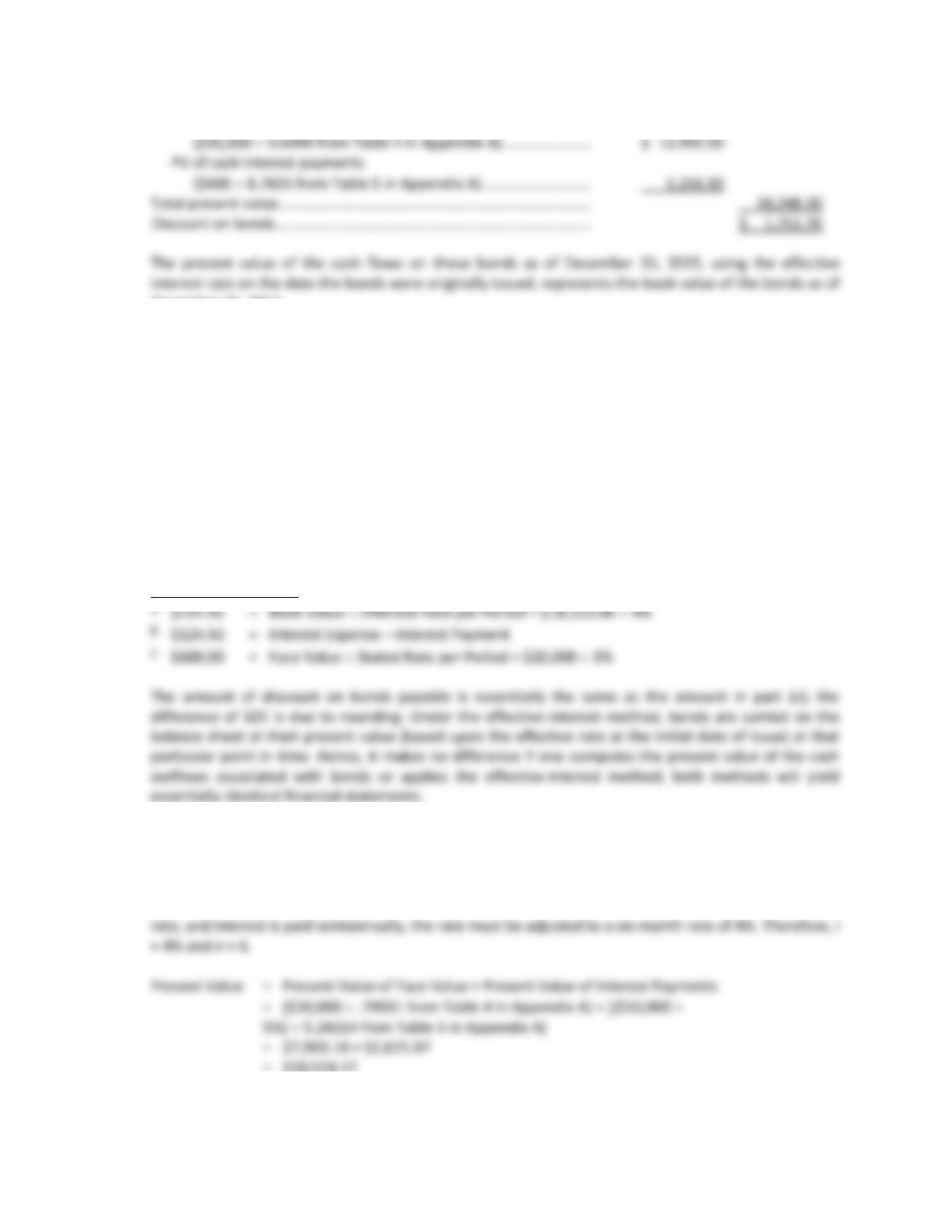
PV of cash payment at maturity
December 31, 2015.
c. The difference of $125.24 in present values from June 30, 2015 and December 31, 2015 represents the
change in book value of these bonds for this six-month period. The change in book value would be
captured by the amortization of the Discount on Bonds Payable account.
P11–7 Concluded
d. Interest Expense (E, –SE) ………………………………………………………………… 724.92a
Discount on Bonds Payable (+L) ………………………………………………… 124.92b
Cash (–A) ………………………………………………………………………………… 600.00c
Incurred and paid interest.
P11–8
a. To compute the amount of money that Ross Running Shoes must invest on June 30, 2015, the future
cash flows must be discounted at the investment rate of 8%. Since the investment rate is an annual
= $10,524.17
b. Interest Expense (E, –SE) ………………………………………………………………… 420.97a
Premium on Notes Payable (–L) ………………………………………………………. 79.03b
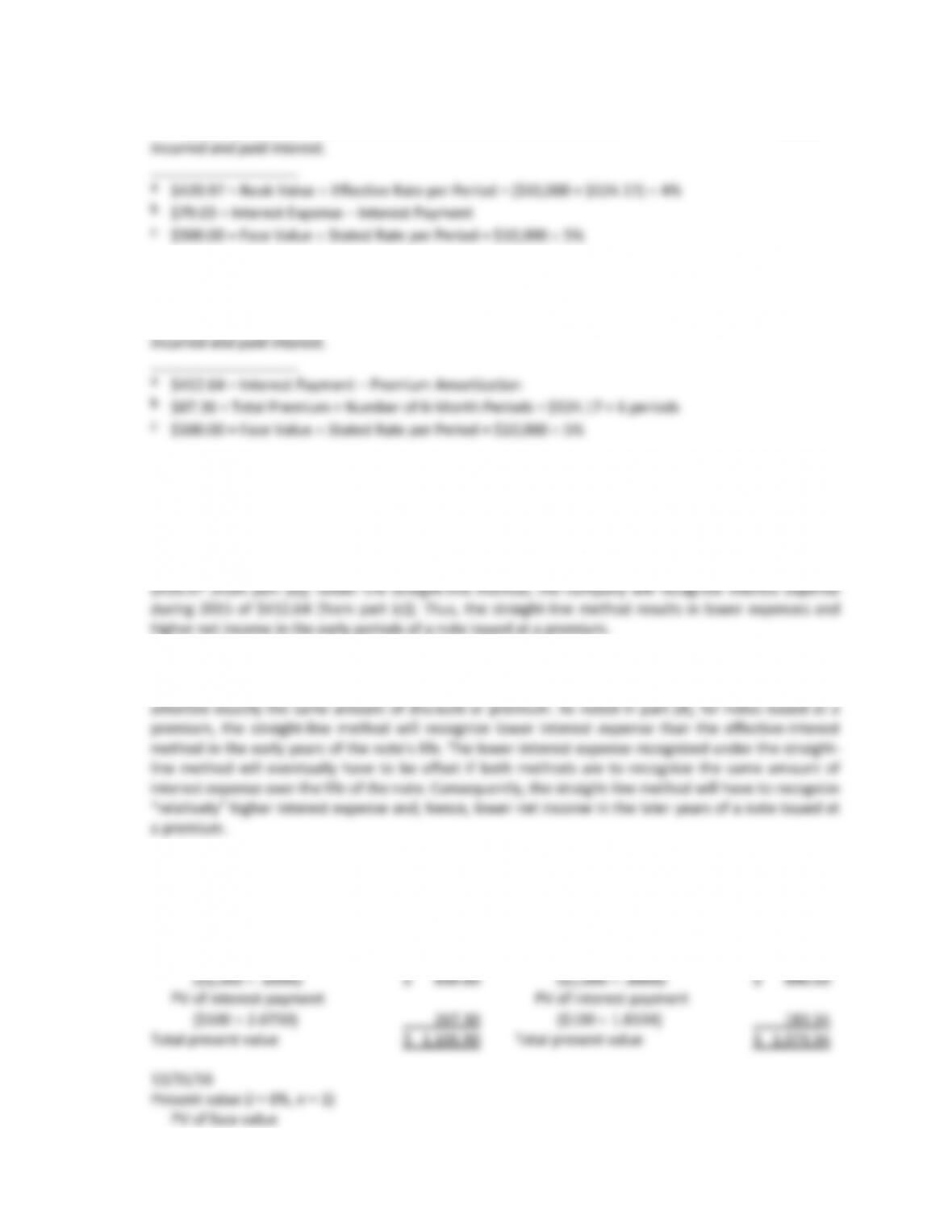
Cash (–A) ………………………………………………………………………………… 500.00c
c. Interest Expense (E, –SE) ………………………………………………………………… 412.64a
Premium on Notes Payable (–L) ………………………………………………………. 87.36b
Cash (–A) ………………………………………………………………………………… 500.00c
P11–8 Concluded
d. Under the effective-interest method, the company will recognize interest expense during 2015 of
e. Over the life of a note or bond, both the effective-interest and straight-line methods will amortize the
entire discount or premium balance. Consequently, over the life of a note or bond, both methods will
P11–9
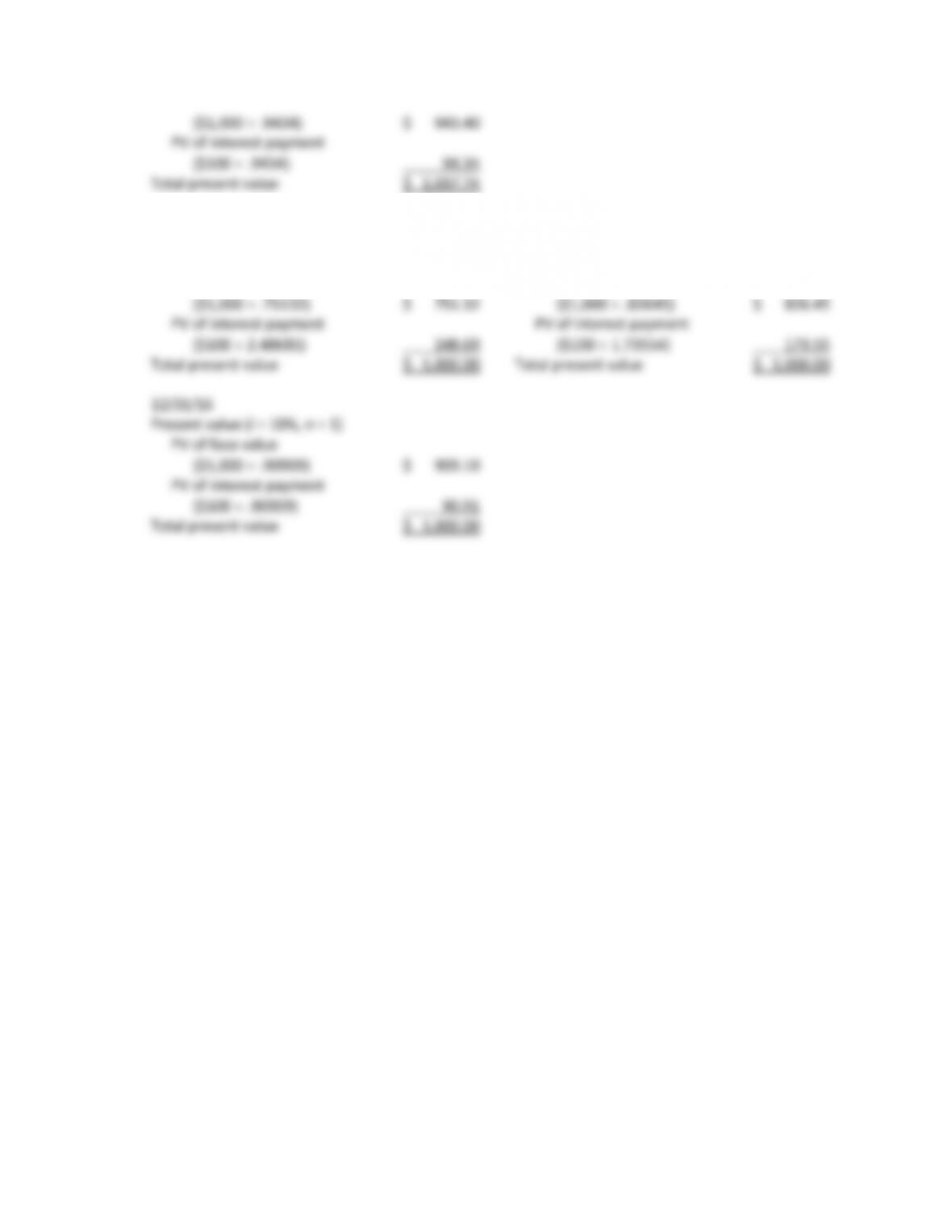
a. Note A
1/1/15 12/31/15
Present value (i = 6%, n = 3) Present value (i = 6%, n = 2)
PV of face value PV of face value
Note B
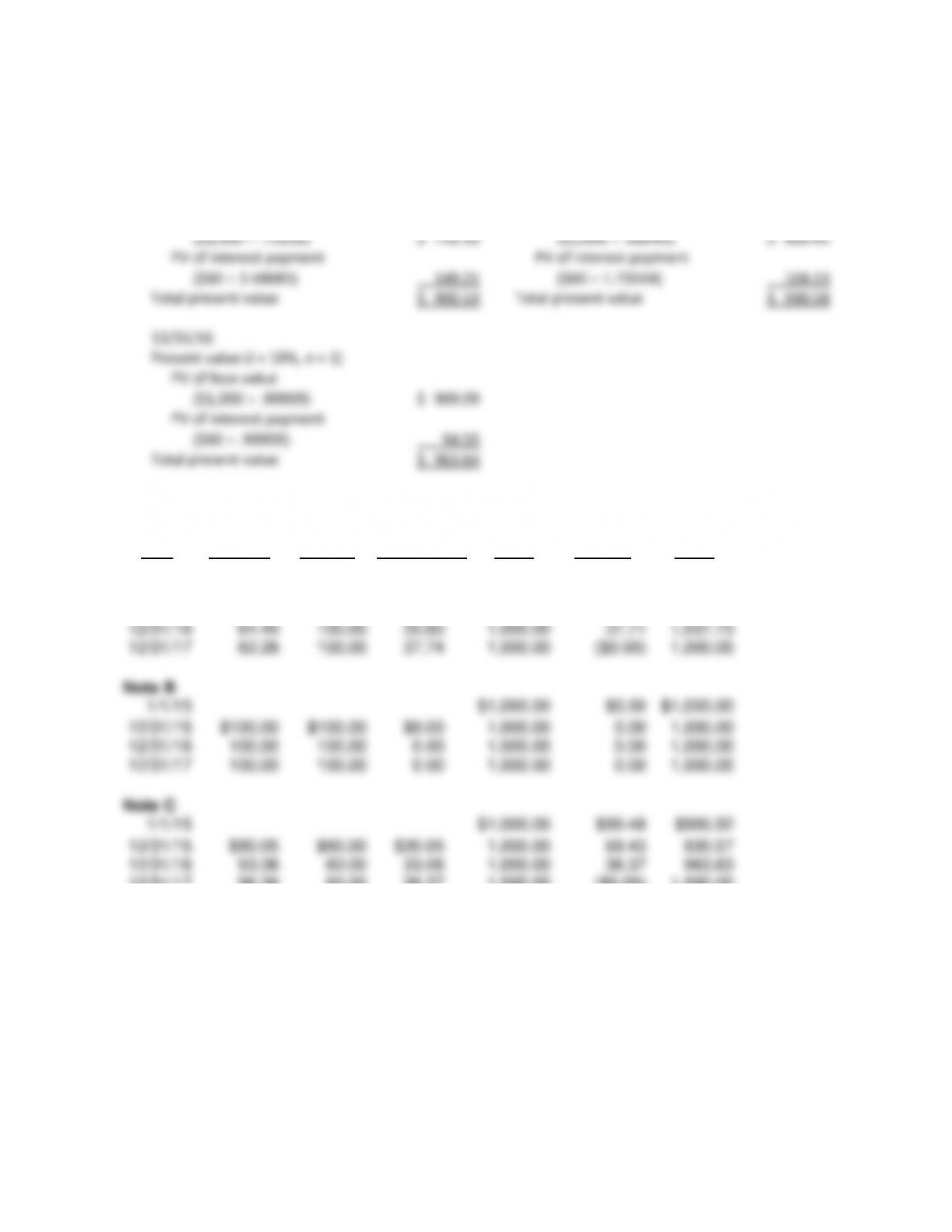
1/1/15 12/31/15
Present value (i = 10%, n = 3) Present value (i = 10%, n = 2)
PV of face value PV of face value
P11–9 Continued
Note C
1/1/15 12/31/15
Present value (i = 10%, n = 3) Present value (i = 10%, n = 2)
PV of face value PV of face value
b.
Interest
Payment
Disc./Prem.
Face
Disc./Prem.
Book
Date
Expense
Amount
Amortization
Value
Balance
Value
Note A
1/1/15
$1,000.00
$106.90
$1,106.90
12/31/15
$66.42
$100.00
$33.58
1,000.00
73.32
1,073.32
12/31/16
64.40
100.00
35.60
1,000.00
37.71
1,037.73
12/31/17
62.26
100.00
37.74
1,000.00
($0.00)
1,000.00
Note B
1/1/15
$1,000.00
$0.00
$1,000.00
12/31/15
$100.00
$100.00
$0.00
1,000.00
0.00
1,000.00
12/31/16
100.00
100.00
0.00
1,000.00
0.00
1,000.00
12/31/17
100.00
100.00
0.00
1,000.00
0.00
1,000.00
Note C
1/1/15
$1,000.00
$99.48
$900.52
12/31/15
$90.05
$60.00
$30.05
1,000.00
69.43
930.57
12/31/16
93.06
60.00
33.06
1,000.00
36.37
963.63
12/31/17
96.36
60.00
36.37
1,000.00
($0.00)
1,000.00
P11–9 Concluded
c.
Interest
Payment
Disc./Prem.
Face
Disc./Prem.
Book
Date
Expense
Amount
Amortization
Value
Balance
Value
Note A
1/1/15
$1,000.00
$106.90
$1,106.90
12/31/15
$64.37
$100.00
$35.63
1,000.00
71.27
1,071.27
12/31/16
64.37
100.00
35.63
1,000.00
35.63
1,035.63
12/31/17
64.37
100.00
35.63
1,000.00
0.00
1,000.00
Note B
1/1/15
$1,000.00
$0.00
$1,000.00
12/31/15
$100.00
$100.00
$0.00
1,000.00
0.00
1,000.00
12/31/16
100.00
100.00
0.00
1,000.00
0.00
1,000.00
12/31/17
100.00
100.00
0.00
1,000.00
0.00
1,000.00
Note C
1/1/15
$1,000.00
$99.48
$900.52
12/31/15
$26.84
$60.00
$33.16
1,000.00
66.32
933.68
12/31/16
26.84
60.00
33.16
1,000.00
33.16
966.84
12/31/17
26.84
60.00
33.16
1,000.00
($0.00)
1,000.00
d. Compare parts (b) and (c) to part (a). The effective interest method maintains the net book value of the
liability equal to the present value of the future cash flows of the liability throughout the liability’s life.
P11–10
a. Book Value of Debt = Face Value of $500,000 + Premium Balance of $12,600
= $512,600
b. Cash Paid to Retire Debt = Face Value 108%