1
LONG-TERM LIABILITIES: NOTES, BONDS, AND LEASES
BRIEF EXERCISES
BE11–1
a. During 2012 Radio Shack paid down $88.1 million of notes payable (long-term debt) and borrowed
$175.0 million of other long-term debt. Further, the reduction in the unamortized discount reflects the
b. Assuming the discount applies to the 6.75% notes and assuming that the debt reduction occurred
c. If Radio Shack paid $300 million to retire the notes in 2012 the company would have recorded a gain of
BE11–2
a. The life of these bonds is 20 years, from 1997 until 2017.
BE11–3
a. The operating lease payments reduced the reported income for the period, reduced the assets on the
balance sheet (payment of cash), and impacted the statement of cash flows by reducing the net income
b. The interest portion of capital lease payments and the depreciation on the capitalized lease assets
reduce reported net income for the period. They also impact the balance sheet by reducing both the
c. The $120 million of operating leases is a form of off-balance sheet financing for SuperValu. Supervalu
E11–1
a. Melrose Enterprises’ debt/equity ratio is currently 1.25 [($200,000 + $300,000) ÷ $400,000]. The
company’s loan agreement specifies that debt can be twice the stockholders’ equity. Consequently, the
b. By definition, Melrose Enterprises will settle its December 31, 2014 current liabilities sometime during
2015. The company will probably also incur new current liabilities as of December 31, 2015. Since no
information is provided as to the expected amount of current liabilities as of December 31, 2015, a
c. At the end of 2015, Melrose Enterprises would have $200,000 in current liabilities and $300,000 in
long-term debt for total debt of $500,000, and it would have $450,000 in stockholders‘ equity
($400,000 + $950,000 in revenues – $800,000 in expenses – $100,000 in declared dividends). The
E11–2
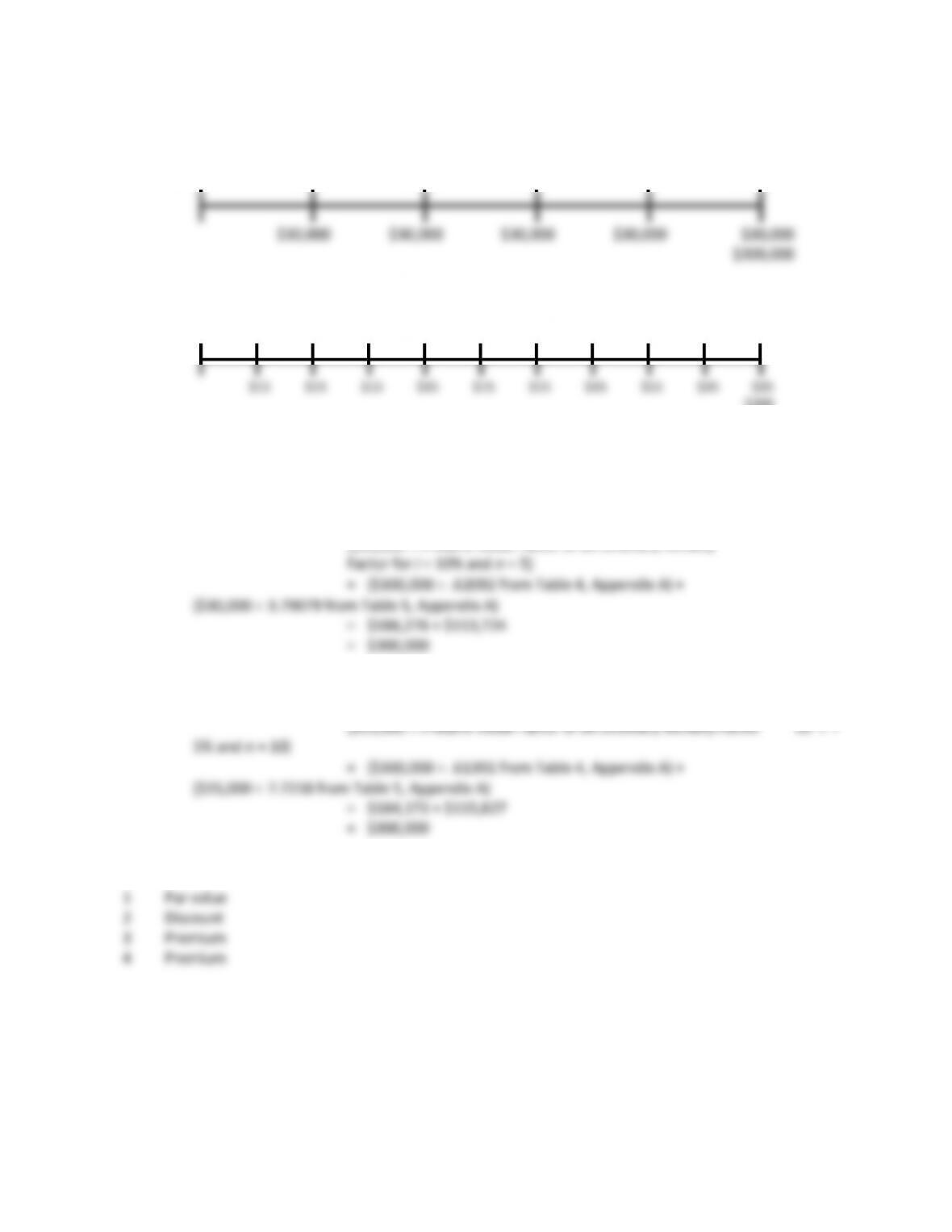
a.
1/1/14 1/1/15 1/1/16 1/1/17 1/1/18 1/1/19
b. All dollar amounts on the time line below are in thousands of dollars.
1/14 7/14 1/15 7/15 1/16 7/16 1/17 7/17 1/18 7/18 1/19
$300
c. Total Present Value = Present Value of Face Value + Present Value of Periodic Interest
Payments
(1) Annual interest payments:
Total Present Value = ($300,000 Present Value Factor for i = 10% and n = 5) +
($30,000 Present Value Factor of an Ordinary Annuity
(2) Semiannual interest payments:
Total Present Value = ($300,000 Present Value Factor for i = 5% and n = 10) +
E11–3
E11–4
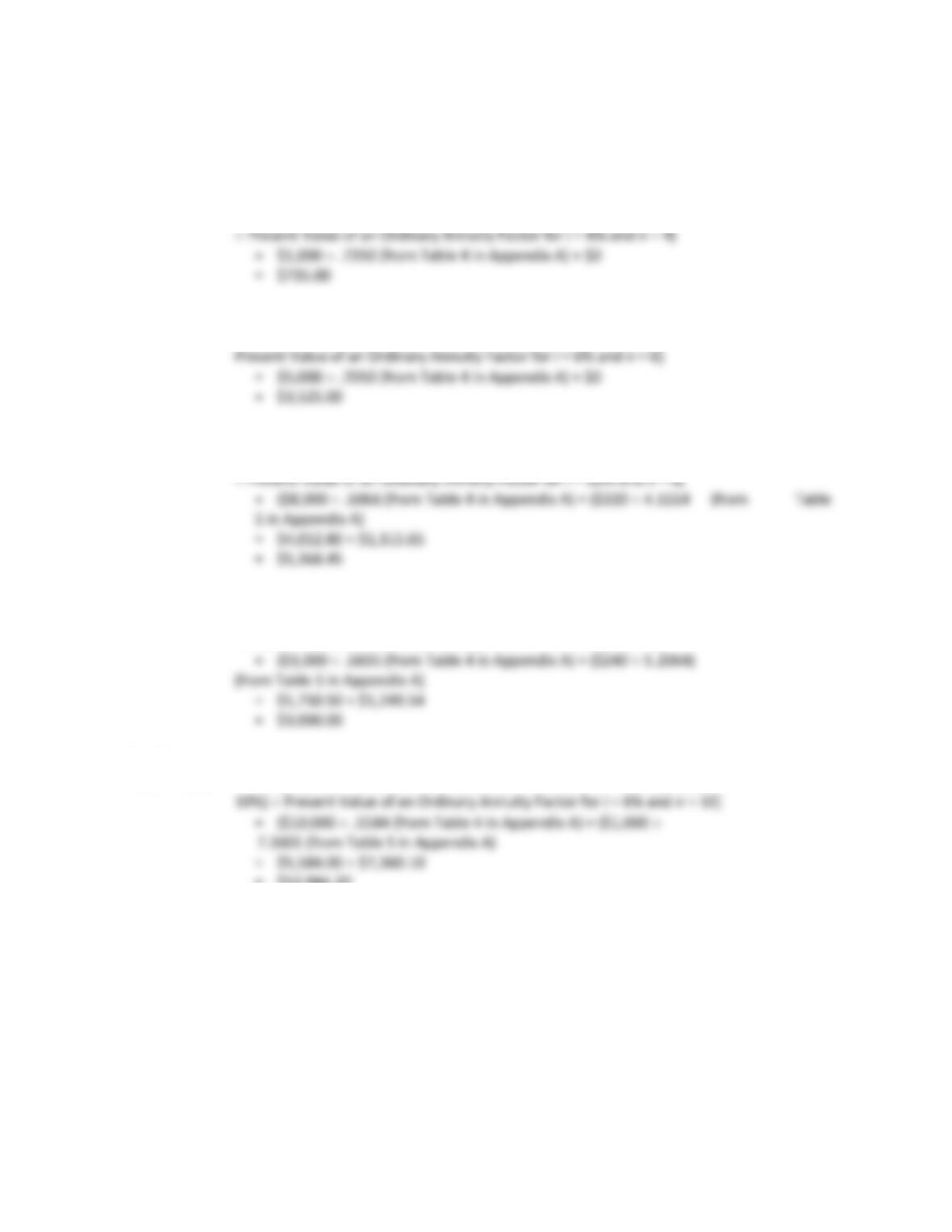
Present Value = Present Value of Face Value + Present Value of Interest Payments
Note 1
Present Value = ($1,000 Present Value Factor for i = 8% and n = 4) + [($1,000 0%)
Note 2
Present Value = ($5,000 Present Value Factor for i = 6% and n = 6) + [($5,000 0%)
Note 3
Present Value = ($8,000 Present Value Factor for i = 12% and n = 6) + [($8,000 4%)
Note 4
Present Value = ($3,000 Present Value Factor for i = 8 % and n = 7) + [($3,000 8%)
Present Value of an Ordinary Annuity Factor for i = 8% and n = 7]
Note 5
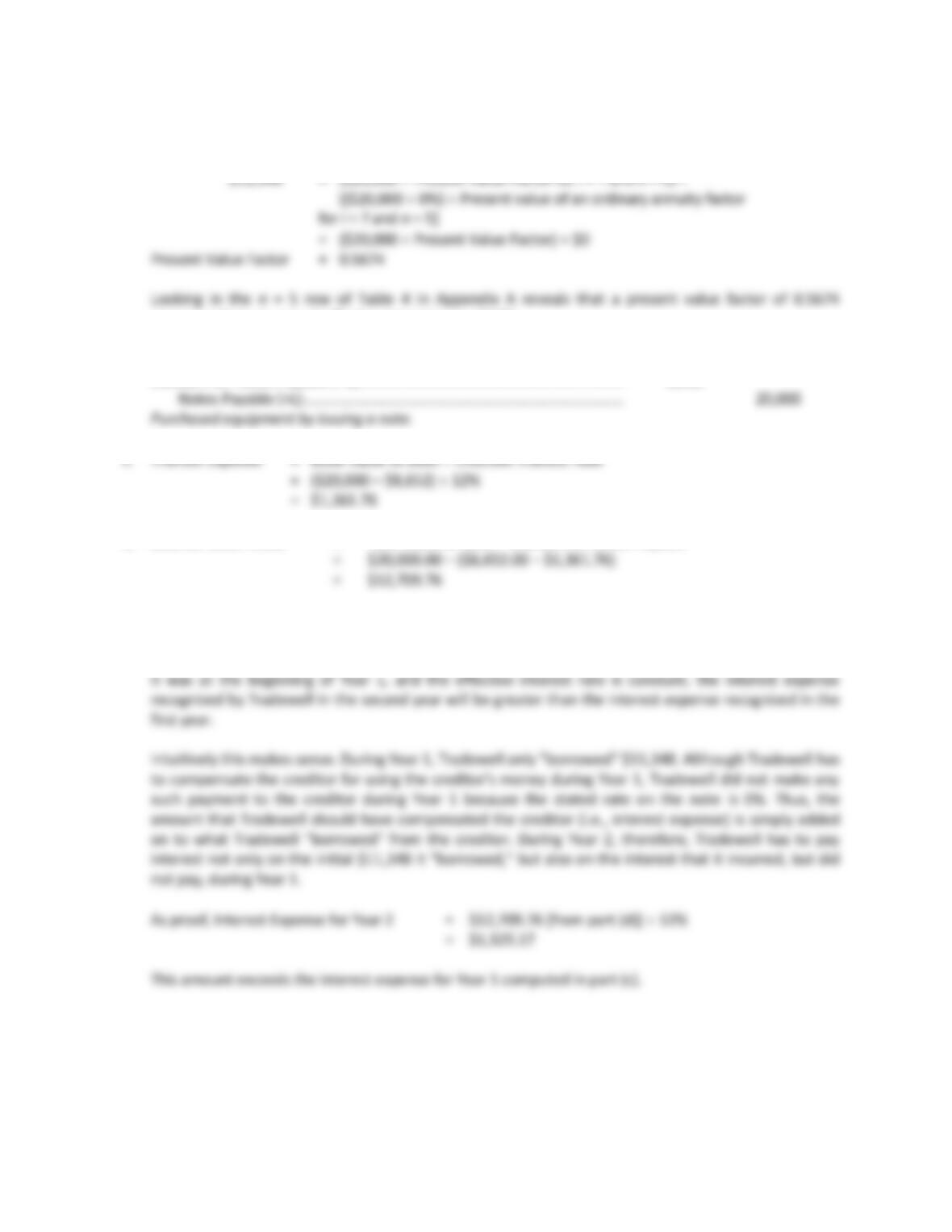
Present Value = ($10,000 Present Value Factor for i = 6 % and n = 10) + [($10,000
= $12,944.10
E11–5
a. Present Value = Present Value of Face Value + Present Value of Interest Payments
$11,348 = ($20,000 Present Value Factor for i = ? and n = 5) +
corresponds to an annual effective interest rate of 12%.
b. Equipment (+A) …………………………………………………………………………….. 11,348
Discount on Notes Payable (–L)……………………………………………………….. 8,652
d. Balance Sheet Value = Face Value of Note – Discount on Notes Payable
e. Interest expense is computed as the debt’s book value times the effective interest rate. For a note
issued at a discount, the book value will increase over time until the book value equals the face value
immediately prior to the note maturing. Since the book value is greater at the beginning of Year 2 than
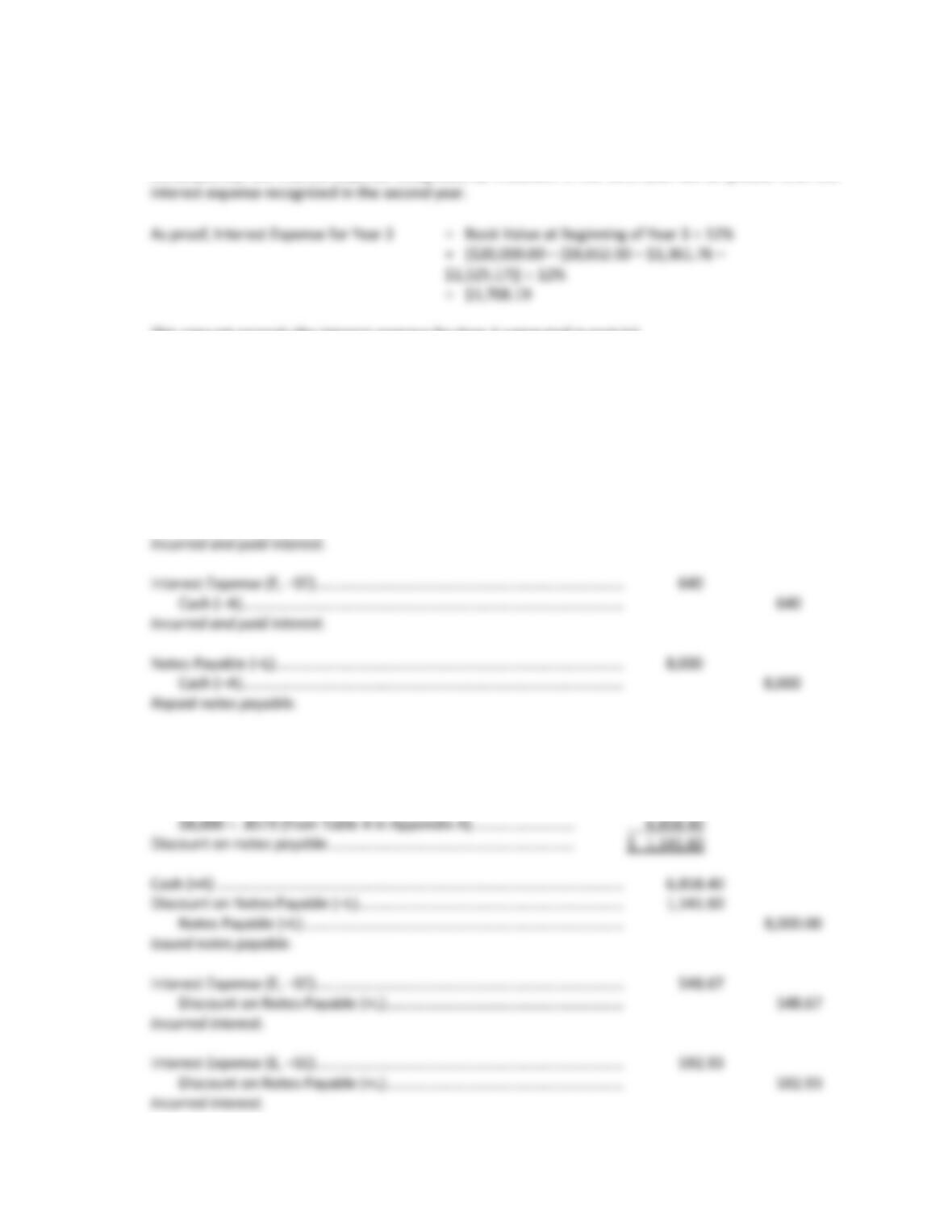
E11–5 Concluded
f. Since the note has not yet matured, the same logic used in part (e) can be applied to this question.
Consequently, the interest expense recognized by Tradewell in the third year will be greater than the
This amount exceeds the interest expense for Year 2 computed in part (e).
E11–6
a. Stated interest rate = 8%
Cash (+A) ……………………………………………………………………………………… 8,000
Notes Payable (+L) …………………………………………………………………… 8,000
Issued notes payable.
Interest Expense (E, –SE) ………………………………………………………………… 640
Cash (–A) ………………………………………………………………………………… 640
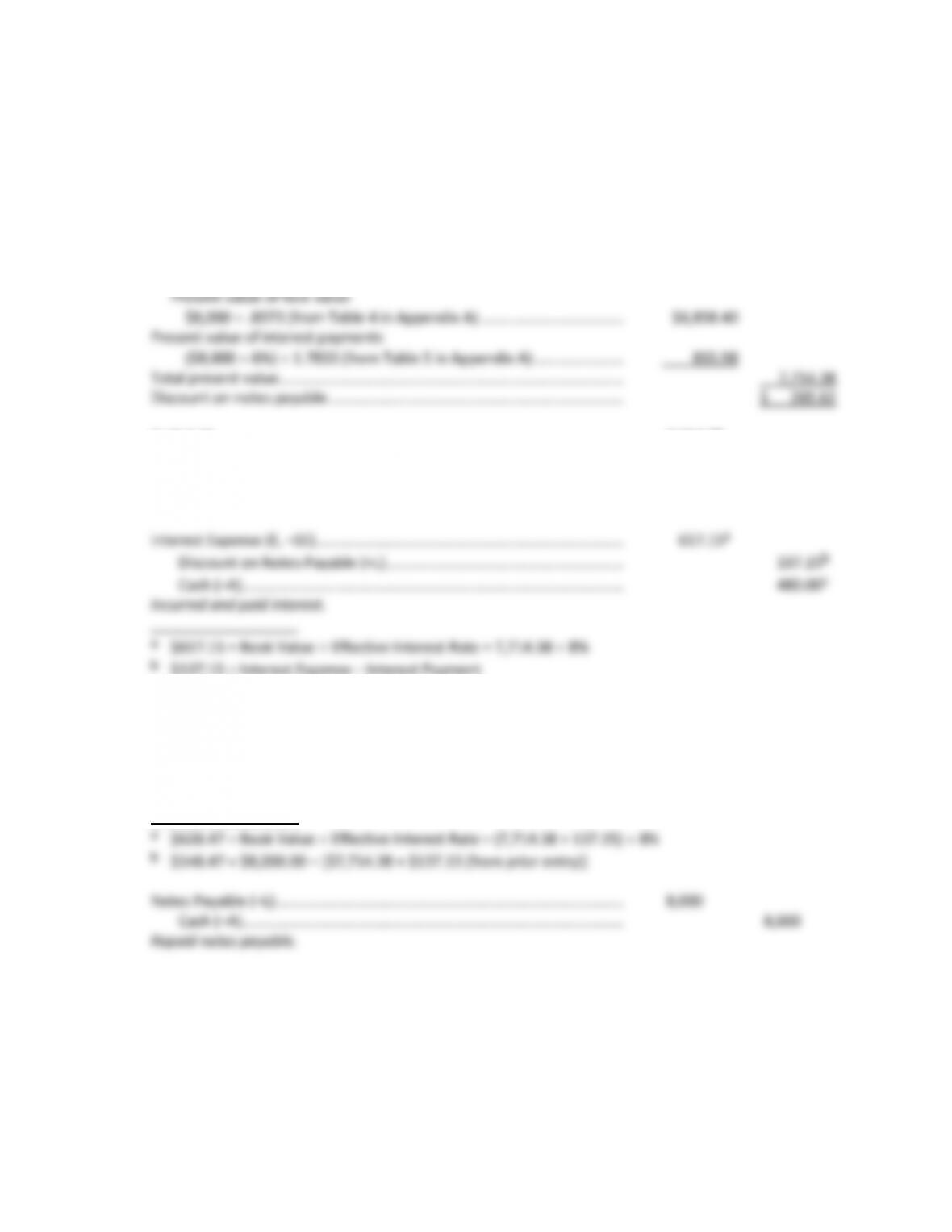
b. Stated interest rate = 0%
Face value ………………………………………………………………………….. $ 8,000.00
Present value (i = 8%, n = 2)
Present value of face value
E11–6 Concluded
Notes Payable (–L) …………………………………………………………………………. 8,000.00
Cash (–A) ………………………………………………………………………………… 8,000.00
Repaid notes payable.
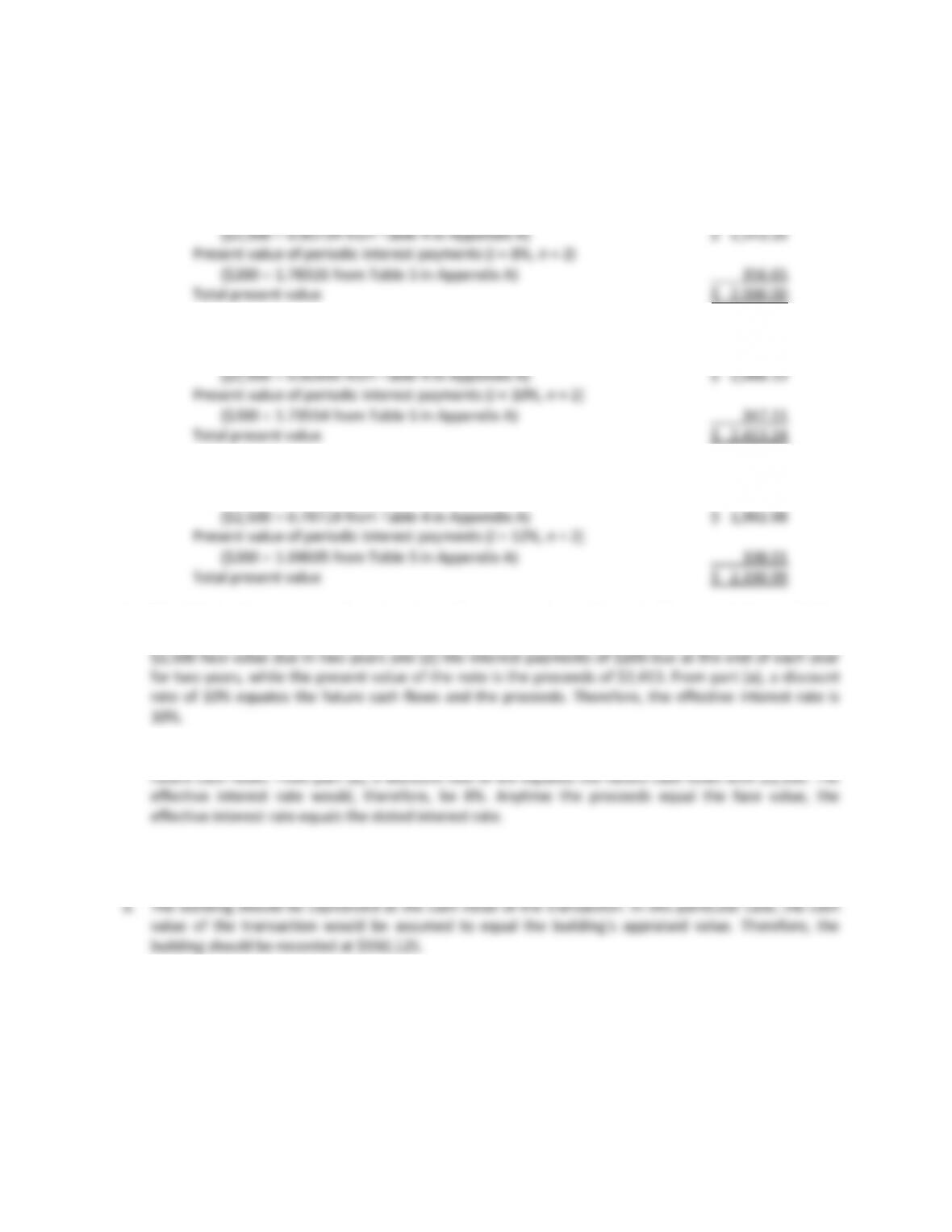
c. Stated interest rate = 6%
Face value …………………………………………………………………………………….. $8,000.00
Present value (i = 8%, n = 2)
Cash (+A) ……………………………………………………………………………………… 7,714.38
Discount on Notes Payable (–L)……………………………………………………….. 285.62
Notes Payable (+L) …………………………………………………………………… 8,000.00
Issued notes payable.
c $480.00 = Face Value Stated Interest Rate = $8,000 6%
Interest expense (E, –SE) ………………………………………………………………… 628.47a
Discount on Notes Payable (+L) …………………………………………………. 148.47b
Cash (–A) ………………………………………………………………………………… 480.00
Incurred and paid interest.
E11–7
a. Present value = Present value of face value + Present value of periodic interest payments
(1) Discount rate = 8%
Present value of face value (i = 8%, n = 2)
(2) Discount rate = 10%
Present value of face value (i = 10%, n = 2)
(3) Discount rate = 12%
Present value of face value (i = 12%, n = 2)
b. The effective interest rate is the interest rate that equates the undiscounted future cash flows with the
present value of the future cash flows. In this case, the undiscounted future cash flows are (1) the
c. If Wilmes Floral Supplies originally borrowed $2,500, the $2,500 would be the present value of the
E11–8
E11–8 Concluded
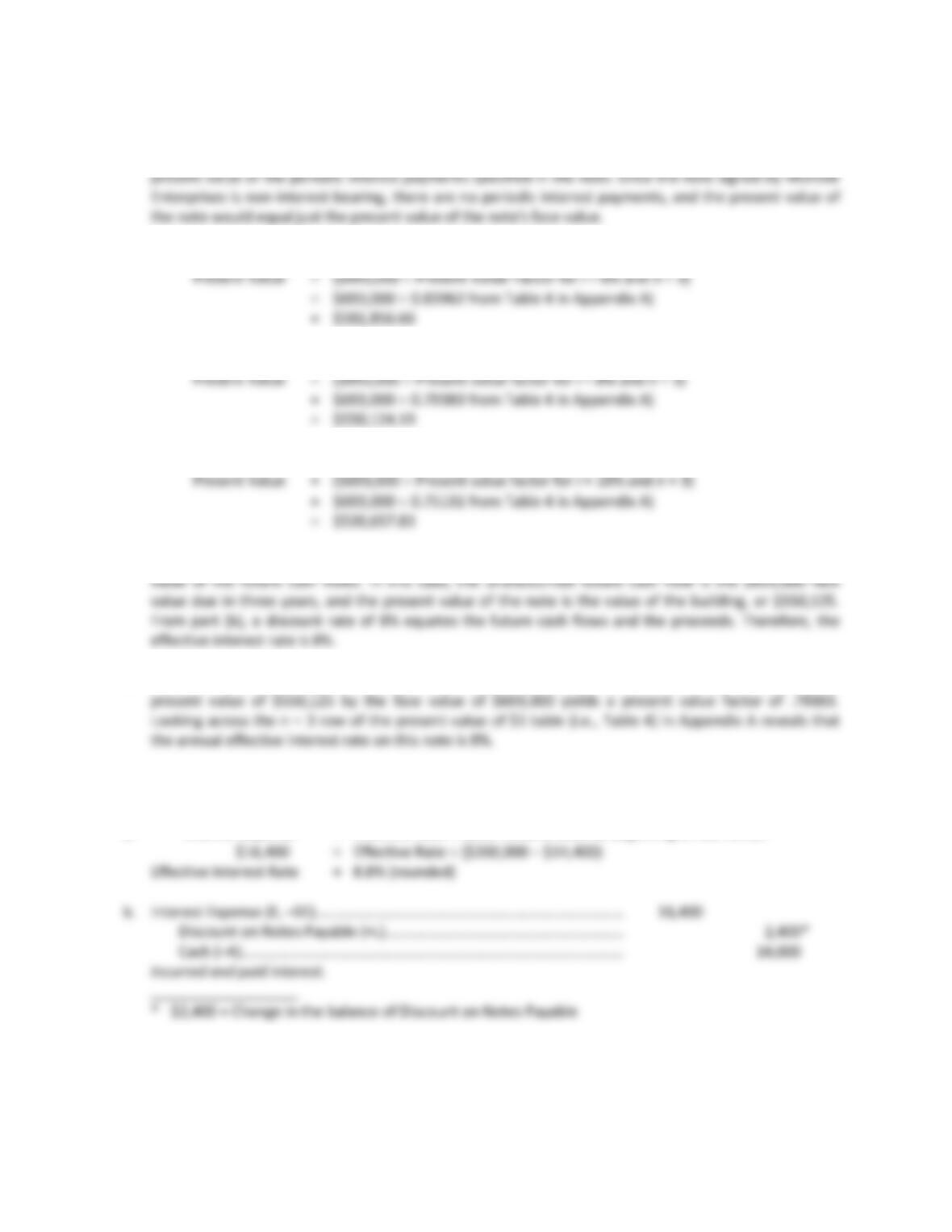
b. The total present value of a note equals the sum of the present value of the note’s face value and the
(1) Discount Rate = 6%
(2) Discount Rate = 8%
(3) Discount Rate = 10%
c. The effective interest rate is the rate that equates the undiscounted future cash flows with the present
d. Since the note is non-interest-bearing, the only cash flow is the face value of $693,000. Dividing the
E11–9
a. Interest Expense = Effective Rate Book Value of Debt at Beginning of the Period
E11–10
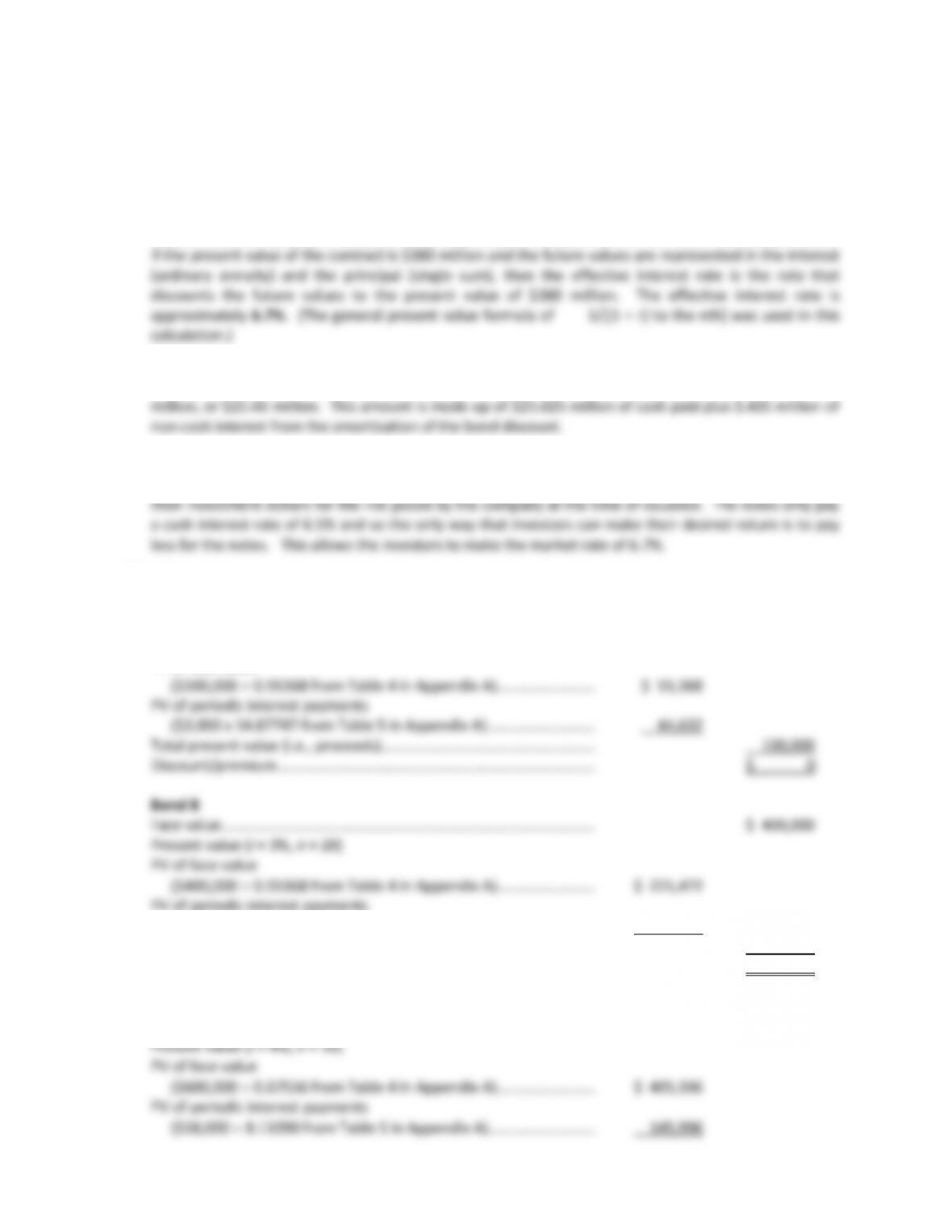
a. The ten-year notes call for annual interest of $25.025 million (stated rate of 6.5% X face value of $385
million) and the repayment of $385 million in principal. The proceeds of the notes were $380 million.
b. The interest expense for 2002 will be the effective rate of 6.7% multiplied by the proceeds of $380
c. The market paid less than $385 million for these bonds because the market demands 6.7% interest for
E11–11
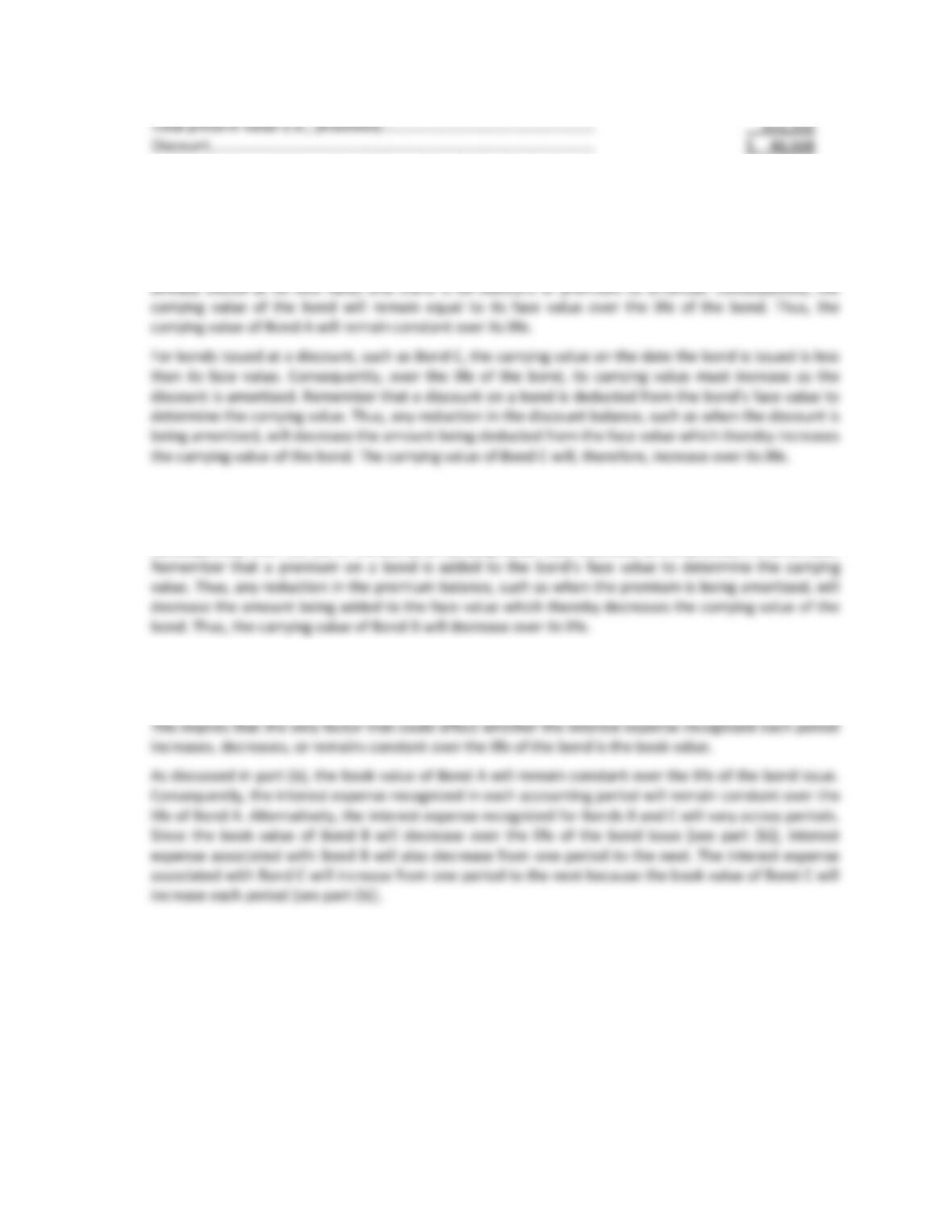
a. Bond A
Face value ………………………………………………………………………………. $ 100,000
Present value (i = 3%, n = 20)
PV of face value
PV of periodic interest payments
($16,000 14.87747 from Table 5 in Appendix A)…………………… 238,040
Total present value (i.e., proceeds) ……………………………………………. 459,512
Premium ………………………………………………………………………………… $ 59,512
Bond C
Face value ………………………………………………………………………………. $ 600,000
E11–11 Concluded
b. Immediately before a bond matures, its carrying value on the balance sheet must equal its face value.
Thus, discounts and premiums must be amortized over time so that the carrying value approaches the
bond’s face value over time. For bonds that are issued at their face value, such as Bond A, the bond is
Alternatively, the carrying value of Bond B will decrease over its life. For bonds issued at a premium,
such as Bond B, the carrying value on the date the bond is issued is greater than its face value.
Consequently, over the life of the bond, its carrying value must decrease as the premium is amortized.
c. Interest expense is computed as the bond‘s book value at the beginning of the accounting period times
the effective interest rate per period. Since accountants use the effective interest rate on the date a
bond is issued to calculate interest expense, the effective interest rate is constant over the bond‘s life.
E11–12
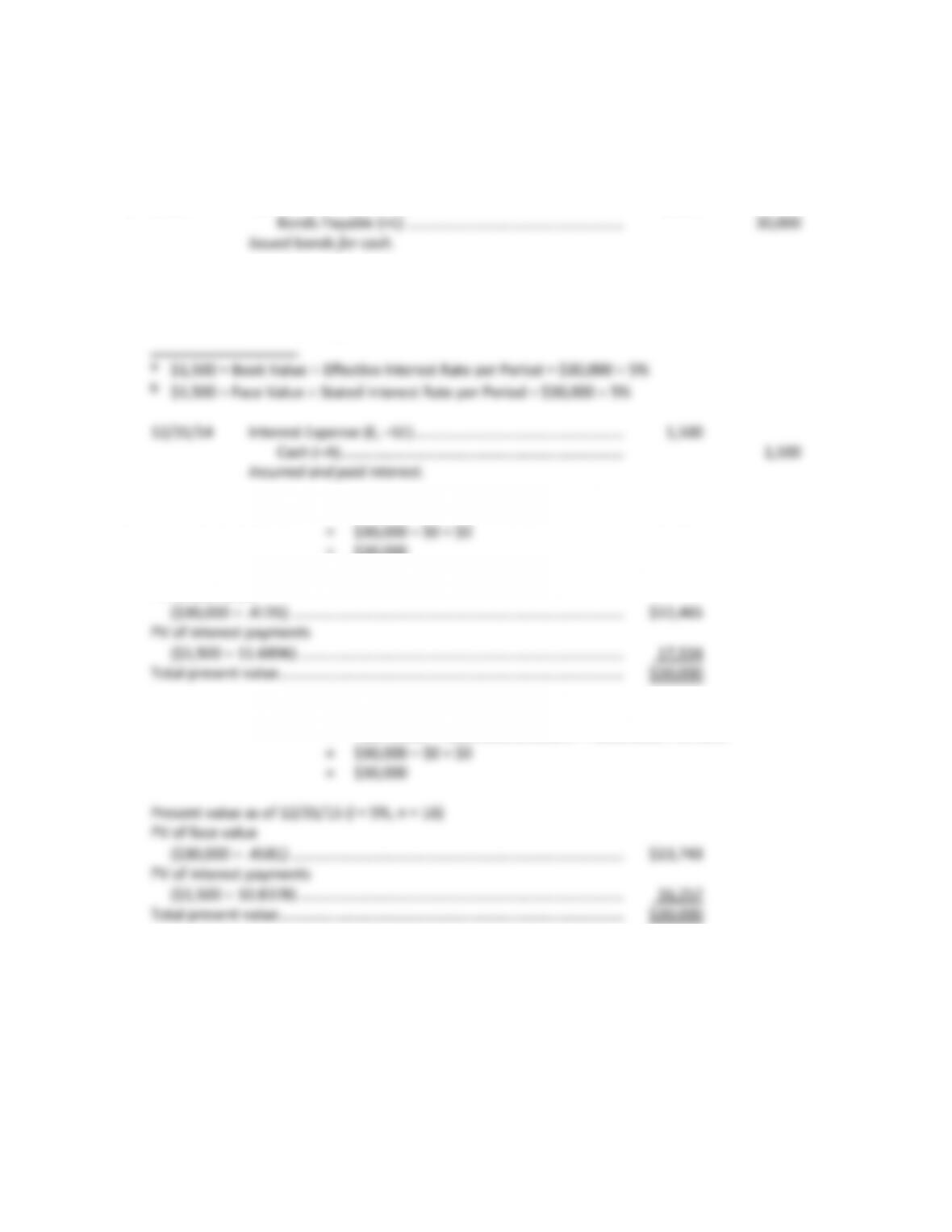
a. 1/1/14 Cash (+A)…………………………………………………………………. 30,000
b. 6/30/14 Interest Expense (E, –SE) …………………………..………………. 1,500a
Cash (–A) ……………………………………………………….….. 1,500b
Incurred and paid interest.
c. Balance Sheet Value = Face Value – Associated Discount + Associated Premium
= $30,000
d. Present value (i = 5%, n = 18)
PV of face value
e. Balance Sheet Value as of 12/31/15
= Face Value – Associated Discount + Associated Premium
Notice that the balance sheet value of $30,000 is identical to the present value just calculated.
Amortizing premiums and discounts using the effective interest rate results in bonds being carried on
the balance sheet at an amount equal to the present value of the future cash flows of the bonds, using
the effective interest rate on the date the bonds were issued as the discount rate.
E11–13
a. Face value ……………………………………………………………………………. $ 500,000
Present value (i = 4%, n = 10)
PV of face value
b. Interest Expense (E, –SE) ………………………………………………………………. 18,378.56a
Discount on Bonds Payable (+L) ………………………………………………. 3,378.56c
c. Balance sheet value as of 12/31/15 = Face value – Discount as of 12/31/15
= $462,842.56
d. Present value (i = 4%, n = 9)
PV of face value
($500,000 0.7026 from Table 4 in Appendix A)…………………………. $ 351,300.00
E11–14
a. Face value ……………………………………………………………………………. $ 100,000
Present value (i = 3%, n = 20)
E11–14 Concluded
Cash (+A) ……………………………………………………………………………………. 114,878
Premium on Bonds Payable (+L) ………………………………………………. 14,878
Bonds Payable (+L) ………………………………………………………………… 100,000
Issued bonds.
b. Interest Expense (E, –SE) ………………………………………………………………. 3,446.34a
Premium on Bonds Payable (-L) …………………………………………………….. 553.66c
c. Balance sheet value as of 12/31/15 = Face value + Premium as of 12/31/15
d. Present value (i = 3%, n = 19)
PV of face value
($100,000 0.57029 from Table 4 in Appendix A)……………………….. $ 57,029.00
E11–15
a. Since it is one year later, two interest periods have passed. Thus, there are only eight remaining
interest periods.
Present value (i = 3%, n = 8)
PV of face value
E11–15 Concluded
would cost the company $21,403.76 rather than $20,000.00. The amount of the loss is the excess of the
bond’s market value over the bond’s book value, or $1,403.76.
b. Present value (i = 5%, n = 8)
PV of face value
bonds’ book value over the bonds‘ market value, or $1,293.44.
c. Companies experience economic gains and losses when their wealth changes. In the case of bonds,
their market value indicates the company’s effective obligation on the bonds at that particular point in
time. If the market value exceeds the bonds’ book value, then the company has experienced a decrease
in wealth; if the market value is less than book value, then the company has experienced an increase in
wealth.
Such gains and losses, however, are not usually reflected in a company’s financial statements because it
is assumed that when a company issues bonds, the bonds will remain outstanding until they mature.
That is, the company will not retire the bonds before they mature. On the date that the company
E11–16
a. Cash paid to redeem the bonds = Face value 101%
= $500,000 101%
= $505,000
b. Bonds Payable (–L) ………………………………………………………………………… 500,000
Premium on Bonds Payable (–L) ……………………………………………………… 7,000
E11–17
a. Lilly paid $47 million to retire this debt. This is comprised of $35 million (book value of bonds), $7.2
million (after tax loss) plus $4.8 million (tax benefit of loss).
b. The $4.8 million is a benefit to the company because the loss offsets against the operating income of
E11–18
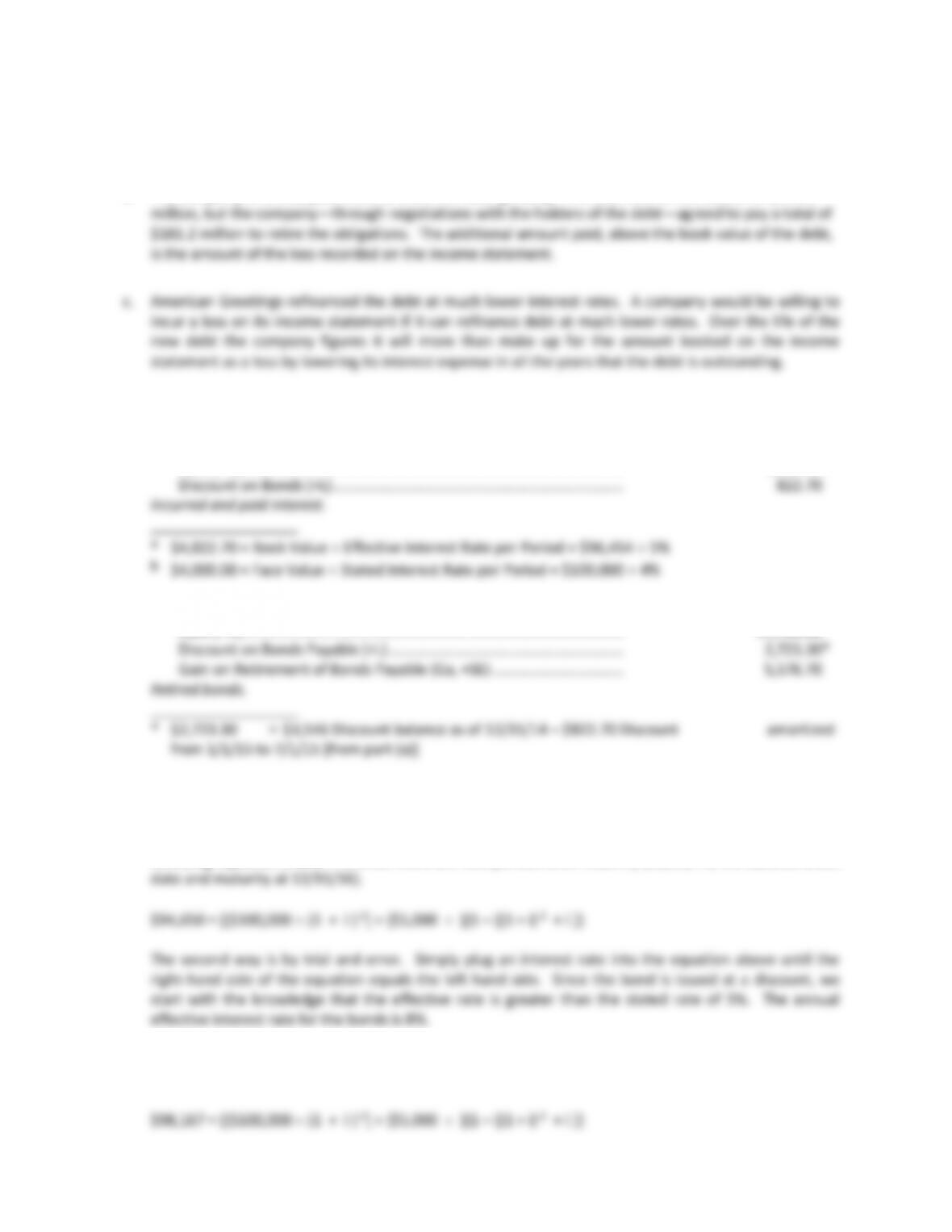
a. American Greetings paid cash of $181.2 million to retire the debt (book value of $142.2 million plus loss
on debt repurchase of $39.0 million).
b. The company, in effect, paid extra to make the debt go away. The debt was on the books for $142.2
E11–19
a. Interest Expense (E, –SE) ………………………………………………………………… 4,822.70a
Cash (–A) ………………………………………………………………………………… 4,000.00b
b. Bonds Payable (–L) ………………………………………………………………………… 100,000.00
Cash (–A) ………………………………………………………………………………… 91,700.00
E11–20
a. The effective interest rate can be calculated in two ways. The first way is by solving for i in the
following equation where n=2 since there are two periods until maturity (12/31/14, the balance sheet
b. To determine the effective rate an investor would be earning if the bonds were purchased on 12/31/14
at the market value of $98,167, perform the same procedure using the equation.
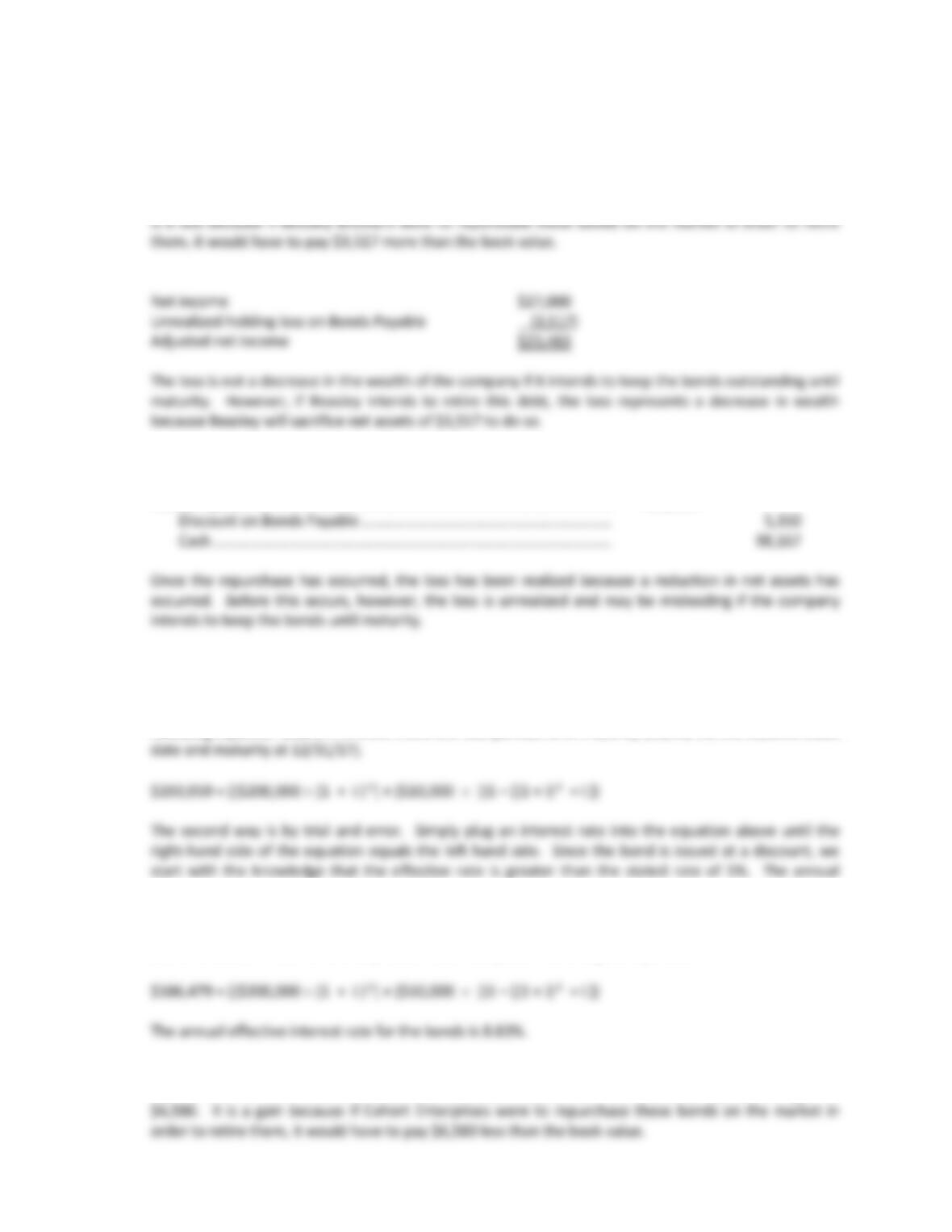
The annual effective interest rate for the bonds is 6%.
c. The book value of the bonds on Beasley Brothers’ books at December 31, 2014, is $94,650. The market
value of the bonds as of December 31, 2014, is $98,167. The difference represents a loss of $3,517. It
d.
Extraordinary Realized Loss on Retirement of Debt ………………………… 3,517
Bonds Payable ……………………………………………………………………………. 100,000
E11–21
a. The effective interest rate can be calculated in two ways. The first way is by solving for i in the
following equation where n=2 since there are two periods until maturity (12/31/15, the balance sheet
effective interest rate for the bonds is 6.92%.
b. To determine the effective rate an investor would be earning if the bonds were purchased on 12/31/15
at the market value of $186,479, perform the same procedure using the equation.
c. The book value of the bonds on Cohort Enterprises’ books at December 31, 2015 is $193,059. The
market value of the bonds as of December 31, 2015 is $186,479. The difference represents a gain of
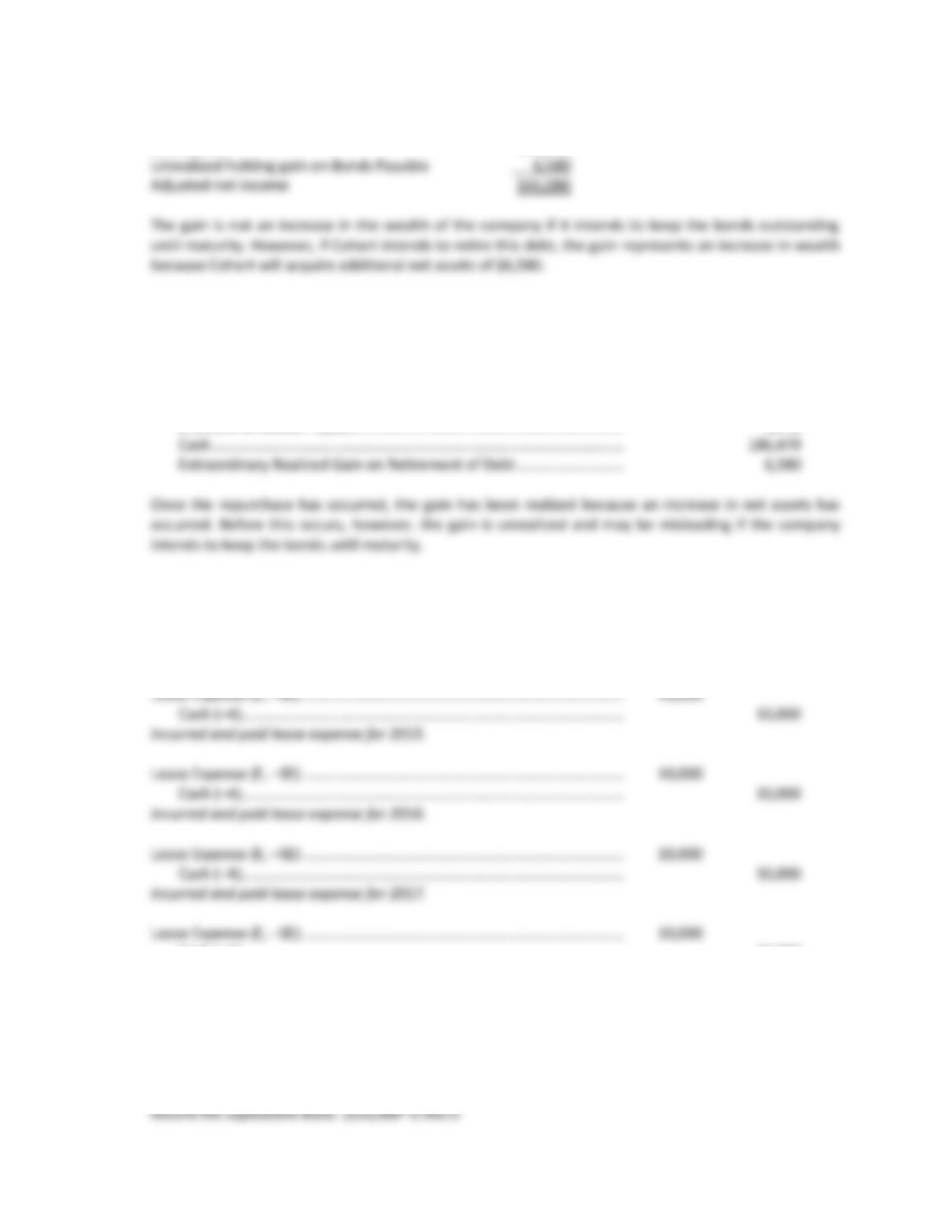
Net income $38,500
d.
Bonds payable …………………………..…………………………………………………. 200,000
Discount on Bonds Payable ………………………………………………………. 6,941
E11–22
a. Lease Expense (E, –SE) …………………………………………………………………… 10,000
Cash (–A) ………………………………………………………………………………… 10,000
Incurred and paid lease expense for 2014.
Cash (–A) ………………………………………………………………………………… 10,000
Incurred and paid lease expense for 2018.
b. The effective interest rate on the lease is 8%. The following entries would be recorded on Q–Mart’s
books.
Facility (A) …………………………………………………………………………………….. 39,927
Lease Liability (L) …………………………………………………………………….. 39,927
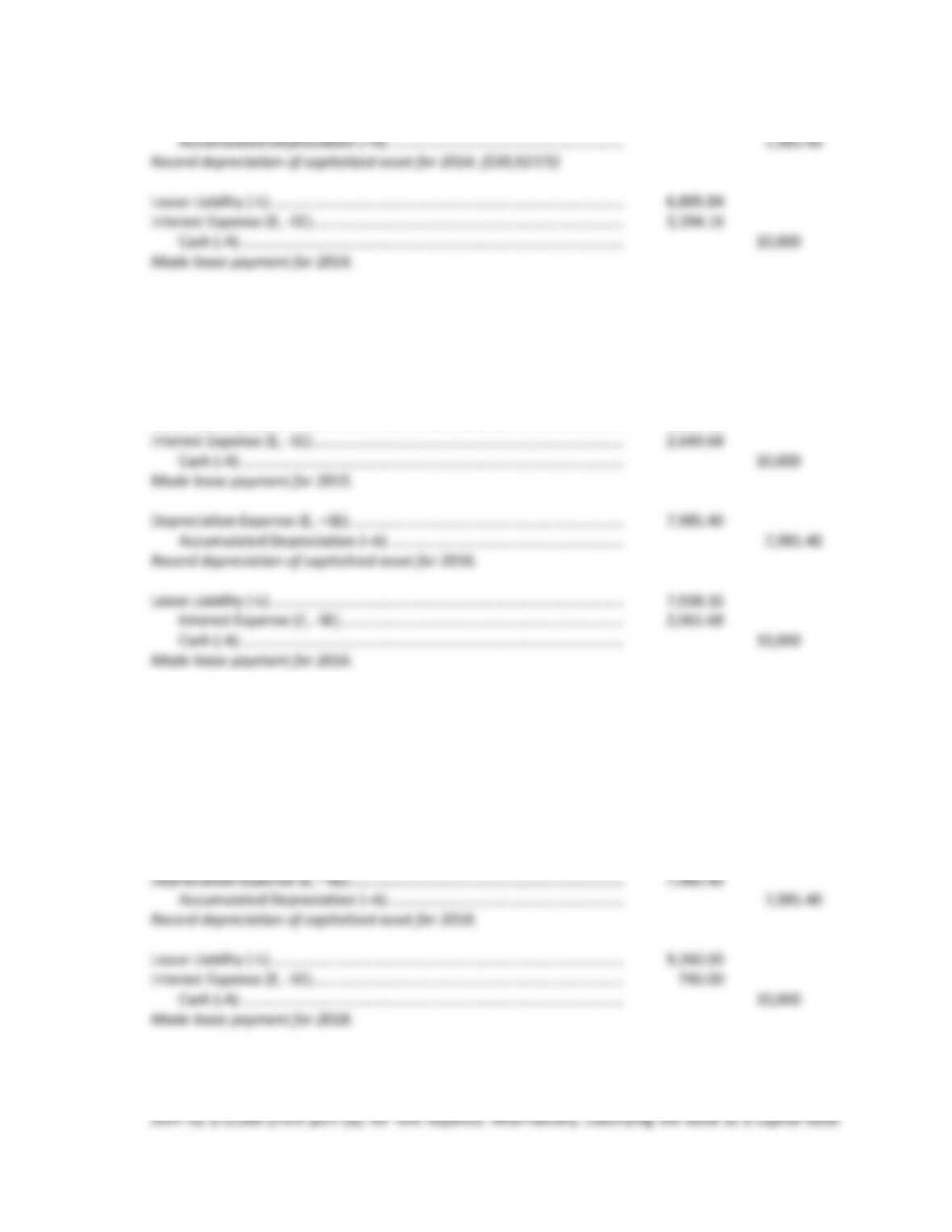
Depreciation Expense (E, –SE) …………………………………………………………. 7,985.40
Depreciation Expense (E, –SE) …………………………………………………………. 7,985.40
Accumulated Depreciation (–A) ………………………………………………… 7,985.40
Record depreciation of capitalized asset for 2015.
Lease Liability (–L) ………………………………………………………………………….. 7,350.32
Depreciation Expense (E, –SE) …………………………………………………………. 7,985.40
Accumulated Depreciation (–A) ………………………………………………… 7,985.40
Record depreciation of capitalized asset for 2017.
Lease Liability (–L) ………………………………………………………………………….. 8,573.36
Interest Expense (E, -SE) …………………………………………………………………. 1,426.64
Cash (-A) ………………………………………………………………………………… 10,000
Made lease payment for 2017.
c. Classifying the lease as an operating lease would give rise to both higher net income and a lower
debt/equity ratio. By classifying the lease as an operating lease, net income would be reduced during