P10–6 Concluded
b. Ending balance = Beginning balance + Promotional expense – Refund payments
P10–7
a.
Restructuing Expense (E, –SE) …………………………………………………………. 425
Assets (-A) ………………………………………………………………………………. 364
P10–8
a. 2010 2011
Pension Expense (E, –SE) …………………………... 40,000 40,000
Cash (–A) …………………………………………….. 32,000 32,000
Pension Liability (+L) …………………………….. 8,000 8,000
Funded pension.
b. Pension Expense Amount Funded Pension Liability
2010 $ 40,000 $ 32,000 $ 8,000
2011 40,000 32,000 8,000
2012 40,000 36,000 4,000
P10–9
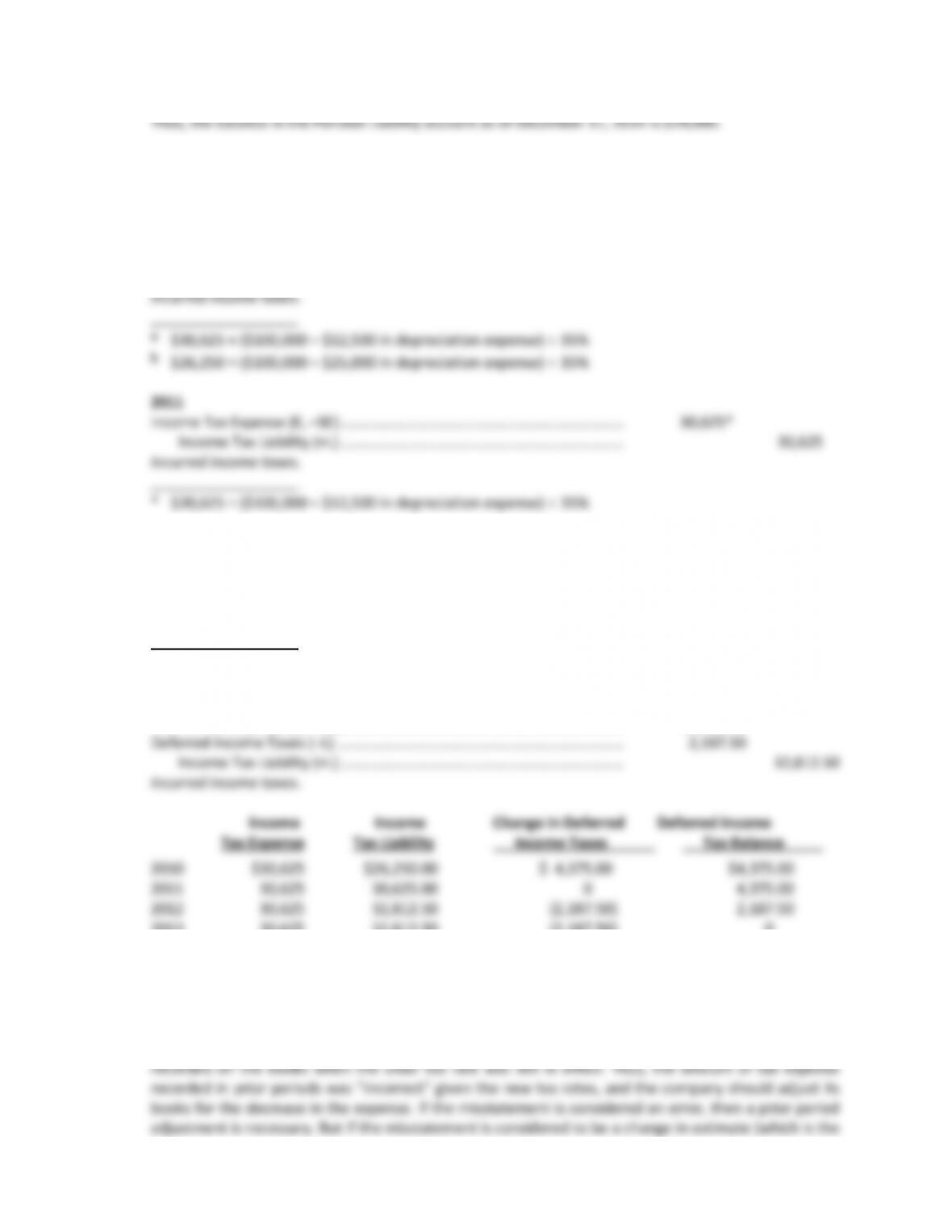
a. 2010
Income Tax Expense (E, –SE) …………………………………………………………… 30,625a
Deferred Income Taxes (+L)………………………………………………………. 4,375
Income Tax Liability (+L) …………………………………………………………… 26,250b
2012
Income Tax Expense (E, –SE) …………………………………………………………… 30,625.00
Deferred Income Taxes (–L) ……………………………………………………………. 2,187.50
Income Tax Liability (+L) …………………………………………………………… 32,812.50*
Incurred income taxes.
* $32,812.50 = ($100,000 – $6,250 in depreciation expense) 35%
2013
Income Tax Expense (E, –SE) …………………………………………………………… 30,625.00
2013 30,625 32,812.50 (2,187.50) 0
b. The balance in Deferred Income Taxes represents the amount a company will, theoretically, have to pay
the government in the future. Amount differences, such as arise when a company uses different
depreciation methods for financial reporting and tax purposes, between book and taxable income
reverse themselves over time. If the government lowers the tax rate, then the tax liability in future
periods when the timing differences reverse themselves will be lower than the associated tax expense
P10–9 Continued
2010 Same as in part (a)
2011 Same as in part (a)
2012
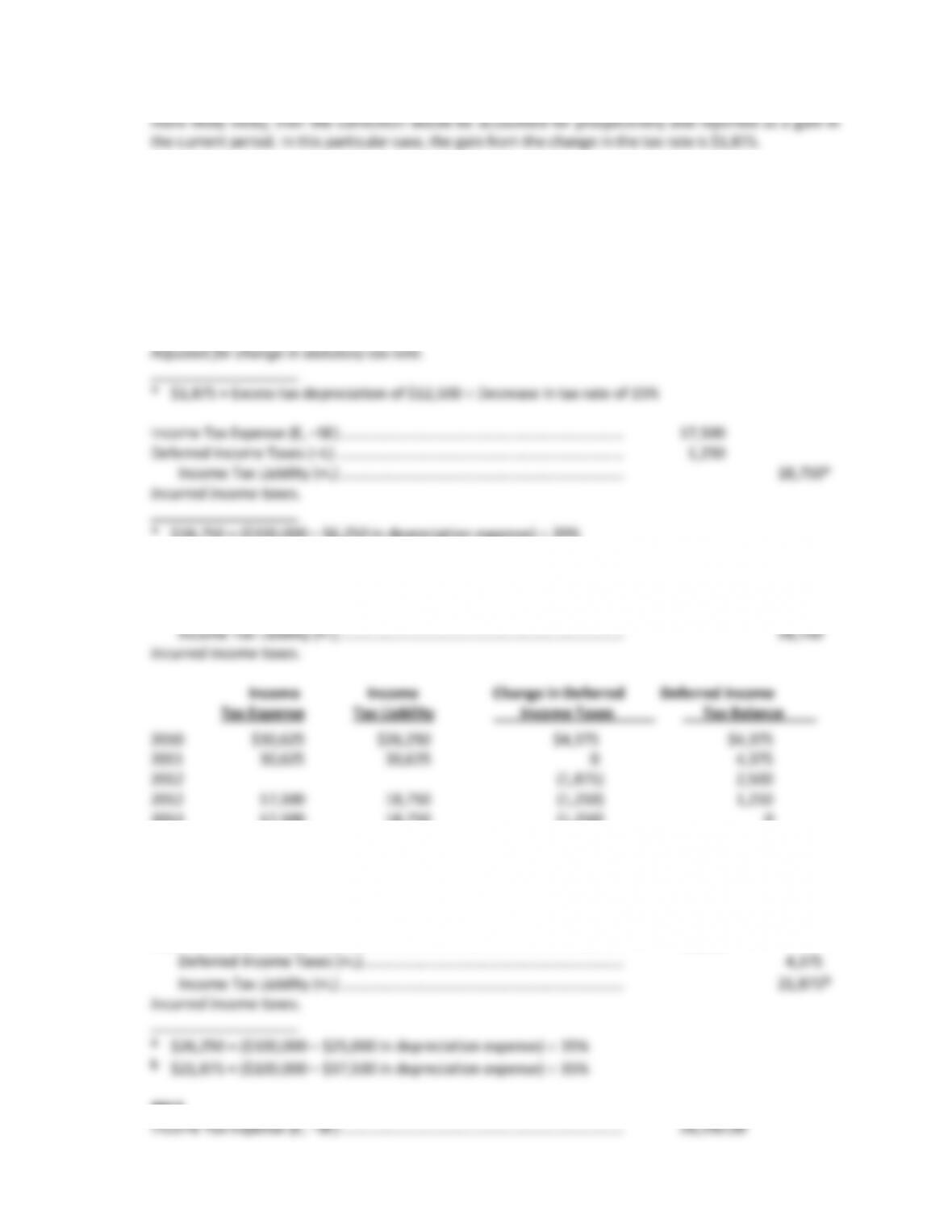
Deferred Income Taxes (–L) ……………………………………………………………. 1,875*
Gain on Deferred Income Taxes (Ga, +SE) …………………………………… 1,875
* $18,750 = ($100,000 – $6,250 in depreciation expense) 20%
2013
Income Tax Expense (E, –SE) …………………………………………………………… 17,500
Deferred Income Taxes (–L) ……………………………………………………………. 1,250
2013 17,500 18,750 (1,250) 0
c. 2010
Same as in part (a)
2011
Income Tax Expense (E, –SE) …………………………………………………………… 26,250a
2012
P10–9 Concluded
2013
Income Tax Expense (E, –SE) …………………………………………………………… 21,875*
Income Tax Liability (+L) …………………………………………………………… 21,875
Incurred income taxes.
* $21,875 = ($100,000 – $37,500 in depreciation expense) 35%
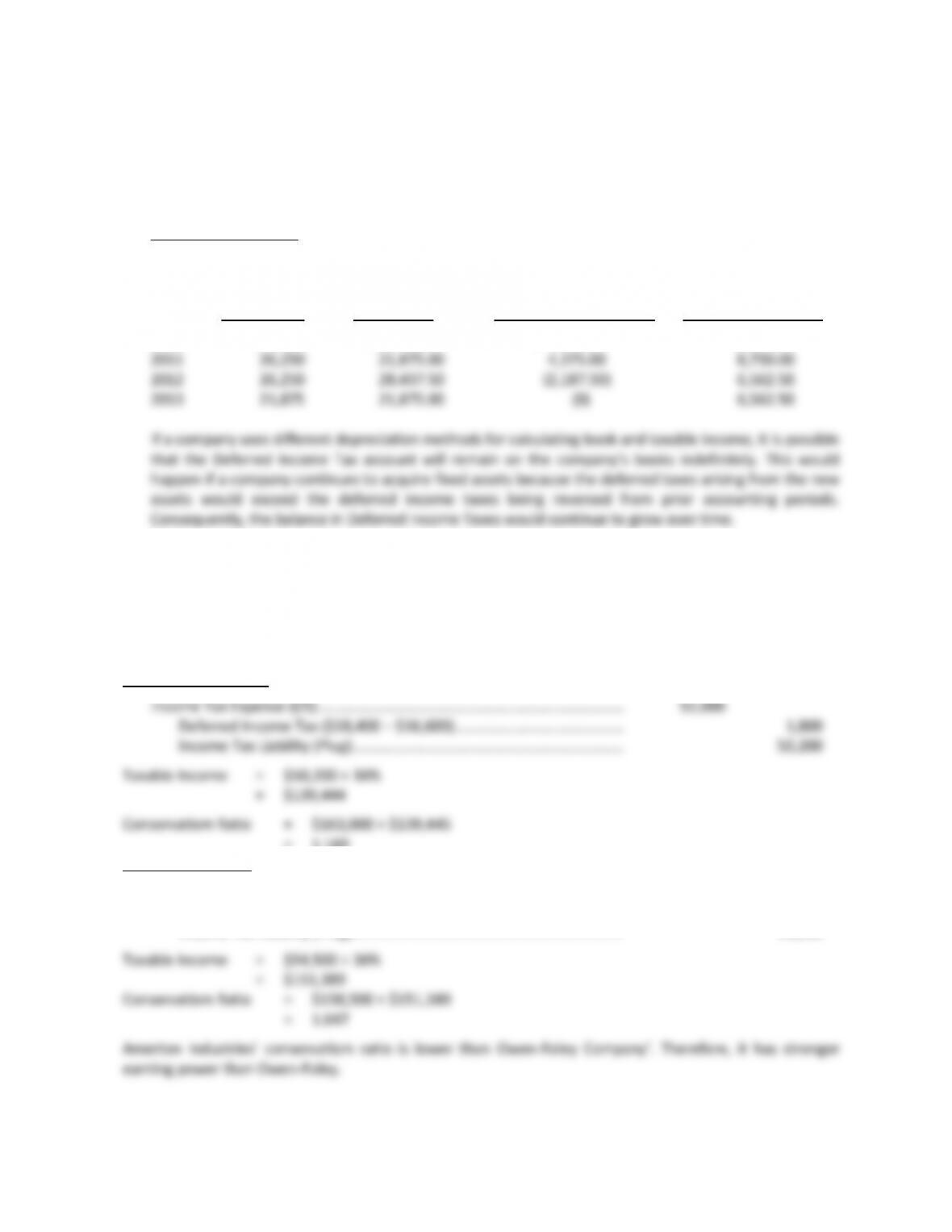
Income Income Change in Deferred Deferred Income
Tax Expense Tax Liability Income Taxes Tax Balance
2010 $30,625 $26,250.00 $ 4,375.00 $4,375.00
P10–10
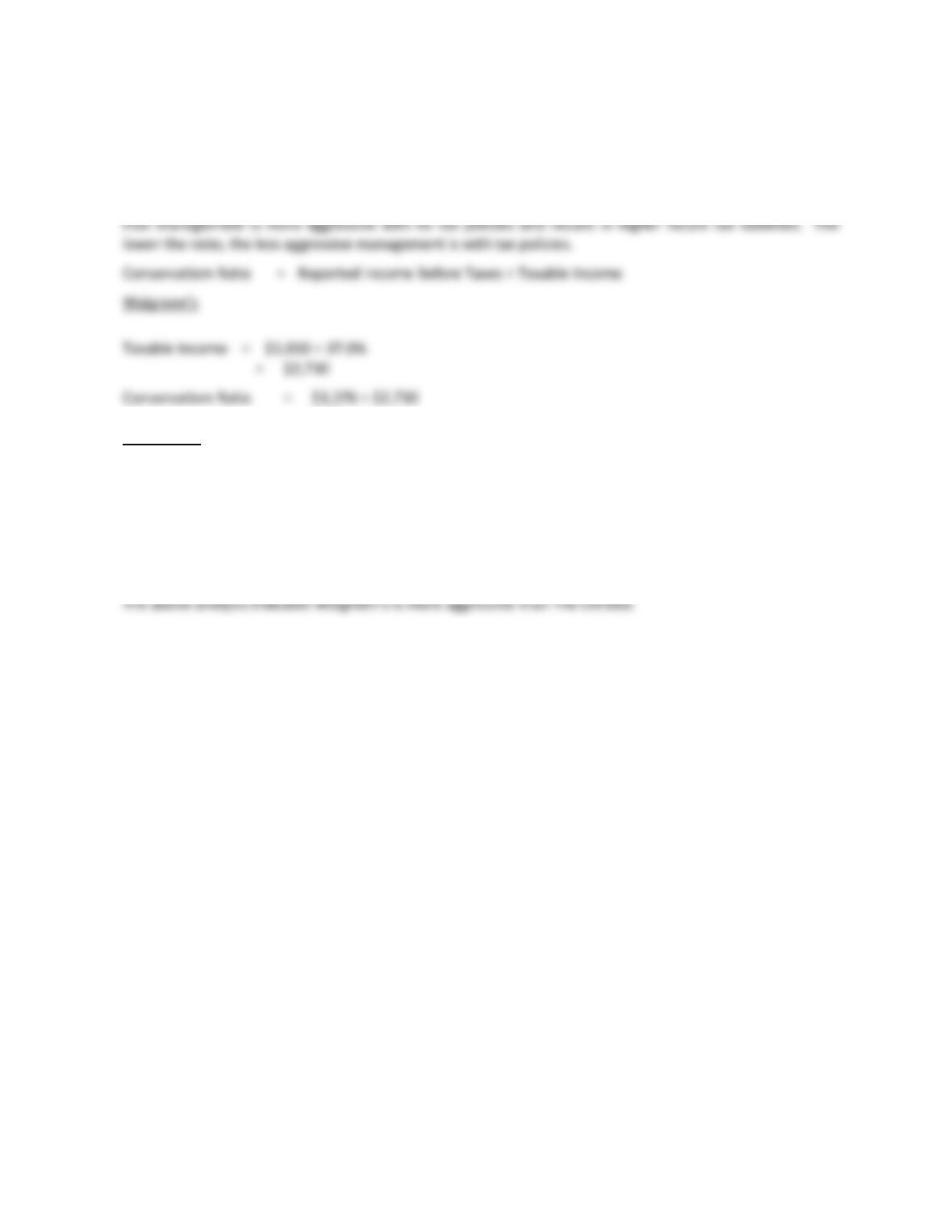
Based on the information provided in this problem, we can compute the conservatism ratio of each
company: The lower the ratio, the higher the earning power of the company.
Conservatism Ratio = Reported Income Before Taxes ÷ Taxable Income
Owen-Foley Company
= 1.169
Amerton Industries
Income Tax Expense (I/S) ……………………………………………………………….. 53,500
Deferred Income Tax ($19,800 – $18,800) ………………………………………… 1,000
Income Tax Liability (Plug) ………………………………………………………… 54,500
P10–11
Based on the information provided in this problem, we can compute the conservatism ratio of each
company: The lower the ratio, the more conservative the company. The higher conservatism ratio indicates
= 1.24
The Limited
Taxable Income = $517 ÷ 41.2%
= $1,255
Conservatism Ratio = $1,281 ÷ $1,255
= 1.02
ISSUES FOR DISCUSSION
ID10–1
a. Under the terms of its debt covenants, FedEx’s current assets must be at least as great as its current
2012.
b. There are many current liabilities where either the creation of or the amount reported for the liability is
under the company’s control. For example, a company‘s board of directors decides when to declare a
dividend (which results in the current liability Dividend Payable), how much the dividend will be and
goods or services for which it collected the advances from customers.
c. Violating a debt covenant results in the borrower being in technical default on the loan. If a company is
in default on a loan, the creditor could require the borrower to immediately repay the outstanding
d. If FedEx purchased the aircraft for cash, its noncurrent assets would increase by $4 billion but its
current assets would decrease $4 billion for the cash disbursed. With no change in its current
ID10–2
a. The account Customers‘ Advance Payments represents cash collected from customers in advance of
providing desired goods or services to the customers. When Ingersoll-Rand makes these collections, it
ID10–2 Concluded
b. Under the revenue recognition principle, a company should not recognize revenue until (1) the
company has earned the revenue, (2) the amount of revenue earned can be objectively determined, (3)
any post-sale costs can be reasonably estimated, and (4) cash collection is reasonably assured.
sale costs—against the revenue in accordance with the matching principle.
c. Ingersoll-Rand should not recognize revenue for simply collecting customer advances; instead, it
generates revenue when it actually ships the goods. Thus, earnings per share would increase when
Ingersoll-Rand ships goods (assuming that the company sells its inventory at a profit), and it would not
be affected by receiving advance payments.
Collecting advance payments would increase both Ingersoll-Rand’s current assets (through the cash
collected) and current liabilities (through the obligation arising from the advances). The actual effect on
ID10–3
a. In 2012, 25.0% ($324/$1,297) of the reserve was classified as current; in 2011, 23.1% ($298/$1,291) of
the reserve was current.
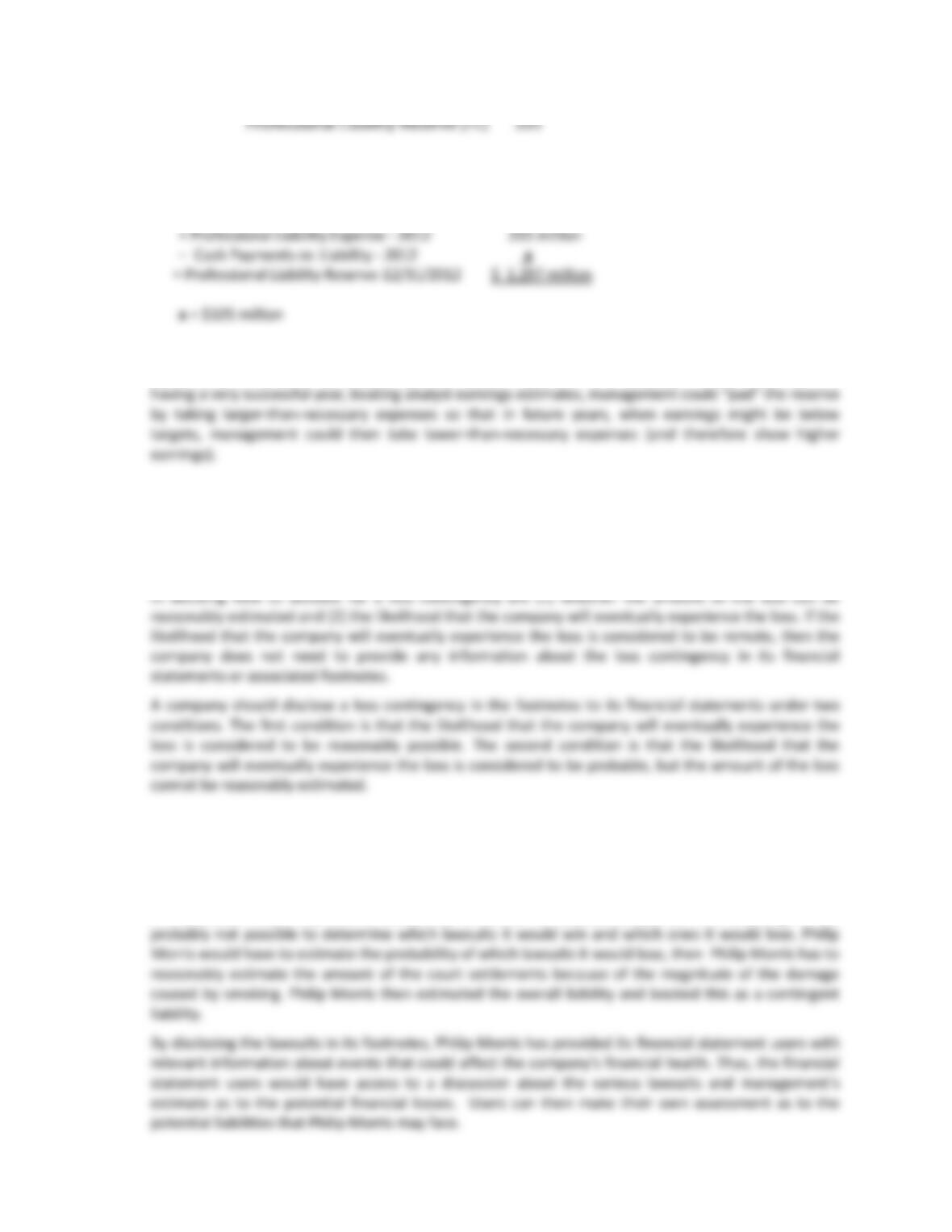
b. The journal entries appear below:
2010:
ID10–3 CONTINUED
c. Professional Liability Reserve– 12/31/2011 $ 1,291 million
d. Earnings could be managed in the healthcare industry with manipulation to the professional liability
reserve (a liability account) by adjusting the annual charge taken for the expense. If the company were
ID10–4
The numerous filed and potential criminal and civil lawsuits against Philip Morris are examples of loss
contingencies. SFAS Statement No. 5, “Accounting for Contingencies,” provides authoritative guidance
in accounting for contingencies. According to this statement, the two factors that should be considered
Finally, a company should accrue the loss if it is both probable that the company will eventually
experience the loss and the amount of the loss can be reasonably estimated. Accruing the loss means
that the company reports a loss on its income statement and, in the case of a lawsuit, an associated
liability on its balance sheet.
It is probable that Philip Morris would lose a number of lawsuits associated with smoking, it was
ID10–5
a. There are two reasons why Lifschultz’s stock could be highly valued even though the company has a
negative book value. First, the stock market expects Lifschultz to win the lawsuits and collect a large
settlement. The expected settlement, however, is currently not reflected in the company‘s financial
statements. Thus, the potential settlement essentially represents an unreported asset. If Lifschultz
b. SFAS Statement No. 5, “Accounting for Contingencies,” provides authoritative guidance in accounting
for contingencies. According to this statement, gain contingencies should usually be ignored for
financial reporting purposes. If it is highly probable that the company will eventually realize the gain,
the company could arguably disclose the gain contingency in a footnote.
Alternatively, there are three potential ways to account for a loss contingency. The first way is to ignore
the loss contingency. This approach would be appropriate if the likelihood of the company eventually
experiencing the loss is remote. The second accounting treatment is to disclose the loss contingency in
Since Lifschultz has a gain contingency, it should not disclose this information in its financial statements
or footnotes. Alternatively, the three trucking companies have loss contingencies associated with the
c. The costs of overstating and understating a company’s financial position and operations is very
different. Assume that a company overstates its financial position and operations in its financial
Alternatively, assume that a company understates its financial position and operations in its financial
statements. People may invest in the company despite its reported financial position and operations,
but once the understatement becomes known, the investment should increase in value. Thus, the
people who invested in the company anyway will probably not be upset and pursue legal action against
ID10–6
a. A “technical default” means that the borrower has violated some term of a debt agreement, usually a
debt covenant. In this particular case, Citibank reacted to Campeau Corporation’s technical default by
b. Campeau’s technical default and Citibank’s statement that they may demand immediate full repayment
of the loan indicate that Campeau may be experiencing severe cash flow problems. Suppliers would
usually be unwilling to ship merchandise to a customer if there is a good chance that the customer will
not be able to pay for the merchandise. If the customer is in danger of declaring bankruptcy, the
suppliers‘ unwillingness would be even greater. This is because suppliers are usually unsecured
ID10–7
a. Unearned Extended Warranty Revenue
|45 (2011 Beginning Balance)
|
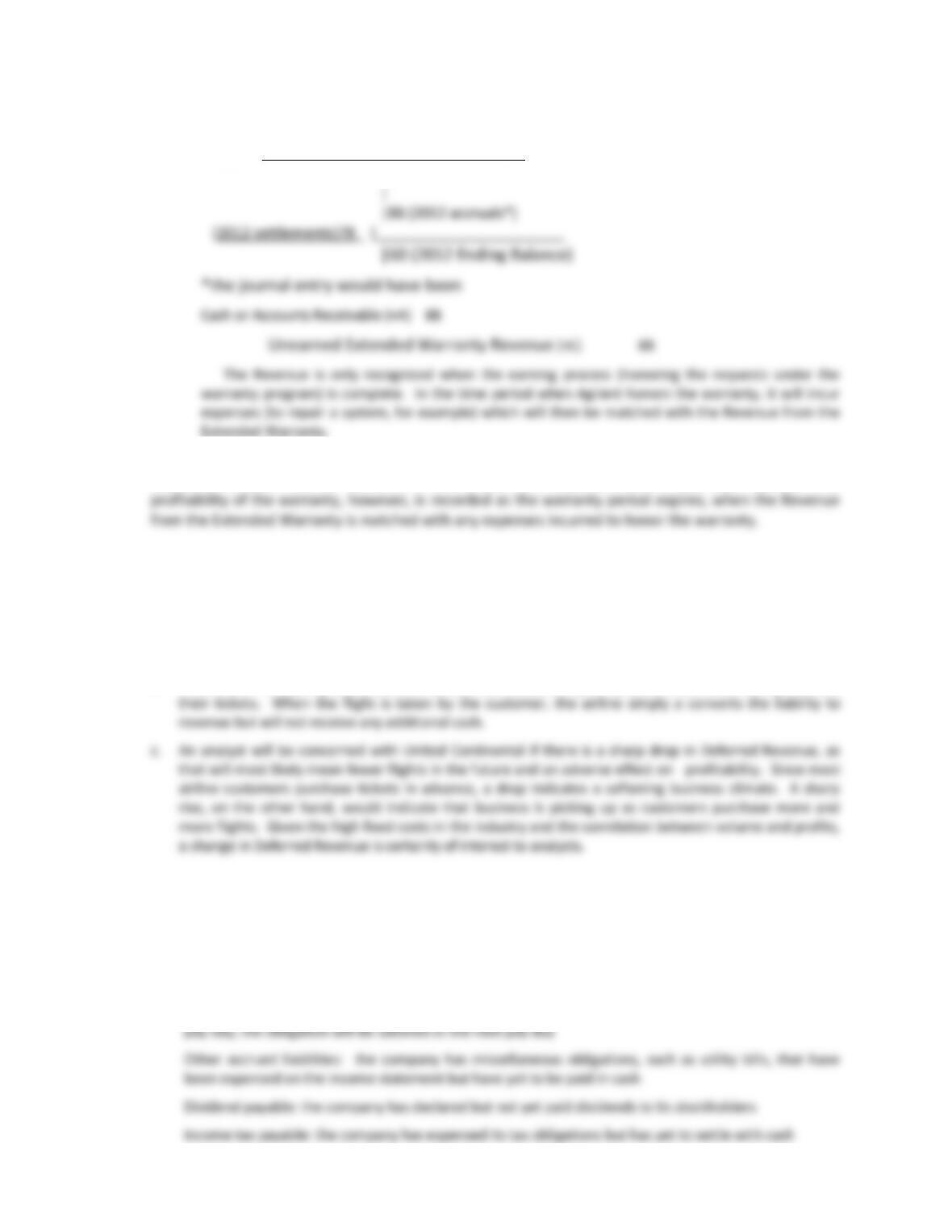
Unearned Extended Warranty Revenue (+L) 72
Unearned Extended Warranty Revenue
|50 (2012 Beginning Balance)
b. The cash from the sale of the Extended Warranty is received on the date of the sale of the warranty; the
Statement of Cash Flow will reflect an inflow of cash in the period that the cash was received. The
ID10–8
a. Deferred Revenue is a liability that represents the obligation that United Continental has to its
customers for flights that have been paid for but have not yet been taken. The liability is carried on the
balance sheet until the Revenue can be recognized. When the revenue is recognized (with a credit), the
liability Deferred Revenue is reduced (with a debit).
b. From a cash flow perspective, the $5.2 billion was received in prior periods when customers purchased
ID10–9
a. Short-term borrowings: the company issued debt securities that are due within 12 months
Trade accounts payable: the company purchased inventory on account, agreeing to pay in the near
future
Employee compensation: the company owes its workers for labor that was performed since the last
Current portion of long-term debt: the company has long-term debt with some principal payments due
in the next 12 months; that portion of the long-term debt due after the next 12 months is categorized
in the noncurrent liabilities section of the balance sheet
b. If these obligations are categorized as current, then they will be satisfied from the conversion of
current assets. For example, the accounts payable obligation will be paid when the company sells
inventory (a current asset) and collects cash.
c. The company might be considering converting the short-term borrowings to long-term. If long-term
d. Return on equity is the ratio of net income to shareholders’ equity. If a company can responsibly use
debt, it can improve its ROE. If the debt is used to add assets that strongly contribute to earnings, then
ID10–10
A proxy is a device whereby a security holder authorizes another person or group of persons to act for him
at a meeting of security holders—in effect a power of attorney.
Whenever the solicitation is made on behalf of the management of the issuer and relates to an annual
meeting of security holders at which directors are to be elected, a proxy statement must be furnished to
ID10–11
Accrued medical and life insurance expense.
b. As part of the Chapter 11 reorganization, LTV negotiated new credit agreements. These credit
agreements contained debt covenants, most likely related to the amount of debt LTV could have. If LTV
had waited until after emerging from Chapter 11, the $2.26 billion insurance liability might have caused
c. There are probably two reasons why LTV chose to take several significant charges while it was under
bankruptcy proceedings. First, the significant charges would adversely affect LTV’s reported results of
latter strategy is known as “taking a bath.”
ID10–12
The conservatism ratio is an excellent measure of a company’s aggressiveness in its tax strategy. The lower
the ratio, the more conservative the company. The higher conservatism ratio indicates that management is
more aggressive with its tax policies and results in higher future tax liabilities. The lower the ratio the less
aggressive management is with tax policies.
Conservatism Ratio = Reported Income Before Taxes ÷ Taxable Income
2010
Taxable Income = $942 ÷ .294
= $3,204
Conservatism Ratio = $3,631 ÷ $3,281
= 1.11
ID10–12 CONCLUDED
ID10–13
a. What Mr. Healy really means is that GM earned $200 million in 1997 not by selling autos but by
working through an accounting adjustment due to a change in the tax rates in its North American
ID10–14
a. A patent gives the holder the exclusive rights to use an idea (or a technology) and prevents
competitors from using the idea (or technology). Patents are considered intangible assets and are
carried on the balance sheet.
b. From Vonage’s perspective, the lawsuits represent contingent losses. Depending on the evaluation
(by Vonage management and legal counsel) of the merits of the lawsuits, the company can ignore
ID10–15
a. Provisions under IFRS are recorded more frequently than contingent liabilities under U.S. GAAP
because under IFRS provisions are accrued when the obligation is “more likely than not,” but GAAP
possible value, while IFRS employs the “best estimate”.
b. When VW increased its provision account, it booked an expense (reducing profitability and equity)
and a liability. The increase may include items such as warranties, restructurings and
ID10–16
a. Working capital is the excess of current assets over current liabilities. It is one measure of the solvency
of a company. Google’s working capital was $43,845 million in 2011 and $46,117 million in 2012,
showing a strong increase.
b. In 2011 working capital was 60.4% of total assets, decreasing to 49.2% in 2012.
c. Google’s current ratio was 5.92 in 2011 and decreased to 4.22 in 2012. The largest factors in the drop
*dividing turnover into 365 days yields 23.0 days on hand for accounts payable
2011
h. Per footnote #13, company employees do not have a pension plan but may participate in a 401(k)
savings program, with the company matching contributions under certain circumstances. Google
ID10–16 Concluded
i.
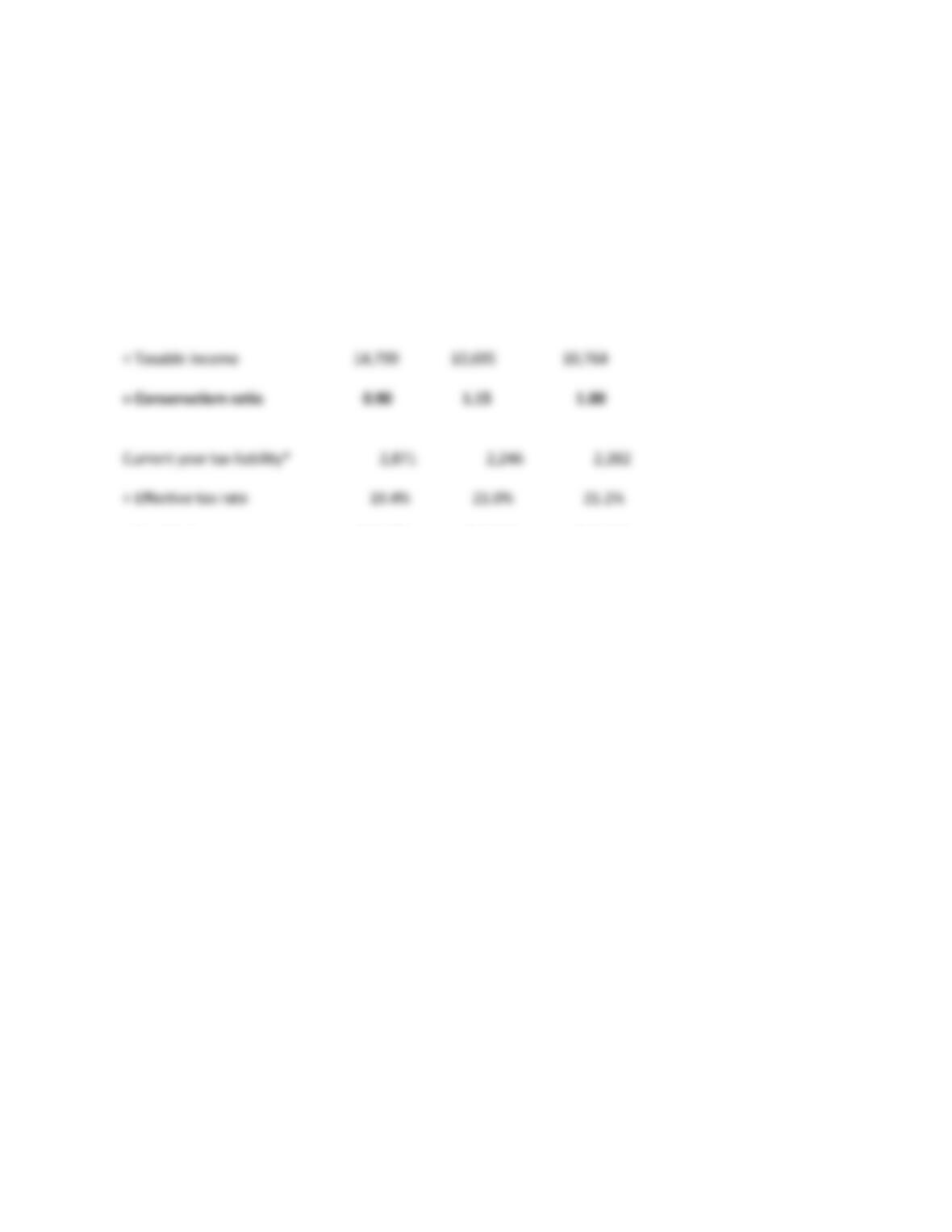
Conservatism Ratio = Reported Income Before Taxes ÷ Taxable Income
2012 2011 2010
Reported income before tax 13,386 12,326 10,796
= Taxable Income $14,799 $10,695 $10,764
*footnote #14
The tax strategy of Google was more aggressive fom 2010 to 2011, but then more conservative from
2011 to 2012.