1
CHAPTER 10
INTRODUCTION TO LIABILITIES: ECONOMIC CONSEQUENCES, CURRENT
LIABILITIES, AND CONTINGENCIES
BRIEF EXERCISES
BE10–1
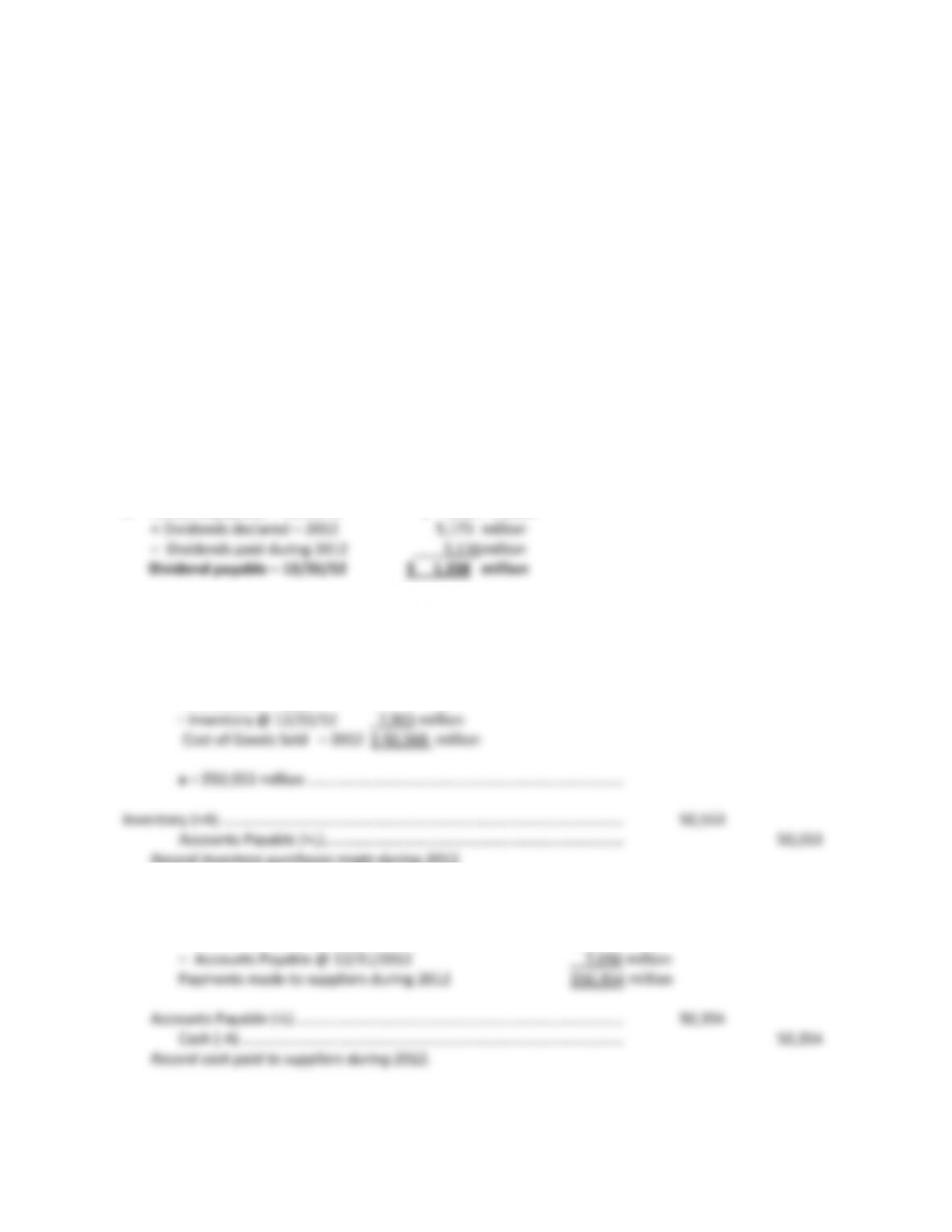
a. Dividends declared during a year and the actual cash paid for dividends during the year may be
different because dividends declared includes dividends that are accrued but not paid as of year end.
The cash paid for dividends will include all payments that relate to dividends during the year, regardless
of when those dividends were recognized in the financial statements.
b. Dividend payable is a short term liability because it represents dividends that will have to be paid
within the next 12 months as of the balance sheet date.
c. Dividend payable – 12/31/11 $ 1,281 million
BE10–2
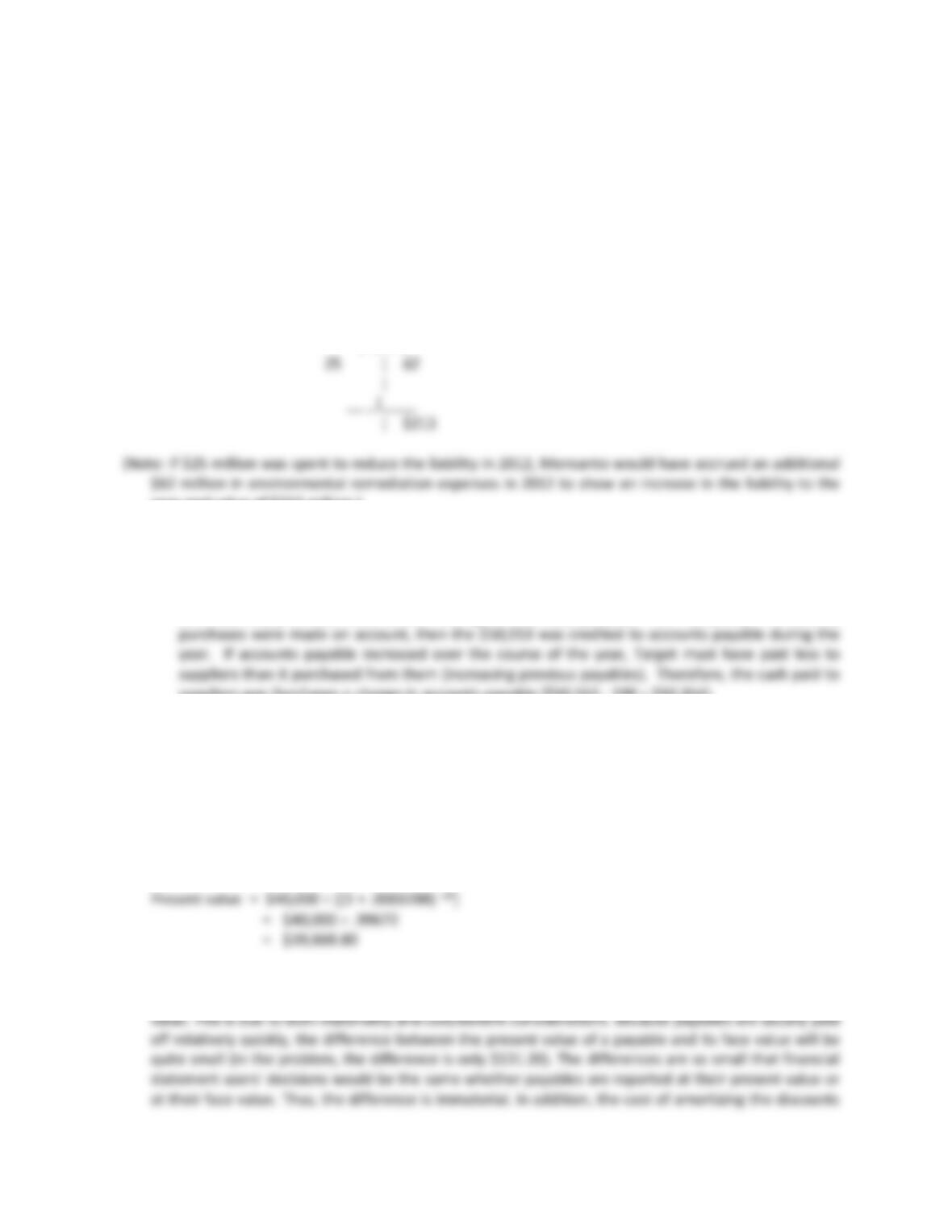
a. Calculation of inventory purchases during 2012:
Inventory @ 12/31/11 $ 7,918 million
+ Purchases – 2012 x
Record inventory purchases made during 2012.
b. Calculation of payments made to suppliers during 2012:
Accounts Payable @ 12/31/2011 $ 6,857 million
+ 2012 Inventory Purchases 50,553 million
BE10–3
a. The accrual for environmental litigation increased the liabilities and reduced stockholders’ equity
(because of lowered profits due to the environmental expense).
b. Monsanto is actually following a couple of accounting principles with this expense. By recording
contingency losses, the company is following the conservatism principle and the matching principle
(taking the expense in the time period in which related revenues were recorded).
c. Environmental Liabilities
| $ 176
year-end value of $213 million.)
BE10–4
a. The decrease in inventory indicates that Target sold more inventory than it purchased. Therefore,
the inventory purchases were COGS – change in inventory ($50,568 – 15 = $50,553). If inventory
suppliers was Purchases + change in accounts payable ($50,553 – 199 = $50,354).
b. The increase in Accounts Receivable represented a “use” of cash and therefore decreased Target’s
cash flows. The decrease in Inventory and increase in Accounts Payables were “sources” of cash
and increased the company’s cash flows.
EXERCISES
E10–1
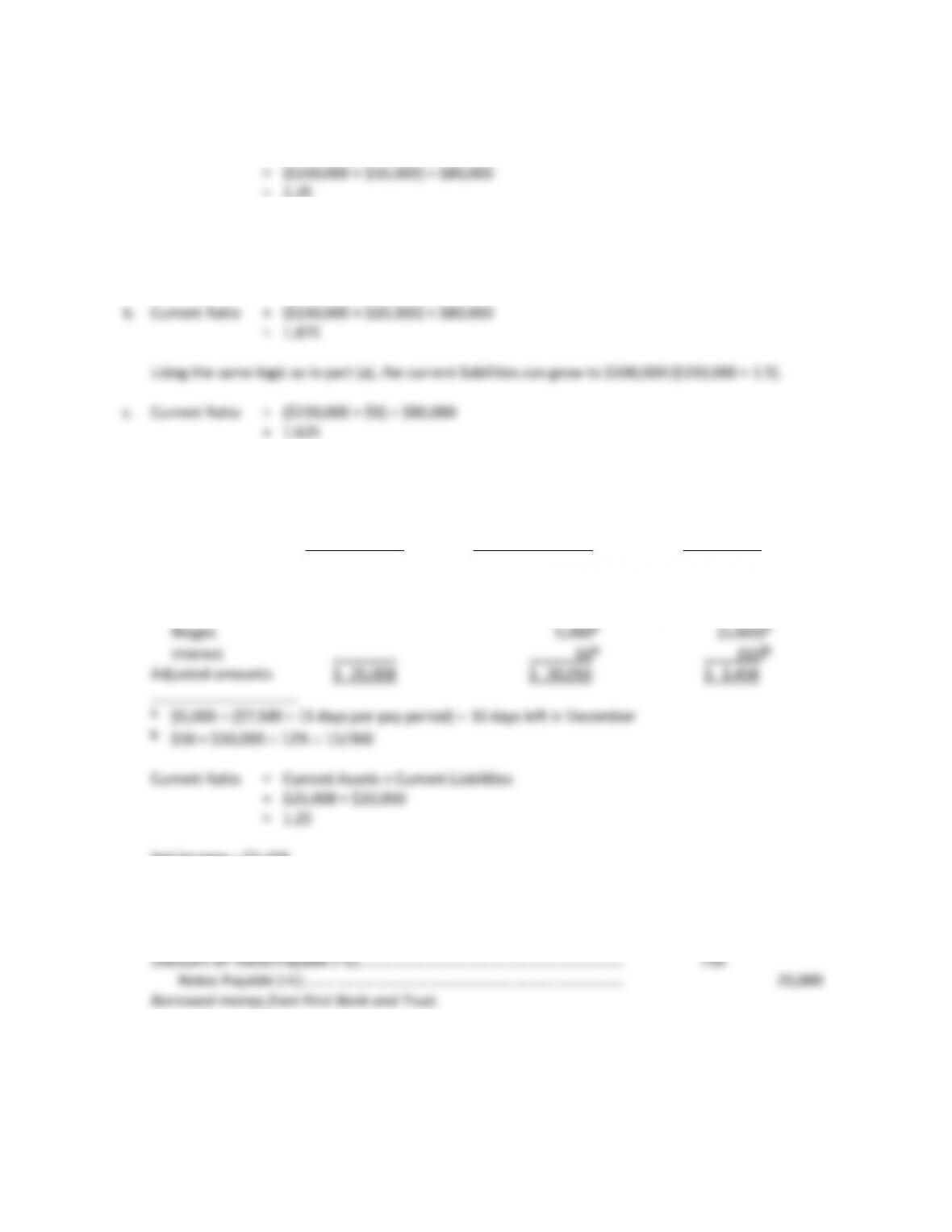
a. A 12% annual discount rate is equivalent to a daily discount rate of .03288%.
b. Although present value probably provides a better economic measure of a company’s liabilities than is
provided by the liabilities’ face value, accounts payable are carried on the balance sheet at their face

E10–2
a. Current Ratio = Current Assets ÷ Current Liabilities
= 2.25
Current assets cannot fall below 1.5 times current liabilities. Therefore, dividing current assets by 1.5
indicates the maximum level that Darrington and Darling can allow current liabilities to grow to without
violating the debt covenant. So current liabilities can grow to $120,000 ($180,000 ÷ 1.5).
Using the same logic as in part (a), the current liabilities can grow to $86,666.67 ($130,000 ÷ 1.5).
E10–3
Current Assets Current Liabilities Net Income
Reported amounts $ 24,000 $ 15,000 $ 7,500
Adjustments:
Rent 1,008 1,008
Net Income = $3,458
E10–4
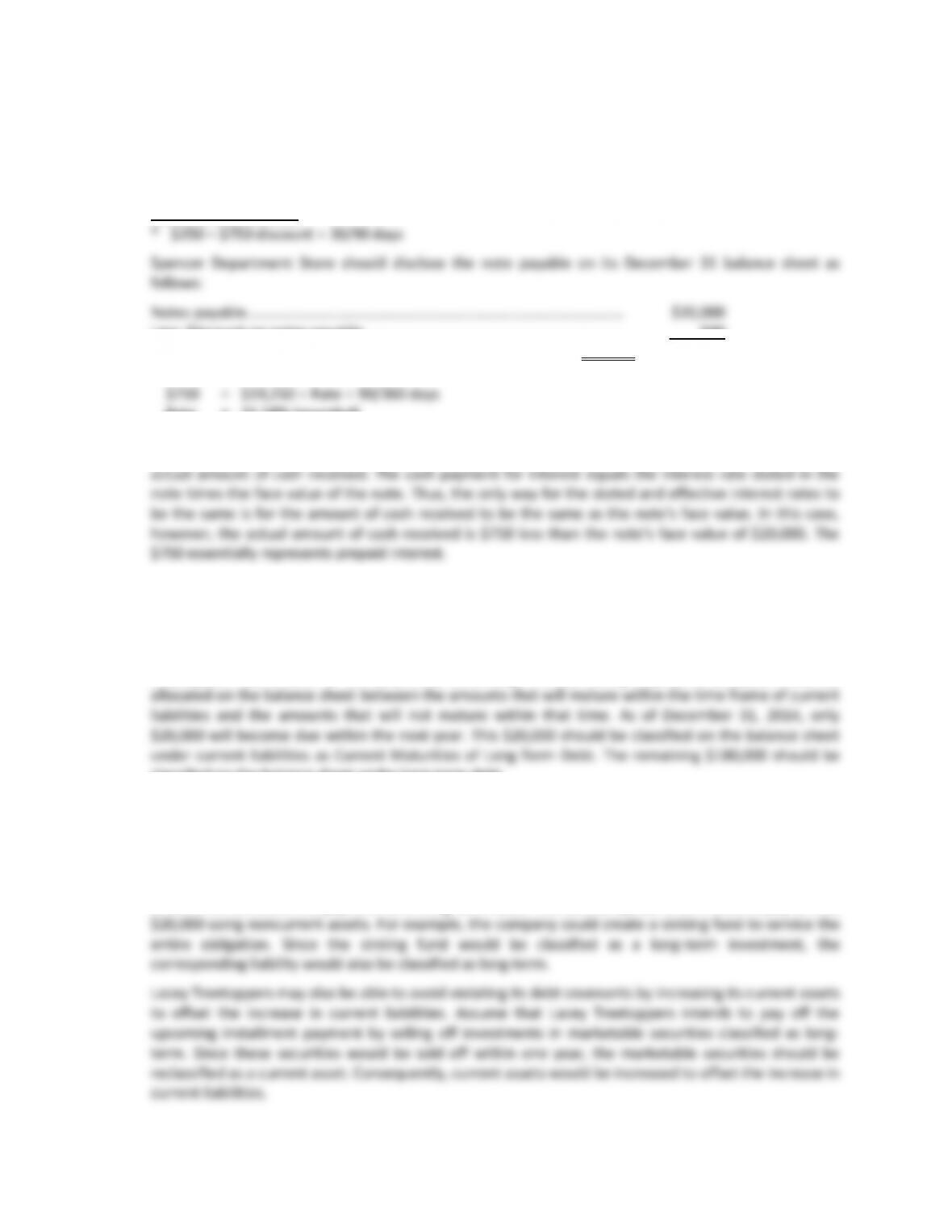
a. Cash (+A) ……………………………………………………………………………………… 19,250
E10–4 Concluded
b. Interest Expense (E, –SE) ………………………………………………………………… 250*
Discount on Notes Payable (+L) …………………………………………………. 250
Incurred interest expense.
Less: Discount on notes payable …………………………..…………………………. 500
$19,500
c. Interest = Principal Rate Time
Rate = 15.58% (rounded)
d. The actual, or effective, interest rate is determined by comparing the cash payments for interest to the
E10–5
a. Lacey Treetoppers has to make a total of fifteen payments of $20,000 each. As of December 31, 2014,
the company has made payments for 2010, 2011, 2012, 2013, and 2014. Consequently, Lacey
Treetoppers has a total of ten payments remaining. The remaining liability of $200,000 must be
classified on the balance sheet under long-term debt.
b. Current liabilities are defined as those liabilities that will be settled through the use of current assets or
through the creation of other current liabilities. If a liability is to be settled through the use of
noncurrent assets or through long-term refinancing, then the liability should be classified as long-term
debt. In this case, Lacey Treetoppers has basically two options in trying to avoid classifying the
upcoming $20,000 installment payment as a current liability. The first option is to negotiate with the
creditor to refinance the payment on a long-term basis. The second option is to intend to pay off the
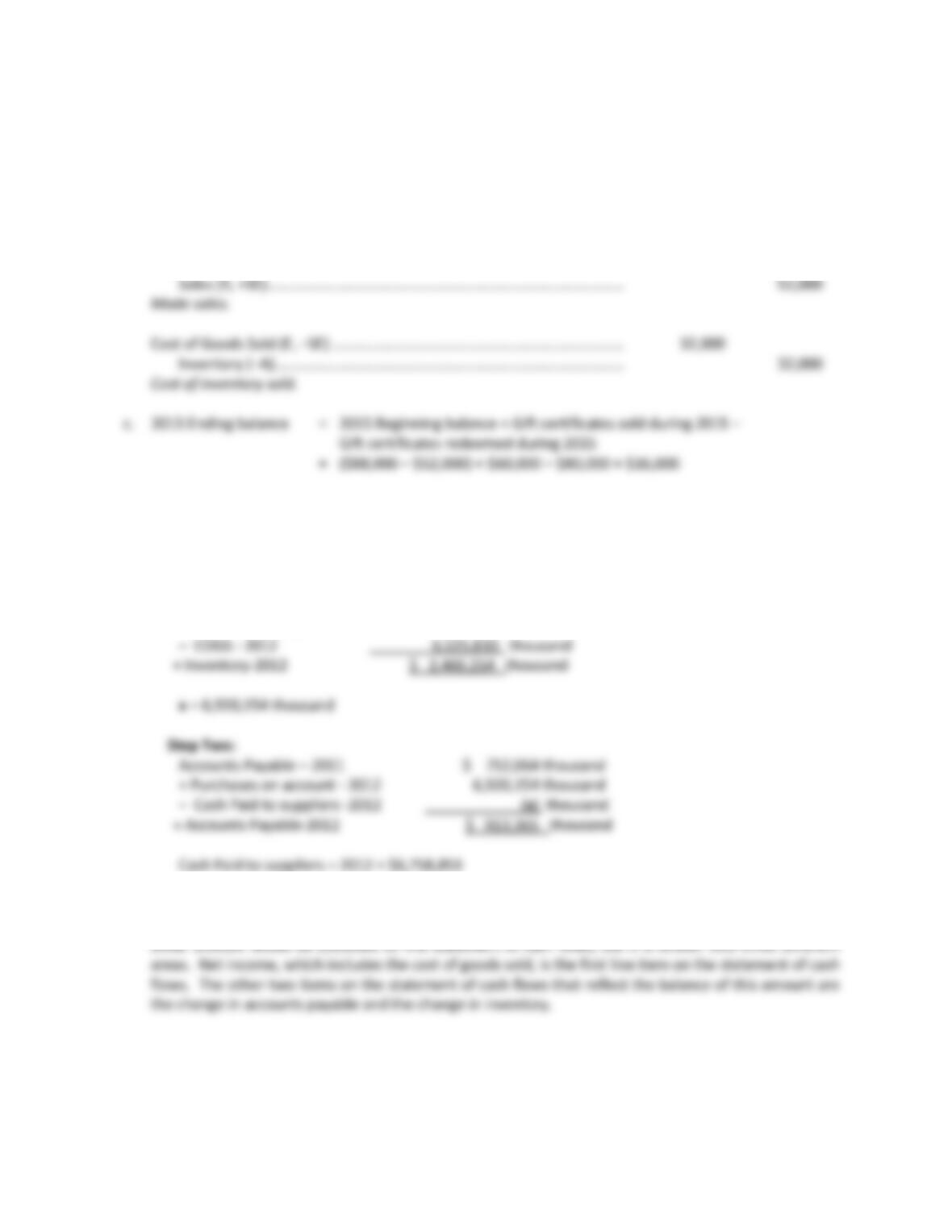
E10–6
a. Cash (+A) ……………………………………………………………………………………… 88,000
Deferred Revenue (+L)……………………………………………………………… 88,000
Sold gift certificates.
b. Deferred Revenue (–L) ……………………………………………………….………….. 52,000
E10–7
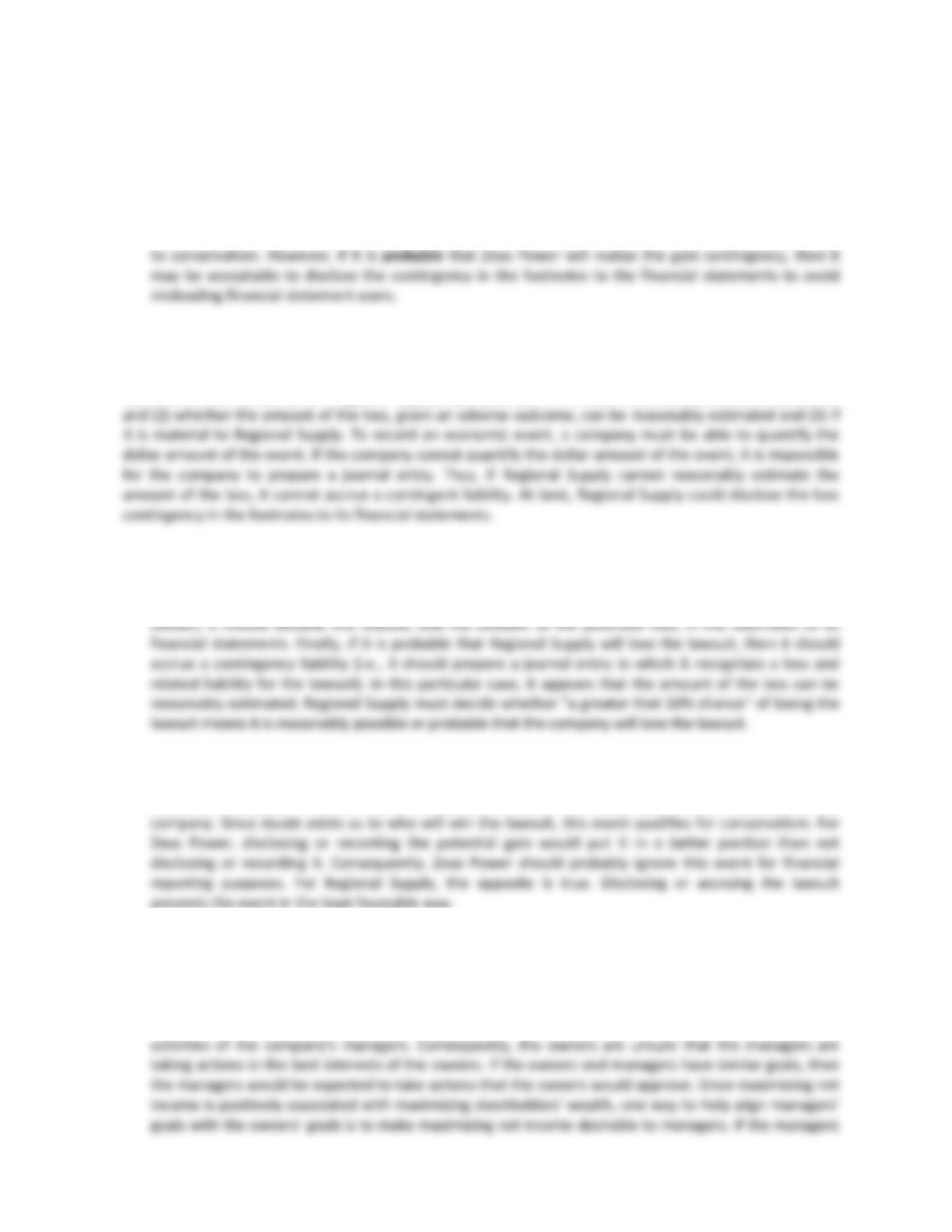
a. Calculation of payments made to suppliers during 2012:
Step One:
Inventory – 2011 $ 2,071,890 thousand
+ Purchases – 2012 x
b. If the Statement of Cash Flows is structured in the direct format, the Cash Paid to Suppliers number
would be disclosed in the Operating Section. If the Statement is structured in the indirect format, this
E10–8
a. Since Zeus Power brought the lawsuit, Zeus Power is facing a gain contingency. Gain contingencies are
ordinarily not disclosed in the financial statements or in the footnotes to the financial statements due
b. Since Regional Supply is the defendant in the lawsuit, Regional Supply is facing a loss contingency. The
appropriate accounting treatment for this lawsuit by Regional Supply depends upon (1) whether an adverse
outcome to the lawsuit (from Regional Supply’s perspective) is remote, reasonably possible, or probable
Alternatively, assume that Regional Supply can reasonably estimate how much it would lose if it lost
the lawsuit. If the probability that it will lose the lawsuit is remote, Regional Supply can ignore the
lawsuit for financial reporting purposes. If it is reasonably possible that Regional Supply will lose the
c. Zeus Power and Regional Supply would account for this lawsuit differently due to conservatism. Under
conservatism, the basic rule is “if in doubt on how to record or report an economic event, put your
worst foot forward.” That is, record or report the event in the way that is least favorable to the
E10–9
a. The owners of a corporation (i.e., the stockholders) usually want the managers to make operating,
investing, financing, and reporting decisions that will maximize the owners’ wealth. However, managers
have their own goals, and the stockholders of a company typically are unable to observe the day-to-day
b. The managers of the company are not eligible for a bonus unless net income exceeds $200,000. So if
net income is only $180,000, nothing would be allocated to the bonus pool.
Assume that Jordan Brothers will eventually lose this lawsuit and that the company will have to pay the
entire $60,000. If Jordan Brothers accrues the loss now, net income will be reduced by $60,000, and no
E10–10
a. (1) Cash (+A) ……………………………………………………………………………. 50,000
Sales (R, +SE) …………………………..……………………………………. 50,000
Sold outboard engines.
(2) Warranty Expense (E, –SE)……………………………………………………. 4,000*
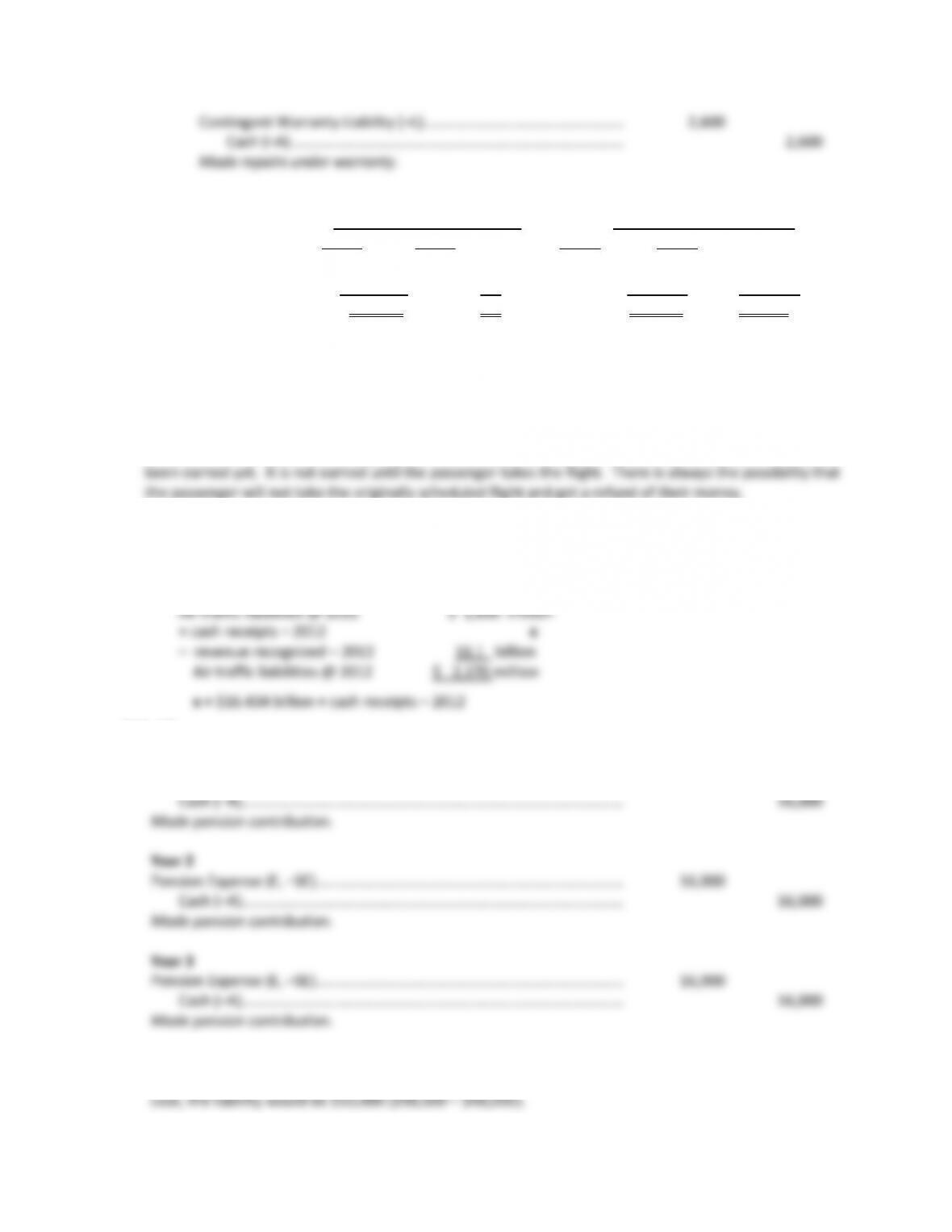
b. Contingency Basis Cash Basis
_2014 _2015 _2014_ _2015_
Revenue $50,000 $ 0 $50,000 $ 0
Warranty expense (4,000) 0 (1,400) (2,600)
Net income (loss) $46,000 $ 0 $48,600 $(2,600)
E10–11
a. Southwest Airlines does not recognize revenue when the cash is received because the revenue has not
b. Air traffic liability is a current liability. Airlines do not sell tickets for flights that are scheduled for more
than 12 months in the future. The liabilites are therefore shown as current.
c.Calculation of cash receipts from passengers during 2012:
E10–12
a. Year 1
Pension Expense (E, –SE) ………………………………………………………………… 16,000
b. The amount that Seasaw Seasons should report for its pension liability equals the difference between
the amount necessary to fund the benefits and the amount already paid into the pension plan. In this
E10–13
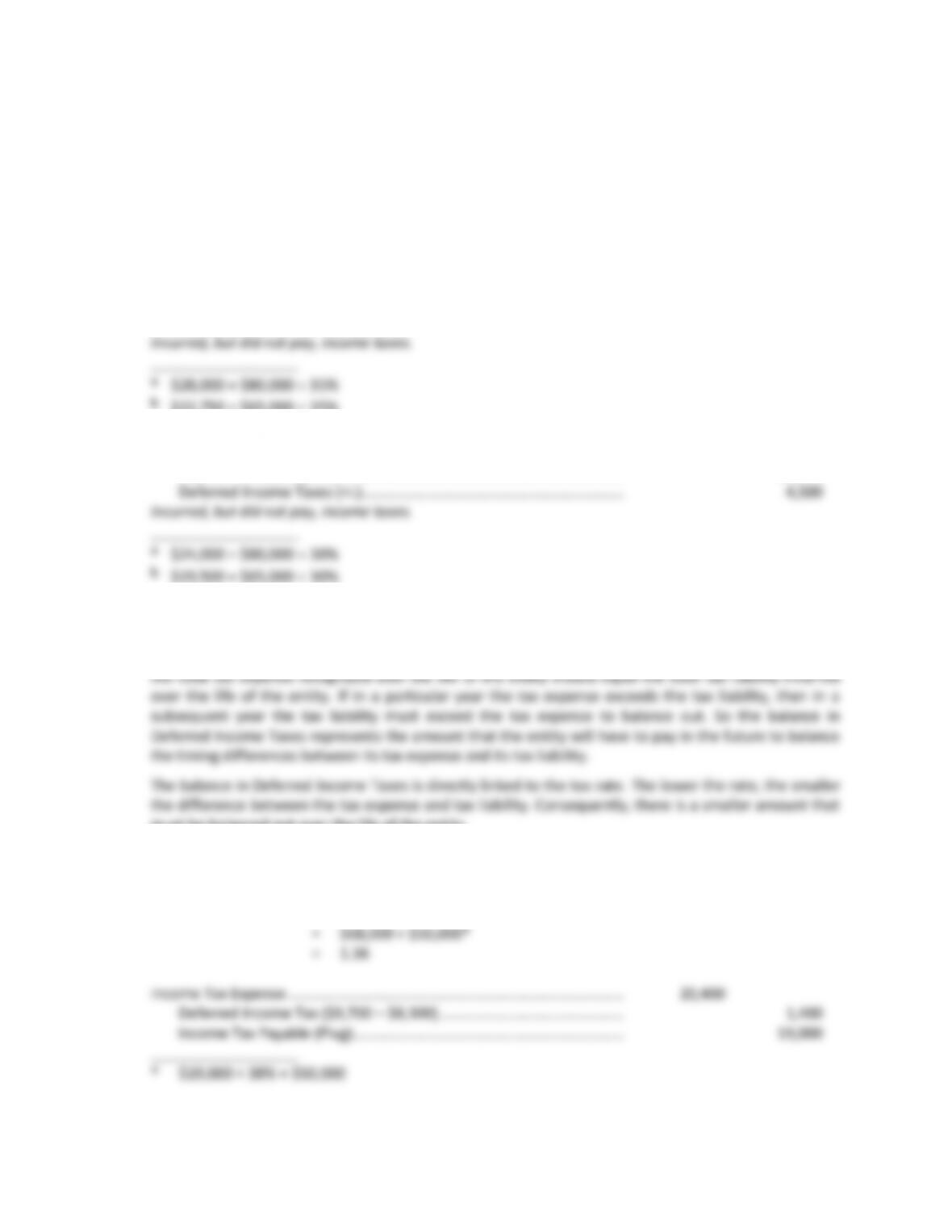
a. Income Tax Expense (E, –SE) …………………………………………………………… 28,000a
Income Tax Liability (+L) …………………………………………………………… 22,750b
Deferred Income Taxes (+L)………………………………………………………. 5,250
b. Income Tax Expense (E, –SE) …………………………………………………………… 24,000a
Income Tax Liability (+L) ……………………………………………………….….. 19,500b
c. Generally accepted accounting principles differ from the Internal Revenue Code. The two sets of
accounting principles/procedures usually yield different income amounts. However, over the life of a
company, total net income should, for all practical purposes, be the same as total taxable income. So
must be balanced out over the life of the entity.
E10–14
a. Conservatism Ratio = Reported Income Before Taxes ÷ Taxable Income
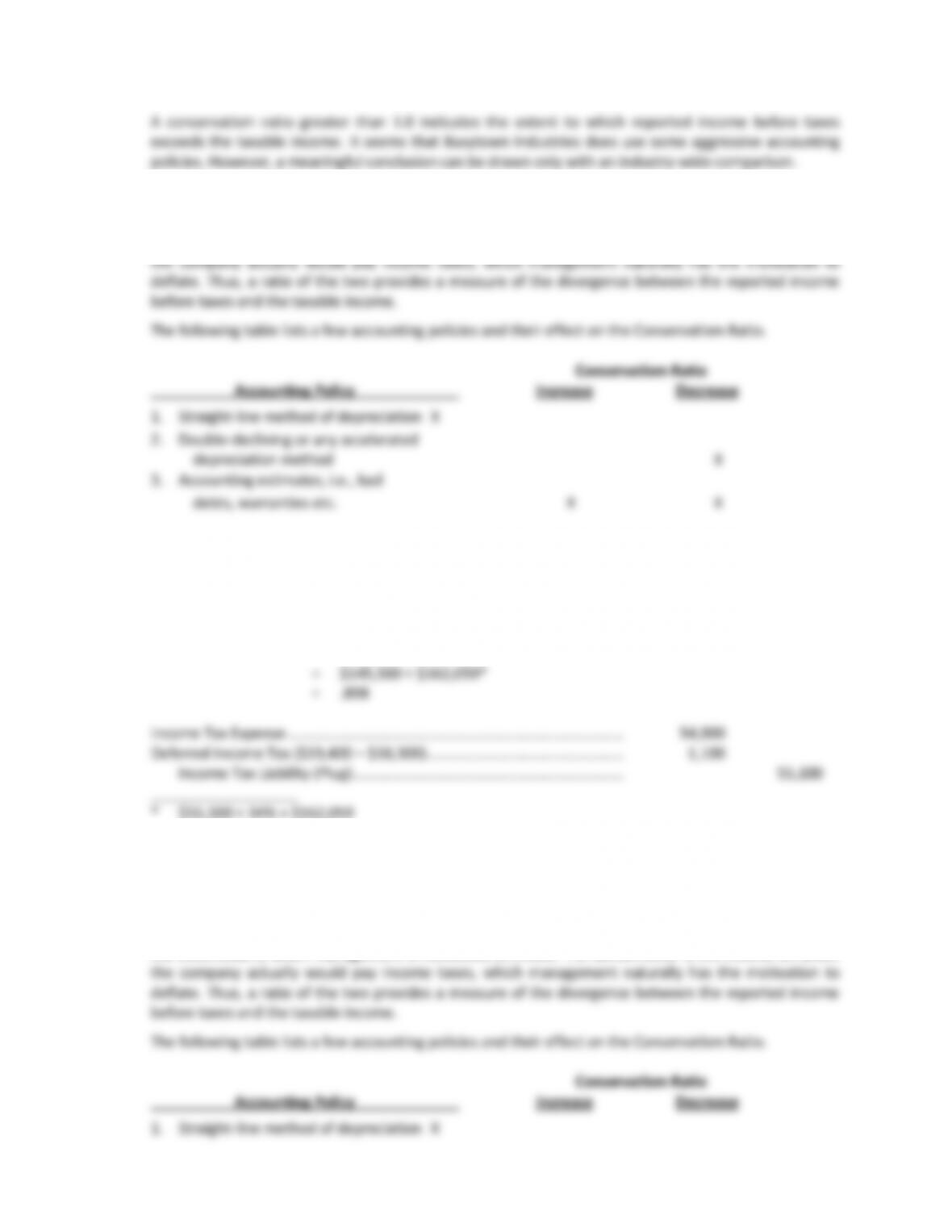
b. The conservatism ratio provides a reasonably good measure of the extent to which a company uses
aggressive versus conservative accounting policies. The numerator of the ratio is income reported to
the stockholders, which management is motivated to inflate. The denominator is the income on which
E10–15
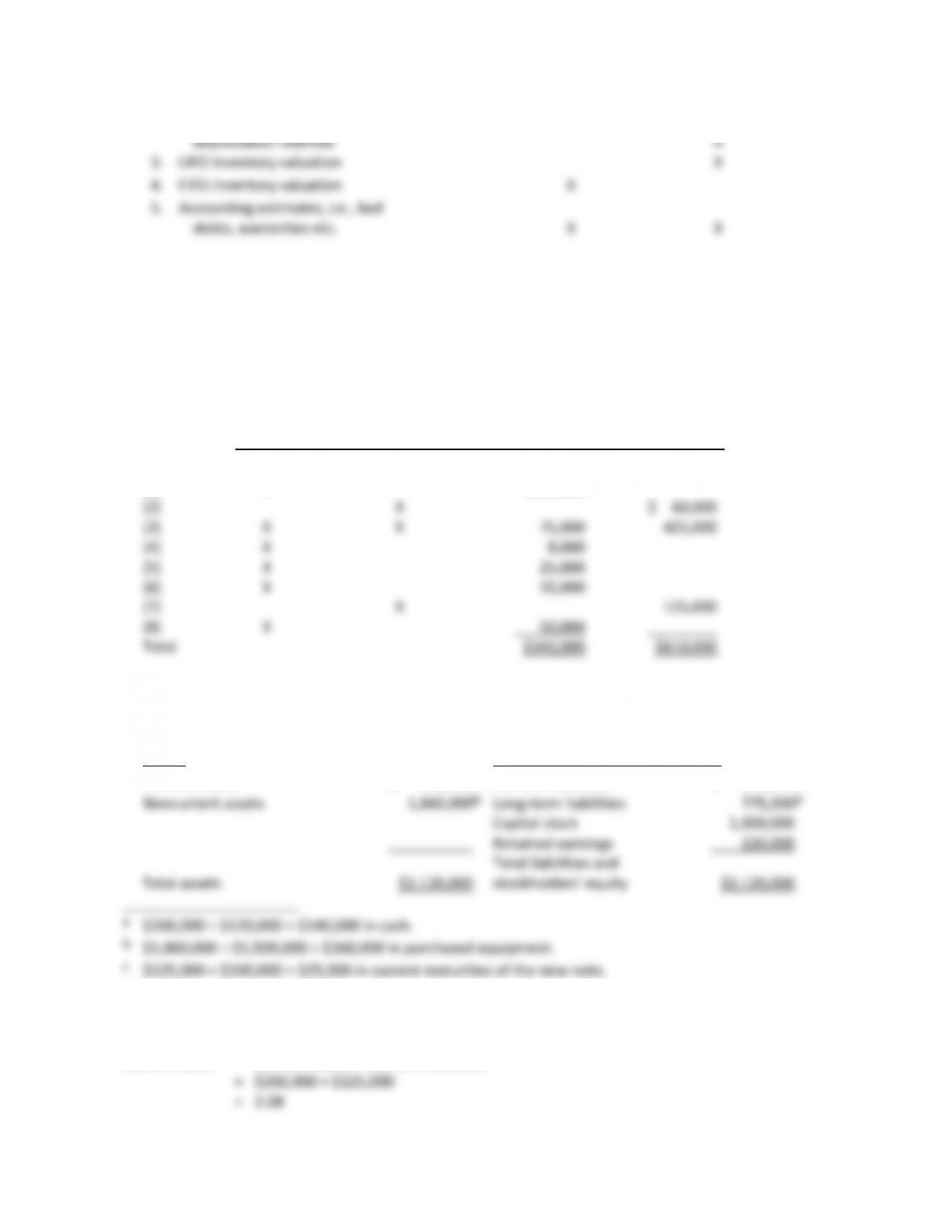
a. Conservatism Ratio = Reported Income Before Taxes ÷ Taxable Income
Since the conservatism ratio is less than 1, it appears that the company is using income-deflating
policies on its income statement.
b. The conservatism ratio provides a reasonably good measure of the extent to which a company uses
aggressive versus conservative accounting policies. The numerator of the ratio is income reported to
the stockholders, which management is motivated to inflate. The denominator is the income on which
2. Double-declining or any accelerated
PROBLEMS
P10–1
a., b., and c.
Classification Amount
Item Current Long-Term Current Long-Term
(1) X $170,000
P10–2
The balance sheet of Linton immediately after the bank loan and purchase of equipment would be:
Assets Liabilities and Stockholders’ Equity
Current assets $ 260,000a Current liabilities $ 125,000c
d $775,000 = $300,000 + $475,000 in long-term maturities of the new note.
The current ratio after recording the bank loan and the purchase of the equipment would be:
Current Ratio = Current Assets ÷ Current Liabilities
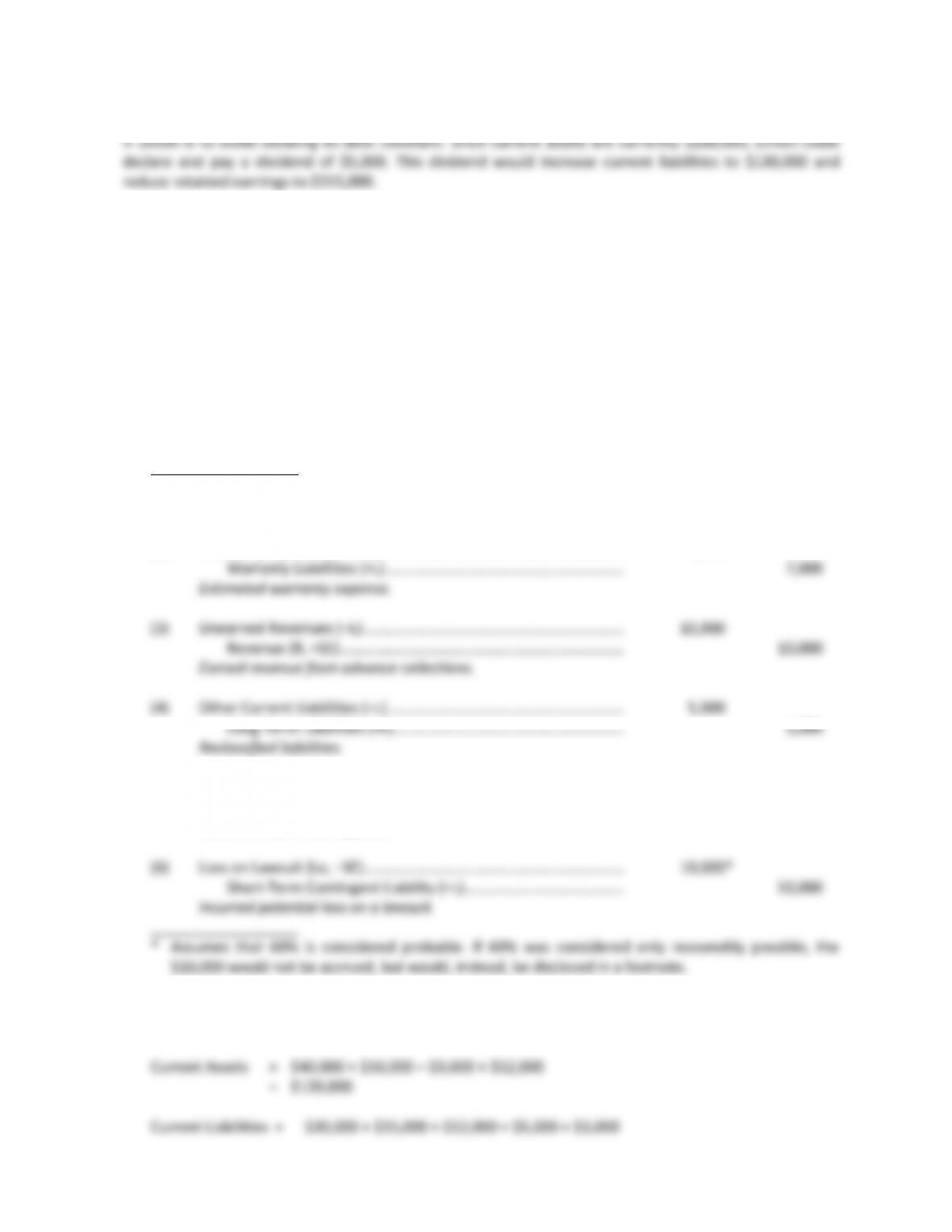
Declaring a dividend would increase current liabilities. Current assets cannot fall below 2 x current liabilities
P10–3
a. (1) Bad Debt Expense (E, –SE) …………………………..……………………….. 1,000*
Allowance for Doubtful Accounts (–A) …………………………….. 1,000
Estimated bad debts.
* $1,000 = ($50,000 Accounts receivable balance 6% Estimated uncollectible
percentage) – $2,000 Balance in the Allowance account
(2) Warranty Expense (E, –SE)……………………………………………………. 7,000
(5) Income Tax Expense (E, –SE) ………………………………………………… 3,000
Income Tax Payable (+L) ………………………………………………… 3,000
Incurred income tax expense.
b. After considering the journal entries in part (a), except for entry (6), current assets and current
liabilities would be as follows.

= $65,000
P10–3 Continued
c. After considering the journal entries in part (a), including entry (6), current assets and current liabilities
would be as follows.
Current Assets = $40,000 + $50,000 – $3,000 + $52,000
= $139,000
d. The company’s auditors must first consider the directives of the FASB. SFAS Statement No. 5,
“Accounting for Contingencies,” addresses contingent liabilities. This pronouncement states that if a
contingent liability is both reasonably estimable and probable, then the liability must be accrued. But if
the contingent liability is reasonably estimable and only reasonably possible, or if it is not reasonably
estimable, then the liability only has to be disclosed in a footnote. Finally, if a contingency is remotely
required the lawsuit to be accrued. Finally, if the liability was considered probable, and hence accrued,
the financial statement users were provided with the correct information and the auditor would not
face any legal liability.
Assume that the company wins the lawsuit. If the liability was considered remotely likely, the financial
statement users were provided with the correct information. The managers of the company would also
be happy because the company was not made to appear worse off than it actually was. If the liability
was considered reasonably possible and only disclosed in the footnotes, it is doubtful that many
P10–3 Concluded
The auditor faces two conflicting interests. The auditor must consider his or her legal liability to
financial statement users. On the other hand, the manager pays the audit fees. If the auditor demands
P10–4
a. From an accounting perspective, the Floor Wax Shop must consider generally accepted accounting
principles. The company would find authoritative guidance in SFAS Statement No. 5, “Accounting for
Contingencies.” According to this statement, the two factors that the Floor Wax Shop must consider are
(1) whether the amount of the loss can be reasonably estimated and (2) the probability that the Floor
Wax Shop will eventually incur the loss.
From an economic perspective, the Floor Wax Shop must consider the costs and benefits of the
P10–4 Concluded
b. The Floor Wax Shop should accrue the lawsuit for two reasons. First, the contingent loss meets the
requirements set forth in SFAS Statement No. 5, “Accounting for Contingencies,” for accruing a
c. The Floor Wax Shop would have made the following entry on December 31, 2014 to accrue the
contingent loss.
Contingent Loss on Lawsuit (Lo, –SE) ……………………………………………….. 742,000
Contingent Liability (+L) ……………………………………………………………. 742,000
Accrued contingent loss.
P10–5
a. Cash (+A) ……………………………………………………………………………………… 332,500
Sales (R, +SE) …………………………………………………………………………… 332,500
Sold cars.
b. 5/30 Contingent Warranty Liability (–L) ……………………………………. 3,000
Cash (–A)…………………………………………………………………. 1,200
Parts (–A) ………………………………………………………………… 1,800
Made repairs under warranty.
c. Warranty Expense (E, –SE) ……………………………………………………………… 26,600*
Contingent Warranty Liability (+L) …………………………………………….. 26,600
Estimated warranty expense.
P10–5 Concluded
d. Ending Balance = Beginning Balance + Warranty Expense for the Year – Cost of Repairs
e. Under the matching principle, all costs that are incurred in generating revenue should be matched
against those revenues. The matching principle does not distinguish between costs incurred before or
after the point of sale. Consequently, both presale and post-sale costs should be matched against the
associated revenue. The problem with matching post-sale costs against the associated revenue is that
P10–6
a. 2014 2015
Cash (+A) ………………………………… 40,000 …….. 56,000
Sales (R, +SE) ……………………….. 40,000 …… 56,000
Made sales.
Promotion Expense (E, –SE)……………… ………. 400a 560b
Contingent Promotion Liability (+L) …. 400 560