1
APPENDIX A
THE TIME VALUE OF MONEY
EXERCISES
EA–1
Time Periods (Years)
Compound Interest
Rates 5 10 15
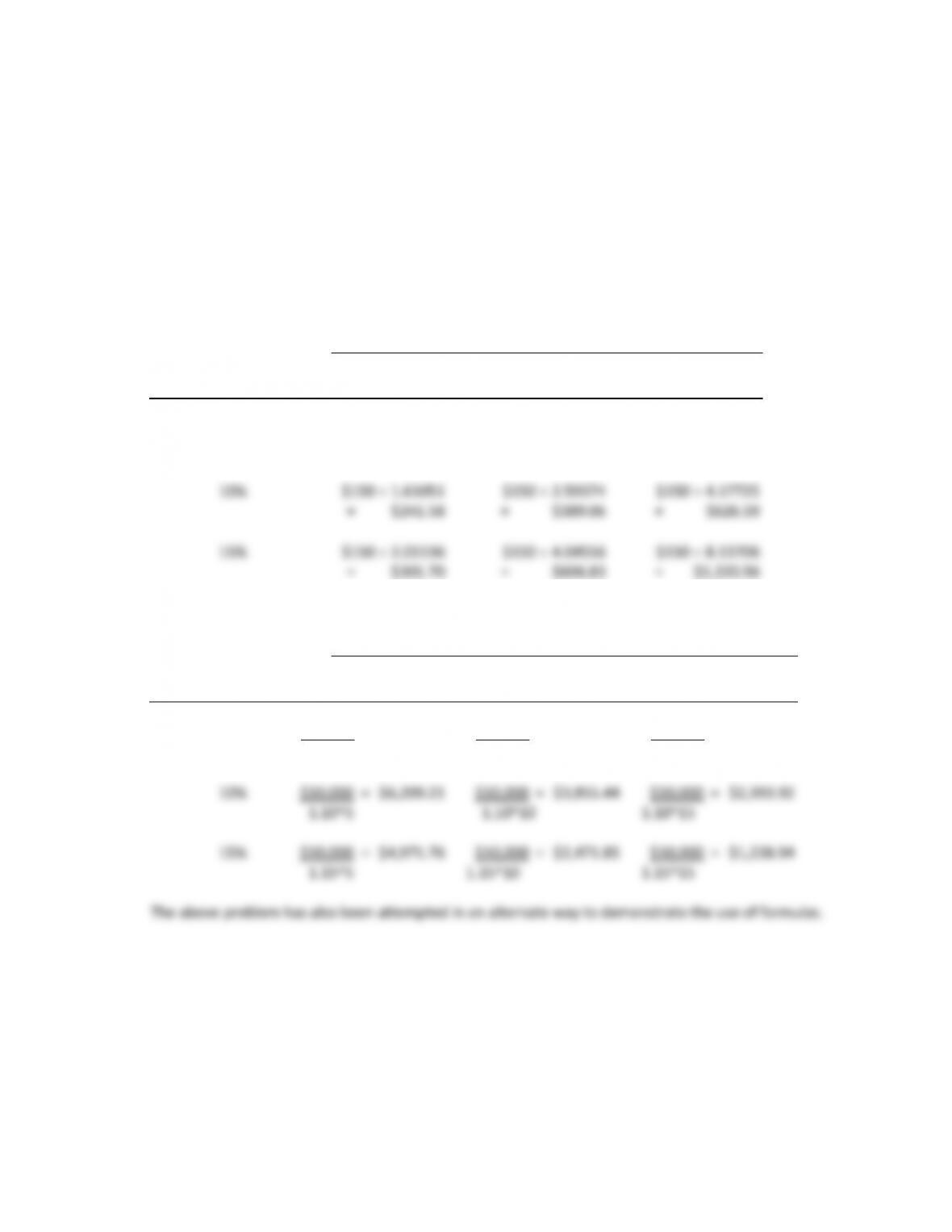
5% $150 1.27628 $150 1.62889 $150 2.07893
= $191.44 = $244.33 = $311.84
EA–2
Time Periods (Years)
Compound Interest
Rates 5 10 15
5% $10,000 = $7,835.26 $10,000 = $6,139.15 $10,000 = $4,810.17
1.05^5 1.05^10 1.05^15
2
EA–3
Time Periods (Years)
Compound
Interest
Rates 5 10 15
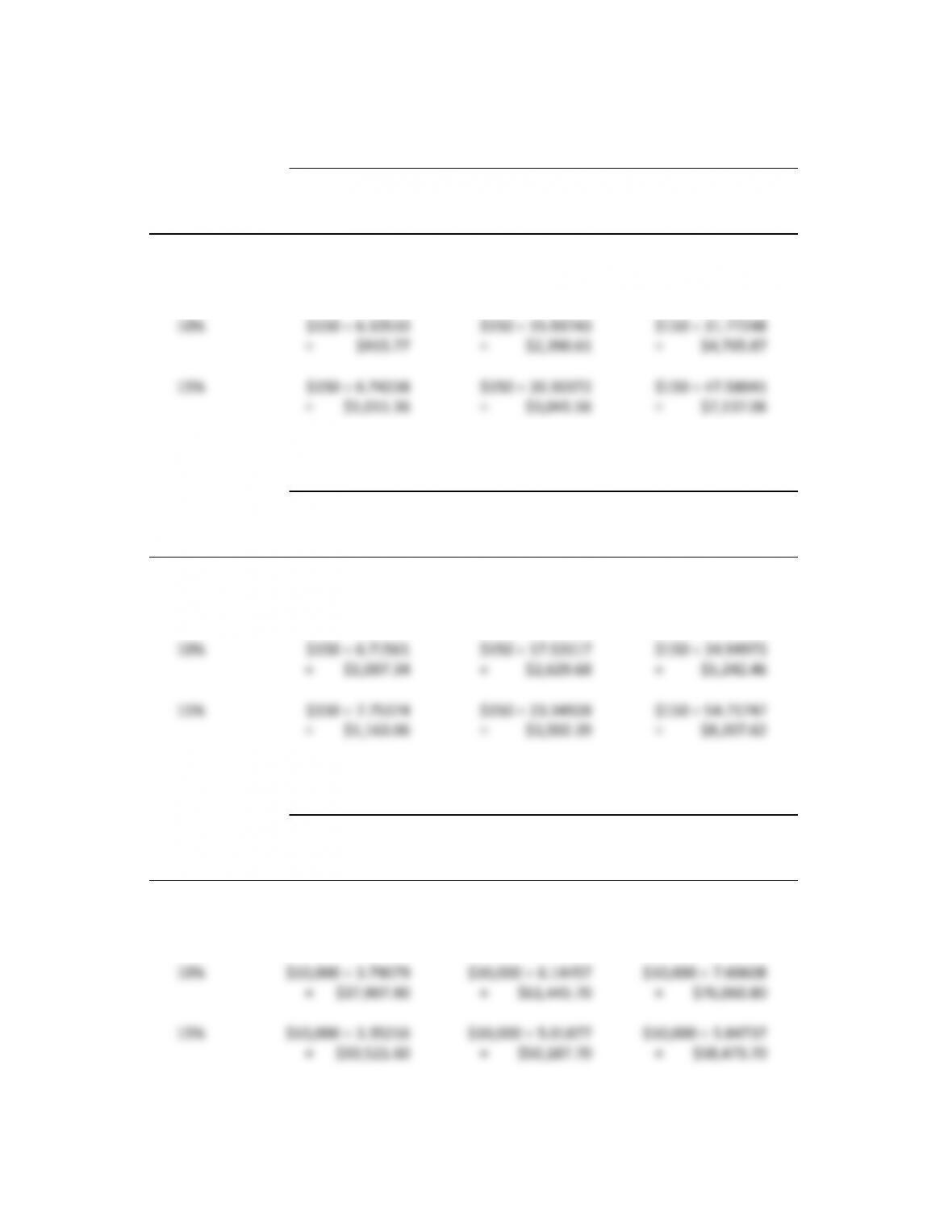
5% $150 5.52563 $150 12.57789 $150 21.57856
= $828.84 = $1,886.68 = $3,236.78
EA–4
Time Periods (Years)
Compound
Interest
Rates 5 10 15
5% $150 5.80191 $150 13.20679 $150 22.65749
= $870.29 = $1,981.02 = $3,398.62
EA–5
Time Periods (Years)
Compound
Interest
Rates 5 10 15
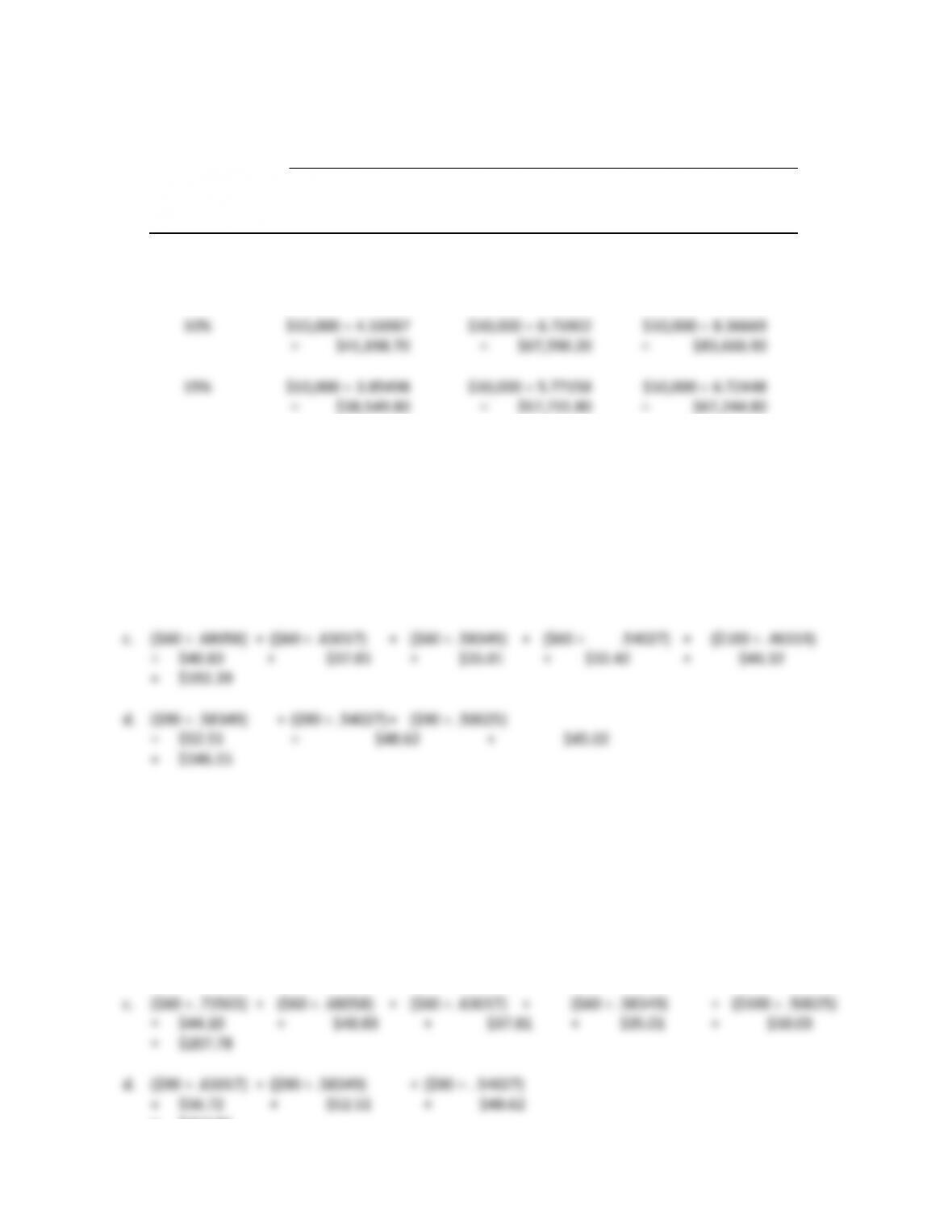
5% $10,000 4.32948 $10,000 7.72173 $10,000 10.37966
= $43,294.80 = $77,217.30 = $103,796.60
3
EA–6
Time Periods (Years)
Compound
Interest
Rates 5 10 15
5% $10,000 4.54595 $10,000 8.10782 $10,000 10.89864
= $45,459.50 = $81,078.20 = $108,986.40
EA–7
a. ($50 .85734) + ($100 .68058) + ($80 .54027)
= $42.87 + $68.06 + $43.22
= $154.15
b. ($100 3.31213) + ($100 .54027)
= $331.21 + $54.03
= $385.24
EA–8
a. ($50 .85734) + ($100 .68058) + ($80 .58349)
= $42.87 + $68.06 + $46.68
= $157.61
b. ($100 3.57710) + ($100 .58349)
= $357.71 + $58.35
= $416.06
= $157.85
4
EA–9
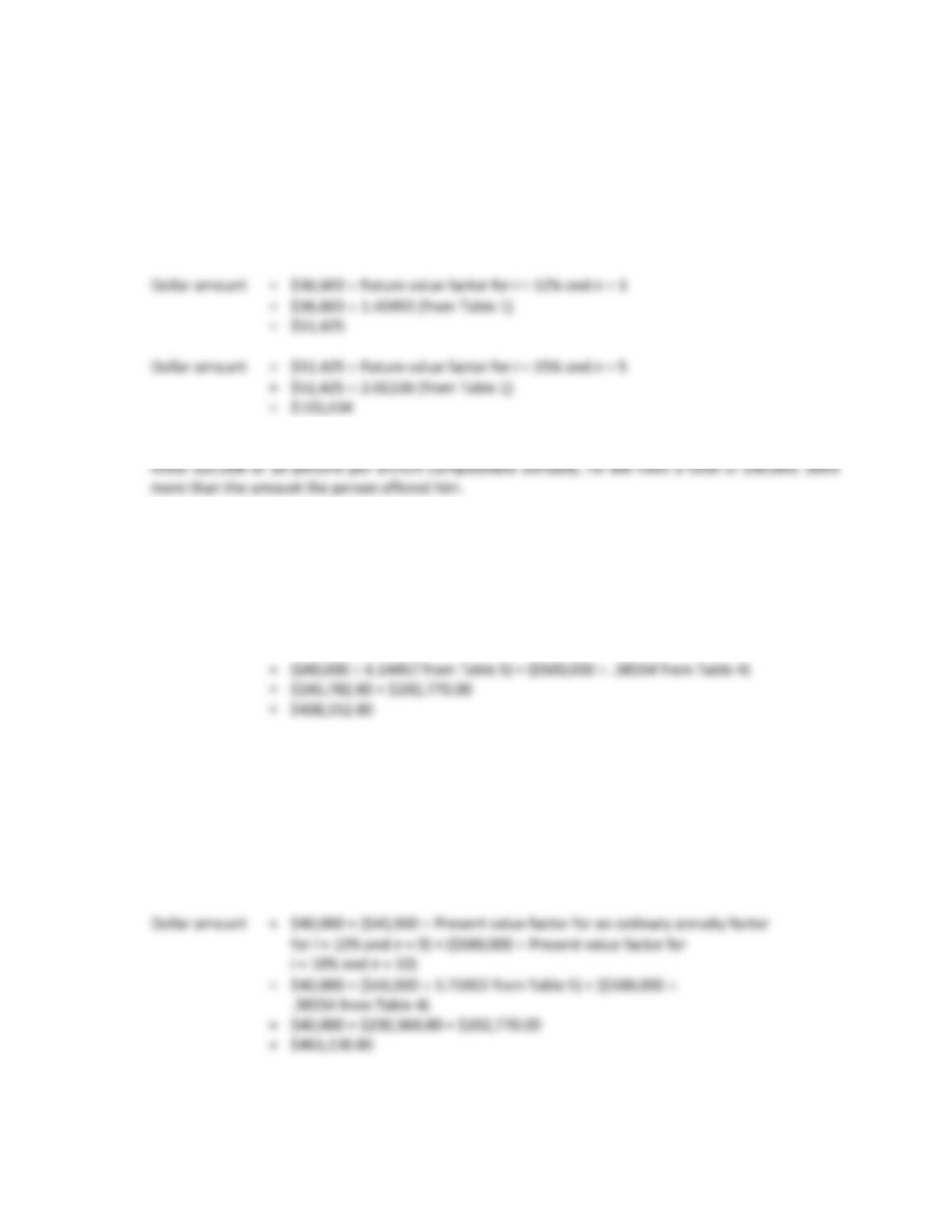
a. Dollar amount = $25,000 Future value factor for i = 10% and n = 4
= $25,000 1.46410 (from Table 1)
= $36,603
b. Ben should not accept $36,000 for $25,000 at the end of 4 years. Why not? Because if he invests the
EA–10
a. Dollar amount = ($40,000 Present value factor for an ordinary annuity factor for
i = 10% and n = 10) + ($500,000 Present value factor for
i = 10% and n = 10)
b. There are two different ways to calculate the dollar amount. The two ways are shown below.
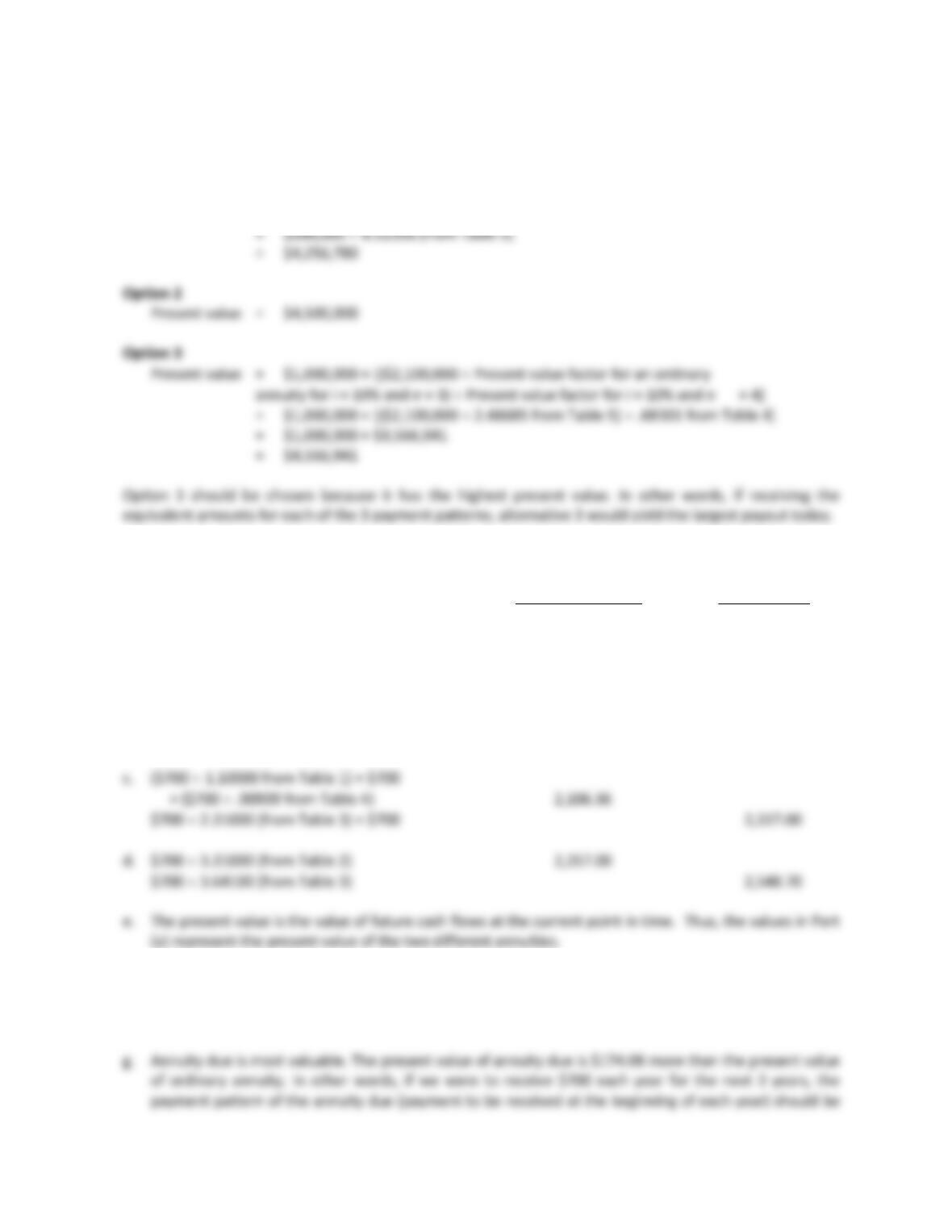
Dollar amount = ($40,000 Present value factor for an annuity due for i = 10% and n = 10)
+ ($500,000 Present value factor for i = 10% and n = 10)
= ($40,000 6.75902 from Table 6) + ($500,000 .38554 from Table 4)
= $270,360.80 + $192,770.00
= $463,130.80
5
EA–11
Option 1
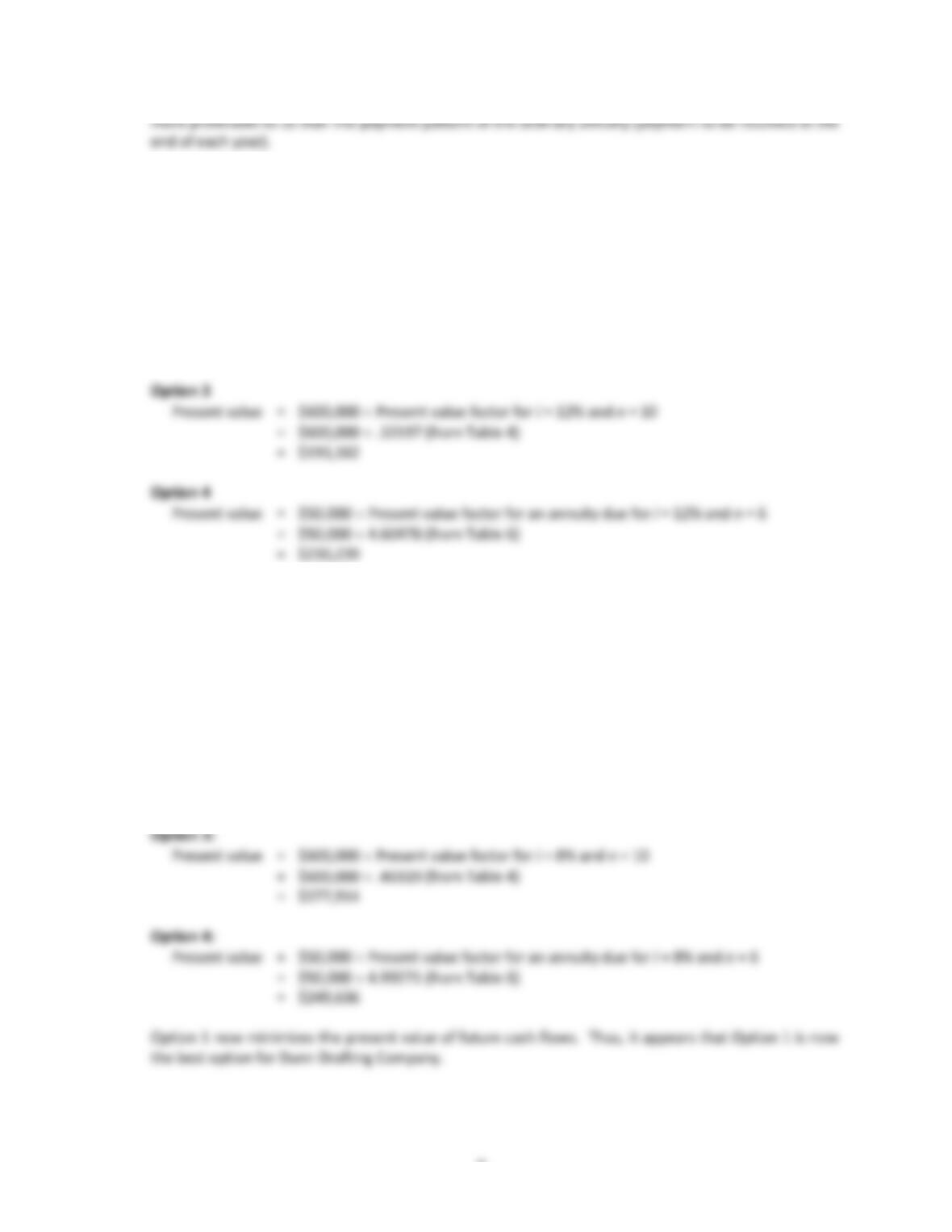
Present value = $500,000 Present value factor for an ordinary annuity for i = 10%
and n = 20)
EA–12
Ordinary Annuity Annuity Due
a. $700 2.48685 (from Table 5) $1,740.80
$700 2.73554 (from Table 6) $1,914.88
b. $700 + ($700 1.73554 from Table 5) 1,914.88
($700 1.10000 from Table 1) + $700
+ ($700 .90909 from Table 4) 2,106.36
f. The future value is the value of future cash flows at a future point in time. Since the ends of Periods 1,
2, and 3 are all in the future, the value of the cash flows at those points in time all qualify as future
values.
6
EA–13
a. Option 1
Present value = $240,000
Option 2
Present value = $500,000 Present value factor for i = 12% and n = 8
= $500,000 .40388 (from Table 4)
= $201,940
b. By computing the present value of each option’s future cash flows, the cost of each option is
comparable. Since Option 3 has the lowest present value, it appears to the best deal for Dunn Drafting
Company.
c. Option 1:
Present value = $240,000
Option 2:
Present value = $500,000 Present value factor for i = 8% and n = 8
= $500,000 .54027 (from Table 4)
= $270,135
7
EA–14
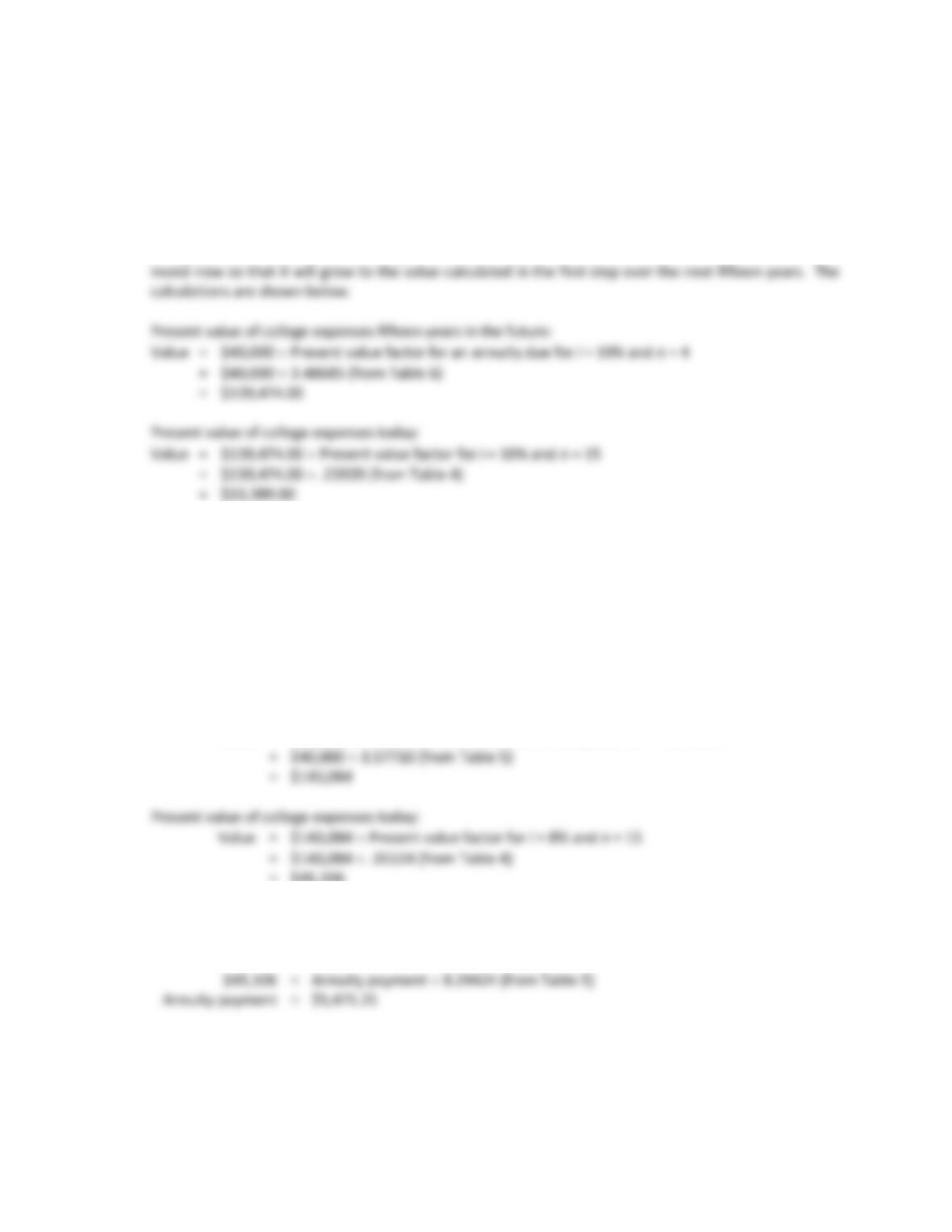
a. Since the Croziers plan to invest a lump sum today and then withdraw the money in the form of an
annuity, two steps are required to determine how much the Croziers must invest today to pay for
Ryan’s college education. The first step is to calculate how much money they will need fifteen years
from now when Ryan enters college to make the four payments at the beginning of each year Ryan is in
college (i.e., the value of the annuity). The second step is to calculate how much they would have to
b. The present value of fourteen annual payments must equal the present value of $33,389 calculated in
part (a). By using the following formula, the amount of the annual payments can be calculated.
Present value = Annuity payment Present value factor for an ordinary annuity for
i =10% and n = 14
$33,389 = Annuity payment 7.36669 (from Table 5)
Annuity payment = $4,532.43
c. Current investment
Present value of college expenses fifteen years in the future:
Value = $40,000 Present value factor for an annuity due for i = 8% and n = 4
= $45,106
Annuity payment
Present value = Annuity payment Present value factor for an ordinary annuity for i = 8%
and n = 14
8
EA–15
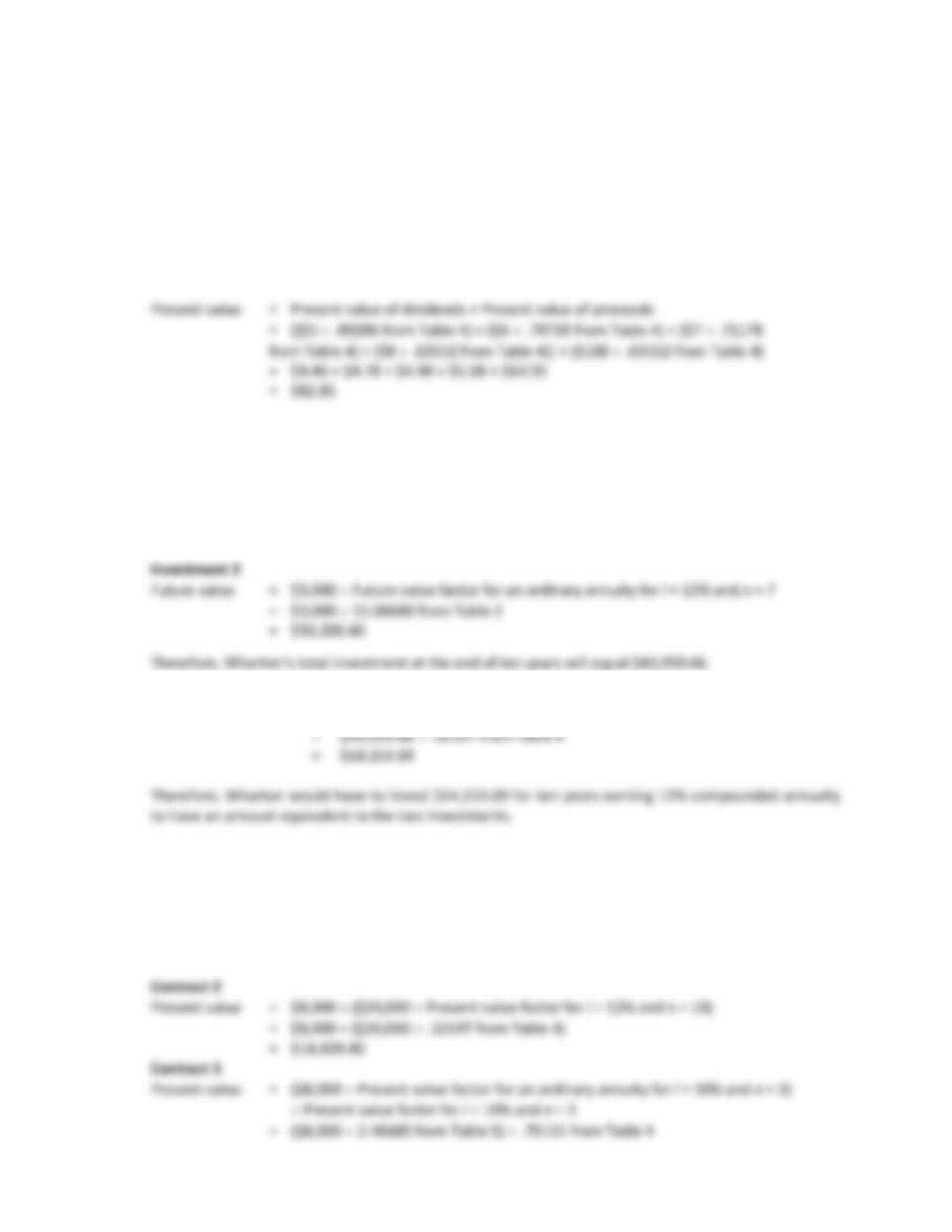
a. ($30,000 .46319) + ($30,000 .42888) + ($30,000 .39711) + ($30,000 .36770)
= $13,895.70 + $12,866.40 + $11,913.30 + $11,031.00
= $49,706.40
9
PROBLEMS
PA–1
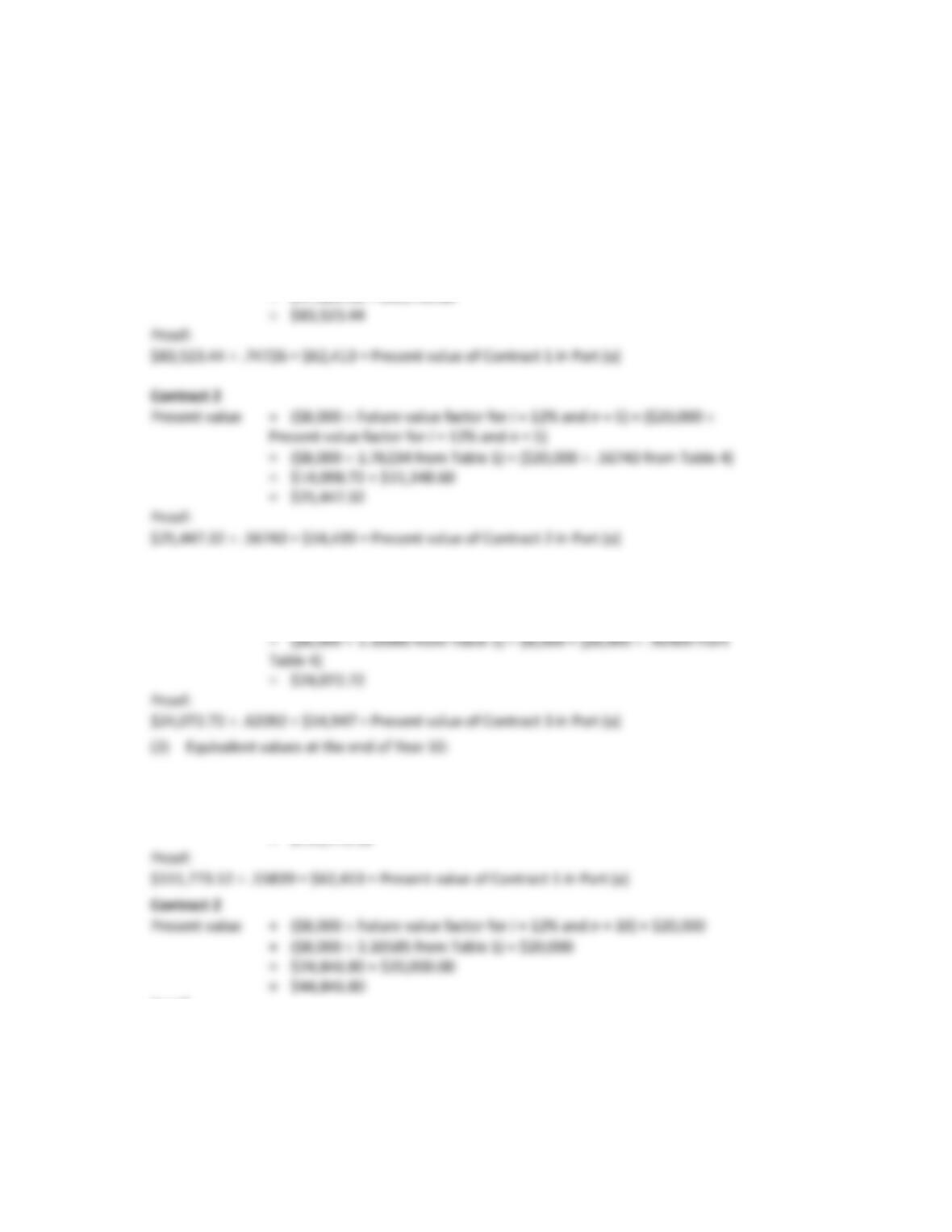
The price that Christie is willing to pay for the stock is comprised of two components: the present
value of the dividends she expects to receive from holding the investment and the present value of
the proceeds she will receive when she sells the investment. The total present value is calculated
as follows.
PA–2
a. Investment 1
Future value = ($1,000 Future value factor for an ordinary annuity for i = 10% and n = 5)
Future value factor for i = 12% and n = 5
= ($1,000 6.10510 from Table 2) 1.76234 from Table 1
= $10,759.26
b. Current investment = Future value Present value factor for i = 12% and n = 10
PA–3
a. Contract 1
Present value = $8,000 Present value factor for an annuity due for i = 6% and n = 10
= $8,000 7.80169 (from Table 6)
= $62,413.52

10
11
PA–3 Concluded
b. (1) Equivalent values at the end of Year 5:
Contract 1
Present value = ($8,000 Future value factor for an annuity due for i = 6% and n = 5) +
($8,000 Present value factor for an annuity due for i = 6% and n = 5
= ($8,000 5.97532 from Table 3) + ($8,000 4.46511 from Table 6)
= $47,802.56 + $35,720.88
Contract 3
Present value = ($8,000 Future value factor for i = 10% and n = 1) + $8,000 +
($8,000 Present value factor for i = 10% and n = 1)
Contract 1
Present value = $8,000 Future value factor for an annuity due for i = 6% and n = 10
= $8,000 13.97164 from Table 3
= $111,773.12
Proof:
$44,846.80 .32197 = $14,439 = Present value of Contract 2 in Part (a)
Contract 3
Present value = ($8,000 Future value factor for an ordinary annuity for i = 10% and n = 3)
Future value factor for i = 10% and n = 4
= ($8,000 3.31000 from Table 2) 1.46410 from Table 1
= $38,769.37

13
PA–4
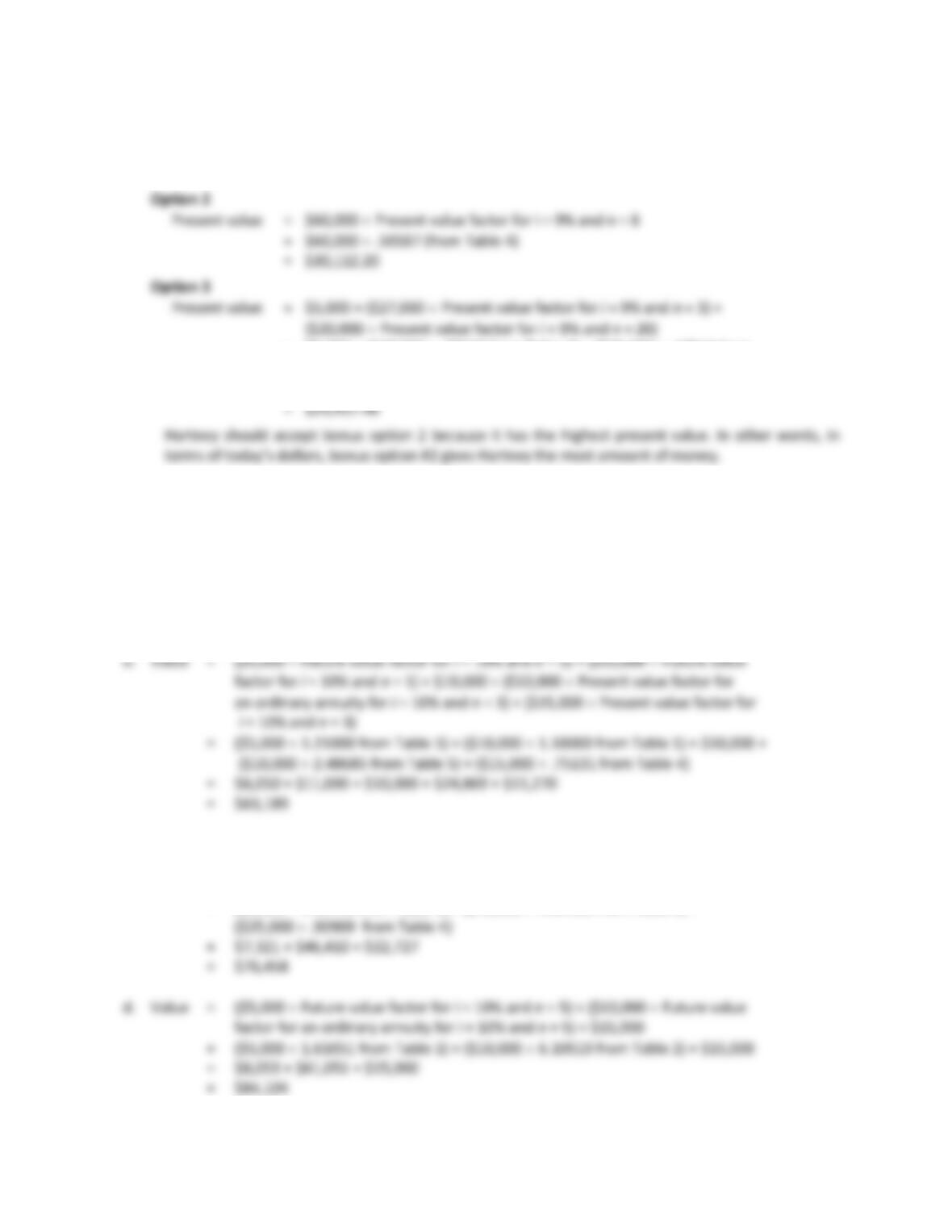
Option 1
Present value = $25,000
= $5,000 + ($27,000 .77218 from Table 4) + ($20,000 .17843 from
Table 4)
= $5,000 + $20,848.86 + $3,568.60
PA–5
a. Value = $5,000 + ($10,000 Present value factor for an ordinary annuity for i = 10%
and n = 5) + ($15,000 Present value factor for i = 10% and n = 5)
= $5,000 + ($10,000 3.79079 from Table 5) + ($15,000 .62092 from Table 4)
= $5,000 + $37,908 + $9,314
= $52,222
c. Value = ($5,000 Future value factor for i = 10% and n = 4) + ($10,000 Future value
factor for an ordinary annuity for i = 10% and n = 4) + [($10,000 + $15,000)
Present value factor for i = 10% and n = 1)]
= ($5,000 1.46410 from Table 1) + ($10,000 4.64100 from Table 2) +
14
PA–5 Concluded
Proof:
Value of each equivalent value today
Option 1 Option 2 Option 3 Option 4
1. $52,222 1.00000 $52,222
PA–6
Present values
a. Value = $10,000
b. Value = $2,000 Present value factor for an ordinary annuity for i = 8% and n = 8
= $2,000 5.74664 from Table 5
f. Value = $3,000 Present value factor for an ordinary annuity for i = 8% and n = 2
= $3,000 1.78326 from Table 5
= $5,349.78
Future values
a. Value = $10,000 Future value factor for i = 8% and n = 4
= $10,000 1.36049 from Table 1
= $13,604.90
PA–6 Concluded
d. Value = ($3,000 Future value factor for an ordinary annuity for i = 8% and n = 5) Future
value factor for i = 8% and n = 5
= ($3,000 5.86660 from Table 2) 1.46933 from Table 1
= $25,859.91
PA–7
a. To determine whether the offer of $110,000 today is a good deal, the future cash flows must be
converted into equivalent values in present dollars (i.e., present values). The contract specifies two
types of future cash flows: $2,000 at the beginning of each year for ten years and a lump-sum receipt
of $300,000 in ten years. The present value of the two types of cash flows are calculated below.
(1) Present value of annual receipts:
(2) Present value of lump-sum receipt:
(3) Total present value:
Value = $13,518.04 + $115,662.00
= $129,180.04
Since the present value of the future cash flows exceeds $110,000, it would not be wise for Joy Don