Chapter 9 – Capital Budgeting
Exercise 9-13
a. The minimum annual payments required would be the amount that
Solutions for Davis & Davis, Managerial Accounting, 2nd ed.
Chapter 9 – Capital Budgeting
9-13
Exercise 9-17
a.
y ears8
$20,000–$225,000
= $25,625 depreciation per year
Incremental income = $57,275 – $25,625 = $31,650
Accounting rate of return =
$31,650
($225,000 – $14,000)
=
15%
accounting rate of return.
Exercise 9-18
$140,000
5 years
b.
$7,000
$140,000
= 5%
Exercise 9-19
a.
($10,000 + $3,500) – $0
5 years
= $2,700 depreciation per year
Annual net operating income = $23,000 – $18,115 – $2,700 = $2,185
b.
Accounting rate of return =
$13,500
$2,185
=
16.2%
SOLUTIONS TO PROBLEMS
Problem 9-20
$15,000,000
30 years
Chapter 9 – Capital Budgeting
Problem 9-21
a. Purchase option
Cash Flow
Timing
Amount
12% PV
Factor
Present
Value
Purchase price
Year 0
($4,300,000)
1.0000
($4,300,000)
Maintenance payments
Years 1-5
($50,000)
3.6048
(180,240)
Present value of purchase
$(4,480,240)
Lease option
Cash Flow
Timing
Amount
12% PV
Factor
Present
Value
Lease payments
Years 1-3
($1,200,000)
2.4018
($2,882,160)
Lease payment
Year 4
($1,000,000)
.6355
(635,500)
Lease payment
Year 5
($1,000,000)
.5674
(567,400)
Maintenance payments
Years 1-5
($80,000)
3.6048
(288,384)
Present value of lease
$(4,373,444)
b. To make the purchase option at least as good as the lease option,
the present value of the salvage must be at least $106,796
$188,219.95
9-16
Problem 9-21, continued
c. To make the lease option financially acceptable, the net present
Annual revenue × PVA5, 12% =
$4,373,444
Annual revenue × 3.6048 =
$4,373,444
Annual revenue =
3.6048
$4,373,444
=
$1,213,227.92
d. Online retail sites must be operational 24/7, so Dan will want to
investigate the level of service and response time to maintenance
Chapter 9 – Capital Budgeting
9-17
Problem 9-22
a.
Year 1
Year 2
Year 3
Year 4
Customers per day
500
550a
605
665.5
Days in operation
× 360
× 360
× 360
× 360
Total customers served
180,000
198,000
217,800
239,580
CM per customer
× $4b
× $4
× $4
× $4
Annual CM for hot food restaurant
$720,000
$792,000
$871,200
$958,320
a500 × 1.1 = 550
b$9 – $5 = $4
b.
Year 1
Year 2
Year 3
Year 4
Customers per day without hot food restaurant
1,200
1,320
1,452
1,597.2
Less customers per day with hot food restaurant
(720)
(792)
(871.2)
(958.3)
Lost customers per day if hot food restaurant opens
480
528
580.8
638.9
Days in operation
× 360
× 360
× 360
× 360
Total customers lost
172,800
190,080
209,088
230,004
CM per customer
× 2.50
× 2.50
× 2.50
× 2.50
Annual CM lost if hot food restaurant opens
$432,000
$475,200
$522,720
$575,010
9-18
Problem 9-22, continued
c.
Year 0
Year 1
Year 2
Year 3
Year 4
Net CMa
$288,000
$316,800
$348,480
$383,310
Initial investment
($350,000)
Salvage at refurbishment
$30,000
Salaries
(80,000)
(80,000
(100,000)
(100,000)
Fixed operating costs
(70,000)
(70,000)
(70,000)
(70,000)
Net cash flow
($350,000)
$138,000
$166,800
$178,480
$243,310
PV Factor @ 8%
× 1.0000
× .9259
× .8573
× .7938
× .7350
Present Value
($350,000)
$127,774
$142,998
$141,677
$178,833
Chapter 9 – Capital Budgeting
9-19
Problem 9-23
a.
Option 1
Cash Flow
Timing
Amount
10% PV
Factor
Present Value
Purchase price
Year 0
($70,000)
1.0000
($70,000)
Annual cash flow
Years 1-10
$28,000
6.1446
172,049
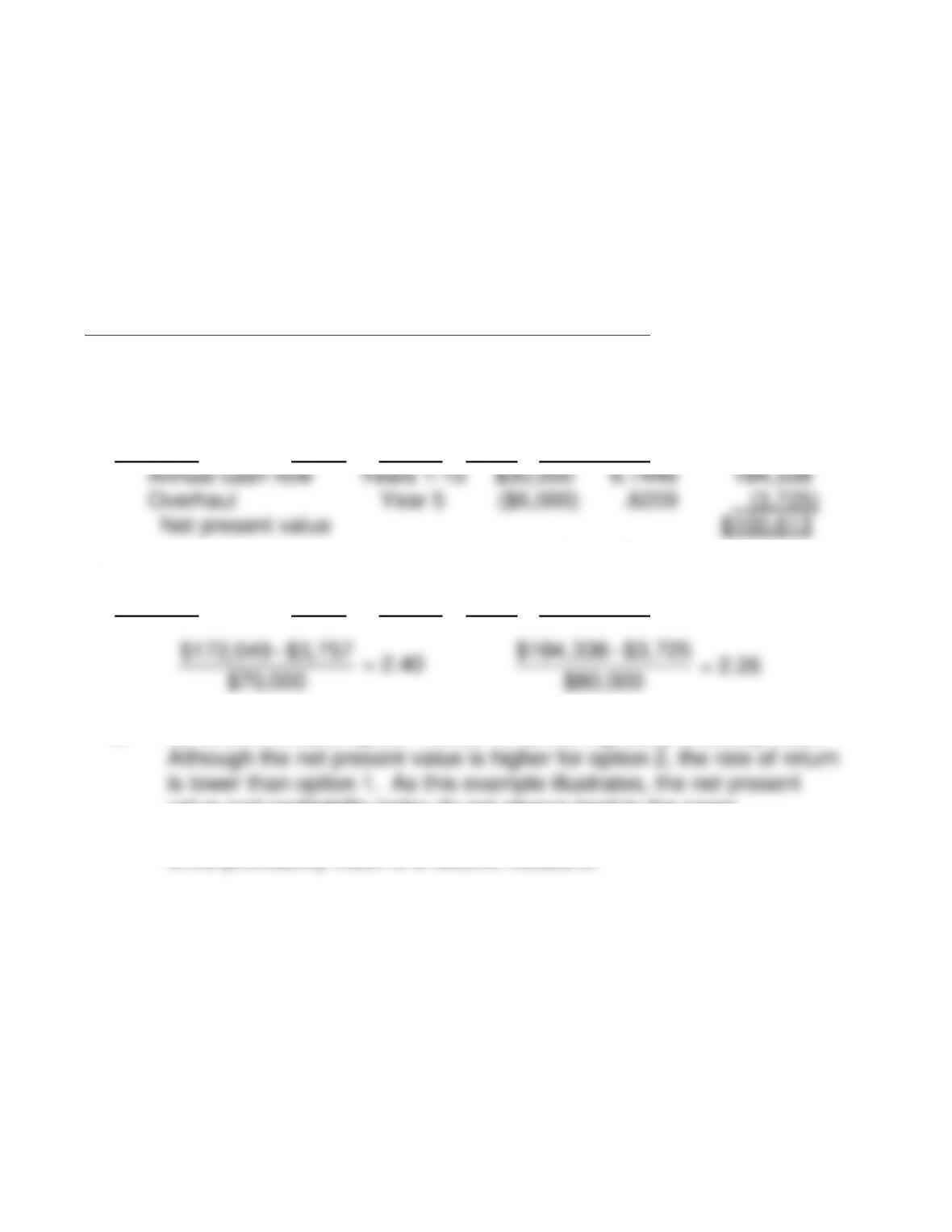
Overhaul
Year 3
($5,000)
.7513
(3,757)
Net present value
$98,292
Option 2
Cash Flow
Timing
Amount
10% PV
Factor
Present Value
Purchase price
Year 0
($80,000)
1.0000
($80,000)
Annual cash flow
Years 1-10
$30,000
6.1446
184,338
Overhaul
Year 5
($6,000)
.6209
(3,725)
Net present value
$100,613
b.
Option 1
Option 2
$172,049 – $3,757
$70,000
= 2.40
$80,000
$3,725–$184,338
= 2.26
c. Bill should choose option 1 since it has the highest profitability index.
Problem 9-24
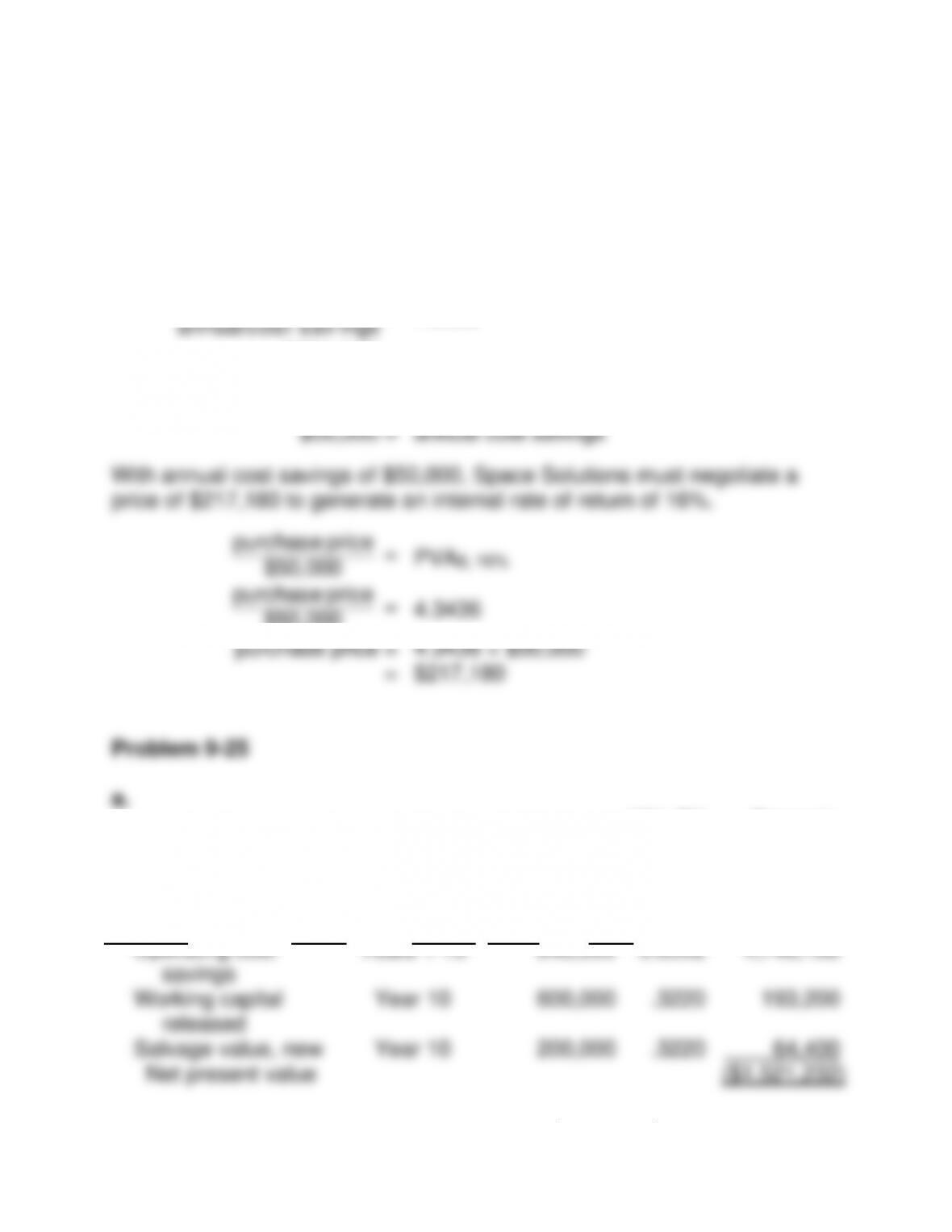
At the list price of $231,945, the annual cost savings required to generate a