Chapter 9 – Capital Budgeting
9-1
Capital Budgeting
Learning Objectives
1. Identify the cash flows associated with capital budgeting decisions. (Unit 9.1)
(Unit 9.2)
3. Use net present value to determine the acceptability of a project. (Unit 9.3)
4. Use the internal rate of return to determine the acceptability of a project. (Unit 9.3)
5. Calculate a project’s payback period. (Unit 9.4)
6. Calculate a project’s accounting rate of return. (Unit 9.4)
Summary of End of Chapter Material
Difficulty: E = Easy, M = Moderate, D = Difficult
Bloom: K = Knowledge, C = Comprehension, AP = Application, AN = Analysis, S = Synthesis, E = Evaluation
AACSB: A = Analytic, C = Communication, E = Ethics
AICPA FN: DM = Decision modeling, RA = Risk Analysis, M = Measurement, R = Reporting, RS = Research, T = Technology
AICPA PC: C = Communication, I = Interaction, L = Leadership, P = Professional demeanor, PM = Project Management,
PS = Problem Solving and Decision Making, T = Technology
IMA: BA = Business applications, BP = Budget Preparation, CM = Cost Management, DA = Decision Analysis,
ID = Investment Decisions, PM = Performance Measurement, R = Reporting, SP = Strategic Planning
Item
L. O.
Difficulty
Level
Minutes to
Complete
Bloom’s
Taxonomy
AACSB
AICPA
FN
AICPA
PC
IMA
Ethics
Coverage
GUIDED UNIT PREPARATION
Unit 9.1
1
1
E
2
K
A
R
C
ID
2
1
M
8
C
A
DM
PS
ID
3
1
M
3
C
A
M
PS
ID
Unit 9.2
1
2
E
1
K
A
M
PS
ID
2
2
M
2
K
A
M
PS
ID
3
2
E
1
K
A
M
PS
ID
Unit 9.3
1
3
M
3
K
A
M
PS
ID
2
3
E
2
C
A
M
PS
ID
3
3
D
3
C, AN
A
M
PS
ID
4
3
D
4
C
A
M
PS
ID
5
4
E
3
K
A
M
PS
ID
6
4
M
2
C
A
M
PS
ID
Unit 9.4
1
5
E
2
K
A
DM
PS
ID
2
5
D
4
C
A
M
PS
ID
3
6
E
3
K
A
M
PS
ID
4
6
M
3
C
A
M
PS
ID
CHAPTER
9
photo: © jsnyderdesign / iStockphoto

9-2
Item
L. O.
Difficulty
Level
Minutes to
Complete
Bloom’s
Taxonomy
AACSB
AICPA
FN
AICPA
PC
IMA
Ethics
Coverage
EXERCISES
9-1
1
M
12
AP
A
M
PS
ID
9-2
1
M
10–12
AP
A
M
PS
ID
9-3
2
E
8
AP
A
M
PS
ID
9-4
2
E
4
AP
A
M
PS
ID
9-5
2
M
12
AP
A
M
PS
ID
9-6
2
M
10
AP, AN
A
DM
PS
ID
9-7
3
M
15
AP, AN
A
DM
PS
ID
9-8
3
D
8-10
AP, AN
A
DM
PS
ID
9-9
3
E
8
AP
A
M
PS
ID
9-10
3
E
10
AP
A
M
PS
ID
9-11
4
E
8
AP, AN
A
DM
PS
ID
9-12
4
E
8-10
AP, AN
A
DM
PS
ID
9-13
4
M
10
AP, AN
A
DM
PS
ID
9-14
5
E
8
AP, AN
A
DM
PS
ID
9-15
5
M
4
AP
A
M
PS
ID
9-16
5
M
10–15
AP, AN
A
DM
PS
ID
9-17
6
M
10–12
AP, AN
A
DM
PS
ID
9-18
6
D
8-10
AP
A
DM
PS
ID
9-19
6
D
8
AP
A
M
PS
ID
PROBLEMS
9-20
2
D
15
AP, AN, E
A
DM
PS
ID
9-21
3
D
20–25
AP, AN, E
A
DM
PS
ID
9-22
3
M
20–25
AP, AN
A
DM
PS
ID
9-23
3
M
15
AP, AN
A
DM
PS
ID
9-24
4
M
12–15
AP, AN
A
DM
PS
ID
9-25
3, 4
D
30–35
AP, AN, E
A
DM
PS
ID
9-26
5, 6
M
20
AP
A
DM
PS
ID
9-27
3, 4,
5
D
30–35
AP, AN, E
A
DM
PS
ID
9-28
3, 4,
5
D
25–30
AP
A
DM
PS
ID
9-29
3, 4,
5, 6
M
20–25
AP, AN
A
DM
PS
ID
C&C CONTINUING CASE
9-30
1, 3
D
25–30
AP, AN
A
DM
PS
ID
CASES
9-31
3
D
55–60
AP, AN
A
DM
PS
ID
9-32
3
D
25–30
AP, AN, E
E
R
C
BA
Chapter 9 – Capital Budgeting
9-3
SOLUTIONS TO GUIDED UNIT PREPARATION
Unit 9.1
1. Capital assets are assets that are expected to generate economic
property, plant, and equipment.
2. A screening decision evaluates a project against a benchmark or
target. If the benchmark is exceeded, the project remains under
return is a screening decision.
top 50 for admission is a preference decision. In a business setting,
choosing the one project with the highest return and committing funds
for that project is a preference decision.
3. Return of investment is recouping the original amount spent for the
above the original investment.
Unit 9.2
1. Present value is how much a future cash inflow is worth in today’s
dollars.
2. Present value depends on the amount of cash flow in the future, the
3. An annuity is a series of equal cash inflows or outflows that occurs
every period.

9-4
Unit 9.3
1. Identify the amount and timing of each cash flow. Determine the
cash flow. Sum the present values.
2. Under the net present value method of capital budgeting, a project is
3. As the discount rate is increased, a project’s net present value will
value will increase.
4. A project’s net present value is the sum of the present value of all
occurring in the present.
5. The internal rate of return can be calculated using
PVAn, i =
Flow Cash Annual
Investment Initial
. Locate this present value of an annuity
determine the internal rate of return.
6. The internal rate of return is the discount rate that generates a net
present value equal to $0.
Unit 9.4
1. Payback period measures how long it takes to recoup the original
investment amount.
2. When annual cash flows are identical, payback period is calculated
using Payback Period =
Flow Cash Annual
Investment Initial
. When annual cash flows
are unequal, payback period is determined by calculating the
cumulative returns until the original investment has been recouped.
Chapter 9 – Capital Budgeting
9-5
3. Accounting rate of return is based on accounting income, not cash
flows. It is calculated as
equipment old of salvage – investment initial
expenses operating project – revenues project
.
4. Average annual income differs from cash flow because of non-cash
expenses, such as depreciation, that are included in the calculation of
income.
SOLUTIONS TO EXERCISES
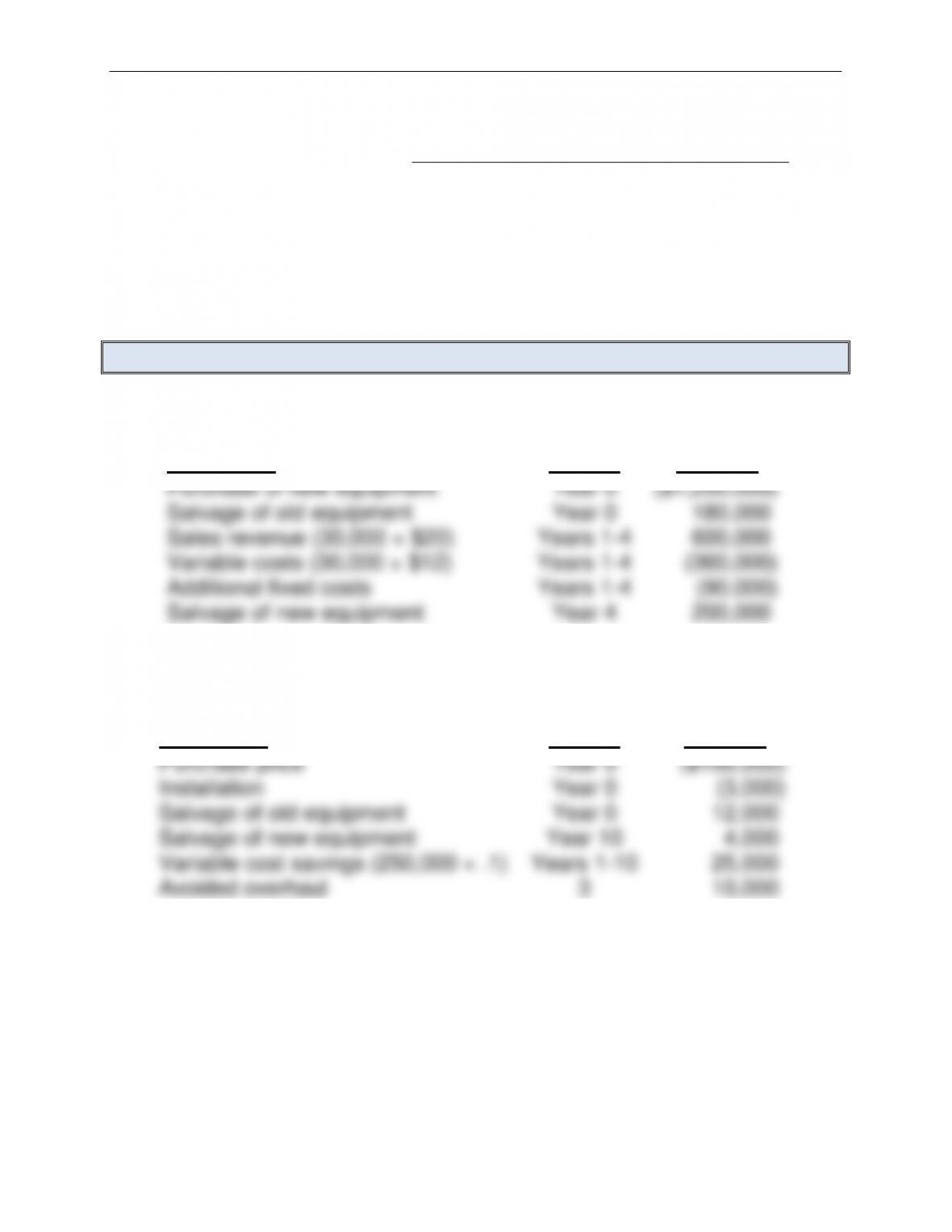
Exercise 9-1
Cash Flow
Timing
Amount
Purchase of new equipment
Year 0
($1,200,000)
Salvage of old equipment
Year 0
180,000
Sales revenue (30,000 × $20)
Years 1-4
600,000
Variable costs (30,000 × $12)
Years 1-4
(360,000)
Additional fixed costs
Years 1-4
(90,000)
Salvage of new equipment
Year 4
200,000
Exercise 9-2
Cash Flow
Timing
Amount
Purchase price
Year 0
($150,000)
Installation
Year 0
(3,000)
Salvage of old equipment
Year 0
12,000
Salvage of new equipment
Year 10
4,000
Variable cost savings (250,000 × .1)
Years 1-10
25,000
Avoided overhaul
3
10,000
9-6
Exercise 9-3
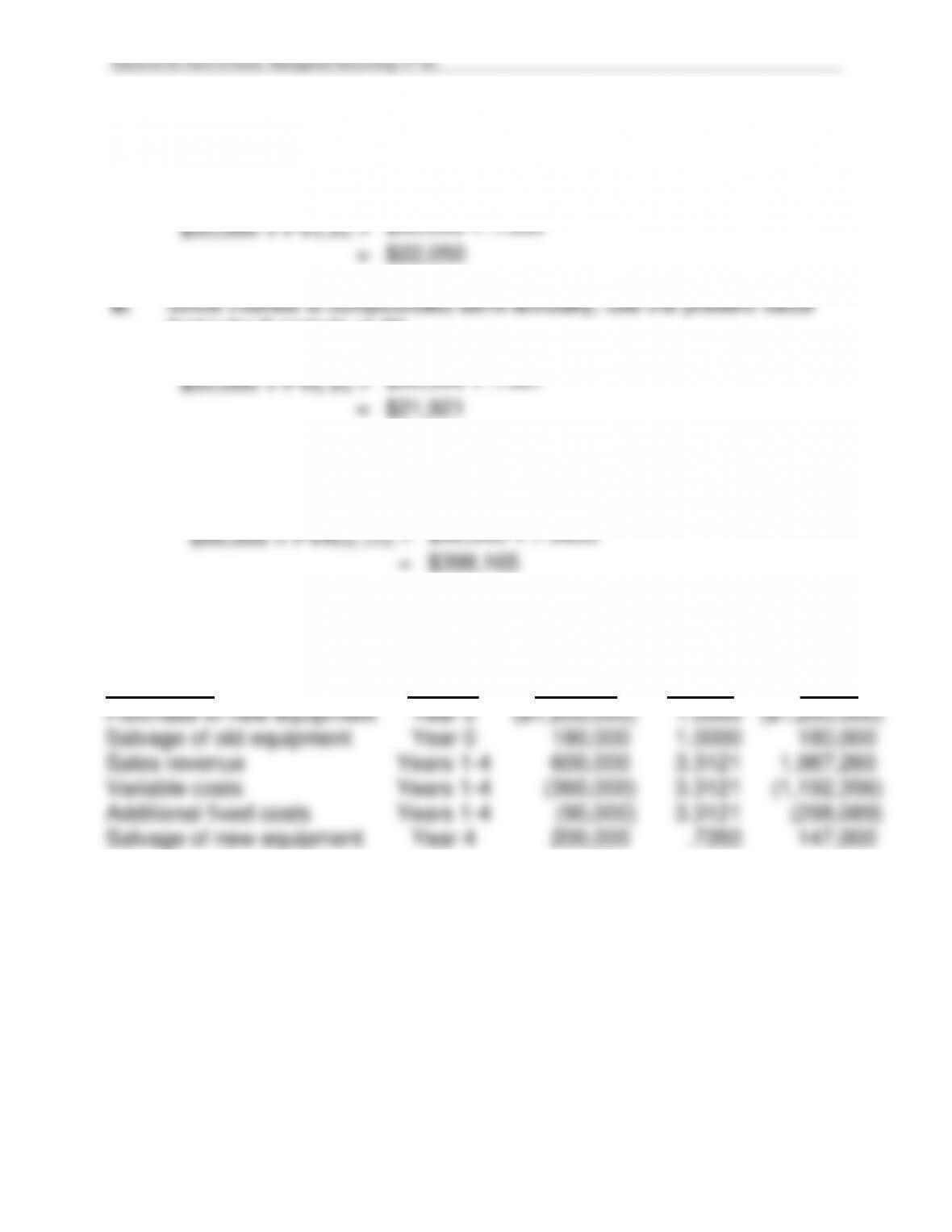
a. Present value of $30,000 received in 4 years at 8% discount rate
$30,000 × PV4, 8% =
$30,000 × .7350
=
$22,050
factor for 8 periods at 4%.
$30,000 × PV8, 4% =
$30,000 × .7307
=
$21,921
Exercise 9-4
$50,000 × PVA20, 11% =
$50,000 × 7.9633
=
$398,165
Exercise 9-5
Cash Flow
Timing
Amount
8% PV
Factor
Present
Value
Purchase of new equipment
Year 0
($1,200,000)
1.0000
($1,200,000)
Salvage of old equipment
Year 0
180,000
1.0000
180,000
Sales revenue
Years 1-4
600,000
3.3121
1,987,260
Variable costs
Years 1-4
(360,000)
3.3121
(1,192,356)
Additional fixed costs
Years 1-4
(90,000)
3.3121
(298,089)
Salvage of new equipment
Year 4
200,000
.7350
147,000
Chapter 9 – Capital Budgeting
9-7
Exercise 9-6
Cash Flow
Timing
Amount
6% PV
Factor
Present
Value
Annual payment
Years 1-14
$15,000
9.2950
$139,425
Final lump sum payment
Year 15
20,000
.4173
8,346
Net present value
$147,771
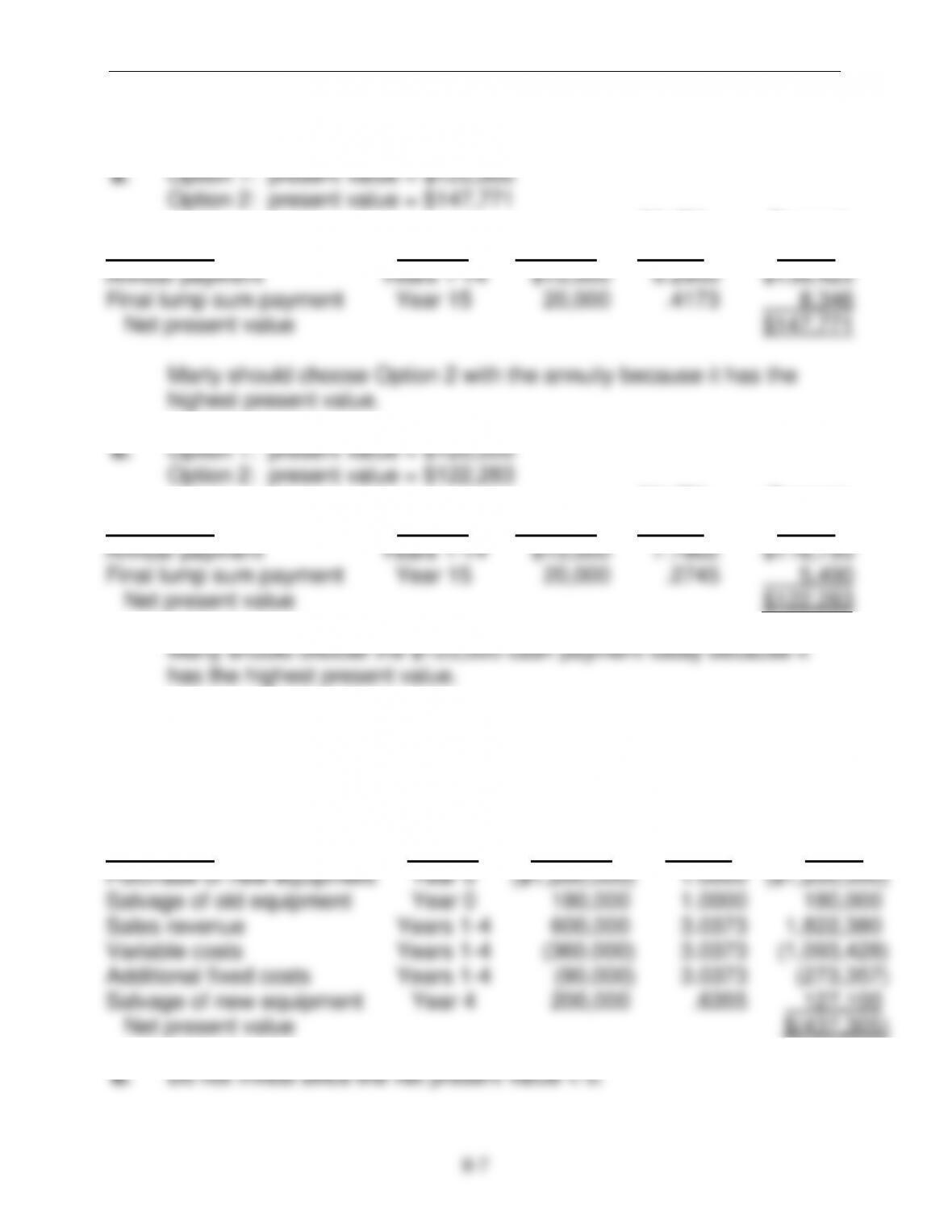
Marty should choose Option 2 with the annuity because it has the
highest present value.
Cash Flow
Timing
Amount
9% PV
Factor
Present
Value
Annual payment
Years 1-14
$15,000
7.7862
$116,793
Final lump sum payment
Year 15
20,000
.2745
5,490
Net present value
$122,283
Exercise 9-7
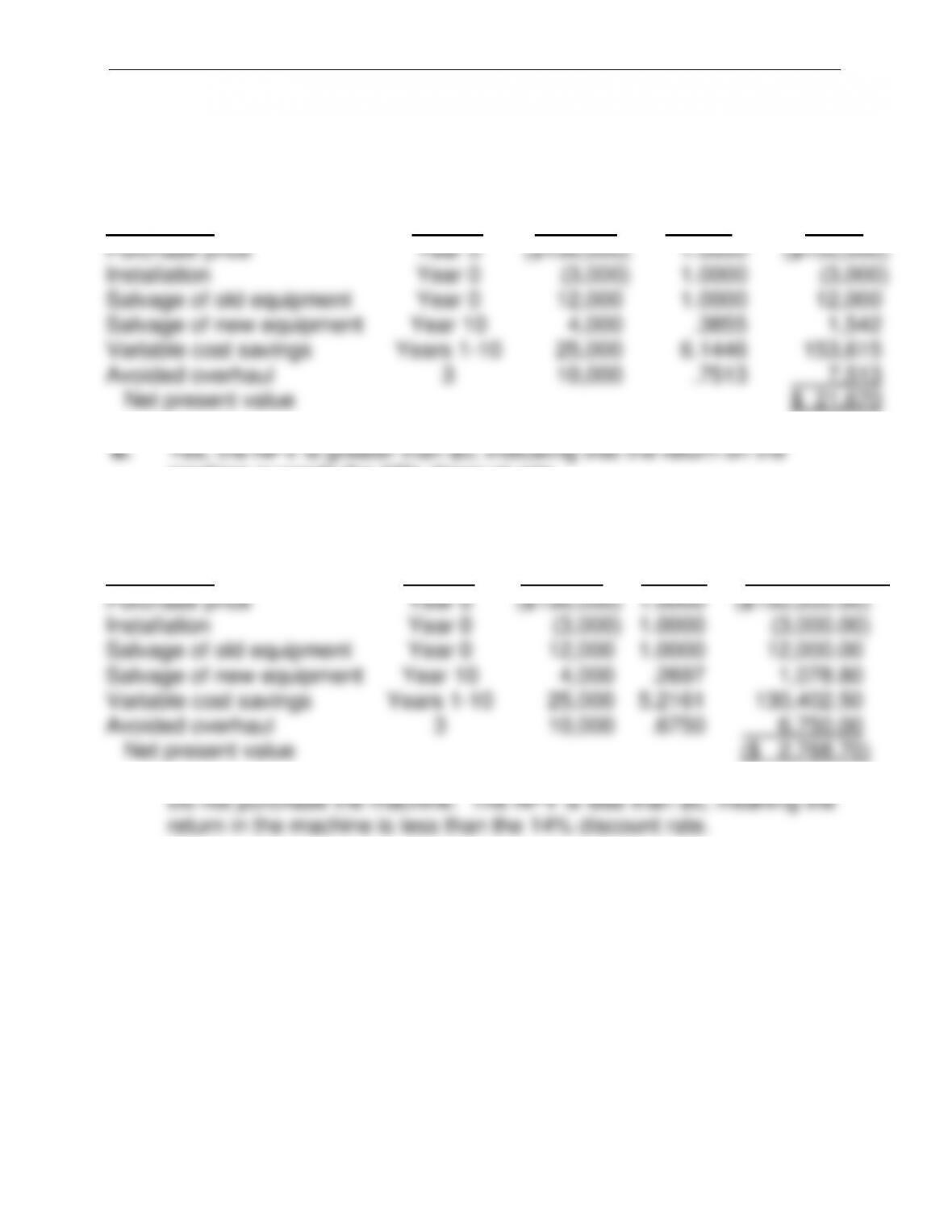
a.
Cash Flow
Timing
Amount
12% PV
Factor
Present
Value
Purchase of new equipment
Year 0
($1,200,000)
1.0000
($1,200,000)
Salvage of old equipment
Year 0
180,000
1.0000
180,000
Sales revenue
Years 1-4
600,000
3.0373
1,822,380
Variable costs
Years 1-4
(360,000)
3.0373
(1,093,428)
Additional fixed costs
Years 1-4
(90,000)
3.0373
(273,357)
Salvage of new equipment
Year 4
200,000
.6355
127,100
Net present value
$(437,305)
9-8
Exercise 9-8
a.
Cash Flow
Timing
Amount
10% PV
Factor
Present
Value
Purchase price
Year 0
($150,000)
1.0000
($150,000)
Installation
Year 0
(3,000)
1.0000
(3,000)
Salvage of old equipment
Year 0
12,000
1.0000
12,000
Salvage of new equipment
Year 10
4,000
.3855
1,542
Variable cost savings
Years 1-10
25,000
6.1446
153,615
Avoided overhaul
3
10,000
.7513
7,513
Net present value
$ 21,670
machine exceeds the 10% discount rate.
c.
Cash Flow
Timing
Amount
14% PV
Factor
Present Value
Purchase price
Year 0
($150,000)
1.0000
($150,000.00)
Installation
Year 0
(3,000)
1.0000
(3,000.00)
Salvage of old equipment
Year 0
12,000
1.0000
12,000.00
Salvage of new equipment
Year 10
4,000
.2697
1,078.80
Variable cost savings
Years 1-10
25,000
5.2161
130,402.50
Avoided overhaul
3
10,000
.6750
6,750.00
Net present value
($ 2,768.70)

Chapter 9 – Capital Budgeting
9-9
Exercise 9-9
(x × PVA4, 11%) – $7,756=
$0
x × 3.1024 =
$7,756
x =
$2,500
b.
(x × PVA4, 14%) – $7,756=
$0
x × 2.9137 =
$7,756
x =
$2,662
Exercise 9-10
Year
Projected
Cash Flows
10%
PV Factor
Present
Value
0
($500,000)
1.0000
($500,000)
1
200,000
.9091
181,820
2
150,000
.8264
123,960
3
100,000
.7513
75,130
4
60,000
.6830
40,980
5
60,000
.6209
37,254
6
40,000
.5645
22,580
7
40,000
.5132
20,528
Net Present Value
$ 2,252
9-10
Exercise 9-11
$14,000
$88,235
return is 13%.
Exercise 9-12
a.
$285,000 $5,305
$40,000 $25,000
=
$279,695
$65,000
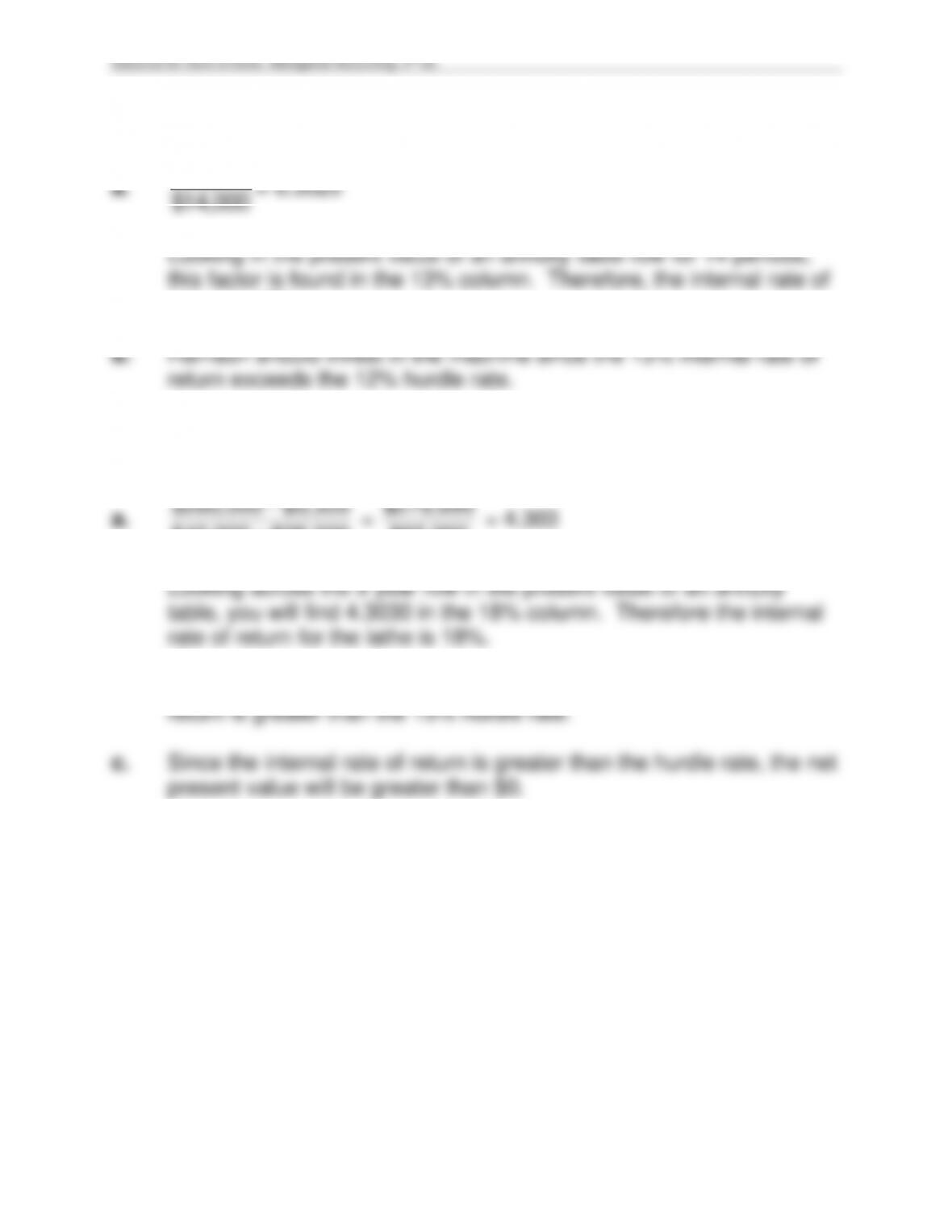
= 4.303
b. Garrett should purchase the lathe since the 18% internal rate of