Chapter 8 – Using Accounting Information to Make Managerial Decisions
8-1
Using Accounting Information to
Make Managerial Decisions
Learning Objectives
1. Identify relevant information for decision making. (Unit 8.1)
2. Determine the qualitative and quantitative impacts of special-order pricing. (Unit 8.2)
3. Determine the qualitative and quantitative impacts of outsourcing decisions. (Unit 8.3)
4. Determine how to allocate constrained resources to maximize income. (Unit 8.4)
5. Calculate the effects on operating income of keeping or eliminating operations. (Unit 8.5)
Summary of End of Chapter Material
Difficulty: E = Easy, M = Moderate, D = Difficult
Bloom: K = Knowledge, C = Comprehension, AP = Application, AN = Analysis, S = Synthesis, E = Evaluation
AACSB: A = Analytic, C = Communication, E = Ethics
AICPA FN: DM = Decision modeling, RA = Risk Analysis, M = Measurement, R = Reporting, RS = Research, T = Technology
AICPA PC: C = Communication, I = Interaction, L = Leadership, P = Professional demeanor, PM = Project Management,
PS = Problem Solving and Decision Making, T = Technology
IMA: BA = Business applications, BP = Budget Preparation, CM = Cost Management, DA = Decision Analysis,
PM = Performance Measurement, R = Reporting, SP = Strategic Planning
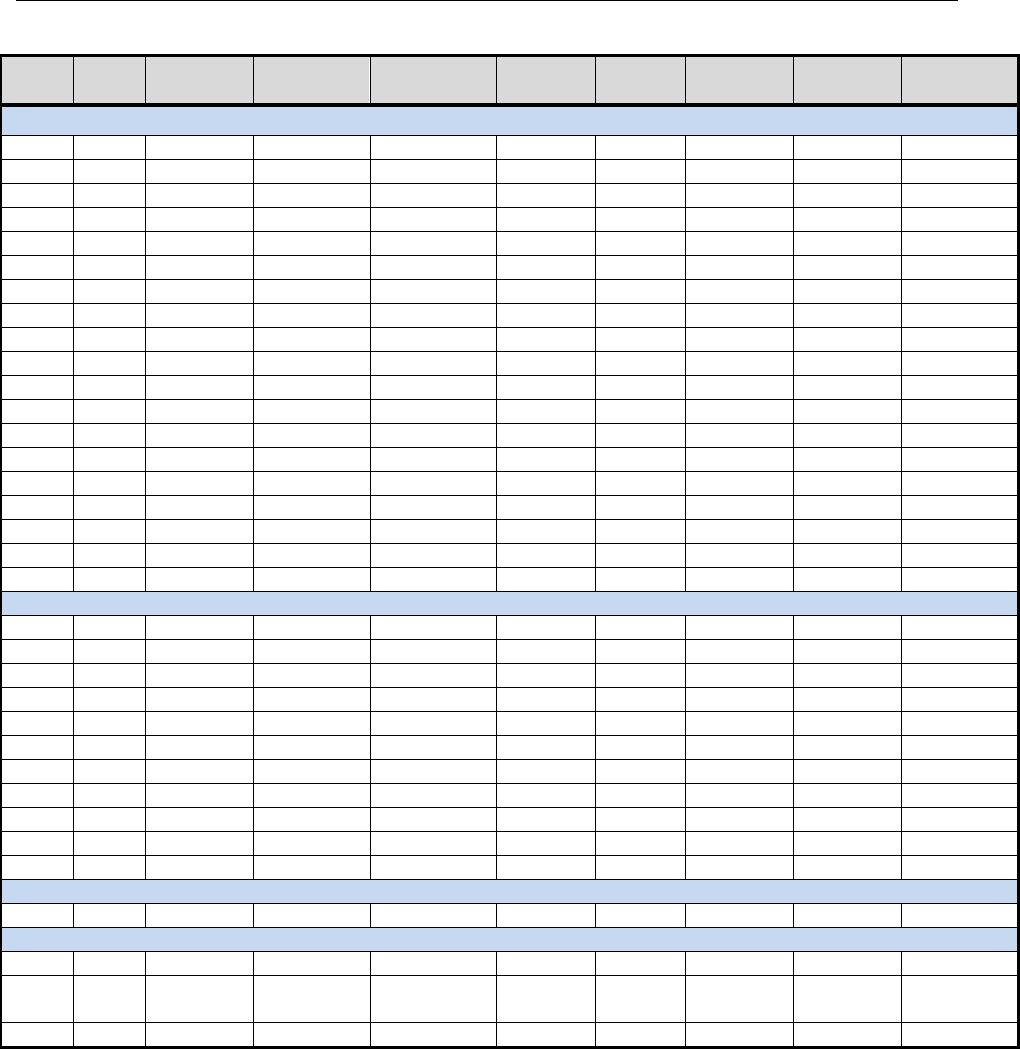
Item
L. O.
Difficulty
Level
Minutes to
Complete
Bloom’s
Taxonomy
AACSB
AICPA
FN
AICPA
PC
IMA
Ethics
Coverage
GUIDED UNIT PREPARATION
Unit 8.1
1
1
E
2
K
A
DM
PS
DA
2
1
M
4
K, C
A
DM
PS
DA
3
1
M
3
K
A
DM
PS
DA
Unit 8.2
1
2
M
4
C
A
DM
PS
DA
2
2
D
2
C
A
DM
PS
DA
3
2
D
4
C
A
DM
PS
DA
4
2
E
2
C
A
DM
PS
DA
Unit 8.3
1
3
M
2
K
A
DM
PS
DA
2
3
D
4
K
A
DM
PS
DA
3
3
E
3
K
A
DM
PS
DA
Unit 8.4
1
4
M
2
C
A
DM
PS
DA
2
4
M
2
C
A
DM
PS
DA
3
4
D
3
C
A
DM
PS
DA
4
4
E
1
K
A
DM
PS
DA
5
4
M
3
C
A
DM
PS
DA
Unit 8.5
1
5
M
2
C
A
DM
PS
DA
2
5
E
1
K
A
M
PS
DA
3
5
M
4
K, C
A
M
PS
DA
4
5
M
2
C
A
DM
PS
DA
CHAPTER
8
phot
o: ©
jsnyd
erdes
ign /
iStock
phot
o
Solutions for Davis & Davis, Managerial Accounting, 2nd ed.
8-2
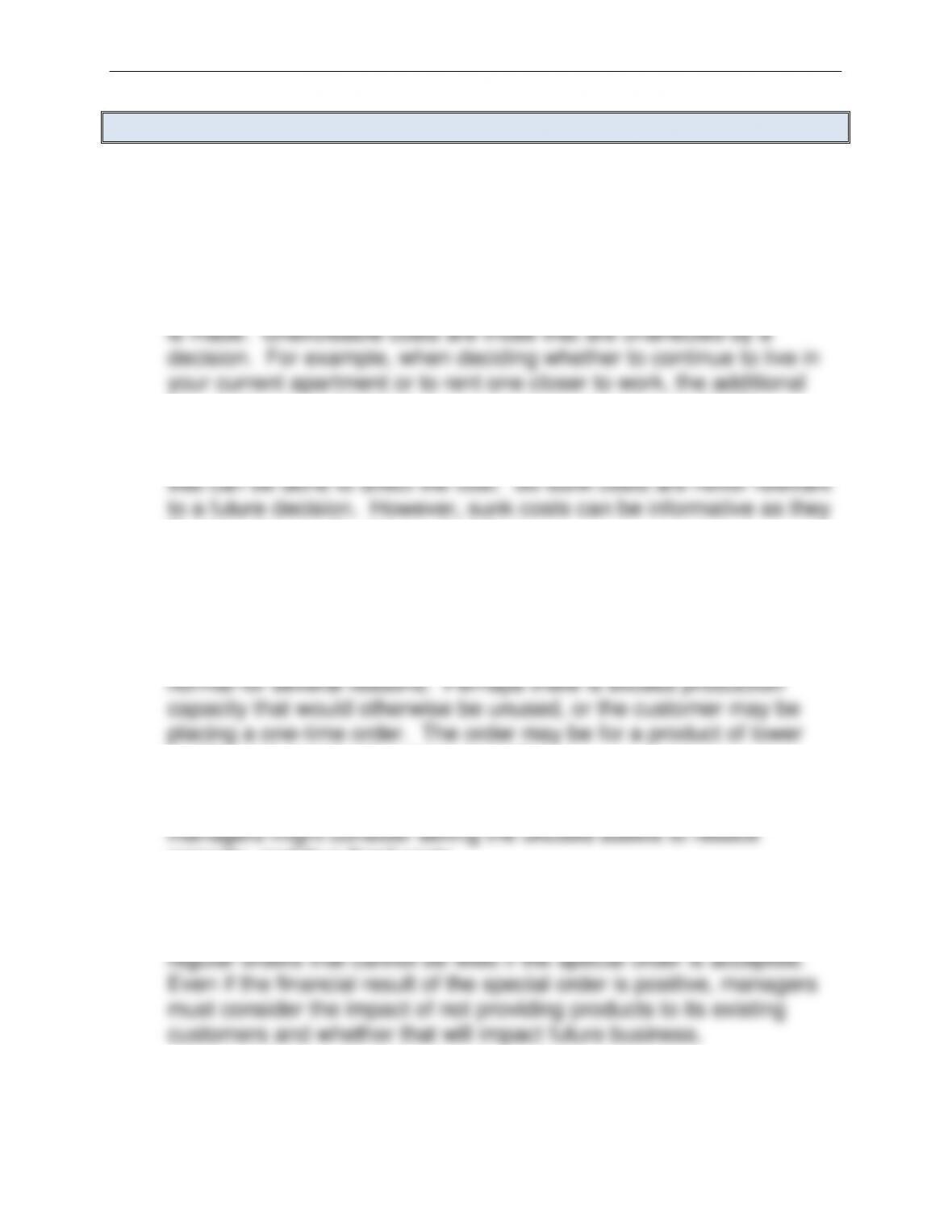
Item
L. O.
Difficulty
Level
Minutes to
Complete
Bloom’s
Taxonomy
AACSB
AICPA
FN
AICPA
PC
IMA
Ethics
Coverage
EXERCISES
8-1
1
M
12
AP
A
M
PS
DA
8-2
1
D
12
AP, AN
A
M, DM
PS
DA
8-3
1
D
15
AP, AN
A
DM
PS
DA
8-4
2
M
10
AP
A
M, DM
PS
DA
8-5
2
D
10–15
AP
A
M, DM
PS
DA
8-6
2
M
10–15
AP, AN
A
M
PS
DA
8-7
2
D
15
AP
A
M, DM
PS
DA
8-8
3
E
10–15
AP, AN
A
M, DM
PS
DA
8-9
3
M
10–15
AP, AN
A
M, DM
PS
DA
8-10
3
M
10
AP, AN
A
M, DM
PS
DA
8-11
3
D
15–20
AP, AN
A
M, DM
PS
DA
8-12
4
E
10–15
AP
A
M, DM
PS
DA
8-13
4
M
15
AP
A
M, DM
PS
DA
8-14
4
M
15
AP
A
M, DM
PS
DA
8-15
4
M
15–20
AP, AN
A
M, DM
PS
DA
8-16
5
E
10–
AN
A
DM
PS
DA
8-17
5
E
10–15
AP, AN
A
M, DM
PS
DA
8-18
5
E
10
AP, AN
A
M, DM
PS
DA
8-19
5
M
15–20
AP, AN
A
M, DM
PS
DA
PROBLEMS
8-20
2
M
25–30
AP, AN
A
M, DM
PS
DA
8-21
2
D
40–45
AP, AN
A
M, DM
PS
DA
8-22
1, 3
M
20–25
AP, AN, C
A
M, DM
PS
DA
8-23
3
E
10
AP, AN
A
M, DM
PS
DA
8-24
3
M
15–20
AP, AN
A
M, DM
PS
DA
8-25
2, 3
D
20
AP, AN
A
M, DM
PS
DA
8-26
4
D
30–35
AP, AN
A
M, DM
PS
DA
8-27
4
D
35–40
AP, AN
A
M, DM
PS
DA
8-28
3, 4
M
30
AP
A
M, DM
PS
DA
8-29
5
M
20–25
AP, AN
A
M, DM
PS
DA
8-30
5
E
30–35
AP, AN, E
A
M, DM
PS
DA
C&C CONTINUING CASE
8-31
4
D
45–50
AP, AN, E
A
M, DM
PS
DA
CASES
8-32
1
D
50–55
AP, AN, E
A
M, DM
PS
DA
8-33
2, 3,
5
D
55–60
AP, AN, E
A
M, DM
PS
DA
8-34
3
D
25–30
AP, AN, E
E
R
C
BA
Chapter 8 – Using Accounting Information to Make Managerial Decisions
8-3
SOLUTIONS TO GUIDED UNIT PREPARATION
Unit 8.1
1. To be relevant, information must pertain to the future and differ
between the alternatives under consideration.
2. Avoidable costs are those that occur only when a particular decision
gas costs are avoidable but your car insurance is unavoidable.
3. A sunk cost is a cost that has occurred in the past; there is nothing
illustrate the results of prior decisions.
Unit 8.2
1. A company may be willing to sell its products at a price lower than
quality, or it may be for a large quantity.
2. If a business always has excess capacity to accept special orders,
capacity, and thus fixed costs.
3. The company should compare the contribution margin earned on the
special order to the contribution margin that will be lost from the
Solutions for Davis & Davis, Managerial Accounting, 2nd ed.
8-4
4. The minimum price that a business can charge for a special order
special order.
Unit 8.3
1. While any process or input can be outsourced, companies generally
strategic advantages for the firm.
2. Information about the avoidable relevant cost to make the product or
issues, such as the transfer of technological risk and the sharing of
confidential information must be considered.
3. An opportunity cost is the cost of the next best alternative. In an
outsourcing decision, the alternative use of freed-up capacity is an
product or deliver the service internally.
Unit 8.4
2. The best way to allocate a constrained resource is on the basis of the
contribution margin per unit of constrained resource.
customers will purchase.
4. A bottleneck is a production process that limits total output.
8-5
5. A bottleneck can be alleviated by purchasing additional machinery,
Unit 8.5
1. Managers are often motivated to consider eliminating an operation or
2. Segment margin is contribution margin minus direct fixed costs.
3. An allocated cost is a cost that is incurred to benefit the entire
4. Managers should continue to produce the product until a better use of
resources is found.
8-6
SOLUTIONS TO EXERCISES
Exercise 8-1
Operating cost of old machine
$10,000
Relevant
Production of old machine
50,000 units
Relevant
Purchase price of old machine
$200,000
Irrelevant
Loan balance
$125,000
Irrelevant
Market value of old machine
$70,000
Relevant
Cost of new machine
$220,000
Relevant
Production of new machine
85,000 units
Relevant
Operating cost of new machine
$12,000
Relevant
Exercise 8-2
a. Scrap (throw away) the defective units
Chapter 8 – Using Accounting Information to Make Managerial Decisions
8-7
Exercise 8-3
a.
Stat-Max
Buy Tracker
Purchase price
$912,000
$500,000
Programmer hours
80 hours
125 hours
Annual License fee
$0
$10,000
Technical support
24–hour
8 a.m. – 5 p.m. CST
b. Other information you would want to know includes ease of report
Exercise 8-4
Exercise 8-5
Since Byways only has capacity to produce 2,000 units, it will have to
8-8
order.
Exercise 8-6
Exercise 8-7
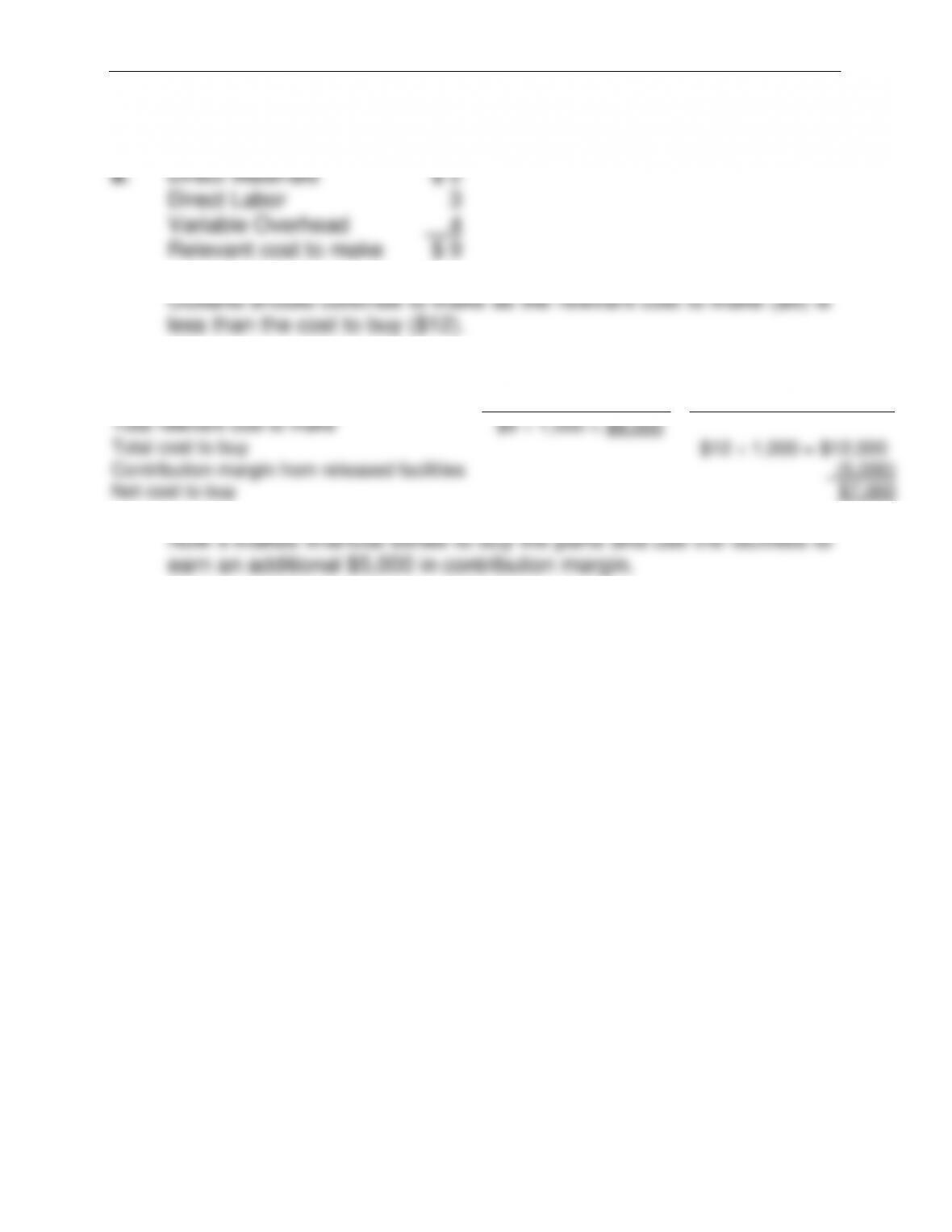
Relevant cost to produce:
Chapter 8 – Using Accounting Information to Make Managerial Decisions
8-9
Exercise 8-8
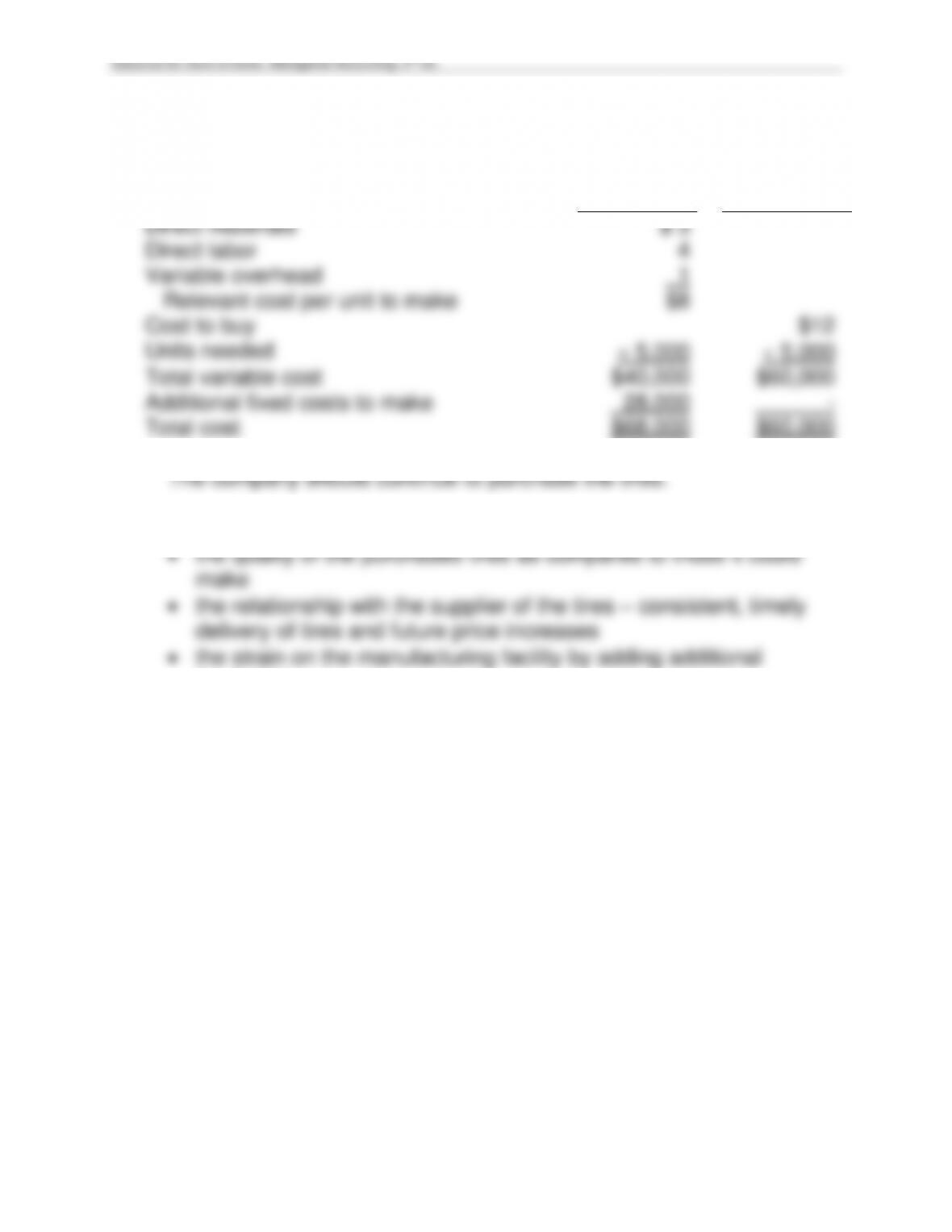
b.
Make
Buy
Total relevant cost to make
$9 1,000 = $9,000
Total cost to buy
$12 1,000 = $12,000
Contribution margin from released facilities
(5,000)
Net cost to buy
$7,000
8-10
Exercise 8-9
a.
Make
Buy
Direct materials
$ 3
Direct labor
4
Variable overhead
1
Relevant cost per unit to make
$8
Cost to buy
$12
Units needed
5,000
5,000
Total variable cost
$40,000
$60,000
Additional fixed costs to make
28,000
–
Total cost
$68,000
$60,000
b. Qualitative factors to consider include:
production