T5-8
Exercise T5-7
that Holmes consumes are labor-intensive.
b. Brown should work with Holmes to move the majority of its orders to
the company’s website and should provide training to Holmes’ staff to
reduce the need to contact the customer service department. Finally,
offices.
SOLUTIONS TO PROBLEMS
Problem T5-8
a.
Chemical
Company
Trailer
Manufacturer
Newspaper
Publisher
Food
Processor
Sales
$466,733
$145,764
$122,604
$167,327
Total cost of sales
406,986
134,823
110,826
143,862
Gross margin
$59,747
$10,941
$11,778
$23,465
Gross margin %
12.8%
7.5%
9.6%
14.0%
b.
Total Cost
(A)
Total Activity
(B)
Activity Rate
(A) ÷ (B)
Filling work orders
$175,875
3,500 orders
$50.25 per order
Hiring temporary employees
81,125
2,950 applicants
$27.50 per applicant
Processing payroll/billing
customers
43,000
215,000 hours
$.20 per hour
Focus Unit 5 – Focus on Customer Profitability
T5-9
c.
Chemical
Company
Trailer
Manufacturer
Newspaper
Publisher
Food
Processor
Sales
$466,733
$145,764
$122,604
$167,327
Total cost of sales
406,986
134,823
110,826
143,862
Gross margin
$59,747
$10,941
$11,778
$23,465
Work ordersa
4,422
2,814
46,632
16,683
Temp employeesb
2,035
1,320
21,835
7,810
Payroll/Billingc
9,474
3,023
2,600
4,553
Customer net profit
$43,816
$3,784
($59,289)
($5,581)
Customer profit
margin
9.4%
2.6%
(48.4%)
(3.3%)
a For chemical company: 88 orders × $50.25 per order
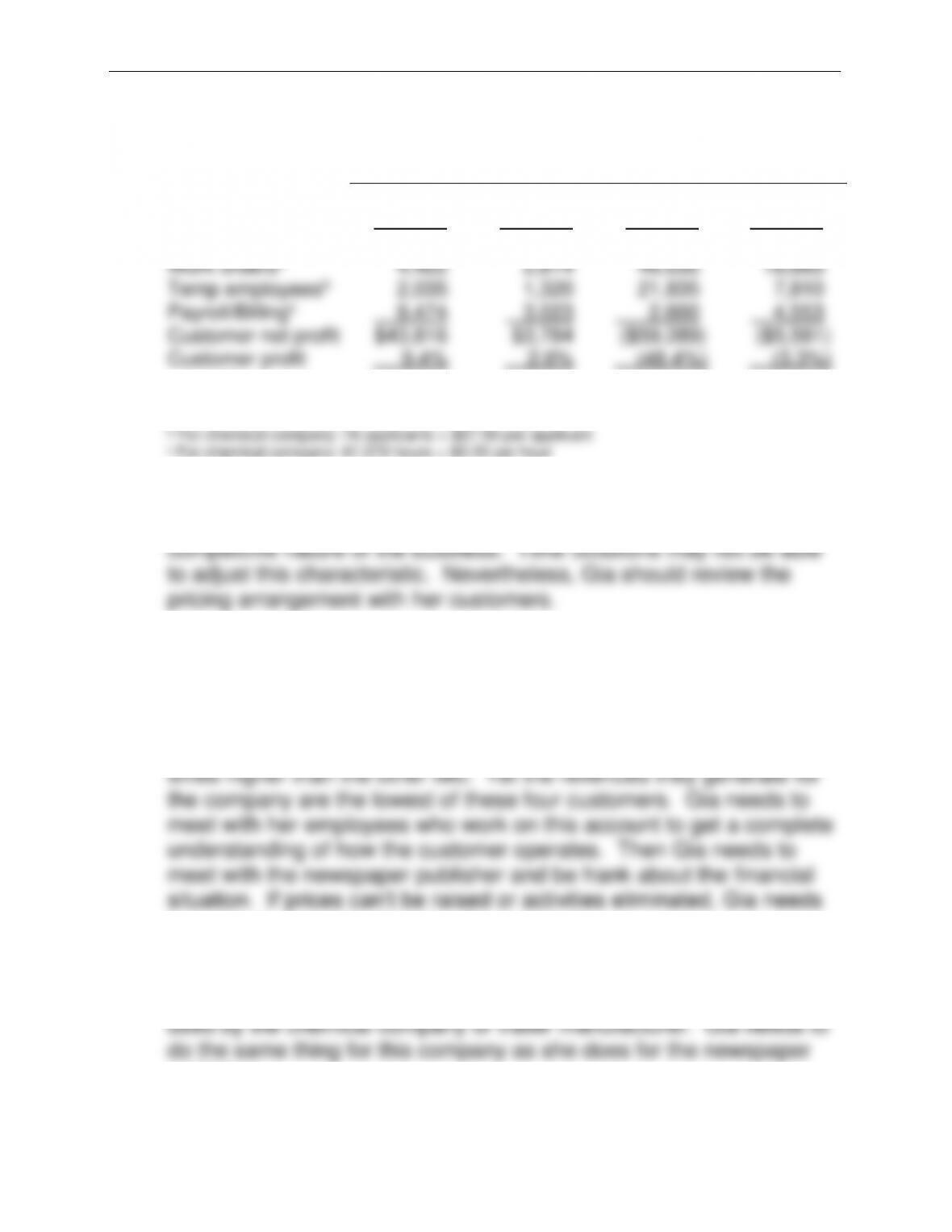
d. From the analysis in part a, it is easy to see that not all customers
have the same markup on wages. This is likely due to the
From the analysis in part c, it is clear that the Newspaper publisher is
causing a tremendous drain on the bottom line. Their use of activities
in the areas of temps ordered and applicants are almost three times
higher than the next highest user of the services and more than ten
to seriously consider dropping the customer.
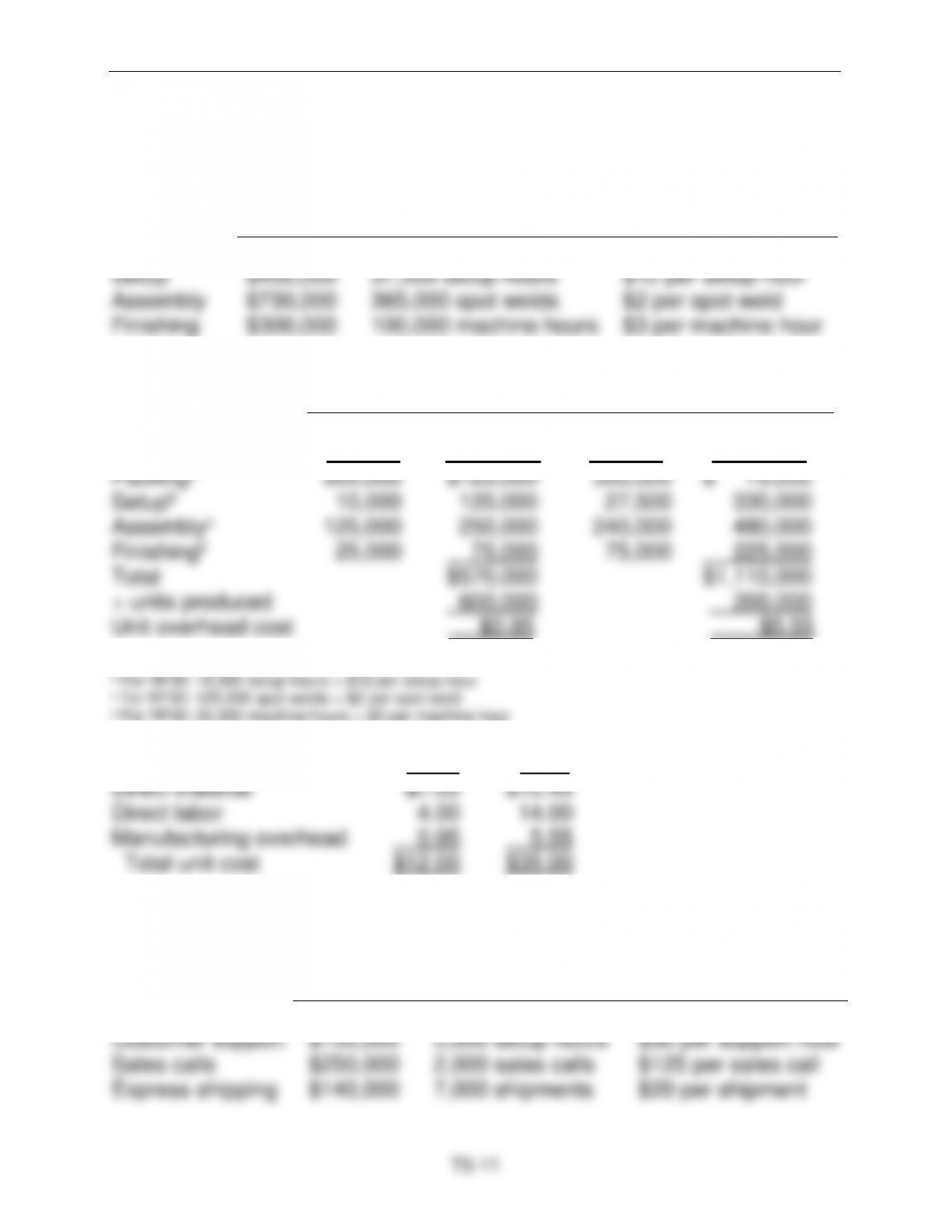
The food processor is another customer that Gia needs to review.
Again, the activities this customer uses are much higher than those
publisher.

T5-10
chemical company and trailer manufacturer available for Gia to
replace these customers?
Focus Unit 5 – Focus on Customer Profitability
T5-11
Problem T5-9
a.
Total Cost
(A)
Total Activity
(B)
Activity Rate
(A) ÷ (B)
Packing
$200,000
800,000 cartons
$0.25 per carton
Setup
$450,000
37,500 setup hours
$12 per setup hour
Assembly
$730,000
365,000 spot welds
$2 per spot weld
Finishing
$300,000
100,000 machine hours
$3 per machine hour
RF30
LF45
Activity
Volume
Allocated
Overhead
Activity
Volume
Allocated
Overhead
Packinga
500,000
$125,000
300,000
$ 75,000
Setupb
10,000
120,000
27,500
330,000
Assemblyc
125,000
250,000
240,000
480,000
Finishingd
25,000
75,000
75,000
225,000
Total
$570,000
$1,110,000
÷ units produced
600,000
200,000
Unit overhead cost
$0.95
$5.55
a For RF30: 500,000 cartons × $0.25 per carton
RF30
LF45
Direct material
$7.05
$15.45
Direct labor
4.00
14.00
Manufacturing overhead
0.95
5.55
Total unit cost
$12.00
$35.00
b.
Total Cost
(A)
Total Activity
(B)
Activity Rate
(A) ÷ (B)
Order entry
$200,000
40,000 orders
$5 per order
Customer support
$150,000
5,000 setup hours
$30 per support hour
Sales calls
$250,000
2,000 sales calls
$125 per sales call
Express shipping
$140,000
7,000 shipments
$20 per shipment
T5-12
Problem T5-9, continued
c.
RF30
LF45
Total
Sales revenuea
$150,000
$150,000
$300,000
Cost of goods soldb
120,000
105,000
225,000
Gross profit
$ 30,000
$ 45,000
75,000
Order entry (300 orders × $5)
1,500
Customer support (500 hours × $30)
15,000
Sales calls (24 calls × $125)
3,000
Express shipping (250 shipments × $20)
5,000
Customer net profit
$ 50,500
Customer profit marginc
16.83%
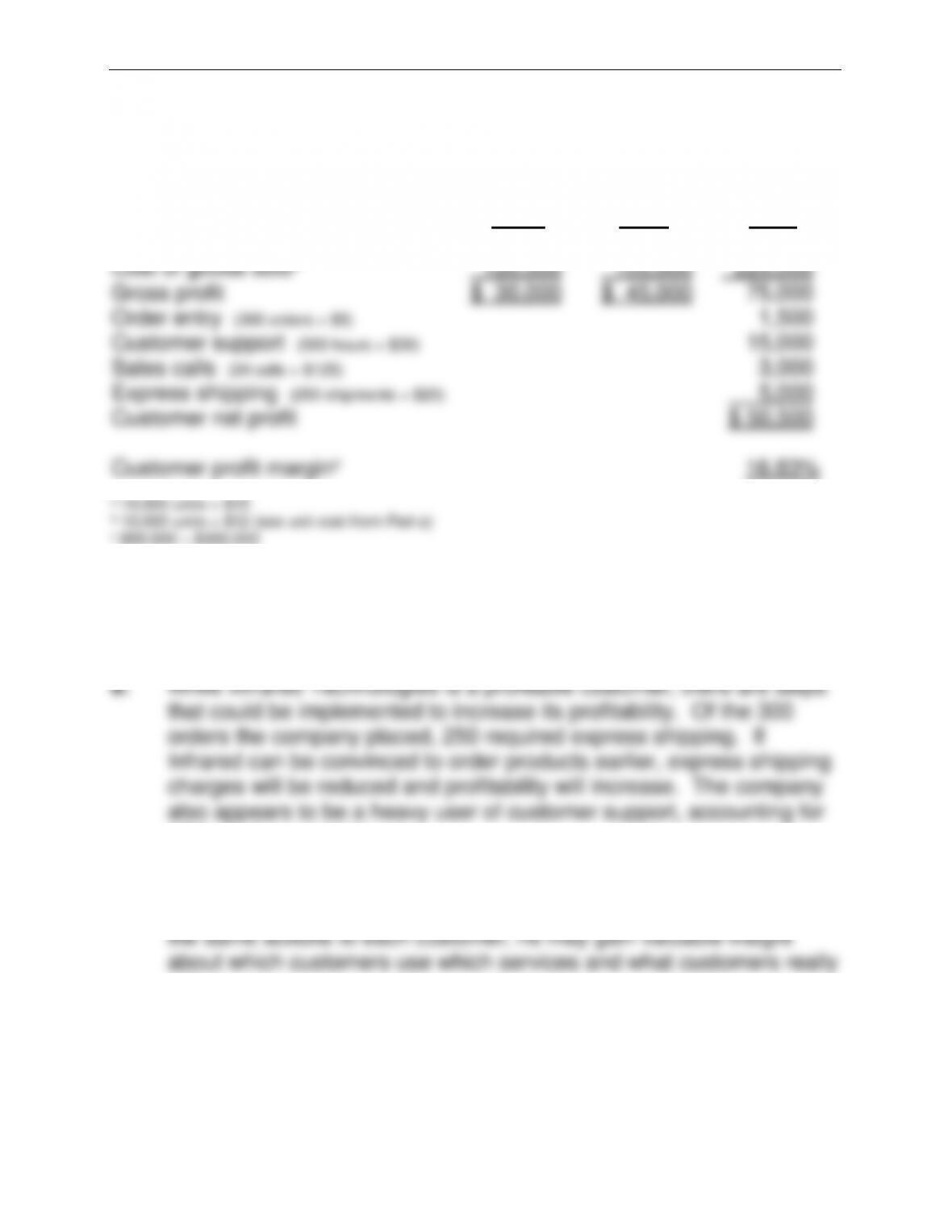
d. Infrared Technologies is a profitable customer. The revenue it
generates more than covers the cost of the products it purchases and
the selling activities it consumes.
10% of all support hours.
It is reasonable for Ford to review all of his customer accounts and
see how they contribute to the bottom line. While he might not apply
value.
Focus Unit 5 – Focus on Customer Profitability
T5-13
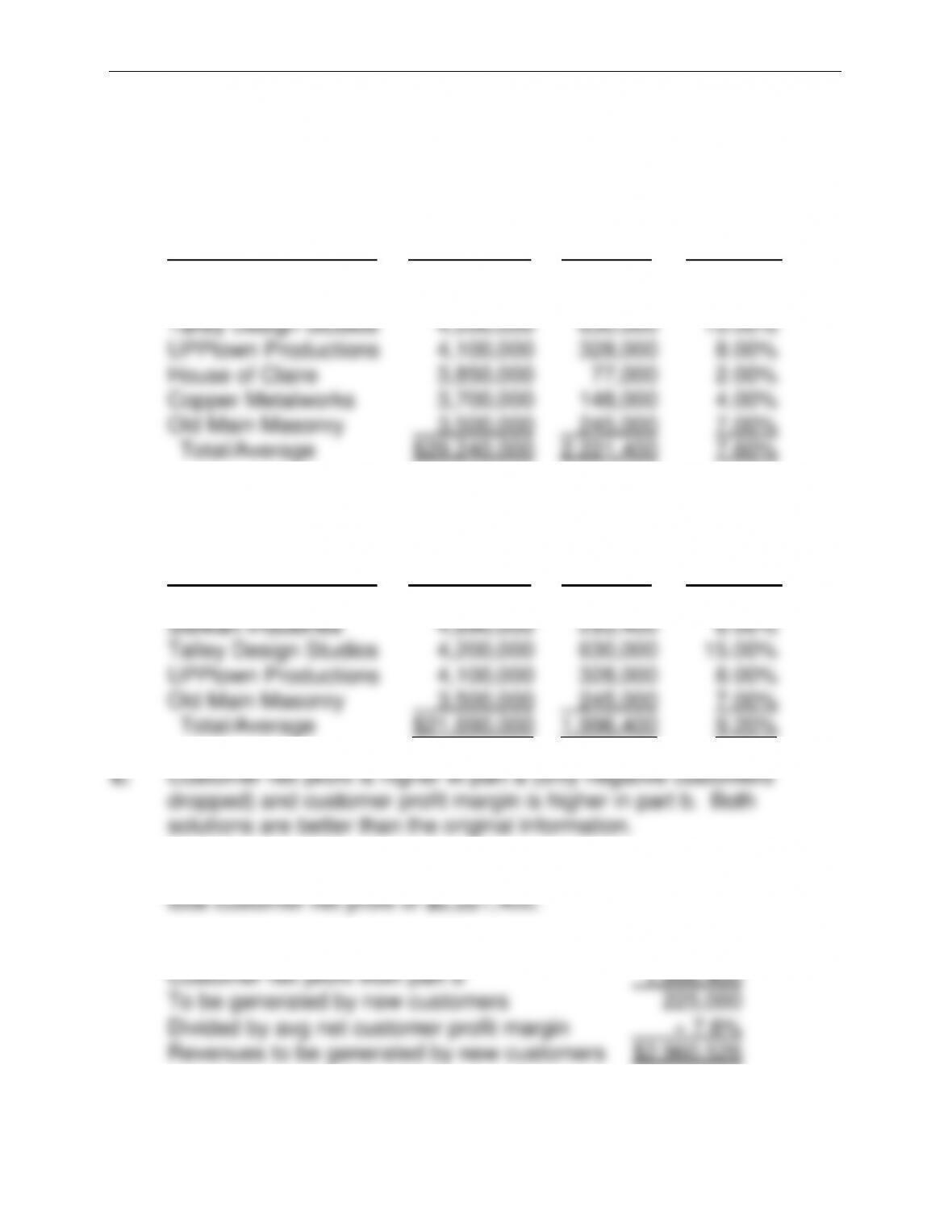
Problem T5–10
a.
Customer
Revenues
Customer
Net Profit
Customer
Profit
Margin
Meredith’s Boutique
$5,000,000
500,000
10.00%
Stewart Industries
4,890,000
293,400
6.00%
Talley Design Studios
4,200,000
630,000
15.00%
UPPtown Productions
4,100,000
328,000
8.00%
House of Claire
3,850,000
77,000
2.00%
Copper Metalworks
3,700,000
148,000
4.00%
Old Main Masonry
3,500,000
245,000
7.00%
Total/Average
$29,240,000
2,221,400
7.60%
b.
Customer
Revenues
Customer
Net Profit
Customer
Profit
Margin
Meredith’s Boutique
$5,000,000
500,000
10.00%
Stewart Industries
4,890,000
293,400
6.00%
Talley Design Studios
4,200,000
630,000
15.00%
UPPtown Productions
4,100,000
328,000
8.00%
Old Main Masonry
3,500,000
245,000
7.00%
Total/Average
$21,690,000
1,996,400
9.20%
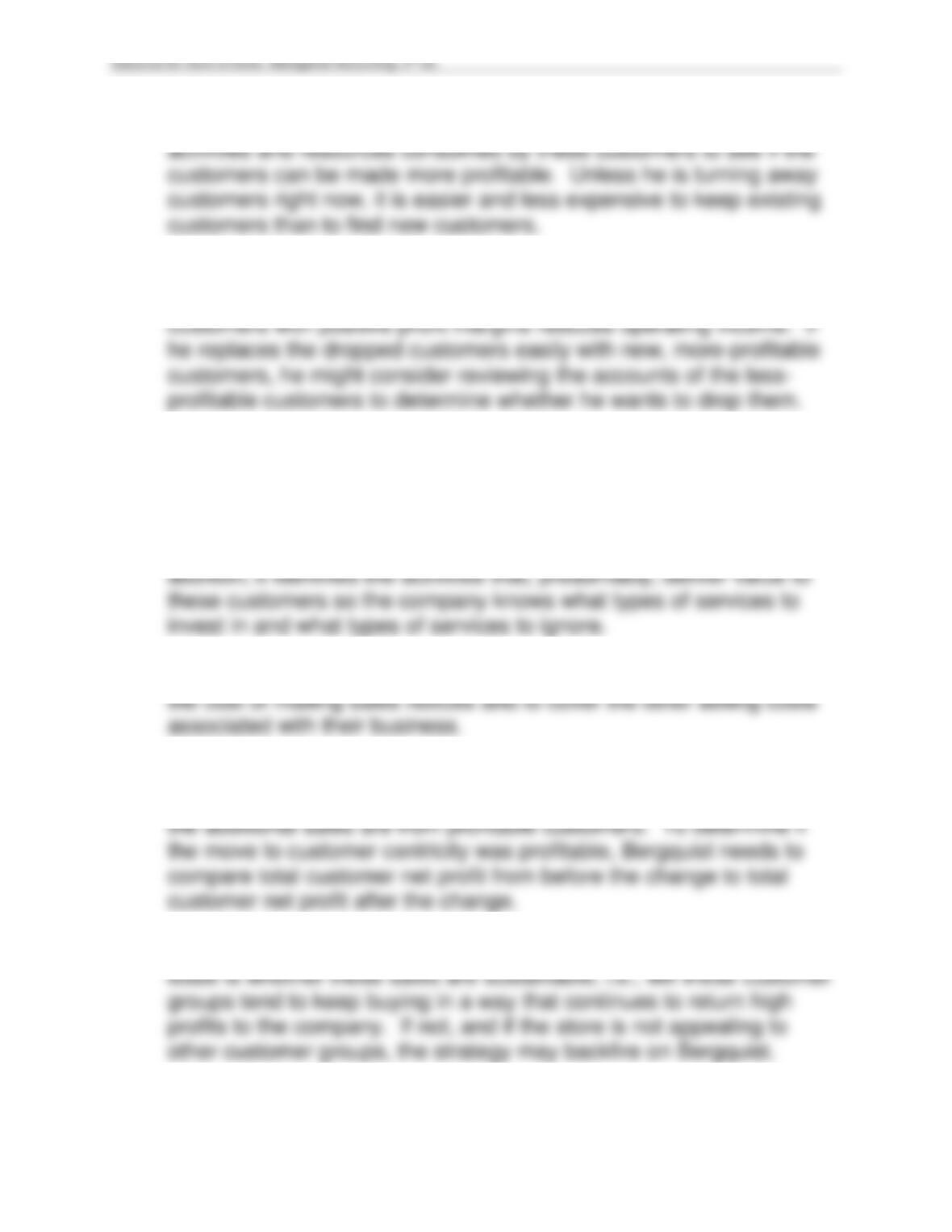
d. To be as well off as in part a, the 10 customers need to generate a
Customer net profit from part a $2,221,400
T5-14
e. Before Ray drops any customers, he needs to review the selling
If Ray determines that customers should be dropped, he should begin
with the customers with negative customer profit margins. Dropping
Problem T5-11
a. Activity-based customer profitability analysis aids in the first step of
implementing customer centricity: identifying profitable customers. In
b. Apparently, the customer net profit margin wasn’t adequate to cover
c. The move to customer centricity appears to have increased sales;
however, based on just this information it is impossible to determine if
Provided that the new sales are from profitable customers, the real