Topic Focus 3 – Variable and Absorption Costing
T3-1
Topic Focus: Variable and
Absorption Costing
Learning Objectives
1. Explain the difference between variable costing and absorption costing.
2. Calculate operating income under variable costing and absorption costing.
Summary of End of Chapter Material
Difficulty: E = Easy, M = Moderate, D = Difficult
Bloom: K = Knowledge, C = Comprehension, AP = Application, AN = Analysis, S = Synthesis, E = Evaluation
AACSB: A = Analytic, C = Communication, E = Ethics
AICPA FN: DM = Decision modeling, RA = Risk Analysis, M = Measurement, R = Reporting, RS = Research, T = Technology
AICPA PC: C = Communication, I = Interaction, L = Leadership, P = Professional demeanor, PM = Project Management,
PS = Problem Solving and Decision Making, T = Technology
IMA: BA = Business applications, BP = Budget Preparation, CM = Cost Management, DA = Decision Analysis,
PM = Performance Measurement, R = Reporting, SP = Strategic Planning
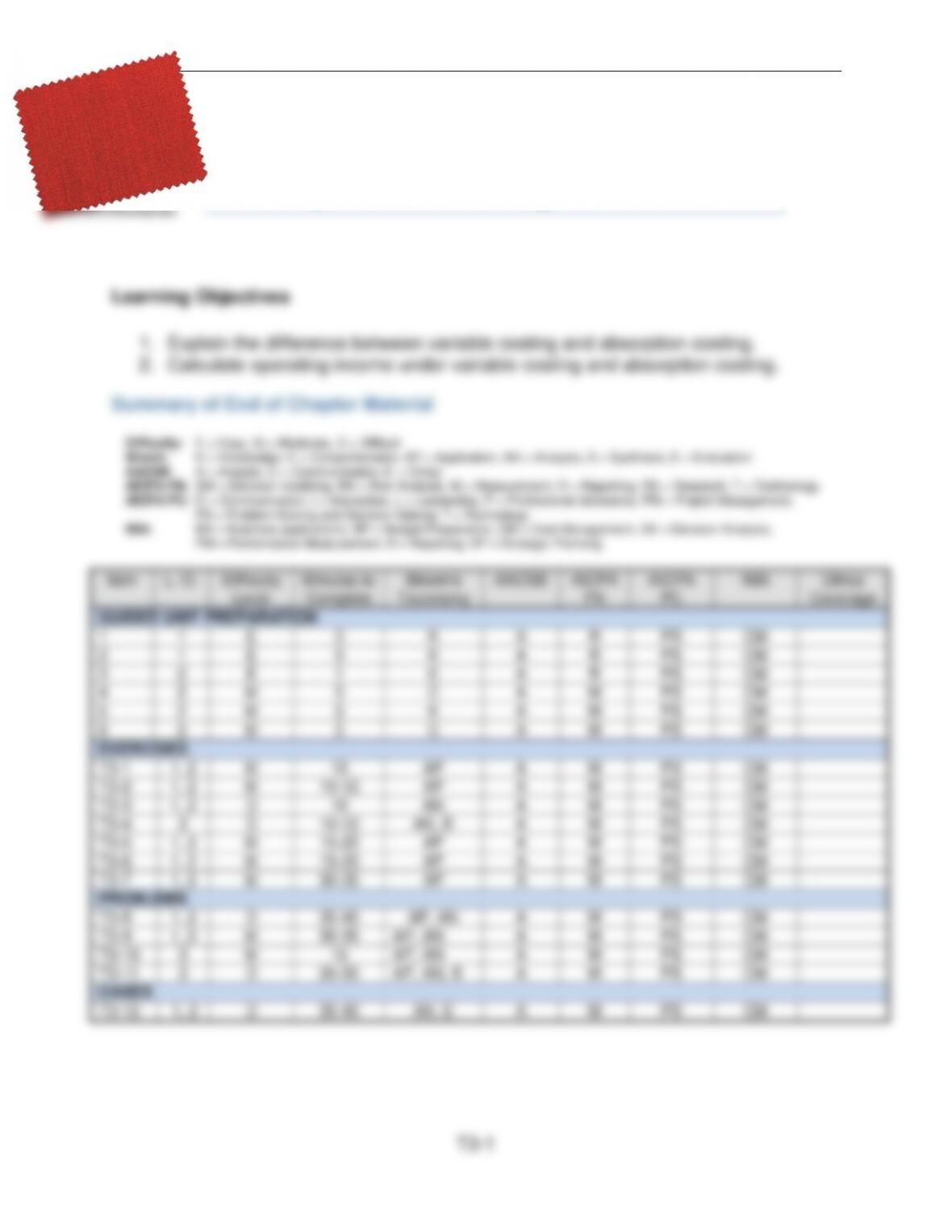
Item
L. O.
Difficulty
Level
Minutes to
Complete
Bloom’s
Taxonomy
AACSB
AICPA
FN
AICPA
PC
IMA
Ethics
Coverage
GUIDED UNIT PREPARATION
1
1
E
3
K
A
R
PS
CM
2
1
E
3
K
A
R
PS
CM
3
2
E
1
K
A
R
PS
CM
4
2
M
3
C
A
M
PS
CM
5
2
M
3
K
A
M
PS
CM
6
2
M
3
C
A
M
PS
CM
EXERCISES
T3-1
1, 2
M
10
AP
A
M
PS
CM
T3-2
1, 2
M
10–12
AP
A
M
PS
CM
T3-3
1, 2
D
10
AN
A
M
PS
CM
T3-4
2
D
10–12
AN, E
A
M
PS
CM
T3-5
1, 2
M
15–20
AP
A
M
PS
CM
T3-6
1, 2
M
15–20
AP
A
M
PS
CM
T3-7
1, 2
M
30–35
AP
A
M
PS
CM
PROBLEMS
T3-8
1, 2
D
35–40
AP, AN
A
M
PS
CM
T3-9
1, 2
M
30–35
AP, AN
A
M
PS
CM
T3–10
2
M
15
AP, AN
A
M
PS
CM
T3–11
2
D
25–30
AP, AN, E
A
M
PS
CM
CASES
T3–12
1, 2
D
35–40
AN, E
A
M
PS
CM
Topic Focus
3
©petekarici/iStockphoto

T3-2
SOLUTIONS TO QUESTIONS
1. Product costs: direct materials, direct labor, variable and fixed
overhead. Period costs: selling and administrative expenses
2. Product costs: direct materials, direct labor, variable overhead.
3. Contribution margin format
4. Income under variable costing is higher than under absorption costing
produced.
5. Change in the number of units in inventory fixed overhead per unit
6. Overproducing for the sole purpose of reducing fixed overhead cost
per unit becomes ineffective under variable costing.
Topic Focus 3 – Variable and Absorption Costing
T3-3
SOLUTIONS TO EXERCISES
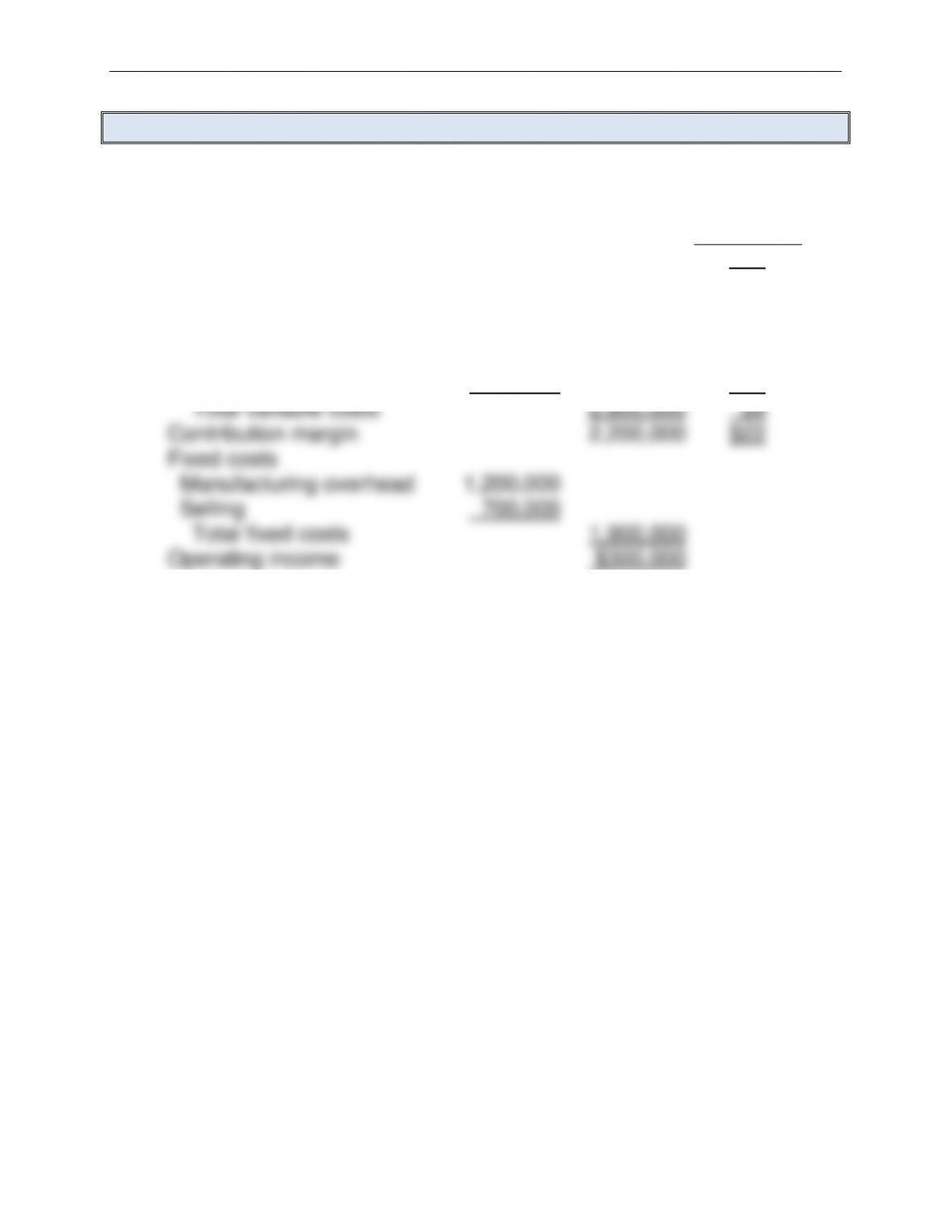
Exercise T3-1
Per Unit
Sales
$5,000,000
$50
Variable costs
Direct materials
1,500,000
15
Direct labor
800,000
8
Manufacturing overhead
300,000
3
Selling
200,000
2
Total variable costs
2,800,000
28
Contribution margin
2,200,000
$22
Fixed costs
Manufacturing overhead
1,200,000
Selling
700,000
Total fixed costs
1,900,000
Operating income
$300,000
T3-4
Exercise T3-2
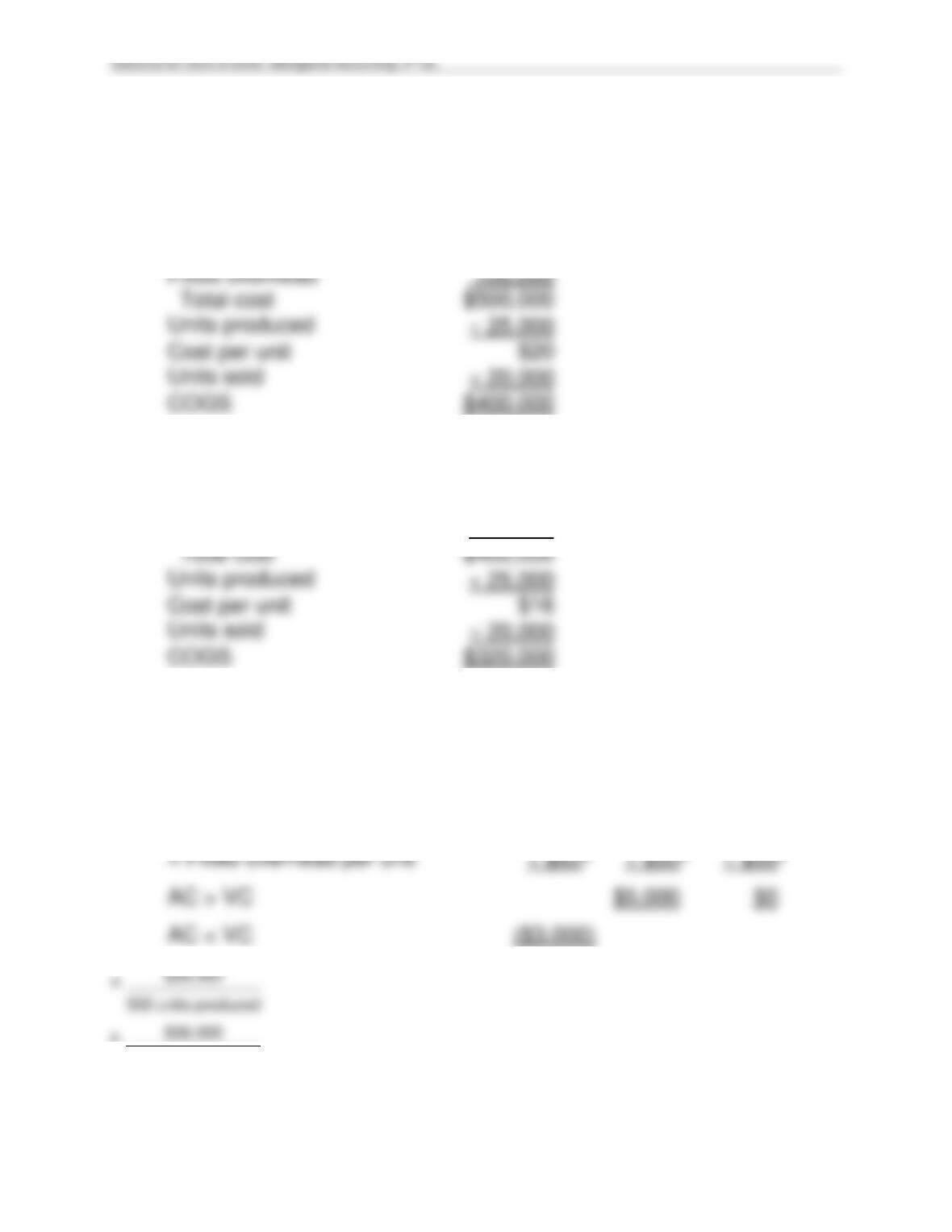
a.
Direct materials
$200,000
Direct labor
150,000
Variable overhead
50,000
Fixed overhead
100,000
Total cost
$500,000
Units produced
25,000
Cost per unit
$20
Units sold
20,000
COGS
$400,000
b.
Direct materials
$200,000
Direct labor
150,000
Variable overhead
50,000
Total cost
$400,000
Units produced
25,000
Cost per unit
$16
Units sold
20,000
COGS
$320,000
Exercise T3-3
1
2
3
Change in ending inventory units
(50)
100
0
× Fixed overhead per unit
$60a
$50b
$50b
AC > VC
$5,000
$0
AC < VC
($3,000)
a
$30,000
500 units produced
b
$30,000
600 units produced
Topic Focus 3 – Variable and Absorption Costing
T3-5
Exercise T3-4
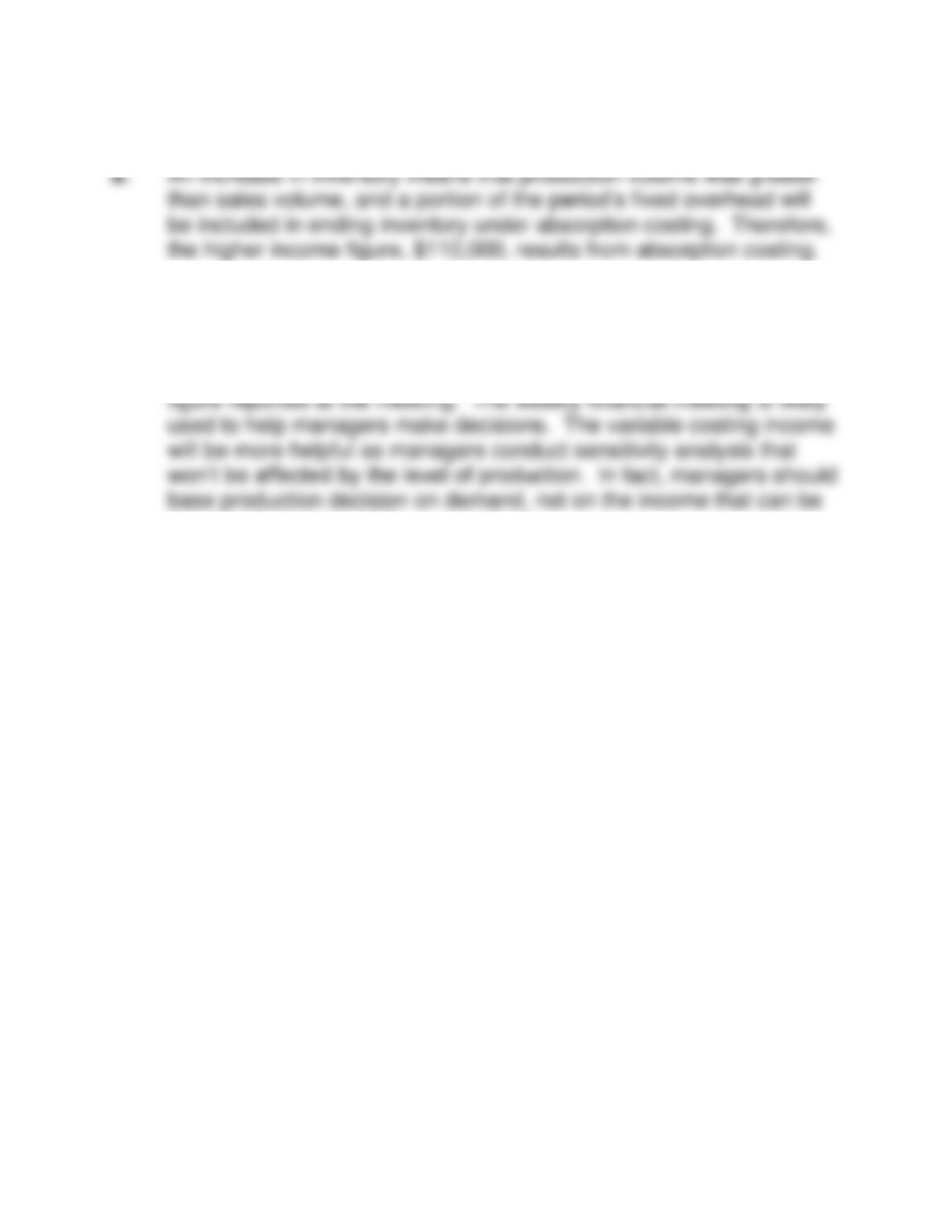
b. Income calculated using variable costing will be higher than income
calculated using absorption costing.
c. Clearly it was confusing to Jacob to have more than one income
temporarily generated by overproducing.
T3-6
Exercise T3-5
a.
Per unit:
Sales
$15.00
Variable costs
Direct materials
3.00
Direct labor
1.75
Manufacturing overhead
.75
Selling
.50
Total variable costs
6.00
Contribution margin per unit
$9.00
Units sold
45,000
Total contribution margin
$405,000
Fixed costs
Manufacturing overhead ($4.25 60,000)
255,000
Selling
5,000
Total fixed costs
260,000
Operating income
$145,000
b.
Direct materials
$3.00
Direct labor
1.75
Variable overhead
.75
Fixed overhead
4.25
Unit cost
$9.75
Units in ending inventory:
Beginning inventory
0
+ Units produced
+ 60,000
– Units sold
– 45,000
= Ending inventory
15,000
Cost of ending inventory
$146,250
Topic Focus 3 – Variable and Absorption Costing
T3-7
Exercise T3-6
a.
Per unit:
Sales
$103
Direct materials
50
Direct labor
16
Variable overhead
10
Fixed overhead
23
Cost of Goods Sold per unit
99
Gross margin per unit
4
Units sold
90,000
Total Gross margin
360,000
Selling costs—variable
180,000
Selling costs—fixed
55,000
Operating income
$125,000
b.
Direct materials
50
Direct labor
16
Variable overhead
10
Unit cost
76
Units in ending inventory:
Beginning inventory
0
+ Units produced
+ 100,000
– Units sold
– 90,000
= Ending inventory
10,000
Cost of ending inventory
$760,000
T3-8
Exercise T3-7
a.
Direct materials
$90,000
Direct labor
99,000
Variable overhead
9,000
Fixed overhead
81,000
Total cost
$279,000
Units produced
18,000
Cost per unit
$15.50
b.
Direct materials
$90,000
Direct labor
99,000
Variable overhead
9,000
Total cost
$198,000
Units produced
18,000
Cost per unit
$11.00
c.
Beginning inventory
20,000
+ Units produced
+ 18,000
– Ending inventory
– 24,000
= Units sold
14,000
Cost per unit
$15.50
COGS
$217,000
d.
Units sold
$11.00
Cost per unit
14,000
COGS
$154,000
Topic Focus 3 – Variable and Absorption Costing
T3-9
Exercise T3-7, continued
e.
Sales ($20 14,000)
$280,000
COGS
217,000
Gross Profit
63,000
Selling and Admin costs
23,000
Operating income
$40,000
f.
Sales
$280,000
Variable COGS
154,000
Variable Selling and Admin
14,000
Total variable costs
168,000
Contribution margin
112,000
Fixed costs
Manufacturing overhead
81,000
Selling and Admin
9,000
Total fixed costs
90,000
Operating income
$22,000
g.
Absorption costing income
$40,000
Variable costing income
22,000
Difference
$18,000
Change in ending inventory units
(24,000 – 20,000)
4,000
× Fixed overhead per unit
($81,000 18,000)
$4.50
Reconciliation
$18,000