
Chapter 11 – Performance Evaluations Revisited: A Balanced Approach
11–11
Exercise 11-7
Student answers will vary; however, here are some measures they
may provide.
effectiveness in a changing market.
Number of design awards: Professional organizations recognize
leaders with industry awards.
changing market.
Solutions for Davis & Davis, Managerial Accounting, 2nd ed.
11–12
Exercise 11-8
Perspective
a.
Number of customer complaints
Customer
b.
Employee turnover
Learning & growth
c.
Net profit per house constructed
Financial
d.
Turnaround time on customer
design changes
Internal business processes
e.
Hours of training per employee
Learning & growth
f.
Average labor cost per house
Financial
g.
Dollars invested in new equipment
Learning & growth
h.
Grade (quality) of brass fixtures
Internal business processes
i.
Variances between budgeted and
actual costs of building a house
Financial
Exercise 11-9
Exercise 11-10
World-class manufacturing is not about the perceived quality or
“image” products.
11–13
Exercise 11-11
Activity
Minutes
Minutes
Processing order
15
–
Waiting for copying to begin
25
–
Copying
20
20
Waiting for binding
30
30
Binding
10
10
Packing for customer
4
4
a. Delivery cycle time
104
b. Manufacturing cycle time
64
Exercise 11–12
60=
90
36–90
=Efficiency Cycle ingManufactur
Exercise 11–13
Activity
Manufacturing
Time (in minutes)
Value–added
Time (in minutes)
Pull calling cards from
inventory
15
–
Set up machine for font
style and color
2
–
Process calling cards
40
40
Inspect cards
5
–
Wait for packaging
16
–
Package cards for
shipping
2
Wait for pick up by FedEx
120
–
Total
200
40
40
Manufacturing Cycle Efficiency = = 20%
200

11–14
SOLUTIONS TO PROBLEMS
Problem 11–14
followed by an increase in repeat sales.
customer sales were increasing, though again this measure lags the
other two by several months.
Chapter 11 – Performance Evaluations Revisited: A Balanced Approach
11–15
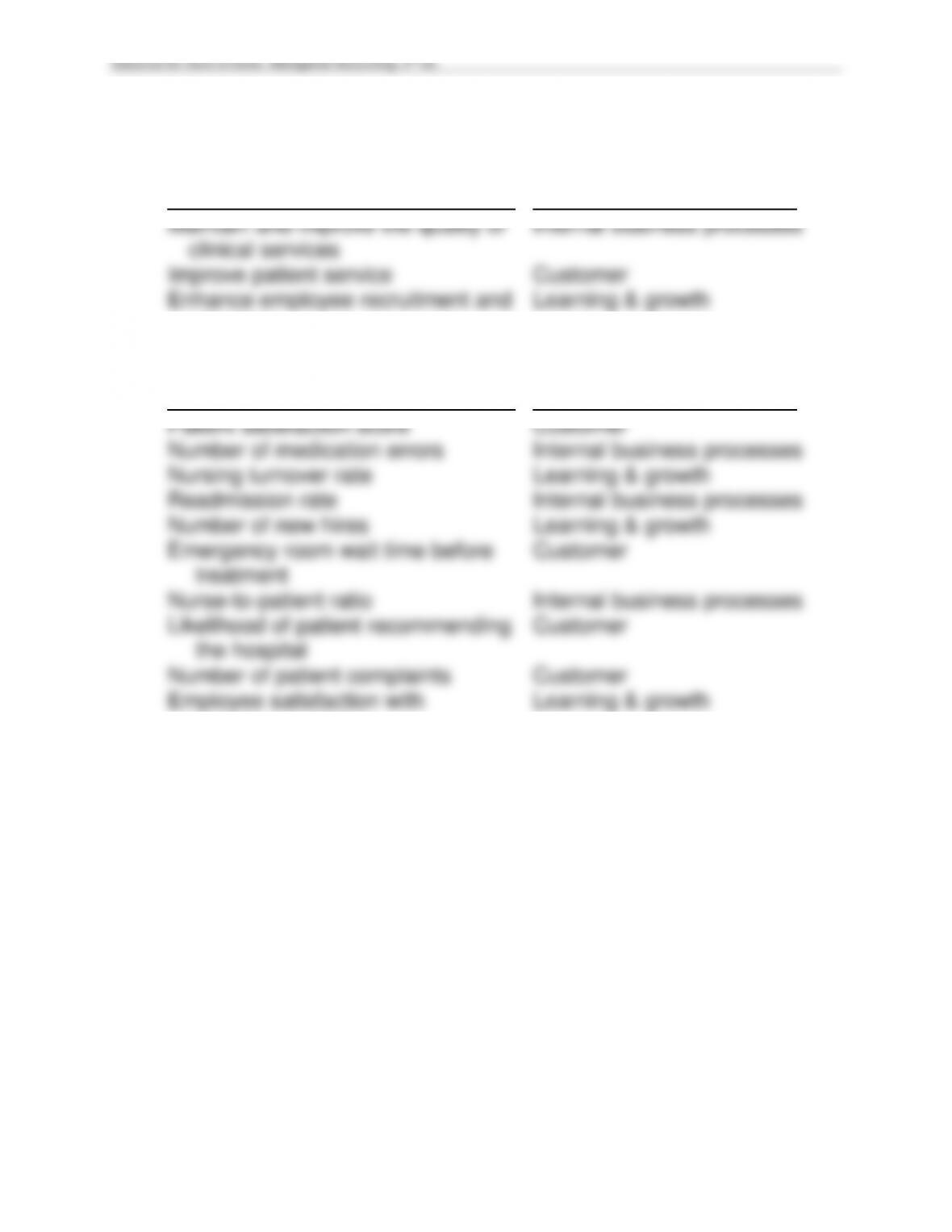
Problem 11–15
Kohl’s Strategy Map
Neiman Marcus’s Strategy Map
11–16
Problem 11–16
a.
Objective
Perspective
Maintain and improve the quality of
clinical services
Internal business processes
Improve patient service
Customer
Enhance employee recruitment and
retention
Learning & growth
b.
Metric
Perspective
Patient satisfaction score
Customer
Number of medication errors
Internal business processes
Nursing turnover rate
Learning & growth
Readmission rate
Internal business processes
Number of new hires
Learning & growth
Emergency room wait time before
treatment
Customer
Nurse-to-patient ratio
Internal business processes
Likelihood of patient recommending
the hospital
Customer
Number of patient complaints
Customer
Employee satisfaction with
incentive systems
Learning & growth
Chapter 11 – Performance Evaluations Revisited: A Balanced Approach
11–17
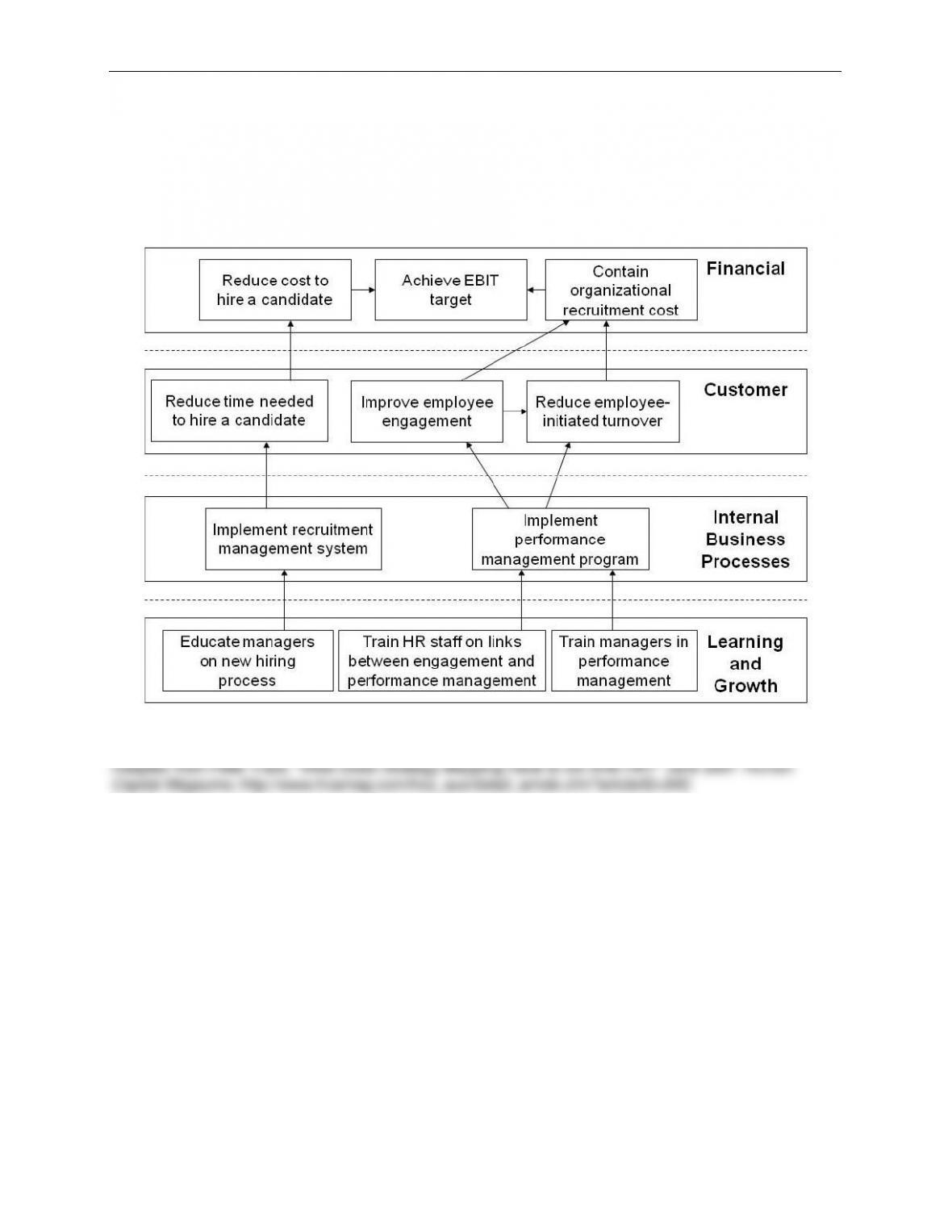
Problem 11–17
a.
11–18
Problem 11-17, continued
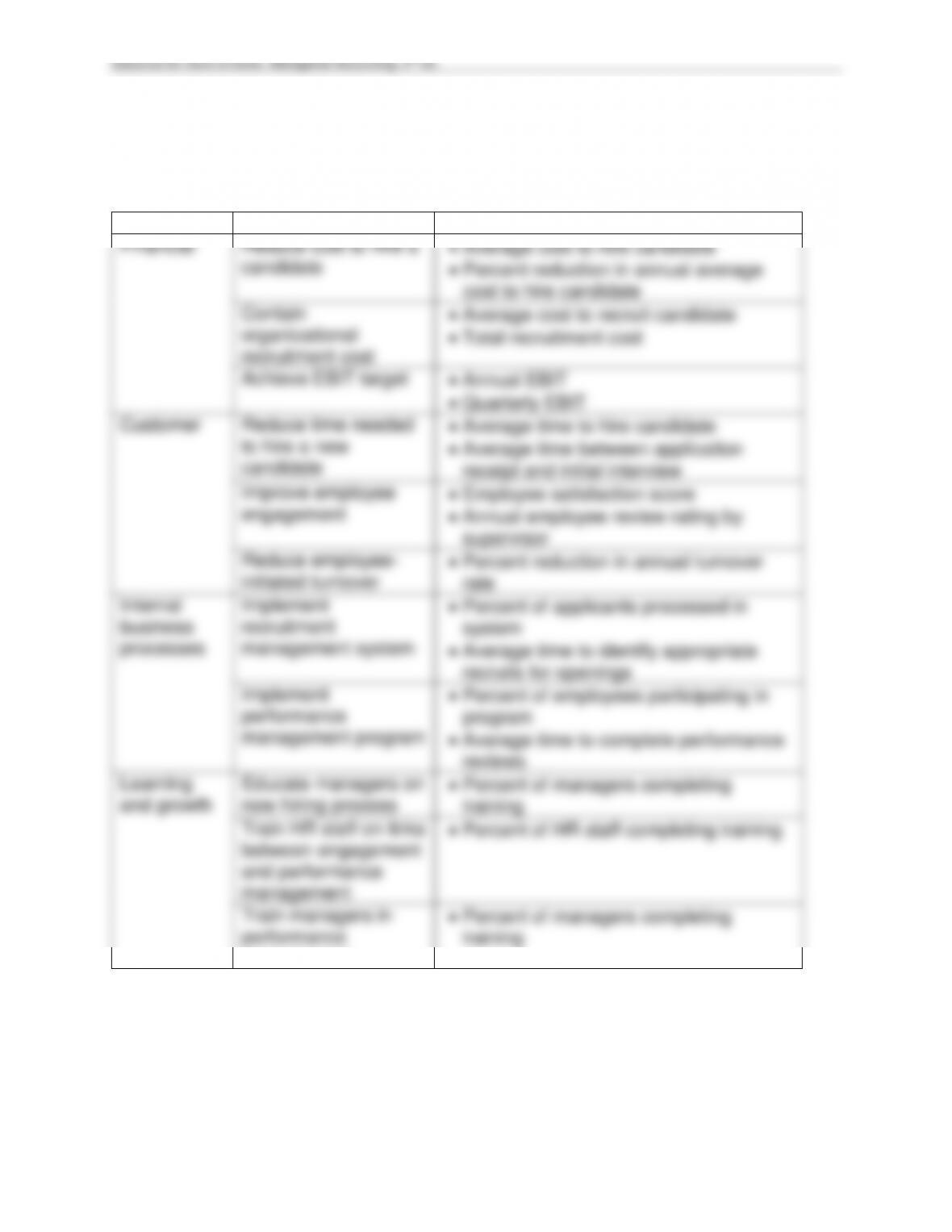
b.
Perspective
Objectives
Measures
Financial
Reduce cost to hire a
candidate
Average cost to hire candidate
Percent reduction in annual average
cost to hire candidate
Contain
organizational
recruitment cost
Average cost to recruit candidate
Total recruitment cost
Achieve EBIT target
Annual EBIT
Quarterly EBIT
Customer
Reduce time needed
to hire a new
candidate
Average time to hire candidate
Average time between application
receipt and initial interview
Improve employee
engagement
Employee satisfaction score
Annual employee review rating by
supervisor
Reduce employee-
initiated turnover
Percent reduction in annual turnover
rate
Internal
business
processes
Implement
recruitment
management system
Percent of applicants processed in
system
Average time to identify appropriate
recruits for openings
Implement
performance
management program
Percent of employees participating in
program
Average time to complete performance
reviews
Learning
and growth
Educate managers on
new hiring process
Percent of managers completing
training
Train HR staff on links
between engagement
and performance
management
Percent of HR staff completing training
Train managers in
performance
management
Percent of managers completing
training