Chapter 10 – Decentralization and Performance Evaluation
10–21
Exercise 10–20
a.
Playground
Pool
Gym
Return on
Investment
$3,500
$25,000
= 14%
$4,800
$40,000
= 12%
$2,700
$15,000
= 18%
Residual
Income
$3,500 – .14($25,000) = $0
$4,800 – .14($40,000) = ($800)
$2,700 – .14(15,000) = $600
Economic
Value Added
.75($3,500) – .1($25,000) = $125
.75($4,800) – .1 ($40,000) = ($400)
.75($2,700) – .1(15,000) = $525
10–22
Exercise 10-21
Exercise 10-22
The Assembly division manager wants to pay as little as possible, but
Exercise 10-23

Chapter 10 – Decentralization and Performance Evaluation
10–23
Exercise 10-24
for $2,500
Printing
Division
Accounting
Division
Corporate
Total
Sales
$2,500
$ 0
$2,500
Variable costs
1,700
2,500
4,200
Contribution margin
$ 800
($2,500)
($1,700)
Accounting division buys brochures from a vendor in town for
Printing
Division
Accounting
Division
Corporate
Total
Sales
$0
$ 0
$ 0
Variable costs
0
1,600
1,600
Contribution margin
$0
($1,600)
($1,600)
external vendor.
Solutions for Davis & Davis, Managerial Accounting, 2nd ed.
10–24
SOLUTIONS TO PROBLEMS
Problem 10-25
a.
Sports Memorabilia
Coins and Stamps
Total Collectibles Division
Revenuea
$1,716,000
$1,144,000
$2,860,000
Less variable expensesb
987,000
658,000
1,645,000
Contribution margin
729,000
486,000
1,215,000
Traceable fixed expenses
810,000
245,000
1,055,000
Segment margin
$ (81,000)
$ 241,000
160,000
Common fixed expenses
220,000c
Operating income
$ (60,000)
Chapter 10 – Decentralization and Performance Evaluation
10–25
Problem 10-26
a.
Specialty Footwear
Stores
Drug Stores
Total Shoe Shock
Revenue
Sole inserts
$ 100,000
$400,000
$500,000
Heel inserts
1,875,000
625,000
2,500,000
Total revenue
$1,975,000
$1,025,000
$3,000,000
Less variable expenses
Sole inserts
60,000
240,000
300,000
Heel inserts
1,500,000
500,000
2,000,000
Total variable expenses
1,560,000
740,000
2,300,000
Contribution margin
415,000
285,000
700,000
Traceable fixed expenses
322,500a
290,250b
612,750
Segment margin
$ 92,500
$ (5,250)
87,250
Common fixed expenses
32,250c
Operating income
$ 55,000
distribution channel can be made profitable.
10–26
Problem 10-27
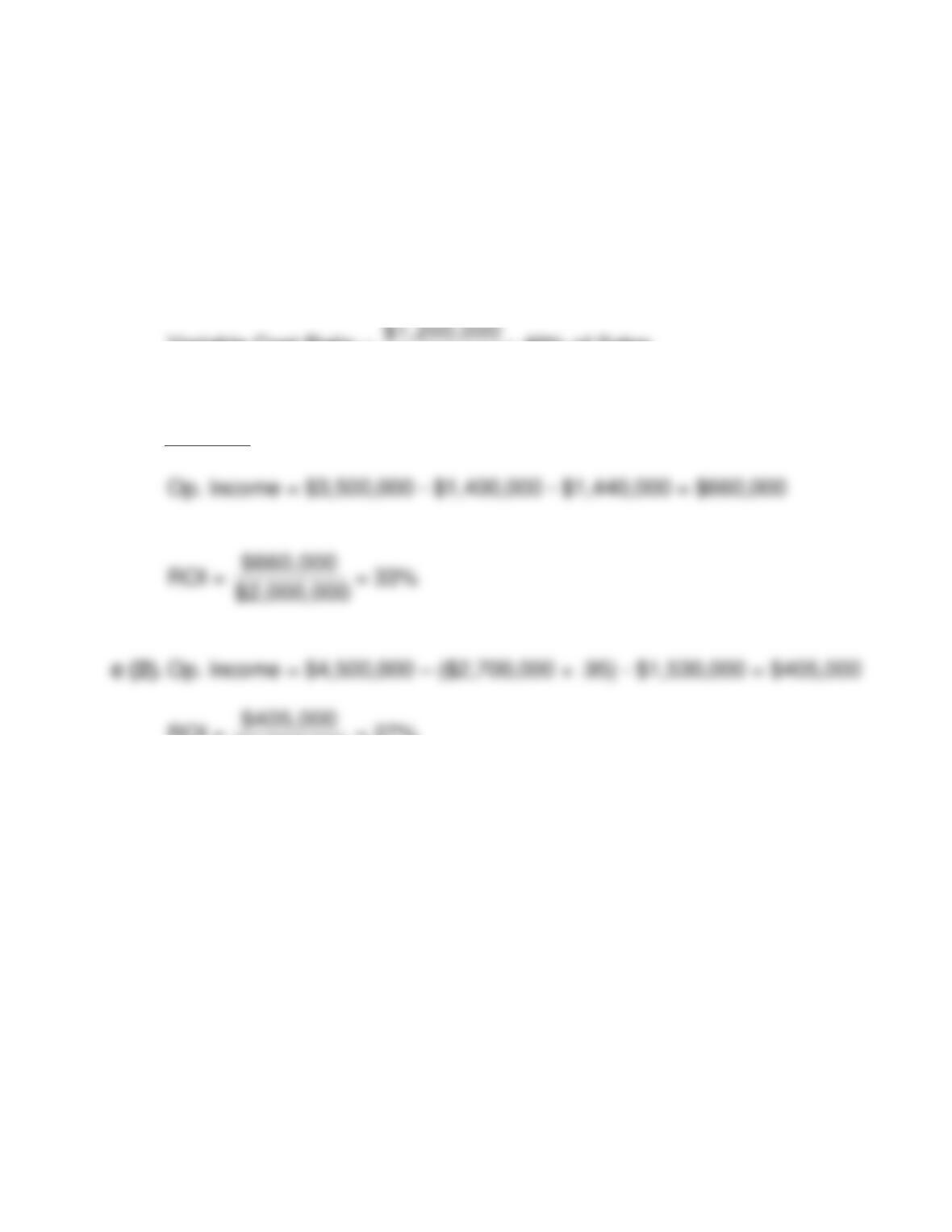
a.
Guitar Cases
Violin Cases
Margin
12%=
$3,000,000
1,440,000 – 1,200,000 – $3,000,000
6%=
$4,500,000
1,530,000 – 2,700,000 – $4,500,000
Asset turnover
1.5=
$2,000,000
$3,000,000
3=
$1,500,000
$4,500,000
ROI
12% × 1.5 = 18%
6% × 3 = 18%
10–27
Problem 10-27, continued
c (1).
$2,000,000
Sales
= 1.75
Sales
= $3,500,000
Variable Cost Ratio =
$3,000,000
$1,200,000
= 40% of Sales
so new variable costs = $3,500,000 × 40% = $1,400,000
Op. Income = $3,500,000 – $1,400,000 – $1,440,000 = $660,000
ROI =
$2,000,000
$660,000
= 33%
$1,500,000

Solutions for Davis & Davis, Managerial Accounting, 2nd ed.
10–28
Problem 10-28
a.
Bristol
Darden
Gregory
$800,000
$94,400
= 11.8%
$91,200
$760,000
= 12%
$57,500
$460,000
= 12.5%
b.
Bristol
Darden
Gregory
Operating income
$94,400
$91,200
$57,500
Required return
80,000a
76,000b
46,000c
Residual income
$14,400
$15,200
$11,500
a$800,000 × 10%
b$760,000 × 10%
c$460,000 × 10%
c.
Bristol
Darden
Gregory
Net operating income
$94,400 × .80 = $75,520
$91,200 × .80 = $72,960
$57,500 × .80 = $46,000
Required return
$800,000 × .06 = 48,000
760,000 × .06 = 45,600
$460,000 × .06 = 27,600
Residual income
$27,520
$27,360
$18,400
The Bristol division had the highest EVA.
Chapter 10 – Decentralization and Performance Evaluation
Problem 10-28, continued
division’s performance.
Problem 10-29