Chapter 10 – Decentralization and Performance Evaluation
10-1
Decentralization and Performance
Evaluation
Learning Objectives
10.1)
(Unit 10.2)
3. Evaluate an operating segment or project using return on investment. (Unit 10.3)
(Unit 10.4)
5. Calculate the minimum transfer price between divisions that maximizes corporate income.
(APPENDIX)
Summary of End of Chapter Material
Difficulty: E = Easy, M = Moderate, D = Difficult
Bloom: K = Knowledge, C = Comprehension, AP = Application, AN = Analysis, S = Synthesis, E = Evaluation
AACSB: A = Analytic, C = Communication, E = Ethics
AICPA FN: DM = Decision modeling, RA = Risk Analysis, M = Measurement, R = Reporting, RS = Research, T = Technology
AICPA PC: C = Communication, I = Interaction, L = Leadership, P = Professional demeanor, PM = Project Management,
PS = Problem Solving and Decision Making, T = Technology
IMA: BA = Business applications, BP = Budget Preparation, CM = Cost Management, DA = Decision Analysis,
ID = Investment Decisions, PM = Performance Measurement, R = Reporting, SP = Strategic Planning
Item
L. O.
Difficulty
Level
Minutes to
Complete
Bloom’s
Taxonomy
AACSB
AICPA
FN
AICPA
PC
IMA
Ethics
Coverage
GUIDED UNIT PREPARATION
Unit 10.1
1
1
E
2
K
C
DM
PS
DA
2
1
M
8
C
C
DM
PS
DA
3
1
E
4
K
C
R
C
PM
4
1
M
3
E
C
R
C
PM
5
1
E
5
K
C
R
C
PM
Unit 10.2
1
2
E
3
K, C
C
R
C
PM
2
2
E
3
K
A
M
PS
PM
3
2
M
2
C
A
R
C
PM
4
2
D
6
C
A
R
C
PM
5
2
D
4
C
A
R
C
PM
Unit 10.3
1
3
E
2
K
A
M
PS
PM
2
3
M
3
K
A
M
PS
PM
3
3
M
3
K
A
M
PS
PM
4
3
D
4
C
A
M
PS
PM
Unit 10.4
1
4
M
2
K
A
M
PS
PM
2
4
D
6
C
A
M
PS
PM
CHAPTER
10
© itaesem/iStockphoto

Solutions for Davis & Davis, Managerial Accounting, 2nd ed.
10-2
3
4
M
3
K
A
M
PS
PM
Item
L. O.
Difficulty
Level
Minutes
to
Complete
Bloom’s
Taxonomy
AACSB
AICPA
FN
AICPA
PC
IMA
Ethics
Coverage
Appendix
1
5
E
2
K
A
DM
PS
DA
2
5
M
8-10
K, C
A
DM
PS
DA
3
5
M
2
C
A
DM
PS
DA
4
5
D
3
C
A
DM
PS
DA
EXERCISES
10-1
1
M
10
AP
C
R
C
PM
10-2
1
M
8
AP
C
R
C
PM
10-3
1
M
6
C
C
R
C
PM
10-4
2
E
10
AP
A
M
PS
PM
10-5
2
M
15
AP, AN
A
M
PS
PM
10-6
2
M
15
AP, AN
A
M
PS
PM
10-7
2
M
12
AP, AN
A
M
PS
PM
10-8
3
E
12
AP
A
M
PS
PM
10-9
3
M
10–12
AP, AN
A
DM
PS
PM
10–10
3
M
10–12
AP, AN
A
DM
PS
PM
10–11
3
E
10
AP, E
A
M, DM
PS
PM
10–12
3
M
20
AP, AN
A
M, DM
PS
PM
10–13
3
E
10
AP
A
M
PS
PM
10–14
4
M
10–12
AP, AN
A
M, DM
PS
PM
10–15
4
M
12
AP, AN
A
M, DM
PS
PM
10–16
4
D
8-10
AP, AN
A
M, DM
PS
PM
10–17
4
M
5
AP
A
M
PS
PM
10–18
4
M
8-10
AP, AN
A
M, DM
PS
PM
10–19
3, 4
M
15–20
AN
A
M
PS
PM
10–20
3, 4
M
10–12
AP, AN
A
M
PS
PM
10–21
5
E
6-8
AP
A
DM
PS
PM
10–22
5
M
12
AP, AN
A
DM
PS
PM
10–23
5
D
8
AP
A
DM
PS
PM
10–24
5
D
8
AP, AN
A
DM
PS
PM
PROBLEMS
10–25
2
M
15
AP, AN
A
M, DM
PS
PM
10–26
2
M
15
AP, AN
A
M, DM
PS
PM
10–27
3
M
20
AP, E
A
M, DM
PS
PM
10–28
3, 4
M
20
AP, AN, E
A
M, DM
PS
PM
10–29
3, 4
D
25–30
AP, AN, E
A
M, DM
PS
PM
10–30
5
D
20
AP
A
M, DM
PS
PM
10–31
5
D
15
AN
A
DM
PS
PM
C&C CONTINUING CASE
10-32
3
D
30–35
AP, AN
A
DM
PS
PM
CASES
10-33
2, 3,
4, 5
D
30–35
AP, AN, E
A
M, DM
PS
PC, DA
10-34
2, 3
M
20–25
AP, AN, E
E
R
C
BA

Chapter 10 – Decentralization and Performance Evaluation
10-3
SOLUTIONS TO GUIDED UNIT PREPARTION
Unit 10.1
1. A decentralized organization is one in which decision making
a small group of top managers.
2. Decentralization typically provides better and more timely information
for operational decision making. It provides opportunities for lower
Decentralization may result in operational decisions that conflict with
overall corporate strategy, if that strategy is not communicated
organizational units. Given inexperienced managers, decision
making authority may increase the potential for errors.
3. Responsibility accounting requires that managers are held
and should not be included in the evaluation of their ability to
minimize costs.
4. Managers typically support responsibility accounting. They do not
and that they cannot influence.
5. The three centers in decentralized organizations are cost, profit, and
investment centers. Cost center managers are evaluated based on

Solutions for Davis & Davis, Managerial Accounting, 2nd ed.
10-4
and economic value added (EVA).
Unit 10.2
1. A segment of an organization is any part of the organization that
college of arts and sciences.
2. Segment margin is a measure of a segment’s controllable revenues
and expenses. It is calculated as
Revenue – Variable expenses – Traceable fixed expenses
3. A segment’s operating income includes all allocated common fixed
costs.
4. Allocated common fixed costs are incurred for the organization as a
allocated to the remaining segments. Since these costs cannot be
be included in any segment evaluation.
5. A cost that is considered common at one level of the organization
may become a direct traceable fixed cost at a higher level. For
division as a whole.

Chapter 10 – Decentralization and Performance Evaluation
10-5
Unit 10.3
1. Return on investment is calculated as
assets operating Average
income Operating
2. Return on investment can be calculated by multiplying margin by
asset turnover.
Margin
×
Asset turnover
rev enue Sales
income Operating
×
assets operating Average
revenue Sales
3. To improve return on investment, managers can: 1) increase sales
revenue; 2) decrease expenses; or 3) decrease assets.
4. If a project’s ROI is higher than the organization’s minimum return but
Unit 10.4
1. Residual income is the income that is earned above a specified
minimum level of return. It is calculated as
2. The ROI shortcoming that residual income can overcome is the
acceptance of new projects that meet or exceed the corporate
Solutions for Davis & Davis, Managerial Accounting, 2nd ed.
10-6
ROI. Residual income is additive, so as long as the residual income
on a project is positive, it will be accepted, benefitting the division and
the organization as a whole.
3. Economic Value Added (EVA) is a variation of residual income that
Net operating profit – [Average invested capital × Weighted
average cost of capital]
Appendix
1. A transfer price is the price used in an internal exchange between two
divisions of an organization.
2. A market-based transfer price is determined by monitoring similar
trades that occur in the marketplace between unrelated parties. At
A cost-based transfer price is the cost to produce the intermediate
product. If the selling group is evaluated as a cost center, a cost-
intermediate product is higher than it really should be.
With a cost-plus-based transfer price, the two divisions agree to a
price that includes some markup added to the product’s cost to

Chapter 10 – Decentralization and Performance Evaluation
10-7
control costs. Though such a transfer price may work well for the
selling division, it is not in the best interest of the corporation as a
really should be.
A negotiated transfer price is one that is agreed to by both the buying
and the selling division. A negotiated price leaves the decision
making to the division managers. Though this price might be
3. When the selling division has excess capacity, the minimum
acceptable transfer price is the variable cost to produce/sell the
intermediate product.
customers.
SOLUTIONS TO EXERCISES
Exercise 10-1
10-8
Exercise 10-2
a. The goal of the department is to provide cost-effective education.
department as a cost center.
b. If the department provides training services for other firms for a fee,
Exercise 10-3
Chapter 10 – Decentralization and Performance Evaluation
10-9
Exercise 10-4
Sunglasses
Earphones
Total
Sales revenuea
$12,000,000
$8,750,000
$20,750,000
Variable expensesb
6,400,000
3,500,000
9,900,000
Contribution margin
5,600,000
5,250,000
10,850,000
Traceable fixed expenses
3,000,000
3,500,000
6,500,000
Segment margin
$ 2,600,000
$1,750,000
4,350,000
Common fixed expensesc
4,000,000
Operating income
$ 350,000
aSunglasses: 400,000 pair × $30; Earphones: 175,000 pair × $50
aSunglasses: 400,000 pair × $16; Earphones: 175,000 pair × $20
c$2,000,000 + $2,000,000
10–10
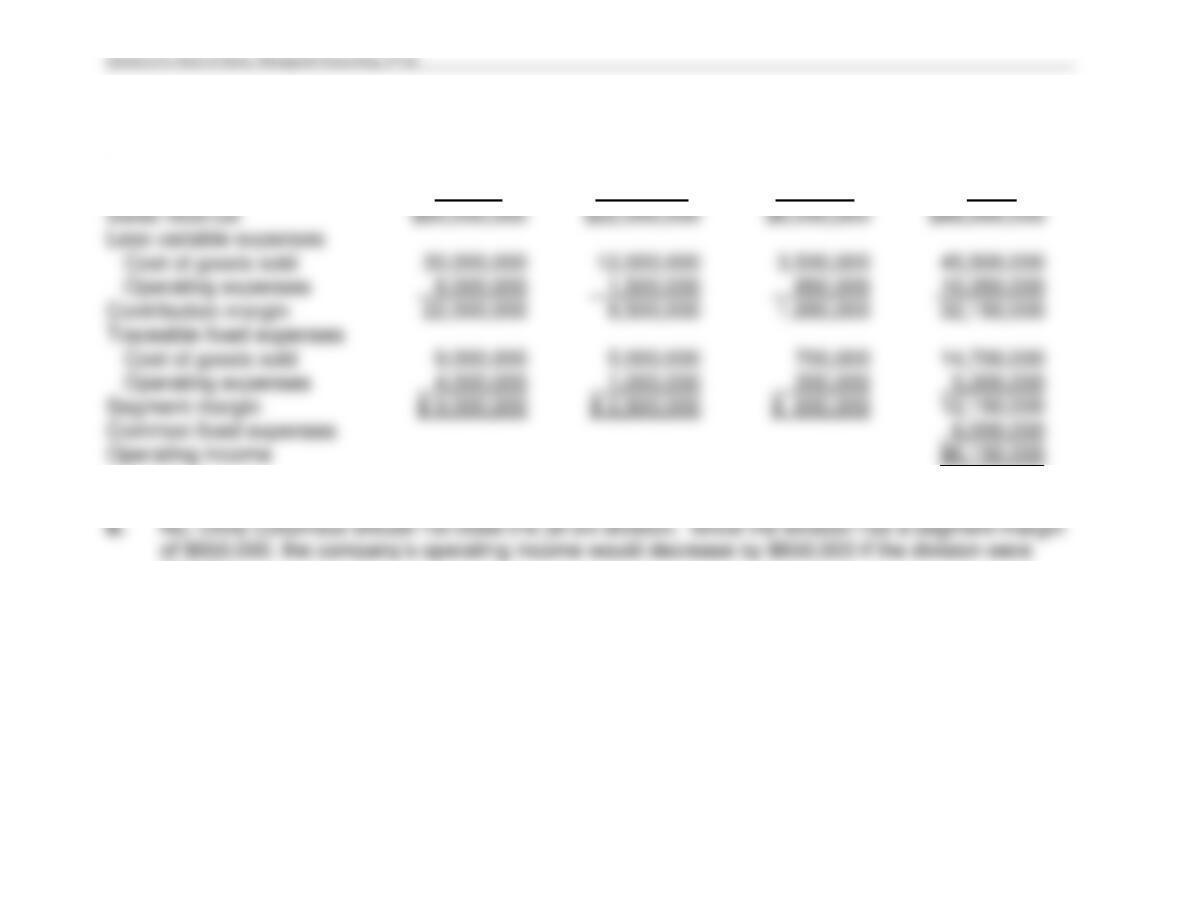
Exercise 10-5
a.
Yachts
Sailboats
Jet Skis
Total
Sales revenue
$60,000,000
$22,000,000
$6,000,000
$88,000,000
Less variable expenses
Cost of goods sold
30,000,000
12,000,000
3,500,000
45,500,000
Operating expenses
8,000,000
1,500,000
850,000
10,350,000
Contribution margin
22,000,000
8,500,000
1,650,000
32,150,000
Traceable fixed expenses
Cost of goods sold
9,000,000
5,000,000
700,000
14,700,000
Operating expenses
4,000,000
1,000,000
300,000
5,300,000
Segment margin
$ 9,000,000
$ 2,500,000
$ 650,000
12,150,000
Common fixed expenses
6,000,000
Operating income
$6,150,000
closed.