Chapter 5 – Planning and Forecasting
5-1
Planning and Forecasting
Learning Objectives
process. (Unit 5.1)
2. Calculate the standard cost of a product. (Unit 5.2)
3. Prepare the operating budget and describe the relationships among its components. (Unit 5.3)
4. Prepare the cash budget and describe the relationships among its components. (Unit 5.4)
5. Prepare pro-forma financial statements and describe their relationship to the master budget
components. (Unit 5.5)
Summary of End of Chapter Material
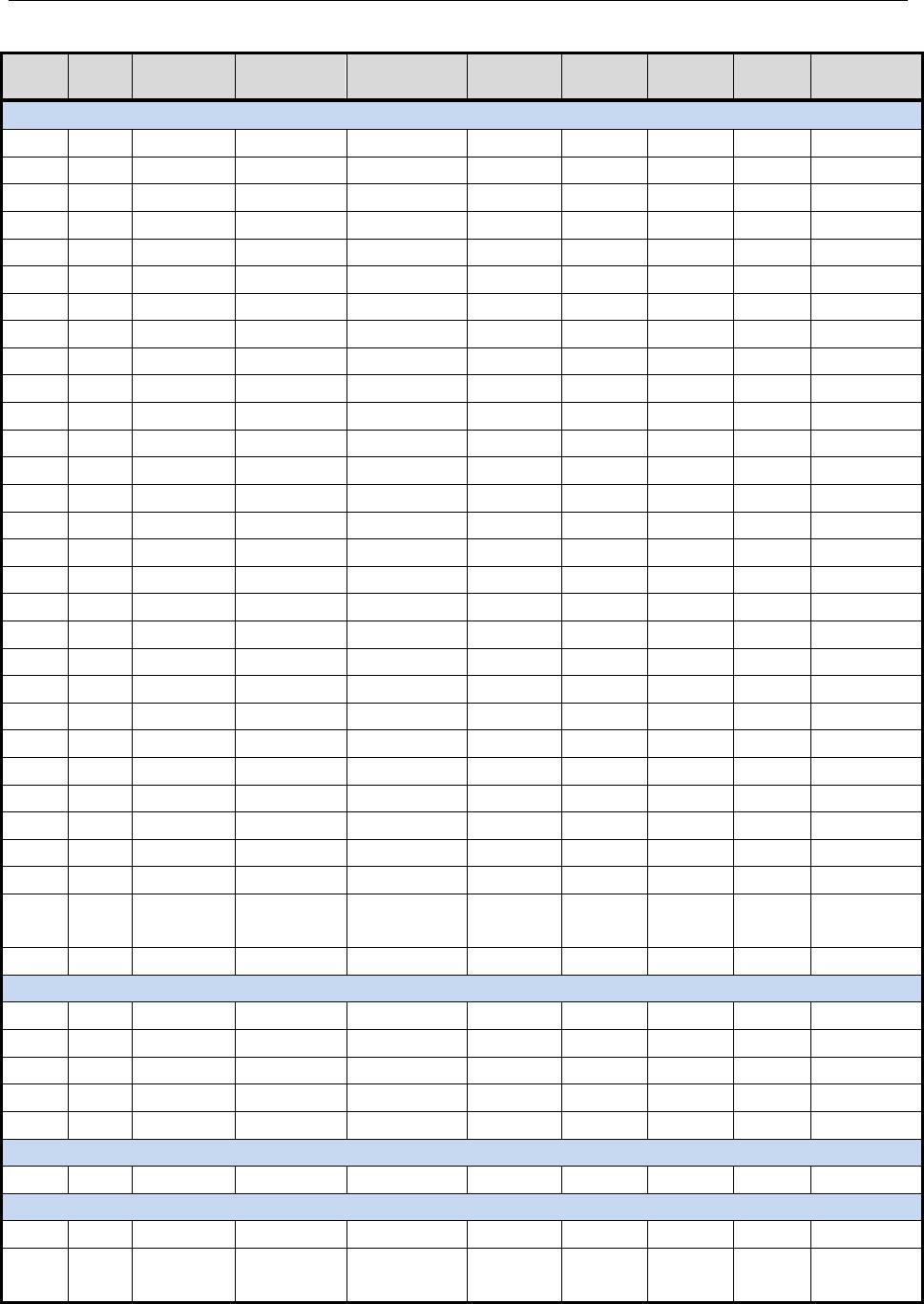
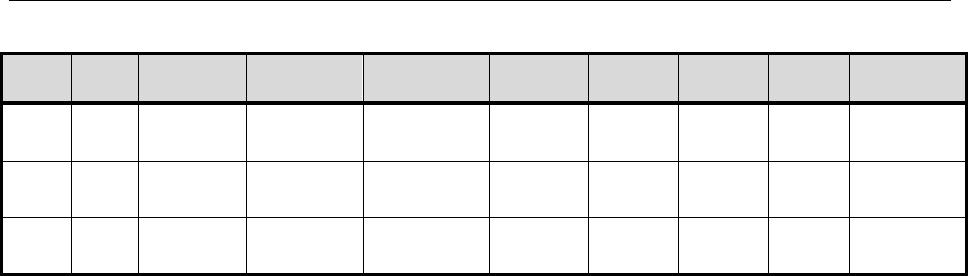
Difficulty: E = Easy, M = Moderate, D = Difficult
Bloom: K = Knowledge, C = Comprehension, AP = Application, AN = Analysis, S = Synthesis, E = Evaluation
AACSB: A = Analytic, C = Communication, E = Ethics
AICPA FN: DM = Decision modeling, RA = Risk Analysis, M = Measurement, R = Reporting, RS = Research, T = Technology
AICPA PC: C = Communication, I = Interaction, L = Leadership, P = Professional demeanor, PM = Project Management,
PS = Problem Solving and Decision Making, T = Technology
IMA: BA = Business applications, BP = Budget Preparation, CM = Cost Management, DA = Decision Analysis,
PM = Performance Measurement, R = Reporting, SP = Strategic Planning
Item
L. O.
Difficulty
Level
Minutes to
Complete
Bloom’s
Taxonomy
AACSB
AICPA
FN
AICPA
PC
IMA
Ethics
Coverage
GUIDED UNIT PREPARATION
Unit 5.1
1
1
E
3
C
A
R
C
BP
2
1
E
1
K
A
R
C
BP
3
1
M
3
E
A
R
C
BP
4
1
M
5-7
C
A
R
C
BP
5
1
E
4
K
A
R
C
BP
6
1
E
4
K
A
R
C
BP
Unit 5.2
1
2
M
3
K, C
A
R
C
PM
2
2
M
3
C
A
R
C
PM
3
2
E
3
C
A
M
PS
PM
4
2
E
2
K
A
R
C
PM
Unit 5.3
1
3
E
2
K
A
R
C
BP
2
3
M
4
V
A
R
C
BP
3
3
M
2
V
A
R
C
BP
4
3
M
3
K
A
R
C
BP
5
3
E
3
K
A
R
C
BP
Unit 5.4
1
4
E
10
K
A
R
C
BP
2
4
M
3
K
A
R
C
BP
3
4
E
3
C
A
R
C
BP
Unit 5.5
1
5
M
2
C
A
R
C
BP
2
5
M
2
K
A
R
C
BP
CHAPTER
5
photo: © jsnyderdesign /
iStockphoto
Solutions for Davis & Davis, Managerial Accounting, 2nd ed.
5-2
Item
L. O.
Difficulty
Level
Minutes to
Complete
Bloom’s
Taxonomy
AACSB
AICPA
FN
AICPA
PC
IMA
Ethics
Coverage
EXERCISES
5-1
1
M
10
C
A
R
C
BP
5-2
2
M
10
AP
A
M
PS
PM
5-3
2
E
10
AP
A
M
PS
PM
5-4
2
E
5
AP
A
M
PS
PM
5-5
2
D
10
AP
A
M
PS
PM
5-6
2
D
10–15
AP
A
M
PS
PM
5-7
3
E
10
AP
A
M
PS
BP
5-8
3
E
15
AP
A
M
PS
BP
5-9
3
M
15
AP
A
M
PS
BP
5-10
3
E
10–15
AP
A
M
PS
BP
5-11
3
E
10–15
AP
A
M
PS
BP
5-12
3
M
15
AP, AN
A
M
PS
BP
5-13
3
M
10–15
AP
A
M
PS
BP
5-14
3
D
15
AP
A
M
PS
BP
5-15
3
D
15
AP
A
M
PS
BP
5-16
3
E
10–15
AP
A
M
PS
BP
5-17
3
E
10
AP
A
M
PS
BP
5-18
3
M
15–20
AP
A
M
PS
BP
5-19
3
M
20
AP
A
M
PS
BP
5-20
3
D
30
AP
A
M
PS
BP
5-21
4
M
20
AP
A
M
PS
BP
5-22
4
M
20
AP
A
M
PS
BP
5-23
4
M
20
AP
A
M
PS
BP
5-24
4
M
20
AP
A
M
PS
BP
5-25
4
M
20
AP
A
M
PS
BP
5-26
4
D
15–20
AP
A
M
PS
BP
5-27
4
M
20–25
AN
A
M
PS
BP
5-28
4
D
30
AP, AN
A
M
PS
BP
5-29
5
D
10
C, AN,
AP
A
R
C
R
5-30
5
D
20–25
AP, AN
A
M
PS
BP
PROBLEMS
5-31
3
D
20–25
AP
A
M
PS
BP
5-32
3
D
30–35
AP
A
M
PS
BP
5-33
3, 4
M
20
AP
A
M
PS
BP
5-34
4
M
30–35
AP, AN
A
M
PS
BP
5-35
4
M
35–40
AP
A
M
PS
BP
C&C CONTINUING CASE
5-36
3
M
20
AP
A
M
PS
BP
CASES
5-37
2
D
20–25
E, AN
E
R
C
BA
5-38
3, 4,
5
D
50–60
AP
A
M
PS
BP
Chapter 5 – Planning and Forecasting
5-3
Item
L. O.
Difficulty
Level
Minutes to
Complete
Bloom’s
Taxonomy
AACSB
AICPA
FN
AICPA
PC
IMA
Ethics
Coverage
5-39
3, 4,
5
D
60
AP, AN
A
M
PS
BP
5-40
3, 4,
5
D
50–60
AP
A
M
PS
BP
5-41
1, 3,
4, 5
D
30–35
E, AN
E
R
C
BA
5-4
SOLUTIONS TO GUIDED UNIT PREPARATION
Unit 5.1
1. Budgets are tactical plans that guide employees as they strive to
those decisions are implemented.
3. No. Budgeting is important for organizations of all sizes. Small
financial distress.
4. With top-down budgeting, upper management determines the budget
and imposes the budget on lower level managers and employees.
With bottom-up, or participative, budgeting, expectations about sales
and expenses are determined by lower- and middle-level managers.
they are prepared by the employees who are closer to operations.
On the other hand, such budgets are subject to budgetary slack as
preparation.
5. Budgetary slack involves under-estimating revenues or over-
Chapter 5 – Planning and Forecasting
5-5
6. Zero-based budgeting requires managers to justify every budget line
item instead of starting from a prior period’s balance. It is much more
year.
Unit 5.2
1. Standards are guides or rules that specify a particular level of
automobiles.
2. Ideal standards specify results from perfect circumstances. Practical
standards are often more appealing since they can be achieved.
3. A standard price is what a company pays per unit of input (e.g., price
an input by the standard quantity of an input per product for each of
direct materials, direct labor and overhead.
4. Direct materials, direct labor and overhead
Unit 5.3
1. The operating budget is the first major component of the master
the income statement.
5-6
2. The operating budget is made up of the following component
budgets: sales, production, materials, labor, overhead, ending
labor and overhead budgets. The sales budget is also used to
determine the selling and administrative expenses budget.
3. The sales budget impacts every other budget in one way or another.
4. Monthly and quarterly budgets will show seasonal trends that are not
during periods of high production.
5. The master budget is a collection of smaller budgets that lead to pro-
Unit 5.4
1. The cash budget has five components:
Cash available to spend – made up of the beginning cash balance for
Cash disbursements – made up of the various cash outflows that will
Cash excess or cash needed – the difference between cash available
Chapter 5 – Planning and Forecasting
5-7
Short-term financing – made up of borrowings during periods of cash
3. It is better to prepare monthly or quarterly cash budgets so managers
Unit 5.5
2. The balance sheet is prepared last. The income statement has to be
5-8
SOLUTIONS TO EXERCISES
Exercise 5-1
short-term financing before major problems arise.
Mark might not know what sales will be, but he should know his
expenses: rent, utilities, insurance, salaries, inventory, etc. He could
Exercise 5-2
Item
Price
List price
$6.50
Volume discount
(.65)
($6.50 × 10%)
Shipping
.08
drums) 25gallons (50
$100
Storage
.55
Standard price per gallon
$6.48
Chapter 5 – Planning and Forecasting
5-9
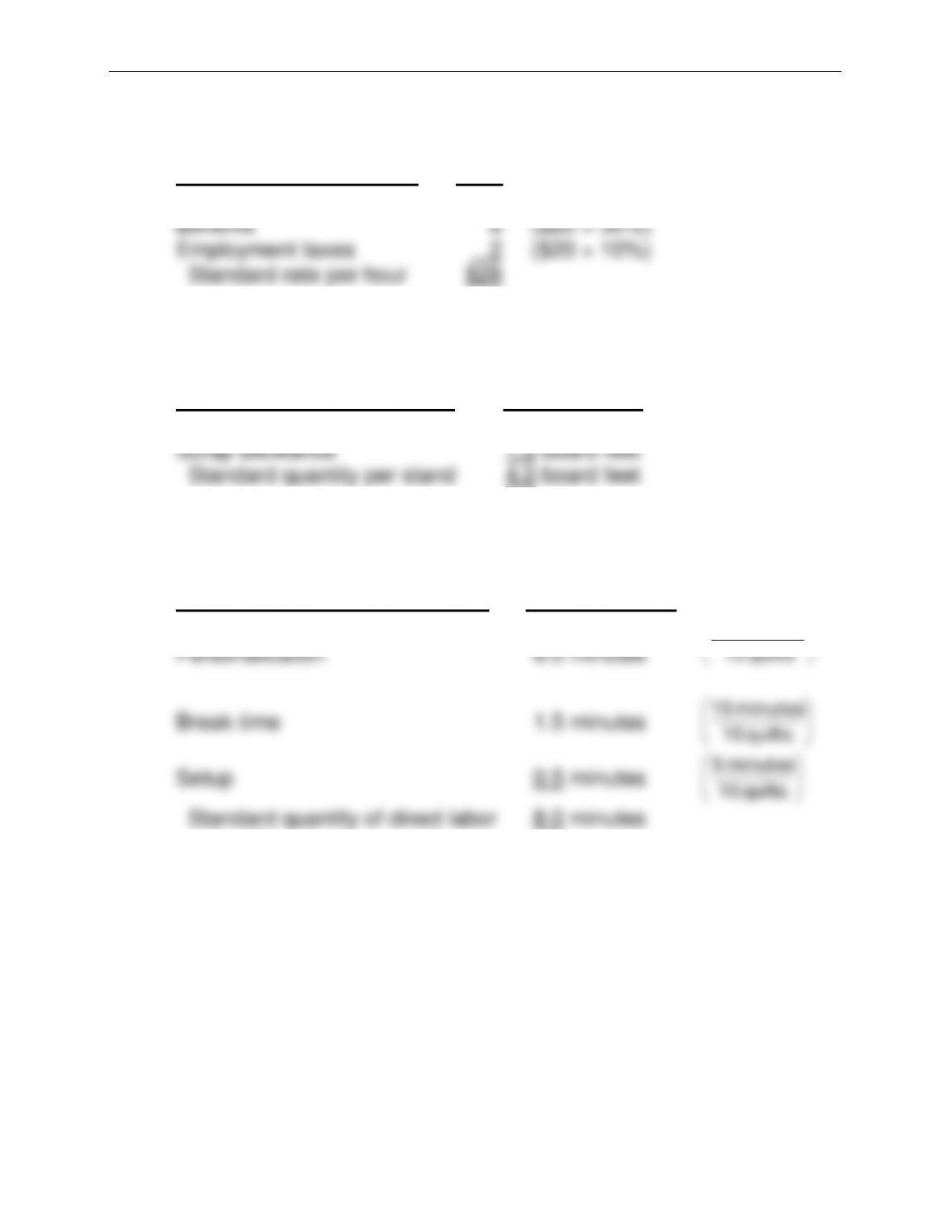
Exercise 5-3
Item
Rate
Base hourly rate
$20
Benefits
6
($20 × 30%)
Employment taxes
2
($20 × 10%)
Standard rate per hour
$28
Exercise 5-4
Item
Quantity
Completed unit
2.5 board feet
Scrap allowance
1.5 board feet
Standard quantity per stand
4.0 board feet
Exercise 5-5
Activity
Time Required
Personalization
6.0 minutes
quilts 10
minutes 60
Break time
1.5 minutes
quilts 10
minutes 15
Setup
0.5 minutes
quilts 10
minutes 5
Standard quantity of direct labor
per quilt
8.0 minutes
5-10
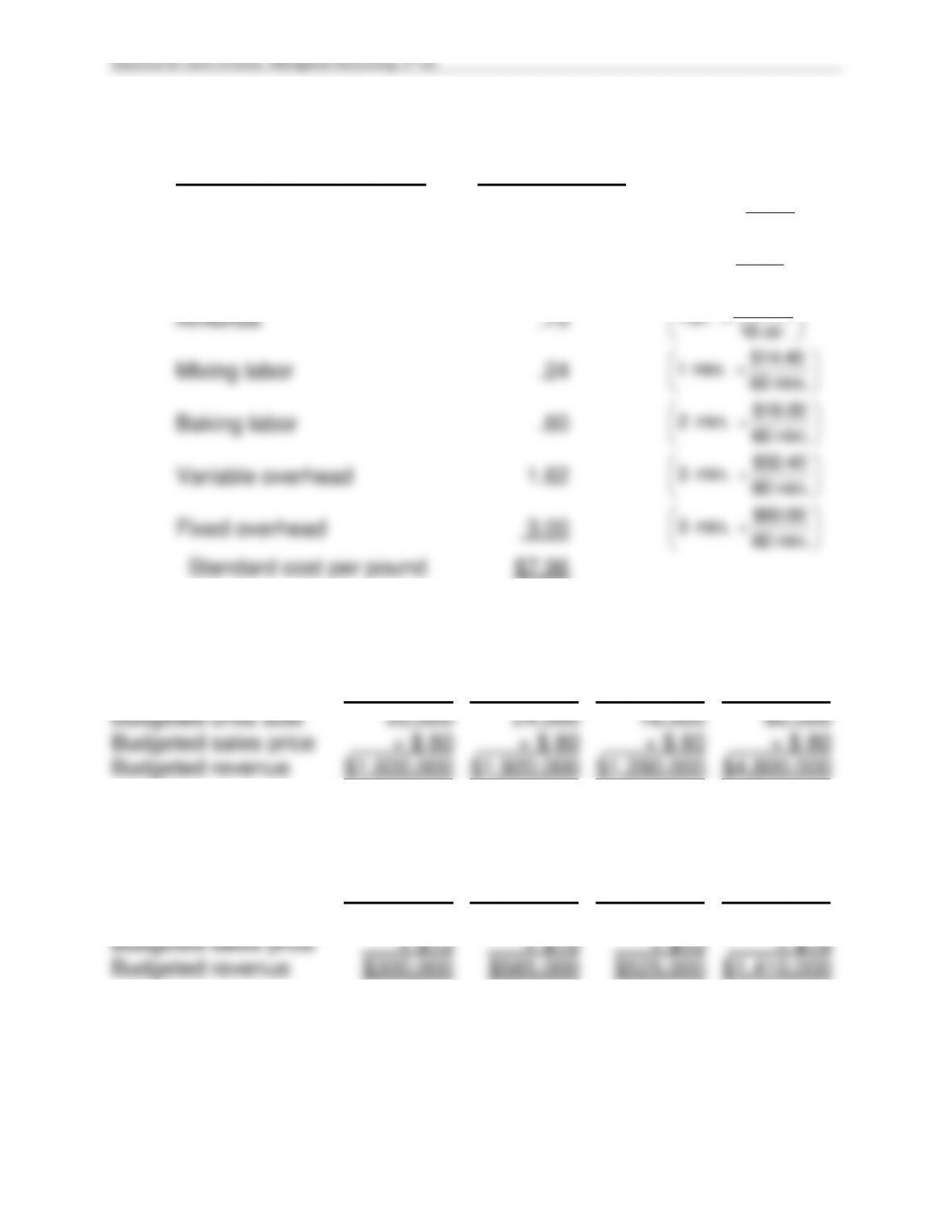
Exercise 5-6
Item
Standard Cost
Commercial cookie mix
$0.50
oz. 16
$0.80
oz. 10
Milk chocolate
1.25
oz. 16
$4.00
oz. 5
Almonds
.75
oz. 16
$12.00
oz. 1
Mixing labor
.24
min. 60
$14.40
min. 1
Baking labor
.60
min. 60
$18.00
min. 2
Variable overhead
1.62
min. 60
$32.40
min. 3
Fixed overhead
3.00
min. 60
$60.00
min. 3
Standard cost per pound
$7.96
Exercise 5-7
January
February
March
Quarter
Budgeted units sold
20,000
24,000
16,000
60,000
Budgeted sales price
× $ 80
× $ 80
× $ 80
× $ 80
Budgeted revenue
$1,600,000
$1,920,000
$1,280,000
$4,800,000
Exercise 5-8
January
February
March
Quarter
Budgeted units sold
20,000
39,000
35,000
94,000
Budgeted sales price
× $15
× $15
× $15
× $15
Budgeted revenue
$300,000
$585,000
$525,000
$1,410,000